
Seismic Wave Attenuation: A Promising Seismic Attribute for Gas and Oil Industry
Editorial
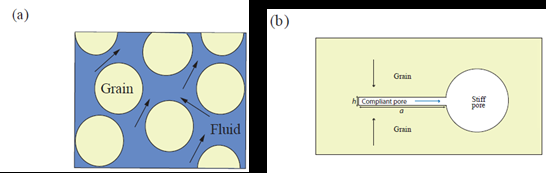
The decrease of seismic wave amplitude is caused by elastic and anelastic losses. Elastic losses such as geometrical spreading and reflection transmission are due to a new redistribution of seismic energy, while the total energy remains conserved. Whereas, anelastic losses, which are hereafter referred to as seismic attenuation, are caused by the conversion of seismic energy into heat, meaning no conservation of energy. Even though that seismic attenuation mechanisms are not fully understood, it is believed that frictional movement induced by seismic waves between pore fluids and solid grains is one of the most important mechanisms. Such mechanism is widely known as wave induced fluid flow (WIFF) mechanism [1, 2]. The WIFF mechanism can be divided into global (Figure 1a) and squirt flow mechanisms (Figure 1b). The former, is the result of the fluid-solid grains friction movement between stiff pores, whereas the latter is takes place between stiff and compliant pores such as open fractures. Furthermore, the relative motion of the solid grains [3, 4] and the friction sliding [5] mechanisms were suggested. However, this latter is assumed to be negligible at seismic exploration frequencies [6]. These mechanisms unravel the close relationship between seismic attenuation and petrophysical properties of rocks, thereby it can be used to investigate physical properties of complex media such as fractured reservoirs.
Seismic attenuation is often quantified through the inverse of quality factor 1 Q−, which is a dimensionless parameter. However, an accurate estimate of 1 Q−remains challenging due to the immaturity of the methodology. Most of the methods are suitable for zero-offset seismic data and requires high quality of data with preserved amplitudes. However, such requirement is sometimes contradictory since obtaining high quality seismic data, often requires an advanced seismic processing which may alter the amplitude information. The 1 Q−estimated from field data is in fact a combination of scattering and intrinsic attenuation, as suggested by Schoenberger and Levin[7].
$$ Q ^ {- 1} = Q _ {i n t} ^ {- 1} + Q _ {s c a} ^ {- 1} \tag {1} $$
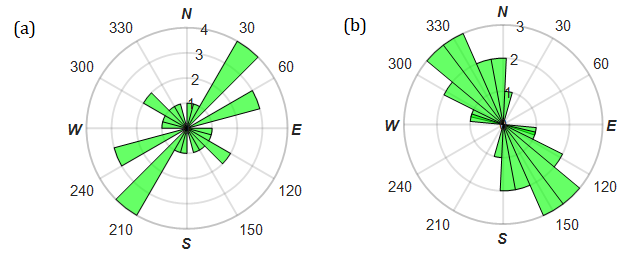
According to equation (1), it is necessary to estimate scattering to determine seismic attenuation magnitude. Several techniques exist to derive scattering from the reflectivity of the medium [9, 10]. The magnitude of scattering in siliciclastic media, is usually found insignificant compared to seismic attenuation [11]. Whereas, in carbonate media scattering is significant due to the high heterogeneous nature of such rocks [12]. Combining scattering and seismic attenuation might be helpful for investigating fractured reservoirs, since the former is strongly sensitive to lithology heterogeneities and the latter to fluid content. For instance, Bouchaala, et al. [9] showed a positive correlation of scattering with fracture density and negative correlation with tar content. Moreover, they noticed the increase of seismic attenuation with oil content. Bouchaala, et al. [13], succeed to separately obtain the orientation of open and cemented fractures, based on the anisotropy of seismic attenuation (Figure 2).
Despite the encouraging results which show the potential of seismic attenuation for improving reservoir characterization studies, more efforts are need on the development of the methodology. New emerging technologies in oil and gas industry such as machine learning and 3D printing technology, should be integrated to improve attenuation estimation and to get more insight on its mechanisms. Due to the lack of raw and pre-stack data which are not easily shared by oil and gas companies, attenuation studies are often conducted on synthetic data. Oil and gas companies should be sensitized about the importance of seismic attenuation studies in the future in the petroleum industry, to expect more data exchange.
References
-
Muller TM, Gurevich B, Lebedev M (2010) Seismic wave attenuation and dispersion resulting from wave-induced flow in porous rocks-A review. Geophysics 75(5): 75A147-75A164.
-
Pride SR, Berryman JG, Harris JM (2004) Seismic attenuation due to wave‐induced flow. Journal of Geophysical Research: Solid Earth 109(B1).
-
Hamilton EL (1972) Compressional-wave attenuation in marine sediments. Geophysics 37(4): 620-646.
-
Mavko GM, Nur A (1979) Wave attenuation in partially saturated rocks. Geophysics 44(2): 161-178.
-
Johnston DH, Toksöz M, Timur A (1979) Attenuation of seismic waves in dry and saturated rocks: II. Mechanisms. Geophysics 44(4): 691-711.
-
Winkler KW, Nur A (1982) Seismic attenuation: Effects of pore fluids and frictional-sliding. Geophysics 47(1): 1-15.
-
Schoenberger M, Levin FK (1974) Apparent attenuation due to intrabed multiples. Geophysics 39(3): 278-291.
-
Murphy III WF, Winkler KW, Kleinberg RL (1986) Acoustic relaxation in sedimentary rocks: Dependence on grain contacts and fluid saturation. Geophysics 51(3): 757-766.
-
Bouchaala F, Ali MY, Matsushima J (2016) Seismic and sonic wave attenuation of carbonate rocks in an onshore Abu Dhabi oil field. SEG Technical Program Expanded Abstracts 2016, Society of Exploration Geophysicists, pp: 2780-2785.
-
Matsushima J, Ali MY, Bouchaala F (2017) A novel method for separating intrinsic and scattering attenuation for zero-offset vertical seismic profiling data. Geophysical Journal International 211(3): 1655-1668.
-
Pevzner R, Mueller T, Alasbali A, Galvin R, Gurevich B (2014) Seismic attenuation from VSP and well log data- NW shelf Australia case study. 76th EAGE Conference and Exhibition 2014, European Association of Geoscientists & Engineers, pp: 1-5.
-
Bouchaala F, Ali MY, Farid A (2014) Estimation of compressional seismic wave attenuation of carbonate rocks in Abu Dhabi, United Arab Emirates. Comptes Rendus Geoscience 346(7-8): 169-178.
-
Bouchaala F, Ali MY, Matsushima J, Bouzidi Y, Takam Takougang EM, et al. (2019) Azimuthal investigation of compressional seismic-wave attenuation in a fractured reservoir. Geophysics 84(6): B437-B446.
- Nigeria’s Vulnerability in the Face of Global Energy Policy
- A Simulation Study of Investigation of Optimum Oil Production Performance by Applying Various Gas Injection Methods in Oil Reservoir
- Characterization of Permo-Triassic Reservoirs through Thermal Maturity Assessment of Westphalian Source Rocks in the Cheshire Basin
- Influence of Microwax on the Rheological and Thermal Behaviour of a Wax Crude Oil
- Real-Time Monitoring and Performance Optimization of Steam Injection in Heavy Oil Reservoirs Using Fiber Optic Sensing and Integrated Predictive Simulation Models
- Rapid On-Site Determination of the Total Petroleum Hydrocarbon Content of Soils by Handheld Fourier Transform Near-Infrared Spectroscopy: Development of a Global, Site- and Scanner- Independent Calibration Model