
The Influence of Permeability Anisotropy on Reservoir Simulation Model Behaviour in Oil Fields
With a geological and dynamic model of the hydrocarbon field, adapted to historical exploitation data, petroleum engineers can gain invaluable insights into the current situation and evaluate proposed solutions with great effectiveness. This resource is highly beneficial, providing invaluable insights that can result in favourable results. Therefore, in order to obtain reliable results, it is very important to build a reservoir model, taking into account their geological features. One of these features can be considered anisotropy of permeability. This is very important when it comes to low porosity and permeability reservoirs, which oil and gas companies are actively developing. The goal of this study was to assess how permeability anisotropy impacts the performance of a hydrodynamic model for a productive reservoir in an oil field. This study involves creating a field model and performing hydrodynamic calculations. This includes using field data to determine a close-to-real value for permeability anisotropy, optimizing an existing development system, and analyzing development maps. As a result of the study, it was found that the omission of permeability anisotropy leads to an overestimation of the accumulated field development indicators. It was found that an increase in the value of anisotropy does not always lead to an increase in cumulative oil production, which undoubtedly emphasizes the peculiarity of the geological structure of the reservoir. In the final stage, a hydrodynamic calculation of the development was performed for 15 years, allowing conclusions to be reached about the correctness of applying operations to enhance oil recovery (EOR).
Introduction
It is common knowledge that permeability is a vector quantity and its alteration happens in three planes that are mutually orthogonal [1, 2, 3, 4]. As a consequence, permeability can be represented as a third-order tensor and viewed as a cuboid:
=
K K K
xx xy xz K K K K
(1) yx yy yz K K K
zx zy zz The elements of the main diagonal of the matrix, kxx, kyy, and kzz, are orthogonal to the planes of the parallelepiped. However, with this representation, the description of the phenomenon of permeability anisotropy becomes much more complicated and still has no solution.Therefore, in the general case, a simplified representation is adopted, the essence of which is to assume the permeability vector as a second-order tensor:
K K K K K =
ii ij (2) ji jj
Where i, j are indices characterizing a certain direction of the vector (x, y, z). The assumption here is that the tangent components kij=kji=1 (Figure 1). The introduction of the described assumption is a forced measure, but nevertheless, it already allows one to conduct a study of the phenomenon, which is supported by a fairly good mathematical basis.
Some authors associate the phenomenon of permeability anisotropy with the lithological and petrophysical heterogeneity of reservoir rocks [5, 6, 7]. Coordinated changes in the structure and texture of rock with a specific spatial orientation are typically recognized as occurrences of interest. It is now well known that the creation of such coordinated changes occurs for two reasons: the interaction of several depositional environments during reservoir formation and the influence of subsequent post-sedimentation processes [8, 9, 10].
![Figure 1: ** Anisotropy of permeability, simplified [2].](/fulltextimages/10757/fig_1.png)
Figure1: Anisotropy of permeability, simplified [2].
It is crucial to understand that the depositional settings play a vital role in shaping the structure and texture of the rocks that make up a reservoir. This is due to the sediment material of the grains, as well as their size and sorting. The latter are directly dependent on the energy at which they move from the place of their formation to the place of deposition. It is widely recognized that water is the primary carrier of the sediments [11, 12, 13].
This refers to the main flow direction that grinds, crushes, sorts, and pulls grains in a specific direction. This leads to the fact that the direction of the sediment, which corresponds to the direction of elongation of the grains, ultimately has improved filtration (flow) properties than in the orthogonal one. Serious changes in lithological and petrophysical states occur when the sedimentation environment changes. However, such processes are not instantaneous and take a long time. After the formation of the reservoir, its further subsidence may be accompanied by a significant manifestation of secondary processes. Such processes can be tectonic movements leading to rock deformation, metasomatic processes, cementation, carbonatization, etc. All considered phenomena form the final heterogeneous flow characteristics of rocks, which is manifested in the phenomenon of permeability anisotropy [14, 15, 16, 17, 18].
Thus, the anisotropy of permeability can be characterised based on its direction and the level of manifestation. It is another important geological characteristic of the reservoir, which must be taken into account when building a geological model in order to obtain more correct results of hydrodynamic calculations in the future. This is exactly what this study aims to accomplish.
Methodology
The object of study is one of the oil fields of the Tomsk region, consisting of terrigenous deposits. The field is situated within a complex system of local uplifts of different orders. This is a notable characteristic of the area. The Jurassic deposits are the main contributor to productivity. These deposits were formed by various sedimentation processes, including regression and transgression, resulting in a diverse distribution of reservoir properties [19, 20, 21, 22].
Construction of Geological and Hydrodynamic Models
In this work, all hydrodynamic calculations were performed using the Petrel Schlumberger software [23, 24, 25]. The following input data were used to build the reservoir model:
- Locations and altitudes of twenty-one wells;
- Well inclinometry;
- Structural map of the base of the studied formation obtained from seismic data;
- Tops of formation Z3 identified for each well;
- Interpreted log data.
The process of geological modelling consists of four stages:
- Structural modelling and construction of a cellular model.
- Facies modelling.
- Petrophysical modelling.
- Modelling of fluid saturation.
Results and Discussions
Structural Modelling
The first step in structural modelling was the loading of each well at given coordinates and inclinometry. Afterwards, a structural map of the surface was created, which was projected along the tops of the Z3 formation. An interpolation method was used to generate the structural map, which was cropped to fit the area under evaluation [26, 27, 28, 29].
In the second step, a cellular model was built. The horizontal cell size was chosen as 50x50 m due to the small size of the area under consideration. The vertical cell size was 0.5 m. This value made it possible not to miss small interlayers in the facies modelling of well-logging data and not to spend a lot of time on calculations on a smaller grid. The size itself was chosen by analysing the range of values from 0.2 to 0.7 m.In conclusion, it can be noted that the size of the created cellular model was 5x5 km horizontally and 21.8 m vertically. The number of cells was 1040000.
Facies Modelling
Based on the preliminary information, the analysed log data was classified into facies based on hydrodynamic flow units [30, 31, 32, 33]. The Truncated Gaussian simulation method was used to build the facies model, which is a method that can be used to characterize heterogeneous reservoirs and environments whose petrophysical properties alternate unevenly, as is the case with coastal bar sandstones [34, 35, 36, 37].
According to the general rules, the facies cube was created by determining the parameters of the variograms, which include the results of saturation and petrophysical modelling. The parameters themselves are shown in Table 1 and were taken as recommended [38, 39].
| Layer | Variogram Type | Correlation Length, m |
|---|---|---|
| Z3 | Major | 18000 |
| Minor | 17800 | |
| Vertical | 33,36 |
Table 1: The parameters of a variogram for the facies modelling.
The variogram parameters for modelling the facies themselves were selected in accordance with their percentage, presented over the entire reservoir thickness (Table 2). Facies eight is a non-reservoir facies (Figure 2).
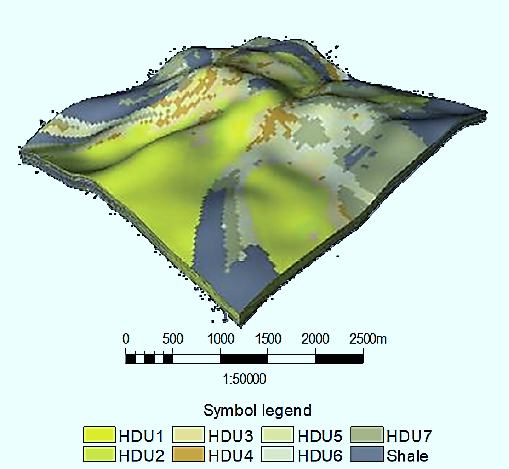
| Facies | Thickness Percentage, % | Thickness, m | Range, m | Nugget, m |
|---|---|---|---|---|
| 1 | 2,34 | 0,498 | 0,998 | 0,0001 |
| 2 | 1,7 | 0,362 | 0,714 | 0,0001 |
| 3 | 4,84 | 1,029 | 1,265 | 0,0001 |
| 4 | 6,26 | 1,332 | 1,363 | 0,0001 |
| 5 | 12,51 | 2,661 | 3,302 | 0,2586 |
| 6 | 6,96 | 1,480 | 2,081 | 0,2279 |
| 7 | 23,68 | 5,036 | 6,432 | 0,3239 |
| 8 | 41,71 | 8,872 | 12,388 | – |
Table 2: Parameters of each facies in the variogram.
The next step in the calculations was considering the influence of the lateral anisotropy of permeability on the behaviour of the intrusion model. This was accomplished by multiplying the permeability cube of the model by 1.48 in the X direction, whereas a factor of 0.67 was applied in the Y direction according to anisotropy calculations [40, 41, 42, 43]. This case’s model calculation results can be seen in Table 3 and in Figures 3 & 4. Where in the Table 3, az – vertical anisotropy value, Qo – cumulative oil production, Qw – cumulative water production, Qinj – cumulative water injection, RF – oil recovery factor.
| Scenario, MM m3 | |||
|---|---|---|---|
| Pessimistic | Most Likely | Optimistic | |
| a z | 0,1 | 0,5 | 0,86 |
| Qo | 1,785 | 2,031 | 1,975 |
| Qw | 1,017 | 1,321 | 0,935 |
| Qinj | 2,634 | 3,246 | 2,763 |
| RF | 0,134 | 0,153 | 0,148 |
Table 3: The outcomes stem from the alteration of vertical and lateral anisotropies.
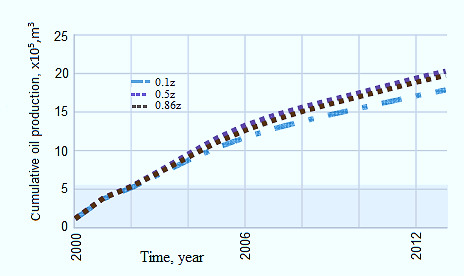
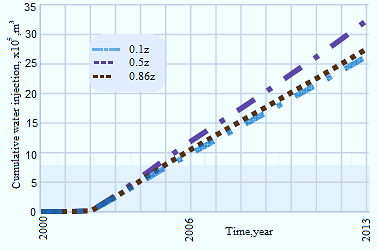
Although the calculation results show similar trends when the value of vertical anisotropy changes, introducing lateral anisotropy into the model calculation generally increases the values of development parameters like Qo, Qw, and Qinj. It is clear, therefore, from hydrodynamic calculations that taking permeability anisotropy into account is crucial for obtaining a more realistic reservoir structure. Further, this makes it easier to adapt the model to historical data and increases the degree of confidence in its forecasts.
Development System Optimization
To assess the effect of permeability anisotropy, a comparison was made of the behaviour of the reservoir in isotropic and anisotropic cases. The calculation results are presented in Table 4 and Figures 5-7.
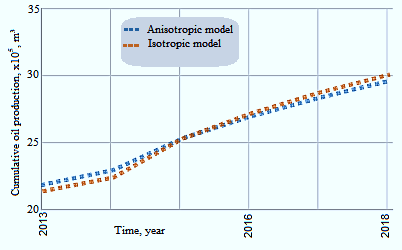
Figure 5 shows that the cumulative oil production for the isotropic model turned out to be higher than the cumulative oil production for the anisotropic model. It is apparent from this result that omitting anisotropy from the model building can result in an overestimation of development parameters, thereby leading to an overestimation of expected production and incorrect economic analysis. This fact again confirms the significant influence of permeability anisotropy on the field development modelling process. To conclude, a calculation was carried out on an anisotropic model, taking into account decisions on hydraulic fracturing in candidate wells and infill drilling of production and injection wells for a period of 15 years (from 2013 to 2028). The results of these calculations are given in Table 4 and Figures 6 and 7. Where STOIIP is the remaining geological oil reserves, (in million m3), OWC External is the outer contour of the oil-water contact, OWC Internal is the inner contour of the OWC, Boundary are the site boundaries.
| Development parameters, MM m3 | ||
|---|---|---|
| 5 years | 15 years | |
| Qo | 3,046 | 3,700 |
| Qw | 5,237 | 11,998 |
| Qinj | 8,745 | 16,607 |
| RF | 0,231 | 0,278 |
Table 4: Improved development system calculation results.
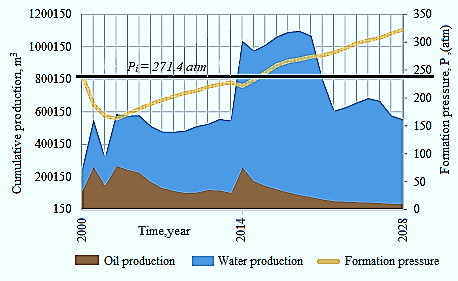
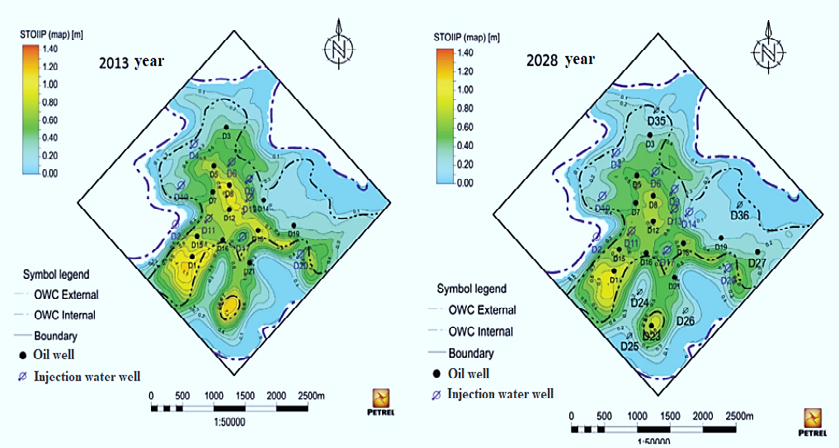
Based on the findings, it is possible to predict the most likely movement of fluids and fractures during hydraulic fracturing by considering anisotropy of permeability, as confirmed by model calculations [44, 45, 46, 47]. According to Figure 6, since 2013, hydraulic fracturing operations have been performed and fluid production has sharply increased in production wells situated parallel to injection wells. Infill drilling of production wells with horizontal wells along the axis of improved properties made it possible to significantly increase oil production to levels close to the initial period of development of the area [48, 49, 50]. This was also facilitated by sidetracking of production wells in areas with degraded properties, which led to an increase in the production of residual reserves in such areas. Infill drilling was also performed for injection wells. As a result, fluid production with a large amount of water has increased sharply, and since 2018, reservoir pressure has been overcompensated by the reservoir pressure maintenance system (RPM). However, despite this consequence, it also contributed to the efficiency of reservoir development and allowed profitable hydrocarbon production in conditions of increased water cuts [51, 52, 53, 54, 55]. Starting in 2023, some injection wells will be phased out.
Conclusion
In this sense, the vertical and lateral anisotropy of permeability introduced into the geological and hydrodynamic model significantly impacts reservoir behaviour. When the vertical anisotropy value is changed, the calculation results show similar trends, but introducing lateral anisotropy generally increases the values of development parameters like Qo, Qw, and Qinj.
Field development indicators are overestimated when permeability anisotropy is omitted. This highlights the peculiarity of the geological structure of the reservoir since an increase in anisotropy does not always result in an increase in cumulative oil production.
By constructing an anisotropic model, it is possible to omit from the accumulated indicator for oil production up to 1% of the same value according to the isotropic model, according to the results of calculations. Therefore, further modelling of the proposed operations to enhance oil recovery will cause this deviation to continue to increase, resulting in distorted development information.
References
-
Wang DP, Zhou YY, Ma PG, Tian TH (2005) Vector properties and calculation model for directional rock permeability. Rock Soil Mech 26: 1294-1297.
-
Al-Obaidi SH (2021) Analysis of hydrodynamic methods for enhancing oil recovery. J Petrol Eng Technol 6: 20-26.
-
Smirnov V, Al-Obaidi S (2008) Innovative methods of enhanced oil recovery. Oil Gas Res 1: e101.
-
Al-Obaidi SH (2016) Improve the efficiency of the study of complex reservoirs and hydrocarbon deposits – East Baghdad field. International journal of scientific & technology research 5(8): 129-131.
-
Fitch PJR, Lovell MA, Davies SR, Pritchard T (2015) An integrated and quantitative approach to petrophysical heterogeneity. Marine and Petroleum Geology 63: 82-96.
-
Al-Obaidi SH, Patkin AA, Guliaeva NI (2003) Advance use for the NMR relaxometry to investigate reservoir rocks. JoPET 2(3): 45-48.
-
Chang W, Al-Obaidi SH, Khalaf F (2021) Determination of the upper limit up to which the linear flow law (Darcy’s Law) can be applied. Journal of Xidian University 15(6): 277-286.
-
Miall AD (2018) Depositional Environments. In: Sorkhabi R, et al. (Eds.), Encyclopedia of Petroleum Geoscience. Encyclopedia of Earth Sciences Series, Springer, Cham.
-
Al-Obaidi SH, Guliaeva NI, Smirnov VI (2020) Influence of structure forming components on the viscosity of oils. Int J Sci Technol Res 9(11): 347-351.
-
Hofmann M, Al-Obaidi SH, Patkin AA (2013) Problems of Transporting “Heavy” Gas Condensates at Negative Ambient Temperatures and Ways to Solve These Problems, JoPET 3(3): 31-35.
-
Cieśla M, Gruca-Rokosz R, Bartoszek B (2023) A new concept to forecast the process of suspended sediment accumulation in the bottom sediment of small reservoirs. International Journal of Sediment Research 38(4): 556- 565.
-
Al-Obaidi SH (2017) Calculation Improvement of the Clay Content in the Hydrocarbon Formation Rocks. Oil Gas Res 3(1): 130.
-
AL-Obaidi SH (2020) A way to increase the efficiency of water isolating works using water repellent. International Research Journal of Modernization in Engineering Technology and Science 2(10): 393-399.
-
Germanou L, Ho MT, Lei Wu Y, Zhang Y (2018) Intrinsic and apparent gas permeability of heterogeneous and anisotropic ultra-tight porous media. Journal of Natural Gas Science and Engineering 60: 271-283.
-
Al-Obaidi S (2022) Investigation of Rheological Properties of Heavy Oil Deposits. Advances in Geophysics, Tectonics and Petroleum Geosciences CAJG, pp: 339-402.
-
Hofmann M, AL-Obaidi SH, Chang WJ (2023) Evaluation of Quantitative Criteria for Triassic Reservoirs in the South Mangyshlak Basin. Natural Sciences and Advanced Technology Education 32(1): 7-24.
-
Al-Obaidi SH, Kamensky IP (2022) Express study of rheological properties and group composition of oil and condensate using nuclear magnetic Resonance- Relaxometry. J Oil Gas and Coal Tech 1(1): 1-5.
-
Cattaneo A, Steel RJ (2003). Transgressive deposits: a review of their variability. Earth-Science Reviews 62: 187-228.
-
Al-Obaidi S, Smirnov V, Alwan HH (2021) Experimental Study about Water Saturation Influence on Changes in Reservoirs Petrophysical Properties. Walailak J Sci Tech 18(13): 1-10.
-
Al-Obaidi SH (2016) High Oil Recovery Using Traditional Water-flooding under Compliance of the Planned Development Mode. Journal of Petroleum Engineering Technology 6(2): 48-53.
-
Tang H, White CD (2008) Multivariate statistical log log-facies classification on a shallow marine reservoir. Journal of Petroleum Science and Engineering 61(2-4): 88-93.
-
Al-Obaidi SH, Hofmann M, Smirnov VI, Alwan HH (2021) Study of compositions for selective water isolation in gas wells. Nat Sci Adv Technol Edu 30(6).
-
Zhang GQ, Yu ZG (2015) Establishment of Reservoir Geological Model Using Petrel Software. Groundwater 37: 208-210.
-
Al-Obaidi SH, Guliaeva N (2002) Determination of flow and volumetric properties of core samples using laboratory NMR relaxometry. JoPET 1(2): 20-23.
-
Marcelo C, Leao J, Ogashawara I, Lorenzzetti J, Stech J (2015) Assessment of Spatial Interpolation Methods to Map the Bathymetry of an Amazonian Hydroelectric Reservoir to Aid in Decision Making for Water Management. ISPRS International Journal of Geo- Information 4(1): 220-235.
-
Al-Obaidi SH (1996) Clay Determination of Productive Reservoirs of Oil and Gas Fields in East Baghdad. OSF Preprints.
-
Al-Obaidi SH (1996) Development of Methods and Technologies for Processing Well Log and Core Data for Determining Estimated Parameters of Oil and Gas Fields in Iraq: At Note. Deposits Vost, Baghdad, OSF Preprints.
-
Bolton AJ, Maltman AJ, Fisher Q (2000) Anisotropic permeability and bimodal pore-size distributions of fine-grained marine sediments. Marine and Petroleum Geology 17(6): 657-672.
-
Al-Obaidi SH, Hofmann M, Khalaf FH, Alwan HH (2021) The efficiency of gas injection into low-permeability multilayer hydrocarbon reservoirs. Technium: Romanian Journal of Applied Sciences and Technology 3(10): 100- 108.
-
Al-Obaidi SH, Khalaf FH (2017) Acoustic logging methods in fractured and porous formations. J Geol Geophys 6(4): 1-6.
-
Patkin AA, Al-Obaidi SH (2001) Influence of Temperature and Pressure of Incoming Oil- Containing Liquid from Field Wells on the Gas Separation Process. Journal of Petroleum Engineering and Emerging Technology 3(4): 20-24.
-
Al-Obaidi SH (2020) Comparison of different logging techniques for porosity determination to evaluate water saturation, pp: 1-124.
-
Beucher H, Renard D (2016) Truncated Gaussian and derived methods. Comptes Rendus Geoscience 348(7): 510-519.
-
Al-Obaidi SH, Kamensky IP, Hofmann M (2010) Changes in the physical properties of hydrocarbon reservoir as a result of an increase in the effective pressure during the development of the field. 1(5): 16-21.
-
Hofmann M, Al-Obaidi SH, Kamensky IP (2021) Calculation method for determining the gas flow rate needed for liquid removal from the bottom of the wellbore. J Geol Geophys 10(5): 1-5.
-
AL-Obaidi SH, Khalaf FH (2023) A New Approach for Enhancing Oil and Gas Recovery of the Hydrocarbon Fields with Low Permeability Reservoirs. Pet Petro Chem Eng J 7(2): 1-8.
-
Fan JY, Kong DC (2023) Geological Modeling with Petrel Software. Open Access Library Journal 10(5): 1-7.
-
Al-Obaidi SH, Khalaf F (2019) Development of traditional water flooding to increase oil recovery. International Journal of Scientific & Technology Research 8(1): 177- 181.
-
Pankov MV (2004) Analysis of the development of the Krapivinskoye oil field: report. Center for Professional Retraining of Oil and Gas Specialists, Tomsk, pp: 425.
-
Al-Obaidi SH, Khalaf FH (2017) The Effect of anisotropy in formation permeability on the efficiency of cyclic water flooding. Int J Sci Technol Res 6(11): 223-226.
-
Kamensky IP, AL-Obaidi SH, Khalaf FH (2020) Scale effect in laboratory determination of the properties of complex carbonate reservoirs. International Research Journal of Modernization in Engineering Technology and Science 2(11): 1-6.
-
Al-Obaidi SH, Khalaf FH (2018) The Effects Of Hydro Confining Pressure on the Flow Properties of Sandstone and Carbonate Rocks. International journal of scientific & technology research 7(2): 1-3.
-
Liao J, Wang H, Mehmood F, Cheng C, Hou Z (2023) An anisotropic damage–permeability model for hydraulic fracturing in hard rock. Acta Geotech 18: 3661-3681.
-
Al-Obaidi S, Galkin AP, Patkin AA (2006) Prospects of high viscosity oil flow rate in horizontal wells. J Petrol Eng Technol 5(4): 56-62.
-
Miel H, AL-Obaidi SH, Hussein KF (2022) Modeling and monitoring the development of an oil field under conditions of mass hydraulic fracturing. Trends in Sciences 19(8): 1-9.
-
Al-Obaidi SH, Kamensky IP, Hofmann M, Khalaf FH (2022) An Evaluation of water and gas injections with hydraulic fracturing and horizontal wells in oil-saturated shale formations. Nat Sci Adv Technol Edu 31.
-
Chaikine AI, Gates DI (2021) A machine learning model for predicting multi-stage horizontal well production. Journal of Petroleum Science and Engineering 198: 108133.
-
AL-Obaidi SH, Chang WJ, Miel H (2022) Modelling the development of oil rim using water and gas injection. Nat Sci Adv Technol Edu 11(4): 1-7.
-
Chang WJ, Al-Obaidi SH, Patkin AA (2021) The use of oil-soluble polymers to enhance oil recovery in hard to recover hydrocarbons reserves. International Research Journal of Modernization in Engineering Technology and Sci 3(1): 982-987.
-
Al-Obaidi SH, Khalaf FH, Alwan HH (2021) Performance analysis of hydrocarbon wells based on the skin zone. Technium 3(4): 50-56.
-
Sinan S, Glover PWJ, Lorinczi P (2020) Modelling the Impact of Anisotropy on Hydrocarbon Production in Heterogeneous Reservoirs. Transp Porous Med 133: 413-436.
-
AL-Obaidi SH (2004) Modified use of microbial technology as an effective enhanced oil recovery. Journal of Petroleum Engineering and Emerging Technology 4(2): 41-44.
-
Chang WJ, Al-Obaidi SH, Patkin AA (2021) Assessment of the condition of the near-wellbore zone of repaired wells by the skin factor. Int Res J Mod Eng Tech Sci 3(4): 1371-1377.
-
Al-Obaidi SH, Khalaf FH (2020) Prospects for improving the efficiency of water insulation works in gas wells. In Re J Mod Eng Tech Sci 2(9): 1382-1391.
-
Al-Obaidi SH, Kamensky IP, Smirnov VI (2020) Investigation of Thermal Properties of Reservoir Rocks at Different Saturation. International Research Journal of Modernization in Engineering Technology and Science 2(12): 12-17.
- Nigeria’s Vulnerability in the Face of Global Energy Policy
- A Simulation Study of Investigation of Optimum Oil Production Performance by Applying Various Gas Injection Methods in Oil Reservoir
- Characterization of Permo-Triassic Reservoirs through Thermal Maturity Assessment of Westphalian Source Rocks in the Cheshire Basin
- Influence of Microwax on the Rheological and Thermal Behaviour of a Wax Crude Oil
- Real-Time Monitoring and Performance Optimization of Steam Injection in Heavy Oil Reservoirs Using Fiber Optic Sensing and Integrated Predictive Simulation Models
- Rapid On-Site Determination of the Total Petroleum Hydrocarbon Content of Soils by Handheld Fourier Transform Near-Infrared Spectroscopy: Development of a Global, Site- and Scanner- Independent Calibration Model