
Geochemical Parameters of Oil and Rock Samples from Murzuq Basin, Libya: An Application for Paleoenvironment Description
Seven sedimentary rocks and seven crude oils undertook a geochemical analysis to describe their organic matter type and then tag the Paleoenvironments based on the organic matter. The samples were collected from B1-NC151, A1-NC58, P1- NC1, E1-NC174, D1-NC151, H29-NC115, and D1-NC174 boreholes, located in Murzuq Basin. The study was established to understand life forms in the ecosystem based on biomarkers that biochemical techniques recognized. Microscopy was used for kerogen typing and Spore Color Index reference. Organic matter (EOM) was extracted from cutting samples. Furthermore, hydrocarbons were saturated and aromatic fractionated from the samples to investigate using Gas chromatograph system. Spore color index (SCI), range between 1.5-3.5, Amorphous organic matter (AOM) from 42 to 95 percentage, Phytoclasts % were 4-15.5, and Palynomorphs % range 0.5 to 7.5. The percentage of Carbon 85.66-86.29, Hydrogen 13.16-13.73, Nitrogen 0.06 -0.27, and Sulfur 0.31-0.70, besides wax were measured, ranging among 1.3 to 6.0 %. Pristine/n-C17, Phytane/n-C18, Pristine/Phytane, carbon preference index measurements (CPI) and DBT/P as saturated hydrocarbon ratios from whole oil chromatographs were established. Tricyclic terpanes, hopanes and n-alkanes were distinguishing as the most important oil biomarkers that reserved the characteristics in the Paleoenvironments.
Abbreviations
SCI: Spore Color Index; AMO: Amorphous Organic Matter; CPI: Carbon Preference Index Measurements; SMO: Sedimentary Organic Matter; EOM: Extractable Organic Matter; CHNS: Content From the Elemental.
Introduction
Three-domains of life the i.e. Archaea, Prokaryotes and Eukaryotes are the main origins of Sedimentary organic matter (SOM) [1]. Description of Palaeoenvironments can be established, using biomarker ratios and specific compound of individual hydrocarbons. Organic compounds like kerogen and Spore color index (SCI) are directly related to the organic content [2]. The Microscope has been used to delineate Spore colour index as parameter of kerogen composition and diverse types of kerogen. During the diagenesis, methane, carbon dioxide and water were released. The evolution of organic matter with burial turned into kerogen, then to oil and sediments of organic matter have been investigated in rich detail to reveal the structure and origin of sedimentary organic matter [3]. The elemental compositions such as Carbon, Hydrogen, Nitrogen, and Sulfur (CHNS) are heteroatomic elements and basic elements of life on Earth as the key constituent of OM. These are directly derived from the macromolecular kerogen and straightly linked to their biological precursors as geosynthetic products [4]. Besides that, wax ratio of n-alkanes (C25-C33) and C29 steranes from plants and green algae [5, 6, 7, 8] diagram is highly used in kerogen classification and as biogeochemistry technician to categorize Kerogen into four types, reflecting many Paleoenvironment characteristics. Furthermore, Biomarkers, for instance hopane, tricyclic terpane and sterane distributions have been used to understand the contribution of marine or lacustrine phytoplankton, green algae and/or land plants to their kerogen [9]. [10] reported that the dibenzothiophene (DBT)/ phenanthrene (P) and Pr/Ph ratios of crude oils can be used to identify their source lithofacies. The current study is the description of palaeoenvironment for rocks and crude oil samples, based on specific biomarker parameters, together with Carbon, Hydrogen, Nitrogen, and Sulfur compounds beside wax ratio.
Geological Settings of the Study Area
The Murzuq Basin is a cratonic sedimentary basin, located in the south-west of Libya (Figure 1), covering parts of Niger, surrounded to the north by Gargaf Arch, the west by Thambouka Uplift and to the east by Tebbisti Complex (Figure 1A). The stratigraphic section of the basin (Figure 1B) is approximately 4000m thick and is predominantly composed of marine Paleozoic clastics, with some Mesozoic sediments of mainly continental origin [11]. The Murzuq Basin has experienced variable degrees of erosion related to tectonic events, mainly during the Caledonian, Hyrcenian, and Alpine orogenies. The sedimentary partition is the central part of the basin, which is mostly composed of Palaeozoic and Mesozoic deposits (Figure 1). The carboniferous formations in the study zone consist of four sediments: Tiguentourine, Dembaba, Assedjefar and Marar Formations. Tanezzuft and Akakus Formations are of Llandovery age (Silurian). The Mamuniyat Formation is followed by MelezShuqran, Hawaz and Ash Shabiyat Formations, presented in Ordovician age. The Cambrian Hasawnah Formation is fluviatile at the base to the shallow marine then Mourizidie Formation Pre- Cambrian is considered to be the lower unit of the Formations [11, 12].
![Figure 1: (a) location of the Murzuq Basin, Libya, (b) general lithostratigraphic column for the studied area (c) the studied wells in the studied area [13-15].](/fulltextimages/13365/fig_1.png)
Materials and Methods
Seven rocks and oils have under taken a detailed analysis to characterize the organic matter type and define the Palaeoenvironments of the sedimentary organic matter. Microscopy was used for kerogen typing by palynofacies analysis and kerogen isolation to define Amorphous organic matter (AOM), phytoclasts, and palynomorphs. The Spore Color Index reference slides used in this analysis, are based on the correlation chart of Collins A [16]. Extractable organic matter (EOM) was extracted and saturated and aromatic hydrocarbons were fractionated using a small scale column chromatographic method [17]. Wax content from the elemental (CHNS) composition, was measured as bulk oil composition. Moreover, Gas chromatograph (GC) was used to analyze Aliphatic and aromatic fractions. The Gas chromatograms of the whole oils, saturated and aromatic hydrocarbon were used (oil and extraction of rocks) to determine biomarkers contents and some selected biomarker ratios in the oils and rock extraction such as transitions m/z 191 and m/z 217.
Results and Discussion
Seven rocks and the seven petroleum samples were analyzed to describe the organic matter type in terms of source potential and correspondingly to determine if correlation existed.
Light Microscope Exams
The Microscope was used to distinguish kerogen type based on Amorphous organic matter (AOM), Palynomorphs%, Phytoclasts content as % and Spore color index (SCI) as numbers (Table 1). All the rocks show a high abundance of AOM, ranging from 85 to 95, reflecting a Type II kerogen assemblage, with the exception of sample P1- NC1, by a content of 40%, revealing a mixture case of Type II/III kerogen assemblage. More confirming finding is the high ratio of Phytoclasts and Palynomorphs in sample P1- NC1 (Table1), referring as well to a potential contribution of an active source of terrestrial organic matter, which was deposited as a Type II/III kerogen accumulation. In most studied samples, the phytoclast content is mostly greater than the palynomorph content, except the samples from wells D1-NC151 and P1-NC1 showed a phytoclast ratio greater than the palynomorph content as an inverse case. Probably this refers to the organic matter of D1-NC151 and P1-NC1 being derived from remote places far from the deposited place. Following usage of the Microscope was to delineate Spore colour index as parameter of kerogen composition [4]. Spore Color Indices have therefore been supplemented with data from acritarchs, for those samples where they were identified. Distinguishable palynomorphs stayed infrequent in these samples, could be due to high levels of degradation. The spore color has improved the data from acritarchs in those samples, where they could identify and support Type II kerogen existence [18].
| Concessions | Depth (ft) | %AOM | Phytoclasts% | Palynomorphs% | Spore |
|---|---|---|---|---|---|
| B1-NC151 | 2575 | 91 | 8 | 2 | 2.5 |
| A1-NC58 | 9225 | 93 | 5 | 4.5 | 3 |
| P1-NC1 | 2225 | 42 | 22 | 35 | 3.5 |
| E1-NC174 | 7255 | 92 | 6 | 0.5 | 2 |
| D1-NC151 | 4622 | 90 | 4.5 | 7.5 | 1.5 |
| H29-NC115 | 4845 | 85 | 15.5 | 2.5 | 3 |
| D1-NC174 | 5981 | 95 | 4 | 1 | 2 |
Table 1: Organic matter constituents contributing to the kerogen.
Extractable Organic Matter (EOM)
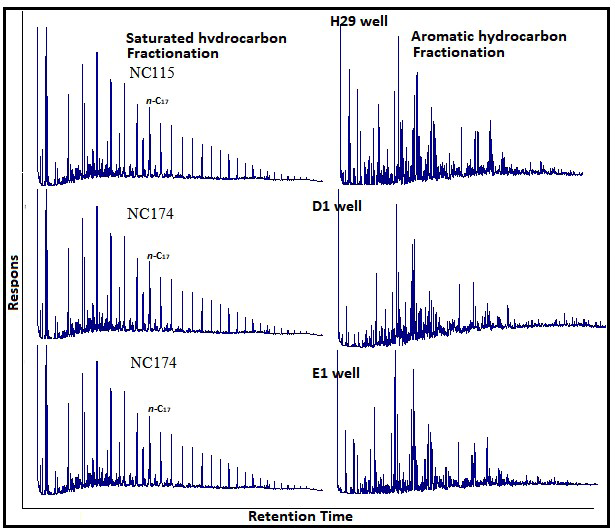
The EOM was fractionated into Saturated eluted with n-pentane and Aromatic with a mixture of n-pentane and DCM and then analyzed by GC- MS. The n-alkanes such n-C17, iso n-C17 (Pristane), n-C18 and iso n-C18 (Phytane) is shown in Figure 2. Low abundances of triterpenes and steranes with dominance of C29 steranes, this typically symbolizes ancient life, about 541-252 million years ago during the paleozoic era.
Bulk Oil Composition
The elemental composition such Carbon, Hydrogen, Nitrogen, and Sulfur (CHNS) besides wax ratio, together of the oils analyzed are given in Table 2. The CHNS of oils point to organic matter was resulting from a mix prokaryotic and eukaryotic organism, decimated and then deposited under diverse environmental conditions. The values of CHNS in the Table 2 are approximate where they point to some who a single ecosystem with exception in oil sample from E2-NC1 well. This sample showed high level of wax ratio as indicator of higher terrigenous contribution affinity.
| Well Name | C wt % | H wt % | N wt % | S wt % | Wax wt % |
|---|---|---|---|---|---|
| A1-NC186 | 86.29 | 13.16 | 0.24 | 0.31 | 1.9 |
| B1-NC186 | 86.16 | 13.41 | 0.09 | 0.34 | 1.4 |
| E2-NC1 | 85.72 | 13.73 | 0.14 | 0.41 | 6 |
| F3-NC174 | 85.77 | 13.56 | 0.35 | 0.31 | 1.9 |
| A-NC115 | 85.66 | 13.47 | 0.17 | 0.7 | 2.6 |
| B-NC115 | 86.06 | 13.49 | 0.06 | 0.39 | 2.1 |
| H-NC115 | 85.85 | 13.33 | 0.27 | 0.55 | 1.3 |
Table 2: The ratios of (CHNS) besides to wax ratios.
N-alkanes
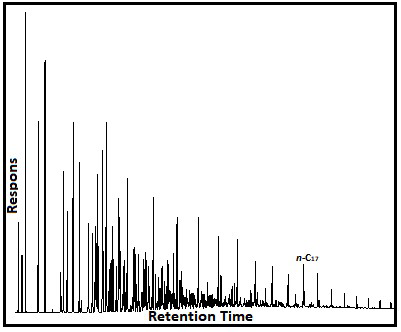
Gas chromatograms of the whole oils showed the presence of abundant n-alkanes (Figure 3), with decrease molecular weight of n-alkanes next n-C18. This case has been subjected to evaporative phenomenon during formatting period. The abundance of n-alkanes as well in the chromatograms demonstrated that there have been no significant biodegradation or water washing effects on these oils as sign of marine environment deposition. The hydrocarbon ratios of (Pristine/n-C17, Phytane/n-C18, Pristine/Phytane, carbon preference index measurements (CPI) and DBT/P) showed in Table 6. Saturated hydrocarbon ratios from whole oil chromatographs are revealing an ecosystem of Paleozoic age with dominance of kerogen Type II as source of oil organic matter. The E2-NC1 sample again hold on differences results by way of environmental mark has been approved that the organic matter of this sample was sourced from further different source were existed or at least mixed with some other type of oil containing relatively high n-alkanes, plus support kerogen III type reality as declared above. The carbon preference indices (CPI) as indication of deposition conditions, as well measured from ratios abnormal number carbon atoms of alkanes. This parameter values > 0.9 is symbol of marine sub-oxic to oxic environments.
| Well Name | Pris/n-C17 | Phyt/n- C18 | Pris/Ph yt | n-C17/n- C27 | CPI | DBT/ |
|---|---|---|---|---|---|---|
| A1-NC186 | 0.63 | 0.45 | 2.22 | 14.69 | 1 | 0.62 |
| B1-NC186 | 0.6 | 0.46 | 1.86 | 11.82 | 0.99 | 0.57 |
| E2-NC1 | 0.33 | 0.26 | 1.61 | 6.93 | 13 | 0.46 |
| F3-NC1 74 | 0.69 | 0.51 | 1.89 | 13.23 | 0.94 | 0.55 |
| A-NC1 15 | 0.56 | 0.38 | 2.08 | 13.2 2 | 1 | 0.66 |
| B-NC1 15 | 0.64 | 0.52 | 1.74 | 0.43 | 0.99 | 0.53 |
| H-NC1 15 | 0.57 | 0.39 | 2.27 | 0.8 | - | 0.72 |
Table 3: Saturated hydrocarbon ratios from whole oil chromatographs.
Tricyclic Terpanes, Hopanes and Sterane
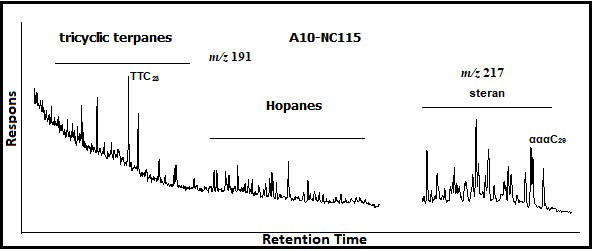
Together Tricyclic terpanes and hopanes have been mentioned as the most important oil biomarkers that reserved the characterizes of construction and suggested as precursors of the C19-C30 Tricyclic terpanes series [19]. Together can reveal the original biological components and commonly used to delineate organic matter precursors. The tricyclohexaprenol have been recommended as precursors of the C19-C30 Tricyclic terpanes series [19], whereas Hopanoids are biological precursor have been recognized as key compounds of metabolites in cell membranes of bacteria [20]. Sterols are characterized as unique precursors of sterane biomarkers, indicative to a wide range of Eukaryotes and algal assemblages [21]. The selective ion monitoring (SIM) within transitions m/z 191 and m/z 217, used to monitor Tricyclic terpanes-hopanes and steranes are shown in Figure 4. Tricyclic terpanes, hopanes and steranes considered the most significant organic matter combinations, derived from crude oil and/or extracted from source rock. They held in reserve, the characteristic structure of the original biological components and usually used to define organic matter precursors. The distribution of biomarkers shows enormous similarity between the studied oils (Figure 4), suggesting that these biomarkers were derived from mixture marine organic matter generated under depositional environment dominated by Prokaryotes (bacteria) and Eukaryotes.
DBT/P versus Pr/Ph
DBT/P and Pr/Ph ratios can be used to recognize source lithofacies of crude-oil organic matter [10]. According to Hughes WB, et al. [10], plot of DBT/P versus Pr/Ph divided into four zones such Zone 1A = marine carbonate; Zone1B=marine carbonate and marl; Zone 2=marine hypersaline; Zone 3= marine shale and lacustrine; Zone 4=fluvio-deltaic shale. Thus, DBT/P ratios versus Pr/Ph ratios for studied samples showed that their source-organic facies felt in Zone 3 (Figure 5). All the samples appear to were sourced from marine shale and lacustrine deposited under sub-oxic conditions (DBT/P < 1, Pr/Ph=1.61-2.27). accordingly, samples from E2-NC1, B-NC115, B1-NC186 and F3-NC174 wells reveal environments comprise coastal lagoons, salt and soda waters. While A-NC115, A1-NC186, and H-NC115 samples were derived from environments containing two major types of organic-rich materials that are typically deposited in the steady deep-sea basin and deep lake/swamp, that known Marine and lacustrine.
![Figure 5: Cross-plot of DBT/P versus Pr/Ph for Murzuq Basin crude oils showing their source rock depositional environments and lithologies [10].](/fulltextimages/13365/fig_5.png)
Conclusion
Based on the results and discussion, the distribution and identifications of hopanes are the most commonly indicating into prokarutic organisms, existing in organic matter from mixture biological precursor, compounds of metabolites in cell membranes of bacteria, identified as Hopanoids and or bacteriohopane polyols and aminopolyols, created under depositional marine environment. Tricyclohexaprenol have been suggested as precursors of the Tricyclic terpanes, mostly correlated with marine and/or lacustrine environment. Steranes reveled in this search define organic matter precursors, derived from eukaryotic cell membranes include sterols such cholesterol, ergosterol and sitosterol. Eukaryotic steroids point to numerous organisms e.g. Pelagophyte algae, Dinoflagellates, Diatoms, Chlorophyte algae and Gloeocapsomorpha Prisca. Organic matter created from a mix prokaryotic and eukaryotic organism holds Carbon, Hydrogen, Nitrogen, and Sulfur as main elements in their bodies. Furthermore, palaeoenvironments can be recognized from this debate and deposited marine hypersaline and marine lacustrine environment.
References
-
Woese CR, Kandler O, Wheelis ML (1990) Towards a natural system of organisms: Proposal for the domains Archaea, Bacteria, and Eucarya. Proc Natl Acad Sci USA 87(12): 4576-4579.
-
Glorioso J, Rattia A (2012) Unconventional reservoirs: basic petrophysical concepts for shale gas SPE/EAGE Eur. Unconventional Resources Conf. and Exhibition SPE-153004-MS.
-
Tissot B, Welte DH (1978) Petroleum Formation and Occurrence. Springer-Verlag, Berlin, pp: 538.
-
Hunt JM (1996) Petroleum geochemistry and geology. 2nd(Edn.), WH Freeman and Company, New York.
-
Eglinton G, Hamilton RJ (1967) Leaf epicuticu lar waxes. Science 156: 1322-1335.
-
Volkman JK (1986) A review of sterol markers for marine and terrigenous organicmatter. Org Geochem 9(2): 83- 99.
-
Kodner RE, Summons, Pearson, Andrew H (2008) Sterols and interpreting Paleozoic steranes Sterols in red and green algae: quantification, phylogeny, and relevance for the interpretation of geologic sterane. Biological Sciences 5(29).
-
Van Kravelen DW (1961) Coal. Elsevier, Amsterdam.
-
Huang WY, Meinschein W (1979) Sterols as ecological indicators. Geochemical et Cosmochimica Acta 43(5):739-745.
-
Hughes WB, Holba AG, Dzou LIP (1995) The ratios of dibenzothiophene to phenanthrene and pristane to phytaneas indicators of depositional environment and lithology of petroleum source rocks. Geochimica et Cosmochimica Acta 59(17): 3581-3598.
-
Hallett D (2002) Petroleum Geology of Libya. Elsevier Science Limited, Kidlington.
-
Rusk DC (2001) Petroleum potential of the underexplored basin centers. Libya. AAPG Memoir (74): 429452.
-
Aboglila S, Abdulgader A, Albaghdady A, Hlal O, Farifr E (2019) Biomarker ratios and stable carbon isotopes to describe crude oil characteristics in the Murzuq Basin Libya. Advances in Research 18(3): 1-12.
-
Albaghdady A, Aboglila S, Farifr E, Ramadan M, Alburki A (2020) Source rock characterization of Silurian Tanezzuft and Devonian Awaynat Wanin formations the northern edge of the Murzuq Basin, South West Libya. Pet Petro Chem Eng J 4(1): 1-13.
-
Rullkotter J, Wendisch D (1982) Microbial alteration of 17a(H)-hopanes in Madagascar asphalts: Removal of C- methyl group and ring opening. Geochim, Cosmochim 46: 1545-1553.
-
Collins A (1990) The 1-spore colour index (SCI) scale: A universally applicable colour maturation scale, based on graded, picked palynomorphs. In: Fermont WJJ, et al. (Eds.), Proceedings of the International Symposium on Organic Petrology. Rijks Geologische Dienst, Zeist, Netherlands 45: 39-47.
-
Bastow TP, Aarssen BGK, Lang D (2007) Rapid small-scale separation ofsaturate, aromatic and polar components in petroleum. Organic Geochemistry 38(8): 1235-1250.
-
Aboglila S, Elaalem M, Ezlit Y, Farifr E (2018) Geochemical characteristics of six formations based on organic geochemical parameters. Murzuq Basin, Libya. Advances in Research 15(4): 1-11.
-
Aquino NFR, Trendel JM, Restle A, Connan J, Albrecht P (1982) Occurrence and formation of Tricyclic and tetracyclic terpanes in sediments and petroleum. In: Bjorøy M (Ed.), Advances in Organic Geochemistry. John Wiley & Sons Ltd, Chichester, pp: 659-667.
-
Rohmer M, Bisseret P, Neunlist S (1992) The hopanoids, prokaryotic, tritrerpenoids and precursors of ubiquitous molecular fossils. Prentice Hall, Englewood Cliffs, New Jersey, pp: 1-1.
-
Volkman JK (2003) Sterols in microorganisms. Appl Microbiol Biotechnol 60: 496-506.
- Nigeria’s Vulnerability in the Face of Global Energy Policy
- A Simulation Study of Investigation of Optimum Oil Production Performance by Applying Various Gas Injection Methods in Oil Reservoir
- Characterization of Permo-Triassic Reservoirs through Thermal Maturity Assessment of Westphalian Source Rocks in the Cheshire Basin
- Influence of Microwax on the Rheological and Thermal Behaviour of a Wax Crude Oil
- Real-Time Monitoring and Performance Optimization of Steam Injection in Heavy Oil Reservoirs Using Fiber Optic Sensing and Integrated Predictive Simulation Models
- Rapid On-Site Determination of the Total Petroleum Hydrocarbon Content of Soils by Handheld Fourier Transform Near-Infrared Spectroscopy: Development of a Global, Site- and Scanner- Independent Calibration Model