
What is Scientific Information for Students? Scientific Journals and Internet Searches
The purposes of this work consisted, first, in analyzing the meanings that 297 undergraduate students of the University of Guadalajara, Mexico, give to scientific information, as well as specifying what they obtain when they search for scientific journals on the Internet. As a conceptual basis, we take The Information and Knowledge Society, to conclude that university students -who answered an open questionnaire with multiple options, analyzed through a thematic content analysis- are more immersed in an information list society, rather than in one based on knowledge and judgment, since their meanings about scientific information do not quite agree with their actions, namely, in the selection of scientific journals, which they confuse with diffusion reviews that circulate widely through the Internet.
Introduction
One of the purposes of universities and higher education institutions is that students who follow a professional career, graduate as best prepared as possible, according to the goals that have been set in each of their curricula in which, of course, scientific knowledge is included. Training in research in general terms -that is, non-specialized, since that is the task of graduate studies- is required in any disciplinary field. The latter does not imply that students graduate as researchers, but that they do understand, and in the best of cases experience, the processes followed in scientific inquiries. Although this scientific process is explained and sometimes lived by the students, it has not been possible to establish roots in most of the cases so that it be anchored throughout the professional training of the students, and we constantly perceive this in the different courses we teach.
Objectives
In this work some findings are presented, as partial results of a larger project, which contributes to the analysis of how 297 undergraduate students of the 6 thematic centers of the University of Guadalajara (Jalisco, Mexico) conceive, first of all, scientific information, and then pinpoint and understand what they get when they search the Internet to obtain scientific information, particularly from journals specialized in the different areas of science, whose readings are usually fundamental in the process of scientific inquiry. Such goals are often poorly established, with an emphasis on the past instead of on more current explanations, so it is considered that this study may provide elements that can be used as support in the evaluation and updating of the learning units related to research skills, as much as in their practice and for the analysis of documents.
The Information and Knowledge Society
To identify the preferences and uses of higher education students in their searches for scientific information, it is necessary for the purposes of this work, to understand them from the framework of the Information and Knowledge Society. I will try to synthesize both concepts separately (for reasons of space, hoping not to be erratic). As pointed out by Selva ADL, et al. [1], the Information Society- located nowadays at the global level- is associated with a technologically advanced society, but this does not mean that knowledge is incorporated by the whole society.
The Information or Informational Society is based on the ideals of modernity -indefinite progress, confidence in development, hope in the future, trust in integration, and belief in the providence of the market [2]. As the researcher says, this model appears as a manifest ideological resource in the assumed diversity of the information and entertainment offer, and the alleged democratization of access; it has a discourse with a marked techno-deterministic bias since it places information and communication technologies (ICT) as engines of progress and social development [2, 3, 4, 5].
Since the nineties (decade in which the first wave of massification of the Internet took place), there has been a marked evolution of the conceptualization, access, use and implementation of ICT, and now, rather than talking about digital divide, there is talk of digital inclusion. Warschauer M, et al. [6] states that it is about establishing a set of elementary conditions, together with access, that lead not only to the increase in the number of users, but that there be more users able to find a meaning to ICT within their everyday lives. A passive insertion in the ICT universe reduced to the consumption of images and narratives distant to the indigenous reality- project a seductive universe that propitiates imaginaries beyond people’s own actuality, thus configuring an effective but limited access to these technologies.
Crovi D, et al. [7]; Marques de Melo J, et al. [8]; Yago T, et al. [9] assert in the previous sense that the active potentialities of production and generation of ICTs are not taken advantage of, since it is an incomplete access that does not consider a substantial part of the available resources. This, according to Yago T, et al. [9] (ibid), ends up being translated into a limited use through a playful-aesthetic facet, and then, ICT are not preponderant because they are the most advanced, but because they fit within “informationalism” as a hegemonic technological paradigm, which according to Castells M, et al. [10] is constituted in the matrix of a sociotechnological species.
Regarding the Knowledge Society, in a review by Alva de la Selva A, et al. [1], she stresses quoting Mostuschi (2005, in ibid), that knowledge does not arise from the accumulation or availability of information, but rather is the product of the classification processing, arrangement and analysis of such information to form a complex structure of multiple connections1. And the author goes further, by asserting that
1 An approach in which several authors have been abounding in cogni- within the framework of globalization and under the impulse of a powerful technological revolution, knowledge and information constitute a first-class source of nutrition for the main productive force which is the human. It is from this crucial role of knowledge that it can be said that this <<new capitalism>> is, with the terms of Moulier Boutang (2003), a cognitive capitalism, a capitalism of knowledge.
The researcher points out that Moulier Boutang places knowledge production as the main axis of capital expansion, thus constituting the so-called “Knowledge Society”, in which productive activity exceeds the limits of salaried work and strict schedules. And the Mexican author adds:
But if such a revolution <opens enormous possibilities, a new continent, the continent of knowledge, with a qualitative expansion of capitalism>>, it also opens up <<prodigious new contradictions>>, among them the access << tolls >> to knowledge, copyright and new social inequalities [1].
With such emphasis, the Knowledge Society has to do with changes in the political-economic areas, related to ICT in educational planning, management and knowledge work (qualitative expansion of the capitalism of hegemonic knowledge); more specifically, this concept refers to the expansion of education, as an economic resource that implies the need to learn throughout life, with and despite educational inequalities in the access to knowledge (access taxes to knowledge).
López-Cerezo J, et al. [11]; Krüger K, et al. [12] agree that it is a concept that involves, in large part, the social transformations that are taking place in modern society and that seeks to offer a view of the future to normatively guide the political actions. This, some people say, must put us on alert towards new risks, like not knowing (ignorance) in modern society. The above, translated as the lack of discernment and a limited critical view in the search and retrieval of scientific information by college students, really worries, and that is the subject of the research submitted here.
Method
The current study is an exploratory descriptive approach of which I present the most relevant results.
Participants
Collaborated 297 undergraduate students of 6 university centers belonging to the university network of the University of Guadalajara, between 18-22 years old: 49 of tive psychology from long ago, such as Howard Gardner, Jean Piaget, Lev Vigotsky, Jerome Bruner, to name a few.
the CUCBA (University Center of Biological and Agricultural Sciences), 61 of the CUCEA (University Center of Economic and Administrative Sciences), 48 of the CUCEI (University Center of Exact Sciences and Engineering), 46 of the CUCS (University Center of Health Sciences) and 43 of the CUCSH (University Center of Social Sciences and Humanities), and 50 of the CUAAD (University Center of Art, Architecture and Design). It is a directed quota sample, that is to say, not probabilistic, in which initially a quota of 50 students per center was contemplated, but at the time of data collection, the groups were not complete, which is why the quota was not the same for all the centers. It was distributed as it appears in the table below. The information was collected between July 2015 and January 2016. The interest in studying undergraduate students lies in the fact that at this stage of the university, students, inserted in the knowledge society, possess analytical tools to distinguish scientific information, using information and communication technologies.
| CUAAD | CUCBA | CUCEA | CUCEI | CUCS | CUCSH | Total | |
|---|---|---|---|---|---|---|---|
| Women | 26 | 19 | 39 | 16 | 27 | 25 | 152 |
| Men | 24 | 30 | 22 | 32 | 19 | 17 | 144 |
| Did not answer | 0 | 0 | 0 | 0 | 0 | 01 | 01 |
| TOTAL | 50 | 49 | 61 | 48 | 46 | 43 | 297 |
Table 1: List of students by university center and by gender.
Instruments
To collect the information a questionnaire was developed consisting of 25 questions, mostly open, but also multiple choice, and related to the media and the use given by students in obtaining scientific information both on the Internet, as in other formats. The answers to the most relevant questions are described in the following section, since for space reasons only those most related to the objectives of the current investigation are presented.
Course of action
From the various readings of the corpus of students open responses, an analysis of thematic content was carried out, that is, the central ideas for each answer were established as topics, as well as the words that were most repeated. This helped to establish a codebook, which facilitated the categorization of student responses from each university center. Next, the information already coded was transferred to Excel for grouping responses and presented by each of the thematic centers.
Data analysis
In this phase of the study only the frequencies by centers have been established as a general approximation that provides a broad overview for the time being. However it is an exploratory-descriptive study, the data was triangulated (comparing all the answers as a whole) so that such approximations are more abundant and thus understand the meaning of the answers as a whole.
Results and Their Analysis
To begin with, it was necessary to understand what scientific information meant to the students, in order to understand, then, what they were looking for when it came to scientific information. The following table presents the categories from the student responses.
| CUAAD | CUCBA | CUCEA | CUCEI | CUCS | CUCSH | Total | |
|---|---|---|---|---|---|---|---|
| 1. Information that is: True, Reliable, Real, with Empirical Foundations, Verifiable, Exact, Demonstrative, New, Specialized, Structured. | 20 | 19 | 35 | 30 | 28 | 21 | 153 |
| 2. With data: That satisfy the needs of the development of an investigation, data collection and analysis. | 12 | 2 | 4 | 6 | 0 | 0 | 24 |
| 3. Origins: From Previous Research, from Scientists, or Experts. | 1 | 6 | 5 | 6 | 6 | 3 | 27 |
| 4. Discoveries and Advances: Inventions, Advances in Science and Technology, that have Revolutionized the World or a Community, Progress on a particular Subject. | 10 | 5 | 11 | 7 | 10 | 9 | 52 |
| 5. Themes of science: In General; or Specifically, Different Branches of Science. | 7 | 6 | 5 | 3 | 2 | 1 | 24 |
| 6. Knowledge: Knowledge Set; Knowledge about a Fact; Based on Theories. | 1 | 3 | 3 | 0 | 1 | 4 | 12 |
| 7. Products of research: Reports, Results, Experimental, Projects, Method, Scientific Process, Trial and Error. | 6 | 5 | 6 | 13 | 3 | 5 | 38 |
| 8. Alternative: Documentation; Keep Informed (Updated); What is Published in Magazines; Opinion of “Allopathic” Doctors is Pure Business (Not Scientific); Support to Make Better Decisions; you have the Date of the Study. | 1 | 8 | 4 | 6 | 2 | 6 | 27 |
| 9. I do not know | 0 | 0 | 1 | 0 | 0 | 0 | 1 |
| 10. Did not answer | 0 | 0 | 4 | 0 | 0 | 1 | 5 |
| Total | 58 | 54 | 78 | 71 | 52 | 50 | 363 |
Table 2: What is “scientific information” for you?.
We observe that the students of the 6 thematic centers agree that, firstly, scientific information contains certain characteristics such as truthful, reliable, real, with solid bases, verifiable, etc.; but also, although not with the same intensity, they refer to the discoveries and advances that scientific information implies, a fact that becomes very noticeable in most of the media, almost every time there is a new prominent discovery. Surprisingly little mention is made about scientific information as related to knowledge and theories (12 responses out of a total of 363), which makes us think more about the trend towards the pragmatic side of science (applied sciences more than basic sciences), that it is the product of research, but based more on the experimental aspect of trial and error. Examples of answers:
“A type of information that is very well founded and based on many practices, trials and errors, and so on”; “Information that has a true base and which I can approach to answer questions”; “New or relevant information that was obtained based on studies and absolute results, being tested more than once”. A first conjecture, based on the set of answers, is that students have a relatively homogeneous conception (which I keep confirming in several works, see for example Domínguez S, et al. [13]) on what “scientific information” means, since their responses are very similar, independently of affiliation center. They say it in their own words, but we will see later if they can distinguish these characteristics with concrete examples.
When we asked them specifically about what the characteristics of scientific information would be, they wrote in the first place, and overwhelmingly, concepts such as verifiable, objective, endorsed by recognized researchers, experimental, impartial, with hypothesis, etc., as presented in Table 3.
These characteristics, which in the words of the students described as: “Verifiable, measurable, replicable”; “That is verified through a scientific method”; “That is true, clear, congruent and that has its correct foundation”; “Updated, useful, etc.”; “Reliable, verifiable, understandable”; “Technological advances, new discoveries” are very similar to the answers in the first category of Table 2. It is evident with these enunciations the relatively homogeneous meanings of what science is for this sample and that they generally agree with the conceptions of doing science but in particular in the natural and formal sciences, leaving aside the particularities of the social sciences_._
| Categories | CUAAD | CUCBA | CUCEA | CUCEI | CUCS | CUCSH | Total |
|---|---|---|---|---|---|---|---|
| 1. Characteristics of the Research: Verifiable, True, Reliable, Real, Concise, Demonstrative, Exact, Concrete, Objective, Use of Scientific Method, Endorsed by a Recognized Researcher, Experimental, Hypothesis, Formal, Explicit, Impartial, Stages. | 47 | 57 | 68 | 64 | 55 | 51 | 342 |
| 2. Novelty: Novel Discoveries; Interesting; Scientific and Technological Advances; Innovative, Generates Theses. | 9 | 11 | 7 | 5 | 10 | 6 | 48 |
| 3. Social benefits: To Provide Benefits to Society; Studies that Improve our Life; Meet New Needs. | 4 | 1 | 3 | 3 | 3 | 1 | 15 |
| 4. Language used: Clear, with Technical Terms, Specialized, Complex, Understandable to the Public. | 2 | 2 | 1 | 0 | 1 | 2 | 8 |
| 5. They imply a publication: With Certified Endorsements, Reliable Sources, published in scientific journals. | 2 | 1 | 2 | 0 | 4 | 2 | 11 |
| 6. Alternate: Mark before and After; Conclusions; What Scientists are Working on and What they are Required to do; View of the World; Long-Term; the Closest to the Truth; It is not exact; Chemical Substances and their Scientific Names; Exact Sciences; Socialization; Everything Related to Science. | 2 | 6 | 3 | 6 | 0 | 6 | 23 |
| 7. I do not know | 1 | 1 | 1 | 0 | 0 | 0 | 3 |
| 8. Did not answer | 0 | 6 | 3 | 0 | 1 | 4 | 14 |
| Total | 67 | 85 | 88 | 78 | 74 | 72 | 464 |
Table 3: Characteristics of scientific information according to students.
It is noticeable that there were few answers about the characteristics of the publications (“we must first consider the origin of the publication, then the authors and finally the institution of origin”), since there were only 11 responses from a corpus of 464, equivalent to 2.4%, which gives an idea that the students possibly, in this broad question, focus on other aspects and not only in scientific journals, an aspect which I will comment afterwards. But it is important to note that although it is a smaller number, there are students who do not ignore such characteristics.
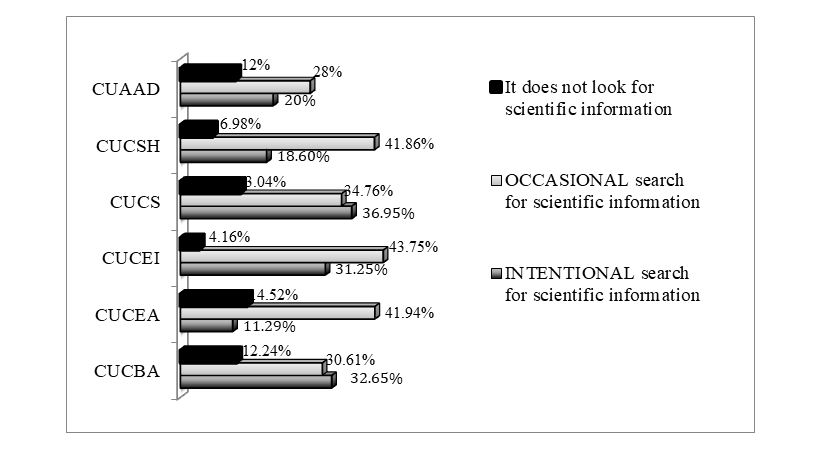
All of them said they used the Internet to obtain scientific information, so when asked about the frequency of their searches on that particular source, they responded:
The occasional search carried out by the vast majority of informant students stands out; however, very close is the intentional search, that especially does students of health sciences (CUCS), the biological and agricultural disciplines (CUCBA) and the exact sciences and engineering (CUCEI).
That is, there is interest of these college students for such approaches, which is a very good sign, which makes this particular sample of informants different from the findings of Barroso C, et al. [14]; Madrid LDL, et al. [15]; Chavarín J, et al. [16].
Specifically, where do informants go when they say that they seek scientific information occasionally and intentionally? The following table clearly shows that the CUAAD
Specifically, where do informants go when they say that they seek scientific information occasionally and intentionally? The following table clearly shows that the CUAAD 1. MAGAZINES AND DISSEMINATION PORTALS: Very Interesting (4), National Geographic (2), History Channel (1) = 7 2. SEARCH ENGINES: Google Scholar (2), Google (3) = 5 3. DIGITAL ENCYCLOPEDIA: Wikipedia = 4 4. VIRTUAL SOCIAL NETWORKS: Facebook (2), Twitter, Sic.World = 4 5. SCIENTIFIC JOURNALS: Cell World, Business Insider, CONACYT = 3 6. BLOGS: 9gag, Culture chases me = 2 7. PAGES OF INVESTIGATIONS: Not specified = 2 8. INTERNET TELEDOCUMENTALS: = 2 8. PARTICULARS: Carmen Aristegui, SEGOB, Development Bank, SEMARNAT, NASA =5 9. NONE IN SPECIFIC = 4 10. I DO NOT REMEMBER = 2 Total = 38 CUCBA 1. SEARCH ENGINES: Google = 6, 2. MAGAZINES AND DISSEMINATION PORTALS: Very Interesting (2), National Geographic, CONABIO = 4 3. MAGAZINE BASES: Redalyc (2), MedLine, PubMed = 4 4. PAGES OF UNIVERSITIES: Not specified (2), UNAM = 3 5. DIGITAL ENCYCLOPEDIAS: Wikipedia, of Medicine = 2 6. SOCIAL NETWORKS: YouTube = 2 7. SCIENTIFIC JOURNALS: We are Viruses and Bacteria = 1 8. TECHNOLOGICAL INNOVATION: Campus Party = 1 9. NEWSPAPERS: El Financiero = 1 10. PARTICULARS: Botanical pages, Libraries, Bioguía, Green Peace, Thesis and work done, MyElt, Todo con dominio.org = 7 11. THEY DID NOT ANSWER = 13 12. I DO NOT REMEMBER = 1 13. NONE IN SPECIFIC = 2 Total = 47 CUCEA 1. MAGAZINES AND DISSEMINATION PORTALS: Very interesting (3), National Geographic (2), Notinerd, History, Discovery, Scientific eye = 9 2. SOCIAL NETWORKS IS VIRTUAL: Facebook (3), YouTube (2), Explainers, UPSOCL =7 3. PORTALS OF NEWSPAPERS: Unspecified (2), The Informer (2), The Financial = 5 4. GOVERNMENT PORTALS: Non-specified government securities (2), SEMARNAT (2)= 4 5. DIGITAL ENCYCLOPEDIA: Wikipedia = 3 6. FORUMS: Not specified = 2 7. WEB SITES OF EXHIBITION OF ACADEMIC WORKS: El Rincon del vago = 1 8. NON-PROFIT ORGANIZATION: TED = 1 9. SEARCH ENGINES: Google = 1 10. BLOGS: Not specified = 1 11. PARTICULARS: Portals with dominio.edu, Scientific journals, New technologies, Intentional Way, American Express, Bloomerang = 6 12. NONE IN SPECIFIC: = 4 13. NOT ANSWERED = 6 Total = 50 most prevalent (either first or second) are magazines and dissemination portals, and after that are the search engines for almost all the informants.
CUCEI
- SEARCH ENGINES: Unspecified search engines (2), Google (3), Goggle Scholar = 6
- MAGAZINES AND DISSEMINATION PORTALS: History, Quo, National Geographic =3
- SOCIAL NETWORKS: YouTube (3), UPSOCL (2), Taringa, Facebook = 7
- NEWSPAPERS: Newspapers not specified (2), The confidential, The Economist = 4
- DIGITAL ENCYCLOPEDIA: Wikipedia = 2
- NON-PROFIT ORGANIZATION: TED = 2
- PARTICULARS: NASA, Greeme, LHC, Fermilab, Microsoft, Medicine and New Technologies, Zacata, eBooks, BBC, Pages of competitions of American universities, Information related to my career, Pages of the government, = 12
- I DO NOT REMEMBER = 2
- NONE IN SPECIFIC = 7 (Whichever is the source, the first page that comes out) **
- THEY DID NOT ANSWER = 2 Total = 36 CUCS
The search engines are very useful tools when the student is beginning in the field of research, even scientific magazines such as Very Interesting, Quo or National Geographic come to introduce a topic, but nothing more; the characteristics of scientific journals are very different from those of dissemination, an aspect that students are not able to differentiate. In fact, as digital natives, their searches go further since they consider virtual social networks, newspapers, news, libraries, databases, blogs, etc. That is, they locate sources of different types where they expect to find scientific information that they themselves described as “verifiable, truthful, reliable, real, concise, demonstrative, exact, concrete, objective, that follows the scientific method, endorsed by a recognized researcher, is experimental, with hypothesis”, etc.
As college students, according to Suárez and Pérez J, et al. [17], are related to knowledge and the generation of knowledge; it is expected of them a formed norm and the possession of skills to discover the purposes of media contents as informal sources (media, Internet included), in addition to other sources such as formal (academic) and non-formal (such as family). From what was learned from the students of the sample, as reflected in the previous tables, it is not that they do not have a norm formed (or are in the process of a comprehensive and complex training), or that they do not have certain skills for the analysis of scientific information, but I share with Ferreiro E, et al. [18], that the declarative plain -what the students say they know- does not necessarily agree with the operative, that is to say their real searches of journals, in this case, the scientific ones.
In other words, students have no problem in saying what scientific information means to them as well as in stating their characteristics, but it seems that this remains at an abstract level, and they have a hard time applying those characteristics to specific situations as to differentiate the scientific journals of those of dissemination. Also, we can see the portals or pages visited on the Internet as shown in table 4, where scientific journals (with their specific names) are not the most visited. There is a vast list of portals where information is found, but not necessarily reliable for its use in scientific/ academic reports, such as virtual libraries, academic Google or scholar, or the universities themselves that in most cases publish academic or scientific journals. González Y, et al. [16], commented that a difficulty/disadvantage of the scholarly use of the Internet, is that “it is so much the information on it, that one does not know how to choose the one that is better”, to which is added that if there is not proper orientation in these specific searches, so the task is even more difficult.
The students of the University Center of Health Sciences (CUCS) at the time of the exchange of information, were taking a course called “Communication and Information Technology”2; this fact made, in part, that their answers shown in Figure 1 and Table 4 are somewhat different from the rest of their university colleagues, in which an advantage is seen in the handling of information (there is a greater congruence between the declarative and the operative). This fact reinforces that learning courses such as the one mentioned are of great support for students, in conjunction with the advice of the professors.
2 Situation of which I realized; I currently teach this learning course at this university center so I know the content of the program.
Conclusion
The students in the sample are more immersed in a society based on “informationalism” [10] than in a knowledge society. In this globalized world governed by ICT, cognitive capitalism or knowledge capitalism [1] has a lower incidence in students, since it is known that knowledge does not arise from the accumulation or availability of information, but rather is more a product of the classification, processing, arrangement and analysis of such information to form a complex structure of multiple connections. So, this cognitive or knowledge capitalism is charging its toll among the students of the sample who have not yet managed to distinguish the substantial part of the information, in so far as it is a matter of distinguishing the scientific journals that circulate on the Internet.
As university students and professors, we are at the mercy of the professional competences promoted to a great extent by the implicit and explicit rules of globalization -of cognitive capitalism-, which implies a great provocation to move from inhabiting an information list society, to a society that deals with knowledge critically.
References
-
Alva de la Selva A (2015) Tele Communications and ICT in Mexico. Mexico: UNAM/Social Communication.
-
Becerra M (2003) chapter 2. Genealogy and concept: definition as a problem. Information society: Project, convergence, divergence. Argentina: Grupo Editorial Norma.
-
Mattelart A (2001) History of the information society, Barcelona: Paidós.
-
Crovi D (2002) Information and knowledge society. Between optimism and despair, Mexican Journal of Political and Social Sciences 185: 13-33.
-
Pérez G, Carabaza J (2011) The e-Mexico National System ten years away: a new discourse with low levels of interaction, Version. Communication and Politics Studies 27: 1-24.
-
Warschauer M (2004) Technology and Social Inclusion. Rethinking the Digital Divide, Cambridge, Massachussets: The MIT Press.
-
Crovi D (2004) Information and knowledge society. Some essential boundaries. _In:_ Delia Crovi (coord..), Information and Knowledge Society. Among the fallacious and possible. Buenos Aires, Argentina: UNAM and La Crujía Ediciones, pp: 17-56.
-
Marques de Melo J (2008) To enter the Knowledge Society: Communication dilemmas in Latin America. Journal of Political Economy of Information and Communication Technologies. Eptic 10(1): 1-15.
-
Yago T (2011) Opening the ICT black box: alphabetical knowledge and digital exclusion. New Epoch Version, pp: 27.
-
Castells M (2007) Informationalism and the network society, _In:_ Himagen P (Eds.), The hacker ethic and the spirit of the information age.
-
López-Cerezo J (2007) Governance in the knowledge society. EIDOS 6: 122-147.
-
Krüger K (2006) The concept of ‘knowledge society’. Bibliographic Journal of Geography and Social Sciences 683(25): 1-31.
-
Domínguez S (2012) Meanings of science in university students. Approaches to the social representations of science, the scientist and scientific activity. Guadalajara, Mexico: University of Guadalajara.
-
Barroso C (2007) The incidence of ICT in the strengthening of habits and skills for study”, Edutec Electronic Magazine of Educational Technology 2-3.
-
López de la Madrid M (2007) Uso de las TIC en la educación superior de México. Un estudio de caso. Apertura 7(7): 63-81.
-
González Y, Jiménez J, Chavarín J (2016) Internet use and reading practice in high school students, Revista Iberoamericana de Educación 72(2): 161-180.
-
Suárez M, Pérez J (2008) The dispute over the contemporary representation of university students in Mexico, or how and for what the public university shapes young people. _In:_ Suárez M, et al. (Eds.), Young university students in Latin America, today, Mexico City: Porrúa/UNAM.
-
Kriscautzky M, Ferreiro E (2014) The reliability of information on the Internet: criteria declared and used by young Mexican students. Educ Pesqui, Sâo Paulo 40(4): 913-934.
- Occupational Stress and Mental Health Outcomes Among Police Officers: A Mini Review
- The Experience of Counterproductive Leadership on Mental Health and Impact on Retention in U.S. Marines: A Phenomenological Study
- Nomophobia in the Digital Age: A Study on College and University Students
- Emotional Regulation in Children with Autism and Learning Disabilities
- Antisemitism on American College Campuses and Its Impact on Jewish Students
- Exploring the Role of Empathy in the Associations of Family Functioning and Purpose in Life with Attitude towards Abortion among Undergraduates: A Moderation Analysis