
The Early-Aged School Going Children (Age 3-14): Uncovering the Learning Status in Perspective of Medico-socio-psychology
The objective of my proposed research paper is to bring about psychological improvements in early school-going children in a developing country like India by providing quality primary education despite limited resources and the availability of various socioeconomic and educational programs and policies. A person’s personality comprises both the physical body and the astral body. Governmental educational programs in India primarily make surface-level attempts to improve children's outward personalities. However, the root of a child’s learning tendency is connected to the subconscious mind, e.g., Solar plexus, Heart plexus and throat plexus. Therefore, by applying psychological methods and the Indian medicinal system's yoga techniques, such as breathing yoga, it is possible to maximize their learning outcomes at the subconscious level.
Introduction
Education is the mirror of society, and building any civilized society is possible only through quality education. Children aged 3-14 are considered part of the non-working population; therefore, educating this segment must be a primary responsibility. Most countries worldwide fall within the low- and middle-income categories, with a lower Human Development Index, and India is also a developing country within this category. One of the major issues in these countries is the lack of quality primary education. In India, states like Bihar, Jharkhand, Odisha, and Madhya Pradesh, where the Scheduled Caste (SC) and Scheduled Tribe (ST) populations are higher, need qualitative improvement in primary education. My proposed work aims to bring qualitative growth in primary education in collaboration with the Piramal Foundation’s initiatives with NITI Aayog.
Psychological Theory of Children’s Learning
Psychoanalytic Theories: Psychoanalytic theories propose that child development occurs through stages, where innate drives conflict with societal expectations. Freud’s psychosexual theory highlights the role of parental management of a child’s urges in personality formation, while Erikson’s psychosocial theory integrates social influences. These theories are particularly effective in addressing deviant behaviours [1].
Behavioural and Social Learning Theories: Behavioural and social learning theories emphasize the role of environment and nurturing in child development. Watson saw children as passive and mouldable; Skinner highlighted learning through reinforcement; and Bandura focused on observational learning. These theories have shaped educational policies and inspired early intervention programs like Head Start [2].
Biological Theories: Biological theories argue that child development is primarily guided by genetics and innate processes, with Gesell identifying predictable developmental milestones. While these theories offer a normative framework, they often overlook environmental and behavioural influences. This singular focus on maturation may inadequately address modern societal complexities [3].
Cognitive Development Theories: Cognitive development theories examine how children build knowledge, with Piaget highlighting self-guided exploration and Vygotsky stressing social and cultural influences. Vygotsky’s concept of the zone of proximal development (ZPD) underscores learning through guided interactions. Agbenyega offers a comparative analysis of Piaget, Gesell, and Vygotsky’s approaches [4].
System Theories: System theories propose that child development results from the complex interaction of multiple factors rather than a single influence. Bronfenbrenner’s ecological systems theory highlights interconnected relationships across family, society, and broader environments, with reciprocal influence between child and environment. His work, along with contributions from Mamie Clark and Edward Zigler, laid the foundation for the holistic approach of the Head Start program [5].
Enhancement of Children’s Learning Outcomes through Indian Governance
Under the NIPUN Bharat Mission, it is the National Initiative for Proficiency in Reading with Understanding and Numeracy. According to NEP 2020, achieving universal foundational literacy and numeracy (FLN) in primary schools by 2025 is the top priority for India’s educational system because it is essential to all subsequent learning. Assisting with this objective, the Ministry of Education will create a national mission on FLN. In order to ensure FLN in all primary schools, state and union territory administrations must create strategies for implementation with phased goals right away. The 2025 goal will be met by careful tracking and monitoring of progress [6].
Under NEP-2020, the Indian government’s Ministry of Education initiated the NIPUN Bharat Mission to encourage foundational literacy and numeracy (FLN) via fun, play-based education. FLN uses rhymes, stories, games, and regional art forms to promote holistic development. From preschool through third grade, the mission’s progressive learning outcomes help kids develop solid foundations for lifetime learning. Here is being given the following development goal [7] (Figure 1).
- Maintaining the children’s good health and wellbeing.
- Being children effective communicators.
- Involvement of children becomes learners and contact with their early environment.
The FLN is a foundational literacy and numeracy program in which a child’s holistic development depends upon the early years (3–14 years), who also set the groundwork for lifelong learning. A child’s social, academic, and intellectual development is greatly enhanced by high-quality early childhood education (ECE) programs, which set them apart from their peers. Enrolment and involvement in school are positively impacted by solid foundations laid throughout these years. Quality ECE improves school outcomes by lowering dropout rates and repetition, according to research. Early learning initiatives are therefore crucial for long-term success in formal education [6].
Material and Methods
The qualitative research methodology is used in this study.
Supporting Tools from Government: • FLN: Foundational Literacy and Numeracy. • TLM: Teacher Learning Material. • Chahak: Children’s Happiness in Ambiance and Acquiring Knowledge. • Mohalla Classes: A community-based street teaching program. • Safe Saturday & Bagless Day: A bagless day is when school is attended by students without their usual bags and textbooks. • Bal Sansad: Bal Sansad is a student council, or children’s parliament, established in Indian schools to help leadership skills, a sense of responsibility, and teamwork be developed by students. • Library: School libraries are educational spaces within schools designed to support the learning needs of students, teachers, and parents. • Other tools: Shiksha-sevak and Talimi-markaz. • Supporting Tools from the Piramal Foundation: • CNAT: Coach Need Assessment Tool. • TNAT: Teacher Need Assessment Tool. • TIPPS: Teacher Instructional Practice and Process System tool (used for the classroom transaction process). • Abstract tools: Gandhi Fellow, Master Trainer, Cluster Facilitator, ALP Book, GRA, Morning Assembly, Bal Sabha, Class Room Transection Process (Grade 1-5) [8].
Results
Study Area
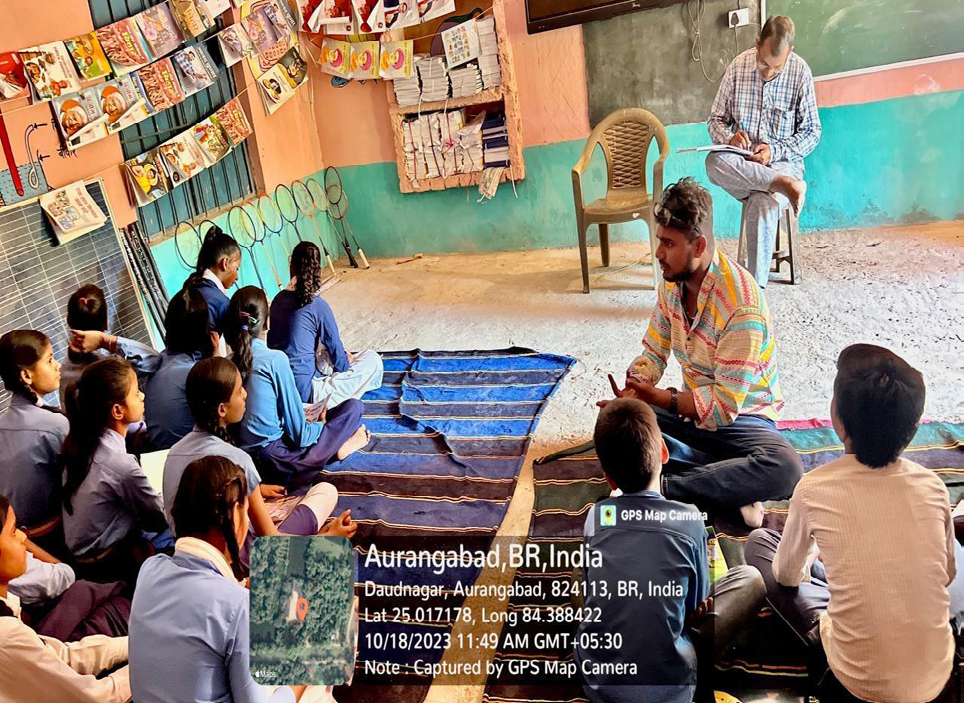
This case study has been conducted for a duration between Sept. 2023 and March 2024 in the study area in the Aurangabad district of Bihar, India. The participating school- going children mostly have been covered from low-middle socio-economic background’s communities who are enrolled in governmental primary and middle school.
Inclusion Criteria
- Age group of children from 3 to 14 years.
- Schooling grade from 1 to 3 standard.
- Participating children are residing in the Aurangabad district of Bihar, near their school.
- Participating children are healthy.
- Participating children are related to all religious and category groups.
Exclusion Criteria
- Children’s age is below 3 years and above 14.
- Schooling grade above 3 standards.
- The unhealthy children.
- Children from outside Aurangabad district of Bihar and distance area. Objective: Our major objective is to promote NEP 2020 in India, which, under Nipun Bharat 2021, is to achieve the goal of foundational literacy and numeracy till 2026–27, e.g., enhancing the SLO (student learning outcome) and reducing the school dropout rate (Table 1).
| Primary & Middle School | Grade/ Classes | Age | Socio-economic Status |
|---|---|---|---|
| Middle School Shamsher Nagar, Block- Daud Nagar, Dist.- Aurangabad, Bihar, India | 1-5 | 3-14 | Low-middle |
| Middle School Angrahi, Block- Daud Nagar, Dist.- Aurangabad, Bihar, India | 1-5 | 3-14 | Low-middle |
| Middle School Kanap, Block- Daud Nagar, Dist.- Aurangabad, Bihar, India | 1-5 | 3-14 | Low-middle |
| Middle School Jamuwaw, Block- Daud Nagar, Dist.- Aurangabad, Bihar, India | 1-5 | 3-14 | Low-middle |
| Middle School Balhama, Block- Daud Nagar, Dist.- Aurangabad, Bihar, India | 1-5 | 3-14 | Low-middle |
Table 1: Showing the selected five governmental primary and middle schools that are most vulnerable in the region
Observation 1
- While observing the Grade 1 Language classroom transaction process in demo schools’ maximum number of students were unable to read small words of 2-3 letters.
- The FLN kit is used by the teachers of Grades 1 and 2. They use flashcards, which enable students’ learning capacity.
- Teachers are overburdened with official work, due to which they are not taking their assigned periods on a regular basis.
- Due to the unavailability of benches in MS Shamsher Nagar, students don’t get an appropriate environment to study, so their willingness is compromised.
Result
- MS Angrahi, MS Kanap Chahak activity is not done.
- MS Angrahi and MS Kanap demonstrated the Chahak activity with the students of Grade 1 so that the teacher could engage them in doing these activities in the classroom transaction process.
- Engaged with the students in the library to demonstrate the roles and responsibilities of the library minister and how library period can be utilized by the students.
- In the morning assembly, the students who led the morning assembly made the group of students from Grade 1 to Grade 5 so that every student gets the opportunity to learn and participate.
- Initiated HM-staff meetings in schools to build an environment where they get an opportunity to share their challenges without being judged so that both parties equally evolve and work around the school process.
Observation 2
During math Grade 1 in school, MS Balhama observed students were identifying 1 to 10 numbers through jumping activities; this was experiential learning for them. The teacher also called students one by one.
- As per the TIPPS indicator, class had a free environment where students were freely responding without fearing their answer was right or wrong. Due to mixed learning, the teacher is not focusing on grade-appropriate teaching. Students were called one by one to form a word from A, B, C, and D. Grade 1 students were not able to answer in comparison to Grade 2 students.
- In a comparison of Hindi, Grade 1 students were actively answering and solving the numerical such as addition and subtraction of 2 digits.
Result
- Demonstrated the use of the TLM kit, where we used alphabet flashcards so that students could remember and recall. Observation of Grade 1 & 2 Math Classroom transactions.
- I met with the members of Bal Sansad to understand their roles and responsibilities and how they contributed to the effectiveness of the school process. Every minister shared their engagement as per their assigned responsibilities. After interacting with them, I observed that the library minister needs guidance regarding how she needs to use library period and how we can add library activity in morning assembly.
- Demonstrated the use of flash cards in language class of Grade 1.
Observation 3
- The lesson plan was not prepared in schools daily.
- In Grade 1, sub-group teaching is not done due to which students who need more attention are left out.
- There are 4 demo schools in the morning assembly where the loudspeaker is not used and no activity is done by the students in assembly.
- The FLN kit is used by the teachers of Grade 1 and Grade 2. They use flashcards, which enable students to identify words and relate them with the images.
Result
- Did HM-Staff meet in 5 demo schools to understand the reason for not preparing lesson plans and to demonstrate how to develop lesson plans.
- In the morning assembly, the students who led the morning assembly made the group of students from Grade 1 to Grade 5 so that every student gets the opportunity to learn and participate and started the use of loudspeakers for Chetna Satra.
- Demonstrated how to do sub-group teaching where students who need more attention are also engaged in group activity.
Observation 4
- Grade 1 language and math. Students were identifying the objects through the TLM kit, but the lesson plan was not developed by the teachers according to the learning level of the students.
- Classroom observation of language and math A sub- group activity was done where Grade 1 students sat in round and square shapes and others were counting the numbers and also identifying the shapes.
- During classroom observation, students were not able to relate the word to the picture shown on the flash card.
Result
- Morning assembly was observed by him, where he gave feedback to the HM to shuffle the students to do Chetna Satra so that other students get opportunities and also include library activity in assembly.
- To make effective Multilevel learning grades I demonstrated two grades that were combined. I demonstrated a sub-group activity with the students with a TLM kit where coins were used to count the digits in ascending and descending order.
- Demonstrated to students with the TLM kit to learn and understand jump counting, and then teachers called students one by one, and out of 20 students, 11 students recognized the numbers.
Observation 5
- While visiting 10 demo schools, there are some demo schools (MS Kanap, MS Jamuwaw, and MS Balhama) where morning assembly, library, and Bal-Sansad are in a better state due to the activeness and engagement of the teachers to strengthen the school process.
- In the classroom transaction process of Grades 1 & 2 (Language & Math), I observed that teachers only focus on the students who actively participate during the transaction; due to this, those students who need more attention from the teachers to help them understand and learn are neglected.
- During classroom transactions, the teacher uses the FLN Kit to do calendar-based Chahak activities.
- During my visits, I observed that only 50% of students have textbooks. This affects other students who don’t have textbooks; this develops a lack of interest.
Result
- In order to strengthen the school process, share the observation with the HM of the respective demo schools to develop the upcoming 2-week area of improvement action plan.
- Conducted Bal Sansad meetings and interacted with the members to understand their roles and responsibilities and their daily contribution to running the school in an effective manner.
- Morning assembly plays a vital role in schools; initiated grade 1 and 2 students led morning assemblies, which will break their hesitation and also enable them to actively participate in classroom transactions.
Discussion
The holistic developmental program of children not only in India but also in the world can be seen into two major scenarios as follows: • Governmental and Inter-governmental Programmes: Governmental and inter-governmental programs for children’s holistic development often emphasize outward personality building, addressing immediate needs. However, these initiatives may overlook the unique psychological and emotional growth of each child. A balanced approach is essential for fostering comprehensive development that nurtures both external support and internal potential. • Modern Psychological and Cognitive Theories: Modern psychological and cognitive theories of children’s holistic development primarily concentrate on the functions of the mind and brain, emphasizing health, nutrition, behaviour, and social learning. These theories provide valuable insights into cognitive processes and the broader context of a child’s outward temperament shaped by familial and societal exposure. • But the Governmental and Inter-governmental Programme, Modern Psychology and Cognitive Science, are narrow focus can lead to an insufficient understanding of a child’s development, although external factors play a critical role in shaping children’s development like their emotional, social, behavioural, well-being, and all that. The Indian psychological theories should be added to the holistic development of children as follows: • Indian psychological theories: Indian psychological theories of children’s holistic development are rooted in the doctrine of Karma, which emphasizes the regulation of mental and physical temperaments. The mental temperaments consist of Sattva (purity), Rajas (activity), and Tamas (inertia), while the physical temperaments include Vata, Kapha, and Pitta. These temperaments contribute to holistic development through the three astral centres of Nadi within the Sukshma-sharir (subtle body). The first centre is the solar chakra, associated with fear; the second is the heart chakra, linked to feelings of inferiority; and the third is the throat chakra, connected to slow learning. Balancing these chakras can be achieved through alternative techniques from Indian medicine and yoga practices, such as regular breathing exercises and other yogic disciplines. As a result, children’s holistic development can be significantly enhanced and accelerated.
Conclusion
In India, numerous projects are underway to enhance the learning outcomes of early-aged school-going children, focusing on their holistic development. The Indian government is collaborating with NGOs to achieve these objectives, primarily emphasizing the outward development of children. However, it is crucial to take additional initiatives that promote holistic child development by incorporating appropriate disciplines from Indian medicine, yoga, and other subtle therapies. Additionally, the Piramal Foundation is making significant strides in this area, demonstrating the capacity to implement innovative ideas and approaches for effective capacity building.
Conflict of Interest: There is no conflict of Interest. Ethical Issue: No Acknowledgement: I offer my best honour to Mr. Nafees Ahmad, Senior Program Manager, Piramal Foundation, U.P., who supported us in this study. I would like to give special thanks to Mr. Shadab Alam, Program Manager, Piramal Foundation, Bihar. I offer my heartfelt thanks to Ms. Spriha Singh, Program Leader, Piramal Foundation Bihar, and, I express my heartily thanks to Dr. Manoj Kumar Singh, Doctoral Fellow, Department of Rachana Sharir, Faculty of Ayurveda, IMS, BHU, Varanasi, U.P., India, for their essential guidance and support.
References
-
Freud S (1959) The Complete Psychological Works of Sigmund Freud. The Hogarth Press 4-5.
-
Bandura A (1977) Social Learning Theory. Prentice-Hall. Science and Human Behaviour. Macmillan.
-
Gesell A (1950) The First Five Years of Life: A Guide to the Study of the Preschool Child. Harper & Brothers.
-
Bronfenbrenner U (1979 The Ecology of Human Development: Experiments by Nature and Design. Harvard University Press.
-
(2024) National Initiative for Proficiency in Reading with Understanding and Numeracy.
-
(2024) Foundational Literacy & Numeracy (FLN).
-
(2024) Anamaya- The Tribal Health Collaborative.
-
(2024) Understanding the Aims and Objectives of NEP 2020: Revolutionising Education in India.
- Occupational Stress and Mental Health Outcomes Among Police Officers: A Mini Review
- The Experience of Counterproductive Leadership on Mental Health and Impact on Retention in U.S. Marines: A Phenomenological Study
- Nomophobia in the Digital Age: A Study on College and University Students
- Emotional Regulation in Children with Autism and Learning Disabilities
- Antisemitism on American College Campuses and Its Impact on Jewish Students
- Exploring the Role of Empathy in the Associations of Family Functioning and Purpose in Life with Attitude towards Abortion among Undergraduates: A Moderation Analysis