
In-Situ Trans-esterification of Cottonseeds Oil (Gossypium Spp) Using CaO Derived from Egg Shell as Catalyst
In-situ trans-esterification of cottonseed oil (Gossypium spp) was carried out with 5g calcium oxide derived from egg shell as catalyst using soxhlet extraction apparatus and 1:1 of n-hexane to methanol. All the trans-esterification reactions were carried out at 600C temperature for 2 hours. The results produced a biodiesel with 35.75% yield, water and sediment content 0.08%, density 0.85g/cm3, specific gravity 0.85, saponification value 16.83mgKOH/g, acid value 0.79mgKOH/g, iodine value 59.22I2/100g, cetane number 357.28, and high heating value 47.85MJ/kg. The GC/MS results indicated the presence of tetradecanoic acid, methyl ester, hexadecanoic acid, methyl ester, 11-octadecenoic acid, methyl ester, 6- octadecenoic acid, (z)-methyl ester, octadecanoic acid, methyl ester, n-hexadecanoic acid, oleic acid and 2-ethyl-2- hexanal. Thus, the processing of cottonseed oil into methyl ester using soxhlet extraction method is recommended as it required low energy input as compare to conventional method.
Introduction
Due to the increasing consumption of worldwide petroleum fuels and the environmental concerns, there is a great demand for alternative resources to petroleum based fuels [1]. Thus, the search for substitute sources of new, sustainable and renewable energy such as biomass, solar, hydro, and wind became necessary [2].
Biodiesel since its early commercialization has become one of the major renewable alternatives and is produced through a catalyzed trans-esterification process, in which mono-alkyl esters of long chain fatty acids are produced when monohydric alcohols, such as methanol or ethanol, in the presence of acid or base catalyst chemically react with triglycerides (vegetable oil or animal fats). It is often used in compressed ignition engines for energy generation [3].
The biodiesel production process has been established and mainly commercialized using homogenous catalysts, such as sodium hydroxide (NaOH) and potassium hydroxide (KOH) dissolved in methanol. Homogeneous catalysts are difficult to separate from the product mixture. Thus, considerable amount of polluted water were created to remove the basic catalyst from the biodiesel product [4]. Other disadvantages of using homogeneous catalysts include their hygroscopic nature which may lead to formation of soap with high free fatty acid feedstock. This results in generation of a lot of wastewater during the washing stage which may pollute the environment [5].
Several researchers embarked on exploration of the activities of wide range of heterogeneous catalysts in a massive attempt to reduce the problems associated with homogeneous catalysts. Literature reported various solid acid and base catalysts found to be suitable for biodiesel production.
Heterogeneous catalysts have the advantage of being easily separated from the reaction mixture and reused many times. The major difficulty with heterogeneously catalyzed biodiesel production is its slow reaction rate compared with homogeneous catalysis. To overcome this major challenge, the reaction conditions of heterogeneous catalysis are intensified by increasing reaction temperature, catalyst amount and methanol/oil ratio [6, 7].
This paper studied the synthesis of biodiesel from cottonseed using soxhlet extraction method using calcium oxide (CaO) generated from eggshells as catalyst. The diesel produced was characterized through GC-MS spectroscopy and its physico-chemical properties were also analyzed.
Materials and Methods
Sample Collection and Purification
The delinted cotton seeds (Gossypium spp) were obtained from Zamfara Textile Industry Limited, Gusau (ZAMTEX). The seeds were identified as Gossipium spp at the Botany unit, Department of Biological Sciences, Usmanu Danfodiyo University, Sokoto. The undesired impurities were removed by hand-picking and the seed was prepared for extraction using mortar and pestle into fine powder. It was then sieved to reduce the particle size and to ensure homogeneity and stored in airtight polythene bag before the analyses. Eggshells were also collected from nearby coffee shops at Usmanu Danfodiyo University Sokoto, hostel mini market.
Catalyst Preparation
The eggshells were washed thoroughly with tap water to get rid of any unnecessary materials adhered on its surface, and rinsed twice with distilled water. The washed egg shells were shed-dried to remove moisture grounded using mortar and calcined in a muffle furnace under static air condition at temperature of 600°C for 2 hours to transform calcium carbonate in the shell to CaO particle as reported by Boey PL, et al. (2009) [8].
Analytical Procedures
Transesterification
40g of cotton seed was weighed inside the thimble, 200cm3 of 1:1(v/v) n-hexane and methanol mixture was measured and transferred into 250cm3 round bottom flask and 5g of CaO derived from egg shell was added to the solvent mixture. The round bottom flask was fitted with a soxhlet extractor. The reaction was carried out at 60oC temperature for 2 hours with constant stirring. At the end of the trans-esterification reaction, the round bottom flask was removed from soxhlet extractor apparatus and allowed to cool. The liquid phase was decanted from the solid phase. The liquid phase was transferred into separating funnel and allowed to settle down overnight. Two layers were formed, the lower layer was dark brown in color contained glycerol and the upper layer was yellow in color contained fatty acids methyl esters which were separated using separating funnel. The biodiesel then evaporated using a rotary evaporator to remove the remaining n-hexane and methanol. Gas Chromatography- Mass Spectroscopy (GC-MS) was used to determine the chemical composition of biodiesel produced and biodiesel yield was calculated using equation below.
𝐵𝑖𝑜𝑑𝑖𝑒𝑠𝑒𝑙 𝑦𝑖𝑒𝑙𝑑 (%) = 𝑀𝑎𝑠𝑠 𝑜𝑓𝑐𝑟𝑢𝑑𝑒 𝑏𝑖𝑜𝑑𝑖𝑒𝑠𝑒𝑙 𝑀𝑎𝑠𝑠 𝑜𝑓 𝑡ℎ𝑒 𝑠𝑎𝑚𝑝𝑙𝑒 𝑋 100
Water and sediment content was determined using the formula reported by density was also determined using the formula reported by Mukhtar M, et al. ( 2015) & Almustapha MN, et al. (2009) [3, 9]. The remaining fuel properties were determined using methods reported by AOCS, (2011) while cetane number and HHV were calculated using equations reported by Sokoto MA, et al. (2011) [10].
Results
Cotton seed crude biodiesel quality produced under reaction conditions (1:1 methanol to n-hexane ratio, 60ºC reaction temperature and 2 hours reaction time at
| Parameters | Cottonseed Biodiesel | EN14214 | ASTM6571 | ||||||||
|---|---|---|---|---|---|---|---|---|---|---|---|
| Biodiesel % | 35.75 | ||||||||||
| Water/sediment (v)% | 0.08 | 0.05max | |||||||||
| Density g/cm3 | 0.85 | 0.90max | |||||||||
| Specific gravity | 0.85 | 0.90max | |||||||||
| Saponification value mg KOH/g | 16.83 | ||||||||||
| Acid value mg KOH/g | 0.79 | 0.5max | 0.8max | ||||||||
| Iodine value I g/100g 2 | 59.22 | 120max | 115max | ||||||||
| Cetane number | 357.28 | 51min | 47min | ||||||||
| High heating value MJ/Kg | 47.85 | 35min |
Table 2: Physicochemical properties of Biodiesel from cotton seed.
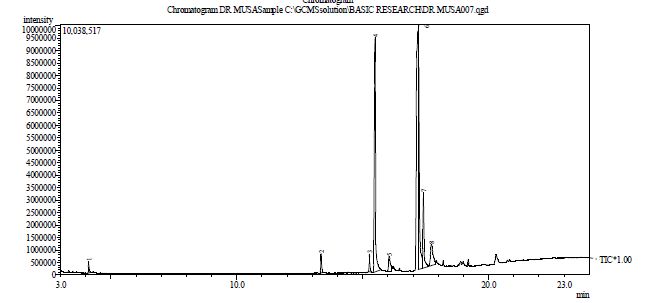
| Retention time (mins) | Possible compounds | Percentage composition (%) | ||||||
|---|---|---|---|---|---|---|---|---|
| 13.35 | Tetradecanoic acid, methyl ester | 2.24 | ||||||
| 15.49 | Hexadecanoic acid, methyl ester | 40.09 | ||||||
| 15.27 | 11-octacecenoic acid, methyl ester | 1.93 | ||||||
| 17.22 | 6-octadecenoic acid, (z)-methyl ester | 33.14 | ||||||
| 17.41 | Octadecanoic acid, methyl ester | 10.49 | ||||||
| 16.05 | n-Hexadecanoic acid | 3.6 | ||||||
| 17.73 | Oleic acid | 7.35 | ||||||
| 4.11 | 2-ethyl-2-hexanal | 1.15 | ||||||
| Total FAME Content | 99.99 |
Table 3: Composition of cotton seed Biodiesel by GC/MS.
Discussion Physicochemical Parameters
Water and sediment, presented in table 1, was found (0.08%) to be higher than the recommended values for biodiesel by ASTM (2007). The result agreed with the findings of who studied the production and properties of diesel produced from Ginger breed Plum seed oil [11]. Water interacts with the methyl ester biodiesel to form free fatty acids which results in microbial growth in the storage tank. This indicates that, cottonseed biodiesel require further post-treatment such as centrifugation to prevent microbial growth and ester hydrolysis in storage tank [11].
According to density is one of the most vital fuel quality parameters related to fuel injector system whose value has to be maintained within a tolerable limit to allow for optimal air to fuel for complete combustion [12]. Table 1 showed that the density of biodiesel obtained was 0.85g/cm3 which was within the accepted value of 0.90g/cm3 recommended by ASTM6571 (2007) for biodiesel. It is however; lower than the 0.87g/cm3obtained by which was found to be 0.87g/cm3 and is slightly higher than 0.81g/cm3 obtained by [9, 13, 14]. The result indicated good combustion and ignition properties of biodiesel.
Table 1 also showed that the specific gravity (0.85) was within the accepted levels (0.90) recommended by ASTM6571 (2007) for biodiesel which agrees with the findings of Hassan LG, et al. (2007) [15]. It further validated the saponification value of 16.83 mg KOH/g which suggested high molecular weight and may be responsible for the high density as reported by Mukhtar M, et al. (2016) [11].
The acid value (0.79mg KOH/g) close to the minimum requirement by ASTM6571 (2007) (0.80max) but above the maximum standard (0.5) accepted by EN14214. The presence of higher free fatty acids content from the GC/MS result such as (3.60% n-hexadecanoic acid and 7.35% oleic acid) may be responsible for higher acid value from the feedstock. Literature reported that direct usage of biodiesel with similar acid values may lead to engine corrosion and. It is recommended that the biodiesel should undergo further acid treatment to reduce the high acidity before being used in diesel engine [11, 16, 17].
According Iodine value measures the total unsaturation within a mixture of fatty acids [10]. It is the amount of iodine required to iodize all the double bonds in the biodiesel. High amount of iodine value can lead to polymerization during combustion. From table 1 above it shows that the biodiesel has iodine value of 59.22I2 /100g which is within the tolerable limit of both ASTM6571(2007) (115max) and EN14214 (120max). This shows that small amount of the biodiesel can be use to cover long distance compared to petroleum diesel.
The higher the cetane number of fuel, the better it is ignition property and the greater quality of methyl ester to be used as a diesel. High cetane numbers help ensure good cold start properties and minimize the formation of white smoke [10]. The cetane number obtained in this work which was shown in table 1 above was (357.28). According to EN14214 specification, biodiesel should have minimum cetane number of 51 while ASTM6571 (2007) is 47as the minimum for biodiesel. based on these two standards, cottonseed oil methyl ester has good ignition quality, because its cetane number exceeds the minimum standards value, this higher cetane number may be as a result of the presence of higher proportion of Hexadecanoic acid, methyl ester and 6-0ctadecenoic acid, (z)-methyl ester.
Heat of combustion is an important parameter for estimating fuel consumption [10]. High heating value is not specified in the biodiesel standards ASTM6571(2007) but 35Mj/Kg as minimum for EN14214.The high heating value obtained from this research work as shown in Table 1 (47.85Mj/Kg) falls within the standard recommended by EN 14214. This indicates that cottonseed oil biodiesel may serve as substitute fuel in tropical region due to its moderate unsaturation level.
GC-MS analysis shows that the major fatty acid methyl ester of Gossypium spp seed oil were tetradecanoic acid, methyl ester, hexadecanoic acid, methyl ester, 11- octadecenoic acid, methyl ester, 6-octadecenoic acid, (z)- methyl ester. Other fatty acids present include oleic acid and n-hexadecanoic acid. The result indicates the successful conversion of Gossypium spp seed oil to methyl ester during the trans-esterification process using 5g CaO derived from egg shell as catalyst.
Conclusion
The paper studied biodiesel production via in-situ trans-esterification of cotton seed. It was found that generally, it is possible to produce fatty acid methyl ester (biodiesel) via in-situ trans-esterification of cotton seed with CaO alkali catalyst using soxhlet extraction method. From the results obtained, it was concluded that Gossipium spp methyl ester could be utilized in place of diesel fuel for diesel engines. It has also shown that density, specific gravity, iodine value, cetane number, and high heating value of the biodiesel when compared to ASTM6571 and EN14214 standards are all within the approved specification for biodiesel to be used as fuel. This is an indication that the biodiesel obtained from cotton seed can be use in diesel engines with regard to these properties. Although, the produced biodiesel was found to have high acid value, and the biodiesel have high water and sediment content. Hence biodiesel from cotton seed would be an efficient renewable substitute to diesel fuel which at the same time would be more environmentally friendly and cheaper than the conventional diesel if properly utilized.
References
-
Li Y, Lian S, Tong D, Song R, Yang W, et al. (2011) One- step production of biodiesel from Nannochloropsis sp. on solid base Mg–Zr catalyst. Applied Energy 88(10): 3313-3317.
-
Aliero AA, Yunus MM, Zuru AA, Faruq UZ (2013) Assessment of Physicochemical Properties of Biodiesel from African Grapes (Lannea microcarpa Engl & K Krause). Nigerian Journal of Basic and Applied Science 21(2): 127-130.
-
Mukhtar M, Muhammad C, Dabai MU, Mamuda M (2015) Ethanolysis of Calabash (Legeneria Sinceraria) Seed Oil for the Production of Biodiesel. American Journal of Energy Engineering 2(6): 141-145.
-
Atadashi IM, Aroua MK, Abdul Aziz AR, Sulaiman NMN (2013) The Effects of Catalysts in Biodiesel Production: A review. Journal of Industrial and Engineering Chemistry 19(1): 14-26.
-
Sharma YC, Sing BJ (2011) Latest developments on from Jatropha Curcas seed oil with conventional diesel fuel (A.G.O). Chemclass journal 6: 43-46.
-
Sokoto MA, Hassan LG, Dangoggo SM, Ahmad HG, Uba A (2011) Influence of Fatty Acid Methyl Esters on Fuel Properties of Biodiesel Produced from the Seed Oil of Curcubita Pepo. Nigerian Journal of Basic and Applied Science 19(1): 81-86.
-
Mukhtar M, Dabai MU (2016) Production and Fuel Properties of Biodiesel from Ginger breed Plum (Parinarimacrophylla) Seed Oil Using MgO/Al2O3 Catalyst. American Journal of Environment Protection 5(5):
-
Galadima A, Garba ZN, Ibrahim BM (2008) Homogeneous and heterogeneous trans-esterification of Groundnut oil for synthesizing Methyl Biodiesel. International journal of pure and applied sciences 2(3): 138-144.
-
Demirbas A (2008) Relationships Derived from Physical Properties of Vegetable Oils and Biodiesel Fuels. Fuel 87: 1743-1748.
-
Sivaramakrishnan K (2011) Determination of Higher Heating Value of Biodiesels. International Journal of Engineering Science and Technology 3(11): 7981- 7987.
-
Hassan LG, Sani NA (2007) Preliminary Studies on Biofuel Properties of Bottle Gourd (Lageneria Sinceraria) Seed Oil. Nigerian Journal of Renewable Energy 14(1-2): 12-15.
-
Atabani AE, Silitonga AS, Badruddin IA, Mahlia TMI, application of heterogeneous basic catalysts for an efficient and eco-friendly synthesis of biodiesel: A review. Fuel 90(4): 1304-1324.
-
Boro J, Konwar L, Deka D (2014) Transesterification of non edible Feedstock with Lithium Incorporated Egg Shell Derived CaO for Biodiesel Production. Fuel Processing Technology 122: 72-78.
-
Shuli Y, Graig D, Siddharth M (2010) Advancements in Heterogeneous Catalysis for Biodiesel Synthesis. Topics Catalysis 53(11-12): 721-736.
-
Boey PL, Maniam GP, Hamid SA (2009) Biodiesel production via trans-esterification of palm olein using waste mud crab (Scylla serrata) shell as a heterogeneous catalyst. Bioresource Technology 100(24): 6362-6368.
-
Almustapha MN, Hassan LG, Ismaila A, Galadima A, Ladan MM (2009) Comparative Analysis of Biodiesel of incompletely converted soya bean oil on biodiesel quickly. Energy 32(5): 844-851.
-
Borges ME, Diaz L (2012) Recent developments on heterogeneous catalysts for biodiesel production by oil esterification and trans-esterification reactions: A review. Renewable and Sustainable Energy Reviews 16(5): 2839-2849.
-
Nakano T, Ikwanani Ozimek L (2003) Chemical Composition of Chicken Eggshell and Shell Membranes. Poultry science 82: 510-514.
- Sense, Gravity, Parity & Chirality in Mathematical Physics
- Quantum Lattice Simulations PHYSICS: Microcircuit Particle Formation and Observable Macroscopic Irreversible Time - A Discrete Lagrangian with Cellular Automata Framework
- Quantum Biology from Biomacromolecule to Cell, and Central Dogma Described by Quantum Theory
- Focus, Agility, Speed and Technology (FAST) for Sustainability and Growth
- Square Root Metric Geometry and Pati-Salam Model in Curved Space-Time
- A Simple System Demonstrating the Mpemba Effect in Classical Mechanics