
Einstein, Heisenberg and C2-inertia
In science history the conflict between Einstein and the Copenhagen school (quantum mechanics) is well known. On the one hand, Einstein's strict determinism, on the other, Heisenberg's uncertainty relations, the collapse of the wave function and the chance at the micro level, regardless of the macroscopic explanations of the postulate cmax=const, regardless of the initial mass. At the time when our Galaxy was the whole world and the mutual velocities in it were negligible according to the speed of light, Einstein held that the mass of the world was one and unique. In 1985, in a lecture on quantum electrodynamics– QED: THE STRANGE THEORY OF LIGHT AND MATTER–Feynman says that he only describes how nature behaves without being able to explain why it behaves like that because no one understands this; and Laughlin in 2005 says, already with the title of his book–A DIFFERENT UNIVERSE: Reinventing Physics From The Bottom Down–that an effort on understanding this fact to humanity is yet to come. This article shows that one should start from the very postulate cmax=const, rethinking this experimental fact–because Einstein's explanation from 1916 is insufficient and in fact wrong: he tacitly takes the coordinate system of the railway embankment as absolute, and to the train speed adds to or subtracts the light speed. And rethinking will lead us to the necessary Heisenberg relations of uncertainty, c2 inertia and new insights into the property of relativity and symmetry of the vacuum itself, to the explanation of the EPR paradox and the so-called the twin paradox. And all together to one Universe, really different from how we imagine it today with a Big Bang.
Introduction
At the time I wrote the article Relativistic Ether and Heisenberg’s Uncertainty Principle [1], I thought it needed no introduction. Then my position was that even the exposition about the fact that postulate c=const cannot be explained at the macro-level because it leads to the elementary contradiction, is sufficient to be an introduction. The paper aimed to show that this contradiction can be solved on a micro-level only, by means of the Heisenberg’s uncertain relation, so that the speed of light remains uncertain until in the interaction with already created mass it is manifested as c2-inertia. Here uncertainty means chance, and c2-inertia means certainty, like strict causality. Chance and causality are, there’s, in mutual relativity and symmetry, in specific circumstances a greater or lesser probability, just as the realization anywhere is the relativity of place, and +t or –t from that realization is the symmetry of time, both by inertia.
However, where did the first mass come from? Safe that it cannot be absolute either. The greater the mass, of course, the greater its influence on the four-dimensional space- time geometry, but not even Gamow when calculating of the origin of chemical elements does not speak of a “Big Bang”, but of an infinitely dense infinitely large heat energy from which, during cooling, all chemical elements could be created according to the laws of causal thermodynamics with chance- based entropy. But inertia remains inertia E/m=const, so no matter how big the mass or small anti‑mass is, no matter how fast the speed of light itself is, maybe beyond the horizon of our cosmos it is different—in that infinitely undetermined infinity of the Universe. Or as Giordano Bruno [2] would put it more simply—in that infinite Universe and Worlds.
About relativity and symmetry as the way in which the whole world could exist by inertia, I published a typescript in 1974 under the title Essay on god, offering it to publishers. However, I received an answer from the Ministry of Culture that religious books are not exempt from tax —“but it’s not religious, but just a deeper reflection of the dialectical materialism that I believe in, just like religious people believe in God”, all the same—publishers refused it. In 2001, no decision from the Ministry was needed, the publishers rejected it again, God in the title and the book is not religious, what if it is a provocation, media will not follow it, and people will not buy it. Later, I had the opportunity to hear the editor-in-chief of a private television station, who in his author’s show says about the breakup of Yugoslavia that it was the first religious war in the history of civilization that was fought by infidels. In 2014, I published THE UNIVERSE AS RELATIVE ZERO [3]; I didn’t even offer the manuscript to publishers. In 1920, also Gravity And C2‑Inertia [4]. At that time, experiments with a laser beam of high energy density, which created thousands of electron-positron pairs in a collision with only one electron as a catalyst, were already known. At the end of that book, I also considered what could happen if the photon gas used by Bose to prove Planck’s law of blackbody radiation, if it condensed and passed through the zero-volume singularity, whether and how it would transition to Maxwell-Boltzmann probability distribution of micro-particles? Both diagrams are bell-shaped symmetrical, both with a slight hint of asymmetry like a hen’s egg, from the embryo of which, due to heat, the multiplication of cells starts as if by inertia. Or exactly as the anecdote about Paul Dirac says. Was at an exhibition of paintings by Mondrian, I guess. He stopped, amazed by the hidden symmetry of one painting. Squares and rectangles of several sizes and colors, but wherever you look, you can see the symmetry: 2 squares here, 2 there; 2 then 1 rectangle there, 1 then 2 there they are on the other side of that straight line that already intersects with the next one; not diagonally forward, not on the other side, but at a right angle. He thought about it, and then approached, and with a felt tip pen he put a dot, randomly where—just to be an indication of possible asymmetry, just to revive the symmetry.
So what in Nature could compress photons so that they create mass by passing through the singularity? Just only virtual photons if there is no mass yet! Admittedly, virtuality in itself means a possibility, i.e. the possibility that there is a mass, i.e. this material world, that I guess does not need to be proven. Not even to solipsists, according to whom the World exists, however, only as a presentation, display for my I-am, the idea only for I-personal (solus-, ipse-), therefore God in an individual human being again and again. Well, that’s not bad either. But it’s not science. And in cosmological science, even natural homocentrism should be put aside. That is why the “Big Bang” cannot be considered science: God created the world, and before that, there was nothing, not even the laws of physics – as if the very possibility that the World exists does not have its logical laws.
Black holes trap light and not only mass particles, that’s why they are not visible, and yet in the meantime, they have been revealed by their impact on the environment, so their gravitational waves have also been detected. Those two super-massive black holes in a mutual spiral collision lost energy, but not a word about any newly created mass; all that loss goes to the alignment of the space-time geometry. Black holes evaporate losing energy-mass in that way too, and finally explode, but there is here no new mass either. And besides, how do they evaporate? By the spontaneous creation of particle‑antiparticle pairs on the very event horizon. Black holes, otherwise mathematically empty after the collapse of super-massive stars? And now the border of the horizon, exactly to the letter, how that, like 6,64.10–34 Planck’s uncertainty constant? Mathematics is powerful, but the explosion of a black hole due to evaporation has not yet been recorded, and mathematically it should have been a long time ago. Starting from page 110 of the book [3], we read about Planck’s constant: “It’s as if Nature itself wants to tell us: I in my bosom, you can hope, maybe I am keeping infinite energy just for you, but not in the way of your infinity, nor your zero, neither as a goal nor as a beginning. Just when you think you’ve reached them, I change the rules, I change the coordinate system. Why don’t you try with the frequency, even if with its zero the entire universe has disappeared?” It’s as if mathematics itself wants to tell us: find other quantities, change the coordinates, otherwise I’m powerless. Any infinite extrapolation is impossible, even with the function y=ex. It is the embodiment of inertia and relativity, but it cannot do without symmetry either, continuity is in symmetry with discontinuity.
So it’s necessary to focus on active galaxies. An active galactic nucleus is the only phenomenon in nature where matter is ejected from a black hole and not just gravitationally falls into it: symmetrically on one side and the other, hundreds of thousands of light years away, while one jet is somewhat shorter and diffusely brighter spots at the end–a small sign of asymmetry. It mast be antimatter in relation to the matter of that galaxy. I was convinced that if I carefully studied the spectroscopic findings from many dissertations on active galaxies, I would spot slight differences, for example, in the line spectrum of the jet of matter on one side compared to that on the other, thinking that observing these spectra with the conviction that there was only one “Big Bang” does not allow this spotting in the multitude of artifacts. However, I have not come across any work that would specifically analyze the jet to one side separately from the jet to the other, as if the current power of telescopes reaches only the analysis of the brightest accretion plasma. But at least I showed schematically that the zero-relative symmetry of the vacuum due to the passage of entropy through the black hole singularity of active galaxies must show this spectral difference [5].
This publication meant a lot to me, institutional science nevertheless allows that the “Big Bang” hypothesis is actually an unscientific hypothesis, which was the first reaction after Lemaitre, not only a doctor of physics but also a theologian, published his hypothesis about the primordial atom. But Gamow’s calculation gave the exact percentage of hydrogen, helium and light elements in the cosmos, and that was crucial, although he did not speak of the “Big Bang” as the beginning of the World, but only of the infinitely large thermal energy of unlimited density that cools according to the laws of entropy. And on the other hand, Hoyle’s hypothesis of the stationary state, according to which the mass at the expansion of the universe is continuously created from the vacuum, has not been confirmed by astronomical observations, because, as today it can be said, does not take into account the symmetry of continuity and discontinuity.
On Macro Level, an Explanation of C=const Postulate is not Possible
It is no wonder that this postulate is not explained in serious scientific articles, and that Einstein’s example with the train and lightning from 1916 is only mentioned somewhere in popular lectures when the audience’s attention should be tickled. At the macro‑level it is indeed not understandable. Let us have a look at three inertial coordinate systems, the fix, immobile Ox-system, and mobile O1x’ and O2x’’, it is sufficient to mark only the coordinate beginnings and x-axes:
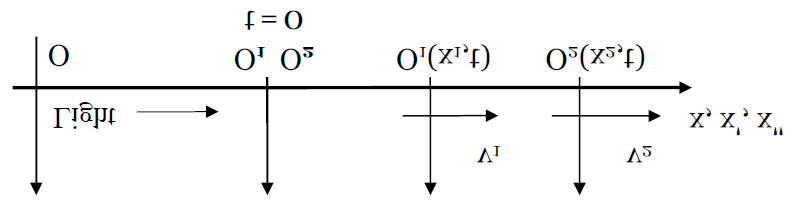
If the current light wave has been emitted from the immobile system in the positive direction of the x-axis, let us suppose that at that moment the other two systems are parallel and coincide, although they move at different speeds v1 and v2, their coordinate origins O1 and O2 are in the same place. After a while, measured from the system that emitted the light wave, the O1 system will be at a distance of x1, and the O2 system, let us suppose, at a larger distance x2. And both systems received the emitted light at the same time, because all the experiments show that Galileo’s speed addition is not valid for light, but that c plus whichever v is again only c. So, the light traveled at the same speed yet it passed different distances over the same time, and all of that was measured in the system which emitted the light: up to x1 and up to x2.
The Elementary Contradiction!
This contradiction can be resolved only at the micro‑level, taking into account the fact a) That photon emission and propagation through vacuum is one event, and photon propagation and reception is another. In the four-dimensional space-time of relativity theory, the position of any particle of mass m1, m2, m3, etc. at any given moment is described by quoting all four of its coordinates in relation to, for example, the resting mass m0, S0(t, 0,0,0).
So-S1(t’, x’, y’, z’) is one event and S0-S2(t”, x”, y”, z”) is another, and so forth, while the intervals S0–S1, S0–S2 or in general, the intervals between any two events S1–S2 in differential form are the same, also for the case of curvilinear coordinates.
$$ b a = c b t \sqrt {I - \frac {v _ {5}}{c _ {5}}}. \tag {r} $$
And that differential is always positive because of cmax, except for photons. For a particle without mass, for a photon in its own coordinate system it is zero. As long as the photon is in vacuum, it is all the same event, its time does not flow, tf = 0, so wherever it is, (xf, yf, zf). It is as if it were a virtual, simply naked possibility until it is caught in some new atomic mass where it will be realized–embodied by now adding mass Δm to it. This can be seen even better by Lorentz transformations: for a photon in relation to rest mass, the dilatation of time is infinite, so its time does not flow at all, it is always zero; by this uncertainty 0/0 it adapts to the time measure of any receiver mass. And due to the infinite contraction of length, it also adapts, by the uncertainty ∞.0, to the unit of length of that coordinate system, each photon to its receiver. Hence b) Not all photons of the same frequency ν from the same emitter are the same–each will be such that it reaches its receiver at the speed c=const. Mathematically:
(2)
At the moment of emission, a photon lost the measure of emitter’s coordinate system, its frequency ν is indeterminate because it is uncertain, completely random, in which atom- receiver it will be caught. Its energy hν is also indeterminate. Moreover, it has no energy per se because it does not have any frequency in its own coordinate system, its time does not flow–the photon is a virtual one. And so on like that– although in the coordinate system of the emitter, specifically in O(0,t) time still flows. Only when a photon reaches its receiver, specifically, those photons being captured in the O1 coordinate system after time t1, only then does their time begin to flow, that is now the time t’ of that coordinate system. Those photons which are not captured, their time still does not flow until at the time t2 of the time measured in the emitter system, they are captured in another coordinate system, in O2, that is now the time t”.
In other words, only at reception is the speed of light realized as the c2‑inertia of the entire cosmos. This is not only about the Doppler Effect due to the divergence or approximation of the masses, but also about the relativistic shortening of the length just like about the energy of the vacuum itself. Hence the unity of vacuum and particles with mass, the very way of existence of vacuum is in unity with particles–by c2‑inertia of the whole cosmos [6].
This is the solution of the EPR paradox: the inertia of vacuum itself. If a spin of one entangled photon is +1, then the spin of the other is immediately –1. It is also the symmetry of vacuum. Symmetry also solves the so-called twin paradox: no matter how many inertial coordinate systems there are, S1, S2, S3, S4, S5, etc.–time will flow fastest in the one which a person chooses to rest [7] because only in it all speeds are calculated as absolute while speeds all others are relatively added together. This, however, is no longer a simple mutual symmetry of two coordinate systems, but the symmetry of the unity of vacuum and particles with mass has been preserved–becoming more complex, cyclical: S1, S2, S3, S4, S5 ...; S2, S3, S4, S5, S1 ...; S3, S4, S5, S1, S2 ...; S4, S5, S1, S2, S3 ...; S5, S1, S2, S3, S4 ... And so on.
And it can already be seen that the hypothesis of the big bang as the beginning of the all world is not sustainable. However, no longer because of geocentrism, nor because of heliocentrism, it is not sustainable because of homocentrism–because of the coordinate system which man (homo) himself chooses to be fixed. Why, namely, would the perfect symmetry of nature be disturbed only because man measures cmax starting from the mass he chooses and only up to his horizon, even if he declares that mass no matter how large and no matter how high the density is? However, how to understand that a constant speed of light is formed only in a collision with a mass and that as a c2‑constant?
Heisenberg Uncertainty Principles Applied to a Photon
In 1900, Planck found the formula for black body radiation, which was possible not with a continuous change in the radiation power but with a quantized, always basic quantum hν. In 1905, Einstein also interpreted the photoelectric effect with the same assumption: a black body absorbs electromagnetic energy quantized, also by photons. In 1919, Rutherford proved experimentally that the atom is not indivisible and proposed a planetary model for the nucleus and electrons, leaving the problem of spiral collapsing unsolved. And in 1913, Bohr postulated that an electron does not radiate while in an orbit whose circumference 2rπ is multiplied by its momentum mv is equal to the integer product of Planck’s constant h, 2rπmv=nh, n=1,2,3 ... It radiates only when it jumps into an orbit of a lower energy level, just as it transitions to a higher energy level by receiving a photon. The postulate was experimentally confirmed in the same year. In 1922 Compton proved that a photon, although it has no rest mass, has a momentum of exactly the same shape as the momentum mv of a body with mass, i.e. mc, but this m is realized only in the atom as the energy difference between higher and lower levels, mc2 =hν, and hence λν=h/mc. In 1924, De Broglie assumed that, like a photon, a particle with a mass must have an appropriate wavelength, i.e. analogous to h/mv that explains stable orbits in an atom: an electron does not radiate because then its wave is standing. In 1925, Heisenberg published his quantum reinterpretation of kinematical and mechanical relations, describing by matrices those electron jumps in orbits, while Schrödinger used De Broglie’s wavelength in the same year and set up his wave equation–a year before electron diffraction was experimentally proven. Interpreting his quantum theory now with the help of the wave nature of both light and electrons, Heisenberg published his famous uncertainty relations in 1927: the position and velocity of a micro‑particle cannot be known at the same time, one of the two must remain indeterminate, from measurement to measurement by chance.
Einstein did not like this chance, he considered Heisenberg’s uncertainty relations to be a consequence of, admittedly, a possible but insufficient theory–the cause is missing. There must be hidden variables that explain that otherwise ghostly action at a distance, he said on the occasion of entangled wave functions from the same source arbitrarily far in both directions. And so the postulate c=const has remained unexplained to this day. That is, I do not know that anyone has dealt with it in particular, that anyone has applied Heisenberg’s uncertainty relations to the macroscopic dimensions of the relativity theory. Compton, for example, proved the x‑photon momentum in a collision with a free electron, but here is an electron of negligible velocity relative to the speed of light, practically both the photon and the electron are in the same coordinate system from the beginning. However, only at high speeds of mutual movement of coordinate systems (emitters and receivers in relation to the stationary system) does the significance of the indeterminacy of the photon impulse, and therefore the speed of light, manifests itself—when that indeterminacy must be taken as a fact in itself. And no longer $\Delta p$ as part of the momentum mc that the photon loses in the collision with the electron losing at its frequency, not only $\Delta p = \Delta v$, but
$$\Delta p = c\Delta m + m\Delta c.$$
(3)
When a photon from relativistic great distances finally came to this or that, by chance, but finally to this, quite definite receiver, the uncertainty of the spatial coordinate of reception is zero, $\Delta x = 0$, no matter how the receiver itself moved relative to some third system at rest. Heisenberg’s uncertainty relation dictates, however, that it must be $\Delta p\Delta x \geq h$. And this is not an uncertainty due to an imprecision of measurement, but an objective uncertainty: with countless different velocities $v < c$ up to the speed of light, it is completely uncertain in which atom the photon will be caught. Heisenberg’s inequality is an objective condition,
$$(c\Delta m + m\Delta c)\Delta x \geq h \rightarrow (c\Delta m + m\Delta c) \rightarrow \infty$$
(4)
Since $\Delta m$ is an insufficient micro size, it remains that all possible macroscopic difference in the speeds of the coordinate systems of the emitter and a particular receiver is covered by the uncertainty $\Delta c$; thus, according to equation (2), the speed of light is adjusted to the measures of length and time of any receiving atom. The vacuum itself, in unity with all hitherto mass-realized particles, integrates all the space around the receiving atom in order to maintain its $c^2$-inertia with the principle of least action. This immeasurably infinite and eternal vacuum shows its $c^2$-inertia over and over again only through a precisely defined realization of the $\Delta m$-mass in the receiving atom.
• Determinism and Chance do not Contradict Each Other, but are, on the Contrary, in the Mutual Relationship of Relativity and Symmetry.
Immeasurable Infinite and Eternal Universe
In 1917, at the time when Einstein announced his Cosmological considerations with the general theory of relativity, the prevailing opinion was that our Galaxy is the whole world, so where will you have larger masses than the mass $M$ of the whole world! Whether Einstein knew of Olbers’ paradox, that warned that standing stars could not be uniformly further and further in infinity in Euclidean space, because the sky would have to shine even at night, or he did not know, he was satisfied with his solution of the gravitational field equation, which due to the curvature of space-time, predicted a gravitational collapse at the coordinate origin. Therefore, he arbitrarily postulated a cosmological $\Lambda$ constant that played the role of negative gravity and prevented that collapse. But when Friedman showed that, depending on the initial conditions, the relativistic equation of the gravitational field has also without a cosmological constant not only a stationary solution but also a solution with a negative space-time curve, where space expands, which is confirmed by Hubble’s law, Einstein renounced his constant.
In all likelihood, however, he did not have the ambition to figure out the very origin of the whole world, but rather simply to inform the Prussian Academy of Sciences out of scientific curiosity as to how the space-time geometry could look like in the context of the newly established theory. Otherwise, whoever would decipher the very origin of the World with the ambition to describe it with the coordinate system of certain units of length and time would first have to ask himself:
Whence the coordinate system in general, whence its measures of length and time in the otherwise immeasurably infinite and eternal Universe?
He/she would have to state, therefore, that without mass there is no such coordinate system [8]. Especially scientists know that neither time nor length is measured by our terrestrial fools but by atomic clocks, for example time by a certain frequency of cesium 133 and length by the wavelength of this frequency.
• In an Immeasurably Infinite and Eternal Vacuum, only a Captured Photon Defines a Certain Time and a Certain Length
The thing is simple: one cannot assume that mass exists, and then from that assumption prove that the world of mass exists. In the history of philosophy, it is the long-known so-called ontological proof of God.
a) Definition: God is a perfect being.
b) Copula: Something cannot be perfect without existing.
c) Proof: So God exists.
That is why Thomas Aquinas (1225–1274) does not seek to prove God, but metaphorically interprets the Bible to formulate basic theses about Him, for example:
a) God is always and eternal,
b) In countless ways, only He makes existence by setting everything in motion.
c) God is everywhere, so in His infinity is the unity of the world always.
Theses that could still be believed today, theses to which the proponents of dialectical materialism of the 20th century swore in their own way as if facts without proof, for example:
a) Matter is uncreated and indestructible,
b) It is in eternal movement and transformation,
c) In infinite Matter is all the unity of the world.
They replaced one word with another–not noticing that their theses stand in a mutually relative and symmetrical relationship with the scholastic theses of the middle Ages. The only thing is that you don’t see God and you seem to see Matter as an objective reality, which is, of course, a matter of enlightenment, but which has nothing to do with the answer to the question of how the World exists.
Both these are simply homocentrism, which as such eludes objective reality.
So:
“Why at all it is What Happens, Instead of Being Just Nothing?”
(Martin Heidegger: INTRODUCTION TO METAPHYSICS, the very beginning)
Cosmology can help philosophy solve this riddle. Philosophy, on the other hand, can help cosmology not be homocentric naive.
First of all, it should be noted that both the theses of medieval scholasticism and the theses of the dogmatic dia-mat speak of inertia: something that is always and eternal or, on the other hand, uncreated and indestructible—that is inertia. And inertia itself carries symmetry: whatever moment you choose as zero for the beginning of time, on the one hand it is +∞ time, it is the future, and on the other −∞, it is the past. Emmy Noether also showed mathematically that every law of conservation, of energy, impulse, angular momentum, carries symmetry. Not only temporally but in general: whichever point we choose as zero for the coordinate origin, we will have symmetry both left-right and back-forth and in general in all directions, a homogeneous and isotropic space. And every symmetry is one in relation to the other–just relativity. No zero is absolute; the world cannot have its beginning: before that beginning nothing and then, behold, the all World. In fact, the Universe cannot have a beginning. But what the ancient Greeks called the cosmos, that can have–however, not an absolute beginning. If our world is the part of an Universe, and it is, the Universe which is always and forever, and it is, then even the beginning of the cosmos cannot escape relativity and symmetry; specifically, the mutual relativity and symmetry between–causality and chance.
Of course, it is not about one single Big Bang as the beginning of the whole World, but about one, two, three, accidentally where and when, but necessarily over and over again about Big Bang, where an implosion and then the explosion of vacuum creates the mass $M_i$ ($i=1,2,3,\dots$) for entire groups of galaxies, for example, with the symmetrical expansion of space-time geometry around that mass over and over again according to, let’s call, Maxwell-Newton postulate,
$$M - \oint dm = 0,$$
(5)
With dm diamass displacement of vacuum over and over again, analogous to Maxwell’s dielectric displacement dq,
$$Q - \oint dq = 0.$$
(6)
A nice illustration of this MN postulate as well as the unique symmetry of the gravitational field and macro mass is the article by: K. Shimizu, Gravitational Energy of a Schwarzschild Black Hole [9].
In doing so, each such mass would have maybe its own $c_{\text{max}}$ perhaps its own different constant $h$ and universal constants in general. In other words, the speed of light measured from the mass of its origin would add up to the already realized $c_{\text{max}}$ so here is a possible explanation for the lack of antimatter and for the inflationary expansion of the universe at the supposed beginning of the world, postulated by Lemaitre, a doctor of physics, however, and not accidentally a doctor of theology–he postulated, and humanity still homocentric insists on his Primeval Atom. What has not been annihilated in the meantime–is separated by inflationary expansion. Here is a possible explanation also for the dark energy that cannot be explained by any negative space-time curve, cannot by any correction of Friedman’s result, because it is probably a problem of only one view from one point of one historical period of the cosmos–in which, contrary to any big bang, the metric by the radiation of the stars aligns. And so on.
Who carefully reads Einstein’s work from 1905, “1st die Trägheit eines Körpers von seinem Energieinhalt abhänging?”[10] he will notice that Einstein actually uses three coordinate systems: one from which the electromagnetic energy L (German Licht) radiates, the second which moves in relation to the first with a speed $v$ and which receives that energy L, and the third which serves as a reference—a situation similar to that of the three coordinate systems that G. Bernhardt explicitly analyzes, so he too is subject to homocentrism without seeing cyclical symmetry. The only difference is that with Einstein, the system $S$, $v = 0$ is tied to the center of gravity of our Galaxy like all masses of the world M, and the systems $S'$ and $S''$ are tied to insignificantly small masses $m_1$ and $m_2$, moving at negligibly low speeds towards the speed of light, $v'v'' < c$. In these circumstances, Einstein, developing into a binomial series the obtained root
$$\sqrt{1 - \frac{v^2}{c^2}} \text{ retains, of course, already on the term } v^2/c^2, \text{ so the formula } E=mc^2 \text{ is reached, and confirmed by the atomic bomb.}$$
However, in those circumstances? The circumstances are by no means the same. For $v \rightarrow c$, as is approximately the case with the velocities of the most distant quasars, that series leads to infinity. Does this cast doubt on the mathematical prediction of a singularity with zero and infinity not only at the center of black holes? (Hawking, Penrose). Or, on the contrary, exactly that is in favor of relativistic gravity, however, without specific units of length and time per se?
Nikodem Poplawski ends his article [11] on affine gravity with the conclusion that “the concept of a graviton as an elementary particle associated with the metric and mediation of the gravitational force becomes unphysical”. The fact that the mentioned binomial series is not convergent, does it have anything to do with the entropy that Verlinde is striving to explain the gravitational force by? [12].
Nothing is said here about the speed of transfer of entropic information, but the Planck length quantum is used to derive the relativistic force of gravity, thus tacitly the speed of light. Since the vacuum as an infinite indeterminacy is the unique one because of the $c^2$-inertia, isn't that where we are talking about virtual photons? So it seems that the action at close range (real, at speed $c_{\max}$) and action at distance (virtual, at a speed higher than $c_{\max}$) are also in mutual relativity and symmetry. Well, it also seems that this theory is correct because at large distances it predicts a decrease in the force of gravity not with $1/r^2$ but more slowly, with $1/r$, which could explain dark energy.
Why does humanity still strive to maintain this idea, that the whole world has its own starting point from which it was created with the “Big Bang”? – striving on from a single coordinate origin to harmonize, for example, Friedman’s radius of curvature with astronomical observations by varying diverse parameters or adding into Einstein’s equation of gravitational field. As early as 1916, Einstein himself, in his popular science book ON THE SPECIAL AND GENERAL RELATIVITY THEORY calculated even the radius of the cosmos—which is interesting and encourages interest in science, but it is not science. Anyway, the opportunity for dogma remained: both for the dogma of God and for the dogma of Matter. If the infinite omnipresent God is the omnipotent creator of the World, why not the single one “Big Bang”? If, on the other hand, Matter without God is infinite, then why not different and increasingly distant galaxies, have people seen them or not? The fact that K. Shimizu took into consideration Schwarzschild’s spherical space-time metric does not say anything about God or Matter. The question remains:
• Why is something at all, and not even nothing?
Hegel, Sima Milošević and Justin Popović
To the question asked, one could simply say: Because both Nothing and Something are in mutually conditioned relativity and the symmetry of becoming and disappearing.
The history of human thought and philosophy is a sea without shores; here are the only stronghold and measure over and again the material circumstances of human history itself—and Nature. In the post-Hegelian era, when dialectical materialism was emerging, historical reflections on political economy corresponded to the name of dialectics: everything changes and develops from itself, constantly moving from its own opposites by the transition from quantity to quality. Hegel attributes this dialectic of his philosophy to the absolute Idea, not Platonic about this or that thing, but the Idea as the logic of both Being and Non-being, on the basis of which the whole world exists. In short, the absolute idea is God, if anyone really demanded to be translated into the language of religion. And, of course, the Church demanded it and did not only demand, but also criticized him because of the dialectic. In that context, materialism made sense. It should have been clearly stated: no God, no any thought that would exist without man and impose itself on him in the name of God.
Sima Marković [13] who can be considered a representative of dialectical materialism from the time when it was still a real philosophy and not a dogma, in his book THE PRINCIPLE OF CAUSALITY AND MODERN PHYSICS, he also criticized Hegel, wrote, however, this: “In Hegel, the idea, alienating itself, passes into nature, so that nature is a kind of realization of logic”. So what is not true here? As if nature is not realization of some kind of logic, its own logic, whatever we call it! Why did he talk about Hegel as if here were something that would not be true?
CHRISTIAN DOGMATICS by Justin Popović [14] who wrote this about Hegel: “Hegel considers the Deity as a pure Idea, as a pure thought activity and knowledge. But since knowledge presupposes the object of knowledge, God from the eternity of Himself distinguishes the knowledge and gives birth to Himself as the Son, and at the same time knows Himself as one or equal to Himself that is Spirit. In Hegel’s system, neither the Son nor the Spirit is considered eternal persons of the Deity. In Hegel’s system, God is–an eternal idea. That idea, in abstract form, unfulfilled, is–the Father; when he separates into appearance, into the exterior of nature, it is–the Son; and when he returns from the phenomenon to the final spirit and to self‑knowledge, it is–the Holy Spirit.” No one has interpreted Hegel more succinctly and in his own way accurately and consistently– however, in the section on Anti-Trinitarian Heresy. That is why Sima Marković did not speak differently about Hegel but that way: dogma against dogma. Yes, Hegel called his absolute Idea pure Thought, not human but pure, therefore, God. But it is absolute and pure because the dialectical unity of Being and Non-being is the inner logic of all Nature; hence the title Science of logic, with Hegel logic is actually ontology.
And so humanity remained in homocentrism.
The Catholic Church, however, declared Thomas a saint some fifty years after his death, and little by little it proclaimed his metaphorical interpretation of the Bible as its official teaching, and in 1951 recognized the evolution of the cosmos. Then a congress of scientists on that topic was organized by the Catholic Church. But the Pope gave them an introductory speech: let them analyze as much as possible the evolution after the Big Bang, but let them know that the Big Bang is the work of God. The Catholic Church finally recognized Kant’s philosophy, which needed God only as the First Mover, however, otherwise attacked him because of the hypothesis about the origin of the solar system (Kant Laplace’s hypothesis).
And so the question remains:
How to Overcome Homocentrism, How through Singularity?
The inertia of the whole cosmos c2=const, due to which atoms are built up again and again from the vacuum, so mass, in addition to explaining the postulate c=const, can explain many other things, for example why teleportation is not possible, but cannot how the World of mass exists at all. Not such a way, isn’t it, that before the Beginning there was nothing, and then, at once, there is the whole world so that there would be a man in it with that beginning as with God! After all, which man when it is cmax‑measure starting from every material point, from any singularity in general?
Instead of the internal logic of the Big Bang, it is more accurate to say internal logic of Nature. First of all, the very possibility of the existence of the World, that is virtuality. In relativistic quantum electrodynamics, virtual photons still affect real results of calculations, verifiable by experiment [15]. That possibility, that virtuality of vacuum is always and forever, it is inertia. Not one elementary possibility, which exactly, why not an opposite of it, the second, the third, without measure and end— here is symmetry, here is also relativity. Relativity is the basic driving force of the whole universe, symmetry is the basic law. The vacuum is one, but not one state; otherwise the entropy would be zero. Everything would stop, where; when–there is no reason for any certainty. There are infinitely many elementary possibilities in all directions, all speeds and accelerations to infinity, at the same moment everywhere–and each photon in its virtual coordinate system. The possibility is getting bigger and bigger, quantity, quantity–all the way to its ultimate determination, here, now. Infinite virtual relativity would not be infinite if it did not refer to itself, in that collision with itself is its limit, the transition to a new quality–to reality. That limit is, let’s call it, Bose’s volume, a certain coordinate system. According to it, this otherwise indefinitely cmax is now calculated. It shows that relativity is actually temperature, the higher the relativity in the smaller volume, the higher the temperature.
However, Bose’s volume? Homocentrism again!
Bose began his statistical derivation of Planck’s radiation law with the words: “Let the radiation be enclosed in a volume ΔV and its total energy be ΔE”, the photons are now of constant cmax, so the real ones—the real energy of ideal photon gas. However, if there is no man (homo), then who does determine that coordinate system and that volume, doesn’t it God? Almost like that. The inner Logic (Logos) of Nature does it determine.
Again relativity, always in the dialectical unity of opposites: in the core of stars due to the fusion of hydrogen into helium there is temperature and its pressure against the force of gravity; temperature against gravity now due to the fusion of helium into carbon. And so on until to iron and until the gravitational collapse into the black hole. No photons can come out of the black hole anymore. Why shouldn’t some black holes with huge masses sometimes collapse grav itationally and, reduced to a singular state, finally explode entropic? And here, therefore, again relativity: nowhere one single state forever, not a single elementary particle without a symmetrical second, third, that is: again this eternal and infinite vacuum in unity with all the newly realized particles– and finally the macro-world.
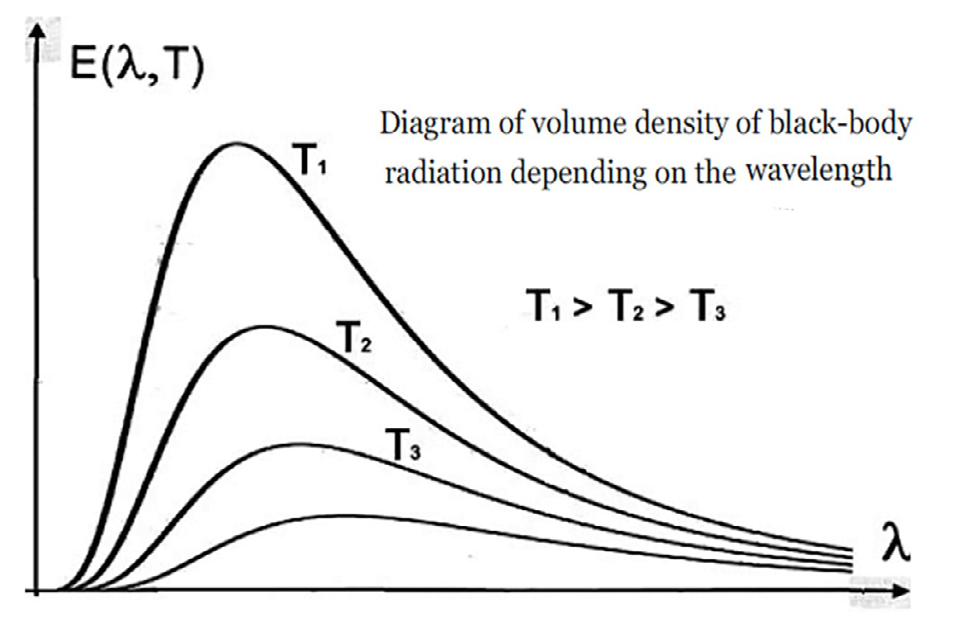
The first following Figures 1 & 2 shows the diagram of Planck’s law of black body radiation—equation (7)—and the second figure diagram Maxwell‑Boltzmann distribution of velocity of micro‑particles with mass—equation (8):
2
8 hc 1 E( ,T)
$$ E (\lambda , \mathrm {T}) = \frac {8 \pi \mathrm {h c}}{\lambda^ {5}} $$
(7)
5 hc KT
1 eλ −
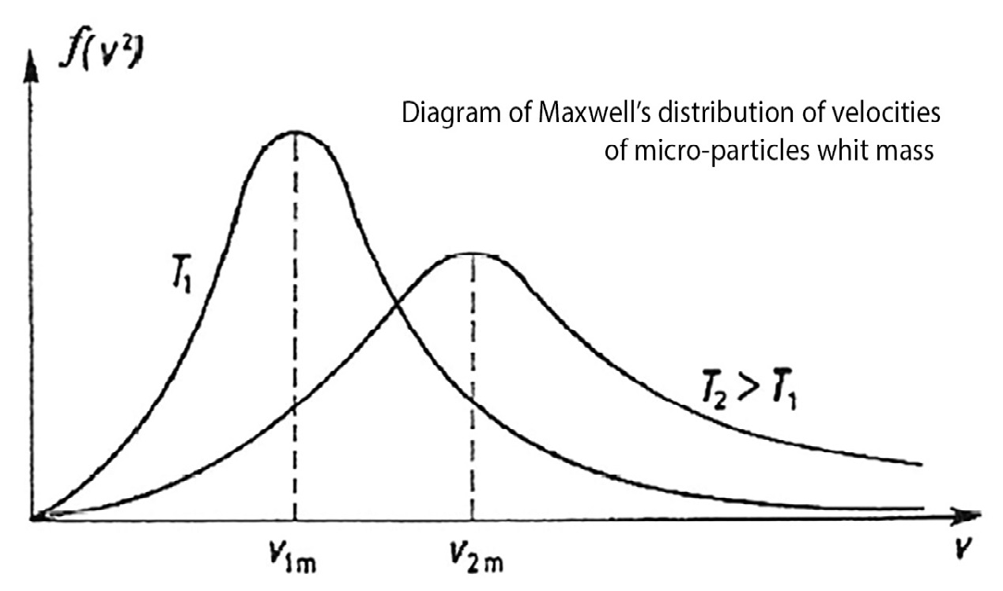
$$ f \left(v ^ {2}\right) = \frac {\mathrm {d N}}{\mathrm {N}} \frac {1}{\mathrm {d E} _ {\mathrm {k}}} = \frac {2 \sqrt {\mathrm {E} _ {\mathrm {k}}}}{\left(\pi \mathrm {K T}\right) ^ {\frac {3}{2}}} \mathrm {e} ^ {- \frac {\mathrm {E} _ {\mathrm {k}}}{\mathrm {K T}}} $$ (8) Similar diagrams, both bell-shaped. Both with the exponent of the natural number e, where all velocities and all accelerations are equally possible, mathematically: all derivatives of the ex-function are the same wherever the coordinate origin was— in accordance with the fact that the force of entropy arises in a singularity as the coordinate origin and then with the range to infinity. Both Maxwell in 1860 and Bose in 1924 started their derivation of formulas from the same assumptions, from a homogeneous and isotropic vacuum space, spherically symmetric, Maxwell
from the coordinates themselves:
x2+y2+z2=r2, and Bose from photon impulses px
$$ p _ {x} ^ {2} + p _ {y} ^ {2} + p _ {z} ^ {2} = c ^ {2} $$
(arbitrary r, and constant c).
Well, can one reduce the volume of particles without mass by going through the singularity (0, ∞) and ultimately obtain Maxwell‑Boltzmann thermal velocity distribution now of particles with mass? The velocity distribution of probability that would show the property of the same relativity and the same symmetry: whatever which mass, particle with mass chosen for the coordinate origin, the bell-shaped diagram remains the same. Is it possible, mathematically? It should be possible. However, how? How, when the only way for a person to get rid of his homocentrism is to omit from the account not only the Earth (so as not to be geocentrism) and the Sun (heliocentrism) as well as real fixed stars in general (fixed Ether), but also his own mass. Otherwise—even if a person was single in the universe, at least the mass of its eye would be what the cmax is determined by.
The coordinate system, therefore, must be equally bound to a particle without mass—that is the solution: bound also to a quantum without mass, to photons. Only with that, after all, the theory of relativity did complete its basic postulate that all coordinate systems are equal; so when that or this, which is more suitable for an application, but always with the thought that everyone is possible. And photons by themselves have no measure, no time neither coordinates, that’s appropriate here. Therefore, in Figure 1, it is not Planck’s law with spatial coordinates, but with wavelengths. Photons themselves, with their increasing relativity, reduce the “volume”. Relativity itself in its own collision transforms itself into a new quality. Otherwise it would not be eternal. And relativity, it is temperature, a multitude of arbitrary quanta of possible energy, a virtual energy that does not have its absolute zero which is also relative—and in fact it is everywhere. How then to reduce the “volume” in the diagram when there is no volume at all? By raising the temperature.
The numerical values of the h, c and k constants are such that, for example, at room temperature hc/λkT >> 1, even with the largest wavelength of visible light. Hence, instead of the ex–1 function, it is appropriate to simply write ex. Due to Wien’s law of displacement λmaxT=b, i.e. due to hc/kb=4.98, this approximation is appropriate for any temperature in general, so the E(λ,T) diagram is proportional to e–x. As the temperature rises, however, how fast will the wavelength decrease, is it faster than the temperature rises? According to the same law, the ratio of frequency and temperature is equal to the ratio of the enormous light speed c and the Wien’s tiny b‑constant: the frequency will increase incomparably faster and the wavelength will decrease than the temperature will rise—all the way to micro‑domain and uncertainty when mass formation begins anyway. Increasing temperatures will, therefore, undoubtedly lead the entire diagram to a single line: the 0‑singularity; in the singularity of the entropy explosion with a range to infinity. And then… Pair Creation in QED-Strong Pulsed Laser Fields Interacting with Electron Beam [16].
“QED effects are known to occur in a strong laser pulse interaction with a counter propagating electron beam, among these effects being electron positron pair creation. We discuss the range of laser pulse intensities of J>5×10²²W/ cm2 combined with electron beam energies of tens of Gee. In this regime, multiple pairs may be generated from a single beam electron, some of the newborn particles being capable of further pair production. Radiation back reaction prevents avalanche development and limits pair creation. The system of integro-differential kinetic equations for electrons, positrons and γ photons is derived and solved numerically.” Radiation back reaction limits the avalanche of pair creation, here’s how through the singularity of the black hole! A black hole does not have this loss of energy. On the contrary, it sucks up enormous energy by the accretion disk, not only particles but also entire meteors and all celestial bodies that cross its event horizon. That energy has to explode. We cannot see how and what is in a black hole. But we see avalanche of newly created particles, the jets of matter from a black hole of active galaxies. One jet is obviously from the matter of that galaxy itself, and the other would have to be from antimatter–according to the LOGIC of Nature as I understand it.
To prove this, I proposed in the article [5] a method of schematic representation of the zero-relative symmetry of the vacuum: the same particles, the same nuclei, but they differ in whether they passed through the black hole singularity, or not. I called that difference the phase difference, maybe it’s better the thermal difference: after falling into the black hole, not until when, but at what temperature a nucleus can still be maintained (while the temperature towards the center of the black hole increases), or to form again (while it from the center decreases). One should find, for example, mutually corresponding strands in jets of ejected matter, the jet and the counter-jet, which would have the same percentage of which nucleus. Then, from the schematic representation of the zero-relative symmetry of the vacuum, determine the expected temperature difference, due to which the gas of the same chemical composition would be ionized differently. With a lower temperature, there would be a counter-jet of antimatter, how much lower depends on which part of the matter did not pass through the singularity, but was joined to the matter that passed through the singularity and was carried by it. But the goal is not an accurate calculation, but proof that the counter-jet is antimatter. The black hole of active galaxies is the embodiment of the experiment mentioned here: in it, γ-rays must also collide with electrons.
On the other side of the singularity is the Maxwell‑Bolzmann velocity distribution of particles with mass. When entropy has already exploded, then the probability of a particle with mass at the point of the explosion, at the coordinate origin, of course, tends zero. At the micro‑level, it is a chance, in fact, only vacuum remains, so virtuality. But when the world of mass has already been created, at the macro-level it is causality: a certain cause, a certain consequence, always to infinity, that is–if there were no relativity: somewhere in infinity again explosions of singularities. Maybe in a black hole, maybe with different constants h, cmax and k? Some different Cosmos, as the ancient Greeks used to put it. Some different World, the one from Giordano Bruno’s treatise On the infinite universe and worlds. The Church’s Inquisition burned Giordano in the 1600—at a time when the doctrines of Thomas Aquinas were already spreading in Europe, the doctrine that God from the Holy Scriptures should be understood metaphorically. Century after century, that teaching has finally become the official doctrine of the Church. In 1951, the Pope made the Big Bang official as a work of God. Thus, the Church recognized Kant’s doctrine on the first mover and Hegel’s dialectical development, which is evolution. There was no atomic bomb in the time of Thomas, Giordano, Kant and Hegel. With the atomic bomb, however, it is necessary to know: neither burning nor shooting in the name of revolution can stop or skip evolution. Quantity, quantity, and only so a new quality. It is not the last contradiction of civilization that between profit and labor, in the name of God or without God. The contradiction is in human being itself, as a subject and as an object. As a subject, human being is faced with its relativity, and yet it would like eternity like infinite inertia or God–even though he/she is already an object to human being next to him/her. By recognizing homocentism, scientists would help to overcome egoism in the name of humanity and nature— no matter who confesses to which God, who protects himself by which God.
Conclusion
Einstein, keeping the definition of the inertial system from classical mechanics, defined his c=const with the postulate that all inertial coordinate systems are equal in describing electromagnetic phenomena too. In 1913, De Sitter proved this constancy by astronomical observation of Jupiter’s satellites, and thus the duality was born. In classical mechanics, the coordinate system related to fixed stars is absolute, and in electromagnetism, all systems related to their own mass are relative. To remove this duality, Einstein adopted in the general theory of relativity the postulate that all curvilinear coordinate systems of space-time are equal in describing both gravity and electromagnetism—with the fact that this curvilinear metric is caused by gravitational masses, the larger the more, and the micro-masses, having no gravitational influence, move by inertia along the geodesic lines of that unique mathematical four-space. According to the “Big Bang” hypothesis, the largest mass, infinite and of infinite density, is the one that exploded, and before it there was nothing, not even metrics, now tacitly assuming that it is the absolute coordinate system that is tied to the background microwave noise. Tacitly—in the same way as Einstein, deriving his famous E=mc2, assumed that in the third coordinate system, the kinetic energy is absolute, the one considered in the first two systems (one of which moves at speed v relative to the other).
Finally, it should be clearly stated that all these tacit coordinate systems can only be quasi-absolute, technically ones, if they give verifiable results by experiment or astronomical observation with regard to the masses that already exist. For example, the coordinate system related to the Sun is sufficient to prove the constancy of the light speed by observing Jupiter’s satellites. Quantum physics itself is impossible without a technical coordinate system, quantization is impossible if a fixed coordinate system is not adopted, now this, now that depending on an experiment.
And as for cosmology, it depends on what is expected of it. If it has to describe the evolution of our cosmos from some assumed moment to the moment as we see it today up to the limits of microwave background noise, well, there are really ingenious attempts to reduce everything to an absolute coordinate system related to that background microwave noise (although after ten thousand years it changed too, not only the position of the fixed stars). If we need to guess the answer to How come the World exists, that’s where things seem—paradoxically—easier. Here is sufficient internal Logic of Nature itself: inertia, symmetry, and relativity. Well, whatever anyone sensed or called that internal logic. Because the absolute coordinate system does not exist. Everything is emerging and disappearing. Existence itself is the arising and the passing away.
Acknowledgement
Publishing my Entropy passage through the Black Hole Singularity in Active Galaxies, I did not know that astronomers do not have the opportunity yet to analyze the jets ejected by black holes of active galaxies with sufficient precision and that they are probably not yet able to use my method of the schematic representation of zero-relative symmetry of vacuum. That’s why I join their appeal for the provision of the necessary facilities [17]. So many efforts of so many scientists deserve to be respectfully and with gratitude given the opportunity to, I hope, prove that there was not and is not just one “big bang”. This would deprive all humanity of at least one temptation – to fight in the era of A- and H-bombs over whose God created the only beginning of the World.
References
-
Nešić MD (2021) Relativistic Ether and Heisenberg’s uncertainty principle. Relativity and Cosmology, pp: 1-5.
-
Nešić MD (2016) WAS GIORDANO BRUNO BURNED IN VAIN? Belgrade. Relativity and Cosmology.
-
Nešić MD (2014) The Big Bang and its Internal Logic: The Universe as Relative Zero. Belgrade, Relativity and Cosmology, pp: 1-19.
-
Nešić MD (2020) Gravity and c2-inertia. Relativity and Cosmology, Belgrade, Serbia, pp: 1-8.
-
Nešić MD (2023) Entropy passage through the black hole singularity in active galaxies. J Mod Appl Phy 6(3): 1-4.
-
Einstein A (1906) The principle of conservation of the center of mass movement and the inertia of energy. Annals of Physics 325(8): 627-633.
-
Bernhardt G (2017) Zum Zwillingsparadoxon in derSpeziellen Relativitätstheorie. Materialien für Unterricht und Studium, pp: 1-12.
-
Nešić MD (2019) There is No Coordinate System without Mass. Relativity and Cosmology, pp: 1-11.
-
Shimizu K (2016) Gravitational Energy of a Schwarzschild Black Hole_._ General Physics.
-
Einstein A (1905) The inertia of a body depends on its energy content. Annals of Physics 323(13): 639-641.
-
Poplawski N (2012) Affine Theory of Gravitation. General Relativity and Quantum Cosmology.
-
Verlinde EP (2010) On the Origin of Gravity and the Laws of Newton. High Energy Physics – Theory, pp: 29.
-
Marković S (1929) Einstein Theory of Relativity. Belgrade, Serbia.
-
Popović J (2003) Dogmatics of the Orthodox Church. Anti‑trinitarian heresies, Belgrade, Serbia.
-
Feynman RP (1949) Space‑time approach to quantum electrodynamics. Physical Review 76(6): 769.
-
Sokolov IV, Naumova NM, Nees JA, Mourou GA (2010) Pair Creation in QED-Strong Pulsed Laser Fields Interacting with Electron Beams. Plasma Physics, pp: 25.
-
Petric A, Lacy M, Juneau S, Shen Y, Fan X, et al. (2019) High Redshift Obscured Quasars and the Need for Optical to NIR, Massively Multiplexed, Spectroscopic Facilities. Astrophysics of Galaxies.
- Sense, Gravity, Parity & Chirality in Mathematical Physics
- Quantum Lattice Simulations PHYSICS: Microcircuit Particle Formation and Observable Macroscopic Irreversible Time - A Discrete Lagrangian with Cellular Automata Framework
- Quantum Biology from Biomacromolecule to Cell, and Central Dogma Described by Quantum Theory
- Focus, Agility, Speed and Technology (FAST) for Sustainability and Growth
- Square Root Metric Geometry and Pati-Salam Model in Curved Space-Time
- A Simple System Demonstrating the Mpemba Effect in Classical Mechanics