
On the Meaning of Yoga in Srimad Bhagavad Gita
‘Yoga’ is popular in contemporary world and is colloquially interpreted as a method of practicing different postures for maintaining core strength, good physical health with flexibility of one’s body. It is a Sanskrit non-translatable and this monograph is an attempt to describe about Yoga and its meaning as per the supreme lord Srikrishna’s teachings in the Srimad Bhagavad Gita (SBG). SBG is sometimes referred to as a ‘Yoga Shastra’ and is a part of the world’s longest epic ‘The Mahabharata’ that is considered to be the Fifth Veda. It is a collection of 700 verses organized in 18 chapters and is considered to be a pinnacle of Indian philosophy (i.e. Sanatana Dharma) that succinctly summarizes the teachings of all Upanishads and Vedas through its Verses (i.e. ‘Shlokas’). SBG is a part of ‘Bhishma Parva’ of the the Mahabharata and the teaching was imparted by none other than ‘Yogeshwara’ (i.e. the Lord of Yoga) Srikrishna to his favourite disciple and warrior Arjuna on the battlefield wherein it is transformed into a classroom to impart the highest philosophical truth whilst being his charioteer. In fact each chapter title ends with the word Yoga (for example, the first chapter is called as Arjuna Vishada Yoga). As we plough through this profound philosophy, we understand that Yoga in SBG is a step-wise teaching algorithm that elevates one’s lower self to become one with higher ‘Self’ through: i)Actions (Karma); ii)Intellect (Buddhi); iii)Devotion (Bhakti) and iv)Knowledge (Jnana). This is accomplished by synchronicity and yoking involving the above four along with meditation(Dhyana) bringing one’s energy forms together to elevate consciousness to a higher plane and merge with the supreme godhead (i.e.i) to attain Self-realization and become a ‘Yogi’
Introduction
The word ‘Yoga’ is derived from Sanskrit root ‘Yuj’ which means “to yoke” or union (i.e. to join). Sanskrit dictionaries like Amarakosha and Medinikosha considers Yoga as a form of meditation, harmony or the techniques to keep the body- mind-senses (BMS) complex fit and steady [1, 2]. The ancient Indian scriptures impart a wide spectrum of meaning to the word Yoga. During the Vedic period, Yoga was known to be ‘Moksha Dharma Shastra’ (i.e. the science of achieving liberation / emancipation) [3]. It was meant to convey something that had experienced the union of individual consciousness with the Universal consciousness. An individual who had attained such a state of Self-realization and self-mastery was called as a ‘Yogi’. The origins of Yoga can be traced to the oldest amongst the four Vedas (i.e. the Rigveda) and the first ever known Yogi was Adiyogi or Lord Shiva, who is one of the three key deities in the ‘Trinity of Hinduism’ (i.e. Sanatana Dharma along with Brahma and Vishnu) [4]. It is said that Lord Shiva poured the profound knowledge and practice of Yoga to the ‘Saptarishis’ (i.e. the seven great sages) and Yoga was considered to be a form of ‘Spiritual Yoking’ [4]. In Katha Upanishad, Yoga meant spiritual efforts to keep one’s senses and mind steady with detachment at all times to realize the inner reality (i.e. the Self) [5]. In ‘Yagnavalakya Samhita’, Yoga was known as the union of individual self with the supreme ‘Self’ (i.e. Atman / Brahman) [6]. The ‘Linga purana’ endorses Yoga to be a method to instill stillness / quietude and stop changes happening in one’s mind [7]. Maharshi Patanjali’s yoga sutras are the oldest and well known treatise on Yoga wherein it is defined as ‘Yogaschi chitta vritti nirodhah’ (i.e. a method to stop the thought waves) [8].
Srimad Bhagavad Gita (SBG) is considered to be a ‘Life manual’ without a shelf life that has solutions to every misery known to mankind and there are several verses that provide fascinating insight into the intricate meanings of Yoga. The author sage Vyasa through his scribe Lord Ganesh have recorded Srikrishna’s motivational hard talk when the accomplished war hero Arjuna is in a conundrum with a confused mind whether to fight the battle and slay his relatives / next of kin fearing loss of lives and bloodshed. This monograph is an attempt to summarize all the meanings of the word Yoga in the order of its appearance in SBG.
Methods
Two investigators painstakingly ploughed through the entire 700 verses of the 18 chapters of SBG specifically looking for the word ‘Yoga’ and its cognate (i.e. yogi / yogam / yoginam / yogena etc…) to identify all Padas (i.e. phrases of 8 or 11 syllables that are a part of Sanskrit poetic metre) and create a table of selected phrases / shlokas. We used the popular Vulgate recension of SBG as published in the critical edition of the Mahabharata (Sukthankar VS et al) by the Bhandarkar Oriental Research Institute (BORI) as our reference source for this task [9]. We also independently reviewed the SBG Sanskrit Padanukramanika from the Holy Geeta: Ready reference guide of Chinmaya international foundation (CIF) and SBG published in English language by ISKCON (International society for Krishna consicousnes) to ensure in-depth assessment of all verses and none were missed / omitted [10, 11].
We identified 87 verses from 16 chapters on our initial search. Three verses (viz: 5-14; 6-43 and 18-38) were excluded as they had the word ‘Sanyoga / Samyoga’ that couldn’t be considered to be a variety of yoga but meant ‘contact’ in it’s strict sense. The chapter-wise breakdown of remaining 84 verses along with the name of each chapter (which is again a ends with word Yoga) and the percentage of verses having this word is represented in Table 1. There were four verses that had the word ‘Yogeshwara’ eulogizing the supreme godhead and preacher Srikrishna (viz: 11-4; 11-9; 18-75 and 18-78). We chose to include only one verse (i.e. 18-75) and omitted the remaining three. A final list of 81 verses and their phrases that formed the basis for this monograph is listed in Table 2.
| Chapter | Name | Verses with Yoga | Total number of verses | Percentage |
|---|---|---|---|---|
| 1 | Arjuna Vishada Yoga | -- | 47 | Zero |
| 2 | Sankhya Yoga | 6 | 72 | 8.30% |
| 3 | Karma Yoga | 2 | 43 | 4.60% |
| 4 | Jnana-Karma-Sanyasa Yoga | 7 | 42 | 16.70% |
| 5 | Karma-Sanyasa Yoga | 8 | 29 | 27.60% |
| 6 | Dhyana (Atmasanyasa) Yoga | 26 | 47 | 55.30% |
| 7 | Jnana-Vijnana Yoga | 2 | 30 | 6.70% |
| 8 | Akshara Brahma Yoga | 7 | 28 | 25% |
| 9 | Raja Vidya Yoga | 3 | 34 | 8.80% |
| 10 | Vibuthi Yoga | 4 | 42 | 9.50% |
| 11 | Vishwaroopa Darshana Yoga | 4 | 55 | 7.30% |
| 12 | Bhakti Yoga | 5 | 20 | 25% |
| 13 | Kshetra-Kshetrajna Vibhaga Yoga | 2 | 34 | 5.90% |
| 14 | Gunatraya Vibhaga Yoga | 1 | 27 | 3.70% |
| 15 | Purushottami Yoga | 1 | 20 | 5% |
| 16 | Daivasurasampad Vibhaga Yoga | 1 | 24 | 4.20% |
| 17 | Sraddhatraya Vibhaga Yoga | -- | 28 | Zero |
| 18 | Moksha-Sanyasa Yoga | 5 | 78 | 6.40% |
| Grand Total | 84 | 700 | 12% | |
| No | Citation | Phrase | Sanskrit verse in English | |
| 1 | 2-39 | बुद्धिर्योग ेत्विमां शृणु | eṣhā te ’bhihitā sānkhye buddhir yoge tvimāṁ śhṛiṇu buddhyā yukto yayā pārtha karma-bandhaṁ prahāsyasi | |
| 2 | 2-45 | निर्योगक्षेम आत्मवान् | trai-guṇya-viṣhayā vedā nistrai-guṇyo bhavārjuna nirdvandvo nitya-sattva-stho niryoga-kṣhema ātmavān | |
| 3 | 2-48 | योगस्थ: कुरु कर्माणि समत्वं योग उच्यत | yoga-sthaḥ kuru karmāṇi saṅgaṁ tyaktvā dhanañjaya siddhy-asiddhyoḥ samo bhūtvā samatvaṁ yoga uchyate | |
| 4 | 2-49 | बुद्धियोगाद्धनञ्जय | dūreṇa hy-avaraṁ karma buddhi-yogād dhanañjaya buddhau śharaṇam anvichchha kṛipaṇāḥ phala-hetavaḥ | |
| 5 | 2-50 | तस्माद्योगाय युज्यस्व योग: कर्मसु कौशलम | buddhi-yukto jahātīha ubhe sukṛita-duṣhkṛite tasmād yogāya yujyasva yogaḥ karmasu kauśhalam | |
| 6 | 2-53 | तदा योगमवाप्स्यसि | śhruti-vipratipannā te yadā sthāsyati niśhchalā samādhāv-achalā buddhis tadā yogam avāpsyasi | |
| 7 | 3-3 | ज्ञानयोगेन साङ्ख्यानां कर्मयोगेन योगिनाम | śhrī bhagavān uvācha loke ’smin dvi-vidhā niṣhṭhā purā proktā mayānagha jñāna-yogena sāṅkhyānāṁ karma-yogena yoginām | |
| 8 | 3-7 | कर्मेन्द्रियै: कर्मयोगम | yas tvindriyāṇi manasā niyamyārabhate ’rjuna karmendriyaiḥ karma-yogam asaktaḥ sa viśhiṣhyate | |
| 9 | 4-2 | योगो नष्ट: परन्तप | evaṁ paramparā-prāptam imaṁ rājarṣhayo viduḥ sa kāleneha mahatā yogo naṣhṭaḥ parantapa | |
| 10 | 4-3 | योग: प्रोक्त: पुरातन: | sa evāyaṁ mayā te ’dya yogaḥ proktaḥ purātanaḥ bhakto ’si me sakhā cheti rahasyaṁ hyetad uttamam | |
| 11 | 4-25 | दैवमेवापर ेयज्ञ ंयोगिन: | daivam evāpare yajñaṁ yoginaḥ paryupāsate brahmāgnāvapare yajñaṁ yajñenaivopajuhvati | |
| 12 | 4-27 | आत्मसंयमयोगाग्नौ | sarvāṇīndriya-karmāṇi prāṇa-karmāṇi chāpare ātma-sanyama-yogāgnau juhvati jñāna-dīpite | |
| 13 | 4-28 | योगयज्ञास्तथापरे | dravya-yajñās tapo-yajñā yoga-yajñās tathāpare swādhyāya-jñāna-yajñāśh cha yatayaḥ sanśhita-vratāḥ | |
| 14 | 4-41 | योगसंन्यस्तकर्माणं | yoga-sannyasta-karmāṇaṁ jñāna-sañchhinna-sanśhayam ātmavantaṁ na karmāṇi nibadhnanti dhanañjaya | |
| 15 | 4-42 | छित्त्वैनं संशयं योगमा | tasmād ajñāna-sambhūtaṁ hṛit-sthaṁ jñānāsinātmanaḥ chhittvainaṁ sanśhayaṁ yogam ātiṣhṭhottiṣhṭha bhārata | |
| 16 | 5-2 | संन्यास: कर्मयोगश्च | śhrī bhagavān uvācha sannyāsaḥ karma-yogaśh cha niḥśhreyasa-karāvubhau tayos tu karma-sannyāsāt karma-yogo viśhiṣhyate | |
| 17 | 5-4 | साङ्ख्ययोगौ पृथग्बाला: | sānkhya-yogau pṛithag bālāḥ pravadanti na paṇḍitāḥ ekamapyāsthitaḥ samyag ubhayor vindate phalam | |
| 18 | 5-5 | एकं साङ्ख्य ंच योगं च | yat sānkhyaiḥ prāpyate sthānaṁ tad yogair api gamyate ekaṁ sānkhyaṁ cha yogaṁ cha yaḥ paśhyati sa paśhyati | |
| 19 | 5-6 | दु:खमाप्तुमयोगत: योगयुक्तो मुनिर्ब्रह्म | sannyāsas tu mahā-bāho duḥkham āptum ayogataḥ yoga-yukto munir brahma na chireṇādhigachchhati | |
| 20 | 5-7 | योगयुक्तो विशुद्धात्मा | yoga-yukto viśhuddhātmā vijitātmā jitendriyaḥ sarva-bhūtātma-bhūtātmā kurvann api na lipyate | |
| 21 | 5-11 | योगिन: कर्म कुर्वन्ति | kāyena manasā buddhyā kevalair indriyair api yoginaḥ karma kurvanti saṅgaṁ tyaktvātma-śhuddhaye | |
| 22 | 5-21 | स ब्रह्मयोगयुक्तात्मा | bāhya-sparśheṣhvasaktātmā vindatyātmani yat sukham sa brahma-yoga- yuktātmā sukham akṣhayam aśhnute | |
| 23 | 5-24 | स योगी ब्रह्मनिर्वाणं | yo ‘ntaḥ-sukho ‘ntar-ārāmas tathāntar-jyotir eva yaḥ sa yogī brahma-nirvāṇaṁ brahma-bhūto ‘dhigachchhati |
Table 1: Chapter-wise breakdown of number of verses with word ‘Yoga’ and its cognate in SBG (n=84).
24 6-1 स संन्यासी च योगी च śhrī bhagavān uvācha anāśhritaḥ karma-phalaṁ kāryaṁ karma karoti yaḥ sa sannyāsī cha yogī cha na niragnir na chākriyaḥ
25 6-2 योगी भवति कश्चन yaṁ sannyāsam iti prāhur yogaṁ taṁ viddhi pāṇḍava na hyasannyasta- saṅkalpo yogī bhavati kaśhchana
26 6-3 योगारूढस्य तस्यैव ārurukṣhor muner yogaṁ karma kāraṇam uchyate yogārūḍhasya tasyaiva śhamaḥ kāraṇam uchyate
27 6-4 योगारूढस्तदोच्यते yadā hi nendriyārtheṣhu na karmasv-anuṣhajjate sarva-saṅkalpa-sannyāsī yogārūḍhas tadochyate
28 6-8 युक्त इत्युच्यते योगी jñāna-vijñāna-tṛiptātmā kūṭa-stho vijitendriyaḥ yukta ityuchyate yogī sama- loṣhṭāśhma-kāñchanaḥ
29 6-10 योगी युञ्जीत सततम yogī yuñjīta satatam ātmānaṁ rahasi sthitaḥ ekākī yata-chittātmā nirāśhīr aparigrahaḥ
30 6-12 युञ्ज्याद्योगमात्मविशुद्धये tatraikāgraṁ manaḥ kṛitvā yata-chittendriya-kriyaḥ upaviśhyāsane yuñjyād yogam ātma-viśhuddhaye
31 6-15 योगी नियतमानस: yuñjann evaṁ sadātmānaṁ yogī niyata-mānasaḥ śhantiṁ nirvāṇa-paramāṁ mat-sansthām adhigachchhati
32 6-17 योगो भवति दु:खहा yuktāhāra-vihārasya yukta-cheṣhṭasya karmasu yukta-svapnāvabodhasya yogo bhavati duḥkha-hā
33 6-19 योगिनो यतचित्तस्य युञ्जतो योगमात्मन: yathā dīpo nivāta-stho neṅgate sopamā smṛitā yogino yata-chittasya yuñjato yogam ātmanaḥ
34 6-20 निरुद्धं योगसेवया yatroparamate chittaṁ niruddhaṁ yoga-sevayā yatra chaivātmanātmānaṁ paśhyann ātmani tuṣhyati
35 6-23 तं विद्याद् दु:खसंयोग योगोऽनिर्विण्णचेतसा taṁ vidyād duḥkha-sanyoga-viyogaṁ yogasaṅjñitam sa niśhchayena yoktavyo yogo ’nirviṇṇa-chetasā
36 6-27 योगिनं सुखमुत्तमम् praśhānta-manasaṁ hyenaṁ yoginaṁ sukham uttamam upaiti śhānta-rajasaṁ brahma-bhūtam akalmaṣham
37 6-28 योगी विगतकल्मष: yuñjann evaṁ sadātmānaṁ yogī vigata-kalmaṣhaḥsukhena brahma- sansparśham atyantaṁ sukham aśhnute
38 6-29 ईक्षते योगयुक्तात्मा sarva-bhūta-stham ātmānaṁ sarva-bhūtāni chātmani īkṣhate yoga-yuktātmā sarvatra sama-darśhanaḥ
39 6-31 स योगी मयि वर्तते sarva-bhūta-sthitaṁ yo māṁ bhajatyekatvam āsthitaḥ sarvathā vartamāno ’pi sa yogī mayi vartate
40 6-32 स योगी परमो मत: ātmaupamyena sarvatra samaṁ paśhyati yo ’rjuna sukhaṁ vā yadi vā duḥkhaṁ sa yogī paramo mataḥ
41 6-33 योऽयं योगस्त्वया प्रोक्त: arjuna uvācha yo ’yaṁ yogas tvayā proktaḥ sāmyena madhusūdana etasyāhaṁ na paśhyāmi chañchalatvāt sthitiṁ sthirām
42 6-36 असंयतात्मना योगो asaṅyatātmanā yogo duṣhprāpa iti me matiḥ vaśhyātmanā tu yatatā śhakyo ’vāptum upāyataḥ
43 6-37 योगाच्चलितमानस: arjuna uvācha ayatiḥ śhraddhayopeto yogāch chalita-mānasaḥ aprāpya yoga- sansiddhiṁ kāṅ gatiṁ kṛiṣhṇa gachchhati
44 6-41 योगभ्रष्टोऽभिजायते prāpya puṇya-kṛitāṁ lokān uṣhitvā śhāśhvatīḥ samāḥ śhuchīnāṁ śhrīmatāṁ gehe yoga-bhraṣhṭo ’bhijāyate
45 6-42 अथवा योगिनामेव atha vā yoginām eva kule bhavati dhīmatām etad dhi durlabhataraṁ loke janma yad īdṛiśham
46 6-44 जिज्ञासुरपि योगस्य pūrvābhyāsena tenaiva hriyate hyavaśho ’pi saḥ jijñāsur api yogasya śhabda- brahmātivartate
47 6-45 योगी संशुद्धकिल्बिष: prayatnād yatamānas tu yogī sanśhuddha-kilbiṣhaḥ aneka-janma-sansiddhas tato yāti parāṁ gatim
48 6-46 तपस्विभ्योऽधिकोयोगी तस्माद्योगीभवार्जुन tapasvibhyo ’dhiko yogī jñānibhyo ’pi mato ’dhikaḥ karmibhyaśh chādhiko yogī tasmād yogī bhavārjuna
49 6-47 योगिनामपि सर्वेषां yoginām api sarveṣhāṁ mad-gatenāntar-ātmanā śhraddhāvān bhajate yo māṁ sa me yuktatamo mataḥ
50 7-1 योगं युञ्जन्मदाश्रय: śhrī bhagavān uvācha mayyāsakta-manāḥ pārtha yogaṁ yuñjan mad-āśhrayaḥ asanśhayaṁ samagraṁ māṁ yathā jñāsyasi tach chhṛiṇu
51 7-25 योगमायासमावृत: nāhaṁ prakāśhaḥ sarvasya yoga-māyā-samāvṛitaḥ mūḍho ’yaṁ nābhijānāti loko mām ajam avyayam
52 8-8 अभ्यासयोगयुक्तेन abhyāsa-yoga-yuktena chetasā nānya-gāminā paramaṁ puruṣhaṁ divyaṁ yāti pārthānuchintayan
53 8-10 भक्त्या युक्तो योगबलेन चैव prayāṇa-kāle manasāchalena bhaktyā yukto yoga-balena chaiva bhruvor madhye prāṇam āveśhya samyak sa taṁ paraṁ puruṣham upaiti divyam
54 8-12 आस्थितो योगधारणाम् sarva-dvārāṇi sanyamya mano hṛidi nirudhya cha mūrdhnyādhāyātmanaḥ prāṇam āsthito yoga-dhāraṇām
55 8-14 नित्ययुक्तस्य योगिन: ananya-chetāḥ satataṁ yo māṁ smarati nityaśhaḥ tasyāhaṁ sulabhaḥ pārtha nitya-yuktasya yoginaḥ
56 8-25 र्योगी प्राप्य निवर्तते dhūmo rātris tathā kṛiṣhṇaḥ ṣhaṇ-māsā dakṣhiṇāyanam tatra chāndramasaṁ jyotir yogī prāpya nivartate
57 8-27 योगयुक्तो भवार्जुन naite sṛitī pārtha jānan yogī muhyati kaśhchana tasmāt sarveṣhu kāleṣhu yoga- yukto bhavārjuna
58 8-28 योगी परं स्थानमुपैति चाद्यम् vedeṣhu yajñeṣhu tapaḥsu chaiva dāneṣhu yat puṇya-phalaṁ pradiṣhṭam atyeti tat sarvam idaṁ viditvā yogī paraṁ sthānam upaiti chādyam
59 9-5 पश्य मे योगमैश्वरम् na cha mat-sthāni bhūtāni paśhya me yogam aiśhwaram bhūta-bhṛin na cha bhūta-stho mamātmā bhūta-bhāvanaḥ
60 9-22 योगक्षेमं वहाम्यहम् ananyāśh chintayanto māṁ ye janāḥ paryupāsate teṣhāṁ nityābhiyuktānāṁ yoga-kṣhemaṁ vahāmyaham
61 9-28 संन्यासयोगयुक्तात्मा śhubhāśhubha-phalair evaṁ mokṣhyase karma-bandhanaiḥ sannyāsa-yoga- yuktātmā vimukto mām upaiṣhyasi
62 10-7 एतां विभूतिं योगं च etāṁ vibhūtiṁ yogaṁ cha mama yo vetti tattvataḥ so ’vikampena yogena yujyate nātra sanśhayaḥ
63 10-10 ददामि बुद्धियोगं तं teṣhāṁ satata-yuktānāṁ bhajatāṁ prīti-pūrvakam dadāmi buddhi-yogaṁ taṁ yena mām upayānti te
64 10-17 कथं विद्यामहं योगिं kathaṁ vidyām ahaṁ yogins tvāṁ sadā parichintayan keṣhu keṣhu cha bhāveṣhu chintyo ’si bhagavan mayā
65 10-18 विस्तरेणात्मनो योगं vistareṇātmano yogaṁ vibhūtiṁ cha janārdana bhūyaḥ kathaya tṛiptir hi śhṛiṇvato nāsti me ’mṛitam
66 11-8 पश्य मे योगमैश्वरम् na tu māṁ śhakyase draṣhṭum anenaiva sva-chakṣhuṣhā divyaṁ dadāmi te chakṣhuḥ paśhya me yogam aiśhwaram
67 12-47 रूपं परं दर्शितमात्मयोगात् | śhrī-bhagavān uvācha mayā prasannena tavārjunedaṁ rūpaṁ paraṁ darśhitam ātma-yogāt tejo-mayaṁ viśhvam anantam ādyaṁ yan me tvad anyena na dṛiṣhṭa-pūrvam
68 12-1 तेषां के योगवित्तमा: arjuna uvācha evaṁ satata-yuktā ye bhaktās tvāṁ paryupāsate ye chāpy akṣharam avyaktaṁ teṣhāṁ ke yoga-vittamāḥ
69 12-6 अनन्येनैव योगेन ye tu sarvāṇi karmāṇi mayi sannyasya mat-paraḥ ananyenaiva yogena māṁ dhyāyanta upāsate
- 70
- 12-9
- अभ्यासयोगेन ततो atha chittaṁ samādhātuṁ na śhaknoṣhi mayi sthiram abhyāsa-yogena tato mām ichchhāptuṁ dhanañjaya
- 71
- 12-11
- कर्तुं मद्योगमाश्रित: athaitad apy aśhakto ’si kartuṁ mad-yogam āśhritaḥ sarva-karma-phalatyāgaṁ tataḥ kuru yatātmavān
- 72
- 12-14
- सन्तुष्ट: सततं योगी santuṣhṭaḥ satataṁ yogī yatātmā dṛiḍha-niśhchayaḥ mayy arpita-manobuddhir yo mad-bhaktaḥ sa me priyaḥ
- 73
- 13-10
- मयि चानन्ययोगेन nityaṁ cha sama-chittatvam iṣhṭāniṣhṭopapattiṣhu mayi chānanya-yogena bhaktir avyabhichāriṇī
- 74
- 13-25
- अन्ये साङ् ख्येन योगेन
- कर्मयोगेन चापरे | dhyānenātmani paśhyanti kechid ātmānam ātmanā anye sānkhyena yogena karma-yogena chāpare
- 75
- 14-26
- भक्तियोगेन सेवते māṁ cha yo ’vyabhichāreṇa bhakti-yogena sevate sa guṇān samatītyaitān brahma-bhūyāya kalpate
- 76
- 15-11
- यतन्तो योगिनश्चैनं yatanto yoginaśh chainaṁ paśhyanty ātmany avasthitam yatanto ‘py akṛitātmāno nainaṁ paśhyanty achetasaḥ
- 77
- 16-01
- र्ज्ञानयोगव्यवस्थिति: śhrī-bhagavān uvācha abhayaṁ sattva-sanśhuddhir jñāna-yoga-vyavasthitiḥ dānaṁ damaśh cha yajñaśh cha svādhyāyas tapa ārjavam
- 78
- 18-33
- योगेनाव्यभिचारिण्या dhritya yaya dharayate manah-pranendriya-kriyah yogenavyabhicharinya dhritih sa partha sattviki
- 79
- 18-52
- ध्यानयोगपरो नित्यं vivikta-sevī laghv-āśhī yata-vāk-kāya-mānasaḥ dhyāna-yoga-paro nityaṁ vairāgyaṁ samupāśhritaḥ
- 80
- 18-57
- बुद्धियोगमुपाश्रित्य chetasā sarva-karmāṇi mayi sannyasya mat-paraḥ buddhi-yogam upāśhritya mach-chittaḥ satataṁ bhava
- 81
- 18-75
- योगं योगेश्वरात्कृष्णा vyāsa-prasādāch chhrutavān etad guhyam ahaṁ param yogaṁ yogeśhvarāt kṛiṣhṇāt sākṣhāt kathayataḥ svayam
Table 2: List of all phrases and verses with word ‘Yoga’ and its cognate in SBG (n=81).
Results
We have attempted to write a succinct summary to describe the meaning and context with the use of word ‘Yoga’ in these 81 verses. We have attempted to generalize the meaning without adherence to any particular school of Indian philosophy (i.e. Advaita / Dvaita / Vishistadvaita etc…). We also haven’t adhered to robust hermeneutic principles and stringent methodology (that philosophical academic manuscripts advocate as a recommended format) in this monograph. The title of each of the 18 chapters of the SBG ends in the word Yoga. An attempt to define its complexity of meanings / that lays the foundation as imparted by the supreme lord Srikrishna actually begins in the second chapter (i.e. Sankhya yoga).
1] 2-39 shloka: This is the first verse where Yoga is used in SBG where Srikrishna introduces the term ‘Buddhi yoga’ (i.e. Yoga of Intellect). He is willing to impart this profound knowledge and understanding by which an individual frees oneself from the bondage of karma / samsara. 2] 2-45 shloka: The supreme lord recommends Arjuna to be an individual who is free from the anxieties of acquiring and protecting materialistic possessions and be a master of oneself. As per the Vedas, the nature (i.e. Prakriti) is composed of three Gunas (i.e. Sattva – Rajas & Tamas). One should strive to acquire / cultivate and live by Sattvic qualities. 3] 2-48 shloka: This verse summarizes the entire Karma yoga in a nutshell. One should abandon the fruits of actions / attachment to results, transcend and break away from the shackles of dualities (i.e. success vs. failure; good vs. bad; pleasant vs. unpleasant and sorrow vs. joy). An individual who has evenness of mind oblivious to such dualities is indeed a Yogi. 4] 2-49 shloka: Here the emphasis is laid on doing the deeds without any thoughts of results (i.e. Nishkama karma) for greater good of all – the concept of ‘Institutional action’ [12]. Buddhi Yoga here means actions performed with proper attitude guided by wisdom. Those who work with an agenda and an eye on results are misers. The intent / purpose behind our actions are as equally important as the actions. 5] 2-50 shloka: This famous phrase that doesn’t make into our ‘Top Ten’ list (Table 3) and Yoga here means ‘Skillfulness in action’. Equipped with an equanimous mind, a Karma yogi gives up Punya and Paapa (i.e. good and bad deeds) in this world. Such (skilled) actions bring meaning, proficiency and excellence to the deeds performed.
| No | Citation | Phrase | Represents | Significance / Meaning |
|---|---|---|---|---|
| 1 | 2-39 | बुद्धिर्योग ेत्विमां शृणु | Buddhi yoga | First time in SBG Yoga is used in a verse. Srikrishna asks Arjuna to listen Re: ‘Yoga of intellect’ by which one is liberated from bondage of karma / samsara. |
| 2 | 2-48 | समत्वं योग उच्यते | Karma yoga | Transcending dualities by detaching oneself from the outcomes of one’s actions and being equanimous /steadfast is a hallmark of a Karma yogi. |
| 3 | 4-42 | छित्त्वैनं संशयं योगम् | Karma yoga | Cutting asunder the doubts that is born out of ignorance, Srikrishna cajoles Arjuna to display dexterity in action and establish firmly in Karma yoga. |
| 4 | 6-12 | युञ्ज्याद्योगमात्मविशुद्धये | Dhyana yoga | Practical tip Re: how to meditate with one-pointed concentration and controlling thoughts. Yoga is a practical tool for purification of the mind. |
| 5 | 6-29 | ईक्षते योगयुक्तात्मा | Dhyana yoga | A Yogi aided by Dhyana sees oneness or unity of everything and everywhere. He realizes all living beings are one with Brahman and united in God. |
| 6 | 9-22 | योगक्षेमं वहाम्यहम् | Bhakti yoga | This the most famous phrase of SBG. Srikrishna assures not only does he protect his devotees’ possessions but he also provides what they need and aspire for. |
| 7 | 11-8 | पश्य मे योगमैश्वरम् | Bhakti yoga | The pinnacle phrase of Bhakti yoga where the supreme lord pleased with Arjuna’s devotion bestows him with divine vision to behold his majestic cosmic form. |
| 8 | 15-11 | यतन्तो योगिनश्चैनं | Jnana yoga | Srikrishna advocates to strive and acquire the Jnana by which the mind is purified, ignorance is eradicated and attain the ‘Self’ (i.e. realize Aham-Brahma-Asmi). |
| 9 | 16-1 | र्ज्ञानयोगव्यवस्थिति: | Jnana yoga | The 26 virtues of divine nature are listed and Srikrishna recommends one to be steadfast in the practice of Yoga with a pure mind to attain liberation. |
| 10 | 18-75 | योग ंयोगेश्वरात्कृष्णा | Penultimate use of the word Yoga | The supreme godhead Srikrishna is the Lord of Yoga and one’s purpose in life should be Gold-realization and to attain / become one with him. |
Table 3: Top Ten catch phrases that summarize the meaning of Yoga from SBG (n=10).
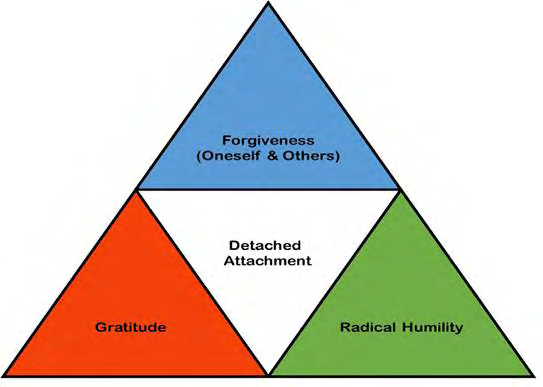
6] 2-53 shloka: The Vedas and all its’ teachings mentions several methods of achieving numerous ends all of which is limited / finite and confusing. Yoga here refers to the self- knowledge acquiring which the confusion is resolved and an individual is firmly established single-pointedly in the ‘Self’ (i.e. Atman). This indeed is Karma yoga and in the subsequent verses the paths towards liberation are explained. 7] 3-3 shloka: There exists a two-fold path: i) through Jnana yoga (i.e. that of self-knowledge) wherein the seeker embarks on contemplation and is not distracted by sensory inputs with steadfastness fixed on Universal consciousness and ii) through Karma yoga (i.e. by renouncing the outcomes / fruits of actions). Such a mind is purified to be receptive for self-knowledge). 8] 3-7 shloka: Amongst the two paths, Srikrishna recommends that for a beginner, the path of Karma yoga to be better suited as it is easier to cultivate an attitude where actions are performed as an offering / sacrifice to the divine (i.e. Yajna). Such an approach gives one the resilience to accept any result as a gift from the divine (i.e. Prasada Buddhi). The wide gamut of meanings and description of several concepts related to Yoga begins from the fourth chapter onwards until the very end of SBG. These are briefly summarized as below where Yoga is meant to the ‘means’ and also the ‘end’ to attain liberation. 9 & 10] 4-2 & 4-3 shlokas: Yoga in this verse means the ‘Essence of eternal wisdom’ that was first taught to Vivasvan (the Sun god) who then transferred to his lineage. Thereafter it got corrupted / lost with a long lapse of time and breakdown of value systems. Srikrishna is willing to impart this to his devotee and friend Arjuna at a critical moment of his life. Yoga is an art / science that is eternal and timeless without a shelf life. It is as relevant in 21st century as it was during the vedic age – requires no further proof. Arjuna has whole-heartedly surrendered to the supreme lord signifying that ‘Every true friend is a glimpse of God’. 11] 4-25 shloka: Here Yoga is considered to be a Yajna (i.e. sacrificial offering) to invoke his grace and blessings. Anything can be offered to God as everything belongs to the almighty. Whilst some offer materialistic possessions, select few offer sacrifice of ‘self’ by the sacrificial act into the fire of the Brahman (the Self) signifying ‘Giving is an act of grace’. 12 & 13] 4-27 & 4-28 shlokas: Here Yoga is considered to be an internal journey towards the self (i.e. spiritual Sadhana) whilst performing charity / offering weath and possessioins is an external act. Few distinguished individuals offer themselves to God and are devoted to self-realization making it their primary purpose of life. Such unique individuals see God in everything in this world and do not see any difference between beings (i.e. recognize the divine in everyone). Their BMS is offered to the Supreme by becoming one with the Universal consciousness. Yoga here stands for ‘Oneness’ i.e. ‘God is everywhere and in everyone’. 14 & 15] 4-41 &4-42 shlokas: A seeker who has renounced his actions is not affected by the results of those deeds. Here Yoga is the means to practice Karma Phala Tyaga and attain a state of equanimity. Such a purified mind connects on a higher plane to attain self-knowledge where all doubts are erased. Yoga here also signifies the yoking of Karma yoga and Jnana yoga. Such an individual does not see oneself as the ‘Doer’ (i.e. Karta) and has therefore renounced the sense of ownership with complete dissolution of ‘Ego’. Such actions become non-binding and one rises from the shackles of duality – ‘When Ego dies, the Soul awakens’. 16] 5-2 shloka: In this verse Yoga is a synonym for ‘path’ and Srikrishna affirms that the Yoga of action (i.e. Karma yoga) is better than the Yoga of renunciation. He subsequently clarifies that ‘renunciation’ is not to be confused with not performing any actions but it is infact renouncing the ‘fruits of actions’ and giving up the sense of Doership (i.e. Kartatva). 17 to 20] 5-4 to 5-7 shlokas: The supreme lord clarifies that both Samkhya (i.e. Jnana yoga) and Karma yoga are one and the same and only the ignorant see them as being different! He assures that both are equally effective means of attaining the end result of oneness with God and are complementary to one other. Karma yoga serves as a basic foundation upon which one advances further in spiritual quest / journey. It is a stepping stone by which an individual who performs actions with equanimity is cultivating a receptive personality this is befitting to receive the knowledge of the higher ‘Self’ (i.e. karma yoga prepares one for acquiring Jnana yoga). When ego is lost, limit is lost and an individual becomes synonymous with humility, gratitude, compassionate, loving, forgiving, and explore unimaginable possibilities. The eternal essence of God is the same in all human beings. So just like all the organs in the body work in a synchronous manner with one other for smooth functioning of the body as a whole, similarly the enlightened human being works towards the well-being of all with the knowledge of that the whole Universe is one with the Supreme being. This is the essence of Lokasamagraha (i.e. greater good of mankind in verse III-20). The worship of God is in our attitude towards other people and the principles by which Srikrishna conducted himself in ‘The Mahabharata’ is illustrated pictorially in Figure 1. He was grateful to Sudama for the gifts, forgave Shishupala several times for all his mistakes and executed actions to uphold and protect Dharma with detachment.
21] 5-11 shloka: When a seeker dedicates and surrenders his BMS and intellect to the divine, the soul is purified. Such a mind is tranquil, transcends dualities and is connected with higher ‘Self’. The soul then gets liberated through selfless service’ (i.e. Nishkama karma) despite such actions being in self-interest and those individuals are Yogis. 22] 5-21 shloka: The seeker who has the realisation of ‘Self’ by conquering the senses and the distractions of the material world through Karma yoga and renunciation attains equanimity. Everything is just perfect in a Yogi’s world as their ‘self’ is in synchronicity with Universal consciousness and there are firmly established in ultimate bliss (i.e. Paramananda)! 23] 5-24 shloka: This shloka enumerates the attributes of a Yogi who has transcended dualities and established in the higher Self (i.e. Brahman). The three key traits are – i) antar-sukah; ii) antar-aramah and iii) antar-jyotih. Such an individual gains Brahma-nirvana (i.e. Moksha). He revels in himself and finds fulfillment in oneself attaining liberation. Highest number of verses with the word Yoga is found in the VI chapter and has become synonymous with the meaning of this word in SBG. The chapter itself is named Dhyana or Atma-samyama yoga. The Yoga of SBG is that of meditation and inward gaze with contemplation (i.e. Antah- ranga sadhana) unlike the cosmopolitan meaning that leans more towards Hatha yoga (i.e. Bahi-ranga sadhana). This is a crucial difference as more than 55% of the verses (i.e. 26 / 47) are devoted to explain the methods and adjuncts to complete this fascinating introspective journey of the alone, led by the supreme lord to attain him. 24 to 27] 6-1 to 6-4 shlokas: Yoga here is used to mean renunciation and an individual who is a renunciate is a Yogi (i.e. Sannyasi / Muni). An individual who performs actions that is to be done and is not driven by end results or attached to outcomes is a true Karma yogi. An individual cannot become a Yogi without giving up Sankalpa (i.e. the impetus from which desires arises). The single-most important and mandatory criteria to qualify as a Yogi is to give-up all binding desires which is a pre-requisite to developing a contemplative mind. The first step is Karma yoga by which the mind is purified and attained the state of tranquility / serenity required to progress to next stage - Meditation (i.e. Dhyana yoga). Meditation is for Antaha-karana-naischalya (i.e. acquiring a steadfast mind) whilst Karma yoga aids in purifying the mind (i.e. Antaha-karana-shuddhi). Such a practitioner possesses virtues: straight-forwardness, truthfulness and oneness with all beings – ‘When the mind is still, the Truth gets its chance to be heard in the purity of Silence’. He is firmly established in Karma yoga, has exercised control and mastery over BMS by acquiring discernment (i.e. Vairagya) – ‘Each victory gained over oneself means new strength to gain more victories’. He continues to live in the world discharging duties that are in-sync with one’s Svadharma without any expectations or attachment akin to – ‘Being in this world but not of the world’. 28] 6-8 shloka: Having acquired the above attributes, a Yogi has his individual consciousness aligned with the Universal consciousness is not reliant on external stimuli / materialistic possessions for his contentment / happiness. He neither accepts nor rejects anything and harbours no insecurity viewing both rock and a lump of gold with equanimity (i.e. Samatva). 29 to 31] 6-10, 6-12 & 6-15 shlokas: These three verses attribute Yoga as a tool that eliminates misery and aid in attaining inner bliss (i.e. Ananda). The seeker is recommended to develop an attitude of working without any personal motive, ego, and giving-up ownership or enjoyment of the deeds (i.e. Kartatva and Bhokratva). A serene mind that is indifferent to favourable vs. unfavourable results and which has reigned on its senses is capable of meditating on the ‘Self’. Maintaining one-pointed focused attention (i.e. Chitta ekagrata) with right attitude is more important than number of hours spent in meditation as it is an art of learning how to tend the sacred ground of one’s life and attain the Brahman. A Karma yogi endowed with a contemplative mind that is serene connects his inner-self with Universal consciousness. The peace of God resides in those whose mind and soul are in harmony. The mind that is free from desires (i.e. Raga and Dvesha) attains the state of oneness with the pure ‘Self’. 32] 6-17 shloka: Moderation and striking the right balance as the key to success is Srikrishna’s practical advice to mankind. Yoga is defined as moderation in all habits (eating, sleeping, working or pleasure pursuits) that is responsible for a paradigm shift in one’s approach that disconnects an individual from sorrows / unpleasant thoughts.
33 & 34] 6-19 & 6-20 shlokas: When a seeker has practiced Dhyana yoga, his mind is calm, steady and quiet that is synonymous to a flame burning in a windless place without a slightest flicker. A mind that is equipped with this attribute becomes ‘rock steady’ and energies are conserved / efforts are channeled to achieve a specified goal / objective. When the mind is quietened with regular and constant practice, it becomes pure to attain the ‘Self’. It is explained as seeing pure ‘Self’ through clear and calm ‘self’. 35] 6-23 shloka: Up to this point, all the means and the ways were described to practice Yoga. So yoga was ‘means’ to an end. Here onwards, the ‘end result’ of practicing Yoga is enumerated. When the seeker has subdued his senses, negated the Ego, erased the ‘I’ness from the mind and has cultivated one’s mind to a reasonable degree, he acquires dispassion (i.e. Vairagya). This is a pre-requisite for gaining the knowledge of the ‘Self’. One realizes that it is the sorrow that keeps the mind engaged. The un-coupling / detachment of mind from sorrow is an important milestone in the journey of the seeker as the ‘Earth has no sorrow that God in the heaven cannot heal’. Living in harmony with oneself be it in sorrow or joy is Yoga. 36 to 40] 6-27 to 6-29 & 6-31 to 6-32 shlokas: These five verses lay emphasis on the importance of patience and determination and presents a profound description of experiences of a seeker (i.e. Sadhaka) who has attained Brahman. The pure ‘Self’ alone should be the centre of all activities and purpose of one’s existence as it is untouched by any sorrow, conflict or defect. Articulating in words has their own limitations and so are the feelings that are beyond the realm of senses. The supreme bliss that pulsates in the wake of meditation is one’s pure essence and his mind should be free of all / any conflicts to experience it. Atyanta-sukha (i.e. immense joy) is the hallmark of his nature (i.e. Svarupa) and he is untouched by any form of sorrow as pain may be inevitable but suffering is optional! This is acquired only through Jnana yoga which is knowledge of the Self as Sat-Chit-Ananda or the Existence – Consciousness – Bliss. Such an accomplished Yogi will see ‘Self’ in all beings and all beings in ‘self’ – i.e. he sees God everywhere and in everyone / everything at all times and so is one with the supreme. He has acquired the self- knowledge and displays highest grade of maturity with mind / soul fixed on God alone to the exclusion of everything else having transcended the dualities. Srikrishna says ‘the person who remains and abides in me alone’ is the most exalted one. 41] 6-33 shloka: Here the word Yoga is used to mean sameness / stability attained through tranquility. Arjuna asks a very valid question that has plagued the mankind for generations –‘How to control the mind that is inherently unstable and fickle. He is earnestly pleading Srikrishna for practical tips towards making it steadfast (i.e. how to slay / suppress thoughts and false ego?). 42 & 43] 6-36 & 6-37 shlokas: Yoga in these couple of verses is considered to be a competency / special skill that is worth acquiring. Srikrishna admits certain pre-requisite skills are mandatory failing which it cannot be mastered. The key attributes needed are: i)constant practice (Abhyasa) and ii)Dispassion with objectivity (Vairagya). Yoga is something that demands 100% commitment and hence a doubt arose in Arjuna’s mind what if one gets distracted from and strays off from this path? Would all the efforts and investment in reading the scriptures and observing austerities go waste despite one’s best efforts in developing this proficiency? What is the fate of such personnel and where do they go to? 44 & 45] 6-41 & 6-42 shlokas: Srikrishna describes the fate of a fallen Yogi in these two verses (i.e. Yogabrastha). People on dharmic path who haven’t attained Self in their life-time but done good deeds are not to be considered as failures. The supreme lord reassures by mentioning that such are the ‘Laws of Karma’ that the benevolent universe conspires to help them in their spiritual journey where they are re-born in the world to a family of rich households or pious / religious Yogis where a favourable environment exists to continue their journey of emancipation – ‘God helps those who are committed in wanting to help themselves’. They are assured of success and it is only a matter of time, determination and patience. In-short the path of spirituality is one-way and journey is only pleasant / better with every step. 46 & 47] 6-44 to 6-45 shlokas: Yoga is these two verses are meant to be a form of knowledge that is beyond the Vedas and that which eradicates ignorance / cleanses impurities of the mind. Srikrishna says those who live by observing Yoga as a way of life are better than those practicing rituals, personnel who are knowledgable in scriptures and people of actions who haven’t transcended dualities. They are a rare breed of select individual given that it takes several live- cycles of births and deaths to just qualify for being a Sadhaka (let alone being a Yogi). The birth and death are not that of the soul but that of the body and the Ego. 48 & 49] 6-46 to 6-47 shlokas: In these two verses, Srikrishna urges Arjuna to aspire for and become an exalted Yogi. This is attained by a seeker who is absorbed in and contemplates on the divine 24 X 7. Among all the seekers who are on the path of liberation, one who has gained the knowledge of Self - whose mind is fixed on supreme godhead with unconditional faith (Shraddha) and unswerving devotion (Bhakti) are the best. There is an emphasis on the importance of these two concepts in spiritual life - ‘Learn from the best so that one day you can become that Best’. 50] 7-1 shloka: The seeker who has taken a recourse in Yoga to know the divine by meditating on the supreme godhead, surrendering oneself completely gains the transcendental knowledge of the ‘Self’. Here Yoga is portrayed as a method to know and become one with God who reveals himself to a seeker who is willing to make an effort. 51] 7-25 shloka: Here Yogamaaya is used to mean ‘veil of delusion’ that acts as a barrier for an ignorant mind to understand the divine. A mind that isn’t uncoupled from dualities and transcended the three Gunas contributes to this delusional veil that prevents from establishing a contact and merge with the Universal consciousness. Srikrishna proclaims that he is unborn and changeless and that the ‘Greatest obstacle to pleasure / bliss is not pain but delusion’. 52] 8-8 shloka: This verse gives an insight Re: how a Sadhaka should prepare for death and journey of the Jiva hereafter. Yoga here is used as an adjective to describe the mind that is endowed with constant practice. Abhyasa (practice) and Yoga are used interchangeably here. A contemplative mind that is immersed in the practice of Yoga attains the supreme and effulgent Purusha (i.e. the Self). 53 to 55] 8-10, 8-12 & 8-14 shlokas: At the time of death, a Yogi is able to attain the divine by directing the prana (life energy) in-between the eyebrows by attaining Sushumna state (i.e. ability to regulate the breath equally between the two nostrils). Yoga is used as a power acquired in controlling the prana by practice of astanga yoga. He inhales, holds the breath, contemplating on the Brahman by meditating on the syllable ‘Om’ and gives up life at will. He is capable of closing all gates of perception (i.e. senses) and channels the nadi (i.e. an imaginary pathway / nerve in yogic sciences) from the heart to the region on top of the head to attain an exalted state in Brahma loka. There Lord Brahma administers him Atma jnana (i.e. knowledge of the ‘Self’) leading to krama mukti wherein he becomes one with the God. 56 to 58] 8-25 & 8-27 to 8-28 shlokas: These verses deals with the science of death. Yoga is not only a skill and dexterity in action (verse 2-50) but also plays a key role during dying and SBG is also perceived to be a Mrythyu shastra. There exist two paths that one takes after death: i)Path of light and ii)Path of dark. Yogis cast off their bodies during daytime and bright half of the moon when the sun is in the course of northern solstice (i.e. Uttarayana). Having acquired discriminative knowledge (i.e. Viveka), they are not deluded by the temptations and possess direct knowledge of the Self. They attain highest possible state (i.e. the primal cause of creation). The ignorant die during nocturnal hour and dark half of the moon whilst sun is in the course of southern solstice (i.e. Dakshinayana) and are reborn. The recommended motto is ‘Always to do good to others independent of their opinions or judgments working selflessly’ – the hallmark of divine life. People engaged in ‘enjoined karma’ (i.e. who practice rituals or charity for material gains / rewards) take the ‘path of smoke’ to be in Chandraloka temporarily and return back after their Karma pot is exhausted. 59] 9-5 shloka: This shloka says the supreme godhead is the creator and sustainer of this Universe (i.e. Jagat - he is both the cause and the effect) and all beings reside in him and that he does not dwell in them. Here Yoga is used as an adjective Aisvaram (i.e. that which belongs to Srikrishna).
60] 9-22 shloka: This is a very famous verse that is the ‘centre / heart’ of the SBG. It is also one of the three verses of SBG that has found its place in ‘Vishnu Sahasranama’ [13]. Yoga here is used to mean ‘well-being’. Srikrishna declares – devotees whose tranquil minds are fixed upon him with complete surrender, unswerving devotion coupled with steadfast concentration are dearest to him. The supreme godhead not only ensures he protects what they already possess, but also provides everything they need and aspire for. 61] 9-28 shloka: Here Yoga is used as a process by which mind is endowed with renunciation. Binding desires accure karma and can provide either Sukha or Dukkha (i.e pleasant vs. unpleasant outcomes). Karma phala tyaga and concepts taught in the fifth chapter is reiterated with an emphasis to perform selfless service and become a karma yogi first in one’s spiritual quest. 62] 10-7 shloka: Here Yoga is used to mean magnificent glories (Vibuthi) of the supreme lord and his connections with them. In-total 84 Vibuthis are described in the chapter which is only tip of any iceberg of his infinite divine attributes. A Sadhaka who understands these divine manifestations and has unshaken vision of lord’s glories is said to be imbued in yoga and one with the divine. 63] 10-10 shloka: Yoga in this verse is used to mean Buddhi yoga (i.e. the knowledge of the intellect) and the vision of supreme lord himself. Srikrishna explains those seekers who are committed towards him at all times (i.e. 24X7 nityayukta) and seek him with love and devotion, he bestows them with the ultimate knowledge by which they become one with him. 64 & 65] 10-17 & 10-18 shlokas: Arjuna clearly expresses a thirst for knowledge and realizes for the first time that Srikrishna is more than just a mere charioteer. The warrior prince ardently beseeched the supreme lord with unswerving devotion pleading him to describe his divine glories once again. He acknowledges Srikrishna to be the greatest of all Yogis addressing him as Janardhana which means Jana+ardhana (i.e. one who is prayed to by all creatures as their caretaker) and wants to know how he is to be meditated upon to receive his divine grace / blessings. 66] 11-8 shloka: Yoga is used to convey the wondrous power / Maya of the supreme lord that is beyond compare. Arjuna requests Srikrishna to reveal his majestic cosmic form (i.e. Vishwaroopa). The supreme lord agrees and bestows him with spiritual eyesight that holds the capacity for everything (i.e. all-knowledge:jnana-shakti; all-activity:kriya-shakti and all-desires:ichcha-shakti) to cherish his immeasurable glory. The climax of SBG unfolds in the middle unlike other thrillers where it is usually revealed in the end! The Vishnu Sahasranama acknowledges Vishnu as ‘Yogo yogavidaam netaa Pradhaana purusheshwaraha’ i.e. the universal problem-solver and Yoga is synonym with Srikrishna (who is an avatar of Lord Vishnu) [13]. The Bhagavatha purana cites nine types of devotion Navavidha Bhakti (viz. Shravana, Keerthana, Smarana, Paada seva, Archana, Vandana, Daasya, Sakhyam and Atma nivedana). Suffices to say ‘It is not because God there is devotion but because of devotion there is God!’ 67] 11-47 shloka: Srikrishna withdraws from his effulgent cosmic form consoling Arjuna with soothing words pleased with his abiding devotion. Yoga in Atmayogat is an illustrative example of his wondrous power and conglomerate of divine attributes (omniscience, omnipotent, omnipresent etc…). He mentions that the universal cosmic form without a beginning or end was not visualized by anyone before was graced on Arjuna for his unflinching belief, faith and surrender (i.e. sharanagati). As much as we yearn for the supreme lord’s grace, God too seeks humans and is ever so willing to help us’. 68] 12-1 shloka: The twelfth chapter is all about Bhakti (i.e. devotion) which is a Sanskrit non-translatable. It is derived from root word ‘Bhaj’ – sense of dedicated service with faith, surrender and adherence to Dharma. Those who serve the supreme godhead incorporating such traits are called Bhaktas. Arjuna’s mind being in conflict asks Srikrishna the same question of fifth chapter with a different terminology as he is still keen on renunciation! Amongst the two types of Bhaktas – Karma yogis (i.e. those who meditate upon Saguna-brahma with form) vs. Jnana yogis (i.e. those who meditate upon Akshara-brahma who is unmanifest and not objectifiable): who is more closer to attainment of Moksha? Krishna says that it is like comparing Apples vs. Oranges. It perhaps is easier for the first group (i.e. Karma yogis who meditate upon Saguna-brahma) as there is no comparison with the second group who are already one with the divine! 69] 12-6 shloka: This verse provides a practical advice regarding how to meditate upon the divine. A Sadhaka should worship keeping God as the ultimate end / as a saviour by observing austerities, performing dharmic actions with unswerving devotion (i.e. Bhakti) to attain him. Yoga is used to describe a ‘unique type of commitment to the exclusion of everything else’. 70 & 71] 12-9 & 12-11 shlokas: Devotion (Bhakti) is difficult to define rationally as it involves Bhavana (i.e. attitude) that is subjective and fuelled by inexpressible feelings of reverence. Srikrishna acknowledges this and recommends Arjuna to try and attain him by practice of Yoga (i.e. Astanga yoga comprised of Yama, Niyama, Asana, Pranayama, Pratyahara, Dharana, Dhyana and Samadhi with emphasis on not mere practice but practice with one-pointed focus and commitment). Teachings from the second chapter and attributes of a Karma yogi are reiterated by recommending Sarva karma phala tyaga (i.e. renouncing all fruits of action) to eliminate all raga – dvesha as the supreme lord is karma phala daata. Form has to be retained for the spirit to be evident that is dependent on the attitude. Nurturing an attitude of Prasada Buddhi and kartatva tyaga gives peace of mind immediately. 72] 12-14 shloka: Here Srikrishna describes the attributes of devotees who are beloved to him. Those individuals who are always contented within oneself, whose mind and intellect is resolved in the divine and are unattached to the fruits of action have attained a tranquil mind with firm ascertainment. Such sadhakas are indeed Yogis who have fixed their mind on higher Self and taken refuge in God is dearest to the supreme godhead. 73] 13.10 shloka: Yoga in this verse is used symbolically to define the nature of devotion. A seeker who has an abiding, unswerving and unflinching Bhakti to the exclusion of everything else where the mind is immersed in the object of devotion sees God in all the beings. Such an individual would have gained the ultimate knowledge (i.e. Tattva jnana) – ‘True knowledge lies in knowing the extent of one’s ignorance’. 74] 13-25 shloka: Srikrishna lays a blue-print of four paths namely i) Sankhya (by enquiry); ii) Karma; iii) Bhakti and iv) Jnana. Yoga is used as a path to self-realization and how these paths aid in crossing the ocean of Samsara (i.e. bondage and suffering). He reassures all those who make a sincere effort attain the final destination (abode of the supreme) though the paths and nature of their journeys may differ. 75] 14-26 shloka: Yoga here is used to mean a tool to transcend the three Gunas and attain the Brahman. The confluence of Bhakti and Jnana is highlighted here and mentions what it takes to be fit to become Brahman (i.e. Aham–Brahma–Asmi). With unswerving commitment and devotion, a seeker pleads the supreme lord to open the gates of his grace and fill one’s life with eternal bliss. 76] 15-11 shloka: The word Yoginah in this verse is used to describe a trait / skill acquired by Sravana – Manana - Nidhidhyasana where the mind is tranquil and receptive to attain higher knowledge of the Self. Such seekers attain self-realization and perceive the luminous soul seeing them being one with the divine (i.e. Satyam – Jnanan – Anantam - Brahman). 77] 16-1 shloka: In this shloka, Srikrishna lists 26 attributes of Daivi sampat (i.e. spiritual wealth). Yoga here is meant to convey one of these 26 traits as ‘steadiness in knowledge and contemplation’. The other 25 are:1)Fearlessness; 2)Purity of mind; 3)Alms-giving; 4)Self-restraint; 5)Observing rituals and performing Yajna (i.e. sacrifices); 6)Study of sacred scriptures; 7)Performing austerities; 8)Candid and upright in words, actions and speech; 9)Harmlessness; 10)Being truthful; 11)Free of anger and resentment; 12)Renunciation; 13)Cultivating a tranquil personality by remaining calm and serene; 14)Absence of calumny and aversion to slander; 15)Being compassionate, empathetic and merciful; 16) Freedom from covetousness; 17)Humility with gentleness 18)Modesty; 19)Absence of physical agitation and useless movements; 20)Vigour and brilliance; 21)Forgiveness and remaining unaffected by insult or injury; 22)Fortitude (i.e.
courage and patience during hardships); 23)Purity of mind and body; 24)Lack of malice and 25)Absence of pride and exaggerated self-importance. 78] 18-33 shloka: The determined efforts that are undertaken to control the mind and the sense organs facilitating them to develop a trait of consistent practice in Yoga brings in a transformational change in an individual. Yoga in this verse is used to indicate a form of practice and a Sattvic quality (i.e. suggestive of virtue, righteousness, dharmic path and resolute faith in the supreme godhead). 79] 18-52 shloka: In this verse, the lifestyle of a seeker who is dedicated to pursuit of Jnana-nistha is described and Yoga is meant to convey the state of a mind that is engaged in Dhyana. Such individuals have renounced the fruits of their actions, seek solitude living in a quiet place and eat lightly having attained mastery over body, mind and speech. 80] 18-57 shloka: The supreme lord advices Arjuna to mentally renounce all the actions on to him and Yoga in this verse means Buddhi yoga (i.e. actions [Karma yoga] guided by intellect acquired by discrimination [Viveka]). Actions performed incorporating such attitudes coupled with Bhakti, an individual merges and becomes one with God attaining liberation. 81] 18-75 shloka: Srikrishna is addressed as Yogeshwara (i.e. the Lord of Yoga) encompassing all meanings of the word Yoga as we have just unearthed. There are three other verses where he is addressed by this title as mentioned earlier and one of them is a part of Vishnu sahasranama (verse 18-78) [13]. This profound teaching of the supreme lord is being transmitted through millennia with the help of Maharshi Vyasa. Yoga transforms an individual profoundly to attain greater heights / explore unimagined possibilities. This also forms the core message of a popular short story form the 1970s ‘Jonathan Livingston Seagull’ [14].
Discussion
We attempted to summarize the meaning of the word Yoga as used in SBG and Srikrishna’s teachings in a structured and objective manner. Attempting to explain the context / meaning of Yoga succinctly in few sentences is impossible given the amount of published literature on it and several pages can be written for each verse / shloka extolling its metaphysical principles / concepts. Several published studies on the meaning of Yoga in SBG have been subjective and fallen short by not comprehensively listing either all verses or providing a complete explanation [15, 16, 17, 18]. This article attempts to plug-in this lacuna and is written in a concise fashion to kindle curiosity / interest in readers. We hope this encourages them to undertake an in-depth study of SBG to recognize / realize their true self. Such a task would be a first step in one’s spiritual journey to discover eternal bliss (i.e. Sat-Chit-Ananda). In an effort to facilitate this, Table
4 provides a bird’s eye-veiw and a succinct chapter-wise summary of the Bhagavad Gita. SBG imparts a social message with an enunciation of spiritual principle how to conduct life by practicing Yoga. Hence a wide gamut of different meanings associated with the use of this four-lettered magical word. This Yoga Shastra of SBG is contrary to the cosmopolitan meaning of Yoga that has become synonymous with body postures (i.e. Hatha yoga) and it is evident from Table 2 that the Yoga of SBG is beyond it. Equally difficult is that the same word (i.e. the Yoga) carries contradictory / diametrically opposite meaning at different places in the SBG. A thorough understanding of SBG is hence necessary to get a gist of the meaning of Yoga and the context of its use in SBG’s verses / shlokas. Suffices to say that it is the message of the almighty to humanity that has a solution to all problems conceivable that are caused by either external factors or engendered by unique internal circumstances. It could be defined as uniting the mind with the body and its sense organs to establish a state of stable balance / equilibrium. The inner transformation that happens will bring in a cascade of chain reactions that causes a paradigm shift that uplifts and transforms the individual self. It is through Yoga that we work for others - light their path to help oneself by exploring the concepts of Karma, Dhyana, Bhakti and Jnana that are influenced by the three Gunas.
| Chapter | Name | Summary |
|---|---|---|
| 1 | Arjuna Vishada Yoga | Arjuna’s sorrow and despondency is described here. Despite being a courageous and accomplished archer / warrior, he is grief-stricken in the battlefield and is dejected. He has to face his own cousins, grandsire and teachers for rightful claim to a kingdom he / his siblings are denied. He becomes detached to materialistic pleasures and takes refuge in Srikrishna his charioteer. He pours out his heartfelt sorrow and confesses to losing the will to fight / face the enemies in battleground. His mind is clouded in self-doubt and he questions the intentions behind the war that is going to be a catastrophe even if he were to emerge victorious. The Supreme Lord’s teaching in the subsequent 17 chapters is the essence of ‘Bhagavad Gita’. |
| 2 | Sankhya Yoga (also known as JnanaYoga) | Having listened patiently for 57 verses (entire 1st chapter and first 10 verses of this chapter), the supreme lord begins his preaching from 58th verse recommending not pitying / weeping for those who are not deserving of it. He talks about ‘Karma yoga’ (i.e. selfless devotional action) and recommends adhering to ‘Dharma’ (i.e. the path of righteousness) and not worry about the results / consequences of those actions. Any selfless act results in a purified thought which brings out an awareness of ‘Self-knowledge’. An individual who follows Dharma moves ahead transforming oneself from pleasure to sacrifice, delusion to love, pride & arrogance to humility and deceit to honesty. A karma yogi transforms into a ‘Stithaprajna’ developing: i) Steadiness in action and ii) Steadiness in knowledge and surrenders to the Supreme. |
| 3 | Karma Yoga | Srikrishna further describes the qualities of a ‘Karma Yogi’. He suggests reigning in on one’s desires that deludes an individual’s senses, mind and corrupts his actions. He recommends abandoning selfishness, narrow-mindedness and living a life of sacrifice (i.e. Yagna) and generosity. The four principle pursuits of human life (i.e. Dharma – Artha – Kama and Moksha) are described. Focusing on the task at hand, being detached to its outcomes and thoughts of hatred towards anyone with selfless service paves way for a karma yogi’s mind to be receptive for the Jnana needed for emancipation. Destroying one’ desires / impure thoughts facilitate purification of the mind that is needed to attain the ‘Brahman’. |
| 4 | Jnana-Karma- Sanyasa Yoga | Karma sanyasa refers not to the renunciation of action but renouncing the results / fruits of our actions. The supreme lord mentions about ‘Karma Phala Tyaga’ and the secrecy of incarnation. He cites teaching this knowledge to several predecessors before Arjuna and it is he alone who establishes / restitutes / sustains ‘Dharma’. It is his duty to establish / protect the good (i.e. Dharma) and destroy the evil (i.e. Adharma). He recommends spiritual sacrifice to be better than materialistic sacrifice which is working for the welfare of the mankind without any self-interest. He emphasizes on the importance of mental discipline of a ‘Karma Yogi’ and how interdependent the power of thought and physical health are. |
| 5 | Karma-Sanyasa Yoga | The attributes of the ‘Brahman’ (i.e. the supreme Soul) is described. It is formless, eternal, blissful and non-destructible. One can attain unison with this supreme through renunciation of action. The physical body, senses are formed out of matter and the ‘Self’ is not concerned with it. Attributes of a ‘Jnana yogi’ is described and emphasis is on meditation. Through meditation, one can experience the worldly and supreme bliss leading to liberation (i.e. Moksha) in one life-time by realizing the supreme ‘Self’. Having discarded his selfishness, a Karma-sanyasa yogi dedicates oneself for the welfare of all creatures with constant musing in contemplation / meditation. |
| 6 | Atmasanyasa Yoga | This chapter emphasis on the practice of self-control and performing selfless action. The supreme lord advocates an attitude of ‘Prasada Buddhi’ (i.e. all results / fruits are an offering of the Lord’s will). This nurtures humility and eliminates ‘Ahankara’ and ‘Damba’. A real sanyasi is one who works with devotion surrendering to the Lord. Meditation is defined as a ‘gist of control of the self’ (i.e. both mind and senses). Constant practice in meditation is the highest means to attain enlightenment, divinity and supreme bliss. The Lord opines that human mind is the root cause of all the sorrow / joy and thoughts originating there also feed it. A true ‘Yogi’ has his mind soaked in devotion and contemplative meditation. |
| 7 | Jnana-Vijnana Yoga | The supreme Lord mentions that he now wishes to bestow upon Arjuna that knowledge knowing which there would be nothing left to be learnt / known. He mentions that the Supreme absolute is formless and without any attributes that creates, nourishes and destroys the creation. The material energy is of two types: i) Para and ii) Apara. The latter (i.e. apara) is inanimate and causes material creation. It has 8 characteristics: i) Air; ii) Space; iii) Earth; iv) Water; v) Fire; vi) Mind; vii) Understanding and viii) Consciousness. The supreme soul appears from ‘Para’ that is the best form of material energy and enters the body. The human body is clouded with illusion and one needs to develop 3qualities: i) Adhidaiva; ii) Adhiyajna and iii) Adhyatma to erase / obliterate this illusion and worship the ‘Supreme soul’ to attain it / become one with it. |
| 8 | Akshara Brahma Yoga | Arjuna asks Srikrishna – What is Brahman and how does one come to know about it? The supreme Lord answers by discussing about the ‘imperishable supreme godhead’ in this chapter. Human life is a puzzle and one often wonders what happens at death / after death? Krishna answers by telling that life is a virtue of supreme soul like a divine light and ‘Para’ constitutes the ‘Consciousness’ whilst ‘Apara’ is the cause of inanimate stuff. The entire universe is pervaded in the supreme lord in his unmanifest form and hence one is recommended to keep one’s mind focussed on the supreme lord at all times. Those who are devoted to him with mind fixed in abstraction attain him / merge with the supreme soul after death. |
| 9 | Raja Vidya Yoga | Arjuna wants to know the secrets of knowing which one is freed from evil and hence the name ‘Raja Guhya’ for this chapter. Srikrishna answers that the simplest / easiest way to attain Brahman is to worship him with unswerving devotion and faith. He declares that all creatures take refuge in him despite him being detached from them. He reassures Arjuna by mentioning that God craves for the love and to serve him with water, flowers and leaves. A devotee who surrenders his mind and worships him with devotion and love attains him. The devotion that is offered with unquestioned surrender is emotional and a form of ‘internal’ bliss and reassures Arjuna that no one who is devoted to the supreme Lord is ever lost. |
| 10 | Vibuthi Yoga | Srikrishna declares that he is the root cause and created the ‘Creation’ by his inexplicable supremacy. He mentions that he is Omniscient and that all attributes that define an individual (tranquillity, contentment, austerities, evenness of mind, free from fear etc...) all originate from him. The seven great Rishis, four Maharshis were all born from his mind and that he exists in the heart of everything being the seed in all things. He is also the beginning, middle and end of all beings. He mentions that he is Narada amongst the celestial Rishis, Sama Veda amongst the Vedas, Chitraratna amongst the Gandharvas and that he is also the Sun, the Moon, the lord Yama and time eternal. The resplendent characteristics of the Lord are summarized in this chapter. |
| 11 | Vishwaroopa Darshana Yoga | Revelation of the Lord’s celestial form is a ‘Climax’ that is unfolded in the middle of the Gita. Blessed with the celestial vision, Arjuna is able to see the ‘Cosmic’ form of the supreme lord. This marks the end of the 1st half and beginning of 2nd half of the Gita. The 10th & 11th chapters are inter-related and Srikrishna summarizes by mentioning that everything is being created and sustained only by a small portion of his energy. Arjuna is bewildered and bows with devotion seeing the cosmic form with blazing fire of >1000 suns emanating from his mouth with infinite such mouths, arms, legs & feet. The supreme Lord asks Arjuna to be a means to his agenda or alternatively he could transform into a ‘Mahakaala’ and slay everyone. |
| 12 | Bhakti Yoga | Arjuna enquires about the mystery of creation and the cause of origin vs. destruction and the means to obtain the supreme Lord. He wanted to know the best path to attain him. He also wanted to know if worshipping the ‘God with attributes’ or the ‘Formless spirit’ was better. Srikrishna advices that the path of devotion (i.e. Bhakti) is practical, easier, simple and probably the best as the worship of the formless spirit is difficult. One who has unswerving devotion with a mind concentrated towards him can become one with the supreme. Worshipping the god with attributes with love and emotions brings welfare and enables mankind to grow towards perfection. Such devotees are always nurtured and protected by the Supreme Lord. |
| 13 | Kshetra- Kshetrajna Vibhaga Yoga | The supreme Lord describes the body (i.e. Kshetra), nature, consciousness and knower of the body (i.e. Kshetrajna). The body is only a minute element of the ‘Self’ and is the abode of the self. The ‘Self’ is the master who nurtures, is a bearer and enjoyer of the body. The individual soul is clouded with illusion (i.e. Jivatma). Srikrishna recommends acquiring the ‘Knowledge of the Self’ to erase this illusion towards attaining emancipation where Jivatma becomes one with the supreme soul. A set of 20 attributes are described as a means for acquiring this ‘Self-knowledge’ are: No conceit, No pride, Non-violence, Forbearance, Honesty, Steadfastness, Purity, Servitude to teachers, Control over one’s senses, Equanimity, Dispassion, Non-attachment etc… |
| 14 | Gunatraya Vibhaga Yoga | The supreme lord describes how the creation came into existence with Brahma being the mighty womb and he being the seed imparting sire. He goes on to describe in-detail about three types of material energies: i) Sattva (i.e. goodness); ii) Rajas (i.e. passion) and iii) Tamas (i.e. ignorance) which constitutes a part of every individual’s personality in varying shades like a personalized RGB. A person with Sattvic traits is pure, bestows happiness, reigns on one’s senses and acquires self-knowledge needed for liberation. A Rajasic individual is fickle-minded harboring jealousy, greed, lust and is materialistic whilst a Tamasic person is deluded, ignorant and reckless). A Sattvic soul that is devoid of hatred, filled with humility transforms into a transcendental soul and merges / becomes one with the supreme soul. |
| 15 | Purushottami Yoga | The Lord once again describes the creation of universe equating it to an ‘Indian Fig tree’ (i.e. Ashwatha tree) with its roots on the top and branches going downwards. The invisible roots are the desires and its branches represent materialistic objects. The Lord recommends an attitude of ‘indifference to the opinion of others / mundane world’ to be released from its bindings. The creation is composed of: i) material energy; ii) individual soul and iii) supreme soul. An individual soul that is devoid of pride, passion, ego, desires, subdued the evil of attachment and steadfast in contemplation of the supreme transforms into an erudite soul of the highest being (i.e. Purushottama) eventually becoming one with it. |
| 16 | Daivasurasampad Vibhaga Yoga | Srikrishna mentions of two types of human nature: i) Daiva (divine) and ii) Asura (demonic). The choice of which path one prefers is entirely independent. An individual with daivic nature nurtures Sattvic qualities, committed to perseverance in pursuit of knowledge and committing good deeds selflessly. Contrary to this, an Asuric nature is filled with Tamasic qualities and filled with three- fold path to hell [i.e. i) Wrath; ii) Avarice and iii) Lust)]. It is possible for one with Asura traits to transform into one of daivic nature by interacting with saints and other personnel of Sattvic virtues (Saint Valmiki was a robber / dacoit who became a revered sage). Such an undertaking will be good for them to attain self-knowledge / Moksha. |
| 17 | Sraddhatraya Vibhaga Yoga | In this chapter, Srikrishna describes the three types of faith: i) Goodness; ii) Passion and iii) Ignorance. He recommends one to subdue faith in passion and ignorance to cultivate faith in the ‘Good’. We are all born with a unique ‘inborn nature of the self’, the conduct of the mind with thoughts / reflexes it is fed is prone to get corrupted. By penance of the mind, senses and speech with utterance of ‘Om-Tat-Sat’, this faith is nurtured towards god realization. Faith alone is the secret of ‘Spiritual’ life as spirituality literally means living up to human spirits of compassion, selfless action and devotion. It is not to be misunderstood as abandonment of one’s duties and actions. Faith alone uplifts life and ‘Om’ is the primal source of all mysteries of strength. |
| 18 | Moksha-Sanyasa Yoga | Here the Supreme Lord preaches on the ‘perfection of renunciation’ and dispels further doubts in Arjuna’s mind. He leaves the final decision whether to fight or run away from the battlefield to him. The Lord summarizes by recommending him to renounce the results of his actions and tread on path of devotion. He emphasis on the importance of ‘Self-knowledge’ and further clarifies saying that action and devotion prepares the mind to receive the knowledge that is mandatory for attainment of Moksha. He ends by citing that the supreme soul is neither a ‘Karta’ (i.e. doer) nor a ‘Bhogta’ (i.e. enjoyer) and to take refuge in him and that he would relieve him of all the sins. The above knowledge of ‘Gita’ is to be imparted only to a genuine seeker. |
Table 4: Succinct summary of all 18 chapters of Srimad Bhagavad Gita.
The main principle of the gospel of SBG when it comes to Yoga is that of inner transformation of one’s nature in the journey of spiritual pursuit (i.e. Antahranga Sadhana). SBG is not just a historical or mythological narrative in context to the Mahabharata on a battlefield in Kurukshetra. Abhinavagupta a renowned sixth century scholar of Kashmir Shaivism school observed that the venue of battlefield Kurukshetra resides in our minds wherein there is a constant war between evil forces (i.e. greed / hatred / malice / jealousy etc…) vs. noble virtues that are fought out every moment of one’s existence [19]. The method / strategy by which an individual triumps over such evil forces and nurtures Sattvic qualities is indeed the hallmark of a Yogi.
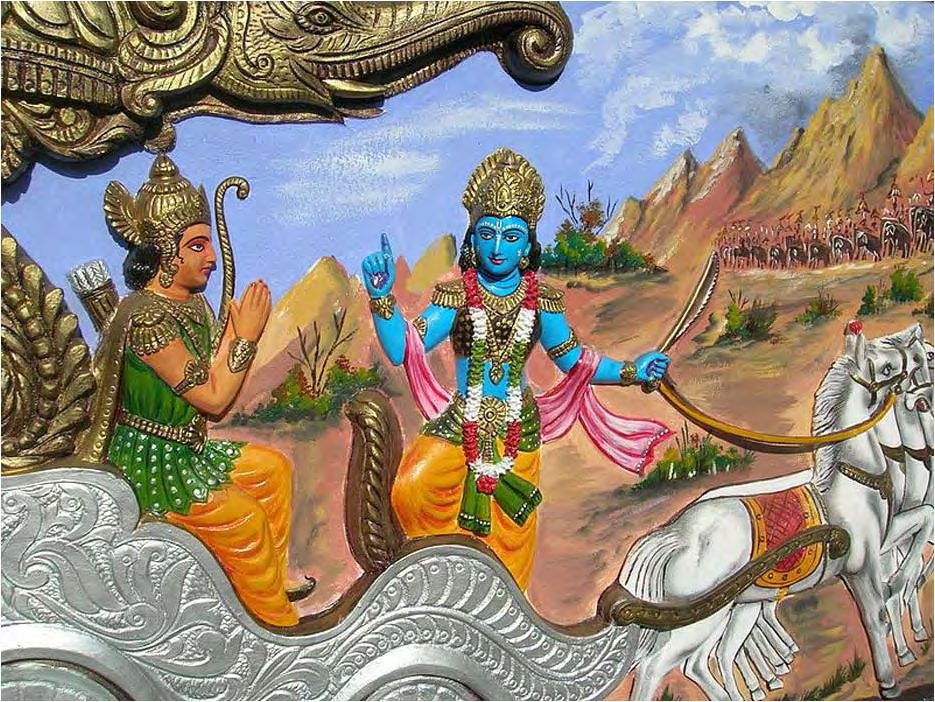
The Yoga of SBG is a message to an aspiring spiritual seeker (i.e. Sadhaka) that uplifts the Jiva (individual self), attempts to emphasize on the purpose of life as ‘God realization’ or Self-actualization and to be the best version of oneself. It is a tool that helps to discover one’s true potential and practice the presence of god in our life. The quintessential message of the Gita is that of a philosophy by which one contemplates on the transcendental absolute wherein the supreme lord chose to be a charioteer and become one with the human – i.e. the yoking or the Yoga (of the individual self with universal self – the Vaishvanara atman). This essence is best illustrated in the verse 18-78 where the purified individual self is seated along-side with the almighty in the ‘Chariot of the Cosmos’ and has been the hallmark of the iconography of SBG in popular art forms (Figure 2). This power of the supreme godhead as a perfect being (i.e. Purushottama) has withstood the test of time for several millennia. The Yoga is a tool that aids one to being a Stithaprajna (verse 2-54) and Kritatman (an individual with immense self-control). In the sixth chapter we realize through Dhyana Yoga that Atmavinigraha is the means for Atmasakshatkara. Whilst Yoga is the means to attain this union / yoking, it also encompasses the pre- conditions and pre-requisites necessary to achieve this purpose – no wonder why the sixth chapter is called Atma samyama yoga.
Patanjali has rightly observed that Yoga to be the cessation of thoughts / impressions arising from the mind, the SBG has succinctly captured the entire essence of its Samadhi pada in few verses of the ninth chapter [8]. SBG lays emphasis on Dhyana or Atmasamyama (i.e. meditation and self-restrain / self-control in thoughts, word and speech) as the principle meaning of Yoga. Dhyana like Yoga is also a Sanskrit non-translatable doesn’t mean just meditation. Several abstract teachings of the Upanishads are conveyed with subtle variances in a simplified manner with practical tips that would aid one in elevating the lower self. One’s level of attention is intimately correlated with his / her level of consciousness and levels of being. Our senses have their own limitations and the Yoga of SBG conveys that there exists something beyond one’s perception wonderfully in the eleventh chapter. The climax of the entire SBG happens in the middle (i.e. chapter XI) wherein Srikrishna satisfied with Arjuna’s unswerving devotion bestows upon him the divine vision for Arjuna to behold and see his cosmic form in its magnificent opulence (i.e. Vishwaroopa Darshana). Srikrishna being identified as a Yogeshwara is portrayed as a man of ‘Institutional action’ and an epitome of stillness (like a flicker-less candle in a windless place in verse 6-19) where all senses are under complete self-control [12].
Whilst Yoga means union, it also means separation / withdrawal from sense pleasures to attain one-pointed focus (i.e. Chitta ekagrata) by acquiring: Dispassion (i.e. Vairagya) and Discriminative capability (i.e. Viveka). The two faces of the coin of the Yoga of SBG are Abhyasa (repetitive and constant practice) and Vairagya. Yoga guides the journey of the ‘self’ to its purified / exalted state and merge one with the divine. The skill and dexterity with which this objective is achieved is Yoga (i.e. Yoga Karmasu Kausalam). The Yoga of SBG also advocated ‘Renunciation’ that needs to be understood correctly. It is not renunciation of action / efforts but that of i) the Will (i.e. sankalpa tyaga) and ii) the Fruits of action (i.e. karma phala tyaga). The sole purpose of action of Karma Yoga is for serving the humanity to the exclusion of everything else (i.e. Lokasamagraha). As one ascends in the path of spirituality, one realizes what first began from ‘action’ to be the means to finally ends up as ‘serenity’ to be the means. The causative force for every action is lack of serenity of the mind. With Yoga one is capable of cultivating tranquillity by controlling the mind and its thoughts. It is a method by which one gains by introspecting the self and discover the hidden significance between ‘action’ and ‘serenity’. The visual perception of movement is not always a criterion of the judgment of the nature of action as intense activity is still possible when the physical body is motionless. This philosophy is best illustrated in the tale of two birds of the Mundaka Upanishad wherein the higher bird that has transcended the ego and firmly established in the true ‘Self’ just looks whilst the lower bird is busy jumping from fruit to fruit on different branches tasting / savouring them! [20].
The Yoga of SBG is also a powerful antidote that drives away fear and insecurity. Path to excellence is not for one who conforms, toes the line or lives by others’ priorities, preferences, choices or concepts of what is right or wrong. When such retarding traits are allowed to make in-roads, one would cease to ‘grow’. In essence, it is fear, not merely of the unknown, but more so of what we are not even sure of which binds us to a vegetating and stagnating life. This is the fear, conceived of by Nobel laureate Gurudev Rabindranath Tagore, when he created that great poem in Gitanjali, commencing with the lines, “Where the mind is without fear” [21]. Fear is a big obstacle to all progress and is cited in at least two separate verses [2-56 and 5-28] of SBG. Srikrishna mentions that casting away all fear is the key to becoming a “sage of stable mind” (sthira-dheer-munihi) and to becoming “liberated” (jivanmukta). This ‘liberation’ is that “heaven of freedom”, the expression figuring at the end of Tagore’s poem. This concept has also been explained upon in the sublime philosophy of a popular short story of 1970s ‘Jonathan Livingston Seagull’ by Richard Bach pointing out that freedom is the “right” of every person, the very nature of his being. Jonathan, who is a bird (i.e. a seagull who is interested and focussed on mastering the art of flight) observes “Whatever stands against that freedom must be set aside, be it ritual or superstition or limitation in any form” [14].
Srikrishna advices Arjuna to take refuge in him in verse 9-22 ((Yoga kshema vahamy aham) by surrendering all his worries on to him with unswerving devotion by assuring that he will not only ensure the protection of what his devotees possess but also ensure all their needs are met. This key message is reiterated again in verses 9-44 and 18-66. In the SBG, several different terms: Yogarudha, Yogabrastha, Yogamaaya are quoted in few verses. Detailed explanations of these terminologies are beyond the scope of this article and we hope this monograph serves by providing a basic foundation to understand them better while reading detailed commentaries on the SBG elsewhere.
Swami Rama in his unique commentary ‘The perennial psychology of the Bhagavad Gita’ provides valuable practical suggestions for applying these concepts of Yoga into daily life and observed SBG teaches one how to handle sorrow / conduct oneself during phase of grief / vulnerability [22]. The sorrow of Arjuna in the first chapter is in reality that of grief to understand the purpose of life and its existence. All he had acquired as an accomplished warrior prince was that of the mundane / ordinary world (i.e sensory / rational / quantifiable and intellectual ones). When there is withdrawal / separation of all faculties of senses and intellect, can there be anything to gain / acquire / learn? SBG is that Yoga shastra that eradicates this darkness and Yoga here is that unique Jyothi (i.e. sparkle of radiance) that fills the void and completes an individual.
American behavioural psychologist Abraham Maslow is famous for his theory on ‘Heirarchy of needs’ that is best represented as a three-tired pyramid in Figure 3 [23]. The pyramid is composed of five steps: i) Food / water and rest / sleep; ii) Shelter and security (i.e. Basic needs); iii) Relationships and emotional support / well-being; iv) Self-esteem and wordly accomplishments that enhances one’s self-worth (i.e. Psychological needs) and v) Self- fulfilment needs – the pinnacle of discovering the meaning / higher purpose of life by being the best version of oneself and successfully working for the upliftment / betterment of society. The Yoga of SBG illustrates that spiritual life is stepping into a newer dimensions of living, navigating unchartered waters and different from the usual models of thinking either in social terms or at an individual level. Yoga perhaps is that master-switch synonymous with re-booting a computer that brings out an inner transformation and is not visible externally. A Yogi in this path leads an intuitive lifestyle whose understandings and feelings are yoked into making rational choices that benefits mankind. The process of self- actualization is a slow process and the Yoga of SBG prepares one in developing the needed psychological detachment. It asserts that the true renunciation is the transcendence of the notion of spatio-temporal externality in the omnipresence of god in our lives that aids in realizing the ultimate reality / truth. SBG’s teachings and concepts has withstood the test of time for several thousands of years that only the direct knowledge of ultimate reality and the ‘self’ brings Kaivalya (i.e. everlasting freedom / liberation and attainment of Nirvana).
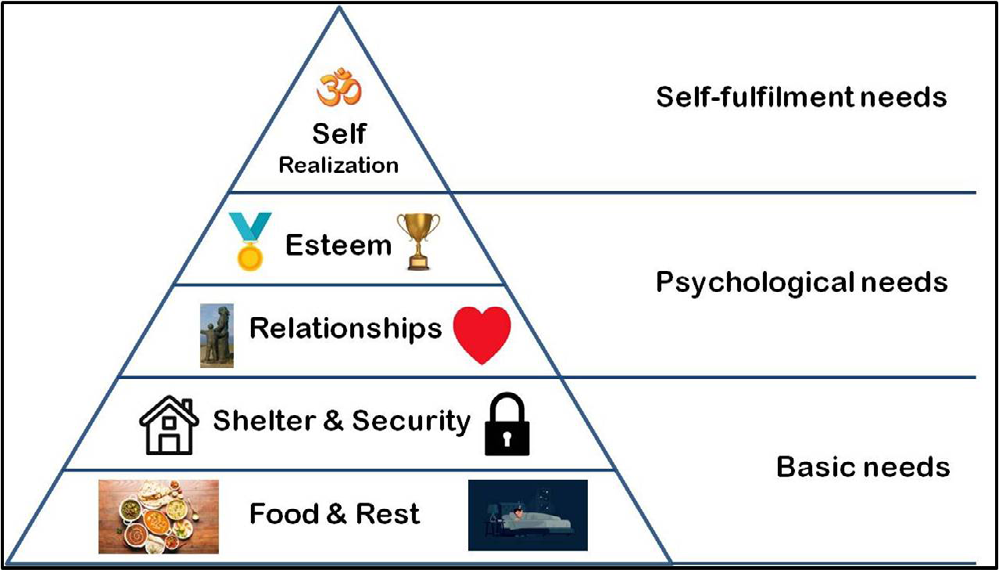
The Yoga of SBG is also the yoking of Jnana with Karma to attain equanimity. Human mind is incapable of grasping the truth of the whole situation. In-short, Yoga is not about spirituality but an internal cascade of transformation in consciousness that is not observable in physical world or quantifiable. There exists no validated test till date to measure an individual’s spiritual quotient (SQ) unlike intelligence quotient (IQ). This spiritual growth is begun initially by practicing Karma yoga and one acquires attributes of a Karma Yogi (Figure 4) that acts as a launch pad by creating favourable circumstances to practice Dhyana, develop Bhakti and attain the Tattva jnana. The Yoga of SBG explains that all actions are mental and physical action perhaps is a minor consequence / not real action at all. What binds (or liberates) is in the state of mind and not determined by the body. An individual firmly established in Yoga (i.e. Yoga-arudha) is indeed a true renunciate (i.e. Sannyasi) having cultivated ‘Sarva sankalpa sannyasa’ (i.e complete relinquishment of one’s individual will). Such a state of balance / tranquillity / steadfast being is firmly established in the nature of the ‘Self’ (i.e. the Atman / Brahman).
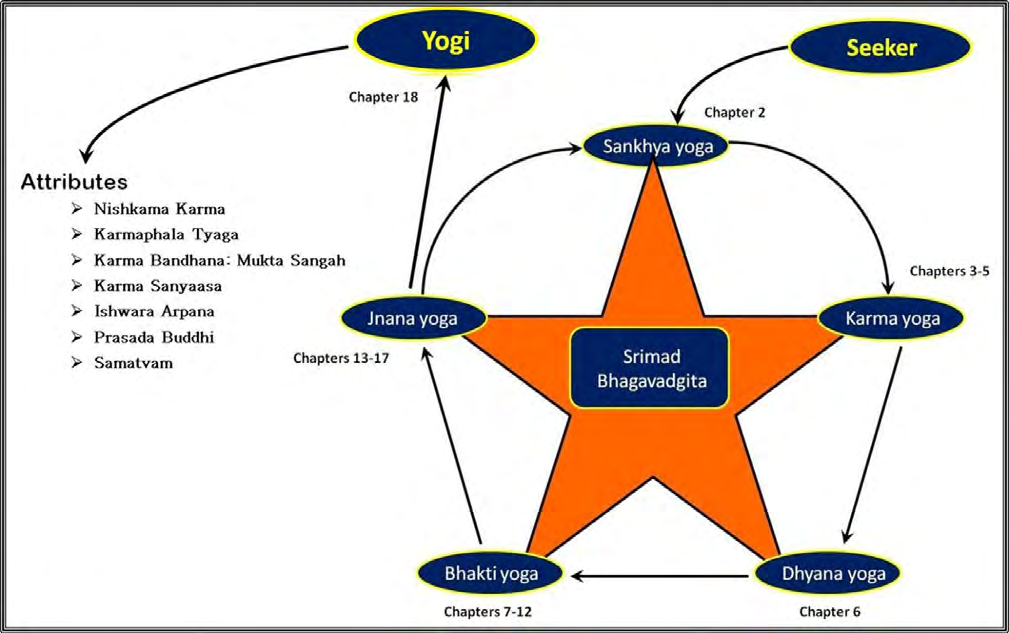
Each one of us is performing Yoga in many of its forms in our own unique way(s). An illustrative figure that depicts the path of the seeker (i.e. Sadhaka) and his transformation into a Yogi on studying SBG is highlighted in Figure 4. At the outset though it might appear to be a vicious cycle where one is entangled in the whirlpool of Sankhya – Karma – Dhyana – Bhakti and Jnana, it in reality is actually a ‘Cycle of Virtue’ akin to Srikrishna’s Sudarshana chakra that cleanses the soul / purifies the mind of Raga – Dvesha / Vritti / Klesha to elevate the individual self and become one with the supreme and Universal ‘Self’. Different schools of Indian philosophy may differ in their approach / paths to attain the ‘Self’. The non-dualists (i.e. Advaita vedantins) firmly believe that it is ignorance the prime cause and knowledge alone liberates by eradication this delusion / Maya revealing efflugent bliss [24]. The dualists (i.e. Dvaita and Vishitadvaita) believers advocate and emphasize the path of Bhakti or devotion seeking the grace of divine with faith and surrender to purify their inner self and attain emancipation [25]. The Shaakta / Tantric school acknowledges the vulnerability of lower self to fall prey to temptations and commit sins [26]. They believe in using the same sins as a launch pad to attain liberation invoking the strength and courage of the feminine divine (i.e. the Shakti) by living through them and emerging triumphant overcoming them successfully. In-short Srikrishna summarizes in verses 4-11 and 9-26 by stating that devotees are free to worship him how so ever they wish and by making any offerings of their choice. He happily accepts them, is accommodative and responds to everyone in an appropriate manner without any discrimination.
S Aurobindo’s ‘Essays on the Gita’ written in early 20th century is a masterpiece that asserts that SBG offers interpretation of various paths of Yoga (i.e. Karma / Bhakti / Jnana / Dhyana and Buddhi) attempting to reconcile the integration of dualist and non-dualist schools by coining the term ‘Integral Yoga’ [27]. The practice of Yoga is no less than warfare by itself and no wonder why it was preached on a battlefield in Kurukshetra. It recommends us to overcome Vaasanas and transcend dualities by cultivating a one- pointed mind (i.e. Chitta ekagrata). It calls us to abandon our ignorance and go after eternal bliss as any / all material possessions are temporary / short-lived that does not provide ever-lasting peace / contentment. This is a Yoga shastra of Brahma vidya (i.e. science of supreme reality or ultimate truth). It is through this Yoga of SBG wherein the ascent of the self is facilitated by its 18 chapters to realize the supreme godhead. A degree of faith and surrender are quintessential in attaining this objective. A reader / seeker who has reached till here reading this monograph only means he / she has transcended the reality of ordinary learning and begun to tread on the ‘Path of Yoga’. When one lives and conducts oneself in the awareness of supreme reality, no wonder anything other than victory, peace, prosperity and establishment of Dharma is a foregone conclusion.
Finally this monograph is not without its limitations. We made an earnest endeavor to identify all verses / phrases in the SBG that contained the word ‘Yoga’ and its soundex. Despite best efforts some verses / phrases may have been overlooked / missed their inclusion. Any error(s) or mistake(s) is due to our own lack of understanding / lacunae or gaps in in-depth knowledge and insight that is required to undertake such a herculean task for beginners like us. Several Sanskrit non-translatable words are used at appropriate places and their meanings may have been left out to adhere with the word count limit. Ultimately the true meaning of Yoga is only known to the Yogeshwara himself (i.e Srikrishna – the lord of Yoga) and this article is the modest attempt of two mortals in attempting to enunciate it in this form fuelled by our limited understanding of his teachings.
Conclusion
To conclude, we have created Table 3 that lists the ‘Top Ten’ important catch phrases (few of which are famous and well-known) that summarizes the essence of Yoga across the entire breadth of SBG’s 18 chapters to assimilate the key message for individuals who are pressed for time (or are busy) and aid those with short attention span. In-addition a comprehensive the ‘Ten’ key generic messages of this monograph is also summarized below:- 1) Every true friend is a glimpse of god
2) When ego dies, the soul awakens 3) The worship of god is in our attitude towards other people 4) The best way to purify one’s mind is through selfless service (i.e. Nishkama karma) 5) When the mind is still, truth gets the chance to be heard in the purity of Silence 6) Every victory gained over oneself means new strength to gain more victories 7) Earth has no sorrow that God in the heaven cannot heal. 8) Learn from the best so that one day, you can become that Best! 9) The greatest obstacle to Bliss (i.e. Ananda) is delusion (i.e. Maya) 10) Real knowledge is to know the existence of one’s ignorance.
Declaration
Conflicts of Interest: None. Acknowledgements: We would like to acknowledge our friends and well-wishers for their invaluable feedback on reading this manuscript prior to its submission for publication. Funding: None sought from any organization / regulatory body (i.e. not applicable).
References
-
White DG (2012) Yoga, Brief History of an Idea. Yoga in Practice 5(1): 1-23.
-
Satyananda S (1996) Asana Pranayama Mudra Bandha. Yoga Publications Trust.
-
Dasgupta S (1975) A History of Indian Philosophy. Motilal Banarsidass Publishers.
-
Vasudev J, Subramaniam A (2017) Adiyogi - The source of Yoga, HarperCollins Publishers.
-
Radhakrishnan S (1994) The Principal Upanishads. HarperCollins Publishers.
-
Larson GJ (2008) The Encyclopedia of Indian Philosophies: Yoga: India’s philosophy of meditation. Motilal Banarsidass Publishers.
-
Shastri JL (1973) The Linga-Purana: Parts 1 & 2, Motilal Banarsidass Publishers.
-
Bryant E (2009) The Yoga Sutras of Patañjali: A New Edition, Translation, and Commentary. North Point Press.
-
Sukthankar VS, Belvalkar SK (1919–66) Critical Edition of The Mahabharata: The Bhandarkar Oriental Research Institute (BORI).
-
Chinmaya International Foundation (2007) Holy Gita, ready reference: a compendium of questions and answers with an alphabetical index of the padas and Gita astoottarasata namavali. Central Chinmaya Mission Trust.
-
https://ebooks.iskcondesiretree.com/pdf/00_-_More/ Bhagavad_Gita_As_It_Is-Only_Shlokas.pdf.
-
Agarwala BK (2021) Desireless action in the Bhagavad Gita. Journal of the Indian Council of Philosophical Research 38(1): 53-82.
-
Saraswati SD (2019) Visnusahasranama (A Detailed Commentary on the Vishnu Sahasranama). Arsha Vidya Research and Publication Trust.
-
Bach R (1972) Jonathan Livingston Seagull. Harper Thorsons.
-
Joshi KS (1965) On the meaning of yoga. Philosophy East and West 15(1): 53-64.
-
Dantu M (2019) Bhagavad Gita and Yoga. International Journal of Yoga and Allied Sciences 8(2): 148-151.
-
Turci R (2021) The yoga of the Bhagavad Gita: Spirituality, meditation, and the rise of a new scientific paradigm. Handbook of Research on Evidence-Based Perspectives on the Psychophysiology of Yoga and Its Applications, pp: 85-102.
-
Prem SK (2008) The Yoga of Bhagavat Gita. 2nd (Edn.), Morning Light Press.
-
Lakshmanjoo S (2015) Bhagavad Gita: In the Light of Kashmir Shaivism. 1st (Edn.), Lakshmanjoo Academy.
-
Saraswati SC (2018) Mundakopanishad (Tale of two birds Jiva and Ishvara). Central Chinmaya Mission Trust.
-
Tagore R and Yeats WB (2000) Gitanjali: Song Offerings. Mineola, Dover Publications.
-
Rama S (2000) Perennial Psychology Of Bhagavad Gita. Himalayan Institute Press.
-
Maslow AH (1943) A theory of human motivation. Psychological Review 50(4): 370-396.
-
Saraswati SD (2015) Bhagavad Gita home study course: Vol 1–9. Arsha Vidya Research and Publication Trust.
-
Sharma BNK (1989) Bhagavad Gita Bhashya of Sri Madhvacharya. Anandatirtha Prathistana, Poornaprajna Vidyapeetha.
-
Samuel G (2008) The Origins of Yoga and Tantra. Cambridge University Press.
-
Aurobindo S (1922) Essays on the Gita. Aurobindo Ashram.
- The Place of Wittgenstein’s Tractatus in the History of Philosophy
- Digital Hermeneutics Embodied in Brian Kim Stefans’ “The Dreamlife of Letters,” and Memory: Analog to Flash Interface in the Light of Ecofeminism
- Using C-Tables to Teach Class Logic
- The Ideology of Education’s Postponed Fantasies: Deepenings on a Pressing Problematic
- Phantasia and Perceptual Realism in Aristotle
- The Pleasures of Solitude