
Transformational Leadership’s Influence on Teacher Well-Being in International Schools
Teachers working and living in foreign countries often rely upon the international school community to offer the support and stability customarily provided by their home environments. This study explores the influence of leadership philosophy on teacher well-being and describes the transformational leadership behaviors that support a healthy school climate. By developing the skills and behaviors identified in this study, transformational leaders in international schools can decrease teacher stress and increase commitment and job satisfaction. The study highlights individual consideration as a relevant component of transformational leadership theory. This research study was conducted in an international school in Thailand and consisted of a mixed- method case study approach with fourteen elementary school teachers. Data was collected through a Likert-scale survey with free response options and examined through interpretive qualitative analysis. Preliminary conclusions of the study include specific behaviors that transformational leaders can utilize to reduce the primary causes of teacher stress and positively influence teacher well-being.
Introduction
Transformational leadership is prevalent in international schools primarily because of the positive expectations it affords teachers. Transformational leaders empower, encourage, and trust teachers to do and be their best by taking stock and accountability for teacher well-being and development. They acclimate well to an international environment because of the leader’s ability to work with people from varying backgrounds and navigate the complexity of their schools.
Teachers working in schools that embrace transformational leadership feel nurtured and valued, allowing them to develop into dedicated, high-performing educators.
The pursuit of well-being has become an increasingly popular topic for educational researchers and leaders. Even before the widespread impact of the COVID-19 pandemic, teachers endured long working hours in demanding and pressure-filled conditions. Teaching has long been considered a physically and mentally taxing profession and even identified as one of society’s most stressful occupations [1, 2, 3]. Teachers that endure job-related stress experience feelings of anger, anxiety, tension, frustration, and depression [4], regardless of whether they are working in their home countries or abroad.
Larrivee [5] states that stress occurs when “your usual way of doing things is inadequate for the demands of the situation” (p.10). She argued that “the nature of the teaching profession places unrelenting demands on a teacher while offering diminishing resources” (p. 6). Demands referenced include increases in workload, time pressures, a lack of autonomy, a stifling of teacher creativity, and imposed government mandates, all of which Larrivee [5] identified as damaging teacher motivation and performance while increasing stress levels and burnout.
Living and working outside the comfort of their home country, international teachers add additional factors that can intensify and increase work-related stress. For many international educators, the additional pressures of working in a foreign environment add to elevated stressful situation. Halicioglu [6] found that when teachers change location, colleagues, and culture, they experience different student demographics and parental expectations leading to “the loss of familiar signs and symbols that may have a significant impact on their professional satisfaction and personal happiness”.
Teacher Wellness
Various studies indicate that teacher well-being is an essential issue for transformational leaders to address when shaping a school climate. When left unchecked, emotional stress and pressure have damaging effects that impact the individual teacher and negatively impact colleagues, students, and the organization. School leaders who fail to place value on their teachers’ well-being face professional relationships and collaborative conditions that are less effective and decrease the team’s overall performance [7]. Transformational leaders, conversely, actively seek to place teacher wellness at the top of their priority list, ensuring that teachers are supported in ways that enable them to teach effectively and ensure student growth. Liu, et al. [8] identified that within the 21st century workplace, taking a transformational philosophical approach to school leadership means considering the “psychosocial work environment issues that are of current concern for employee well-being and occupational health” (p. 455).
Larrivee [5] defined teacher well-being as requiring a balance of harmony between body and mind, an absence of suffering within the realms of pressure and stress, and possessing a “state of mind in which you are not languishing in life; you are flourishing” (p.166). Margolis, et al. [9] further described well-being in terms of an individual’s innate desires to accomplish personal goals and reach one’s potential. They identified such aspects of well-being within education as being grounded in “physical, emotional, mental and spiritual contentment” (p. 393). When considered in an educational context, teacher wellness includes the harmony created when mind and body are in balance. However, there is also a professional element and a need for stimulation and purpose in their work. With over a third of teachers self- assessing as either stressed or extremely stressed (p. 1190) [10], teachers face high-pressure situations daily, exhausting their emotional resources. Well-being is an emerging topic for educational organizations to consider, as it directly impacts teacher performance and health.
Employee well-being within educational contexts has become an increasingly popular topic in recent research due to organizations facing increased teacher absences, high turnover, low morale, and motivation. Margolis, et al. [9] categorizes these negative teacher states as being caused by inattention to the topic of well-being in schools (p.392). Their research concluded that too much blame has been placed on teacher character, while not enough attention has been directed towards the various situational contexts which impact the work lives of teachers. Furthermore, they identify that teacher well-being acts as a mediator to institutional well-being, further emphasizing its importance within educational organizations. Teacher well- being was identified by Bubb and Earley [11] as being of prime importance if educational standards and the experiences of students are to improve, stating that “teachers suffer greater levels of stress than comparable occupational groups” (p.10).
Wellness and Teacher Effectiveness
It comes as no surprise that research has found that well-balanced and mentally healthy teachers outperform their stressed, overworked, and undervalued colleagues. Furthermore, there is a direct correlation between teacher motivation, retention, and efficacy, as self-efficacious teachers are more satisfied with their job and motivated to perform [1], which are key outcomes and behaviors of teachers with transformational leaders. Not only will these attributes lead to improved student performance, but satisfied and motivated teachers are also more likely to stay longer at their schools. Guest, et al. [12] fortified this argument, identifying that employee well-being leads to increased “performance, commitment, and intention to stay as long as possible with the organization” (p.21).
Well-being does not just affect teachers and their colleagues, but it also plays a role in influencing the experiences and interactions that students have in the classroom. Anderson [3] found that teacher well-being influences student well-being, stating that their teachers’ energy and attitudes largely shape the moods and attitudes of students about school. Teachers who experience stress and lack attention to their own well-being become emotionally disconnected from their students, causing them to increase student levels of stress and anxiety [3]. As a result, teacher well-being impacts student relationships, levels of self- efficacy, and organizational efficacy.
Stress and Leadership
Research conducted by Bubb and Earley [11] found that educational leadership directly influences teacher workload, stating that successful educational reform depends on the strategic value of the human resource. They found that “teachers need time to reflect on their work, plan lessons, develop skills and knowledge, and interact with colleagues” (p.3), highlighting the issue that unmanageable workload inhibits a teacher’s ability to teach effectively and manage levels of professional stress. With seven tasks consuming most of the teacher’s time, including instruction, preparation, grading, parent contact time, school/staff management, administrative tasks, and individual/professional development, school leaders can prioritize resources that maximize teacher efficiency and capacity. Workload and well-being are closely related, and teachers must find a healthy balance that enables them to teach effectively, with adequate support from school leaders.
Stress is a direct result of an individual’s subjective interpretation of external pressures that cause an emotional response [7]. Many issues stem from prolonged periods of stress and a lack of well-being within the workplace [3, 13]. For example, Guest, et al. [12] found absenteeism and employees resignations as issues directly caused by mental health and stress-related problems. In addition, they identified growing job demands, insecurity, and unpredictable change as factors that increase stress among employees. Guest, et al. [12] define well-being within the workplace as “freedom from mental and physical harm,” noting that “well‐being will be manifested in an absence of negative experiences” (p.21). As a result, from both a moral and professional standpoint, leaders should commit to reducing the damaging effects of stress by improving the working climate and developing a balanced work environment.
Transformational Leadership
Transformational leaders validate the needs and feelings of followers with genuine interest and concern. They provide personal care and attention to develop trust between community members and school administrators. Transformational leadership theory includes Bass and Riggio’s [14] four components, known as the four I’s: idealized influence, individualized consideration, intellectual stimulation, and inspirational motivation. Each of the I’s can be utilized to influence and increase teacher well-being [8]. The four I’s include:
- Idealized influence represents the leader’s ability to develop trust and respect. The leader’s behaviors and characteristics affect their ability to provide a positive role model and impact employee well-being [15].
- Inspirational motivation represents the leader’s ability to build a positive organizational culture based on effective collaboration and collective efforts towards meaningful, common goals.
- Intellectual stimulation which represents the leader’s ability to create a climate that encourages positive behavior between teachers as professionals and supports a culture that welcomes diverse opinions, autonomy, trust, creativity, and shared decision-making.
- Individualized consideration, as the primary focus of this study, is most closely associated with teacher well-being. Individualized consideration involves the leader’s ability to recognize the professional strengths of the individuals in the organization and add value to their well-being through empathetic attitudes, feelings, and behaviors [8].
Transformative and other collegial models of leadership prevail in international schools to face unique challenges. The first challenge is the multicultural literacy of school personnel. When looking to employ a foreign teacher, it can be problematic to determine the multicultural literacy levels of candidates through their resumes alone. Ospina and Medina [16] noted that living overseas requires a mindset that is open to being uncomfortable, including “embracing the changes and uncertainties of their new lives” (p. 39). Finding teachers who can take risks and adapt is difficult through current hiring practices. The second challenge is the transient nature of international school communities. International educators, and the families they serve, often relocate which leads to issues with long-term faculty investment and the effectiveness of school initiatives. Garder-McTaggart [17] concluded that “transience is a real, debilitating problem for international schools.” To face the challenges present in international schools, one of the components of transformational leadership, individualized consideration, focuses primarily on the well- being of teachers. Individualized consideration allows for growth in areas like multicultural literacy and encourages participation from all teachers, regardless of the length of their tenure. A relevant takeaway from Garder-McTaggart’s research was that transformational leaders are in high demand due to their effectiveness in nurturing teachers and students. Actively listening to teachers and collaborating with them to find solutions is critical to providing permanence and cultural competency in international schools.
Individualized Consideration
In terms of influence on teacher well-being, individualized consideration is the primary aspect of transformational leadership. Individualized consideration enables leaders to recognize the professional strengths of their staff and encourage them to focus on the personal well-being of their teachers [8]. Leadership behaviors that offer favorable, affective responses to the feelings and needs of individuals form the foundation of individualized consideration.
Other aspects of individualized consideration include leaders being thoughtful, showing feelings of empathy, making themselves available, having regular conversations, and providing support and opportunities for personal growth, all central features of Figure 1.
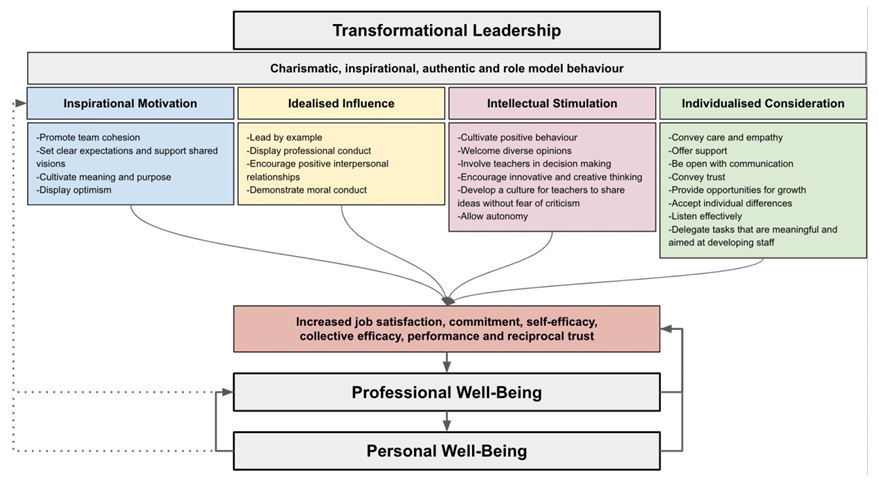
Note. The model includes a feedback loop, presenting a leader’s ability to implement the four I’s of transformational leadership is increased through their involvement in improving teacher well- being. This feedback loop is illustrated using dotted lines and reflects Paais and Pattiruhu’s [18] research into leaders improving their own leadership abilities by increasing employee commitment, trust, and job satisfaction. The vicious and virtuous cycles found within the relationships and outcomes of leadership and teacher well-being act as a useful theme for further research. From A. Procter, Leadership approaches that support teacher well- being. A case study within an international primary school in Thailand, 2021 [19].
A theme within the literature related to individualized consideration is the transformational leader’s ability to encourage self-awareness and support growth. Larrivee [5] found that a self-aware leader provides teachers with professional development opportunities as a stress management strategy. Stress management, in this fashion, aligns with transformative leadership philosophy that recognizes the importance of individual needs. A crucial aspect of self-awareness involves teachers recognizing that they need to maintain a work- life balance, putting their well- being at the forefront, which Bubb and Earley [11] argue is imperative if teachers remain motivated and satisfied.
Furthermore, it has been proposed that teachers need to make time for their well-being and relationships with friends and family, which enhances “the good health needed to be great teachers” (p.7) [3]. Teachers who fail to acknowledge and nourish their well-being will find it more challenging to help others, most notably their students [3]. Self-care and the assistance of others are significant responsibilities for international teachers who can live and work long distances and many time zones away from their own family and friends.
The prevalence of transformational leadership in international schools and its positive influence on teacher wellness led researchers to pose the following questions to drive the inquiry of this study.
Research Questions
- In what ways do transformational leaders influence the wellness of international school teachers?
- How can leaders engage in behaviors that promote teacher wellness in international school settings?
Methodology
This research is a case study designed to gather perspectives and evidence from the teachers working in an international primary school in Thailand. Hitchcock and Hughes [20] state that research based on reflection and criticism can improve professional practice directly. For professionals to have the opportunity to play a part in creating new knowledge or uncovering new understandings, it is imperative that they critically reflect on their professional situation and practices to identify the aspects that they feel need improvement. This process provides the foundational approach to this study.
Fourteen self-selected teachers comprised the study participants, and data was collected through an online survey. A mixed-method approach to data collection led to an interpretive data analysis paradigm. The empirical study into the specific social science related to well-being guided the development of a theoretical framework. It also informed how the data was gathered, analyzed, and supported the relevant literature in this area.
Hitchcock and Hughes [20] identified two dominant models of social research that were taken into account when planning and selecting the data collection methods for this study. The first model was the positivist paradigm, which primarily collects quantitative data and is strongly associated with traditional scientific research procedures. The second model was the interpretive paradigm, defined as researchers describing discoveries instead of discovery itself. Bell and Waters [21] advised that when selecting the methods for collecting data, researchers start by considering what they need to know and why. This case study aimed to further understand and gain insight into the perceptions of well-being and the leadership behaviors that influenced well- being. The relationship between these two factors warranted a cause-and-effect style research approach to identify the causes and effects of teacher well-being.
The data that features within this study was primary- sourced. Although the research contained elements of quantitative data, the key aim was to obtain qualitative data that elicited a clearer picture of the opinions and experiences of teachers. The researchers developed the survey instrument and piloted it prior to distribution to the participants. Table 1 displays a quantitative example of part of the survey instrument.
| Part 3: Personal Well-Being | |||||
|---|---|---|---|---|---|
| Indicate the level to which the following factors contribute to the category | |||||
| Low | Moderate | High | Very High | ||
| Causes of Stress | |||||
| Student behavior | |||||
| Teaching students with | |||||
| mixed abilities | |||||
| Workload | |||||
| Job security | |||||
| Interactions with | |||||
| students’ parents | |||||
| Influences on Well-being | |||||
| Relationship with | |||||
| colleagues | |||||
| Trust among colleagues | |||||
| Relationship with | |||||
| students | |||||
| Sense of belonging and | |||||
| agency within the | |||||
| organization | |||||
| Being recognized for the | |||||
| things you do | |||||
| Your personal sense of | |||||
| self-efficacy |
Table 1: Part 3 of Well-Being Survey.
Results
The online questionnaire resulted in both qualitative and quantitative data that provided what Franklin [22] referenced as being “suitable when a researcher is looking to capture attitudes, opinions, or gain insight into how people behave” (p.171). The data collection consisted of one phase and three sections. The first section collected the participants’ demographic information, including their age, gender, number of years teaching, and number of years teaching internationally. The second part targeted data related to the participants’ experiences and opinions of their professional well-being and perception of leadership influences. Finally, the third section was constructed like the second part, except perceptions related to personal well-being were targeted.
The fourteen participants included a mixture of homeroom teachers, ‘English as an Additional Language’ teachers (EAL), team or support teachers, and specialist subject teachers, including music, art, physical education, computer technology, Chinese, and Thai. The homeroom teachers were citizens of Canada, England, and the United States. The EAL, team, and specialist teachers were citizens of the Philippines, Thailand, and China.
Demographics
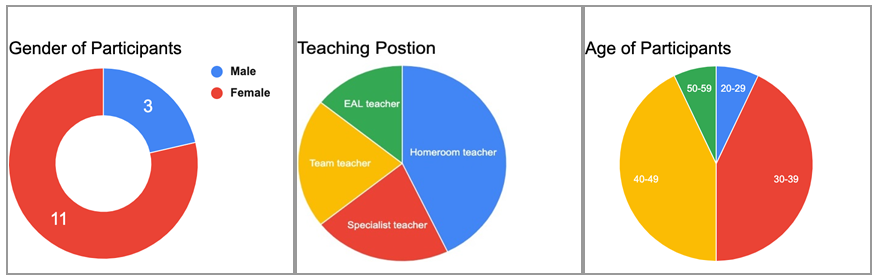
Study participants included three male and eleven female teachers who worked in positions of homeroom teachers (6), specialist subject teachers (3), team teachers (3), and EAL teachers (2). The ages of participants included six in their thirties, six in their forties, one in their twenties, and one in their fifties. Figure 2 displays the demographic data of the participants.
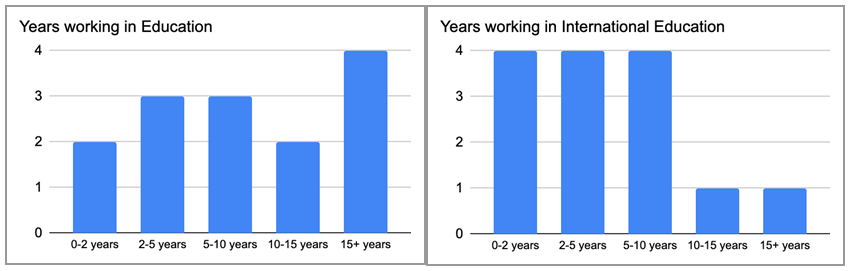
The participants’ years of experience working in education were varied, ranging from less than two years to more than fifteen years. The participants’ years of experience working in international education also varied;
however, most of the participants (12) had under ten years of international education experience. Figure 3 shows the experience of the study’s participants.
Well-being and Stress
The survey asked participants to identify how strongly they agree with the following statement: It is a leader’s responsibility to consider my professional well-being_. Out of fourteen participants, the majority (9) either agreed (3) or strongly agreed (6) with the statement. The remaining participants voted for neutral (3), disagree (1), and strongly disagree (1). Participants were also asked to identify how strongly they agree with the following statement: My professional well-being affects my life outside of the workplace._ Of the fourteen participants, the majority of the participants (11) either agreed (3) or strongly agreed (8) with the statement. The remaining participants voted for neutral (1), disagree (1), and strongly disagree (1). The results of these responses are shown in Figure 4.
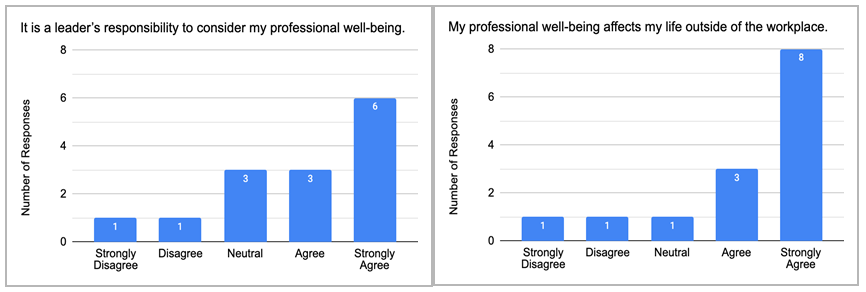
Figure 4’s results align with Danna and Griffin’s [23] research, which found that general health was one of the main factors related to stress. Anderson [3] found poor health resulted in adverse effects on teachers’ personal relationships, which hinders their ability to teach effectively, another theme that emerged from the study. Despite limited coverage in recent literature, finances featured predominantly in this sample. Various participants stated salary and finances as factors that influence their personal and professional well-being. These results indicate that financial security may be a contextual issue and in need of addressing by this particular institution.
Participants were asked to explicitly identify the factors that cause stress within their current workplace. The themes that emerged from the participants’ responses included behaviors by school administrators and families and a professional environment that included the presence of bias, miscommunication, poor work conditions, and organization mismanagement. Table 2 contains in Vito data from individual responses and is organized by theme.
| Themes | Participants’ Responses |
|---|---|
| Administration | Disconnect between upper management and teachers |
| A lack of support in decision-making | |
| A lack of support in the classroom | |
| Demanding superiors | |
| Unrealistic expectations | |
| Lack of organization and function | |
| Families | Families Too much parent involvement |
| (Parent) complaints met with no support | |
| Demanding parents | |
| Unresponsive parents | |
| Bias | Power imbalances |
| Different expectations for different teachers | |
| Bias that isn’t being addressed | |
| No fixed salary scale and benefits, comparison between colleagues, selfish | |
| networking, and connections. | |
| Favoritism. | |
| Communication | Limited financial transparency |
| Disagreements | |
| Not being heard | |
| Disorganization | |
| Unclear chain of command | |
| Conflict with co-workers | |
| Lack of communication | |
| Conditions | Time constraints |
| Insufficient time to plan | |
| Too many activities planned within a month | |
| Disruptive students | |
| Organization | High turnover rate of co-workers and admin |
| Lack of goals |
Patterns in the data indicate that various negative relationships lead to stress, reflecting the ideas presented by Klusmann, et al. (p.703) [4] regarding emotional exhaustion, depersonalization, and reduced personal accomplishment. Anderson [3] and Cigala, et al. [24] highlight the importance of professional learning communities to promote effective communication and positive relationships amongst staff. As a result, teachers do not feel isolated and can develop collaborative skills that enable them to work toward a shared goal. Additionally, a safe environment emerges where teachers can work confidently within a team, improving professional relationships and helping to develop a strong sense of collective efficacy, which, as Cooper [13] noted, directly influences well-being.
The research methodology utilized in this research was effective at identifying answers to the research questions:
- In what ways do transformational leaders influence the wellness of international school teachers?
- How can leaders engage in behaviors that promote teacher wellness in international school settings?
The fundamental aim of this research was to identify how school leaders can support teacher well-being and subsequently identify the associations between professional and personal well- being and teacher stress and the reciprocal relationships between these facets.
Discussion
This study highlights a leader’s influence on teacher stress and well-being. As a result, international school leaders looking to promote a transformational school climate should familiarize themselves with the study’s conclusions.
- Transformational leadership increases commitment, performance, reciprocal trust, self- efficacy, and collective efficacy.
- Through transformational leadership, increased commitment, performance, reciprocal trust, self-efficacy, and collective efficacy influences teachers’ professional well-being.
- Professional well-being impacts personal well-being and teacher performance.
- Personal well-being has a reciprocal effect on professional well-being and performance.
- Personal and professional well-being have a reciprocal effect on the level of commitment, performance, reciprocal trust, self-efficacy, and collective efficacy that teachers experience.
Transformational leaders looking to improve their skills can consider three themes: (1) consideration, (2) communication, and (3) support. Leader consideration includes empathy and a willingness to work to reduce workload and causes of stress. For example, teachers felt they could perform more effectively when provided sufficient time to plan and reflect. Additionally, teachers experienced increased job satisfaction when the work and assigned tasks allowed them to develop their practice and student growth. Leaders aiming to reduce stress within the workplace can also demonstrate care and empathy by aiding teachers in their recovery who are recovering from stress-induced illnesses [25]. Finally, a leader’s sense of care demonstrates to the broader school community that staff is valued and a top priority for an organization, which increases loyalty and retention.
The leader’s perceived skills in effective communication emerged as an indicator of trust and respect. “Trust decreases organizational fear and encourages the risk-taking that provides the opportunities for others to be leaders” (p.62) [26]. Trust and care are aspects of individualized consideration, which, as targeted in this study, play an essential part in establishing and maintaining teacher well- being.
Leader support described leaders putting a priority on the development of teacher self- efficacy. This emphasis promotes “levels of personal accomplishment, commitment, and job satisfaction” (p.1007) [1]. Furthermore, teachers with low levels of self- efficacy are more likely to experience emotional exhaustion, reduced job satisfaction, and stress, which ultimately results in them leaving the organization [1]. If leaders can develop self-efficacy among their teachers and encourage collaboration and a climate of learning together, not only will teacher performance and student outcomes improve, but so will the overall organizational culture of the school. The three transformational leadership themes and the supporting participant data can be found in Table 3.
| Theme | Participants’ Responses |
|---|---|
| Consideration | Be thoughtful and reach out if needed. |
| Show feelings of empathy and respect for individual preference. (Display) equal respect | |
| Provide an encouraging working environment, justified, and multi perspective. | |
| Address concerns in a proactive manner Checking in with teachers. | |
| Leaders need to be outspoken in their recognition of personal stressors, taking necessary breaks, and providing non-professional opportunities for reflection. Understand some limitations such as wages and working hours. | |
| Providing opportunities for training and development – whether work or resilience-related. Offering mentoring or a support system | |
| Communication | Easy to approach |
| Making themselves available and promoting a safe space for sharing input and ideas. | |
| Positive reinforcement and an asset-based approach to teaching staff. Listen to reasons before deciding on a solution. | |
| Increase positive communication amongst the team. Open and understanding. | |
| Having regular conversations. Professional | |
| Enabling teachers to feel seen and heard. Transparent. | |
| Listening to concerns and being understanding. Open communication. | |
| Open to conversation about personal well-being. | |
| Support | Addressing concerns in a proactive manner. |
| Seeing and knowing what is happening within the classrooms. Backup to higher admin and parents. | |
| Provide adequate advice and support. | |
| Trust and believe in the work of the personnel in the organization. Follow up and update on best practices. | |
| Encourage personal and professional growth as well as support long term goals. | |
| Encouraging positive behavior, giving constructive feedback, being strict with difficult students or parents. | |
| Offer regular support, give regular feedback on teaching practices, provide opportunities for professional growth, assume positive intent. | |
| Encouraging and positive relationships. Promoting a healthy work culture. | |
| Possess a feeling of empathy, respect, and trust. |
Table 3: How Leaders Promote Teacher Well-Being.
In conclusion, positive teacher well-being nurtures the well-being and development of students, therefore “if we try to put others’ needs before our own, not only will we not make it, but neither will the ones we are trying to help” (p.7) [3]. International school leaders and teachers can take care of their well-being by contributing to the well-being of others. Well-being must be a priority for transformational schools that want teachers to perform at their best and maintain healthy balance and wellness [27, 28].
Limitations and Recommendations
Certain restrictions and school closures made it challenging to facilitate face-to-face interviews and focus group meetings; however, the quality of the data gathered through the online survey was deemed appropriate for the scope of the study. Additionally, bias was also a prominent issue within this research as both authors were employed at the school throughout the duration of the study.
Transformational leadership notes that leaders should delegate tasks and duties to alleviate stress and develop skills within their teachers by considering teachers’ individual skills and needs. Nevertheless, some participants insisted that equity in task assignment is more critical than recognizing the skills or needs of each individual. This inconsistency indicates a potential conflict between the expectations of this study’s participants and past literature on transformational leadership theory, providing another consideration that potentially warrants further consideration and attention.
This research aims to be useful for international school educational leaders who aim to create transformational school cultures. Although the research took place within a specific context, the findings and literature are relevant and transferable to other educational organizations. There are immediate and practical steps and follow-ups within this case study that deserve further attention. Additionally, there are areas within this research that would benefit from follow-up interviews to gain further and deeper insights into teacher well-being.
References
-
Zee M, Koomen HM (2016) Teacher self-efficacy and its effects on classroom processes, student academic adjustment, and teacher well-being. Review of Educational Research 86(4): 981-1015.
-
Huang S, Yin H, Lv L (2019) Job characteristics and teacher well-being: The mediation of teacher self-monitoring and teacher self-efficacy. Educational Psychology 39(3): 313-331.
-
Anderson M (2010) The well-balanced teacher: How to work smarter and stay sane inside the classroom and out. Association for Supervision and Curriculum Development (ASCD).
-
Klusmann U, Kunter M, Trautwein U, Lüdtke O, Baumert J (2008) Teachers’ occupational well-being and quality of instruction: The important role of self-regulatory patterns. Journal of Educational Psychology 100(3): 702-715.
-
Larrivee B (2012) Cultivating teacher renewal: Guarding against stress and Burnout. Rowman & Littlefield Education.
-
Halicioglu ML (2015) Challenges facing teachers new to working in schools overseas. Journal of Research in International Education 14(3): 242-257.
-
Spilt JL, Koomen HM, Thijs JT (2011) Teacher wellbeing: The importance of teacher–student relationships. Educational Psychology Review 23(4): 457-477.
-
Liu J, Siu OL, Shi K (2010) Transformational leadership and employee well-being: The mediating role of trust in the leader and self-efficacy. Applied Psychology 59(3): 454-479.
-
Margolis J, Hodge A, Alexandrou A (2014) The teacher educator’s role in promoting institutional versus individual teacher well-being. Journal of Education for Teaching 40(4): 391-408.
-
Collie RJ, Shapka JD, Perry NE (2012) School climate and social–emotional learning: Predicting teacher stress, job satisfaction, and teaching efficacy. Journal of Educational Psychology 104(4): 1189-1204.
-
Bubb S, Earley P (2004) Managing teacher workload: Work-life balance and well-being. Paul Chapman Pub.
-
Guest DE, Isaksson K, Witte HD (2010) Employment contracts, psychological contracts, and employee well- being: An international study. Oxford University Press.
-
Cooper CL (2013) From stress to Wellbeing Volume 1: The theory and research on Occupational Stress and Wellbeing. Palgrave Macmillan.
-
Bass BM, Riggio RE (2005) Transformational leadership. L Erlbaum Associates.
-
Kelloway EK, Turner N, Barling J, Loughlin C (2012) Transformational leadership and employee psychological well-being: The mediating role of Employee Trust in leadership. Work & Stress 26(1): 39-55.
-
Ospina NS, Medina SL (2020) Living and teaching internationally: Teachers talk about personal experiences, benefits, and challenges. Journal of Research in International Education 19(1): 38-53.
-
Gardner McTaggart A (2018) International Schools: Leadership reviewed. Journal of Research in International Education 17(2): 148-163.
-
Paais M, Pattiruhu JR (2020) Effect of motivation, leadership, and organizational culture on satisfaction and employee performance. The Journal of Asian Finance, Economics, and Business 7(8): 577-588.
-
Procter A (2021) Leadership approaches that support teacher well-being. A case study within an international primary school in Thailand. Master’s thesis, University of Nottingham.
-
Hitchcock G, Hughes D (1995) Research and the teacher: A qualitative introduction to school-based research. Routledge.
-
Bell J, Waters S (2018) Doing your research project: A guide for First-time researchers. Open University Press, McGraw-Hill Education.
-
Franklin MI (2013) Understanding research: Coping with the quantitative-qualitative divide. Routledge.
-
Danna K, Griffin RW (1999) Health and well-being in the workplace: A review and synthesis of the literature. Journal of Management 25(3): 357-384.
-
Cigala A, Venturelli E, Bassetti M (2019) Reflective practice: A method to improve teachers’ well-being. A longitudinal training in early childhood education and care centers. Frontiers in Psychology 10: 2574.
-
Kinder A, Hughes R, Cooper CL (2008) Employee well- being support a workplace resource. Wiley.
-
Slater L (2008) Pathways to building leadership capacity. Educational Management Administration & Leadership 36(1): 55-69.
-
Bradley B (2015) Well-being. Polity Press.
-
Fletcher G (2016) The philosophy of well-being: An introduction. Routledge.
- The Place of Wittgenstein’s Tractatus in the History of Philosophy
- Digital Hermeneutics Embodied in Brian Kim Stefans’ “The Dreamlife of Letters,” and Memory: Analog to Flash Interface in the Light of Ecofeminism
- Using C-Tables to Teach Class Logic
- The Ideology of Education’s Postponed Fantasies: Deepenings on a Pressing Problematic
- Phantasia and Perceptual Realism in Aristotle
- The Pleasures of Solitude