
Smart Cities from a Sudanese Perspective
This article aims at identifying the constraints facing Sudanese cities and prevent them to be smart cities. It is also a trail to define smart cities from a Sudanese point of view. This article is dependent to a large extent on reviewing the available literature and personal experience of the author. The constraints facing Sudanese cities to be sustainable or smart could be classified to sets of factors. The first groups are natural factors while the second ones are related to human factors which are particularly related to infra-structure development. Natural factors are summed into the following: ill location of residential areas such as flood plains which will increase the annual flooding hazards, natural drainages and rapid urban expansion due to environmental degradation in rural areas which encourages illegal expansion of settlement in illsuited areas and /or at the expense of agricultural lands. While anthropogenic factors can be summarized as follows: poor infrastructure in cities which are manifested in lack of adequate and efficient drainage of rains water, roads are badly constructed and maintained lack of coordination between Ministry of Road and Transport with other related Ministries or government department such Ministry of Electricity and dams and telecommunication and Urban water resources corporation. This resulted in the continuous destruction of asphaltic roads to extend cables of electricity or telephones and domestic water supply networks. However, the present location of the central transport station is not suitable and has resulted in traffic jamming and wasting of time as well as increase fuel consumption that leads to increase in emitted air pollutants and noise pollution. Moreover, regardless of building of new hospitals and clinics most of the Sudanese have no access to health services because of its high costs and most of the people have no health insurance or their insurance cannot cover the actual expenses. Horizontal expansion of Khartoum capital was not accompanied with accessible roads an d adequate transportation means Smart cities from a Sudanese perspectives are cities where the people have an access to basic services such as water, steady electric and water supply, regular maintenance of roads and improvement of the present rain water drainage systems and building of new bridges and suitable location of thetransport central stations. One can conclude that each country should have its own prerequisites for cities to be smart depending on the prevailing climatic and environmental conditions and the available infrastructure.
Introduction
Introduction to the National Context
The Republic of Sudan is the largest country in Africa. It’s highly diverse landscape ranges from desert to tropical forest, and its abundant natural resources include oil, timber, extensive agricultural land, and marine and inland fisheries. The country is also culturally diverse, as it bridges the Islamic culture of North Africa with the largely Christian south, and comprises hundreds of distinct tribal and ethnic groups.
Unfortunately, Sudan has long been plagued by civil war and regional conflict. In the fifty years since achieving independence, the country as a whole has been at peace for only eleven years (1972-1983). While a historic peace agreement was reached for Southern Sudan in 2005, conflict rages on in Darfur [1].
Adding to the burden of war, Sudan has experienced several severe droughts in the past thirty years, and food production in many regions has dropped at the same time as the population has increased. The combined impacts of conflict and food insecurity have caused over five million Sudanese to be both internally and internationally displaced into camps and urban fringes, and over five million to receive international food aid [1].
Objectives
This article has two main objectives: 1. Causes that prevent Khartoum State from being non- smart i.e. non-sustainable. 2. To highlight what is smart cities meant from a Sudanese perspectives
Short Review about the study area
Context and history Khartoum was established as an outpost of the Egyptian army and as a regional trading post in 1821, and was proclaimed the capital of the Anglo-Egyptian Condominium in 1899. Following independence in 1956, Khartoum’s population grew from 250,000 to an estimated 3.3 million in 1990. By 2005, official estimates put the capital’s population at 4.5m, though unofficial estimates quote more than 7m. The latest census in 2008 found that Khartoum’s population had fallen to 5,271,321 (Central Bureau of Statistics, 2009), but these figures are contested and have not been officially released. Whatever the actual figure, Khartoum is Sudan’s primary city, not only in terms of absolute population, but also politically, economically and socially.
Greater Khartoum today consists of three cities in one: Khartoum, Omdurman and Khartoum North (Bahri). 2 Khartoum, south of the Blue Nile, is often identified as the commercial hub, while Bahri, on the northern bank, is traditionally considered the industrial centre; Omdurman, to the west of the White Nile, is known for its political history and agricultural links. Khartoum’s downtown centre, characterized by its colonial architecture, has until recently been the commercial heart of the city. The recent relocation of the central bus station and associated markets further out has diminished its importance and resulted in changing market habits and greater commercial competition in upper-class areas of Amarat and Al Riyadh, as well as in Mayo, El- Salama and Haj Yousif. Omdurman and Bahri are both expanding, with low-level housing, infrastructure development and associated planning challenges. The old Mahdist capital, Omdurman, with a UNESCO world heritage site marketplace at its centre, retains its traditional character, with narrower streets and houses built with local materials. Around the city, the urban poor and displaced people are concentrated in camps and settlements. Settlement Patterns in Khartoum Khartoum can sometimes appear to have a split personality. Strict Islamic behavioural codes and the veneer of control that the city exudes mean that Khartoum is often touted as one of the safest capitals in Africa. Yet beyond the inner city is another, hidden world of frustration, desperation, poverty and crime. Even so, Khartoum’s people manage to live side-by-side, despite glaring injustices and tense identity politics.
Settlement patterns in Khartoum have long been influenced by political, economic and tribal or family factors. Specific areas of the city have historically been associated with, or were even designated for, particular elements of the workforce, such as industrial laborers, the military and civil servants. During the colonial period, the duyum (suburbs) of Omdurman and Khartoum were classified as Native Lodgings for the lower working classes, and some have retained this identity. Much of the land close to the Nile has long been inhabited by farming communities, and previous governments have periodically allocated land to specific groups for political reasons. Many migrants and IDPs traditionally used relatives as an entry point into Khartoum, not least for social protection and employment support, and this further compounded the phenomenon of ethnic concentration in different areas of the city. Figure 1 shows the Map of Khartoum State.
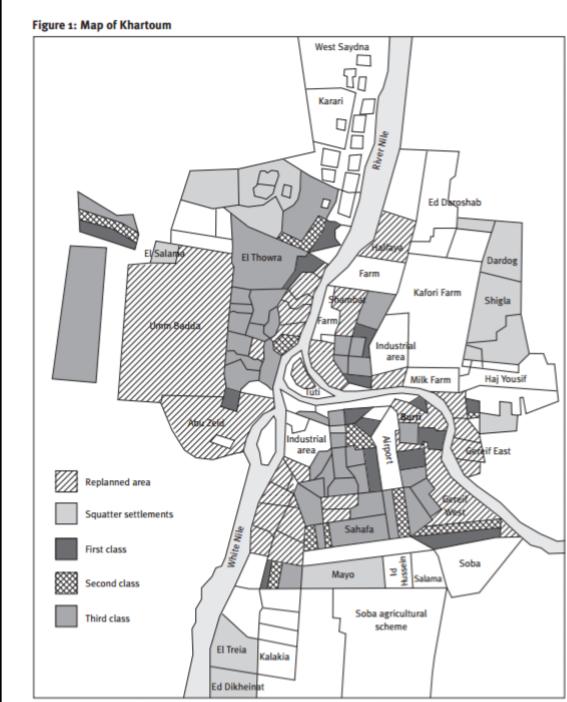
As Khartoum has significantly expanded over the last three decades, these settlement patterns have also changed. New settlements, mostly unregulated but also resulting from ill- conceived urban plans, have sprawled in the peripheral neighborhoods of the city. Today, wealthier residents are largely located in specific neighborhoods such as Manshia, Riyad, Taif, Amarat, Khartoum 2, Garden City, Kafuri, Mohandiseen and a few other wealthy suburbs, such as Soba Hilla’s Golf Course and the gated communities emerging there and in Burri [1].
Results and Discussion
Why is Khartoum State a Non-Smart City: Khartoum state is non- smart due to groups of natural as well as man-made factors.
Natural Factors: they can be summed up into the following: ill location of residential areas (such as flood plains which will increase the annual flooding hazards, areas of poor natural drainage and rapid urban expansion due to environmental degradation in rural areas which encourages illegal expansion of settlement in ill-suited areas and /or at the expense of agricultural lands [2].
Sudan has suffered a number of long and devastating droughts in the past decades, which have undermined food security and are strongly linked to human displacement and related conflicts. The vulnerability to drought is exacerbated tendency to maximize livestock herd sizes rather than quality, and by the lack of secure water sources such as deep boreholes that can be relied on during short dry spells. Despite serious water shortages, floods are also common in Sudan. The most devastating occur on the Blue Nile, as a result of deforestation and overgrazing in the river’s upper catchment. One of the main impacts of watershed degradation and associated flooding is severe riverbank erosion in the narrow but fertile Nile riverine strip [3]. Anthropogenic factors can be summarized as follows: 1) poor infrastructure in cities which are manifested in: • lack of adequate and efficient drainage of rains water,
![Figure 2: The lack of a storm water drainage system in Khartoum causes major flooding, as observed here in August 2006. As the flood waters recede, pools of stagnant water increase the risk of spreading waterborne diseases, particularly in crowded areas like IDP camps [3].](/fulltextimages/2351/fig_2.jpeg)
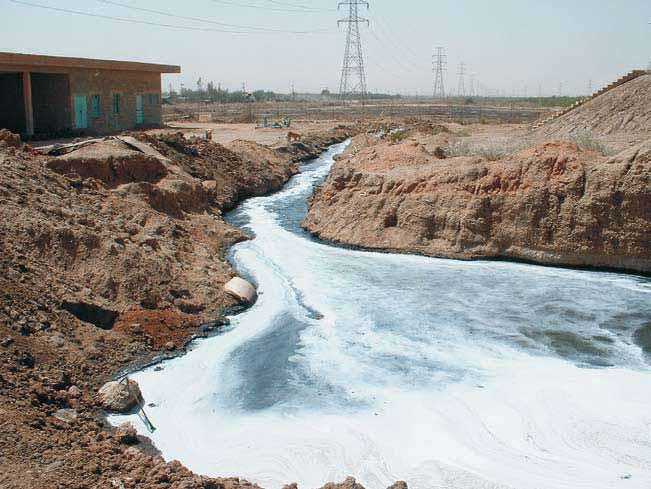
2) No proper system of sewage treatment increases the hazards facing urban environmental health and may lead to the manifestation of water –borne diseases and pollution of the river Nile water.
![Figure 3: shows raw sewage flowing to the White Nile. Though there is a sewage network in Khartoum, it does not cover the entire city and no longer works properly, as it is stretched well beyond capacity • Roads are badly constructed and maintained due to lack of coordination between Ministry of Road and Transport with other related Ministries or government department such Ministry of Electricity and dams and telecommunication and Urban water resources corporation. This resulted in the continuous destruction of asphaltic roads to extend cables of electricity or telephones and domestic water supply networks [4]. • However, the present location of the central transport station is not suitable and has resulted in traffic jamming and wasting of time as well as increase fuel consumption that leads to increase in emitted air pollutants and noise pollution. Moreover, regardless of building of new hospitals and clinics most of the Sudanese have no access to health services because of its high costs and most of the people have no health insurance or their insurance cannot cover the actual expenses. 3) Horizontal expansion of Khartoum capital was not accompanied with accessible roads an d adequate transportation means [5]. 4) inadequate domestic water supply in Khartoum state: it is attributed to: human, institutional and managerial challenges as well as natural factors: Human factors which are responsible for water shortage of drinking water in urban areas can be summed up in the following: rapid urban expansion which resulted from poor development and absence of essential infrastructure in rural areas, insufficient number of domestic water treatment plants, limited capacity of networks, and failure of investment in water supply to match the growth of needs, While the demand is increasing of water losses are also increasing as a result of leakage and breakdown. The unaccounted for losses in the distribution systems in Khartoum are as high as 40%, the quality of urban water supply is also questionable. The following factors were identified to affect water quality: contamination of surface water by heavy loads of suspended loads during the flooding season, septic tanks and soak-away wells in urban areas and distribution networks are old and potential weak links. These factors present a constant threat of contamination of ground water sources [6].](/fulltextimages/2351/fig_3.jpeg)
Figure 3: shows raw sewage flowing to the White Nile. Though there is a sewage network in Khartoum, it does not cover the entire city and no longer works properly, as it is stretched well beyond capacity
- Roads are badly constructed and maintained due to lack of coordination between Ministry of Road and Transport with other related Ministries or government department such Ministry of Electricity and dams and telecommunication and Urban water resources corporation. This resulted in the continuous destruction of asphaltic roads to extend cables of electricity or telephones and domestic water supply networks [4].
- However, the present location of the central transport station is not suitable and has resulted in traffic jamming and wasting of time as well as increase fuel consumption that leads to increase in emitted air pollutants and noise pollution. Moreover, regardless of building of new hospitals and clinics most of the Sudanese have no access to health services because of its high costs and most of the people have no health insurance or their insurance cannot cover the actual expenses. 3) Horizontal expansion of Khartoum capital was not accompanied with accessible roads an d adequate transportation means [5]. 4) inadequate domestic water supply in Khartoum state: it is attributed to: human, institutional and managerial challenges as well as natural factors: Human factors which are responsible for water shortage of drinking water in urban areas can be summed up in the following: rapid urban expansion which resulted from poor development and absence of essential infrastructure in rural areas, insufficient number of domestic water treatment plants, limited capacity of networks, and failure of investment in water supply to match the growth of needs, While the demand is increasing of water losses are also increasing as a result of leakage and breakdown. The unaccounted for losses in the distribution systems in Khartoum are as high as 40%, the quality of urban water supply is also questionable. The following factors were identified to affect water quality: contamination of surface water by heavy loads of suspended loads during the flooding season, septic tanks and soak-away wells in urban areas and distribution networks are old and potential weak links. These factors present a constant threat of contamination of ground water sources [6].
Institutional and managerial challenges of fresh water consumption in Sudanese cities are: lack of institutional foundation and legislations related to production and distribution of drinking water at both national and states levels, insufficient number of well-trained staff needed for water resource development, production and distribution of water, weak flow of credit to finance development projects in the state had led to poor or insufficient coverage of the actual expenses of water supply and sanitation, delay in paying the water fees by the customers made the situation even more worse, deterioration in the working environment at all levels in different water supply treatment plants or bore-hole stations, poor coordination between the Public Water Corporation and State Corporations with regard to integrated planning for developing water resources and specifying priorities for the water production and distribution., there is no agreed standards and specifications for equipment and spare parts needed for the safe water production, weak provision of water safety to protect surface and ground water resources, no application of technical and modern innovations with regard to the production of safe water because of scarce financial resources, Lack of coordination between the state water resources authorities and Ministries of Industry, Health, Education and other related government departments to protect water resources [6]. 5) Displacement as a cause of non-sustainability of Khartoum State There are three principal causes of displacement in Sudan:
- conflict-related insecurity and loss of livelihoods;
- natural and environmental causes: drought, desertification and flooding; and
- Government-sponsored development schemes.
The principal cause of displacement has historically been the major conflicts that have afflicted Sudan since its independence. The second is natural disasters: drought, desertification and flooding. The third cause of displacement is government-sponsored development schemes, specifically mechanized rain-fed agricultural schemes, such as the Aswan dam and the new Merowe dam. In these cases, displacement takes the form of organized resettlements and land allocation for new agricultural schemes.
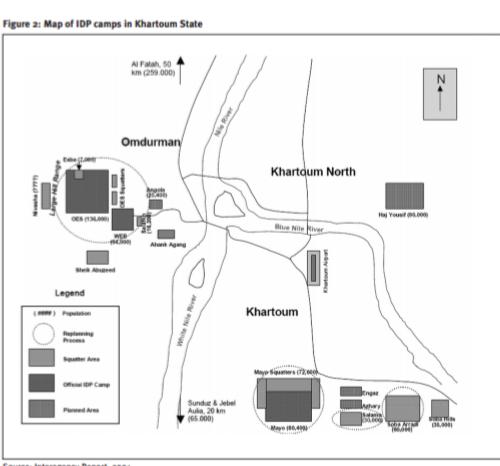
The figure (3) below is a map of the internal displace people (IDP) in Khartoum State.
Other environmental impacts of displacement: Uncontrolled urban and slum growth:
The majority of displaced people in Sudan are located in or close to towns and cities; there are over two million in the Khartoum region alone.
Large-scale migration from the countryside to urban centers has been largely uncontrolled, with the result that a large number of urban slums or informal squatter settlements have been established. Urban slums are associated with a series of environmental and social problems; the urban issues associated with the north- south conflict have been ongoing for over twenty years.
In contrast, the Darfur crisis is now creating new urban problems, as the majority of the displaced person camps are tightly linked to the regional towns and cities and are fast becoming a permanent part of those settlements [4]. 6) Deterioration of Urban Environment and Environmental Health of Khartoum State is another threat to smartness of Khartoum State Urban environment and environmental health issues are some of the most visible symptoms of the challenges facing Sudan. Sprawling slums, litter and polluted waterways are prevalent in most urban centers, and health and development statistics quantify in some detail the massive impact of this situation on the quality of life of the Sudanese population.
Shelter, potable water, sanitation and waste management are cross-cutting issues, and deficiencies in any of these areas can be categorized as development, health or environmental problems, general flight from rural poverty in search of better livelihoods and services, such as hospitals and schools in the cities, large-scale informal settlements have multiplied in the Khartoum area since the 1980s. Most of these settlements have very limited access to water, and no sewage or waste management [4].
The shortcomings in water quality and sanitation in Sudan are directly reflected in the incidence of waterborne diseases, which make up 80 percent of reported diseases in the country. The incidence of disease is highly seasonal: the greatest problems usually occur at the start of the wet season as the rains and run-off mobilizes the faecal matter and pollution that have accumulated during the dry season. 7) Poor Solid waste management:
Solid waste management practices throughout Sudan are uniformly poor. Management is limited to organized collection from the more affluent urban areas and dumping in open landfills or open ground. In the majority of cases, garbage of all types accumulates close to its point of origin and is periodically burnt. Litter – plastic bags in particular – is a pervasive problem across the country, with Khartoum state being worst affected due to its population density and relative wealth [4].
Smart Cities from a Sudanese Perspectives
Smart cities from a Sudanese perspectives are those cities where the people have an access to basic services such as water, health and education, steady electric and water supply, regular maintenance of roads and improvement of the present rain water drainage systems and building of new bridges and suitable location of the transport central stations. One can conclude that each country should have its own prerequisites for cities to be smart depending on the prevailing climatic and environmental conditions and the available infrastructure [3].
References
-
Pantuliano S, Assal M, Elnaiem BA, Mc Elhinney H, Schwab M, et al. (2011) City limits: urbanization and vulnerability in Sudan, Khartoum case study.
-
De Waal A (2007) Sudan: What Kind of State? What Kind of Crisis?. Occasional paper.
-
Personal experience of the author.
-
UNEP (2007) Sudan Post Conflict, Environmental Assessment. Kenya.
-
El Tohami AEA (2014) Towards sustainable livelihood un Sudanese cities with special emphasis on Khartoum State. Journal of Environmental philosophy 2.
-
El Tohami AEA (2017) Constraints of efficient domestic supply of drinking water in Sudanese cities. International Journal of Agricultural and Environmental Sciences IJGAES 4.
- hMPV: Is It Another Covid-19 Like Situation?
- Streptomyces: Sources of Novel Discoveries in Antibiotic Research to Combat Antimicrobial Resistance
- A Review of Mosquitoes (Diptera: Culicidae) and Their Biodiversity, Medical and Veterinary Importance
- Past and Current Immunotherapy in Cancer
- Hematological Cancer and Viral Infection
- The Growing Threat of Antimicrobial Resistance in India: Challenges and Solutions