
Nanotechnology: An Aid to Human Welfare in COVID-19 Pandemic Era
The novel coronavirus disease 2019 (COVID-19) outbreak has led to a worldwide demand for efficacious identification and medication as well as preventing the spread of infection. Based on an abundance of engineered materials recognizable through their useful physicochemical properties, nanotechnology provides a number of perspectives to tackle with this pandemic disease. Nanotechnology can aid to fight against COVID-19, infectious diseases in general, as well as future pandemics. It works on nano scale level ranging from 0 to 100 nanometers. Nanoparticles are small in size but they have greater surface area in comparison to large sized molecules which increase its efficiency. The technology has potential to manipulate the molecules in our desired nature. Nanoparticles are used in almost every area for human welfare. It can be also be a useful tool for the treatment of COVID-19 outbreak like development of rapid detection kits for the testing of COVID-19 infection. Nano biotechnology may also be helpful to cure many other chronic diseases, in development of improved personal protective equipment including facemasks, effective vaccines and targeted drug delivery systems. Summarily, nanotechnology can be crucial in preventing COVID-19 and future pandemics.
Introduction
Nanotechnology refers to a multi-disciplinary area that operates on nano scale. The nanoparticles are 1-100 nanometers in size but have great potency for human welfare. Genetic engineering is correlated with this field due to the size of DNA particles and man-made vectors for insertion of foreign DNA into the host cells. The term nanotechnology was coined by Japanese scientist Norio Taniguchi [1]. Nanotechnology is mainly categorized into two branches, the first one is green nanotechnology and the second one is nano engineering. This technology is benefitting to the human society in many ways such as agriculture development, nano biosensors, targeted drug delivery, lab on-a chip (LOC) and also helpful in treatment of many chronic diseases including the novel coronavirus disease 2019 (COVID-19) pandemic [2, 3, 4].
LOC is a chip which is very small ranging nearly millimeters to centimeters and these chips are developed for the detection and analysis purposes for the physician. The chip has the capability to work with very small fluids volumes down to less than Pico-liters [4]. The concept of Nano biology expands the research field in a broad way just like nano devices including biological machines and many more. It creates a new view to analyses molecules and detects the disease in its early conditions and observes the effect of therapies.
Nano medicine is the medical uses of nanotechnology, and it may be a new way to treat many diseases like cancer, COVID-19, etc. Chemotherapy has been used for treating cancer patients. But, it has many side effects like fatigue or nausea, and it not only kills cancer cells but also affects the normal healthy cells in humans. Nowadays, patients have an alternate option instead of chemotherapy. Nano robots have special sensors to detect the target molecules. It can be programmed to diagnosis and treat fatal diseases like cancer [5]. In nano robots therapy, the drug can be injected with the help of nano robots that targets the cancer cell and kill them without harming the healthy cells of humans [6].
There are also engineered nano materials manufactured genetically such as amyloids which are seen in bacterial biofilms [7]. Lipid nanotechnology is another area of research in which we use physico-chemical properties of lipids to make nano devices as they have the capacity of antifouling and self-assembly. This capability of lipid molecules makes them useful in engineering and medical sciences [8]. Nanoparticles also act like carriers and contain herbicide, chemicals, or genes into it and target a particular part and release that chemical in the plant part [2, 9].
COVID-19 pandemic outbreak, a human beta coronavirus severe acute respiratory syndrome (SARS-CoV-2) virus infection, has severely affected global population and its treatment is a big challenge for researchers, globally. This viral infection is increasing every day and emerged as a significant socio-economic burden for every class of the world [10]. Thus, there is an urgent need to develop therapeutics and technology for the treatment of COVID-19 which is a global health threat. As virus size is generally in nanometer range so the role of nanotechnology is relevant here. Development of effective drug delivery might be possible through nanotechnology which may be helpful in blocking the initial attachments of viral spike glycoprotein with host cell receptors, disruption of virus structure, and nano carriers can be designed for effective vaccination for SARS-CoV-2 [11]. Paliwa, et al. [10] reported that bio-nanotechnology may facilitate a more accurate understanding and management of COVID-19.
The present review discusses the applications of nanotechnology in human welfares particularly in the treatment of COVID-19 and targeted drug delivery.
Application of Nanotechnology in Drug Design and Delivery
Nanotechnology is important for treatment of various diseases with the help of nanoscale materials like biocompatible nanoparticles [12] and nanorobots that are used for many diagnostic applications [13]. There are many possible role of nanotechnology in biomedical research area (Figure 1). With the aid of nanoparticles, effective nanomedicines can be developed for better health of humans. In future, Nano medicines can be used for the treatment of many chronic diseases that occurs in humans. So, nano biotechnology is a boon to humanity.
Drug designing at the Nano scale started recently for cure of diseases and with the aid of nanotechnology, targeted drug delivery occurs at a particular location in the body in a controlled manner. When these agents are reached they allow forming of a well-defined structure due to self-assembly or patterns spontaneously formed from building blocks [14]. So, drugs are not wasted in the body. This targeted drug delivery system is a better way for treating a disease because it has lower toxicity, improved bio distribution and the extended drug life cycle [15]. The different modes for drug delivery systems are passive and self-delivery.
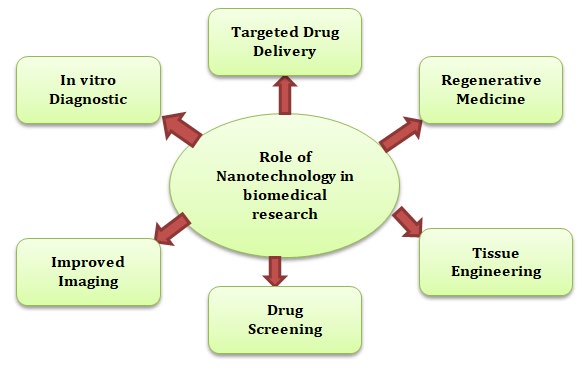
Nowadays, carrier nanostructure is use for easy drug delivery. Chen, et al. [16] explained how nano carriers work and discussed about its sensory applications. Nanocarriers have a distinct drug release profile, and its ways to find its target regions of the organism being prepared recently [17]. Some examples of nanocarriers are natural polysaccharides, antibodies, cell membrane, peptides, etc.
How Nanotechnology Can Help in COVID-19 Outbreak
The whole world is facing the challenging problem of COVID-19, and people are dying every day all over world. COVID-19 pandemic is a serious and burning topic of current scenario. COVID-19 spread in the world from Wuhan city of China [18, 19]. In the beginning of 2020, it spread from China to over 200 countries including India. The novel coronavirus has +ssRNA genome and uses RNA dependent RNA polymerase so it can easily infect any host. Incubation period of COVID-19 infections is 2-14 days [19]. SARS-CoV-2 contains spike, envelope and membrane proteins and its spike protein structure resembles a crown so it has its name coronavirus [18].
In the human body, COVID-19 enters through the nose and it affects the lungs. In the lungs it gets attached with ACE II receptors (angiotensinogen converting enzyme) and causes severe symptoms in the human body. If any person has low immunity then this COVID-19 can easily be incorporated into the human lungs and suppresses the development of antibodies against COVID-19 (Figure 2). But if a person has strong immunity then it gets recovered easily from COVID -19 because ACE II receptor suppressants get entered into the lungs.
![Figure 2: Structure of SARS -CoV-2 adapted from Kostarelos [20].](/fulltextimages/5993/fig_2.jpeg)
On February 11 corona virus group of the international Committee virus Taxonomy (ICTV) designated the virus as SARS-Co-V-2 based on phylogeny and taxonomy [21]. On March 11, 2020, WHO declared the COVID-19 outbreak as pandemic? During May 2020, SARS-COV-2 infection spread in the world across 185 countries, with millions of infection and hundreds of thousands of death, WHO report-98 [22]. Some researchers also reported that COVID-19 patients have some other problems too due to SARS-CoV-2, like heart kidney, eye conjunctivitis and brain encephalitis [23, 24].
The SARS-CoV-2 genome has been fully sequenced [25] and shows high similarity with other coronavirus genomes causing respiratory disease like SARS-CoV-2 [26]. The SARS COV-2 binds to the C-terminal domain of ACE-II receptors (angiotensinogen converting enzyme). It binds C-terminal domain through spike protein. Through this mechanism SARS-Cov-2 enter into the respiratory tract. The details of this binding to ACE II receptor and spike protein have been provided by solving the crystal structure of the complex [27]. The diagnostic methods used for the detection of SARS-CoV-2 are mainly molecular (real time polymerase chain reaction) and serological (antigen or antibody based detection).
Nanomaterial based technology provides a number of solutions against the COVID-19. Nanotechnology not only provides a solution for this pandemic but it may also fight against future pandemics. Nanotechnology can create facial masks and PPE kits through nanoparticles and create novel surfaces which are coated with nanoparticles that have the capacity to kill the virus. Nanotechnology not only provides tools for novel delivery but also acts like a soldier for the dangerous viruses [28]. The vaccine development will depend upon the direct administration of viral antigens. For example, in the form of recombinant proteins, vectored vaccines, whole inactivated or attenuated virus or it contain RNA or DNA encoding viral antigen [29].
Liu, et al. [30] discussed about a translatable subunit Nano vaccine for COVID-19 that elicit humeral immune response and T cell immunity by activating both CD4+ and CD8+, which may play important roles in diminishing viral load in patients. Recently discovered remdesivir, approved by Food Drug Administration (FDA) for COVID-19 treatment in the U.S appears to be the best promising treatment for adults diagnosed with COVID-19. Nanotechnology based methods have also used to increase the capability of remdesivir in the context of other emerging viral (Nipah virus) infections (Kerry 2019). Indian Council of Medical Research (ICMR) and Bharat Biotech Company are also working for the development of effective vaccine against SARS-CoV-2.
Immune system is the main barriers of any virus, bacteria or any other foreign material. In case of COVID-19, the patient who died showed symptoms of lymphocytic apoptosis. If we consider the role of macrophages (expressing from ACE II) have SARS-CoV-2 nucleoprotein antigen and showing an increased level of interleukin-6 [31, 32]. With the help of nanoparticles, it is possible to increase the specificity level of immune supplement drugs. Now we can easily target the drug at a particular location and this technique can reduce drug overdose as well as side effects. Nanobiosensors can also be an alternate option instead of RT-PCR for rapid detection of COVID-19.
Conclusion
Nanotechnology can be a milestone in the era of COVID-19, and boon for human welfare. Nanobiosensors may be used to detect the virus in early stage of infection and blocking it using antiviral nanocomposites, nano vaccines, etc. Fast and inexpensive diagnostic methods can be developed with the aid of nanotechnology for quick analysis or detection of COVID-19. In the future, nanotechnology can be helpful to fight against other pandemics.
References
-
Taniguchi N (1974) Basic Concept of Nanotechnology. Proc. Int. Conf. Prod. Eng. Tokyo, Part II, Japan Society of Precision Engineering.
-
Tripathi M, Kumar S, Kumar A, Tripathi P, Kumar S (2018) Agro-nanotechnolgy: a future technology for sustainable agriculture. International Journal of Current Microbiology and Applied Sciences 7: 196-200.
-
Ghallab Y, Badawy W (2004) Sensing methods for dielectrophoresis phenomenon: from bulky instruments to Lab-on-chip. IEEE Circuits and System Magazine 4(3): 5-15.
-
Volpetti LR, Yetisen AK (2014) Commercialization of micro fluidic devices. Trends in Biotechnology 32(7): 347-350.
-
Venkatesan M, Jolad B (2010) Nanorobots in cancer treatment. INTERACT pp: 258-264.
-
Tripathi R, Kumar A (2018) Application of nanorobotics for cancer treatment. Material Today Proceedings 5(3): 9114-9117.
-
Peter N, Zsofia B, Pei Kun T, Neel J (2014) Programmable biofilm based materials from engineered curli nanofiber. Nature Communication 5: 4945.
-
Mashaghi S, Jadidi T, Koenderink G, Mashaghi A (2013) Lipid Nanotechnology. International Journal of Molecular Science 14(2): 4242-4282.
-
Thangavelu RM, Gunasekaran D, Jesse MI (2016) Nanobiotechnological approach using plant nooting hormones synthesized silver nanoparticles as “nandbullits” for the dynamic applications in. horticulture- An in vitro and ex vitro study. Arabian Journal of Chemistry 11: 48-61.
-
Paliwal P, Sargolzaei S, Bhardwaj SK (2020) Grand challenges in bio-nanotechnology to manage COVID-19 pandemic. Frontiers in Nanotechnology.
-
Chauhan G, Madou MJ, Kalra S, Chopra v, Ghosh D, et al. (2020) Nanotechnology for COVID-19: therapeutics and vaccine research. ACS Nano 14(7): 7760-7782.
-
McNamara K, Tofail SA (2007) Nanosystem: the use of nanoalloy, metallic, bimetallic and magnetic nanoparticles particles in biomedical applications. Chemical Physics 17(42): 27981-27995.
-
Saadeh Y, Vyas D (2014) Nanorobotics applications in medicine: current proposals and design. American Journal of Robotic Surgery 1(1): 4-11.
-
Lu H, Wang J, Wang T, Jian Z, Ying B, et al. (2016) Recent progress on nanostructures for drug delivery applications. Journal of Nanomaterials 2016: 1-12.
-
Mirza AZ, Siddiqui FA (2019) Nanomedicine and drug delivery: a mini review. International Nano Letters 4: 94.
-
Chen CW, Syu WJ, Huang TC, Lee YC, Hsiao JK, et al. (2017) Encapsulation Au/Fe3O4 nanoparticles into a polymer Nanoarchitecture with combined near infrared- triggered chemo-photothermal therapy based on intracellular secondary protein understanding. Journal of Materials Chemistry 5(29): 5774-5782.
-
Torchilin VP (2012) Multifunctional nanocarriers. Advanced Drug Delivery Reviews 58(14): 1532-1555.
-
Prasad N, Kumar N, Tripathi M (2020) Novel coronavirus disease (COVID-19) pandemic in India: a review. Eurasian Journal of Medical Investigation 4(3): 279-283.
-
Tripathi M, Kumar S (2020) Epidemiology, treatment and microbiological surveillance of SARS-CoV-2. Annual Research and Review in Biology 35(5): 114-121.
-
Kostarelos K (2020) Nanoscale nights of COVID-19. Nature Nanotechnology 15: 343-344.
-
Gorbalenya AE, Baker SC, Baric RS, de Groot RJ, Drosten C, et al. (2020) Severe acute respiratory syndrome-related coronavirus: the species and its viruses -a statement of the Coronavirus Study Group. Nature Microbiology 5: 536-544.
-
WHO Report-98 (2020) John Hopkins University.
-
Bansal M (2020) Cardiovascular disease and COVID-19. Journal of diabetes and metabolic syndrome 14: 247- 250.
-
Wu Y, Xu X, Chen Z, Jiahao D, Kenji H, et al. (2020) Nervous system involvement after infection with COVID-19 and other coronavirus. Brain Behavior and Immunity 87: 18- 22.
-
Zhou P, Yang XL, Wang XG, Hu B, Zhang L, et al. (2020) A pneumonia outbreak associated with new coronavirus of probable bat origin. Nature 579(7798): 270-273.
-
Shereen MA, Khana S, Kazmi A, Bashir N, Sidique R, et al. (2020) COVID-19 infection: origin, transmission and characteristics of human coronavirus. Journal of Advanced Research 24: 91-98.
-
Wang Q, Zhang Y, Wu L, ShengNiu, Chunli S, et al. (2020) Structural and functional basis of SARS-CoV-2 entry by using human ACE2. Cell 181(4): 894-904.
-
Weiss C, Carriere M, Fusco L, Ilaria C, Jose Angel R, et al. (2020) Toward nanotechnology enabled approaches against the COVID-19 pandemic. ACS Nano 14(6): 6383- 6406.
-
Amanat F, Krammer F (2020) SARS-CoV-2 vaccine: status report. Immunity 52(4): 583-589.
-
Liu L, Zhijia L, Chen H, Hong L, Qiang G, et al. (2020) A translatable subunit nanovaccine for COVID-19. ChemRxiv Preprint.
-
Kerry RG, Malik S, Redda YT, Sahoo S, Patra JK, et al. (2019) Nano-Based approach to combat emerging viral (NIPAH Virus) infection. Nanomedicine 18: 196-220.
-
Chen Y, Feng Z, Diao B, Wang R, Wang G, et al. (2020) The novel severe acute respiratory syndrome coronavirus 2 (SARS-COV-2) directly decimates human spleens and lymph. Med Rxiv.
- hMPV: Is It Another Covid-19 Like Situation?
- Streptomyces: Sources of Novel Discoveries in Antibiotic Research to Combat Antimicrobial Resistance
- A Review of Mosquitoes (Diptera: Culicidae) and Their Biodiversity, Medical and Veterinary Importance
- Past and Current Immunotherapy in Cancer
- Hematological Cancer and Viral Infection
- The Growing Threat of Antimicrobial Resistance in India: Challenges and Solutions