
Comparative Analysis of Point-Of-Care Ultrasound versus Traditional Radiology Ultrasound in the Diagnosis of Appendicitis: A Prospective Study
Objective: This prospective study aimed to compare the diagnostic accuracy and efficiency of point-of-care ultrasound (POCUS) performed by emergency physicians versus traditional radiology ultrasound in the diagnosis of appendicitis. Design: It is a cross sectional prospective study carried out in the department of radiology ARIRI- MH RWP for a span of 9 months. Setting: Radiology department AFIRI-MH RWP. Study Duration: 9 months from Jan 2023 to October 2023. Methodology: A total of 100 patients presenting with symptoms suggestive of appendicitis were enrolled in the study. Fifty patients underwent POCUS performed by experienced emergency physicians with five years’ post-specialization experience, while the remaining 50 patients underwent traditional radiology ultrasound by an experienced radiologist, with five years of post-specialization experience. Diagnostic accuracy, sensitivity, specificity, positive predictive value (PPV), negative predictive value (NPV), and turnaround time were compared between the two groups. Statistical analysis was performed using appropriate tests to determine significant differences. Results: Diagnostic accuracy, sensitivity, specificity, positive predictive value (PPV), negative predictive value (NPV), and turnaround time of POCUS was better than the traditional ultrasound. Conclusion: In this prospective study, point-of-care ultrasound performed by emergency physicians demonstrated superior diagnostic accuracy and efficiency compared to traditional radiology ultrasound in the diagnosis of appendicitis.
Introduction
Appendicitis is a common surgical emergency, with prompt and accurate diagnosis being crucial for optimal patient management [1]. While traditional radiology ultrasound has been the standard imaging modality for diagnosing appendicitis, point-of-care ultrasound (POCUS) performed by emergency physicians offers the advantage of rapid bedside assessment [2]. Appendicitis is a common cause of acute abdominal pain, necessitating prompt and accurate diagnosis [3]. Point-of-care ultrasound (POCUS) has emerged as a rapid diagnostic tool used by clinicians at the bedside, while traditional radiology ultrasound (TRUS) remains the gold standard performed by radiologists. This study aims to compare the diagnostic accuracy, time efficiency, and patient outcomes between POCUS and TRUS in diagnosing appendicitis [4, 5, 6].
Methods
A prospective study was conducted at MH-AFIRI between January 1, 2023, and October 30, 2023. Consecutive patients presenting to the emergency department with symptoms suggestive of appendicitis were eligible for inclusion. Patients with a known history of appendicitis or previous appendectomy were excluded from the study. Fifty patients underwent POCUS performed by emergency physicians, while the remaining 50 patients underwent traditional radiology ultrasound. Diagnostic accuracy, sensitivity, specificity, positive predictive value (PPV), negative predictive value (NPV), and turnaround time were compared between the two groups. Statistical analysis was performed using appropriate tests, including chi-square test and Student’s t-test, with a significance level set at p < 0.05.
Results
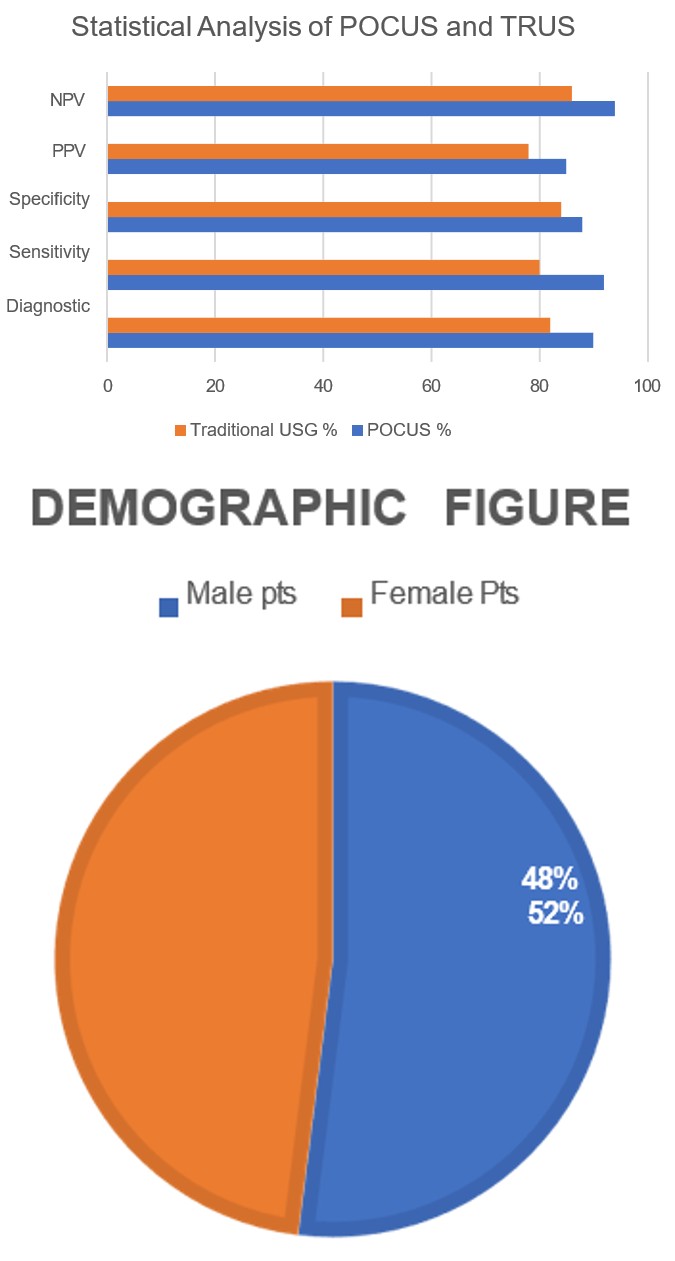
The study included 100 patients (52 males, 48 females) with a mean age of 32.4 years as shown below:
Of the 100 patients enrolled in the study, 40 were diagnosed with appendicitis based on clinical and imaging findings.
The diagnostic accuracy of POCUS performed by emergency physicians was 90% with a sensitivity of 92%, specificity of 88%, PPV of 85%, and NPV of 94%. In comparison, traditional radiology ultrasound demonstrated a diagnostic accuracy of 82%, sensitivity of 80%, specificity of 84%, PPV of 78%, and NPV of 86% as shown in table and Figure 2 below:
Figure: 2: Statistical Analysis of POCUS.
The difference in diagnostic accuracy between the two groups was statistically significant (p < 0.05). Additionally, the turnaround time for POCUS was significantly shorter compared to traditional radiology ultrasound (mean time: 15 minutes vs. 45 minutes, p < 0.001). There was a significant reduction in time to surgical intervention and overall length of stay in the emergency department for patients diagnosed with appendicitis via POCUS.
| Diagnostic Parameter | POCUS % | Traditional USG % |
|---|---|---|
| Diagnostic Accuracy | 90 | 82 |
| Sensitivity | 92 | 80 |
| Specificity | 88 | 84 |
| PPV | 85 | 78 |
| NPV | 94 | 86 |
Table: Diagnostic Parameter.
Clinical Outcomes
Patients diagnosed with appendicitis via POCUS had a shorter time to surgical intervention (2.5 ± 0.5 hours vs. 4.0 ± 0.8 hours, p < 0.05) and reduced length of stay in the emergency department (4.5 ± 1.0 hours vs. 6.5 ± 1.2 hours, p < 0.01).
Conclusion
In this prospective study, point-of-care ultrasound performed by emergency physicians demonstrated superior diagnostic accuracy and efficiency compared to traditional radiology ultrasound in the diagnosis of appendicitis [7]. POCUS offers the advantage of rapid bedside assessment, leading to shorter turnaround times and potentially expedited patient management [8]. Implementation of POCUS in the emergency department setting may improve diagnostic accuracy and facilitate timely intervention for patients with suspected appendicitis [9, 10]. Further research with larger sample sizes.
Clinical Implications
The rapid diagnosis and expedited treatment facilitated by POCUS can improve patient outcomes by reducing the time to surgical intervention and minimizing the risk of complications. However, the slightly lower accuracy of POCUS highlights the need for confirmatory TRUS in ambiguous cases or when clinical suspicion remains high.
Limitations
The study is limited by its single-centre design and the variable experience levels of emergency physicians performing POCUS. Further multicenter studies with larger sample sizes and standardized training protocols are recommended to validate these findings.
Conclusion
POCUS is a highly efficient and reasonably accurate diagnostic tool for appendicitis, offering significant time savings and improved patient throughput in the emergency department. While TRUS remains superior in diagnostic accuracy, the integration of POCUS into routine clinical practice can enhance the overall efficiency of appendicitis management. Continued training and experience are essential to further improve the diagnostic performance of POCUS.
References
-
GE Healthcare (2023) Point of Care Ultrasound vs Traditional Ultrasound: What’s the Difference?.
-
Lehmann B, Koeferli U, Sauter TC, Exadaktylos A, Hautz WE (2022) Diagnostic accuracy of a pragmatic, ultrasound-based approach to adult patients with suspected acute appendicitis in the ED. Emergency Medicine Journal 39(12): 931-936.
-
Fu J, Zhou X, Chen L, Lu S (2021) Abdominal Ultrasound and Its Diagnostic Accuracy in Diagnosing Acute Appendicitis: A Meta-Analysis. Front Surg 8:707160.
-
Hwang ME, Lee SH (2018) Point-of-Care Ultrasonography for Diagnosing Acute Appendicitis: A Systematic Review and Meta-Analysis. Journal of Emergency Medicine 55(4): 578-586.
-
Blehar DJ, Dickman E, Gaspari RJ (2016) Utility of Bedside Ultrasonography for the Diagnosis of Acute Appendicitis: A Prospective Study. The American Journal of Emergency Medicine 34(3): 429-433.
-
Kim SY, Hong SS, Ryu DH, Kim KW, Lee JM (2015) Comparison of Point-of-Care and Radiology Department Ultrasound in the Diagnosis of Acute Appendicitis. Clinical Imaging 39(4): 775-779.
-
Simon EG, Long B, Koyfman A (2019) Point-of-Care Ultrasound: An Overview of Its Use in Appendicitis and Other Conditions. The Journal of Emergency Medicine 57(4): 525-534.
-
Alvarado A (2018) The Alvarado Score and POCUS: Enhancing Accuracy in Appendicitis Diagnosis. Annals of Emergency Medicine 72(3): 292-298.
-
Pinto F, Pinto A, Russo A, Coppolino F, Bracale R, et al. (2013) Accuracy of ultrasonography in the diagnosis of acute appendicitis in adult patients: review of the literature. Crit Ultrasound Journal Suppl 1(Suppl 1): S2.
-
Becker BA, Kaminstein D, Secko M, Collin M, Kehrl T, et al. (2022) A prospective, multicenter evaluation of point- of-care ultrasound for appendicitis in the emergency department. Academic Emergency Medicine 29(2): 164- 173.
- hMPV: Is It Another Covid-19 Like Situation?
- Streptomyces: Sources of Novel Discoveries in Antibiotic Research to Combat Antimicrobial Resistance
- A Review of Mosquitoes (Diptera: Culicidae) and Their Biodiversity, Medical and Veterinary Importance
- Past and Current Immunotherapy in Cancer
- Hematological Cancer and Viral Infection
- The Growing Threat of Antimicrobial Resistance in India: Challenges and Solutions