
Molecular Characterization of HCV NS5A in Patients Receiving Interferon Therapy
In our country Pakistan, despite intensive awareness, treatment and prevention programs by public sector and NGO’s, rapidly increasing rate of HCV infection has evolved as an epidemic over last decade. Genotype 3a predominantly found in Pakistan. The objective of this study was to analyze structural changes in NS5A region of HCV 3a genome and the subsequent possible outcome. We included five hundred patients in our study. Results of 12 selected samples being presented here. The gender selection was random, ratio of male to female patients was nearly equal. The study was performed in Department of Biotechnology, University of Karachi where nested PCR of HCV seropositive isolates was performed. Other lab parameters were carried out in Rahila Diagnostic Research and Reference lab (pvt) Ltd; including qualitative & quantitative RT-PCR and genotyping. We analyzed NS5A region in the span of residues (2213-2352) including the ISDR, PKRBD & short sequence outside PKRBD (2281-2335). Multiple mutations have been found. The most notable substitutions found in this region was Proline to Leucine (P2274L). The peptide epitopes in NS5A have been studied abroad in the context of vaccine development against HCV. Effective vaccine development is the major demand in healthcare field for therapy & prevention of HCV. Our study on HCV genotype 3a along with other peer research work in our country and other parts of world would provide new parameters and better understanding of structural changes in NS5A region of HCV genome that would be helpful to modulate therapeutic approach and vaccine preparation against Hepatitis C virus. In addition, it demonstrates the importance of application of bioinformatics tools for the study of proteins that are difficult to be investigated by other experimental procedures.
H, Mahwish K and Somia G
jawedbadvi1958@gmail.com proteins that are difficult to be investigated by other experimental procedures.
Keywords: Hepatitis C virus; Interferon therapy; HCV NS5A region; Transcriptional activation Interferon Sensitivity- Determining Region; INF-α: Interferon Alpha; IRB: Institutional Review Board
Introduction
Hepatitis C virus is one of important pathogens that have a special predilection to infect hepatocytes, giving rise to the disease commonly known as Hepatitis C. Initially this viral pathogen has been recognized as NonA NonB virus. Later on, in 1989 its identity has been unearth as Hepatitis C virus (HCV) [1]. The HCV is segregated into seven genotypes (1 to 7) that further grouped into subtypes (a, b, c,--) showing nucleotide variations by approximately 30% and 20% respectively [2, 3]. An enveloped positive sense RNA constitutes HCV genome, having a size of approximately 9.6 kb [4]. At least 10 HCV proteins are produced from this polyprotein with the distinction of 3 structural (core, E1 AND E2 envelop glycoproteins and 7 non-structural proteins (p7-NS2- NS3-NS4-ANS4B-NS5A-NS5B [5]. Globally out of 200 million HCV infected individuals, 130 million became chronic HCV carrier Ali, et al. Despite extensive research over development of preventive and therapeutic vaccine, a licensed vaccine is still not available [6]. An important constraint towards successful vaccine development is hyper variable nature of HCV genome, therefore addition of multiple epitopes is the most favored approach. Phase I studies on HCV peptide vaccines used conserved T-cell epitopic peptides of structural & nonstructural proteins, though it requires further optimization of immunogenicity [7]. The non-structural protein 5A (NS5A) is a membrane-associated protein and appears to be an active constituent of the HCV replicase playing an essential role in regulation of viral replication [8]. The propensity towards RNA binding, definitely point towards the role of NS5A in genome replication and potentially a functional target for the action of antiviral therapeutic agents [9]. It has been suggested that role of NS5A in transcriptional activation, modulates response to interferon and viral replication through transcription of certain cellular factors that have an antiviral potential or involvement in viral replication [10]. One of the pioneer studies of probing into role of mutations in NS5A protein was conducted upon Japanese patients infected with HCV genotype 1b Enomoto, et al. It was reported that a minimum of four mutations in ISDR region were associated with sustained virological response to sole therapy with Interferon-α. Subsequent studies ruled out correlation of mutations in the PKR binding domain (PKRBD) of HCV with the sustained virological response (SVR) in patients who received IFN-α alone or in combination with ribavirin. However similar correlation not found in some of the studies performed on Pakistani patients infected with HCV 3a [11]. Several studies have been performed to correlate NS5A mutations with the treatment response and produced valuable data. The areas of conflicts among these studies reflects possible role of quasispecies nature of HCV, requiring further in depth research and analysis of genomic mutations within interferon sensitivity- determining region(ISDR) and the PKRBD region in all genotypes. With a burden of nine million individuals infected with HCV, Pakistan is considered to be an endemic region. There is persistent rise in toll of infected patients. This can be correlated with poor hygienic living conditions, overcrowding and lack of awareness regarding spread of communicable diseases [12, 13]. Overall prevalence of HCV is reported to be 6% with range from 3% to 6% [14], but reported to be much higher in interior Sindh as compared to other parts of country [15].
Materials & Methods
Samples of 500 HCV seropositive patients who were receiving interferon alpha (INF-α) were included in the study. Permission for study was granted by Institutional Review Board (IRB), DUHS. We analyzed mutations in NS5A region. For this we followed the protocol of performed their study in Brazil on patients infected with HCV 3a [16]. Our amplified products encompassed Domain II of NS5A, containing ISDR, PKRBD and additional residues that span after these regions. Extraction of HCV RNA: It was performed by using relevant commercially available kit (QIAamp. Viral RNA, Qiajen). Reverse Transcription: cDNA was prepared using commercially available M-MLV (Affymatrix, reverse transcriptase) & random hexamers (Favorogen).
Amplification of HCV NS5A region
Nested PCR done to amplify residues in part of NS5A region. We prepared primers similar to those used in above mentioned Brazilian study [16]. In the first round we used external primers (NS5B_MK33s and NS5B_MK90as). First PCR Sense NS4B_MK33 S 5’-GAG GGG GCN GTN CAG TGG ATG AA-3’ (6085-6106). Antisense NS5B_MK90 AS 5’-GGT AAC CTT AYT CTG ACG- 3’ (7771-7788). Denaturation done at 940C for 2 min, followed by 40 cycles of 94 0C for 30 sec, 480C for 30 sec and 720C for 1 min. For second round fragment consist of (439 bp). Sense NS5A_ MK 94: 5’-GCA AGC TCA TCC GCC AGC CA-3’ 6952-6971. Antisense NS5A_ MK36: AS 5’-GCT AGC GCC GCG GAC ACA TT-3’ 7372-7391. PCR done by initial denaturation at 940C for 5 min, followed by 40 cycles of 940C for 1 min, 600C for 1 min and 720C for 2 min and final extension at 720C for 10 min.
Electrophoresis
Results
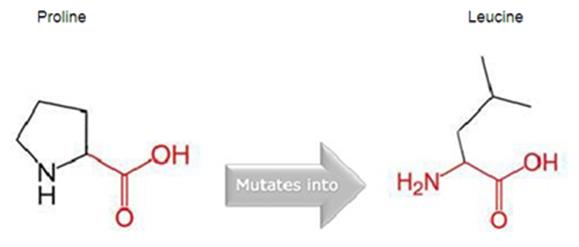
Multiple alignment of 12 selected samples was done with HCV reference sequence (NCBI accession NC_009824), using Clustal W. Multiple mutations were found. Most notable mutation was substitution of Leucine in place of Proline at position 2274 of HCV genome corresponding to position 296 of NS5A. All mutations are depicted in (Tables 1 & 2).
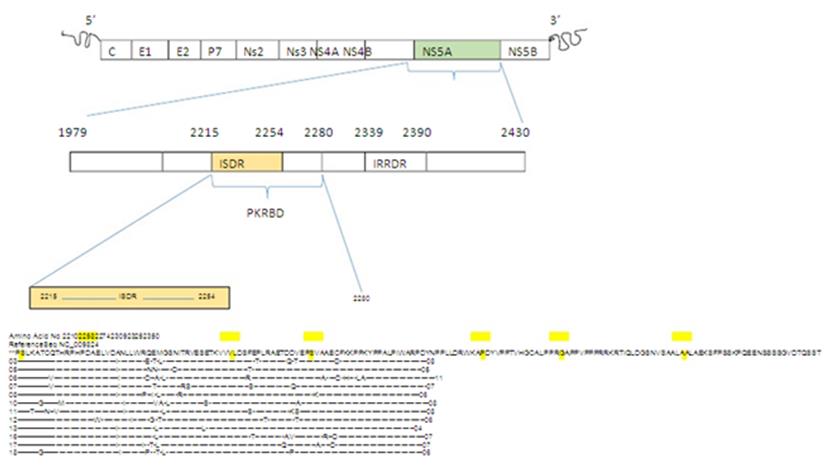
- NS5A region mutations found in study samples (HCV3a Sequences) sample 3
- V2258I
- D2270E V2272T P2274L V2313T R2325Q A2327T G2343D sample 5
- V2258I
- D2271N V2272N E2279D A2309T sample 5
- A2230V
- V2258I
- T2269D V2272A P2274L K2308R T2338A G2343D N2345H A2349L L2350A sample 7
- A2230V
- V2258I
- V2272T K2283R P2284S A2309S R2325Q sample 8
- V2258I
- T2269D
- V2272I P2274L K2282R R2337K sample 10 R2225G V2233M
- V2258I D2271V V2272A P2274L P2289S G2326A sample 11 C2221T
- H2227N A2230V V2258I P2274L A2309S R2325K G2326S sample 12 R2249W
- F2262I
- D2270G V2272T P2315T A2327T sample 13 V2258I
- P2274L
- I2293L sample 16 V2258I
- V2276L
- V2313T G2326A A2327V Q2340R G2343D sample 17 V2258I
- D2271I
- P2274L V2276L R2325Q T2338A G2343D sample 18 R2225G
- V2258I
- D2271P P2274L V2276L G2326P
Table 2: Representation of multiple mutations found in NS5A region of HCV3a isolates.
- Table 1: Multiple Sequence Alignment of HCV NS5A Region showing ISDR & PKRBD. Reference sequence HCV NC_009824 in NCBI database. Highlighted amino acid corresponds to highlighted position given above. ISDR (interferon sensitivity determining region); PKRBD (protein kinase R binding domain). Number of mutations mentioned at the end of each sequence.
Table 1: Multiple Sequence Alignment of HCV NS5A Region showing ISDR & PKRBD. Reference sequence HCV
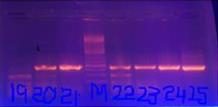
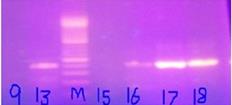
Electrophoresis
Three Dimensional Pictures
Figures 3 & 4: showing proline replacement by leucine in HCV 3a at position 2274 (NS5A position 296).
Discussion
Several studies ruled out correlation of NS5A mutation to treatment outcomes, many of these favor a positive correlation whereas some other denied this and presented converse data. Significance of various host factors like immune status, race, geographic influences etc; and viral factors like generation of quasi-species, genotype variation, tropism etc, in modulation of immune response have also been addressed. This variance of data generated through the studies of NS5A mutations reflects that instead of correlating these mutations to factors like pre-treatment viral load, response to therapy etc, the actual changes these mutations brought in the structure and function of NS5A protein should be evaluated. The present study, therefore focused on certain substitutions in NS5A region, found in our study population. When compared with HCV reference sequence (NCBI database Accession: NC_009824), we noticed that proline is replaced by leucine at position 2274.
![Figure 5: Schematic structures of the Proline (left), present in Reference sequence and the mutant residue Leucine (right). The backbone is depicted in red color which appears same for each amino acid. The side chain, peculiar for each amino acid, is depicted in black color [17]. Structural peculiarity of proline is that it is the unique amino acid in which the side chain is linked to the protein backbone twice, forming a pentagonal nitrogen containing ring. This transforms proline into an imino acid (since the isolated form of proline has an NH2+ instead of NH3+). Due to this change proline is unable to embrace several of the main-- chain conformations that are conveniently taken up by all other amino acids. For this reason protein structures usually contain proline in sharp & rigid turns (i.e. where the direction of polypeptide chain must be changed). Proline causes kinking in α-helices, because of its inability to adopt a normal helical conformation. Due to these properties, rare involvement of proline is seen in active or binding sites of proteins.](/fulltextimages/1681/fig_5.jpeg)
Figure 5: Schematic structures of the Proline (left), present in Reference sequence and the mutant residue Leucine (right). The backbone is depicted in red color which appears same for each amino acid. The side chain, peculiar for each amino acid, is depicted in black color [17]. Structural peculiarity of proline is that it is the unique amino acid in which the side chain is linked to the protein backbone twice, forming a pentagonal nitrogen containing ring. This transforms proline into an imino acid (since the isolated form of proline has an NH2+ instead of NH3+). Due to this change proline is unable to embrace several of the main-- chain conformations that are conveniently taken up by all other amino acids. For this reason protein structures usually contain proline in sharp & rigid turns (i.e. where the direction of polypeptide chain must be changed). Proline causes kinking in α-helices, because of its inability to adopt a normal helical conformation. Due to these properties, rare involvement of proline is seen in active or binding sites of proteins.
![Figure 6: Proline in polypeptide change making rigid turn [17].](/fulltextimages/1681/fig_6.png)
On the other hand, the substituted amino acid leucine display certain features that affect structure and function of this region. Leucine contain two non-hydrogen substituents attached to their Cβ carbon, that increases bulkiness near to protein backbone and restrict normal structural adaptations. The span of residues containing the P2274L mutation is marked as ‘Transcriptional activation region’. Both amino acids differ in size, charge and extent of hydrophobicity. The amino acid Lucien is bigger than the amino acid proline. The structural rigidity of proline that confer special conformation to protein backbone is distorted due to replacement by Lucien. As we know that inherent flexible nature of domains II & III facilitate NS5A to interact with viral & host proteins [18], further enhancement of this behavior by this mutation would have remarkable effects by favoring more interactions. The difference in side chain profoundly affect structure & biological activity of protein. This is now clear that proline to leucine mutation brought two main changes. One is the loss of binding and recognition of substrates that have special propensity towards proline. Second is the structural modification from rigid twist to more flexible architecture that possibly exposes internal moieties to be recognized and bounded by other proteins like neutralizing antibodies or ligands of vaccines & antiviral therapeutic agents. Therefore this mutation is likely to modify certain special feature which might be essential to this region. The present study, therefore suggests that the P2274L mutation could possibly direct an approach towards effective vaccine development against HCV 3a. It has been suggested that for an effective vaccine development, two kinds of epitopes should be included. One type from HCV structural proteins (core,E1,E2) in their correct three-dimensional conformation, eliciting high titres of neutralizing antibodies. Other type consists of HCV-specific T-cell epitopes from HCV nonstructural proteins (NS3, NS4, NS5), capable of inducing strong cellular responses [19]. The intrinsic immunogenicity of NS5A has been highlighted by post- immunization production of high titres of NS5A-specific IgG antibodies and proposes its utilization in vaccine composition. NS5A- based DNA vaccine has been shown to induce specific T cell production and it might be a suitable candidate for therapeutic vaccine in chronic HCV infection [20]. This is supported by the study on HIV-1 that determined that a single mutation of alanine to threonine in the V3 loop at position 21 vanishes neutralizing epitope that constitutes target of one of the monoclonal antibodies. So in the V3 loop of HIV-1, a conformation dependent epitope may be lost secondary to single mutation causing neutralization escape in vivo [21]. Our findings of structural changes in NS5A due to proline to leucine substitution that possibly generating phenotypic changes in this region, opens a way towards an effective preventive and therapeutic approach against HCV 3a.
Conclusion
It may be inferred from the present study that the P2274L mutation not only create the structural disturbances by distorting original backbone conformation, it possibly disturb the function akin to the native structural organization of this region. It’s possible role in vaccine development need to be evaluated by further studies focused on Lucien as target of anti HCV vaccine or antiviral therapeutic agents that might dock here and cause functional inhibition of this transcriptional activation region.
References
-
Akhtar H, Akhtar S, Raheel U, Faheem M, Arshad M, et al. (2013) Interferons as immune regulators: A rivalry between HCV and interferons. J Clin Cell Immunol 4: 136.
-
McCaffrey K, Boo I, Owczarek CM, Hardy MP, Perugini MA, et al. (2017) An optimized hepatitis C virus E2 glycoprotein core adopts a functional homodimer that efficiently blocks virus entry. J Virol 91(5): 1668- 1716.
-
Murphy DG, Sablon E, Chamberland J, Fournier E, Dandavino R, et al. (2015) Hepatitis C virus genotype 7, a new genotype originating from central Africa. J Clin Microbiol 53(3): 967-972.
-
Romero-Brey I, Merz A, Chiramel A, Lee JY, Chlanda P, et al. (2012) Three-dimensional architecture and biogenesis of membrane structures associated with hepatitis C virus replication. PLoS pathogens 8(12): e1003056.
-
Hanoulle X, Badillo A, Wieruszeski JM, Verdegem D, Landrieu I, et al. (2009) Hepatitis C virus NS5A protein is a substrate for the peptidyl-prolyl cis/trans isomerase activity of cyclophilins A and B. J Biol Chem 284(20): 13589-13601.
-
Abdelwahab KS, Ahmed Said ZN (2016) Status of hepatitis C virus vaccination: Recent update. World J Gastroenterol 22(2): 862-873.
-
Sabet LP, Taheri T, Memarnejadian A, Azad TM, Asgari F (2014) Immunogenicity of multi-epitope DNA and peptide vaccine candidates based on core, E2, NS3 and NS5B HCV epitopes in BALB/c mice. Hepat Mon 14(10): e22215.
-
Kumthip K, Pantip C, Chusri P, Thongsawat S, O'Brien A, et al. (2011) Correlation between mutations in the core and NS5A genes of hepatitis C virus genotypes 1a, 1b, 3a, 3b, 6f and the response to pegylated interferon and ribavirin combination therapy. J Viral Hepat 18(4): 117-125.
-
Huang L, Hwang J, Sharma SD, Hargittai MR, Chen Y, et al. (2005) Hepatitis C virus nonstructural protein 5A (NS5A) is an RNA-binding protein. J Biol Chem 280(43): 36417-36428.
-
Shah HA, Jafri W, Malik I, Prescott L, Simmonds P (1997) Hepatitis C virus (HCV) genotypes and chronic liver disease in Pakistan. J Gastroenterol Hepatol 12(11): 758-761.
-
Mansoor A, Ali L, Sabah NU, Hashmi AH, Khan MH, et al. (2013) Study of PKRBD in HCV genotype 3a infected patients in response to interferon therapy in Pakistani population. Virology journal 10: 352.
-
Abbas Z, Afzal R (2014) Addressing viral hepatitis in Pakistan: not all is gloom and doom. J Coll Physicians Surg Pak 24(2): 75-77.
-
Rafique I, Saqib MA, Siddiqui S, Munir MA, Qureshi H, et al. (2015) Experiences of stigma among hepatitis B and C patients in Rawalpindi and Islamabad, Pakistan. East Mediterr Health J 20(12): 796-803.
-
Anwar MI, Rahman M, Hassan MU, Iqbal M (2013) Prevalence of active hepatitis C virus infections among general public of Lahore, Pakistan. Virol J 10: 351.
-
Abbas Z, Jeswani NL, Kakepoto GN, Islam M, Mehdi K, et al. (2008) Prevalence and mode of spread of hepatitis B and C in rural Sindh, Pakistan. Trop Gastroenterol 29(4): 210-216.
-
Malta Fde M, Medeiros-Filho JE, Azevedo RS, Gonçalves L, Silva LC, et al. (2010) Sequencing of E2 and NS5A regions of HCV genotype 3a in Brazilian patients with chronic hepatitis. Mem Inst Oswaldo Cruz 105(1): 92-98.
-
Barnes MR, Gray IC (2003) Bioinformatics for geneticists. John Wiley & Sons.
-
Yamasaki LH, Arcuri HA, Jardim ACG, Bittar C, De Carvalho-Mello, et al. (2012) New insights regarding HCV-NS5A structure/function and indication of genotypic differences. Virol J 9: 14.
-
Roohvand F, Kossari N (2011) Advances in hepatitis C virus vaccines, Part one: Advances in basic knowledge for hepatitis C virus vaccine design. Expert Opin Ther Pat 21(12): 1811-1830.
-
Holmström F, Pasetto A, Nähr V, Brass A, Kriegs M, et al. (2013) A synthetic codon-optimized hepatitis C virus nonstructural 5A DNA vaccine primes polyfunctional CD8+ T cell responses in wild-type and NS5A-transgenic mice. J Immunol 190(3): 1113-1124.
-
di Marzo Veronese F, Reitz MS, Gupta G, Robert- Guroff M, Boyer-Thompson C, et al. (1993) Loss of a neutralizing epitope by a spontaneous point mutation in the V3 loop of HIV-1 isolated from an infected laboratory worker. J Biol Chem 268(34): 25894- 25901.
- Update on Malariology and Malaria Vaccines
- Addressing Vaccine Hesitancy in the Age of Measles Resurgence: A Mini-Review
- Exploring Barriers and Facilitators of Group Antenatal Care Implementation in Kaduna State, Nigeria: A Qualitative Evaluation
- The Role of IL-11 in Regenerative Medicine and Tissue Engineering
- New Prediction of Mortality rate of Covid -19 According to WHO Estimation
- Measles Vaccine in Kano, Northern Nigeria: Past, Present and Future