
Optimum Vector Combinatorial Theory and Its Applications
Optimum vector combinatorial theory, namely the concept of Ideal Ring Bundles (IRBs), can be used for finding optimal solutions for wide classes of scientific and technological problems. IRBs are cyclic sequences of positive integers which form perfect partitions of a finite interval [1, s] of integers. The sums of connected sub-sequences of a numerical IRB enumerate the set of integers [1, s-1] exactly k-times. Example: The numerical IRB {1,3,2,7} containing four elements allows an enumeration of all numbers 1=1, 2=2, 3=3, 4=1+3, 5=3+2, 6=1+3+2, …12= 3+2+7 exactly once.
Abbreviations
IRBs: Ideal Ring Bundles; PDP: Perfect Distribution Phenomenon.
Introduction
Optimum Vector Coding Systems
Theory of optimum vector coding systems has its roots in originate of intelligent relationships “parts- whole” encoded into rotational symmetry [1] as two perfect complementary asymmetries [2]. An example of such relationship is S-fold (S=7) rotational symmetry (S= n 2 – n +1) = 7, where set of all angular distances between of three (n = 3) blue lines emanating from centre of the symmetry enumerates a set of angular intervals [α, 6α] exactly once (_R_1=1): α,2α,3α,…6α, while just twice between yellow ones (_R_2=2). The visual presentation of the Perfect Distribution Phenomenon (PDP) originated from the 7-fold planar rotational symmetry is given below (Figure 1).
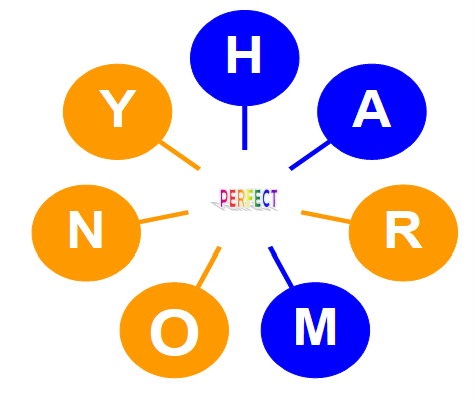
If we allow go round seven (S=7) lines {H A R M O N Y} moving clockwise, we can obtain a set of angular distances [α, 6α] between of distinct pairs of three (n_1=3) blue lines (_H A M) as cyclic numerical relationship {1: 2: 4}, whereas between of distinct pairs of four (n_2=4) yellow ones (_R O N Y) as cyclic link {2: 1: 1: 3}. The first of them allows optimal partition of a ring in three (n_1=3) parts for obtain the set of harmonious proportions from 1/7 to 6/7 by spatial interval α=360º/7 exactly once, while the second - as optimal partition of the ring in four (_n_2 =4) parts for finding the same proportions exactly twice. The idea of intelligent basis of _t-_dimensional rotational symmetry is useful in understanding cyclic _n-sequence of t-_stage integer-value sub-sequences of the sequence, where _t-modular (m_1, _m_2 , …, _m_t) sums of consecutive _t-stage terms enumerate the set of t-_dimensional manifold topology coordinate system. The principal property of the model is that ring _n-sequence {K_1, _K_2,… _Kn} of t -stage its sub-sequences to be completed with non-negative integers allows on enumeration of all nodal points coordinates grid _m_1 × _m_2× …× _m_t of the coordinate system.
Example: The vector IRB {(1,1), (0,1), (2,2), (2, 1)} containing four (n = 4) two-dimensional (t = 2) vectors generate ring vector-sums, taking complex modulo _m_1 = 3, and _m_2 = 4 as follows:
( ) ( ) ( ) ( ) ( ) ( ) ( ) ( ) ( ) ( ) ( ) ( ) ( ) ( ) ( ) ( ) ( ) ( ) ( ) ( ) ( ) ( ) ( ) ( ) ( ) ( ) ( ) ( )
1,1 0,1 1,2 + ≡ + ≡ + ≡ + ≡ + + ≡ + + ≡ + + ≡ + + ≡
0,1 2,2 2,3
2,2 2,1 1,3
2,1 1,1 0,2 mod3,mod 4 1,1 0,1 2,2 0,0
0,1 2,2 2,1 1,0
2,1 1,1 2,2 2,0
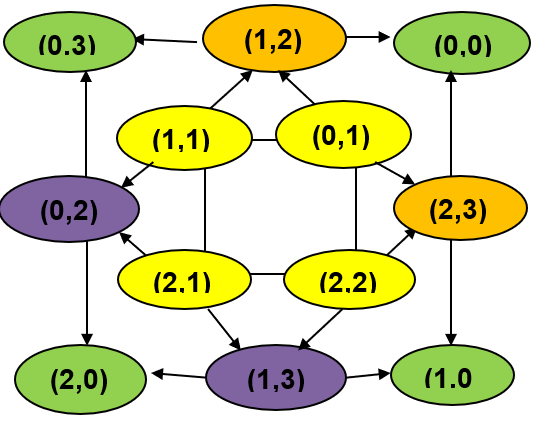
1,1 0,1 2,1 1,3 So long as the vectors (1,1), (0,1), (2,2), (2,1) of the ring sequence themselves are 2D vector-sums too, the complete set of these vector sums: (0,0), (0,1), (0,2), (0,3), (1,0), (1,1), (1,2), (1,3), (2,0), (2,1), (2,2), (2,3).
The result of the calculation forms two-dimensional (t =2) grid over 2D torus surface of sizes 3 × 4, where 2D modular coordinates of each node of the grid occurs exactly once.
Here is schematic diagram of coordinate grid 3×4 based on the IRB {(1,1), (0,1), (2,2), (2, 1)} (Figure 2).
| № | Vectors | 2D datasets | Optimum vector monolithic 2D code | ||||
|---|---|---|---|---|---|---|---|
| A | B | (1,1) | (0,1) | (2,2) | (2,1) | ||
| 1 | (0,0) | 0 | 0 | 1 | 1 | 1 | 0 |
| 2 | (0,1) | 0 | 1 | 0 | 1 | 0 | 0 |
| 3 | (0,2) | 0 | 2 | 1 | 0 | 0 | 1 |
| 4 | (0,3) | 0 | 3 | 1 | 1 | 0 | 1 |
| 5 | (1,0) | 1 | 0 | 0 | 1 | 1 | 1 |
| 6 | (1,1) | 1 | 1 | 1 | 0 | 0 | 0 |
| 7 | (1,2) | 1 | 2 | 1 | 1 | 0 | 0 |
| 8 | (1,3) | 1 | 3 | 0 | 0 | 1 | 1 |
| 9 | (2,0) | 2 | 0 | 1 | 0 | 1 | 1 |
| 10 | (2,1) | 2 | 1 | 0 | 0 | 0 | 1 |
| 11 | (2,2) | 2 | 2 | 0 | 0 | 1 | 0 |
| 12 | (2,3) | 2 | 3 | 0 | 1 | 1 | 0 |
Table 1: Optimum 2D vector data system processing at the same time in torus surface coordinate grid 3 × 4 displays.
Table 1 contains n (n –1) =12 binary four- digit (n = 4) combinations for coding two-dimensional vectors (t = 2) in optimum torus coordinate system of sizes 3×4, where IRB {(1,1), (0,1), (2,2), (2,1)} is basis of the 2D vector encoding system. This system provides encoding the full set of 2D vectors from (0,0) to (2,3) in the torus coordinate grid by exactly one monolithic code combination, each of them is a ring sequence with no more of two solid packets of the same characters. The set of 2D code combinations one-to-one corresponds to set of torus coordinate grid 3×4.
Conclusion
The prospects for the development of optimum vector combinatorial theory are opened based on the minimization of the basic structure of multi-dimensional information flow processing systems and the functionality of vector computer systems is expanded. At last, optimum vector combinatorial systems theory discovers direct application of the underlying scientific approach for systems engineering design for development perspective R&S research in contemporary information technologies, computing, telecommunication, systems engineering, and education as an alternative to quantum ones.
References
-
Wigner P (1970) Symmetries and Reflections. Indiana university press. Bloomington.
-
Riznyk V (2017) Multi-modular optimum coding systems based on remarkable geometric properties of space. Advances in Intelligent Systems and Computing 512: 129-148.
- Group Consensus of Nonlinear Hybrid Multi-Agent Systems with Self-Triggering Event Mechanism
- Manifold Systems Applied Theory for Innovative Robotic Technology
- Collaborative Robots: Human-Robots Coexistence in Industrial Environments
- Utilizing Idle Time for Job Clusters Reduces Inventory and Total Job Completion Time for Single Machine Scheduling
- Embracing the Future of Robotics with ART
- The Fascinating World of Cloud Robotics