
Vitamin D Deficiency in Elderly Saudi Patients with Type 2 Diabetes Mellitus
Introduction: Vitamin D deficiency and type 2 diabetes mellitus (T2DM) remain major health problems. We conducted a cross sectional study to investigate the prevalence vitamin D deficiency in elderly patients with T2DM. Method: A cross-sectional single center study was conducted in 1622 patients 60 years or more with T2DM attended the Diabetes Centre at King Fahad Armed Forces Hospital, Jeddah, Saudi Arabia between January 2018 and December 2018. The serum concentration of 25-hydroxyvitamin D (25-OHD) and HbA1c were measured. Results: There were 1622 patients with T2DM, 28.3% male and 71.7% female. Vitamin D deficiency was found in 37.6%. Moreover, vitamin D deficiency was significantly more prevalent among females than males (61.6% vs. 38.4% respectively, p
Introduction
The global prevalence of vitamin D deficiency is estimated at 30-87% [1, 2]. Moreover, in Saudi Arabia, these estimates range between15-30% in the general population [3, 4]. In addition, the prevalence of type 2 diabetes mellitus (T2DM) in Saudi Arabia is one of the highest reported in the world, reaching up to 30% [3]. It has been demonstrated that vitamin D deficiency is associated with T2DM [4, 5, 6]. The prevalence of vitamin D deficiency in patients with T2DM varies from 70 to 90%, depending on the threshold used to define vitamin D deficiency [7, 8, 9]. Few published researches have been found that surveyed the prevalence of vitamin D deficiency in patients with T2DM in Saudi Arabia [10].
The elderly population is the more susceptible population to suffer vitamin D deficiency, especially the elderly who live in nursing homes and who are hospitalized [11, 12, 13, 14]. Hollick found that 84% African males and females 65 years old in Boston experienced vitamin D deficiency [11, 15]. Meanwhile, Setiati found 35.1% prevalence in the female population aged 60-90 years old who lived in the nursing home [16, 17, 18, 19, 20, 21, 22, 23].
The proportion of people in Saudi Arabia aged 60 or more is predicted to be 25 percent of the total population of 40 million by the end of 2050. Moreover, the number of people aged 80 or more is expected to reach 4 percent of the country’s total population in the same period [24]. We conducted a cross sectional study to investigate the prevalence vitamin D deficiency in elderly Saudi patients with T2DM.
Methods
A cross-sectional single centre study was conducted in 1622 patients with T2DM attended the Diabetes Centre at King Fahad Armed Forces Hospital, Jeddah, Saudi Arabia between January 2018 and December 2018. Eligible patients were 60 years or older. Exclusion criteria were known hepatic or renal disease, metabolic bone disease, malabsorption, hypercortisolism, malignancy, immobility for more than one-week and medications influencing bone metabolism. The serum concentration of 25-OHD was measured by competitive protein binding assay using kits (Immunodiagnostic, Bensheim, Germany). Vitamin D deficiency was defined as serum 25-OHD concentration<50 nmol/L [1]. Glycosylated hemoglobin (HbA1c) was measured by the high performance liquid chromatography method (Bio-Rad Laboratories, Waters, MA, USA). The total numbers of cohort were separated on basis of age values into two groups: 60-69 years and ≥70 years. The study was approved by the ethical committee board of King Fahad Armed Forces Hospital.
Statistical Analysis
Data are presented as means ± standard deviation (SD) or numbers (%). Quantitative variables were compared between two groups by using the Student’s test. Differences in categorical variables were analyzed using the chi-square test. The relationship between continuous variables was assessed using coefficients of correlation. Logistic regression analysis was carried out to identify the independent predictors of vitamin D deficiency considering age, gender and HbA1c as risk factors and to estimate odds ratio (OR) and 95% CI. P value <0.05 indicates significance. The statistical analysis was conducted with SPSS version 23.0 for Windows.
Results
There were 1622 patients with T2DM, 472 (28.3%) male and 1150 (71.7%) female (Table 1). The mean age was 70.1.9 ±7.9 years (60-112 years). The mean and median 25-OHD concentrations were 63.3 ±31.9 and 59nmol/l respectively. Vitamin D deficiency (defined as 25-OHD<50 nmol/l) was found in 610 (37.6%) (Table 2). Moreover, vitamin D deficiency was significantly more prevalent among females than males (61.6% vs. 38.4% respectively, p<0.0001) with female to male ratio 1.6:1.0. In addition, Vitamin D deficient patients were statistically significant younger than non-vitamin D deficient (69.0±7.3 vs. 70.7±8.2 respectively, p<0.0001). Vitamin D deficient patients have statistically significant higher
| Variables | Values | |||||
|---|---|---|---|---|---|---|
| Total | 1622 | |||||
| (Year)Age | 70.1.9±7.9 | |||||
| Gender | Male | 472 (29.1) | ||||
| Female | 1150 (70.6) | |||||
| (%)HbA1c | 7.8±1.8 | |||||
| 25-hydroxyvitamin D (nmol/L) | 63.3±31.9 |
Table 1: Patient characteristics [mean±standard deviation or number (%)].
HbA1c than non-vitamin D deficient (8.3 ±1.9 vs. 7.4 ±1.6 respectively, p<0.0001). As expected, the mean 25-OHD concentration was statistically significant lower in the vitamin D deficient patients compared to non-vitamin D deficient (35.4 ±9.4 vs. 80.1±28.8 respectively, p<0.0001).
| Vitamin D Deficiency | ||||||||||
|---|---|---|---|---|---|---|---|---|---|---|
| Variables | ||||||||||
| Present | Absent | P values | ||||||||
| Numbers | 610(37.6) | 1012(62.4) | ||||||||
| (Year)Age | 69.0±7.3 | 70.7±8.2 | <0.0001 | |||||||
| Gender | Male | 234(38.4) | 238(23.5) | <0.0001 | ||||||
| Female | 376(61.6) | 774(76.5) | ||||||||
| (%)HbA1c | 8.3±1.9 | 7.4±1.6 | <0.0001 | |||||||
| 25-hydroxyvitamin D (nmol/L) | 35.4±9.4 | 80.1±28.8 | <0.0001 |
Table 2: Vitamin D deficiency among elderly type 2 diabetes mellitus patients [mean±standard deviation or number (%)].
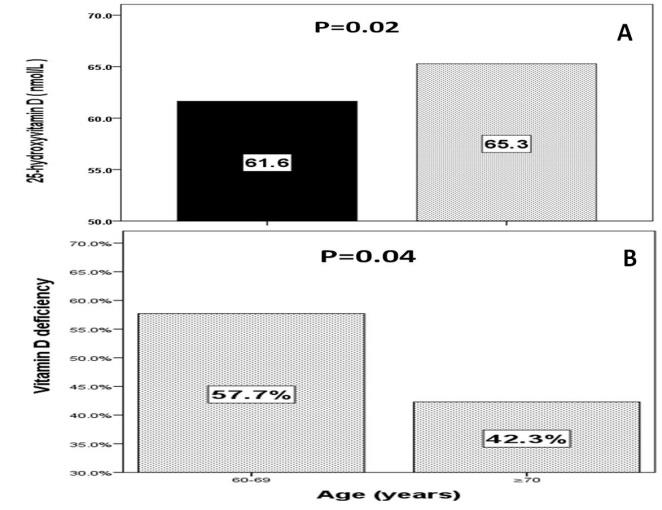
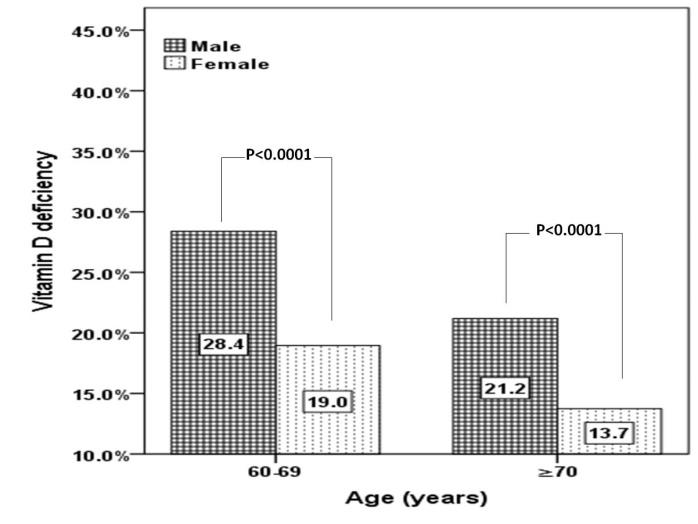
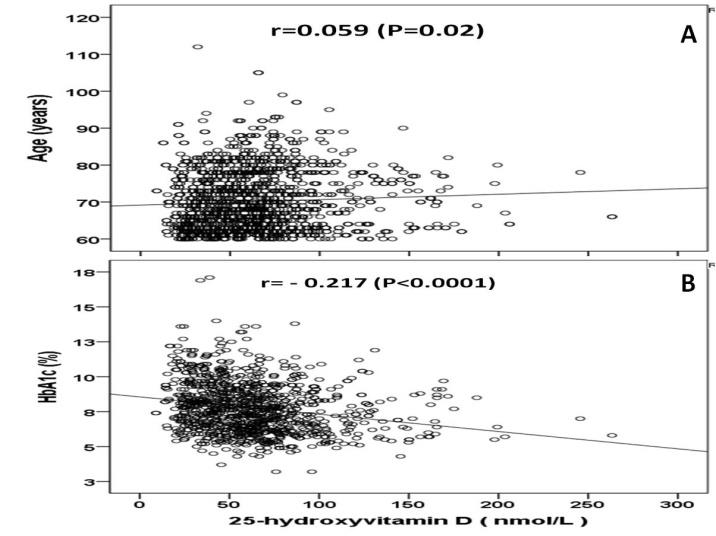
Regression analysis of odd ratio of risk factors for patients with vitamin D deficiency showed that female gender, age and HbA1c were statistically significant associated with vitamin D deficiency, (OR=1.840; 95% confidence interval [CI]=1.422-2.380), p<0.0001), (OR=0.974; 95% CI=0.958-0.991), p=0.002) and (OR=1.312; 95% CI=1.221-1.410), p<0.0001) respectively (Table 3).
| Parameter | Odd Ratio(95% CI) | P Value | ||||||
|---|---|---|---|---|---|---|---|---|
| Female Gender | 1.840 (1.422-2.380) | <0.0001 | ||||||
| (year)Age | 0.974 (0.958-0.991) | 0.002 | ||||||
| HbA1c | 1.312(1.221-1.410) | <0.0001 |
Table 3: Regression analysis for odd ratio of risk factors for patients with vitamin D deficiency.
Discussion
The high incidence of T2DM worldwide and in Saudi Arabia and the accumulated evidence on the status of vitamin D under different conditions make it extremely important to determine the relationship between vitamin D and diabetes mellitus [5, 25]. In the present study, we used the cut-off level less than 50nmol/l in order to define vitamin D deficiency and we found 37.6% prevalence. To our knowledge, this is the first study conducted in Saudi Arabia, which establishes the prevalence of vitamin D deficiency in elderly patients with T2DM. When compared with previous studies in elderly populations (35.1-84%), our study was within the prevalence rate [11, 15, 26, 27, 28]. The lower vitamin deficiency in our study compared to others might be due to the different subject’s characteristics, which were not limited only to the elderly group as the previous studies. Our study involved elderly, male and female subjects of general population and not only on limited population such as subjects who lived in nursing home. It is of importance to state that the sample size is representative for a number of subjects suffering from T2DM in the area and study population of one institution does not represent the entire city of Jeddah, in addition the study sample confined to patients with T2DM but without comparable groups.
Some factors estimated as affecting factors on the development of vitamin D deficiency were analyzed and we found evidence that gender, age and HbA1c were statistically significant. The female gender variable seemed to be the most affecting factor in the development of vitamin D deficiency, which was higher in female (61.6%) compared to male (38.4%) and whereas the risk was increased by 84%. Female subjects often used sun protectors, which consequently reduced the direct sun light exposure. Other possibilities include. Male subjects generally had more frequent and longer duration in doing outdoor activities; therefore most of them had more exposure to direct sun light.
We found serum 25-OHDconcentration was strongly correlated with age that is similar to the findings of Hashemipour, et al. [29] in a cohort of 1210 Iranians adult. The strong correlation of 25(OH)D to age is also in agreement with a study carried out in the US, where vitamin D deficiency was found to be more common among the young, and less common among the elderly [30].
We found vitamin D deficient patients aged 60-69 years have statistically significant higher HbA1c than the older group. Moreover, 25-OHD concentration was inversely correlated with HbA1c. These findings are supported by a number of international studies. In contrast some studies show no association of a low vitamin D with HbA1c levels [31]. But inverse correlation between the level of vitamin D and glucose level is well known [32, 33, 34]. In many studies vitamin D levels were low in subjects having higher HbA1c values in patients with T2DM indicating that they are inversely related [35]. Vitamin D has various effects on glucose homeostasis. Besides its role in insulin secretion, it also has an influence on insulin resistance directly or via Ca indirectly [36]. Changes in Ca in primary insulin target tissues may contribute to peripheral insulin resistance via impaired insulin signal transduction, leading to decreased glucose transporter-4 activity [37]. The results from the trials on the effect of vitamin D and/or Ca supplementation on insulin resistance have showed improvement on insulin action [38].
We had several limitations. Our study was a cross- sectional study; therefore, it could not evaluate the causal association directly among the studied variables as observed in longitudinal or interventional study. In addition, the study was done at one centre and was done at one point of time. The study sample confined to patients with T2DM but without comparable groups. Another limitation in our study includes the limited sample size. The high prevalence of vitamin D deficiency in our study consequently will call for greater sample size. Parathyroid level should also be studied as an indicator of vitamin D deficiency.
In conclusion, the prevalence of vitamin D deficiency in elderly patients with T2DM is high and that more females with T2DM are affected than males. We recommend larger scale studies for detecting vitamin D deficiency in our population with T2DM and suggest planning strategies to supplement our population with vitamin D.
Acknowledgment
There is no any financial support or relationships that may pose conflict of interest.
References
-
Hilger J, Friedel A, Herr R, Rausch T, Roos F, et al. (2013) A systematic review of vitamin D status in populations worldwide. Br J Nutr 111(1): 23-45.
-
Holick MF (2006) High prevalence of vitamin D inadequacy and implications for health. Mayo Clin Proc 81(3): 353-373.
-
Sedrani SH, Elidrissy AW, El Arabi KM (1983) Sunlight and vitamin D status in normal Saudi subjects. Am J Clin Nutr 38(1): 129-132.
-
Al Turki HA, Sadat Ali M, Al Elq AH, Al Mulhim FA, Al Ali AK (2008) 25-Hydroxyvitamin D levels among healthy Saudi Arabian women. Saudi Med J 29(12): 1765-1768.
-
Alqurashi KA, Aljabri KS, Bokhari SA (2011) Prevalence of diabetes mellitus in a Saudi community. Ann Saudi Med 31(1): 19-23.
-
Thorand B, Zierer A, Huth C, Linseisen J, Meisinger C, et al. (2011) Effect of serum 25-hydroxyvitamin D on risk for type 2 diabetes may be partially mediated by subclinical inflammation: results from the MONICA/KORA Augsburg study. Diabetes Care 34: 2320-2322.
-
Mori H, Okada Y, Tanaka Y (2015) Incidence of vitamin D deficiency and its relevance to bone metabolism in Japanese postmenopausal women with type 2 diabetes mellitus. Intern Med 54(13): 1599- 1604.
-
Tahrani AA, Ball A, Shepherd L, Rahim A, Jones AF, et al. (2010) The prevalence of vitamin D abnormalities in South Asians with type 2 diabetes mellitus in the UK. Int J Clin Pract 64(3): 351-355.
-
Miñambres I, Sánchez Quesada JL, Vinagre I, Sánchez Hernández J, Urgell E, et al. (2014) Hypovitaminosis D in type 2 diabetes: relation with features of the metabolic syndrome and glycemic control. Endocr Res 40(3): 160-165.
-
Al Zaharani M (2013) The prevalence of Vitamin D deficiency in Type 2 Diabetic patients. Majmaah J Health Sciences 1(1): 18-22.
-
Holick MF (2004) Sunlight and vitamin D for bone health and prevention of autoimmune diseases, cancer, and cardiovascular disease. Am J Clin Nutr 80(6): S1678-S1688.
-
Gloth FM, Gundberg CM, Hollis BW, Haddad JG, Tobin JD (1995) Vitamin D deficiency in homebound elderly persons. Jama 274(21): 1683-1686.
-
Peterlik M, Cross HS (2005) Vitamin D and calcium deficits predispose for multiple chronic diseases. Eur J Clin Invest 35(5): 290-304.
-
Hollick MF (1994) McCollum award lecture, 1994: Vitamin D-new horizon for 21st century. Am J Clin Nutr 60(4): 619-630.
-
Hollick MF (2004) Vitamin D: Importance in the prevention of cancers, type 1 diabetes, heart disease, and osteoporosis. AmJ Clin Nutr 79(3): 362-371.
-
Setiati S, Oemardi M, Sutrisna B (2007) The role of ultraviolet B from sun exposure on vitamin D and parathyroid hormone level in elderly women in Indonesia. Asian J Gerontol Geriatr 2: 126-32.
-
Ayesha I, Bala TS, Reddy CV, Raghura MN (2001) Vitamin D deficiency reduces insulin secretion and turnover in rats. Diabetes Nutr Metab 14(2): 78-84.
-
Cade C, Norman AW (1996) Vitamin D3 Improves Impaired Glucose Tolerance and Insulin Secretion in the Vitamin D Deficient Rat in Vivo. Endocrinol 119(1): 84-90.
-
Chertow BS, Sivitz WI, Baarnetsky NG, Clark SA, Waite A, et al. (1993) Cellular mechanism of insulin release: the effect of vitamin D deficiency and repletion on rat insulin secretion. Endocrinol 113(4): 1511-1518.
-
Kadowaki S, Norman AW (1994) Dietary vitamin D is essential for normal insulin secretain. J Clin Invest 73(3): 756-766.
-
Nyomba BL, Bouillon R, De Moor P (1994) Influence of vitamin D status of insulin secretion and glucose tolerance in the rabbit. Endocrinol 115(1): 191-197.
-
Tanaka Y, Seino Y, Ishida M, Yamaoka K, Yabuuchi H, et al. (1994) Effect of vitamin D3 on the pancreatic secretion of insulin and somatostatin. Acta Endocrinol (Copenh) 105(4): 528-533.
-
Billaudel B, Barakat L, Faure Dussert A (1998) Vitamin D3 deficiency and alterations of glucose metabolism in rat endocrine pancreas. Diabetes Metab 24(4): 344-350.
-
(2015) Data were extracted from the Population Division of the Department of Economic and Social Affairs of the United Nations.
-
Rosen CJ (2011) Clinical practice. Vitamin D insufficiency. N Engl J Med 364(3): 248-254.
-
Baynes KC, Boucher BJ, Feskens EJ, Kromhout D (1997) Vitamin D, glucose tolerance and insulinemia in elderly men. Diabetol 40(3): 344-347.
-
Sumariyono, Setyohadi S, Anggoro S (2008) Vitamin D status and hyperparathyroidism in postmenopausal osteoporotic patients in Cipto Mangunkusumo Hospital Jakarta. Acta Med Indones 40(2): 69-73.
-
Hidayat R, Setiati S, Soewondo P (2010) The association between vitamin D deficiency and type 2 diabetes mellitus in elderly patients. Acta Med Indones 42(3): 123-129.
-
Hashemipour S, Larijani B, Adibi H, Javadi E, Sedaghat M, et al. (2004) Vitamin D deficiency and causative factors in the population of Tehran. BMC Public Health 4: 38.
-
Plotnikoff GA, Quigley JM (2003) Prevalence of severe hypovitaminosis D in patients with persistent, nonspecific musculoskeletal pain. Mayo Clin Proc 78(12): 1463-1470.
-
Husemoen LLN, Thuesen BH, Fenger M, Jorgensen T, Glumer C, et al. (2012) Serum 25 (OH)D and Type 2 Diabetes Association in a General Population: A prospective study. Diabetes Care 35(8): 1695-700.
-
Palomer X, Gonzalez Clemente J, Blanco Vaca F, Mauricio D (2008) Role of vitamin D in the pathogenesis of type 2 diabetes mellitus. Diabetes Obes Metab 10(3): 185-197.
-
Boucher BJ, Mannan N, Noonan K, Hales CN, Evans SJ (1995) Glucose intolerance and impairment of insulin secretion in relation to vitamin D deficiency in eastLondon Asians. Diabetologia 38(10): 1239-1245.
-
Hutchinson MS, Figenshau Y, NjølstadI, Schirmer H, Jorde R (2011) Serum25-hydroxyvitamin D levels are inversely associated with glycated haemoglobin (HbA(1c)). The Tromsø Study. Scand J Clin Lab Invest 71(5): 399-406.
-
Kositsawat J, Freeman VL, Gerber BS, Geraci S (2010) Association of A1Clevels with vitamin D status in U.S. adults: data from the National Health and Nutrition Examination Survey. Diabetes Care 33(6): 1236-1238.
-
Borissova AM, Tankova T, Kirilov G, Dakovska L, Kovacheva R (2003) The effect of vitamin D3 on insulin secretion and peripheral insulin sensitivity in type 2 diabetic patients. Int J Clin Pract 57(4): 258- 261.
-
Zemel MB (1998) Nutritional and endocrine modulation of intracellular calcium: implications in obesity, insulin resistance and hypertension. Mol Cell Biochem 188(1,2): 129-136.
-
Nazarian S, St Peter JV, Boston RC, Jones SA, Mariash CN (2011) Vitamin D3 supplementation improves insulin sensitisity in subjects with impaired fasting glucose. Transl Res 158(5): 276-281.
- Investigation of Polymorphisms in PPAR-Ɣ and TRHR Genes and their Impact on Turkish Diabetic and Obese Individuals
- The Impact of Aircraft Noise Exposure on the Efficacy of Empagliflozin Therapy in an Animal Model of Obesity
- Rooibos Mitigates Metabolic and Inflammatory Dysfunctions in Mice Fed a High-Carbohydrate Diet
- Synergistic Effect of Combined Leaf Extract of Vernonia amygdalina, Ocimum gratissimum, and Zingiber officinale Tuber on Phytochemical Profile, Antioxidant Activity, Serum Insulin, and Biochemical Parameters in Streptozotocin-Induced Diabetic Rats
- Investigation of Cardiovascular Responses to Aerobic Exercise in Obese University Students
- A Look at the Phase Angle Obtained by Electrical Bioimpedance