
Status and Conservation Effort of Distance Waters Fisheries in Indonesia
Distant waters fisheries in Indonesia are an important fisheries sector which accounts for foreign exchange from the export of tuna and the tuna like commodities. Lack of private investment and government support led to the development of these fisheries is not as fast as coastal fisheries. In recent years, the government has provided significant support for the development of offshore fisheries, such as implementation of a policy of aid 1000 units of larger fishing vessels 30 GT to fishermen to operate in Indonesia EEZ waters, and provided some policies that support the fisheries including Indonesia’s participation in regional fisheries management organizations (RFMO). This will support better conditions for business activities of the fisheries. By becoming a member of RFMO, Indonesia plays an active role in achieving global sustainable fisheries management. Nevertheless, some important issues and problems in particular tuna fisheries is a challenge that must be solved. This paper reviews the status of distant waters fisheries in Indonesia and conservation efforts as well as the management of fish resources.
Introduction
As the world’s largest archipelagic state, Indonesia has 13,466 islands (Geospatial Information Agency 2012) with 5.8 million square kilometers marine area and 95,181 kilometers coastline. Accordingly, this country has a huge potency of marine fisheries resource both in quantity and diversity. The maximum sustainable yield of marine fish resource was estimated at 6.52 tones/year consisted of large pelagic fish 1,145.4 tones/year, small pelagic fish 3,645.7 tones/year, demersal fish 1,452.5 tones/year, penaeid shrimp 98.3 tones/year, reef fish 145.3 tones/year, lobster 4.8 tones/year, and squids 28.3 tones/year (MFMA 2011).
Fishing activity is still dominated by artisanal fisheries that engage in coastal fishing ground using small fishing boat of less than 15 GT. This fact influences to fisheries production as well as complexity in fisheries management. In the fisheries book 2011, the marine capture fisheries production was about 5.06 million tones, with production value reached 65.7 trillions rupiah. The biggest production number was eastern little tuna (0.380 million tones), followed by skipjack tuna (0.345 million tones), and other tunas (0.231 million tones). The tuna production contributed 18.88% of total national marine capture fisheries production.
Although the fisheries production is still lower than it’s potency as mentioned above, it cannot be said that the increase of fishing effort will result in the production increase. Review on the fisheries production data during the period of 1976-2008 showed slowly increasing trend and the production approaches to optimum level (Agency for Marine Research and Development 2012). This condition is also happened in tuna fisheries as the National Stock Assessment Commission reported that the tunas were fully and over exploited in most FMA, excepted skipjack was on moderately exploited. Nowadays, tuna fisheries has developed rapidly, in fact some Indonesian fishing fleets have being conducting operation in offshore waters and cruising over the western part of Indian Ocean as far as around Maldives and Mauritius waters. Beside that, purse seine equipped with fish aggregating device (FAD) that used to catch tuna has developed rapidly in archipelagic waters especially in the eastern Indonesia and southern Java [1]. The use of FAD has attracted small pelagic fish including baby tunas accumulated around FAD that subsequently being caught by the purse seine. The catching of some juvenile/baby tunas around FAD has become concerned of researchers and tuna fisheries managers, therefore it needs on an appropriate tuna fisheries management and conservation.
This paper discusses the status of distant water fisheries in Indonesia especially tuna fishing, and distant water fisheries resource management and conservation. Data used were collected from MFMA, IOTC, WCPFC, CCSBT, and other related publications [2, 3, 4].
Overview of Distance Water Fisheries
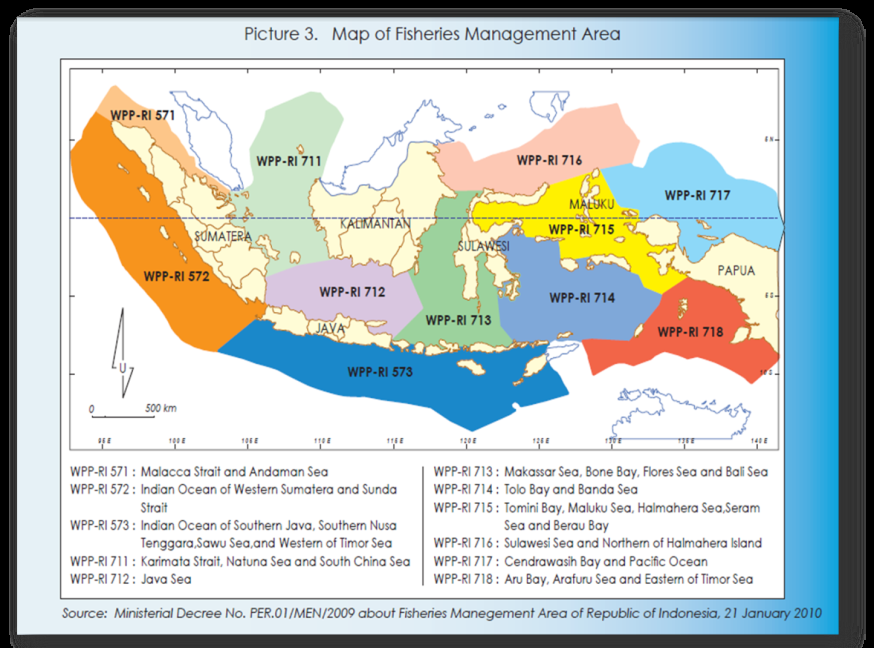
Fishing Grounds Based on Fisheries Management Area (FMA): Indonesia’s seas have border on Indian and Pacific Ocean that become main fishing ground for distant water fisheries especially tuna fishing. According to the Regulation of Minister of Fisheries and Marine Affairs (MFMA) No. 01/2009, the Fisheries Management Areas (FMAs) within Indonesia’s seas are divided into 11 FMAs (Figure 1). There are 2 FMAs adjacent to the western and central part of the Pacific Ocean (716- Sulawesi Sea and northern Halmahera Island; 717- Cendrawasih Bay and the Pacific Ocean) and 2 FMAs are in the Indian Ocean (572-Indian Ocean of west Sumatera; 573- India Ocean of south Java).
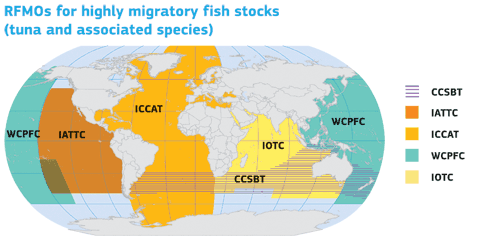
Pacific and Indian Ocean become distant water fishing ground for big fishing vessel from many countries. Tunas are the main target species with long line, big pelagic purse seine, pole and line, and gillnet as the fishing gears. Because of distant water fisheries in Indonesia have not been developed yet, only few the national fishing fleets engage for catching tunas. Ministry of Fisheries and Marine Affairs has made a policy about ship aid with size above 30 GT to many fishers in Indonesia. This program is supposed can support fishing fleet to utilize tuna potency in Indian and Pacific Ocean. The tuna production is mainly contributed by the distant water tuna fisheries in the FMAs. Tuna fisheries management in Indonesia cannot be separated from Regional Fisheries Management Organizations (RFMOs). At least, there are 3 RFMOs that have direct influence to tuna fisheries policy in Indonesia (Figure 2), IOTC (Indian Ocean Tuna Commission) CCSBT (Commission for the Conservation of Southern Bluefin Tuna) and WCPFC (Western and Central Pacific Fisheries Commission). The RFMOs have rule and determination of total allowable catch and quota allocation for each member of RFMO. The rules are necessary to maintain orderliness in the management of tuna in the regions and to create harmony between regional and country-based rules.
Fishing Fleets
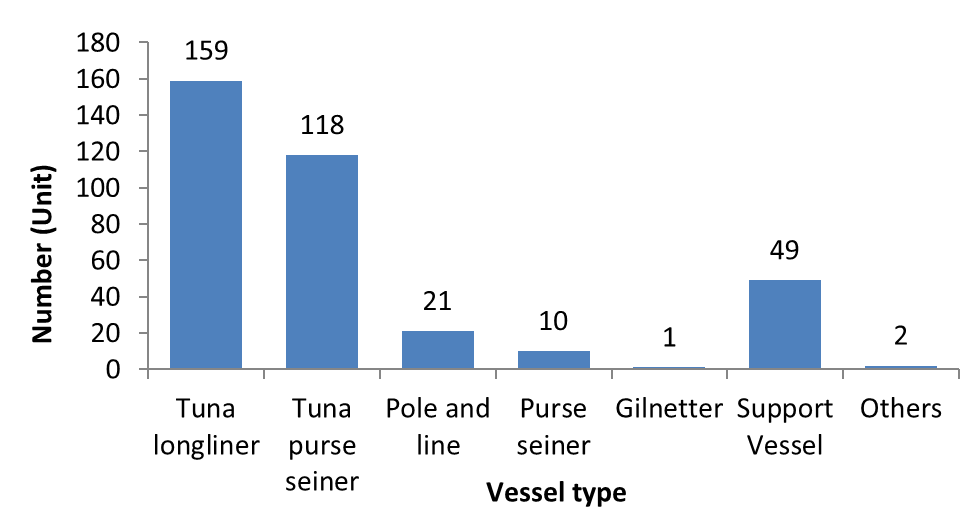
Pacific Ocean (FMA 716 and 717): Distant water fisheries in Eastern Indonesia especially in FMA 716 and 717 (Sulawesi Sea and Pacific Ocean) dominated by tuna fishing vessel. The main tuna fishing industry in the Eastern Indonesia is based on Sulawesi (Bitung, Luwuk, Kendari, and Kolaka), Maluku (Ternate, Labuha, Ambon, and Banda), Papua (Sorong, Biak, and Manokwari) and East Nusa Tenggara (Maumere) (Sala, 1999). Various fishing vessels that operate in FMA 716 and 717 have different fishing gear used. According to data from WCPFC [4], there were about 201 units of Indonesia tuna fishing fleets registered until 2012. Tuna long liner and tuna purse seiner was dominant fishing vessel (Figure 3) with main targets of big eye, yellow fin and skipjack tuna.
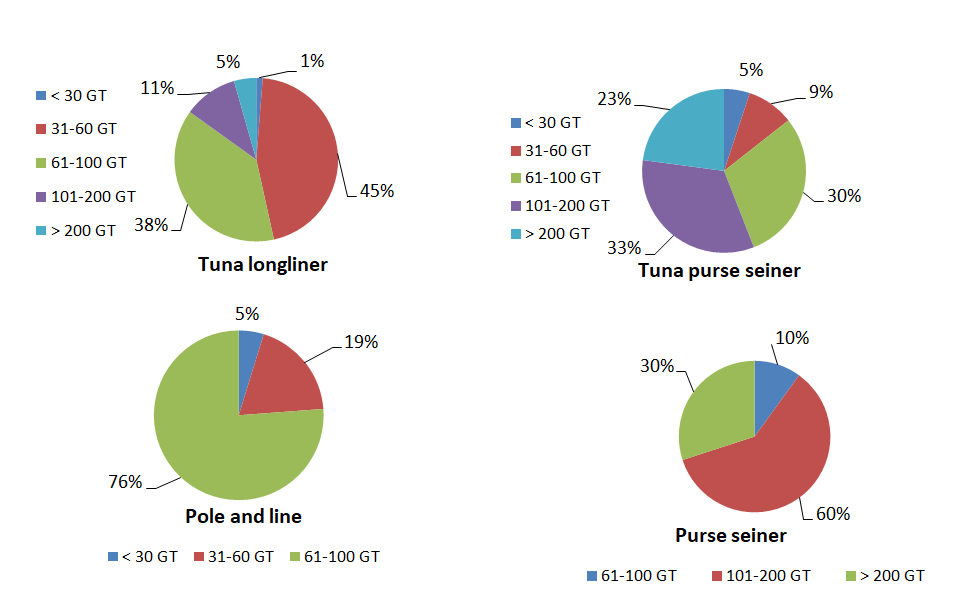
The tuna long liner was dominated by 31-60 GT (45%), whereas the vessel of larger than 200 GT was only 5%. Tuna purse seiner was dominated by 101-200 GT (33%), while pole and line was dominated by 61-100 GT (76%) as shown in Figure 4. This fact describe about number of Indonesia tuna long liner is still limited in utilizing EEZ and distant water tuna potency, especially in FMA 716 and 717. In addition, traditional tuna fisheries rapidly develop in coastal area using various small fishing boats and fishing gears to catch skipjack or yellow fin tuna that migrate from Pacific Ocean. These traditional fisheries contribute to the national production of tuna that mostly absorbed by local markets.
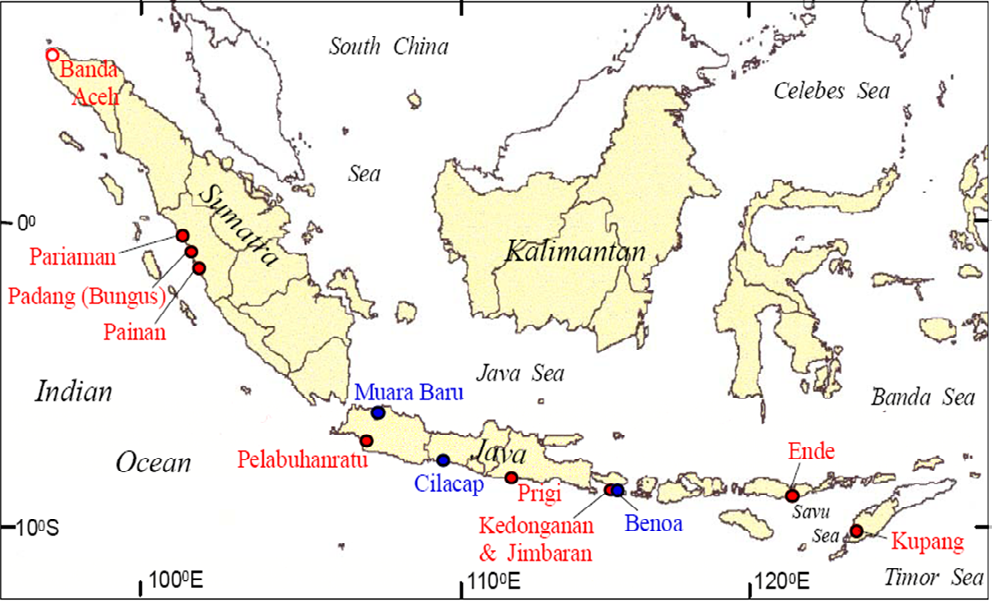
Indian Ocean (FMA 572 and 573) Fishing ground for tuna fishing in Indian Ocean spread out from west Sumatera to south Java. Fishing vessel can unloading their catch at fishing port that close to their fishing ground. The main fishing ports of tuna unloading are Muara Baru, Cilacap, Benoa and Bungus. Several fishing ports have industrial facilities for tuna processing. The main landing sites for industrial tuna fishing fleet are Benoa Fishing Port (Bali), Muara Baru Fishing Port (Jakarta), Palabuhanratu Fishing Port (West Java), and Cilacap Fishing Port (Central Java) [5].
![Figure 5: Primary fishing port/landing sites the industrial (blue label) and artisanal (red label) [5].](/fulltextimages/12561/fig_5.png)
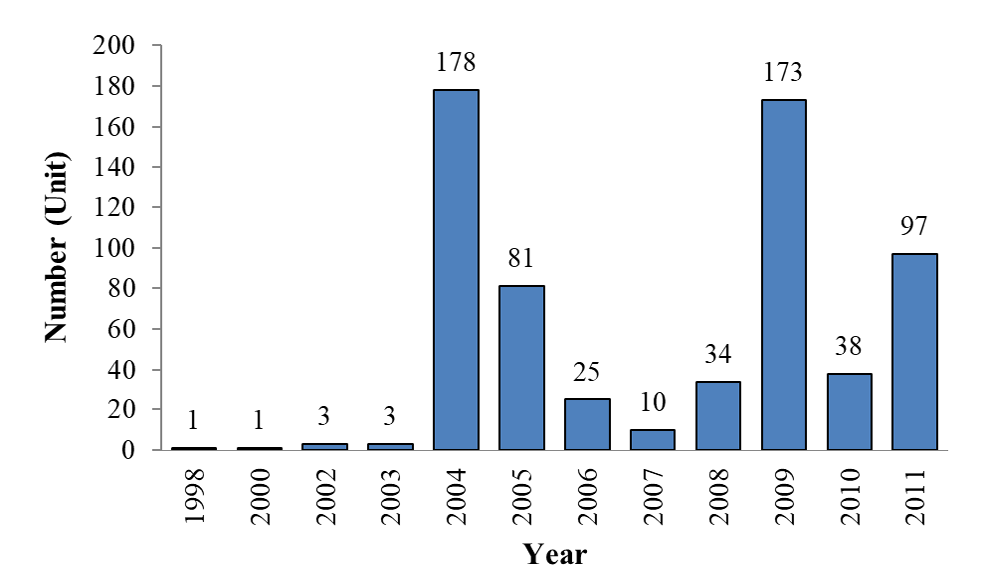
Based on data report from IOTC (2012), the number of Indonesia’s fishing fleets that have first reported to IOTC from 1998 to 2011 showed high fluctuation (Figure 6). In early 2000, there was a little fishing fleet that reported to IOTC. In this period, Indonesia experienced heavy economic crisis that gave affect to fisheries sector especially for tuna fishing industry. The increase price of fuel used for industry after the economic crisis also gave influence to declining number of offshore fishing fleets.
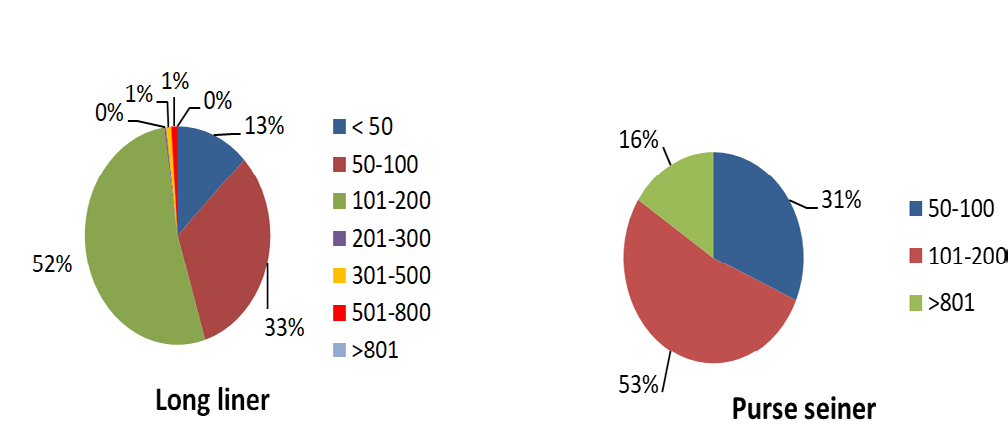
The number of registered fishing vessels as reported to IOTC in the FMAs 572 and 573 (Indian Ocean) on 2012 was 1,278 units. The number of long line was 1,256 units, purse seine 19 units, gillnet 2 units and carrier boat 1 units (Figure 7). Those fishing vessels have various sizes from less than 50 GT to 1,025 GT, among them 33 vessels over 200 GT and mostly 100-200 GT. The number of tuna long line fishing vessels in the Indian ocean has slightly increased from 1,188 units in 2010 to 1,256 boats in 2012 [6].
Production
Pacific Ocean: Indonesia tuna fisheries in 1950-1970’s were limited as subsistence fishing, with only very minor commercial activities [7]. The higher price of fish commodities in the world at 1970-1980’s had caused many countries increasing their tuna export volume. This condition had triggered national fishing company in Indonesia to utilize tuna potency, especially in coastal and EEZ waters. Production trend from 1980-1990’s of main commodities (big eye, skipjack, and yellow fin tuna) showed significantly increase. Skipjack was dominant with increase in production by 472% during ten years (44,298 tonnes in 1980 became 253,493 tonnes in 1999).
In the middle 1997, Indonesia experienced strongly economic crisis until 2002 [8]. Many sectors got worst impact, as well as fishing industry. Skipjack tuna production decreased by 32% from 1999 to 2003. But yellow fin and big eye tuna production did not have same trend. Big eye production increased with production in 2011 was around 16,584 tonnes (Figure 9).
Annual catches of four main tuna species (skipjack, yellow fin, big eye, and albacore tuna) in Indonesia has the same trend with the catch from WCPFC area. The production increased continuously since the beginning of significant commercial exploitation in the early 1950’s (Figure 10). In 2009, the highest ever catch of 2.46 million tonnes was recorded [7]. The expansion in the total catch over the past 30 years has been due primarily to the development of purse seine fishing in the region. As a result, catches of skipjack, the main target of the purse seine fishery, and yellow fin, a secondary target species, have been the main source of catch increases [9].
![Figure 10: Total catch of the main tuna species in the WCPFC area by species [9].](/fulltextimages/12561/fig_10.png)
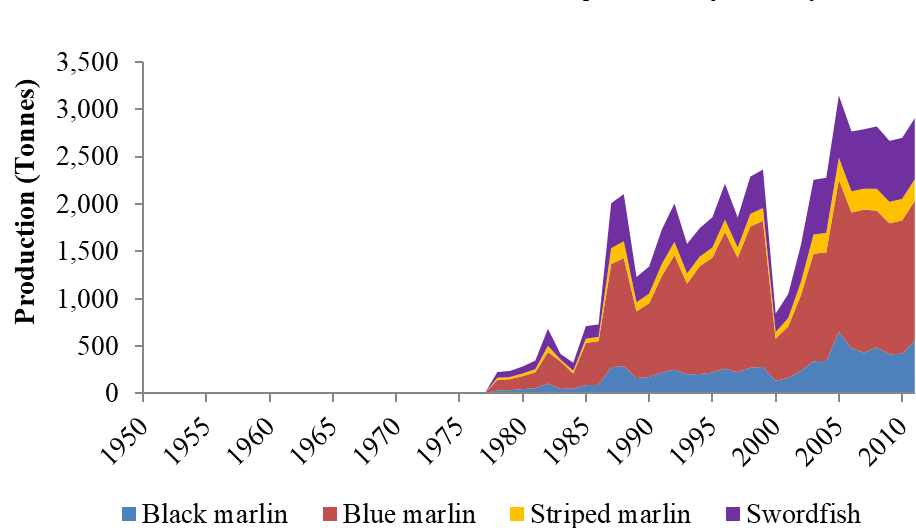
Blue marlin production has the same trend with skipjack (Figure 11). Drastic decreasing production happened from 1991 to 2000 up to 71%. After 2002 periods, the national economic condition has been recovery and the fisheries sectors came back to good condition. World fish demand that continually increase especially in Japan, Korea, USA and UE have to fulfill. Even though billfish are not the main target species, but commonly caught in long line fishing. The long line fishery commands the highest prices for its landed tunas, but also takes billfish and shark species as by-catch [3].
![Figure 11: Indonesia’s fishing vessel production of billfish [4].](/fulltextimages/12561/fig_11.png)
Indian Ocean: The total tuna production in 2011 was about 150,010 tonnes and was dominated by skipjack (56%) as shown in Figure 12. There was significantly increased on skipjack production from 2007 until 2011 (63%). The total catches of Indonesia’s tuna fishing fleet in Indian Ocean slightly increased from 2007 to 2011. The positive trends show about fishing effort in Indian EEZs and distant water fisheries increase too. Purse seine and gillnet are dominant fishing gear to catch skipjack in distant waters. But in neritic tuna fishing, pelagic Danish seine contributed about 77 % of neritic tuna landing in Palabuhanratu [10, 11].
![Figure 12: There was significantly increased on skipjack production from 2007 until 2011 (63%). The total catches of Indonesia’s tuna fishing fleet in Indian Ocean slightly increased from 2007 to 2011. The positive trends show about fishing effort in Indian EEZs and distant water fisheries increase too. Purse seine and gillnet are dominant fishing gear to catch skipjack in distant waters. But in neritic tuna fishing, pelagic Danish seine contributed about 77 % of neritic tuna landing in Palabuhanratu [10,11].](/fulltextimages/12561/fig_12.png)
Meanwhile, tuna catches in Indian Ocean increased rapidly from about 237,986 tonnes in 1980 to 654,754 tonnes in 1995. They have continued to increase up to 2005; the catch was 1,318,648 tonnes forming about 26% of the world catch. However, since 2006 onwards there was a decline in tuna catch and in 2010 the catch was only 1,257,908 tonnes (Figure 13). Tuna production in Indian Ocean continued to increase with fluctuations from 63,633 tonnes during 2001- 2005 to an average 78,400 tonnes during 2006-2010, and in 2010 the catch declined again to only 65,863 tonnes. Tuna is an important fisheries commodity but not a well-managed fishery in the Indian Ocean and Indian EEZ waters [12].
![Figure 13: Trends in tuna catch in Indian Ocean from 1950-2010 [12].](/fulltextimages/12561/fig_13.png)
Development Prospect
Principal market tuna species in 2008 are mostly harvested from the Pacific (70.2%), Indian Ocean (20.4%), Atlantic and the Mediterranean Sea (9.4%). Leading tuna catching nations in the Indian Ocean are Japan, Taiwan, Indonesia, South Korea, Spain and France [12]. Tuna’s potency in Pacific and Indian Ocean is mostly in good condition [9, 10]. In Pacific region, tuna catch in EEZ Indonesia is in the third rank with purse seine as dominant fishing gear (Figure 14).
Distant water fisheries have to develop with high concern in all sectors and stakeholders collaboration. The limiting fishing fleets that operate in Pacific and Indian Ocean become weakness to increase utilization potency in high seas. However, efficient fishing method has also become an increasing source of worry for tuna-RFMOs and for fishermen using artisanal and logline gears because of their negative influence on skipjack, big eye, and yellow fin biomass [13].
The small number of fishing fleet operating in EEZ waters of Indonesia, providing opportunities for the development of offshore fishing. In recent years the Indonesian government has implemented a policy of aid 1000 units of larger fishing vessels 30 GT to fishermen to operate in areas Indonesian EEZ.
Implementation of this policy is expected to increase fish production in particular for large pelagic fish commodities including tuna and simultaneously improve the welfare of fishermen. In addition, with the increasing number of national fishing fleet operating in the Indonesian EEZ area is also expected to suppress illegal fishing activities.
The decline of world fish stocks, including tuna should be aware towards the possibility of a fisheries collapse. Some evidence of the capture of young tunas in large numbers by the purse seine fleet that now growing rapidly in Indonesia would be a threat to the conservation of fish resources. Operation of the purse seine using FADs for attracting the fish gather around FADs, is become the main cause of many young tunas caught by this fishing gear. Thus FADs management policies as stipulated in the Decree of the Minister of Marine Affairs and Fisheries No. Kep.30/Men/2004 about the installation and use of FADs and Ministerial Regulation No. Per.02/ Men/2011 on fishing track and placement of fishing gear and fishing auxiliaries in fisheries management area of the Republic of Indonesia, should be implemented consistently.
![Figure 14: Average annual catch of tunas in 2007-2009, by EEZ [9].](/fulltextimages/12561/fig_14.png)
Distant Water Fisheries Resource Management and Conservation
Fisheries Resource Management
Fish resource management and conservation on the high seas to Indonesia becomes the responsibility that must be done and cannot be separated from regional rules.
Indonesia as one of the countries that are members of Regional Fisheries Management Organization (RFMO) bound with conservation management measures that have been established. At this time Indonesia has a full member of the IOTC (Indian Ocean Tuna Commission) and CCSBT (Commission for the Conservation of Southern Bluefin Tuna), has not a full member of WCPFC (Western and Central Pacific Fisheries Commission). RFMOs have rule and determination of total allowable catch and quota allocation for each member of RFMO. The rules are Necessary to maintain orderliness in the management of tuna in the regions and to create harmony between the regional and country-based rules.
The legal basis of the high seas fisheries management, including the mandate for establishment of RFMO are such as the United Nations Convention on the Law of the Sea (UNCLOS) 1982, the Agreement to Promote Compliance with International Conservation and Management Measures by Fishing Vessel on the High Seas (FAO Compliance Agreement) 1993, the United Nations Agreement for the Implementation of the Provision of 19 December 1982 Relating to the Conservation and Management of Straddling Fish Stocks and Highly Migratory Fish Stocks (UN Fish Stock Agreement) 1995, FAO Code of Conduct for Responsible Fishing (CCRF) 1995, and the International Plan of Action (IPO) on IUU Fishing 2001.
Indonesia’s national policy on fisheries management, including the management of fisheries in the high seas has been regulated in Law Number 31 of 2004 on Fisheries, as amended by Act No. 45 of 2009. In Article 5, paragraph 2 of Law No. 31 of 2004 states that fisheries management outside the territory of the Republic of Indonesia hosted fisheries management based on laws and regulations, requirements, and/or international standards generally accepted. In the explanation stated that is “outside the fishery management fishery management area of the Republic of Indonesia” is the management of fisheries in the high seas. This policy is intended to fisheries management in the fishery management area of the Republic of Indonesia conducted to achieve optimal and sustainable benefits, as well as ensuring the sustainability of fish resources (Article 6, Paragraph 1). Furthermore, in order to strengthen Indonesia’s position in fisheries management cooperation on regional and international forums, the Indonesian government sought to participate actively in the membership bodies/institutions/ regional and international organizations referred to (Article 10). Related to fishery management in the jurisdiction areas, the Minister of Marine Affairs and Fisheries has issued regulation No. Per.30/Men/2012. This regulation provides that all fishing activities located at the territory of the Republic of Indonesia fisheries management.
As mentioned above, Indonesia has a strong legal basis to participate in achieving responsible and sustainable fisheries management, especially in high seas waters that are managed by regional fisheries management organizations such as the RFMO. This reflects the readiness of Indonesia in realizing sustainable fisheries management globally [14, 15].
Conservation Regulation and its Implementation
Conservation of the fishery resources is done in order to protect the sustainability of the fisheries resources. Migratory fish resources include cross-border (trans boundary) that required the presence of a co-operation between the states in the management of fisheries in the high seas with the jurisdiction of a state (UN Fish Stock Agreement 1995, Article 8, Paragraph 1). Some of determining conservation and management measures for highly migratory fish is in Article 8 Paragraph 2, which states that:
- Biological unity and other biological characteristics of the stocks and the relationships between the distribution of stocks, fishery and certain geographic areas relevant circumstances, including the extent to which the stocks are located and caught in the areas of national jurisdiction based.
- Consider the conservation measures and management in accordance with article 61 of UNCLOS in 1982 related to the same stocks by coastal States within areas of national jurisdiction based.
- Such determining same stocks for the high seas that is any part of the territory of the Convention by the coastal States and States fishing on the high seas in accordance with UNCLOS 1982 and WCPFC Convention.
- Consider measures that had been agreed upon and applied in accordance with UNCLOS 1982 and WCPFC Convention in same stocks by the RFMO.
- Consider the dependence of each coastal States and States fishing on the high seas on the stocks concerned.
Conservation and Management Measures (CMM) is the implementation of Article 10 of the Convention relating to the function of the commission to regulate the conservation and management of the target species, non-target species, and species dependent or associated with the target stocks, and MCS (monitoring, control and surveillance). Until the year 2012 there are 31 who have applied CMM as can be seen from Table 1.
| No. | CMM | Content |
|---|---|---|
| 1 | CMM 2004-03 | Specification for the marking and identification of fishing vessels |
| 2 | CMM 2004-04 | Resolution on Conservation and Management Measures |
| 3 | CMM 2005-03 | Conservation and Management Measure for North Pacific Albacore |
| 4 | CMM 2006-04 | Conservation and Management Measure for Striped Marlin in the Southwest Pacific |
| 5 | CMM 2006-07 | Conservation and Management Measure for the Regional Observer Programme |
| 6 | CMM 2006-08 | WCPFC Commission Boarding and Inspection Procedures |
| 7 | CMM 2007-01 | Conservation and Management Measure for the Regional Observer Programme |
| 8 | CMM 2007-04 | Conservation and Management Measure to Mitigate the Impact of Fishing for Highly Migratory Fish Stock on Seabirds |
| 9 | CMM 2008-01 | Conservation and Management Measure for big eye and yellowfin tuna in the WCPFC |
| 10 | CMM 2008-03 | Conservation and Management of Sea Turtle |
| 11 | CMM 2008-04 | Conservation and Management Measure to Prohibit the use of large scale driftnets on the high seas in the convention area |
| 12 | CMM 2009-01 | Record of Fishing Vessels and Authorization to fish |
| 13 | CMM 2009-02 | Conservation and Mangement Measure on the Aplication of High seas FAD closures and Catch retention |
| 14 | CMM 2009-03 | Conservation and Management for Swordfish |
| 15 | CMM 2009-05 | Conservation and Management Measure Prohibiting Fishing on Data buoys |
| 16 | CMM 2009-06 | Conservation and Management Measures on Regulation of Transshipment |
| 17 | CMM 2009-09 | Conservation and Management Measure for Vessels without Nationality |
| 18 | CMM 2009-10 | Conservation and Management Measure to Monitor landings of purse seine vessels at ports so as to ensure reliable catch data by species |
| 19 | CMM 2009-11 | Cooperating non-member |
| 20 | CMM 2010-01 | Conservation and Management Measure for North Pacific Striped Marlin |
| 21 | CMM 2010-02 | Conservation and Mangement Measure for the Eastern High seas pocket special Management area |
| 22 | CMM 2010-04 | Conservation and Management Measure for Pacific Bluefin tuna |
| 23 | CMM 2010-05 | Conservation and Management Measure for South Pacific Albacore |
| 24 | CMM 2010-06 | Conservation and Management Measure to establish a list of vessels presumed to have carried out illegal, unreported and unregulated fishing activities in the WCPO |
| 25 | CMM 2010-07 | Conservation and Management Measure for sharks |
| 26 | CMM 2011-01 | Conservation and Management Measure for temporary extension of CMM 2008-01 |
| 27 | CMM 2011-02 | Vessel Monitoring System (VMS) |
| 28 | CMM 2011-03 | Conservation and Management Measure for Protection of cetaceans from purse seine fishing operation |
| 29 | CMM 2011-04 | Conservation and Management Measure for Oceanic Whitetip Shark |
| 30 | CMM 2011-05 | Conservation and Management Measure on Charter Notification Scheme |
| 31 | CMM 2011-06 | Conservation and Management Measure for Compliance Monitoring Scheme |
Table 1: Conservation and Management Measures (CMM). Source: Compilation from CMM WCPFC 2004 -2011vide Candra (2013) [14].
From the total of 31 Conservation and Management Measures, they can be categorized into (1) Vessel Monitoring System (VMS), (2) law enforcement, (3) fishing vessel,(4) fishing gear and auxiliary fishing gear, (5) management of target catch,(6) management of bycatch, (7) observer programme and vessel inspection,(8) data buoys and (9) transhipment.
Indonesia as a member of the RFMO has implemented a policy of sustainable fisheries management and conservation both in territorial and offshore waters. It has been applied a policy of catch document scheme (log-book and observer) for offshore tuna fishing fleets. In recent years, the catch certification policy is in the process of implementing, and is also catch traceability and port state measures. Besides that, in efforts to protect fish resources to remain sustainable, the Indonesian government has implemented a policy of FADs management in the regulations stipulated by the minister of Marine and Fisheries. Policy for the minimum mesh size restrictions on purse seine fishing gear has also been applied to the high seas, although the MCS activity remains weak.
Closing Remarks
As has been described above that the Indonesian fishing vessels operating in Indonesian EEZ waters have not been a big number, however the development of offshore fisheries in the future will face issues and problems to be solved. Common problem today is the decline of fish stocks, including stocks of tuna and other species, and the incidence of non-selective fishing gears.
Some specific issues and problems in the offshore fisheries that needs attention and challenge from Indonesia today as described below:
- Indonesia requires observers to be placed on Indonesian vessels were fishing in the convention area, especially at the close of the use of FADs.
- Based on the study of big eye tuna stocks performed WCPFC Scientific Committee in 2009 concluded that domestic catches of Indonesian longline vessels contributed to the decline in stocks big eye tuna in the Convention area.
- Reports of the Scientific Committee Fifth Regular Session in 2009, the Scientific Committee recommends that the yellow fin tuna have been fully exploited. One reason is the large number of juvenile yellow fin tuna caught by purse seine vessels using FADs so that a decline in population.
- Inaccurate data on transhipment vessels will contribute to IUU fishing activities.
References
-
Martosubroto MP (2012) Study on proposal for development of sustainable and responsible fisheries management institution. WWF Indonesia.
-
[DGCF] Directorate General for Capture Fisheries and Western, Central Pacific Fisheries Commission (2012). National Tuna Management Plan Indonesia. WCPFC, Indonesia, pp: 60.
-
Western and Central Pacific Fisheries Commission (2010) Report of The First Indonesia (WCPFC area) Tuna Fisheries Annual Catch Estimates Review Workshop. WCPFC, Indonesia, pp: 21.
-
Western and Central Pacific Fisheries Commission (2012) WCPFC Tuna Fishery Year Book. WCPFC.
-
Proctor CH, IGS Merta, M FA Sondita, RI Wahyu, TLO Davis, et al. (2001) A review of Indonesia’s Indian Ocean Tuna Fisheries. CSIRO-Marine Research, Research Institute of Marine Research MMAF, Bogor Agricultural University, Australia, pp: 108.
-
Irianto HE, Wudianto, F Satria, B Nugraha (2013) Tropical tuna fisheries in the Indian Ocean of Indonesia. Third Working Party on Neritic Tunas Bali, Indonesia, pp: 14.
-
Williams P (2009) Indonesian tuna fisheries: Getting to know our neighbors. PCF Fisheries News Letter, pp: 29- 33.
-
Salamah L (2001) Indonesia economic crisis circle. Jurnal Masyarakat Kebudayaan dan Politik 14(2): 65-76.
-
Hampton J (2011) Tuna Fisheries Status and Management in the Western and Central Pacific Ocean. WCPFC Oceanic Fisheries Program Report pp: 23.
-
Polacheck P (2006) Tuna longline catch rates in the Indian Ocean: Did industrial fishing result in a 90% rapid decline in the abundance of large predatory species. Marine policy 30(5): 470-482.
-
Hidayat T, T Noegroho, K Amri, D Nugroho (2013) Catch Performance of Fishing Gears for Neritic Tuna In Indian Ocean Based on Palabuhanratu Fishing Port. Third Working Party on Neritic Tunas Bali, Indonesia, pp: 8.
-
Pillai NGK, Satheesh Kumar P (2013) Conservation and management of tuna fisheries in the Indian Ocean and Indian EEZ. International Journal of Marine Science 3(24): 187-192.
-
Fonteneau A, Chassot E, Bodin N (2013) Global spatio- temporal patterns in tropical tuna purse seine fisheries on drifting fish aggregating devices (DFADs): Taking a historical perspective to inform current challenges. Aquatic living resource journal 26(1): 37-48.
-
Candra A (2013) Policy strategy of Indonesia capture fisheries in regional fisheries cooperation in Western and Central Pacific Fisheries Comission (WCPFC). Bogor Agricultural University, Indonesia, pp: 263.
-
Badan Informasi Geospasial (2013) ada 13.466 pulau di Indonesia. Badan Koordinasi Kehumasan Pemerintah (Bakohumas).
- Genetic Improvement of Nile Tilapia (Oreochromis niloticus): Advances in Selective Breeding and Genomic Approaches for Sustainable Aquaculture
- Microplastics, Contaminants, and Waste Hotspots: Divergences and Faults in Prioritizing Control Efforts
- Creating a Healthier, More Vibrant Open and Closed Aquatic Environment. A Submersible, Centrifugal Magnetically Affixed Current Changing Aquarium Pump
- An Attempt to Assess Alpha Diversity and Sample Size: Using the Ostracod Assemblages off Kumamoto Port, Japan
- Assessment of the Efficiency of Common Fishing Gears and Crafts Used at Mohananda River of Chapai Nawabganj, Bangladesh
- Fish Productivity and Biodiversity Status of Sundarban Mangrove in Bangladesh