
A New Confirmation Record of the Introduced Sailfin Catfish Pterygoplichthys disjunctivus (Weber, 1991) in the Inland Waters of Syria (Orontes River)
A new occurrence of the sailfin catfish, Pterygoplichthys disjunctivus, has been documented in the inland waters of Syria, specifically in the Orontes River. The specimens measured between 23.5 and 27 cm in total length and weighed between 100 and 150 g. They were captured by artisanal fishermen using a trammel net at a depth of approximately 2-3 meters and recorded the surface temperature at 20°C. The reappearance of Pterygoplichthys disjunctivus indicates potential changes in freshwater biodiversity. Monitoring these developments is crucial for understanding the regional ecosystem. These findings underscore the necessity for further research to achieve a more comprehensive understanding of these emerging phenomena.
Abbreviations
TL: Total Length; TW: Total Weight; SL: Standard Length.
Introduction
The Loricariidae family is the largest within the Siluriformes order, consisting of approximately 1,228 species distributed among 164 genera [1]. These catfish are native to South America, except Chile and Panama, and are known for their large bony plates and ventral mouths. Species of the genus Pterygoplichthys with at least ten dorsal fin rays are often called Sailfin Catfish, according to Armbruster JW, et al. [2].
The species Pterygoplichthys disjunctivus [3] has been successful in colonizing new habitats. This success is attributed not to specific biological traits but to the species’ popularity in the aquarium trade [4]. The release of species from the genus Pterygoplichthys has caused significant environmental harm, leading to habitat damage and ecosystem disruption. These species can successfully establish themselves in new environments, negatively impacting local species. One of the most significant consequences is the modification of food web dynamics, as projected by Nico LG, et al. [5] in Florida.
Species of Pterygoplichthys have found their way into various countries outside their native habitats, including Hawaii, Mexico, Puerto Rico, and the United States [6, 7, 8], where they are considered potential pests [9]. The species is documented in Southeast Asia by Nico LG, et al. [5] and Wakida-Kusunoki AT, et al. [10].
Furthermore, reports indicate its presence in the United Kingdom [11]. In the Middle East, Golani D, et al. [12] documented the presence of P. disjunctivus. Earlier records were noted by Özdilek SY [13] in Turkey, particularly along the Orontes River. Hamwi N, et al. [14] provided the first documentation of the species in Syria, also on the Orontes River.
The family Loricariidae inhabited the inland waters of the Orontes River basin in Syria, specifically represented by the genus Hypostomus, which includes one species, Hypostomus punctatus [15]. This situation changed with the reporting of Pterygoplichthys disjunctivus in Syrian inland waters, particularly in the Orontes River basin, by Hamwi N, et al. [14]. This study provides a new documented record of P. disjunctivus in the Orontes River basin of Syria.
Methods and Materials
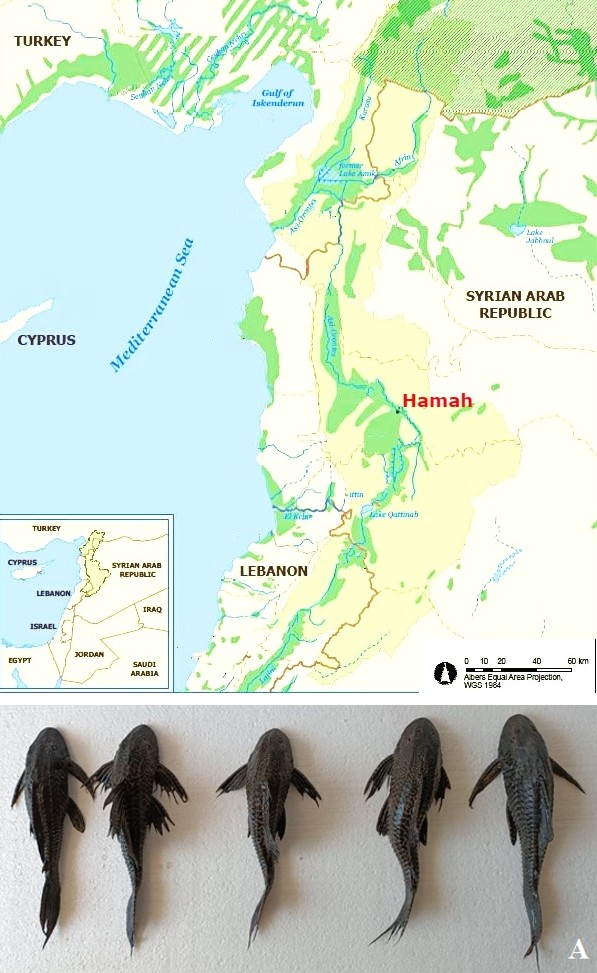
During a traditional longline fishery at a depth of 25 m from the Orontes River, north of Hama, five specimens of Pterygoplichthys disjunctivus were captured on 25 May, 2024, at a sea surface temperature of 20°C (Figure 1). The specimens measured in centimeters for length and grams for weight, and various morphometric measurements recorded as percentages of total length (TL). The Pterygoplichthys disjunctivus` identification key was based on the work of Armbruster JW, et al. [2] and Wanjari RN, et al. [16].
Results
The specimens of Pterygoplichthys disjunctivus exhibited several diagnostic features. They had a large dorsal fin, and their abdomens displayed a colour pattern characterized by light and dark vermiculation due to the merging of spots. The ventral surface showed dark ventrolateral vermiculation that was either broader than or matched the width of the light vermiculation. In addition, the specimens did not have a prominent supra-occipital process (Figures 2A-2D).
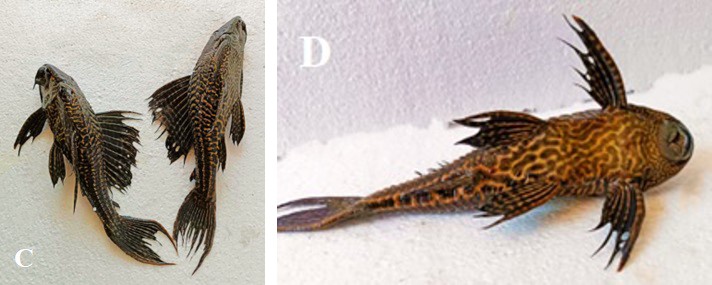
C) Lateral view D) Ventral view. Figure 2: (A-B) Specimens of Pterygoplichthys disjunctivus with total lengths ranging from 23.5 to 27 cm were collected from the Orontes River, Hama, 10 September 2024.
| Meristics | |
| Dorsal fin | II, 10 |
| Pectoral fin | I, 5 |
| Pelvic fin | I, 5 |
| Anal fin | I, 4 |
| Lateral line bony plates | 29 |
Table 1: The meristic characteristics of the _Pterygoplichthys_ _disjunctivus_ specimens collected from the Orontes River (Hama C
The body was elongated and flattened, characterized by a robust, armoured head. The dorsal fin consists of two spines, the first relatively small and the second substantial and more robust. Additionally, the dorsal fin contained ten soft rays. The adipose fin was comparatively short, while the anal fin featured one spine and four soft rays. The pectoral fin had one spine and five soft rays, with the first ray being the largest. The caudal fin was distinctive, exhibiting an elongated and pointed lower lobe. The body features 29 rows of lateral line plates (Table 1).
In terms of colouration, the body exhibited patches of black and yellow, accompanied by dark vermiculation on the dorsal surface of the head. The fins presented a brown- grey colour with light grey spots, while the abdominal region displayed a reticulated pattern of white and brown elements.
The total lengths of the specimens varied from 23.5 to 27 centimetres, with standard lengths ranging from 17 to 19.5 centimetres and weights between 100 and 150 grams (Table 2).
| Morphometric measurements | cm | %SL |
| Total length (TL) | 23.5-27 | |
| Standard length (SL) | 17-19.5 | 100 |
| Head length | 3.5-4.5 | 20.6-23.1 |
| Body depth | 4-5 | 23.5-25.6 |
| Pre-dorsal fin length | 6-8.7 | 35.3-44.6 |
| Post-dorsal fin length | 8-Jun | 35.3-41 |
| Pre-pectoral fin length | 4-5 | 23.5-25.6 |
| Post-pectoral fin length | 1.8-2.5 | 10.6-12.8 |
| Pre-pelvic fin length | 7-9.5 | 41.2-48.7 |
| Post-pelvic fin length | 1-4 | 5.9-20.5 |
| Pre-anal fin length | 11.5-14 | 67.7-71.8 |
| Post-anal fin length | 0.5-2.7 | 2.9-13.9 |
| Caudal peduncle depth | 2-7 | 11.8-35.9 |
| Dorsal fin base length | 2.5-3.5 | 14.7-18 |
| Pectoral fin base length | 1-2.7 | 5.9-13.9 |
| Anal fin base length | 0.5-1.8 | 2.9-9.2 |
| Adipose fin base length | 0.5-0.8 | 2.9-4.1 |
| Dorsal fin Height | 5-6.5 | 29.4-33.3 |
| Pectoral fin Height | 5.9-7 | 34.7-35.9 |
| Pelvic fin Height | 5-5.8 | 29.4-29.7 |
| Anal fin Height | 2.5-4.5 | 14.7-23.1 |
| Adipose fin Height | 0.8-1 | 4.7-5.1 |
| HL% | ||
| Eye diameter | 0.7-0.8 | 17.8-20 |
| Snout length | 2-3.7 | 57.1-82.2 |
| Total Weight (TW,g) | 100-150 |
Table 2: The morphometric measurements, documented in centimetres and as a percentage of standard length (%SL), along with the we
Discussion
This manuscript documents the second recorded occurrence of the sailfin catfish, Pterygoplichthys disjunctivus, in Syrian inland waters, specifically within the Orontes River. We offer a detailed description of the morphometric and key body characteristics of the specimens examined.
Previous research by Hamwi N, et al. [14] identified the inaugural record of P. disjunctivus in these waters, suggesting that its introduction to the Syrian ecosystem may be attributed to the aquarium trade, as this species is considered desirable for its ornamental appeal. This recent finding offers compelling evidence of the species’ establishment in the Orontes River, indicating successful adaptation and reproduction within the local environment.
Given its invasive nature [17], there is a notable potential for P. disjunctivus to expand its range along the river and potentially colonize new habitats over time. The situation underscores the importance of monitoring and managing this species to mitigate any ecological impacts it may pose in the region.
Conclusion
This discovery highlights the importance of monitoring and managing invasive species, as their establishment in new ecosystems can have significant ecological and economic ramifications. Additional research and monitoring are necessary to assess the presence of Pterygoplichthys disjunctivus in Syrian freshwater bodies.
Acknowledgment
The authors would like to express their gratitude to Mr. Imad Al-Khabouri for providing us this specimen.
Conflicts of Interest
The authors declare that there are no conflicts of interests.
References
-
Fricke R, Eschmeyer WN, Van der Laan R (2024) Eschmeyer’s catalog of fishes: genera, species, references. The California Academy of Sciences.
-
Armbruster JW, Page LM (2006) Redescription of _Pterygoplichthys punctatus_ and description of a new species of Pterygoplichthys (Siluriformes: Loricariidae). Neotrop Ichthyol 4(4): 401-409.
-
Weber C (1991) Nouveaux taxa dans _Pterygoplichthys_ _sensu_ lato (Pisces, Siluriformes, Loricariidae). Revue Suisse de Zoologie 98: 637-643.
-
Orfinger AB, Goodding DD (2018) The global invasion of the suckermouth armored catfish genus Pterygoplichthys (Siluriformes: Loricariidae): Annotated list of species, distributional summary, and assessment of impacts. ZOOL STUD 57: e7.
-
Nico LG, Martin RT (2001) A population of the South American armored catfish _Pterygoplichthys anisitsi_ (Pisces: Loricariidae) in Texas, with comments on foreign fish introductions in the American southwest. SOUTHWEST NAT 46: 98-104.
-
Bunkley-Williams L, Williams EH, Lilystrom CG (1994) The South American sailfin armored catfish Liposarcus multiradiatus (Hancock), a new exotic established in Puerto Rican fresh waters. CARIBB J SCI 30(1-2): 90-94.
-
Fuller PL, Nico LG and Williams JD (1999) Nonindigenous Fishes Introduced into Inland Waters of the United States. American Fisheries Society, USA, 27: 622.
-
Edwards RJ (2001) New additions and persistence of the introduced fishes of the upper San Antonio River, Bexar County, Texas. TEX J SCI 53: 3-12.
-
Froese R, Pauly D (2014) FishBase. World Wide Web electronic publication.
-
Wakida-Kusunoki AT, Ruiz-Carus R, Amador Del Angel R (2007) Amazon sailfin catfish, _Pterygoplichthys pardalis_ (Castelnau 1855), another exotic catfish established in Southern Mexico. The Southwest Nat 52(1): 141-144.
-
Munson A, Bifi AG, Campos D (2024) First records of the introduced sailfin catfish Pterygoplichthys in the United Kingdom. BIR 13(1): 241-250.
-
Golani D, Snovsky G (2013) Occurrence of Suckermouth Armored Catfish (Siluriformes, Loricariidae, Pterygoplichthys) in inland waters of Israel. BioInvasions Records 2(3): 253-256.
-
Özdilek SY (2007) Possible threat for middle-east inland water: an exotic and invasive species, _Pterygoplichthys_ _disjunctivus_ (Weber, 1991) in Asi River, Turkey. JFAS 24(3): 303-306.
-
Hamwi N, Ali-Basha N, Al-tajer H (2024) First documented occurrence of the introduced Sailfin catfish _Pterygoplichthys disjunctivus_ (Weber, 1991) in the inland waters of Syria (Orontes River). Species 25(75): e29s1679.
-
Al-Saloum M (2009) An illustrated atlas of the fish of the Orontes River Basin within Syrian territory, Publications of the Ministry of Agriculture and Agrarian Reform, General Authority for Scientific Agricultural Research. Hama, Syria, pp: 168.
-
Wanjari RN, Shah TH, Telvekar Pb (2024) A new record of the invasive vermiculated sailfin catfish _Pterygoplichthys_ _disjunctivus_ in the Wainganga River, Eastern Maharashtra, India. J ASIA-PAC BIO 17(3): 484-489.
-
Weber C (1992) Revision du genrew _Pterygoplichthys_ _sensu_ lato (Pisces, Siluriformes, Loricariidae). Revue Francaise d Aquariologie Herpetologie 19: 1-36.
- Genetic Improvement of Nile Tilapia (Oreochromis niloticus): Advances in Selective Breeding and Genomic Approaches for Sustainable Aquaculture
- Microplastics, Contaminants, and Waste Hotspots: Divergences and Faults in Prioritizing Control Efforts
- Creating a Healthier, More Vibrant Open and Closed Aquatic Environment. A Submersible, Centrifugal Magnetically Affixed Current Changing Aquarium Pump
- An Attempt to Assess Alpha Diversity and Sample Size: Using the Ostracod Assemblages off Kumamoto Port, Japan
- Assessment of the Efficiency of Common Fishing Gears and Crafts Used at Mohananda River of Chapai Nawabganj, Bangladesh
- Fish Productivity and Biodiversity Status of Sundarban Mangrove in Bangladesh