
A Brief Review of Naga (Lead) through Rasaratna Samucchaya
Background: Naga Bhasma is widely-used in various herbo-metal formulation of Ayurveda, indicated specially for urogenital and gastro-intestinal disorders such as Prameha (Diabetes), Pradara (leucorrhoea), Atisara (Diarrhoea), Grahani (Malabsorption syndrome), Arsha (Haemorrhoids). Aim: The present work aims to collect and summarize all the information regarding the Naga Bhasma from Rasaratna samuchchaya. Materials and Methods: Critical review of Grahyaagrahyatva, pharmacodynamics properties, Shodhana, Marana procedures, dose, Anupana and formulations of Naga bhasma is compiled from Rasaratna Samucchaya. Therapeutic efficacy of Naga bhasma is discussed on the basis of available data. Results: After critical review, total 45 formulations were observed in Rasaratna samuchchaya. In which maximum number of formulations as an ingredient of Naga bhasma are mentioned in the management of Prameha (13) internally and in the management of Netraroga (12) as an Anjana form externally. Percentage of Naga Bhasma was observed minimum 0.47% to maximum 66.66% in formulations. Conclusion: This review is expected to refurnish the existing knowledge and give an insight to the researchers in this area of education and research.
Krushnkumar Taviad1*, Shweta Vekariya2, Prashant Bedarkar3
and Patgiri BJ4
Research-Savli, Vadodara -India
Email: drkrishnat@gmail.com
Grahani (Malabsorption syndrome), Arsha (Haemorrhoids).
samuchchaya.
efficacy of Naga bhasma is discussed on the basis of available data.
minimum 0.47% to maximum 66.66% in formulations.
area of education and research.
Keywords: Ayurveda; Lead; Naga Bhasma; Rasaratna Samuchchaya; Rasashastra
Introduction
Rasa Shastra (subject dealing with Ayurvedic drug manufacturing and confirming their safety and efficacy) is enriched with description of metallic/mineral origin of raw materials, their varieties, characteristics, manufacturing techniques, properties, therapeutic uses, possibilities of developing adverse effects and their management in a comprehensive way. The well‑known metals frequently used in Ayurveda include mercury (Parada), gold (Swarna), silver (Rajata), copper (Tamra), iron (Lauha), tin (Vanga), lead (Naga), and zinc (Yasada) [1]. Various Samskaras (processing) like Shodhana (preliminary process of eliminating unwanted substances), Jarana (roasting with herbs), Marana (incineration) etc. converts macro, rocky and toxic metallic/mineral materials into suitable therapeutic dosage form that is popularly known as Bhasma, and this assures the safety regarding its intended use to the patients [1]. These formulations are more popular in therapeutics because of its smaller dose, palatability, shelf life, and efficacy [2]. Rasaratna Samuccaya (RRS) a 13th century C.E. alchemical treatise, authored by Vagbhaṭacharya, throws light on the state of Indian expertise in the field of alchemy regarding the extraction, purification, conversion of metals/minerals into therapeutically suitable forms, various instruments developed for alchemical purposes and treatment of numerous diseases by using herbo‑mineral preparations [2]. Naga Bhasma (incinerated lead) is widely-used as a medication since long in various herbo-metal formulation of Ayurveda, indicated specially for the diseases of urogenital system such as Prameha (Diabetes), Pradara (leucorrhoea), and also useful in disease conditions like Amavata (rheumatoid arthritis), Vataroga(_Nervous disorders), _Vrana (non-healing wounds), Arsha (piles), etc [3]. It is one of the vital ingredient in popular formulations like Garbhapala Rasa, Mahayograj guggulu [4], Trivanga Bhasma [4], Vata Vidhwans Rasa. In the present review, an attempt has been made to collect and summarize all the information regarding the Naga’s Grahyaagrahyatva, pharmacodynamics properties, Shodhana, Marana procedures, dose, Anupana and formulations from Suratnojjvala Hindi commentary of RRS by Ambikadatta Shastri. Collected information was compared with other available literature of Rasashastra. Research of modern science was also utilized to explore some facts mentioned by RRS.
Materials and Methods
Rasaratna Samuccaya (13th century CE), a well‑known comprehensive treatise of Ayurveda authored by Vagbhatta with Suratnojjvala hindi commentary by Kaviraj Ambikadatta Shastri was screened to compile references of Naga. The references of characteristics features, properties, Shodhana procedures, Marana procedures were compiled. In this review, attempt has been made to describe formulations with name and its pharmaco-therapeutic review in the following systematic manner i.e. Kalpa (formulations), percentage of Naga Bhasma, other metals/minerals/herbs used in formulation, Adhikara (prime indication and secondary indication), Aushadha Kalpana (Dosage forms), Anupana (Vehicle), Matra (Dose), Bheshaja Prayoga Marga (Routes of drug administration). The classics treatise has given Naga formulations comprising of minerals, herbs, poisons and animal products with the view of reaping benefits from these formulations. Only the formulations having as Naga are considered for the study. Percentages of Naga bhasma are calculated by considering all herbal, metallic and mineral ingredients. Quantity of Naga bhasma in few formulations is quoted as “Sarva dravya samam Nagam” which means 50% of the formulation will be Naga Bhasma (incinerated lead). In other formulations the quantity is calculated in accordance with the solid constituents, where in the ingredients like decoctions (Kwatha), fresh juices (Swarasa), ghee (Ghrita-clarified butter), and honey (Madhu) are not taken into consideration. Calculation is based on the raw ingredients taken prior to the pharmaceutical processes. The metallic and mineral ingredients in every formulation are in calcined form except Parada, Gandhaka, Haratala, Manahshila, Rasasindura, Ṭankana, Shilajatu and Hingula.
Method of Calculation
Percentage of Naga Bhasma (NB) = 100×weight of NB/weight of total solid ingredients (including NB). E.g., in Dipika Rasa total weight of all ingredients mineral and herbal is 70 g out of which 10 g is NB. Percentage of NB is 100×10 g/70 g = 14.29 %. Bhavana dravyas like Jambiri swarasa, Meghanada swarasa, Ghritakumari swarasa, Aja mutra, Gomutra are not considered for calculation.
Observations and Results
Naga Grahya Lakshana
Sample of Naga which melt easily on fire (Drutadravam), heavy in weight (Mahabharam), the freshly cut surface shows a bright black metallic lustre (Chede Krishna Samujwalam), emits foul smell while melting (Putigandham) and externally black in colour (Bahihkrishnam) should be considered genuine variety and preferred for therapeutic purposes [4].
Naga Samanya Shodhana
| Sesamum indicum) | , Takr | |||
|---|---|---|---|---|
| urine) | , Kanji | (sour gruel) | ||
| of Dolichus biflorus) | respe |
Naga Vishesha Shodhana
Method 1: Raw Naga should take in the vessel containing Nirgundi Swarasa (juice extract of Vitex negundo) and this was exposed to sunlight for seven days & left it until it dries completely. Or Raw Naga should take in iron pan and subjected to intense heat for melting. After that Nirgundi Churna (powder of V. negundo) should add to it and roasted for 7 days for Shodhana. Method 2: Raw Naga should take in a clean and dry iron pan and subjected to intense heat in charcoal furnace. Subsequently, after melting of Naga Nirgundimula Churna, Nirgundibija Churna, Harida Churna should add to Naga in 1/16th part as Prakshepa dravya and rubbed with iron ladle. After subsiding the fumes powdered Naga should quench in another vessel containing Nirgundipatra Swarasa. After self-cooling, Naga should be collect from the Swarasa, dried and the process of melting, roasting and quenching should repeated for three times. Such Shodhita Naga used in therapeutics it’s free from adverse effect like Murchha (fainting), Sphota (eruptions, nodules) etc.
Naga Marana
Method 1: Shodhitaa Naga (940 g) is taken in Bhrashtri Yantra and subjected to intense heat till complete melting. After melting, Shuddha Pararda (12 g) is added in it and strongly rubbed with iron ladle. Arjuna, Bibhitaka, Aragvadh, Dadim, Aparmga kshara (46 g each kshara) are also added in this mixture and continuously rubbed with iron ladle for 21 days on Bhastri yantra. After that it turns in the red (rakta) or grey (kapot) coloured fine powder. It Naga Bhasma possess Deepana (gastro-stimulant), Atiushna (very hot for internal use) and snigdha (unctuous) properties and bitter taste (Tikta Rasa) dominant. It alleviates disorders caused by vata-kapha and is widely used in the treatment Prameha (diabetes), Amavata (effective in rheumatoid arthritis) and waterborne diseases. Naga Formulations is said to be such Naga Bhasma devoid of Dosha and having Rasayana guna. Method 2: Utthapana literally means Swarupapadanam (regaining original state).[4] Naga Bhasma which has attained the state of fine Varitar (float on water) ash is brought back to its original state by the help of strong heating in sublimation apparatus (urdhvapatana yantra) and then again subjected for repeated ten cycles of intense heating. It is said to be such Naga Bhasma devoid of Dosha and having Rasayana guna. Method 3: Shodhita Naga should take in a clean and dry iron pan and subjected to intense heat in charcoal furnace. Subsequently, after melting of Naga 1/4th part of Ashwattha Twaka and Chinchtwaka Bhasma should add to Naga as Prakshepa dravya and rubbed with iron ladle till convert in fine powder. Thereafter, Jarita Naga was mixed with equal amount of Shuddha Manahshila and levigation was carried in granite Khalva Yantra with Jambiri Swarasa or Kanji. Pellets were prepared and dried in sun light and kept in Sharava Samputa, which was subjected to Putapaka. In subsequent putas 1/20th part of Manahshila added in Naga and levigated with Amla Dravya (Jambiri Swarasa or Kanji). Total sixty numbers of Puta required achieving desired quality of Bhasma. Method 4: In this method, Shuddha Naga is first converted into sheets followed by application of thick layer of Arka dugdha bhavita Manahshila, shade dried and subjected to Putapaka. The incineration process should be repeated 10 to 15 times (putas) to obtain Niruttha Naga Bhasma.
Properties of Naga Bhasma
| Sr. No. | Formulation B | % of Naga hasm | a | Other Metals & Minerals | Herbal Drugs | Anupana | Dose | Prime indication | Secondary indication | Dosage form | Page no. | Reference |
|---|---|---|---|---|---|---|---|---|---|---|---|---|
| 1 | Dipika rasa | 14.29 | Parada, Gandhaka, Saidhava lavana, Sauvarchala lavana | Pippali, Chitraka, | Sharkara, Ghrita | 3 rati | Sarvajwara | - | Churna | 223 | 12/20-25 | |
| 2 | Sarvajwarari rasa | 11.11 | Hartala, Tamra, Lauha, Chapala, Tuttha, Abhraka, Kantalauha | Punarnava moola, | - | 1 (125mg) rati to 3 (375 mg) rati | S arvajwara | - | Churna | 228 | 12/43 | |
| 3 | Sannipatakut hara rasa | 14.2 | Vanga, Parada, Manahshila, | Vatsanabha, Chitraka, Trikatu, | Adraka Swarasa, | 1 valla (375 | Sannipat jwara | - | Churna | 242 | 12/129- 130 |
Gandhaka, Tamra Bhringaraja, Hastishundi,
Ativisha, Jayapala, Tanduliyaka
Vanga, Rasasindura, Tamra,Gandhaka,T
4 Jirnajwarari
Vatsanabha Adraka swarasa
rasa 10 ankana, Parada, Manashila, Hartala,
Pippli, Maricha,
Sankha, Varatika, Tuttha, Gandhaka,
5 Sankheswara
rasa 22.45 - madhu, Parada, Tankana
Ghrita
Shankha,Varatika,
Maricha
Tuttha, Hartala, churna, Madhu,
6 Vaidhyanatha
rasa 2.17 Gandhaka, Tankana, Rajata,
- ghrita, tambul patra Parada, Swarna, Kharpara
satva, Praval bhasma, Mukta bhasma, Tamra bhasma, Abhraka bhasma, Hartala,
½ g Maricha
churna, 2 g Ankola beeja, Kanguni beeja, gandhaka,
7 Vajra rasa 4.29
Madhu applied on tambul patra
Tuttha Tankana,
Varatika
Suvarna bhasma,
Rajata bhasma,Tamra bhasma, Abhraka
Bhairavanath
Bhasma, Kantalauha Bhasma, Vanga Bhasma, Gandhaka,
Trikatu churna,
ee panchamruta
a rasa 6.62 - na, vidanga Lauha Bhasma, Hartala, Gandhaka
ghrita Parada, Gandhaka,Saidhanv
- Surana, Goghrita
10 Arkesha rasa 12.5
a, Samudra, Vida,
Tuttha, Sankha
Bhasma,
11 Nagasundara 5.88 Parada, Abhraka, Madhu 125 mg Atisara Guda Vati 311 16/32-37 Madhu mg)
2 rati (250mg)Jirnajwara - Vati 245 12/145-
| 28 | RasendraChu damani rasa | 8.26 | Parada, Suvarna, Abhraka, Vanga, Kantalauha, Swarnamakshika, Raupyamakshika, Vimala | Sharkara, madhu | 2 gm | Vajeekaran | Churna | 616 | 27/85-94 | ||
|---|---|---|---|---|---|---|---|---|---|---|---|
| 29 | Chaturtha Loha Kalpa | 33.33 | Vanga, Mrigashringa bhasma, | Nakulikandabeeja | Mahish takra | Prameha | Churna | 634 | 28/73 | ||
| 30 | Panchama Loha Kalpa | 1 | Triphala, Daruharidra, Nakulikanda, Dhaturamoola | Takra, haritaki, daruharidra, bibhitaka, patha | 2 tablet | Prameha | Vati | 635 | 28/74-75 | ||
| 31 | Shathama Loha Kalpa | 1 | Triphala | Krishna loha bhasma | 2 tablet | Prameha | Vati | 635 | 28/76 |
Table 3: Formulations containing Naga Bhasma as an ingredient for internal application.
% of Naga Bhasma
Sr. No. Formulation
Other Metals &
Minerals Herbal Drugs Applied
Saindhava lavana,
Tuttha, Sphatika, Varatika bhasma,
Rasanjana, Kataka,
Trikatu, Musta,
Madhu, Goghrita, Godugdha
Tamra Bhasma,
Karpura, Samudraphena, Vacha, Triphala,
1 Garudanjana 3.70
Lauha Bhasma,
Narkapalasthi bhasma, Parada, Tankana, Nilanjana,
Yastimadhu
2 Timirhara
anjana 16 Parada, Nilanjana Karpura Madhu,
with Prime indication Secondary
Dosage
Page
no. Reference
indication form Netraroga Churna 527 23/44-45
Ghrita Timira Churna 527 23/46
Kamsya, Rasanjana Madhu Shukla arma, Timira,
4 Nagadi Varti 23.08 Parada, Tuttha, Karpura Madhu,
5 Indradi Varti 20 Tamra, Rasanjana Karpura, Yashtimadhu
Chandana
6 Shulbadi Varti 20 Tamra, Abhraka, Lauha, Nilanjana Dadhi Kaphaja Abhishyanda - Churna 530 23/61
7 Rasendra
Amalaki, Karpura, Pippali, Saindhava
8 Nagadi varti 9.09 Parada, Mukta Bhasma, Rasanjana
Sharkara, Madhu, Jala
Lavana, Jiraka
Tamra, Rajata, Parada, Shankha
Lodhra, Katurohini,
9 Tamradi Varti 9.09
Karpura, Pippali
bhasma, Kamsya
10 Paradadi varti 16.67 Parada, Rasanjana,
Mridagamoola,
Gogrita, Madhu, Jala
Lauha
Sarjarasa,
11 Ektrishang
Varti 3.23 Parada, Rasanjana,
Pravala, Kasisa,
Ghrita Abhishyanda - Varti 529 23/59
Kwatha Vatika Abhishyanda - Varti 529 23/60
Varti 20.98 Parada, Nilanjana Karpura, Sarjaraja - Sannipata Abhishyanda - Churna 530 23/62-63 Pittabhishyanda, Adhimantha Varti 531 23/65 Gogrita, Madhu, Jala Netraroga Varti 531 23/66 Adhimantha, Timira, Armaroga, Pilla, Varti 531 23/67-68 Shuklarma Lodhra, Saptaparna, Madhu, Jala Adhimantha Pilla Varti 531 23/69-70
- Tamra, Gairika,
- Saindhava lavana,
- Trikatu,
- Samudraphena,
- Tuttha, Mukta
- Triphala, Shati, bhsama,
- Panchalavana
- Babbulatwaka,
- Sweta aparajita,
- Putrajivaka,
- Dhaturamoola,
- Chinchabeeja,
- 12
- Shadanga
- Varti
- 16.67
- Anjana, Parada,
- Lauha
- Karpura, Pippali
- Madhu
- Shukla arm, Kach,
- Parada, Gandhaka,
- Tikta
- Koshataki
- 13 Kalagni rasa 16.67
- Saindhava lavana,
- Jeeraka
- Tuttha
- Kwatha
- 14
- Ekvinsho
- Loha Kalpa
- 66.66
- Lauha
- Jala
- Netraroga
- Varti
- 639
- 28/98
Table 4: Formulations containing Naga Bhasma as an ingredient for external application.
| Sr. No. | Diseased conditions | No. of time repeated |
|---|---|---|
| 1 | Prameha (diabetes) | 13 |
| 2 | Netraroga (eye diseases) | 13 |
| 3 | Rajyakshma (pulmonary tuberculosis) | 4 |
| 4 | Jwara (fever) | 4 |
| 5 | Arsha (Haemorrhoids) | 2 |
| 6 | Grahani (Malabsorption syndrome), Atisara (diarrhoea), Shoola (all types of pain), Kushtha (skin diseases), Dantaroga (diseases of teeth), Karnaroga (diseases of ear), Bhagandara (fistula in ano), Vajeekarana (aphrodisiacs), Vidradhi (abscess) | 1 |
Table 5: Diseased conditions where _Naga Bhasma_ is indicated.
| Sr. No. | Disease Condition | Anupana | No. of Anupana |
|---|---|---|---|
| 1 | Prameha (Diabetes) | Haridra (Curcuma longa Linn), Amalaki (Emblica officinalis Gaertn), Nimba (Azadirachta indica A.Juss.), Guduchi Satva (Tinospora cordifolia (Thunb.) Miers), Triphala (Emblica officinalis Gaertn, Terminalia bellirica (Gaertn.) Roxb.), and Terminalia chebula Retz.), Nakuli Churna (Rauvolfia serpentine (L.) Benth. ex Kurz), Kapittha Niryas (resins of Feronia linonia Linn.), Haritaki (Terminalia chebula Retz.), Gandhanakuli (Aristolochia indica L.), Daruharidra (Berberis aristata DC), Bibhitaki (Terminalia bellirica (Gaertn.) Roxb.), Patha (Cissampelos pareira L.), Chakramada beeja (seeds of Senna tora (L.) Roxb.), Madhu (honey), Takra (buttermilk). | 15 |
| 2 | Rajyakshma (Pulmonary tuberculosis) | Pippali (Piper longum L.), Maricha (Piper nigrum L), Tambula Patra (Piper betle L.), Trikatu (fruits of Piper longum L, fruits of Piper nigrum L and rhizomes of Zingiber officianalis R), Madhu (honey), Ghrita (ghee) | 6 |
| 3 | Jwara (Fever) | Aamlaki churna or swarasa (powder or juice of Emblica officinalis Gaertn), Adraka Swarasa (juice of Zingiber officinale Roscoe), Madhu (honey), Sharkara (sugar candy), Ghrita (ghee) | 5 |
| 4 | Arsha (Haemorrhoids) | Ajmoda (Trachyspermum roxburghianum (DC.) Craib), Chitraka (Plumbago zeylanica Linn.), Vidanga (Embelia ribes Burm.f.), Ghrita (ghee) | 4 |
| 5 | Vajeekarana (aphrodisiacs) | Madhu (honey), Sharkara (sugar candy) | 2 |
Table 6: Anupana used in various disease condition for Naga Bhasma.
| 6 | Vidradhi (abscess) | Adraka (Zingiber officinale Roscoe), Maricha (Piper nigrum L) | 2 |
|---|---|---|---|
| 7 | Shoola (all types of pain) | Adraka Swarsa (juice of Zingiber officinale Roscoe) | 1 |
| 8 | Kushtha (skin diseases) | Adraka Swarsa (juice of Zingiber officinale Roscoe) | 1 |
Table 7: Anupana used in various disease condition for Naga Bhasma.
| Sr. No. | Dosage Form | Internal | External | Total | ||||||||||
|---|---|---|---|---|---|---|---|---|---|---|---|---|---|---|
| 1 | Churna (powder) | 18 | 5 | 23 | ||||||||||
| 2 | Lepa (topical application) | - | 1 | 1 | ||||||||||
| 3 | Parpati (thin flakes) | 2 | - | 2 | ||||||||||
| 4 | Varti (suppositories) | - | 8 | 8 | ||||||||||
| 5 | Vati (tablets) | 11 | - | 11 | ||||||||||
| Total | 31 | 14 | 45 |
Table 8: Dosage Form where _Naga Bhasma_ is indicated.
| Sr. No. | Origin | Drug | Total | ||||||||
|---|---|---|---|---|---|---|---|---|---|---|---|
| 1 | Herbal | Vatsanabha (Acontium ferox Wall. Ex Ser) | 4 | ||||||||
| Jayapala (Croton tiglium Linn) | 1 | ||||||||||
| Dhattura (Datura metal Linn) | 2 | ||||||||||
| Gunja (Abrus precatirius Linn) bhwwq | 2 | ||||||||||
| Langali (Gloriosa superba Linn) | 2 | ||||||||||
| Bhanga (Cannabia sativa Linn.) | 1 | ||||||||||
| 2 | Mineral | Parada (Mercury) | 34 | ||||||||
| Hingula (Cinnabar) | 2 | ||||||||||
| Haratala (Arsenic trisulphide) | 11 | ||||||||||
| Manahshila (Arsenic disulphide) | 6 | ||||||||||
| Tuttha (Copper sulphate) | 12 |
Table 9: Schedule E(1) drugs used in Formulations.
Discussion
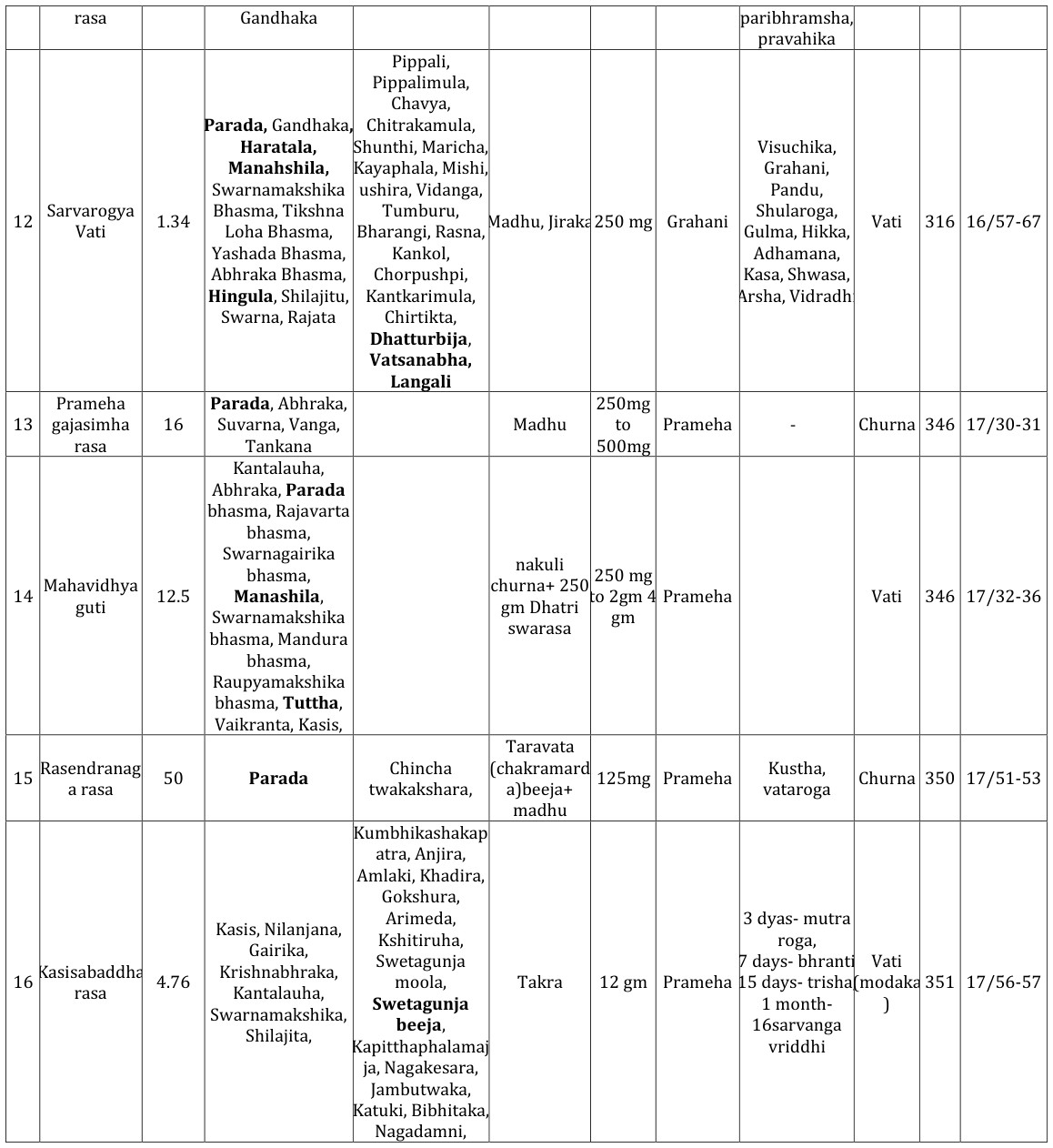
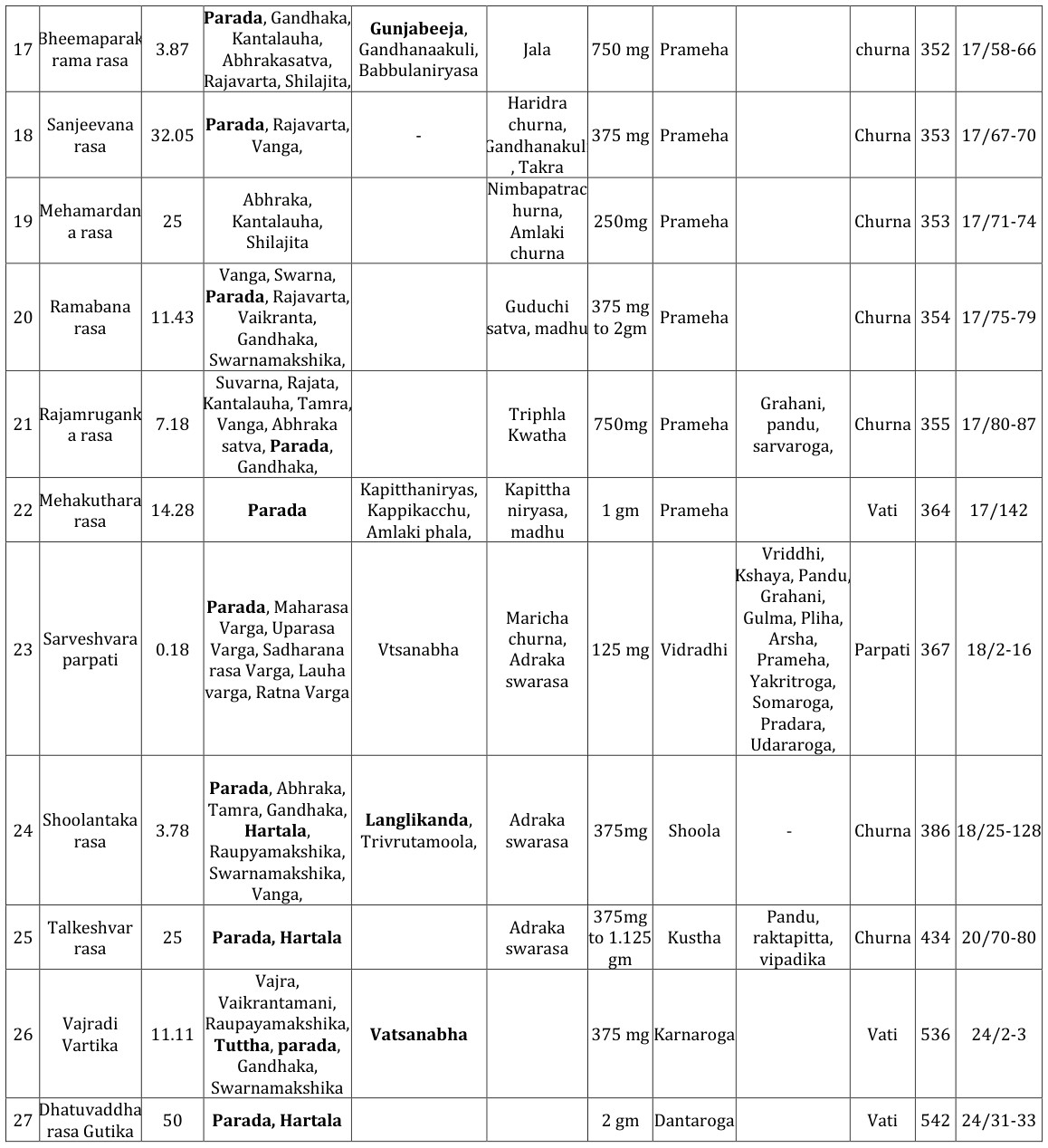
Naga bhasma is incorporated as an ingredient in various formulations which are used internally as well as externally. Most of the references found for Naga bhasma are of internal use only. Naga Bhasma is found as an important contain in 45 formulations of a total 950 formulations of the RRS. Percentage of Naga Bhasma was observed minimum 0.47% to maximum 66.66 % in formulations. Most of the formulations containing Naga Bhasma are indicated in Prameha (13), Netraroga (13), Rajyakshma (4), Jwara (4) etc. (Table no.2). Naga bhasma is also administered externally in forms of Anjana, Lepa, in disease conditions like Netraroga and Bhagandara respectively. Shodhana vidhi and Marana vidhi of Naga bhasma is also described.
RRS mentions thirty one formulations for the internal applications which contain up to 50% Naga bhasma. Maximum percentage of Naga bhasma (50%) is observed in Rasendranaga rasa while minimum percentage in Bhairavanathee panchamruta parpati (0.47). In which, Shankheshwara Rasa has typical method of preparation like Lokanatha Rasa. Varnaga is used instead of Naga Bhasma in Mulakuthara rasa. For Varanag preparation, equal part of Teekshna Loha and Neelanjana are taken in crucible and heated in controlled temp till the soft metal obtained as Varnaga. Rasendranaga Rasa is prepared with Jarita Naga but for internal administration it should be always used after proper Marana procedure. Naga Bhasma containing maximum formulations are indicated in Prameha and advised to administrate along with various antidiabetic herbs like Haridra, Amalaki, Nimba, Guduchi etc_. Recent researches show that _Naga Bhasma possesses anti hyperglycemic effect in several experimental models [4, 5]. The action of drugs depends largely upon the Anupana i.e. the vehicle for the drug. Appropriate selection of Anupana and Sahapana enhances the efficacy of Naga bhasma and also avoids complications.
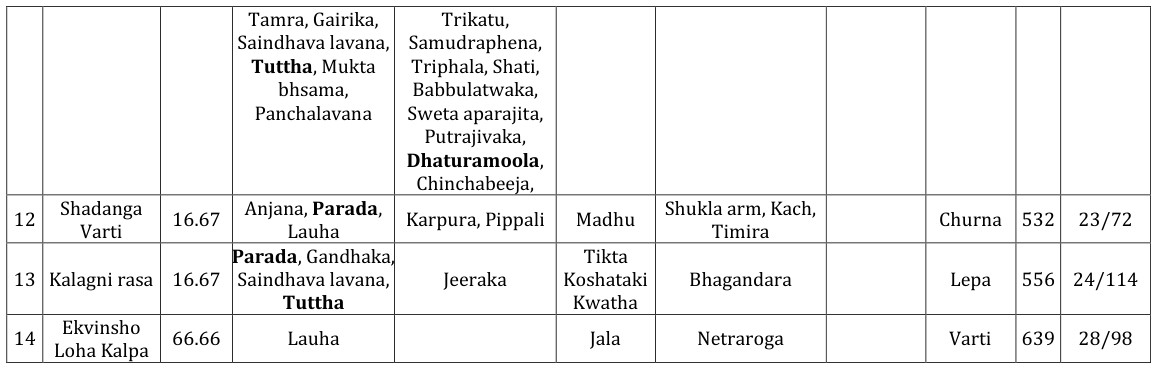
Naga bhasma is also used as an external application in the form of Anjana (corrylium) in the various eye diseases. Lowest proportion of Naga bhasma is found in Ektrishang Varti that contain 3.23% while highest proportion in Ekvinsho Loha kalpa i.e. 66.66 %. In the remaining formulations, percentage of Naga bhasma ranges from 3.70% to 23.08% when used for external application. Total five different dosage form of Naga Bhasma containing formulations were found in RRS. Among them Churna (23) form were used in maximum formulations followed by Vati (11), Varti (8) [6, 7, 8, 9, 10, 11, 12, 13].
Conclusion
In Rasaratna Samuchchaya, about 45 formulations of Naga bhasma are reported with five different dosage forms in almost 14 different disease conditions in the form of internal as well as external administration. Most of the formulations of Naga bhasma are not available in the market and no research work has been performed on the safety of these formulations. Thus, there is an urgent need to conduct research on safety and efficacy of formulations of Naga bhasma.
References
-
Sarkar PK, Das S, Prajapati PK (2010) Ancient concept of metal pharmacology based on Ayurvedic literature. Ancient Sci Life 29(4): 1-6.
-
Mohapatra S, Rai P, Kumar N, Jha CB (2015) Corollary of processing of metals and minerals in Ayurvedic system of medicine. Int J Ayurveda & Med Sc 1(1): 14- 18.
-
Vagbhattacharya (2015) Rasaratna Samuchchaya with Health and Family welfare, Government of India, New Delhi, pp: 612
-
The Ayurvedic Formulary of India (2008) Part II-A, Formulations 16:14, Department of AYUSH, Ministry of Health and Family welfare, Government of India, New Delhi.
-
The Ayurvedic Formulary of India (2008) Part I-A, Formulations 5: 6, Department of AYUSH, Ministry of Health and Family welfare, Government of India, New Delhi, pp: 212-215.
-
The Ayurvedic Formulary of India (2008) Part I-A, Formulations 18:6. Department of AYUSH, Ministry of Health and Family welfare, Government of India, New Delhi, pp: 607-609.
-
The Ayurvedic Formulary of India (2008) Part I-A, Formulations 20:45, Department of AYUSH, Ministry of Health and Family welfare, Government of India, New Delhi, pp: 722-724.
-
Vagbhattacharya (2015) Rasaratna Samuchchaya with Suratnojjvala Hindi commentary, 10th (Edn.), 5th chapter, verse 170, Chaukhmbha Amarabharti Prakashan Varanasi, pp: 125.
-
Vagbhattacharya (1995) Rasaratna Samuchchaya, Suratnojjvala commentary by Ambikadatta Shastri, 9th (Edn.), chapter 8, verse 65, Chaukhamba Amarbharati Prakashana, Varanasi, pp: 142. Suratnojjvala Hindi commentary, 10th (Edn.), 28th chapter, verse 1, Chaukhmbha Amarabharti Prakashan Varanasi, pp: 624.
-
Sumersingh DR, Gokarn R, Jagtap CY, Galib R, Patgiri BJ, et al. (2016) Critical Review of Rasaratna Samuccaya: A Comprehensive Treatise of Indian Alchemy. Ancient Science of Life 36: 12-18.
-
The Ayurvedic Formulary of India (2008) Part I-A, Formulations 18: 7, Department of AYUSH, Ministry of
-
Dhirajsingh R, Mukesh N, Biswajyoti P, Pradeepkumar P (2015) Experimental study on antihyperglycemic effect of Naga Bhasma (incinerated lead). Journal of indian system of medicine 3(4): 180-183.
- Potential Medicinal Herbs and Secondary Metabolites in Combating Corona Virus
- Monkeypox and its Clinical Implications in Pregnancy
- Pharmacognostical Analysis of the Leaves of Important Nervine Medicinal Plant: Strychnos Nux-Vomica L
- Assessment of Antibacterial Activity of Various Solvent Extracts of Dictyota Dichotoma Against Multidrug Resistant Bacterial Strain
- An Insights of Bioactive Elements on Malignancy: Mechanistic Avenues
- Advances and Future Directions in Pharmacognosy and Chinese Medicine