
Flax Seeds and Their Role in Human Health
When it arrives at human health benefits flax seeds play an essential part. Flax seed or linseed (Linum usitatissimum) derived from flax plants has several medicinal properties when consumed. Flaxseeds are abundant in lignans, linolenic acid, omega-3 fatty acids, secoisolariciresinol, and other nutrients and proteins that aid in the prevention of illnesses such as cardiovascular disease, cancer, and diabetes. Linen fibre is derived from flax plants, which are employed in the textile industry, in addition to nutritional advantages. Flax seeds are utilized in a variety of food processing products (bakery, dairy, snack, fermented) because they have physicochemical, phytochemical, and sensory qualities. Flax seed is a potential nutraceutical that may be used to make preventive, therapeutic, and medicinal foods. Flax seeds are anti-inflammatory and antioxidant. This article addresses the nutritional health benefits and dietary fibre of flax seeds.
Chemical Composition of Flaxseeds
Various chemicals are present in the flax seeds shown in the Tables 2-7 stratified based on their nature [2].
| Minerals | Milligrams Per 100 Grams of Flax Seeds |
|---|---|
| Calcium | 2.36 |
| copper | 1 |
| iron | 5 |
| magnesium | 431 |
| phosphorus | 622 |
| potassium | 831 |
| sodium | 27 |
| Zinc | 4 |
Table 2: Minerals and their weight present in 100 grams of flax seeds.
| Vitamins | Milligrams Per 100 Grams of Flax Seeds |
|---|---|
| Ascorbic acid/vitamin c | 0.5 |
| Niacin/nicotinic acid | 3.2 |
| Pantothenic acid | 0.6 |
| Pyridoxine/vitamin B6 | 0.6 |
| Riboflavin/vitamin B2 | 0.2 |
| Amino acids | Grams per 100 grams of flax seeds |
| Aspartic acid | 9.3 |
| Arginine | 9.2 |
| Cysteine | 1.1 |
| Histidine | 2.2 |
| Isoleucine | 4 |
| Methionine | 1.5 |
| Leucine | 5.8 |
| Lysine | 4 |
| Proline | 3.5 |
| Serine | 4.5 |
| Threonine | 3.6 |
| Tryptophan | 1.8 |
| Tyrosine | 2.3 |
| Valine | 4.6 |
| Amino acids | Grams Per 100 Grams of Flax Seeds |
| Aspartic acid | 9.3 |
| Arginine | 9.2 |
| Cysteine | 1.1 |
| Histidine | 2.2 |
| Isoleucine | 4 |
| Methionine | 1.5 |
| Leucine | 5.8 |
| Lysine | 4 |
| Proline | 3.5 |
| Serine | 4.5 |
| Threonine | 3.6 |
| Tryptophan | 1.8 |
| Tyrosine | 2.3 |
| Valine | 4.6 |
Table 3: Vitamins and their weight present in 100 grams of flax seeds.
| Milligrams Per 100 Grams of Flax Seeds | |
|---|---|
| Neutral arabinoxylan fraction | 1.2 |
| Rhamnogalacturonan fraction | 0.4 |
Table 4: Carbohydrates and their weight present in 100 grams of flax seeds.
| Grams per 100 grams of flax seeds | |
|---|---|
| Soluble fibres | 4.3-8.6 |
| Insoluble fibres | 12.8-17.1 |
Table 5: Carbohydrates and their weight present in 100 grams of flax seeds.
| Introduction | |
| History: The flaxseed plant originated thousands of years | |
| Time Span | |
| Development | |
| 30,000 BC | |
| Flax fabric fibres were found in turkey | |
| 6000 BC | |
| Linseed first recorded for food consumption | |
| 2000 BC | |
| Babylonians used flax threads for weaving | |
| 1000 BC | |
| Egyptians used linseed oil for preserving the body after death and linen fibre used to wrap mummies | |
| 500 BC | |
| Hippocrates used linseed as medicine for digestion and laxative | |
| 800 AD | |
| Emperor Charliemagne officially passes the law to the people of France to grow and consume linseed for their health | |
| 1600 AD | |
| Nicolas Culpeper, herbalist explained cold drawn processes from linseed as treatment for inflammation tumours and infections | |
| 1940 AD | |
| Flax plants are grown for fibre which is used for parachute harness and clothing | |
| 1950 AD | |
| In modern era linseed is used as functional food. Johanna Budwig followed combine cold-press linseed oil cottage cheese in treatment of arthritis, cancer, diabetes, and digestion. Catherine Kousmine prescribed cold-press linseed oil for diet in India. Flax is cultivated for fibres and oil | |
| Fatty acids | Grams Per 100 Grams of Flax Seeds |
| Palmitic acid | 2.1 |
| Oleic acid | 7.3 |
| Steric acid | 1.3 |
| Linolic acid | 23 |
| Alpha linolic acid | 22.8 |
Table 1: History of discovery and usage of flax seeds.
Nutritional Benefits
Flax seeds contain many nutrients and nutraceuticals which provide health benefits to human beings and animals. It consists of polyunsaturated fatty acids, ω-3- fatty acids, Dietary fibres, lignans, proteins, carbohydrates, amino acids [3].
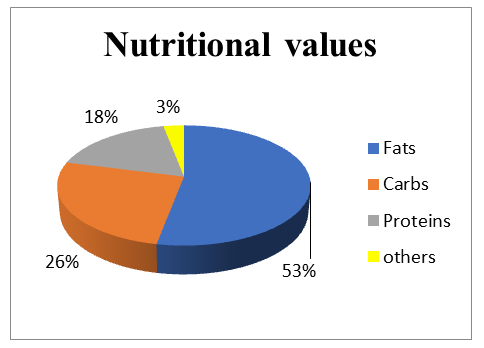
10 grams of flax seeds contain 55 calories of energy, 7% of water, 1.9 % of proteins, 3 grams of carbohydrates, 0.2 grams of sugars, 2.8 grams of fibre and 4.3 grams of fat. The percentage contribution by various nutrients is shown in Figure 1 [4, 5].
Micronutrients
Flax seeds are the source of vitamins and minerals like calcium, magnesium, and potassium and are also abundant in vitamins like Niacin and tocopherols (α, β, γ) [6].
Omega-3-Fatty Acids
Flax seeds rich source of omega -3- fatty acids i.e., ACA (53%), oleic acid (19%), linolic acid (17%), palmitic acid (5%), stearic acid (3%), among these ACA has greater bioavailability, omega fats are omega-3, omega-6 fatty acids. 3 types of ω-3- fatty acids include linoleic acid, eicosapentaenoic acid (EPA), docosahexaenoic acid (DHA). By intake of omega-3-fatty acids, it helps to reduce B.P. in hypertension Patients. Polyunsaturated fatty acids are essential for humans. Flaxseed oil contains high antioxidants such as tocopherols, beta-carotene. Flaxseed oil gets easily oxidized after extraction and purification [7].
Dietary Fibre
Flax fibres consist 25 % of soluble and insoluble dietary fibres, 75 % of soluble fibre fractions of are mucilage gum and insoluble fibre fractions consist of cellulose and lignin contributing 75 percentage. 1 gm of soluble fibre and 3 gm of insoluble fibres increases the daily fibre intake in a daily diet of 10 g of flaxseed [8].
Lignans
These are plant compounds present in almost all plants and have antioxidant, antifungal properties. Also acts as phytoestrogens, which are similar to the female sex hormone estrogen. Lignans have anticancer properties for reducing the growth of cancerous tumors. These are fermented by bacteria and reduce the growth of cancers like breast, uterus and prostate cancer. Lignans are 800 times more in flaxseed when compared with other plant foods. Lignan content composed of secoisolariciresinol diglycoside (SDG) lariciresinol and pinoresinol [9].
Proteins
The protein content of flaxseed is 18%. Flax seeds are a good source of plant-based protein. They are rich in amino acids- Arginine, aspartic acid and glutamic acid. Flaxseed protein improves immunity, prevents cancer, lower cholesterol and has antifungal property. It comprises 80% of globulins (linin, Conlinin) and 20% glutelin. They lack amino acid- lysine hence called incomplete protein [10].
Carbohydrates
Most of the carbohydrate in flaxseed is fibre. This fibre regulates blood cholesterol and boosts immunity and makes a feeling of fullness after eating [11]. Other carbohydrates come from sugar [12].
Vitamins and Minerals
Flax seeds are a good source of both vitamins and minerals. Thiamine- water-soluble vitamin needed by body Niacin. Vitamin B6 and folate are present in high content essential for the functioning of nerves. Minerals in flax seeds include mainly Copper, important for growth and functioning, Magnesium and Molybdenum [13].
Health Benefits and Medicinal Value of Flax Seeds
Flax seeds provide several health benefits to mankind as shown in Table 8.
| Constituent | Health Benefit |
|---|---|
| Omega-3-fatty acid | Reduces blood pressure and chances of heart attack and stroke [14]. It has antioxidant, anti-ulcer and anti-inflammatory activities [15]. |
| Proteins | Have properties of lowering cholesterol [16] dyslipidemia prevention [17], improving immunity, preventing tumors [18], preventing hypersensitivity and show antifungal properties. |
| Dietary fibres | Regulate blood sugar and cholesterol levels and suppress hunger [19]. Provide glycemic control [20]. Insoluble fibres prevent constipation [21]. |
| Vitamins and Minerals | Decrease blood pressure and elicit antioxidant properties [22]. |
| Lignans | Reduce the risk of all cancers, control hypertension [23] and other cardiovascular diseases and elicit antioxidant properties [24] |
| Omega -3-fatty acid, lignans, dietary fibres. | Improve heart health and protect skin from harmful radiations and decrease the hot flashes in post-menopausal women [25]. |
Table 6: Health Benefits and Medicinal Value of Flax Seeds.
Miscellaneous Applications of Flax Seeds
Flax seeds are consumed in different forms which help to treat health problems [26].
- Flaxseed tea used against cough, asthma, bronchitis [27].
- Flaxseed drink used against/ helps out in constipation [28].
- Flaxseed flour strengthens the nervous system, improves memory, cures mental illness and cures abdominal pain and stomach ulcers [29].
Flax seeds also reduce osteoporosis [30], aid in losing weight, reduce hair loss, prevent diarrhea and constipation and also used in conditions like acne, sore throat, respiratory tract infections and kidney problems.
Conclusion
Functional food and nutraceutical provide reduce the burden on the health system. Plant foods have greater importance in health care. Flaxseed is one of the emerging food which has nutritive and functional ingredients. Many clinical trials proved that flax seed constituents provide preventive and therapeutic benefits. These are used as herbal medicines which consist of a high amount of lignan, alpha-linolenic acid, fibre. Also have greater potential in the prevention of diseases like cardiovascular disease, osteoporosis, cancer, rheumatoid arthritis. Being a rich source of alpha-linolenic acid, it reduces serum and LDL concentration. Every part of the flax plant is used therefore it results in no wastage.
References
-
Allaby RG, Peterson GW, Merriwether DA, Fu YB (2005) Evidence of the domestication history of flax Linum usitatissimum L from genetic diversity of the sad2 locus. Theoretical and Applied Genetics 112(1): 58-65.
-
Vickram B, Ophélie F, Éric G, Frédéric L, Lamine B, et al. (2007) Microwave assisted extraction of the main phenolic compounds in flaxseed. Phytochemical analysis 18(4): 275-282.
-
Kajla P, Sharma A, Sood DR (2015) Flaxseed a potential functional food source. Journal of Food Science and Technology 52(4): 1857-1871.
-
Madhusudan KT, Singh N (1984) Effect of heat treatment on the functional properties of linseed meal. Journal of the Science of Food and Agriculture 35: 29-35.
-
Madhusudan KT, Singh N (1985) Isolation and characterization of major protein fraction 12 S of flaxseed proteins. Journal of Agricultural and Food Chemistry 33: 673-677.
-
Martinchik AN, Baturin AK, Zubtsov VV, Molofeev V (2012) Nutritional value and functional properties of flaxseed. Vopr Pitan 81(3): 4-10.
-
Bernacchia R, Preti R, Vinci G (2014) Chemical Composition and Health Benefits of Flaxseed. Austin Journal of Nutrition and Food Science 2(8): 1045.
-
Nowak W, Jeziorek M (2023) The Role of Flaxseed in Improving Human Health. Healthcare Basel 11(3): 395.
-
Bekhit AEA, Shavandi A, Jodjaja T, Birch J, Teh S, et al. (2018) Flaxseed Composition detoxification utilization and opportunities. Biocatalysis and Agricultural Biotechnology 13: 129-152.
-
Lorenc F, Jarošová M, Bedrníček J, Smetana P, Bárta J (2022) Structural Characterization and Functional Properties of Flaxseed Hydrocolloids and Their Application. Foods 11(15): 2304.
-
Mahesh MH, Shekara NR, Anurag AP, Prakruthi M (2020) Flax Seeds Linum usitatissimmum Nutritional composition and health benefits. IP Journal of Nutrition Metabolism and Health Science 3(2): 35-40.
-
Goyal A, Sharma V, Upadhyay N, Gill S, Sihag M (2014) Flax and flaxseed oil an ancient medicine modern functional food. Journal of Food Science and Technology 51(9): 1633-1653.
-
Kakkar S, Tandon R, Tandon N (2021) How Can Flaxseed be Utilized as Functional Food. In: Yildirim E, et al. (Eds.), Vegetable Crops Health Benefits and Cultivation. Intech Open.
-
Bagheri A, Talei S, Hassanzadeh N, Mokhtari T, Akbari M (2017) The Neuroprotective Effects of Flaxseed Oil Supplementation on Functional Motor Recovery in a Model of Ischemic Brain Stroke Upregulation of BDNF and GDNF. Acta Med Iran 55(12): 785-792.
-
Ratan ZA, Jeong D, Sung NY, Shim YY, Reaney MJT, et al. (2020) LOMIX a Mixture of Flaxseed Linusorbs, Exerts Anti-Inflammatory Effects through Src and Syk in the NF-κB Pathway. Biomolecules 10(6): 859.
-
Mohammadi SM, Mazloom Z, Raeisi DH, Barati BR, Bellissimo N, et al. (2017) The effect of flaxseed supplementation on body weight and body composition a systematic review and meta analysis of 45 randomized placebo-controlled trials Flaxseed and body composition. Obesity Reviews 18(9): 1096-1107
-
Kristensen M, Jensen MG, Aarestrup J, Petersen KE, Søndergaard L, et al. (2012) Flaxseed dietary fibers lower cholesterol and increase fecal fat exrection but magnitude of effect depends on food type. Nutr Metab.
-
Buckner AL, Buckner CA, Montaut S, Lafrenie RM (2019) Treatment with flaxseed oil induces apoptosis in cultured malignant cells. Heliyon 5(8): e02251.
-
Ibrugger S, Kristensen M, Mikkelsen MS, Astrup A (2012) Flaxseed dietary fiber supplements for suppre;ssion of appetite and food intake. Appetite 58(2): 490-495.
-
Hutchins AM, Brown BD, Cunnane SC, Domitrovich SG, Adams ER, et al. (2013) Daily flaxseed consumption improves glycemic control in obese men and women with pre diabetes a randomized study. Nutrition Research 33(5): 367-375.
-
Ramos CI, Lima AFAD, Grilli DG, Cuppari L (2015) The short term effects of olive oil and flaxseed oil for the treatment of constipation in hemodialysis patients. J Ren Nutr 25(1): 50-56.
-
Ursoniu S, Sahebkar A, Andrica F, Serban C, Banach M (2016) Effects of flaxseed supplements on blood pressure A systematic review and meta analysis of controlled clinical trial. Clinical Nutrition 35(3): 615-625.
-
Toulabi T, Yarahmadi M, Goudarzi F, Ebrahimzadeh F, Momenizadeh A, et al. (2022) Effects of flaxseed on blood pressure, body mass index, and total cholesterol in hypertensive patients A randomized clinical trial. Explore 18: 438-445.
-
De Silva S.F, Alcorn J (2019) Flaxseed Lignans as Important Dietary Polyphenols for Cancer Prevention and Treatment Chemistry Pharmacokinetics and Molecular Targets. Pharmaceuticals Basel 12(2): 68.
-
Oliver L, Dietrich T, Marañón I, Villarán MC, Barrio RJ (2020) Producing Omega-3 Polyunsaturated Fatty Acids: A Review of Sustainable Sources and Future Trends for the EPA and DHA Market. Resources 9(12): 148.
-
Nowak W, Jeziorek M (2023) The Role of Flaxseed in Improving Human Health. Healthcare 11(3): 395.
-
Dzuvor CKO, Taylor JT, Acquah C, Pan S, Agyei D (2018) Bioprocessing of Functional Ingredients from Flaxseed. Molecules 23(10): 2444.
-
Kajla P, Sharma A, Sood DR (2015) Flaxseed A potential functional food source. Journal of Food Science and Technology 52(4): 1857-1871.
-
Rabetafika HN, Van RV, Danthine S, Paquot M, Blecker C (2011) Flaxseed proteins Food uses and health benefits. International Journal of Food Science and Technology 46(2): 221-228.
-
Ghaseminasab PM, Nazarinia MA, Akhlaghi M (2022) The effect of flaxseed with or without anti-inflammatory diet in patients with rheumatoid arthritis a randomized controlled trial. European Journal of Nutrition 61(3): 1377-1389.
- Potential Medicinal Herbs and Secondary Metabolites in Combating Corona Virus
- Monkeypox and its Clinical Implications in Pregnancy
- Pharmacognostical Analysis of the Leaves of Important Nervine Medicinal Plant: Strychnos Nux-Vomica L
- Assessment of Antibacterial Activity of Various Solvent Extracts of Dictyota Dichotoma Against Multidrug Resistant Bacterial Strain
- An Insights of Bioactive Elements on Malignancy: Mechanistic Avenues
- Advances and Future Directions in Pharmacognosy and Chinese Medicine