
Preparation Physicochemical Evaluation and Characterization of Tamra Bhasma
Background: Bhasmas is an ancient nanomedicine prepared with herbs and minerals or metals and can be used for curing various diseases and disorders. Bhasma a herbomineral preparation called as Tamra Bhasma prepared from metallic copper which is recommended for various ailments. The Tamra Bhasma was prepared by various processes by sodhana, marana and bhavana. Aim: The aim of the research work was to prepare Tamra Bhasma by subjecting to various methods of preparation such as Sodhana, purification, Marana, incineration and Bhavana, levigation. Tamra Bhasma was prepared by using Electric Muffle Furnace and traditional method varaputa method. Methods: The Bhasma was prepared by Samayana sodhana by incorporation of Tila taila, Takra, Gomutra, Kanji and Kulatha Kwatha. The prepared Bhasma was subjected to quality control and evaluation studies such as ash values, acid insoluble ash value and water-soluble ash value, extractive values, colour, odour, taste, appearance, floating test, finger print analysis, curd test, etc. Results: The prepared Bhasma was subjected to characterizations which include Infrared spectroscopy (FTIR), X-Ray Diffraction (XRD) and (SEM) was performed for the Bhasma and Scanning Electron Microscope was used to determine the size and shape of Bhasma. Conclusion: The ancient methods can be used to prepare these precious formulations and these predominant formulations can be preserved in future.
Introduction
Bhasmas is an ancient nanomedicine prepared with herbs and minerals or metals and can be used for curing various diseases and disorders. Bhasma is a combination of Herbs and minerals together prepared by three different methods such as sodhana, marana and bhavana. Sodhana involves detoxification or purification and to preserve the potency and efficacy of raw materials. Sodhana comprises two types’ samanyan sodhana and Vishesha sodhana.
Marana known as Incineration or calcination is a process of conversion of plant materials and minerals or metals into ash. Bhavana involves process called as levigation [1].
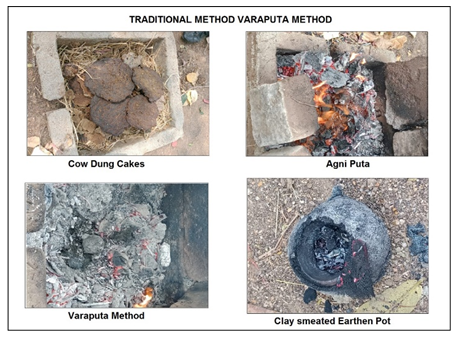
In this preparation copper was utilized for preparation of Bhasma, (Tamra Bhasma). Tamra Bhasma was prepared by two different methods Electric Muffle Furnace and Traditional method known as varaputa method. Tamra Bhasma was prepared by quenching the red-hot copper wire in Sesamum indicum, Sasame oil, (Tila Taila), Butter milk (Takra), Sour gruel (Kanji), Cow urine (Gomutra) and Decoction of seeds of Dolichos biflorus Linn. (Kulattha Kwatha) finally levigation bhavana was performed with Fruit juice of Citrus limon (Linn.) Burm. F (Nimbu swarasa). Electric muffle furnace was used for the preparation, the temperature profile was noted every 15 mins. The increase in temperature was observed for each cycle and the incineration was performed by gradually increasing the temperature. The Bhasma prepared by EMF and the final temperature was 850oC [2]. The traditional method known as varaputa method was performed by preparing cowdung cakes. Cowdung cakes were prepared by taking cowdung and prepared in to circular cakes and dried in sun for several days. The prepared cakes were then transferred into a pit (35 cowdung cakes), the pit was filled with cowdung cakes and the copper wire was plunged in tila taila, takra, kanji, gomutra and kulatha kwatha and transferred into an earthen pot and sealed in a clay smeared cloth with Multani metti. The pots were arranged in the pit with cowdung cakes and burned for 120 minutes with addition of cowdung cakes. Finally, after two hours the pots were removed from the pits after cooling. The Bhasma was removed and transferred and preserved for further studies. Then nimbu swarasa was performed by quenching in lemon juice and subjected to incineration in Electric Muffle Furnace [3].
Both the Bhsamas were prepared by different process and the prepared Bhasma was subjected to quality control studies such as colour, odour, taste, appearance, floating test, finger print analysis, curd test, etc. The prepared Bhasma was subjected to characterizations which include UV-Visible spectroscopy, Fourier Transform Infrared spectroscopy (FTIR), X-RAY Diffraction Spectroscopy, Scanning Electron Microscope SEM studies and antimicrobial screening against microorganisms. X-Ray Diffraction method was performed for the Bhasma and Scanning Electron Microscope was used to determine to size and shape of Bhasma [4].
Materials and Methods
Tamra (copper) was obtained from the Loba Chemie Pvt Ltd. Mumbai, Maharashtra, Entire preparation of Tamra Bhasma was carried out in Department of Pharmacognosy, Seven Hills College of Pharmacy, Tirupati. Powder X-ray Diffractometer Panalyticals-III X Ray Diffractometer, Panalytical Netherlands, SEM Analysis: FFSEM (FEL Quanta 250 FEG Eindhoven, The Netherlands). Muffle Furnace- BIOTECH A1-7941.
Preparation of Bhasma by Electric Muffle Furnace (EMF) and Traditional Method
The Bhasma was prepared by modern method Electric Muffle Furnace (EMF) by monitoring the temperature profile and the traditional method known as varaputa method. In the varaputa method cow dung cakes were prepared using different compositions of cow dung, paddy husk and saw dust to identify suitable composition. Initially 35 cow dung cakes were filled to the Varaha Puta pit, sealed earthen pot with clay smeared cloth containing copper was placed in it and then covered with the remaining cow dung cakes. Then cow dung cakes were ignited from all four sides and in the middle of the pit. When burning was over, the contents in the earthen pot was allowed to self-cool completely. The varaputa method was performed initially starting with 35 mins and then the time was exceeded for 120 mins, after self-cooling the Bhasma was removed from the pot and subjected for standardization methods, touch and texture, odour, floating test, finger print analysis and curd test [5].
Tila Taila: Tila Tila was performed after heating the copper wire for red hot and plunged in sesame oil (Sesamum indicum), incineration was performed the time was noted and the obtained Bhasma was preserved for further studies.
Takra (Butter Milk): Takra was performed after heating the copper wire for red hot and quenched in butter milk and incineration was carried out and time was noted and the obtained Bhasma was preserved for further studies.
Gomutra (Cow Urine): Gomutra was performed after heating the copper wire for red hot and quenched in Gomutra cowurine and incineration was carried out and time was noted and the obtained Bhasma was preserved for further studies.
Kanji (Sour Gruel): Procedure was performed after heating the copper wire for red hot and plunging in Kanji Sour Gruel and incineration was carried out and time was noted and the obtained Bhasma was preserved for further studies.
Kulattha Kwatha (Dolichos Biflorus Linn.): Procedure was performed after heating the copper wire for red hot and quenching in Kulattha Kwatha (decoction of Dolichos biflorus Linn.) and incineration was carried out and time was noted and the obtained Bhasma was preserved for further studies.
Analysis of Tamra Bhasma Using Ancient Parameters (Bhasma Pariksha): The final Bhasma was analyzed for quality control as described in the ancient texts and the following observations were made [6].
Finger Print Analysis: After proper trituration, small amount of bhasma was taken in between thumb and index finger. It filled into the fine lines of fingers.
Floating Test: After proper trituration, small amount of bhasma was sprinkled on the surface of water. Bhasma being light floated on the surface of water. Appearance: Small quantity of bhasma was observed under bright sunlight for presence of any free shiny metal particle. There was no shining particle observed in the Bhasma.
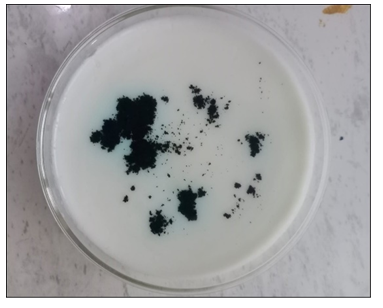
Curd Test: Tamra Bhasma was taken in little quantity and sprinkled over the curd taken in a watch glass and kept undisturbed for 24 hours. No bluish discolouration was seen after 24 hours.
Nimbu Swarasa Pareeksha: Very little quantity of Tamra Bhasma was added to the fresh Nimbu Swarasa taken in a test tube and kept aside for 24 hours. On the next day there was no colour change in the lemon juice.
Results and Discussion
Preparation of Bhasma
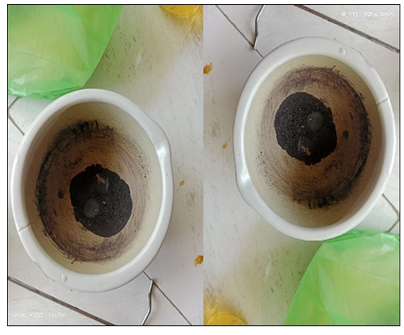
Bhasma is prepared by different methods by tila taila, takra, gomutra, kanji and Kulatha kawatha [7]. Table 1 represents the organoleptic characteristics of Bhasma, Figure 1 Final Bhasma.
| for header rows | for data cells | |
|---|---|---|
| 1 | Colour | Black |
| 2 | Touch | Soft, Smooth |
| 3 | Taste | Tasteless |
| 4 | Odour | Not Specific |
| 5 | Sound | Soundless |
Table 1: Physical parameters of Bhasma.
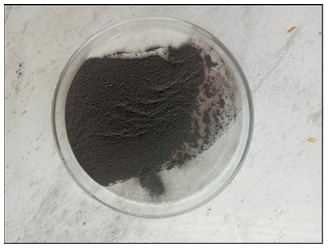
The prepared Bhasma was subjected to different methods which involved Samanya shodhana tila taila (Sesamum indicum, sesame oil), takra (butter milk), gomutra (cow urine), kanji (sour gruel) and Kulatha kwatha (horse gram decoction) [8]. Table 2 Specifies the colour and pH of media, Figure 2 represents of Samayana Sodhana.
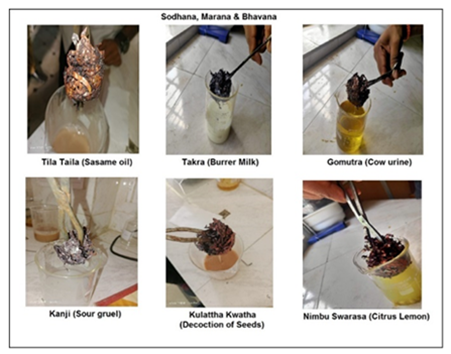
| Media | PH of Media | Colour of Media | ||
|---|---|---|---|---|
| Tila Taila | Sesamum indicum | 6 | Yellowish | Brownish |
| Takra | buttermilk | 3 | Milky white | White |
| Gomutra | Cow urine | 8 | Light Brown | Dark brown |
| Kanji | Sour gruel | 4 | White | Greyish |
| Kulattha Kwatha | Dolichos biflorus Linn. | 7.5 | Brown | Blackish brown |
Table 2: Specifies the colour and pH of media.
Physicochemical Evaluation of Bhasma
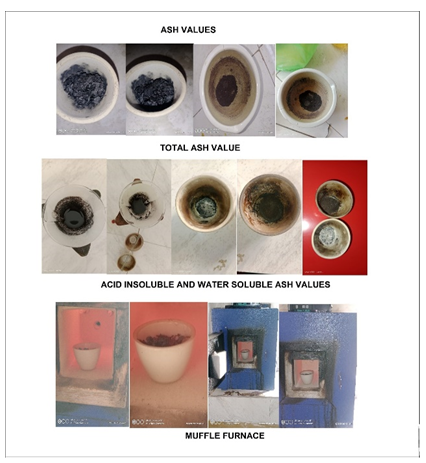
All the quality control parameters and evaluation parameters such as loss on drying, ash values, extractive values, were performed for the Bhasma. Ash values, total ash value, acid insoluble ash value, water soluble ash value were performed in EMF and water-soluble extractive value was also performed [9]. Figure 3 represents the Quality Control and Evaluation of Bhasma.
Preparation of Bhasma by Traditional Method Varaputa Method
The traditional method known as varaputa method was performed for Bhasma using cowdung cakes. All the quality control tests such as colour, odour, taste, floating test, finger print analysis, curd test and size and shape analysis were performed by XRD and SEM analysis [10]. Figure 4 represents the Traditional method of preparation of Bhasma.
Analysis of Bhasma
Final bhasmas prepared in the muffle furnace were analysed using traditional tests mentioned in ayurvedic texts such as colour (varna), floatability. Further, loss on drying, total ash, acid insoluble ash, chemical composition and particle size distribution were done [11].
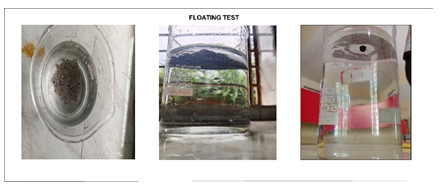
Floatability: Small amount of bhasma was taken and sprinkled slowly on to a stagnant water surface from a short distance [8]. Figure 5 represents Floating Test.
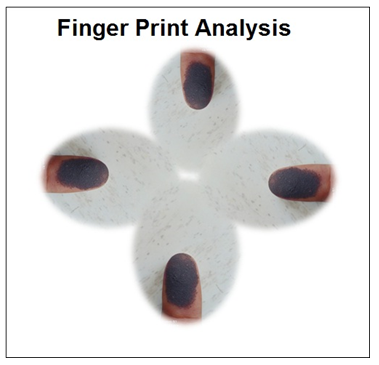
Fineness: Small amount of bhasma was rubbed in between index finger and thumb to observe whether particle can fill furrows of finger tips. Figure 6 finger print analysis of Bhasma.
Curd Test: 50 grams of curd was taken in petri dish and 500 mg of TB sample was kept in it and observed for 24 hrs. No discoloration surrounding the Bhasma area was considered as proper Bhasma and greenish bluish discoloration was considered as improper Bhasma. Figure 7 Depicts curd Test.
Loss on Drying: One gram of bhasma was taken in a crucible and dried in an oven at 105 °C for about 1 h. The sample was allowed to cool and the dry mass was determined. Table 3 represents Physicochemical Parameters of Bhasma Figure 8.
| S. No | Parameters | TB |
|---|---|---|
| 1 | Loss on Drying | 1.16% |
| 2 | Total Ash Value | 57.79 |
| 3 | Acid Insoluble ash value | 2.89 |
| 4 | Water soluble ash value | 0.77 |
Table 3: Represents Physicochemical Parameters of Bhasma.
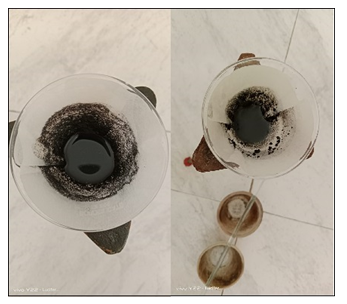
Total Ash: Two grams of each ash samples were weighed accurately in silica crucibles. The samples were spread uniformly on the bottoms of the crucibles, incinerated, cooled and weighed. Difference between the weight of the crucible with incinerated bhasma and the empty crucible gives the total ash value. Figure 8 Depicts Loss on Drying.
Acid Insoluble Ash: The residues from total ash estimations were boiled with Hydrochloric acid. The insoluble matter was washed with hot water, transferred to a crucible, dried and weighed. The weight difference between the crucible with incinerated bhasma and the empty crucible gives the acid insoluble ash value.
Water Soluble Ash: The residues from total ash estimations were boiled with Distilled water. The insoluble matter was washed with hot water, transferred to a crucible, dried and weighed. The weight difference between the crucible with incinerated bhasma and the empty crucible gives the water- soluble ash value. Figure 9 Depicts acid insoluble and water- soluble ash values [12].
Temperature Profile of Tamra Bhasma: The temperature was increased gradually for preparation of Bhasma. The temp was increased from 0 C to 850 °C the time was noted and the increase in temp was noted until it reached 850 °C to obtain the Bhasma. Table 4 Represents Temperature Profile of Bhasma.
| Time (Min) | Temperature (℃) |
|---|---|
| 0 | 25 |
| 20 | 60 |
| 30 | 120 |
| 40 | 275 |
| 50 | 500 |
| 60 | 650 |
| 70 | 800 |
| 80 | 850 |
| 95 | off |
Table 4: Represents Temperature Profile of Bhasma.
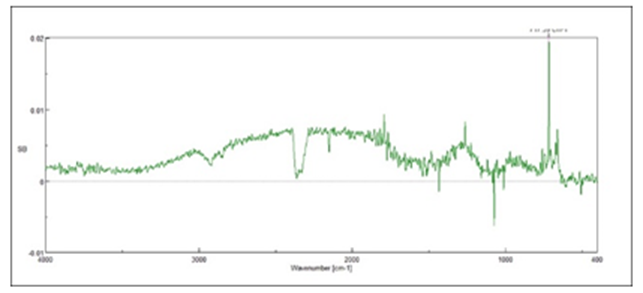
Fourier Transform Infrared Spectroscopy (FTIR): Sample was placed in the Potassium bromide plate of FTIR spectrometer and the interference pattern was detected by the infrared detector as variations in the infrared energy level, and the obtained spectral information was calculated. Figure 10 Represents FTIR Spectra of Bhasma.
X-Ray Diffraction
Analysis of Tamra Bhasma Using Modern Parameters
Anchor Scan Parameters: Powder X-ray Diffractometer Panalyticals-III X Ray Diffractometer, Panalytical Netherlands using Cu-Kα1-radiation (1.54 Å) at 45 KV, 30 mA, using iCore in a continuous scan mode data were collected with step size [o2θ] 0.0080. X-Ray Diffraction (XRD) Tamra Bhasma was subjected to XRD at NIPER, Hyderabad.
Procedure
Argon gas and an electric field are both used by the sputter coater. The sample is positioned in a tiny compartment that is vacuum sealed. An electric field and argon gas remove one electron from argon, making the atoms positively charged. The argon ions are subsequently drawn to a gold foil that is negatively charged Figure 11. The gold atoms on the surface of the gold foil are removed by the argon ions. A thin layer of gold is formed on the sample’s surface as a result of these gold atoms falling and settling there Table 5.
Operator User Raw Data Origin XRD measurement (*. XRDML) Scan Axis Gonio Start Position [°2θ] 3.0178 End Position [°2θ] 89.9728 Step Size [°2θ] 0.0330 Scan Step Time [s] 67.9450 Scan Type Continuous PSD Mode Scanning PSD Length [°2θ] 2.12 Offset [°2θ] 0.0000 Divergence Slit Type Automatic Irradiated Length [mm] 13.00 Specimen Length [mm] 10.00 Measurement Temperature [°C] 25.00 Anode Material Cu Intended Wavelength Type K-α1 K-α1 [Å] 1.54060 K-α2 [Å] 1.54443 K-β1 [Å] 1.39225 K-β2 [Å] 1.38113 K-β3 [Å] 1.39261 K-A2 / K-A1 Ratio 0.50000 K-Alpha2 Line Shift 0.00000 K Absorption Edge 1.37868 Generator Settings 30 mA, 45 kV Diffractometer Type 0000000011268541 Diffractometer Number 0 Goniometer Radius [mm] 240.00 Dist. Focus-Diverg. Slit [mm] 144.50 Incident Beam Monochromator No Spinning Yes
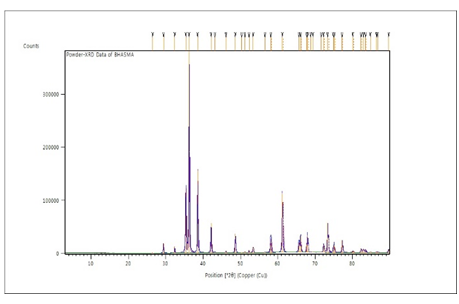
| Pos. [°2θ] | Height [cts] | FWHM Left [°2θ] | D-Spacing [Å] | Rel. Int. [%] |
|---|---|---|---|---|
| 26.4314 | 348.52 | 0.1299 | 3.36937 | 0.09 |
| 29.4067 | 17299.29 | 0.1624 | 3.03489 | 4.51 |
| 32.3602 | 11212.86 | 0.1624 | 2.76432 | 2.93 |
| 35.4041 | 122096.7 | 0.2598 | 2.53332 | 31.86 |
| 36.2526 | 383219 | 0.1948 | 2.47595 | 100 |
| 38.5521 | 155395.7 | 0.1624 | 2.33339 | 40.55 |
| 42.1286 | 56373.93 | 0.2273 | 2.1432 | 14.71 |
| 43.157 | 1414.51 | 0.2273 | 2.09448 | 0.37 |
| 46.0998 | 3514.52 | 0.2273 | 1.96739 | 0.92 |
| 48.5918 | 34866.64 | 0.2598 | 1.87216 | 9.1 |
| 50.3254 | 411.25 | 0.2598 | 1.81166 | 0.11 |
| 51.1836 | 2226.14 | 0.2598 | 1.78328 | 0.58 |
| 52.2841 | 4756.34 | 0.1299 | 1.7483 | 1.24 |
| 53.3275 | 10539.52 | 0.2922 | 1.71653 | 2.75 |
| 56.5245 | 809.18 | 0.1948 | 1.62679 | 0.21 |
| 58.1201 | 25933.54 | 0.3168 | 1.58587 | 6.77 |
| 58.3151 | 12396.26 | 0.0792 | 1.58103 | 3.23 |
| 61.1966 | 111514.4 | 0.1584 | 1.51331 | 29.1 |
| 61.3974 | 93277.55 | 0.0792 | 1.50884 | 24.34 |
| 65.6485 | 17958.93 | 0.3564 | 1.42105 | 4.69 |
| 66.1094 | 30640.57 | 0.1188 | 1.41225 | 8 |
| 66.3188 | 18117.9 | 0.1188 | 1.4083 | 4.73 |
| 67.7227 | 15579.48 | 0.1188 | 1.38248 | 4.07 |
| 67.9588 | 31696.58 | 0.1584 | 1.37825 | 8.27 |
| 68.1737 | 14135.55 | 0.1188 | 1.37443 | 3.69 |
| 68.7579 | 1100.57 | 0.1584 | 1.36417 | 0.29 |
| 69.4139 | 903.4 | 0.1188 | 1.35287 | 0.24 |
| 71.59 | 946.6 | 0.1188 | 1.317 | 0.25 |
| 72.2466 | 15073.32 | 0.2376 | 1.30664 | 3.93 |
| 72.4726 | 8957.72 | 0.1188 | 1.30312 | 2.34 |
| 73.352 | 55735.45 | 0.1584 | 1.28966 | 14.54 |
| 73.5831 | 32271.94 | 0.1188 | 1.28618 | 8.42 |
| 74.8405 | 11891.67 | 0.1584 | 1.26765 | 3.1 |
| 75.0979 | 14505.7 | 0.1188 | 1.26395 | 3.79 |
| 75.3713 | 6455.09 | 0.1188 | 1.26004 | 1.68 |
| 77.214 | 23312.97 | 0.1584 | 1.2345 | 6.08 |
| 77.4604 | 12847.99 | 0.1584 | 1.23119 | 3.35 |
| 80.0677 | 3972.81 | 0.1584 | 1.19753 | 1.04 |
| 80.335 | 2303.65 | 0.1584 | 1.19422 | 0.6 |
| 82.2611 | 6892.18 | 0.198 | 1.17106 | 1.8 |
| 82.5288 | 5517.1 | 0.1188 | 1.16794 | 1.44 |
| 82.9335 | 6907.19 | 0.198 | 1.16327 | 1.8 |
| 83.4941 | 5838.82 | 0.1188 | 1.15688 | 1.52 |
| 83.7583 | 3292.29 | 0.1188 | 1.1539 | 0.86 |
| 84.7872 | 912.08 | 0.1584 | 1.1425 | 0.24 |
| 86.436 | 1247.47 | 0.198 | 1.12489 | 0.33 |
| 86.7316 | 1223.38 | 0.198 | 1.12182 | 0.32 |
| 89.6376 | 5805.81 | 0.2376 | 1.09283 | 1.52 |
Table 5: Peak List. Microscopical Images of Bhasma
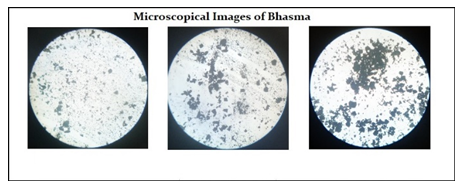
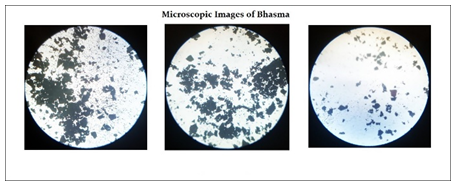
A small amount of bhasma was transferred on to the glass slide and observed using a compound microscope. Microscopical images of bhasma was observed in an compound microscope and magnified at 10X. The images are depicted in Figure 12 & 13.
Sem Analysis
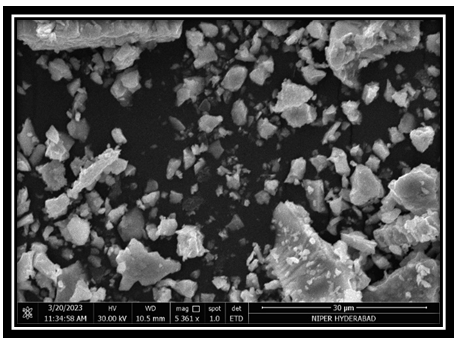
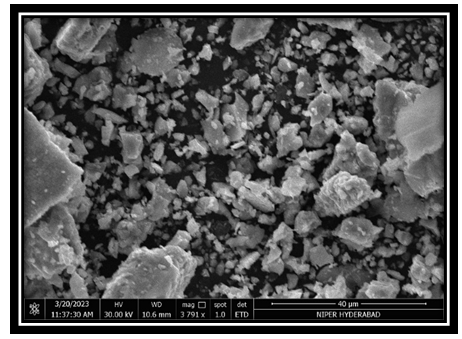
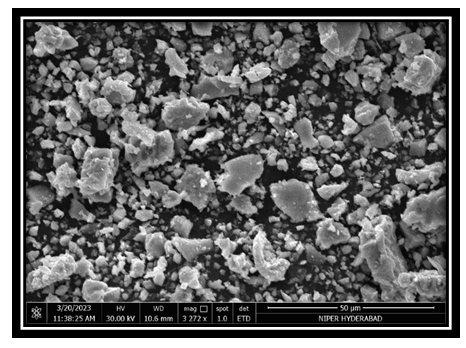
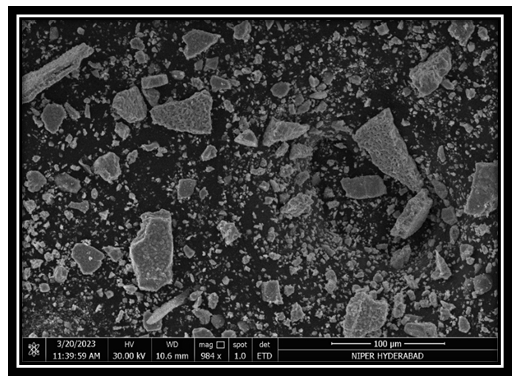
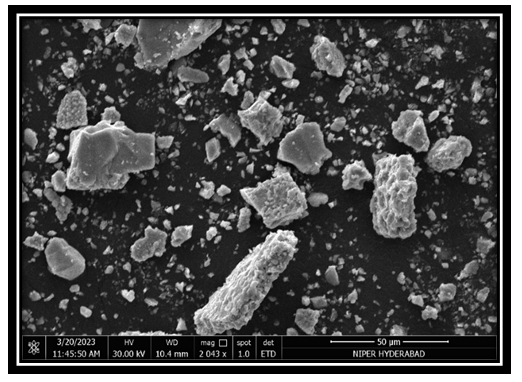
FFSEM (FEL Quanta 250 FEG Eindhoven, The Netherlands) was used to study habit modification, SEM was operated at 25 kV excitation voltage. Crystals were layered on double sided adhesive tape over sample stubs and sputter coated with gold using an ion sputter (QUORUM gold coater). Figure 14-18 Depicts the SEM images of Bhasma.
Discussion
The traditional methods such as varaputa method is an ancient method of preparation of Bhasma, other methods include sodhana, marana and bhavana. Sodhana is performed by samayana sodhana and visesha sodhana, which is done for purification by removing toxic chemicals, marana is known as incineration/calcination of Bhasma, and bhavana is known as levigation. In the preparation of Bhasma numerous approaches were performed such as samayana sodhana which include tila taila, (Sasame oil) takra, (Butter milk) gomutra, (cow urine) kanji (Sour gruel) and kulatha kwatha (Horse gram decoction). Samayana sodhana was preformed and then the Bhasma was subjected to quality control and evaluation parameters such as colour, odour, taste size and shape. Color, odour and taste of Bhasma were observed quality control was evaluated by ash values and extractive values. The ash value determines the quality and purity of Bhasma. The total ash value determines the presence of very high inorganic content. Lower value of the acid insoluble ash suggests the greater physiological availability of the drug. In the ultraviolet-visible spectral region, absorption spectroscopy or reflectance spectroscopy are both referred to as UV-Spectroscopy.
The wavelengths of the radiation that various compounds absorb vary. A molecule’s structural groups are represented by a number of absorption bands in an absorption spectrum. U.V. electromagnetic spectrum ranges from 190 to 400 nm, whereas visible electromagnetic spectrum ranges from 400 to 800 nm. Tamra Bhasma’s UV spectrum revealed greatest absorption at 220 nm, indicating that it is absorbent in the UV region. FTIR was used to look for organic legends or functional groups in Tamra Bhasma. Infrared spectroscopy deals with the infrared region of the electromagnetic spectrum that is light with a longer wavelength and lower frequency than visible light. When infrared light or radiation hits a molecule, the bonds in the molecule absorb the energy of the infrared and respond by vibrating. Size and shape of Bhasma was evaluated by Scanning electron Microscope SEM. The Phase and crystalline properties of materials can be identified by X-ray diffraction spectroscopy.
X-ray diffraction Spectroscopy (XRD) is a technique used in materials science to determine the crystallographic structure of a material. Scanning electron Microscope SEM determines the size and shape of Bhasma. The methods involved in the preparation of Bhasma are ancient methods. These methods are precious methods to be preserved for future. These Traditional methods must be used in this modern world with modern scientific tools to develop new terminologies and new findings to prepare these ayurvedic and siddha formulations. These herbal formulations such as asavas and aristas, Bhasma, churnas, lehyas, gutika/vati, rasayana, etc, can be prepared by using modern sophisticated equipments/instruments. These prepared formulations can be tested for quality control and evaluation parameters can be carried out. This preparation can be characterized by using UV-Visible spectroscopy, Fourier Transform Infrared Spectroscopy, X-Ray Diffraction Spectroscopy, Scanning Electron Spectroscopy, etc.
Conclusion
According to the results of the current study, Tamra Bhasma is a nano-sized particle with a high rate of dispersion to the target site, demonstrating its significant therapeutic efficacy. The Tamra Bhasma contained no free metal, indicating that toxicity and negative effects were not present. All of these cutting-edge analytical studies assist in bringing the obscured truths claimed by our ancient science to the attention of modern science and demonstrating their authenticity. With the increased demand for herbal medicine and enhanced usage of herbal medicine, the development of an authentic standardization parameter and evaluation tool will help in sustaining the quality of such predominant polyherbal preparations.
Competing Interest
Authors have declared that no competing interests exist.
Acknowledgements
Authors express their sincere gratitude to Seven Hills College of Pharmacy, Tirupati, for continuous motivation, support, and guidance for research activity and for providing all required facilities to accomplish the entitled work.
References
-
Pal D, Sahu CK, Haldar A (2014) The ancient Indian nanomedicine. Journal of Advanced Pharmaceutical Technology Research 5(1): 4-12.
-
Chaudhari SY, Jagtap CY, Galib R, Bedarkar PB, Patgiri B, et al. (2013) Review of research works done on Tamra Bhasma Incinerated Copper at Institute for Post-Graduate Teaching and Research in Ayurveda Jamnagar. Ayu 34(1): 21-25.
-
Singh RK, Kumar S, Aman AK, Karim SM, Kumar S, et al. (2019) Study on physical properties of Ayurvedic nanocrystalline Tamra Bhasma by employing modern scientific tools. Journal of Ayurveda Integrative Medicine 10(2): 88-93.
-
Chaudhari SY, Nariya MB, Galib R, Prajapati PK (2016) Acute and subchronic toxicity study of Tamra Bhasma incinerated copper prepared with and without Amritikarana. Journal of Ayurveda Integrative Medicine 7(1): 23-29.
-
Sahu L, Kujur MS, Sahu L, Singh TR, Parhate S (2021) Preparation of Tamra Bhasma by classical method. Journal of Ayurveda and Integrated Medical Sciences 6(01): 55-63.
-
Jagtap CY, Prajapati PK, Patgiri B, Shukla VJ (2012) Standard manufacturing procedure of Tamra Bhasma. Ayu 33(4): 561-568.
-
Swati S, Manoj S, Kashyap CP, Vijayant B (2019) Pharmaceutical Preparation of Tamra Bhasma. International Journal of Ayurveda and Pharma Research 7(7): 66-73.
-
Ophale S, Gupta SL, Dubewar A (2022) Tamra Bhasma preparation by two methods and evaluating their effect on the Liver Function test pre-clinically. International Journal of Ayurvedic Medicine 13(2): 377-383.
-
Gunja KD, Sandip BK, Shashiprabha G (2019) Pharmaceutical and analytical study of tamra bhasma a research article. International ayurvedic medical journal 7(12): 2159-2164.
-
Kale B, Rajurkar N (2019) Synthesis and characterization of Vanga bhasma. Journal of Ayurveda and Integrative Medicine 10(2): 111-118.
-
Pathiraja PMYS, Ranatunga YMMK, Herapathdeniya SKMK, Gunawardena SHP (2020) Swarna Makshika Bhasma preparation using an alternative heating method to traditional Varaha Puta. Journal of Ayurveda and Integrative Medicine 11(3): 206-212.
-
Parmar DK, Patgiri BJ, Prajapati PK (2010) Standardization of Gaja Puta and Ardha Gaja Puta in the preparation of Vanga Bhasma. Ayu 31(4): 511-515.
- Potential Medicinal Herbs and Secondary Metabolites in Combating Corona Virus
- Monkeypox and its Clinical Implications in Pregnancy
- Pharmacognostical Analysis of the Leaves of Important Nervine Medicinal Plant: Strychnos Nux-Vomica L
- Assessment of Antibacterial Activity of Various Solvent Extracts of Dictyota Dichotoma Against Multidrug Resistant Bacterial Strain
- An Insights of Bioactive Elements on Malignancy: Mechanistic Avenues
- Advances and Future Directions in Pharmacognosy and Chinese Medicine