
The Discovery of a New Genus of the Prosthenorchis Travassos, 1915 (Acanthocephala: Oligacanthorhynchidae) Complex in North America, with the Description of Neoprosthenorchis bifestoonatus n. gen., n. sp. from Bobcats in Louisiana
Neoprosthenorchis bifestoonatus n. gen., n. sp. (Oligacanthorhynchidae) is described from a bobcat, Lynx rufus (Schreber) (Felidae) in Louisiana. Neoprosthenorchis is the third of the genera comprising the Prosthenorchis Travassos, 1915 complex and the first in North America. The other two genera are Prosthenorchis from primates in South America and Felidae in Africa and Paraprosthenorchis Amin, Ha, Heckmann 2008 from Manidae in Vietnam. Neoprosthenorchis n. gen. is distinguished from the other genera of the complex by having two conspicuous sets of festoons at the anterior end of the trunk. The first set is made up of long and narrow vertical ribs encircling the anterior trunk and the overlaying second is a prominent horizontal undulating band. The festoons of Neoprothenorchis bifestoonatus n. gen., n. sp., especially the second set, are unique and different from all others previously described. Species in the two other genera normally have one crown of vertically ribbed festoons each. In addition, the North American species N. bifestoonatus also has a non-ornate longer than wide proboscis with 12 rows of 3 hooks with lateral slits, each without barbs but with simple heart-shaped roots and slight anterior manubria. A detailed description with line drawings and light microscope images along with the history of the concept of Prosthenorchis are provided.
Introduction
The keys of Petrochenko [1], Golvan [2], and Yamaguti [3] have been insufficient to resolve the contraversies surrounding the historically confused taxonomic literature of the Oligacanthorhynchidae. Schmidt [4] studied species of all genera known then and revised the family on sound morphological lines without resorting to separating the genera on the basis of definitive hosts as have been historically done, e.g., Oligacanthorhynchus Travassos, 1915 from birds and Hamanniella Travassos, 1915 from opossums and edentates, etc. [4]. The identification of juveniles lacking adult structures and the interpretation of proboscis hooks in spiral rows by some remains problematic.
The three original species of Prosthenorchis constituting the classical genus complex are Prosthenorchis elegans (Diesing, 1851) Travassos, 1915, Prosthenorchis fraterna (Baer, 1959) Schmidt, 1972, and Prosthenorchis lemuri Machado, 1950 (Table 1). Much has transpired over the last 50 years since Schmidt [4] published his revision. One other species of Prosthenorchis have been described since: Prosthenorchis cerdocyonis Gomes, Olifiers, Souza, Barbosa, D’Andrea & Maldonado Jr., 2015 from the crab-eating fox in Brazil (Gomes, et al. [5]). This species has all the characteristics of the genus Prosthenorchis outlined in Table 1 including the vertically ribbed festoons, barbed hooks and complex manubriated hook roots. Prosthenorchis sinicus Hu- Jiand, 1990 from a dog Canis familiaris Linn. in the Tacheng area of Xinjiang, China [6] is a misidentification. Most of the continuing research on acanthocephalans from this complex has dealt with P. elegans from New World primates covering the following selected topics. Mitochondrial DNA diversity in Colombia [7], pathology in marmosets in Brazil [8], cryptic diversity [9], case reports in tamarins Sanguinus leucopus (Günther) in Colombia [10], from primates in the Moscow Zoo [11], and from free-living primates in the Atlantic Forest of Bahia [12].
Our present work deals with the basic taxonomy of a new genus and species in the Prosthenorchis complex from a Felidaean, the bobcat, in the USA. This is the first record of any member of the Prosthenorchis complex in North America.
Materials and Methods
Collection
We have only one adult female in the ovarian ball stage that was collected from a bobcat, Lynx rufus (Schreber) (Felidae) in Louisiana by Dr. Richard L. Buckner. The specimen was already whole mounted in Canada balsam on a microscope slide labeled “Oncicola, Lynx rufus intestine, Oligacanthorhynchida, JW 20, RLB 1474” and the glass slide was etched with the same “RLB 1474.” Measurements are in micrometers, unless otherwise noted; the range is followed by the mean values between parentheses. Width measurements represent maximum width. Trunk length does not include proboscis, neck, or bursa.
Line Drawings
Line drawings were created by using a Ken-A-Vision micro projector (Ward’s Biological Supply Co., Rochester, N.Y.) which uses cool quartz iodine 150W illumination. Images of the stained whole mounted specimen were projected vertically on 300 series Bristol draft paper (Starthmore, Westfield, Massachusetts), then traced and inked with India ink. The completed line drawings were subsequently scanned at 600 pixels on a USB then downloaded on a computer.
Optical Microscope Images
Optical microscope images were obtained using a BH2 light Olympus microscope (Olympus Optical Co., Osachi- shibamiya, Okaya, Nagano, Japan) attached to an AmScope 1000 video camera (United Scope LLC, dba AmScope, Irvine, California), linked to an ASUS laptop equipped with HDMI high-definition multimedia interface system (Taiwan- USA, Fremont, California). Images from the microscope were transferred from the laptop to a USB and stored for subsequent processing on a computer. This specimen was not perfect but informative.
Results
Most species previously ascribed to Prosthenorchis are indistinguishable from Oncicola Travassos, 1916 except for 3 species noted by Schmidt [4] to have conspicuous festooned collar, e.g., P. elegans, P. fraterna, and P. lemuri (Table 1). Only one additional species, Prosthenorchis cerdocyonis was recently described since from a fox in Brazil by Gomes, et al. [5]. Another species, “Prosthenorchis sinicus” described from a dog in Xinjiang, China by Hu-Jiand [6] is a misidentification. It does not have a festooned collar and appeared to belong in Oncicola; see Figs. 1A & 1B in Hu-Jiand [6]. Van Cleave’s [13] extensive treatment of the Acanthocephala of North American mammals referred only to the one species of Oncicola known in North America, O. canis (Kaupp, 1909) from domestic dog, cats, coyote, and a “lynx.” Van Cleave [13] made no reference to the recovery of any specimens of Prosthenorchis. In this presentation, we describe Neoprosthenorchis bifestoonatus n. gen., n. sp. from a bobcat, Lynx rufus (Schreber) (Felidae) in Louisiana. This is the first record of any member of the Prosthenorchis complex in North America.
Description
Neoprosthenorchis n. gen. (Figs. 1-15)
Diagnosis: Female with short-medium trunk, broader anteriorly, gradually tapering posteriorly. Anterior trunk with two sets of festoons. First set of many vertical long and narrow ribbed festoon with large rimmed sensory stomata overlayed by a second set of undulating horizontal festoon, both encircling anterior trunk near its anterior end. Proboscis sub-globular, non-ornate. Rooted hooks in 12 alternating rows with 3 hooks each in dome-shaped teguments, sharply curved, smaller posteriorly, with lateral slits and without barbs. Hook roots simple, heart-shaped and blunt posteriorly to rosette-shaped. Receptacle thick walled with no outer wall and cephalic ganglion near middle of ventral inner surface. Lemnisci relatively long, thick anteriorly, gradually tapering posteriorly. Protonephridia obscured. Gonopore subterminal. Specimen with only ovarian balls; no eggs. Type species: Neoprosthenorchis bifestoonatus n. sp. Remarks: This acanthocephalan represents the third genus in the Prosthenorchis complex and the first to be found in North America. The other two genera are known from primates and Felidae in South America and Africa and in Manidae in Vietnam (Table 1). Neoprosthenorchis has many common
Description
Neoprosthenorchis bifestoonatus n. sp.
features with the two other genera but is distinctly different in having two sets of unusually shaped festoons as opposed to one. Species of “Prosthenorchis” that lacked festoons have all been relegated to other oligacanthorhynchid genera such as Oncicola, Pachysentis Meyer, 1931, and Neoncicola Schmidt, 1972. The genus Neoprosthenorchis n. gen. is further distinguished from Prosthenorchis and Paraprosthenorchis by non-ornate longer than wide proboscis, non-barbed hooks, simple hook roots, size of lemnisci, subterminal gonopore, smaller worm size, and host and geographical distribution.
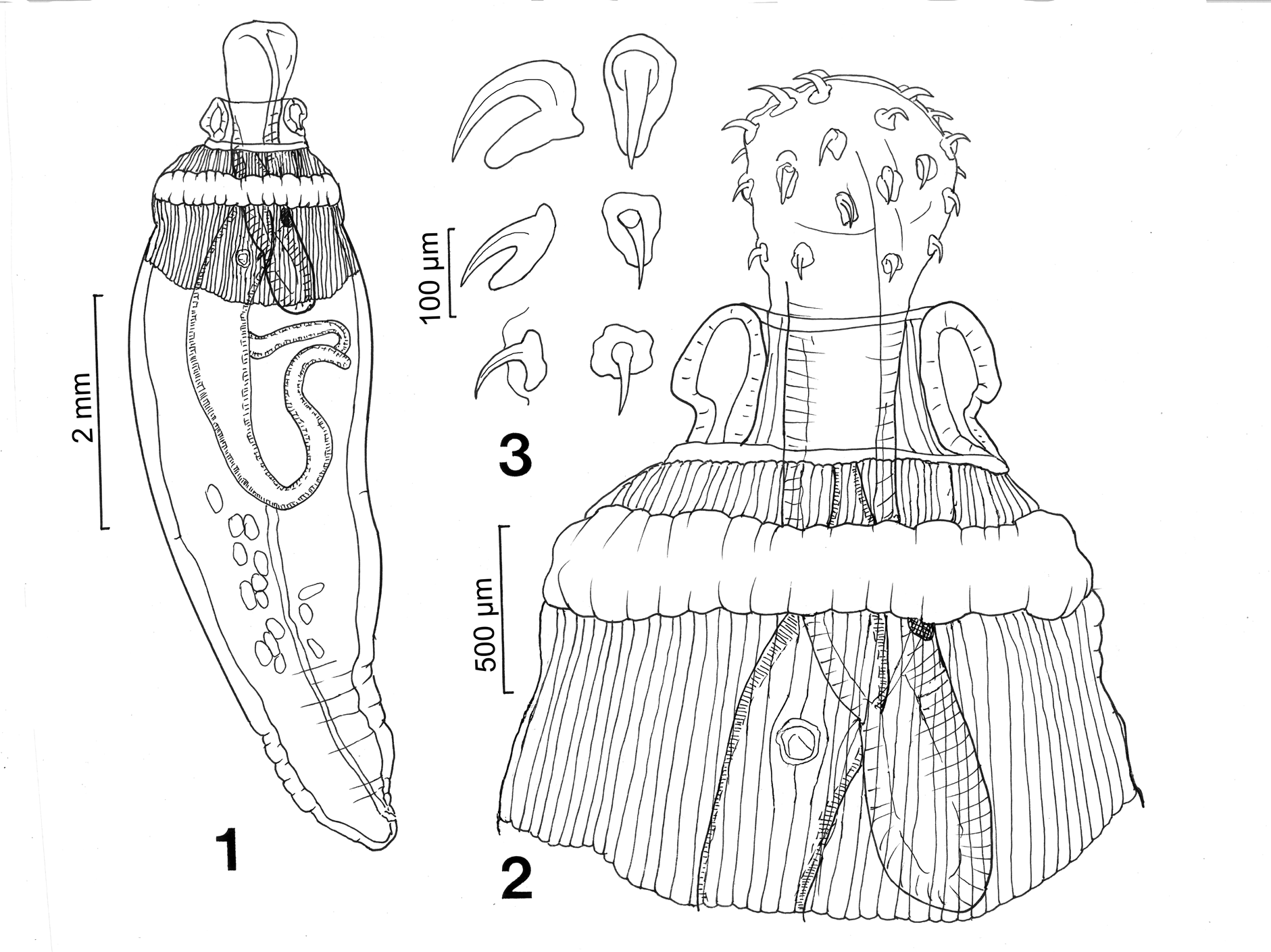
Figures 1-3: Line drawings of the holotype female of Neoprosthenorchis bifestoonatus n. gen., n. sp. from the bobcat, Lynx rufus in Louisiana. 1. The holotype female. Note the unique shape and position of the festoons, the anteriorly thick lemniscus, the subterminal gonopore and the long slender uterus. 2. A higher magnification of the praesoma showing details of the two festoons and the large orifice of the sensory pore. Note the cephalic ganglion near the middle of ventral inner surface of the receptacle just below the horizonal festoon. 3. Anterior, middle, and posterior hooks in profile and in face view.
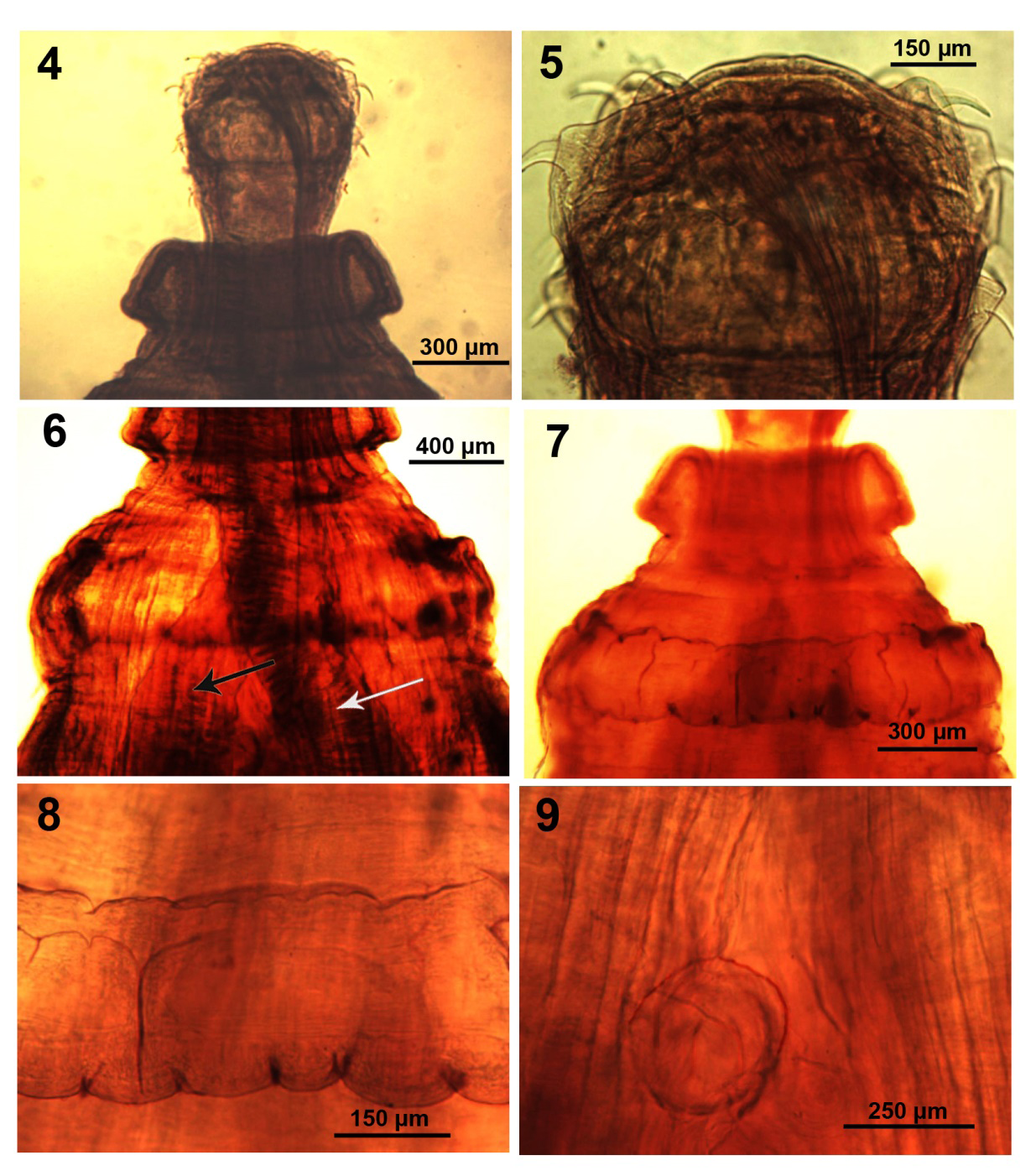
Figures 4-9: Light microscope images of the holotype female of Neoprosthenorchis bifestoonatus n. gen., n. sp. from the bobcat, Lynx rufus in Louisiana. 4. The praesoma. Anterior trunk is slightly retracted. 5. Anterior proboscis. Note the strong retractor muscles. 6. Anterior trunk. Image focuses on internal anatomy. Note the comparable size of the lemniscus (black arrow) and the proboscis receptacle (white arrow). 7. Anterior trunk. Image focuses on external surface. Note the horizontal undulating festoon encircling the anterior trunk. 8. High magnification of the horizontal festoon. 9. Part of the underlying vertical lamellated festoon and the large sensory orifice.
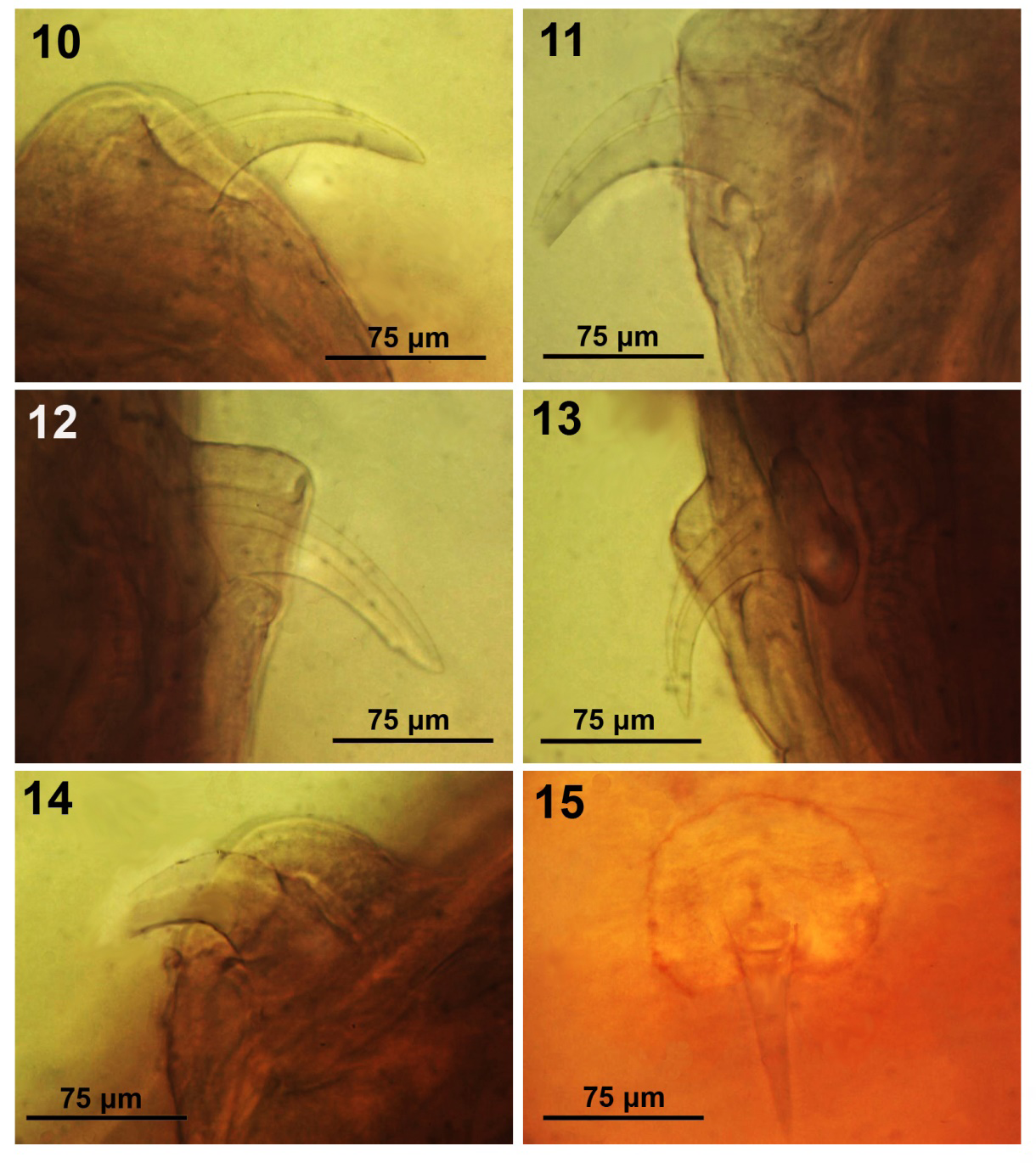
Figures 10-15: Light microscope images of the holotype female of Neoprosthenorchis bifestoonatus n. gen., n. sp. from the bobcat, Lynx rufus in Louisiana. 10-14. Lateral view of anterior, middle and posterior hooks and roots, in the same order. All hooks show the lateral slits or furrows. 15. Face view of a basal hook showing the frontal shape of the root.
Female (based on 1 female in the ovarian ball stage). Trunk small-moderate widest in anterior third with thick integument (Fig. 1), 7.50 long by 2.15 wide. Proboscis sub- globular 625 long by 650 wide, with 12 extremely alternating rows of 3 hooks each showing marked size variations (Figs. 2-5). Hooks not barbed, extremely curved, with lateral slits, largest anteriorly, in dome-shaped bulbs (Figs. 2,3), vary in size in alternate rows. Roots simple posteriorly directed and blunt heart-shaped with small anterior manubria. Anterior hooks largest (Figs. 10,11), 145-156 long. Middle hooks (Fig. 12) 124-146 long. Basal hooks (Figs.13-15) 94-109 long on both dorsal and ventral sides (Fig. 2). Neck 550 long by 750 wide at base. First set of festoons at anterior end of trunk of about 80 longitudinal ribs 1.50-1.60 mm long by 0.041- 0.062 mm wide with paired rimmed sensory pore 260 in orifice diameter (Figs. 2,9). Second set of festoons of 33 undulating segments of horizontal band 1.75 mm wide by 0.27-0.37 mm long vertically, at anterior end of first set of festoons (Figs. 2,7,8). Thick-walled receptacle 2.00 mm long by 0.40 mm wide (Fig. 6, white arrow) with cephalic ganglion near middle of its ventral inner surface. Lemnisci 6.00 long by 0.50 wide anteriorly (Fig. 6, black arrow). Reproductive system with subterminal gonopore and long uterus reaching posterior end of receptacle (Fig. 1).
Taxonomic Summary
Type host: Bobcat, Lynx rufus (Schreber) (Felidae). Type locality: Louisiana, USA. Specimen: Deposited at the Harold W. Manter Laboratory (HWML) of Parasitology Coll. no. HWML 216486 (accessioned P-2023-046)., Nebraska State Museum, Lincoln, Nebraska. Etymology: The new genus is named for its similarities to species in the genus Prosthenorchis and the species named for its unique double festoon sets. ZooBank LSID#AB254E1-5021-42ED-B80C-424E556731FB
Remarks
Neoprothenorchis bifestoonatus n. gen., n. sp. is distinguished from all other species of the Prosthenorchis group; in having two unique sets of festoons and hooks with lateral slits. The first set of festoons is made up of long and narrow vertical ribs encircling the anterior trunk just posterior to the neck and the overlaying second set is a prominent horizontal undulating band encircling the first set of vertical festoons near its anterior margin (Fig. 2).
| Genera | Neoprosthenorchis n. gen. | Paraprosthenorchis | Prosthenorchis* |
|---|---|---|---|
| Species | N. bifestoonatus n. gen., n. sp. | P. ornatus | P. elegans (Deising, 1851) P. fraterna (Baer, 1959) P. lumuri Machado, 1950 |
| Sources | This paper | Amin, et al. (2008) | Schmidt (1972); Baer (1959); Machado (1950) |
| Trunk length (mm) | Female about 8.00 mm | Females over 200 mm | Up to 50 mm long |
| Festoons | 2 sets of longitudinal & horizontal festoons near anterior end of trunk | 1 set of longitudinal festoons at anterior end of trunk | 1 set of longitudinal festoons at anterior end of trunk |
| Proboscis | Sub-globular, not ornate, slightly longer than wide | Sub-globular, ornate with beady rings around hooks | Not ornate, sub-globular |
| Proboscis hooks | 3 in each of 12 alternating rows | 3 in each of 16 rows | 3 in each of 12 rows |
| Barbs on hooks | Absent | Absent | Present |
| Hook root | Simple, heart-shaped, bluntly pointed. minimal manubria | Simple, heart-shaped, bluntly pointed. No manubria | Manubria large & complex specially anteriorly |
| Posterior hook root | Heart-shaped-rosette | Large, oblong horizontally | Small, discoid |
| Lemnisci | Unequal. Long & thick, tapering posteriorly | Subequal. Very long & slender with giant nuclei in swellings | Equal, moderate to very long & slender, multi nucleated |
| Protonephridia | Obscured | Gill-like, capsular on uterine bell in females | Small, gill-like, curved on uterine bell in females |
| Female gonopore | Subterminal | Terminal | Subterminal |
| Host & distribution | Bobcat, USA | Manidae in Vietnam | Primates in South America & Felidae in Africa |
| Intermediate hosts | Unknown | Ants and termites | Cockroaches & beetles |
Table 1: Comparison between the genera and the classical species of the Prosthenorchis complex (Oligacanthorhynchidae).
*Prosthenorchis cerdocyonis Gomes, Olifiers, Souza, Barbosa, D’Andrea & Maldonado Jr., 2015 from the crab-eating fox in Brazil is not included. Table 1: Comparison between the genera and the classical species of the Prosthenorchis complex (Oligacanthorhynchidae).
The first set of festoons may be hard to distinguish as it is more deeply embedded in the integument. Species in the two other genera normally have one crown of vertically ribbed festoons each. Some structures such as hook sizes of N. bifestoonatus overlap with those in Paraprosthenorchis ornatus Amin, Ha, Heckmann 2008 and P. elegans, P. fraterna, P. lemuri (Table 1) and P. cerdocyonis [4, 14, 15] that have the same type of festooned collar totally different from those of Neoprosthenorchis. Compared to N. festoonatus, P. ornatus the trunk is much longer, the hooks are without barbs, in beady grids and in 16 rows, posterior hooks with horizontally oblong root, and the lemnisci are very long and slender with giant nuclei in swellings. In the 4 known species of Prosthenorchis, the trunk is up to 50 mm long, hook tips with barbs, hooks roots complex with large manubria, lemnisci are slenderer and may reach the posterior end of trunk, and are found in primates or carnivores in South America and Felidae in Africa. In N. festoonatus, the lemnisci are as robust anteriorly as the proboscis receptacle and truncated.
Discussion
Considering the unique pattern of festoons in Neoprosthenorchis that are unlike any of those previously described in other acanthocephalans, we redefine the term festoon to indicate “an outcrop of a sculptured decorative curved tegument-based chains or strings in variably shaped vertical or circular arrangements at the anterior end of the trunk of acanthocephalans.” This definition applies to the analogous festoons in oligacanthorhynchid acanthocephalans but comparable definitions are found for garlands, architecture, insects and many other contexts in various dictionaries.
Paraprosthenorchis ornatus was reported from the pangolin Manis pentadactyla Linn. in Vietnam. The only other oligacanthorhynchids reported from pangolins are Nephridiorhynchus palawanensis Tubangui and Masilungan, 1938 collected from Manis javanica Desmarest in Palawan Island, the Philippines, and Oligacanthorhynchus gerberi (Baer, 1959) Schmidt, 1972 and Oligacanthorhynchus manisensis (Meyer, 1931) Schmidt, 1972, from Manis tricuspis Rafinesque in Africa. These forms have non-ornate proboscides with 12 rows of 3 or 4 hooks each; the female protonephridia occur as a compact closed capsule and lack festooned collar [16].
Schmidt [4] summarized the status of the genus Prosthenorchis and its 3 species known then, e.g., P. elegans, P. fraterna, and P. lemuri. The fourth known species of this genus, P. cerdocyonis from the crab-eating fox Cerdocyon thous Linn. in the Brazilian Pantanal Wetlands has 12 rows of 3 proboscis hooks each is distinguished from the other 3 species of Prosthenorchis by its smaller trunk, longer lemnisci reaching posterior end of the body as they do in P. fraterna, prominent paired ducted papillae at the base of proboscis, about 24 irregular festoons with transverse divisions below ribbed neck (Fig. 9), larger eggs, and host and geographical distribution. The number of festoons in the other 3 known species of Prosthenorchis have up to 23 vertical ribs and about 35 ribs in Paraprosthenorchis [16]. Having only one whole-mounted female specimen provided by Richard Buckner does not provide the opportunity to create SEM, Energy Dispersed x-ray or molecular analysis. The light microscopy images helped elucidate some of the morphological features depicted by line drawings. The implications to the evolutionary tree of oligacanthorhynchid acanthocephalans are enormous but regrettably, one whole mounted specimen will not help elucidate its genetic profile.
Acknowledgements
We are grateful to Dr. Nataliya Rubtsova, Parasitology Center, Inc., Scottsdale, Arizona, for her expert help with the management of the line drawings and light microscope images. For providing the specimen of Neoprosthenorchis bifestoonatus n. gen., n. sp., our gratitude goes to Dr. Richard L. Buckner who may have been at Livingston University, Alabama when this research specimen was provided. This work was supported by an institutional grant from the Parasitology Canter, Inc. Scottsdale, Arizona, USA.
Conflicts of Interest: The authors declare no conflicts of interest. Ethical Approval: The authors declare that they have observed all applicable ethical standards.
References
-
Petrochenko VI (1958) Acanthocephala of domestic and wild animals. Akad. Nauk, SSSR, Moscow 2: 458.
-
Golvan YJ (1962) Le phylum des Acanthocephala (quatrieme note). La classe des Archiacanthocephala (A. Meyer 1931). Ann Parasit 37: 1-72.
-
Yamaguti S (1963) Systema Helminthum. Vol. V. Acanthocephala. Interscience, New York, USA 5: 423.
-
Schmidt GD (1972) Revision of Class Archiacanthocephala Meyer, 1931 (Phylum Acanthocephala), with emphasis on Oligacanthorhynchidae Southwell and MacFie, 1925. J Parasitol 58 (2): 290-297.
-
Gomes APN, Olifiers N, Souza JGR, Barbosa HS, D’Andrea PS, Maldonado Jr A (2015) A new acanthocephalan species (Archiacanthocephala: Oligacanthorhynchidae) from the crab-eating fox (Cerdocyon thous) in the Brazilian pantanal wetlands. J Parasitol 101 (1): 74-79.
-
Hu-Jiand D (1990) Une nouvelle espece de _Prosthenorchis_ (Oligacanthorhynchida: Oligacanthorhynchidae). Acta Vet Zoot Sinica 21: 65-66.
-
Falla AC, Brieva C, Bloor P (2015) Mitochondrial DNA diversity in the acanthocephalan _Prosthenorchis elegans_ in Colombia based on cytochrome c oxidase I (COI) gene sequence. Intern J Parasitol: Parasites Wildlife 4(3) 401- 407.
-
Oliveira ARd, Hiura E, Guião-Leite FL, Flecher MC, Braga FR, et al. (2017) Pathological and parasitological characterization of _Prosthenorchis elegans_ in a free- ranging marmoset _Callithrix geofroyi_ from the Brazilian Atlantic Forest. Pesq Vet Bras 37(12): 1514-1518.
-
RojasSánchez E, UmañaBlanco F, Jimenez-Rocha A, Vega- Benavides K, Medaglia A, et al. (2023) Cryptic diversity in a gastrointestinal acanthocephalan of New World primates from Costa Rica. Nature-Sci Rep 13: 2402.
-
Pérez J, Peña J, Soler-Tovar D (2013) Spiny-Headed Worms (_Prosthenorchis elegans_) in Silvery-Brown Bare- Face Tamarins (_Saguinus leucopus_): A Case Report. In: Colombian Endangered Primates. 1st (Edn.), Defler T, Stevenson P, et al. (Eds.), Chapter 8. Asociación Primatológica Colombiana.
-
Sokolov SG, Alshinetsky MV, Berezin MV, Efeykin BD, Spiridono S Ed (2016) Acanthocephalans _Prosthenorchis_ cf. _elegans_ (Archiacanthocephala: Oligacanthorhynchidae), parasites of primates in the Moscow Zoo. Parasitol 50(3): 185-196.
-
Catenacci LS, Colosio AC, Oliveira LC, De Vleeschouwer KM, Munhoz AD, Deem SL, PintoJMS (2016) Occurrence of _Prosthenorchis elegans_ in Free-living Primates from the Atlantic Forest of Southern Bahia, Brazil. J Wildlife Dis 52(2): 364-368.
-
Van Cleave HJ (1953) Acanthocephala of North American mammals. Illinois Biol Monogr 23(1-2): 1-179.
-
Baer JG (1959) Exploration des Pares Nationaux du Congo Belge.. Helminthes parasites. Institut des Parcs Nationaux du Congo Belge, Bruxelles. Fasc 1: 163.
-
Machado DA (1950) Revisão do genero _Prosthenorchis_ Travassos, 1915 (Acanthocephala). Mem Inst Osw Cruz 48: 495-544.
-
Amin OM, Ha NV, Heckmann RA (2008) New and already known acanthocephalans mostly from mammals in Vietnam, with descriptions of two new genera and species in Archiacanthocephala. J Parasitol 94(1): 194- 201.
- Mitochondrial Bio-Logistics: Steering Co-Enzyme Q10 and Lycopene Synergies within the Science 4.0 Bio-OS Framework
- Hymenoptera Specimens from the Caño Negro Wetland, of the National Museum Collection, Costa Rica
- Science 4.0: Comprehensive Architecture of the Biological Operating System (Bio-OS) A Framework for Systemic Resilience and Industrialized Bio-Governance
- Rabbit on, or Hare Back? Understanding Climate Change
- Clinical Validation of Science 4.0: Flow Steering and Epigenetic Drift Inversion on a 76-Year-Old Hybrid System
- Seeds Planted by another Mind