
Bioaccumulation of Heavy Metals in two Species of Fish in the Rio Doce Basin after the Rupture of the Ore Tailings Dam in Mariana city, Minas Gerais, Brazil
Heavy metals appear in the aquatic environment mainly due to anthropogenic activities, such as mining. The impacts of environmental pollution by metals can be identified and quantified in target organs of animals, which tend to accumulate such pollutants. In November 2015, the ore tailings dam in Mariana-MG ruptured, dumping toxic mud into the Doce River Basin, with great mortality of fish and other organisms, in addition to long-term effects due to water and soil contamination
Opinion
Heavy metals appear in the aquatic environment mainly due to anthropogenic activities, such as mining. The impacts of environmental pollution by metals can be identified and quantified in target organs of animals, which tend to accumulate such pollutants. In November 2015, the ore tailings dam in Mariana-MG ruptured, dumping toxic mud into the Doce River Basin, with great mortality of fish and other organisms, in addition to long-term effects due to water and soil contamination. Contamination was mainly due to heavy metals, whether from mud or sediments stirred up from the bottom of rivers. The objective of this work was to analyze the concentration of heavy metals in the gills, liver and muscle of cara Geophagus brasiliensis and Nile tilapia Oreochromis niloticus collected in two areas in the Rio Doce Basin, affected and not affected by the mud, two years after - rupture of the dam. The affected area was on the Doce River, in Santa Cruz do Escalvado-MG., and the unaffected area was on the Piranga River in Ponte Nova-MG. Sixty fish were collected, 15 of each species in each location. The chosen species have an omnivorous/iliophagous feeding habit, with Opinion native cara and exotic tilapia. The metals evaluated were Cr, Cu, Mn, Fe, Ni, Cd, Pb, Zn, Co and Al. The statistical test used to compare groups (affected and unaffected areas) was the t test, with a significance level of 5% (α = 0.05). In cara and tilapia gills, all metals were more concentrated in the affected area, with the exception of Fe and Pb, with the exception of iron and lead, which did not differ between areas (Fig.1A). In cara liver, levels of all metals were higher in the affected área, with the exception of Ni and Cd, with the exception of iron and lead, which did not differ between areas; in tilapia liver, levels of all metals were higher in the affected area (Fig. 1B). For the muscle of both species, most metals did not differ between areas, only Fe, Pb, Co and Al in the case of cara, with higher levels in the affected area (except for Pb and Zn); and only Cr, Pb and Zn in tilapia, which were higher in the unaffected area (Figure 1). In general, the high levels of Al and Fe in fish tissues call attention. Comparing the two species, it can be said that the levels of most metals were higher in cara. Comparing the organs, it can be said that for most metals, the levels were higher in the gills, followed by the liver and muscle. Such results reflect the environmental contamination of the Rio Doce Basin and the bioaccumulation of heavy metals in fish, especially in areas affected by tailings mud.
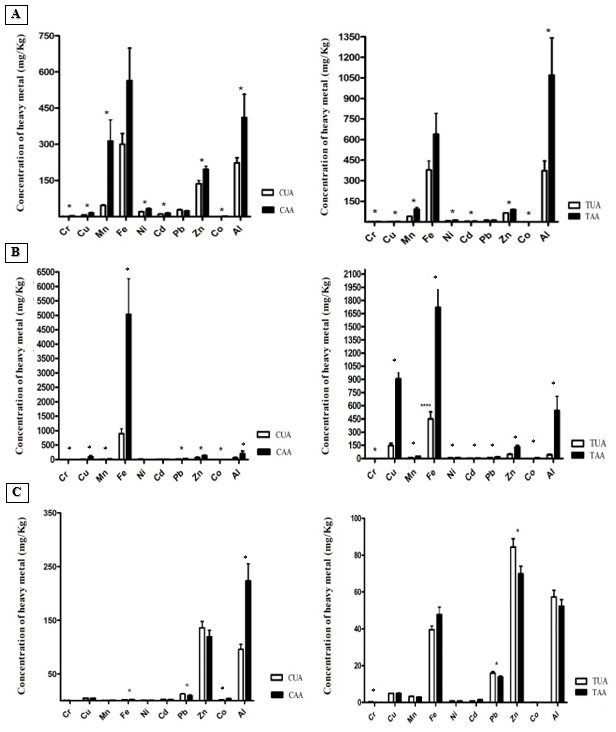
Figure 1: Concentration of heavy metals in the gills (A), liver (B) and muscle (C) of caras and tilapias collected in unaffected and affected areas by the collapse of the ore tailings dam in Mariana-MG. Data expressed as mean ± standard error. * Indicates a significant difference, using the t test or Mann-Whitney test, at a 5% significance level. CUA: caras from unaffected area, CAA: caras from affected area, TUA: tilapias from unaffected área, TUA: tilapias from affected área.
- Mitochondrial Bio-Logistics: Steering Co-Enzyme Q10 and Lycopene Synergies within the Science 4.0 Bio-OS Framework
- Hymenoptera Specimens from the Caño Negro Wetland, of the National Museum Collection, Costa Rica
- Science 4.0: Comprehensive Architecture of the Biological Operating System (Bio-OS) A Framework for Systemic Resilience and Industrialized Bio-Governance
- Rabbit on, or Hare Back? Understanding Climate Change
- Clinical Validation of Science 4.0: Flow Steering and Epigenetic Drift Inversion on a 76-Year-Old Hybrid System
- Seeds Planted by another Mind