
Can a Soil Index Reveal Ecosystem Recovery? The Biodiversity Soil Resilience Index: A New Index to Assess Resilience in Environmentally Stressed Ecosystems
Ecological resilience remains a central yet challenging concept to operationalise. In this study, we present the Biological Soil Resilience Index (BSR-Index), a composite, field-deployable metric that integrates three complementary bioindicators: soil microarthropods, entomopathogenic nematodes and fungi (EPNs, EPF), and earthworms. Raw values are normalised to fixed theoretical maxima and combined using a weighted mean (40% microarthropods, 30% EPN/EPF, 30% earthworms), producing a unitless score on a 0–100 scale that is classified into four resilience levels. The index was applied across forest, agricultural and agroforestry systems arranged along a stress gradient. Results show that the BSR-Index effectively discriminates between soils of high and low biological integrity, capturing both structural composition and functional depth of soil communities. By integrating multiple biological compartments into a single metric, the BSR-Index advances beyond traditional single-taxon approaches, offering a robust and reproducible framework for resilience assessment. Standardised scoring facilitates crossecosystem comparisons and provides a practical decision-support tool for land management, conservation and environmental policy. The BSR-Index highlights the pivotal role of soil biodiversity in maintaining ecosystem services and offers a scalable framework for monitoring, restoration prioritisation and adaptive planning in the context of ecological resilience.
Altieri GM¹*, Garrido J², Moino A³, Tkaczuk C⁴, Mato S², Santarcangelo V¹, Bari G¹ and Tarasco E¹
¹Department of Soil, Plant and Food Sciences, University of Bari ‘Aldo Moro’, Italy ²Department of Ecology and Animal Biology, Faculty of Sciences, University of Vigo, Spain ³Department of Entomology, Federal University of Lavras (UFLA), Lavras, Brasil ⁴Department of Horticulture and Plant Protection, University of Siedlce, Siedlce, Poland
Abbreviations
EPNs: Entomopathogenic Nematodes; EPF: Entomopathogenic Fungi; BSR: Biological Soil Resilience;
EMI: Edaphic Morphological Index.
Introduction
Ecological resilience has long been a central yet debated concept in ecology [1]. Since the pioneering work of Holling [2] and the subsequent theoretical developments by Gunderson [3] and Scheffer, et al. [4], multiple frameworks have been proposed to define and classify resilience. However, translating these theoretical perspectives into operational and quantifiable measures applicable across ecosystems remains a challenge.
A widely accepted definition emphasises the ability of an ecosystem to recover its structure, composition, and functions following disturbance [5]. More recent studies have highlighted the importance of spatial and temporal dimensions—such as scale, connectivity, and landscape position—in shaping ecosystem responses [6, 7]. Despite these advances, many approaches remain limited, focusing on single aspects of resilience (structural recovery [8, 9], species-specific responses [10], or bioclimatic indices [11]) without fully capturing the complexity of recovery processes. Within this broader debate, biological soil resilience has gained increasing attention as a foundational component of ecological resilience. Soil biodiversity underpins nutrient cycling, organic matter decomposition, water regulation, and natural pest control.
The capacity of soil biotic communities to withstand and recover from disturbance forms the base upon which broader ecosystem resilience rests. Among soil organisms, entomopathogenic nematodes (EPNs) and entomopathogenic fungi (EPF) have emerged as promising bioindicators: beyond their role as biocontrol agents, EPNs (mainly Steinernema and Heterorhabditis) and EPF (e.g., Beauveria bassiana, Metarhizium anisopliae) respond sensitively to management, pesticide use, and land-use change [12, 13, 14, 15] and can reflect broader stressors, including heavy metals and salinity [16].
Building on these findings, we operationalise biological soil resilience through a synthetic, field-deployable metric—the Biological Soil Resilience Index (BSR-Index)— that integrates microarthropods (QBS-ar), EPNs/EPF, and earthworms to evaluate resilience across forests, agricultural lands, and agroforestry systems.
Materials and Methods
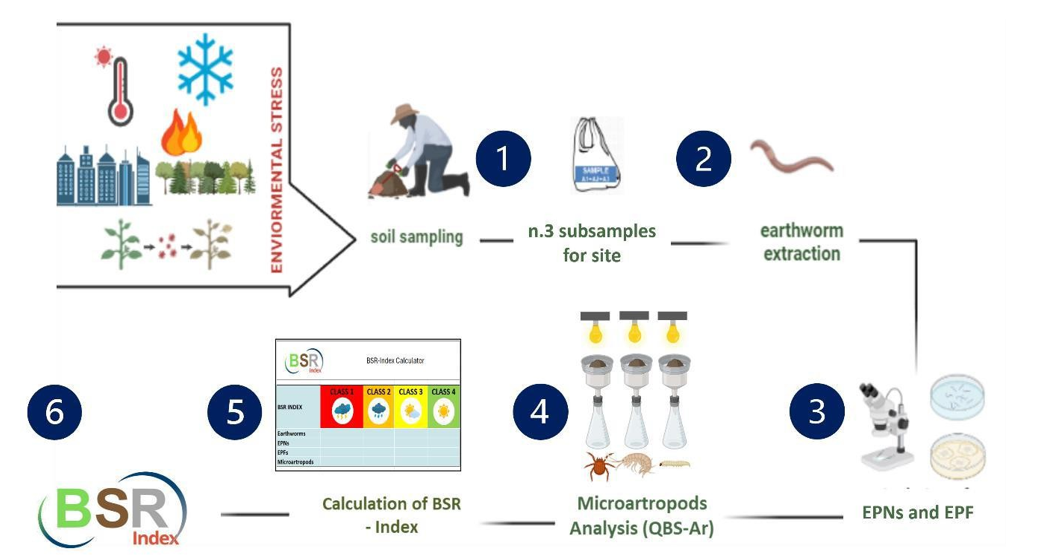
We operationalise the Biological Soil Resilience Index (BSR-Index) across three ecosystem types—forests, agricultural lands, and agroforestry systems—arranged along a pragmatic stress gradient (low, medium, high). Within each site, we adopt a fixed triangular sampling layout to ensure spatial coverage and repeatability: three soil samples are collected at the vertices of an equilateral triangle (10 m side). Field and laboratory procedures (sampling geometry, extraction/isolations, scoring rules, normalisation, weighting, thresholds) are kept constant across sites to guarantee comparability and reproducibility. Soil microarthropods are extracted using Berlese–Tullgren funnels, sorted into morphologically homogeneous groups, and scored following the QBS-ar protocol.
Each taxon/group receives an Edaphic Morphological Index (EMI) from 1 to 20 proportional to its adaptation to soil life (e.g., depigmentation, eye reduction, elongation); the sum of EMI provides the site-level QBS-ar value (AR_ raw= Range 0-353) [17-19 see also 1–5 for the resilience framework]. Entomopathogenic nematodes (EPNs) (Steinernema, Heterorhabditis) and entomopathogenic fungi (EPF) (Beauveria bassiana, Metarhizium anisopliae) are detected using a Modified Insect-Bait technique with last- instar Galleria mellonella [20, 21].
Infected cadavers are surface-sterilised and processed to isolate and identify EPNs/EPF. To emphasise detectability rather than abundance, we assign a presence-based site score (EP_raw range 0-20): 20 if both EPNs and EPF are present, 10 if only one group is present, and 0 if neither is detected [12, 13, 14, 15, 16]. Earthworms are sampled by hand-sorting soil monoliths and timed searches. Individuals are classified into Epigeic (EPI), Endogeic (END), and Anecic (ANE) forms. We compute a presence-and-form score (EW_raw) by summing fixed weights for each form detected: EPI =72+5, END = +10, ANE = +20 (range 0–35), capturing the functional depth stratification of the earthworm community [22]. To render components comparable, we apply max-scaling to 0–100.
$$ \begin{array}{l} \mathrm {A R} _ {\mathrm {n o r m}} = 1 0 0 \times \mathrm {A R} _ {\mathrm {r a w}} / 3 5 3; \mathrm {E P} _ {\mathrm {n o r m}} = 1 0 0 \times \mathrm {E P} _ {\mathrm {r a w}} / 2 0; \\ W _ {\mathrm {n o r m}} = 1 0 0 \times E W _ {\mathrm {r a w}} / 3 5 \\ \end{array} $$ where ARmax is the maximum QBS-ar observed across the study. The BSR-Index is then computed as a weighted mean that emphasises the microarthropod signal:
BSR = 0.40 ARnorm + 0.30 EPnorm + 0.30 EWnorm;
For interpretation, BSR values (0–100) are assigned to four resilience classes: Class 4 (Excellent resilience) ≥ 75; Class 3 (Good resilience) 50.00–74.99; Class 2 (Moderate resilience) 25.00–49.99; Class 1 (Low resilience) < 25. All methodological choices—sampling geometry, extraction and isolation procedures, scoring rules, normalisation, weights, and thresholds—are held constant across sites and ecosystem types to ensure consistency and reproducibility [6, 7, 8, 9, 12, 13, 14, 15, 16, 17, 18, 19, 20, 21, 22] (Figure 1).
Results and Discussion
To demonstrate the operation of the BSR-Index, we present a worked example based on invented, non- inferential data used solely to illustrate calculation and interpretation. Component values are rescaled to unitless 0–100 scores using fixed theoretical maxima set a priori (microarthropods: 353; entomopathogens: 20; earthworms:
35) and combined as a weighted mean with weights 0.40 (microarthropods), 0.30 (entomopathogens), 0.30 (earthworms). Under these conventions, Site S1 achieves high normalised scores for all components and falls in the top class; S2 shows an intermediate profile constrained mainly by entomopathogens and earthworms; S3 is limited across all three components (Table 1).
| Site | AR_raw | EP_raw | EW_raw | AR_norm | EP_norm | EW_norm | BSR (weighted) | Class |
|---|---|---|---|---|---|---|---|---|
| S1 | 180 | 20 | 35 | 50.99 | 100 | 100 | 80.4 | Class 4 (Excellent resilience) |
| S2 | 135 | 10 | 10 | 38.24 | 50 | 28.57 | 38.87 | Class 2 (Moderate resilience) |
| S3 | 90 | 0 | 5 | 25.5 | 0 | 14.29 | 14.48 | Class 1 (Low resilience) |
Table 1: Illustrative example with fixed normalisation caps (microarthropods 353; entomopathogens 20; earthworms 35). Classes on
Narratively, S1 acts as a functional reference: entomopathogens are detected (both groups present), the earthworm assemblage spans all three functional forms, and the microarthropod signal reaches roughly half of its theoretical cap—together producing an Excellent composite score. S2 is Moderate, with a respectable microarthropod contribution but a partial entomopathogen signal (only one group detected) and a shallow earthworm profile (Endogeic only). S3 is Low, reflecting the absence of entomopathogens, a truncated earthworm structure (Epigeic only), and a reduced microarthropod signal. Because the index is monotonic with fixed weights, increases in any normalised component necessarily raise the final score, allowing transparent attribution of shortfalls to the underlying biological dimensions. The BSR index classifies sites into four distinct resilience categories, providing a standardised framework for evidence-based land management. Sites in Classes 1 and 2 show decreased biological activity and limited diversity of functional soil organisms, indicating a weakened state of ecological resilience. These areas are thus identified as priority targets for ecological restoration and mitigation efforts aimed at restoring soil functions, increasing edaphic biodiversity, and promoting system stability. In contrast, Classes 3 and 4 represent soils with higher resilience, where biological structure and function remain more intact despite external pressures. Overall, the BSR index offers a scientifically grounded, practical tool for assessing soil resilience across various land-use types, including agricultural, forest, and agroforestry systems. By incorporating multiple biological indicators, the index supports comprehensive environmental monitoring and informs land management decisions that align with sustainability and ecosystem conservation principles.
Conclusions
The use of the Biological Soil Resilience Index (BSR) represents a substantive advance in assessing soil health and ecological resilience. Unlike traditional biological indices such as QBS-ar [17, 19], the BSR provides a more comprehensive, multidimensional appraisal by combining multiple functional and structural bioindicators— microarthropods, earthworms, entomopathogenic nematodes (EPNs), and entomopathogenic fungi (EPF). These groups, often overlooked in conventional monitoring, are particularly responsive to environmental disturbances including soil degradation, pollution, and intensive farming [12, 13, 14, 15, 26, 29]. In our demonstrative application, sites subjected to anthropogenic pressures exhibited markedly lower EPN and EPF activity, confirming their value as early indicators of ecological disturbance. Integrating these functional groups within a single index enables joint evaluation of structural makeup and functional performance of soil ecosystems: earthworms are well established drivers of nutrient cycling, aeration, and aggregation [24]; microarthropods reflect overall biological quality through their degree of adaptation to soil life [18]; and EPNs/ EPF provide insight into trophic interactions and natural biological control within the soil food web [25, 26]. A multi-year, seasonally replicated design further enhances robustness and transferability across land-use types and ecological gradients. The BSR also classifies sites into four resilience categories, supplying a standardised framework for evidence-based land management. Classes 1 and 2 denote degraded or highly vulnerable conditions with reduced biodiversity and limited functional capacity, thereby warranting priority for ecological restoration and mitigation [27]. By contrast, Classes 3 and 4 indicate soils that are stable and functionally resilient, capable of sustaining key ecosystem services even under external pressures. Overall, the BSR is a scientifically rigorous yet practical tool for soil biomonitoring and resilience evaluation: it provides both a current snapshot of soil condition and predictive insight into longer-term recovery potential, guiding sustainable agriculture, conservation strategies, and environmental policy in support of soil ecosystem services essential to food security, biodiversity, and human well-being [28].
Data Availability Statement
The original contributions presented in this study are included in the article. Further inquiries can be directed to the Corresponding Author
Acknowledgements
This study was carried out within the Agritech National Research Center and received funding from the European Union Next-GenerationEU (PIANO NAZIONALE DI RIPRESA E RESILIENZA (PNRR) – MISSIONE 4 COMPONENTE 2, INVESTIMENTO 1.4 – D.D. 1032 17/06/2022,
Conflicts of Interest
The authors declare no conflicts of interest.
References
-
Walker BH (2020) Resilience: what it is and is not. Ecol Soc 25: 11.
-
Holling CS (1973) Resilience and stability of ecological systems. Annu Rev Ecol Syst 4: 1-23.
-
Gunderson LH (2000) Ecological resilience—in theory and application. Annu Rev Ecol Syst 31: 425-439.
-
Scheffer M, Carpenter S, Foley JA, Folke C, Walker B (2001) Catastrophic shifts in ecosystems. Nature 413: 591-596.
-
Thompson J (2009) Ecosystem resilience and the limits of stability. Trends Ecol Evol 24: 12-20.
-
Allen CR, Angeler DG, Cumming GS, Folke C, Twidwell D, et al. (2016) Adaptive inference for distinguishing alternative states in ecosystems. Ecol Lett 19: 127-139.
-
Chambers JC, Allen CR, Cushman SA (2019) Operationalizing ecological resilience concepts for managing species and ecosystems at risk. Front Ecol Evol 7: 241.
-
Bryant M (2019) Structural recovery indices in ecosystem resilience assessment. Ecol Indic 101: 681-692.
-
Ibáñez I (2019) Structural dynamics and resilience metrics in forest ecosystems. J Ecol 107: 2444-2457.
-
Keane RE (2018) Species-specific resilience assessment in forest ecosystems. For Ecol Manag 429: 1-11.
-
Ferrier S (2020) Bioclimatic indices and ecosystem resilience. Glob Ecol Biogeogr 29: 128-140.
-
Grewal PS, Ehlers RU, Shapiro-Ilan DI (2005) Nematodes as Biocontrol Agents. CABI Publishing, Wallingford.
-
Jaffuel G (2016) Agricultural practices influence entomopathogenic nematodes in soil. Appl Soil Ecol 100: 184-193.
-
Campos-Herrera R (2015) Entomopathogenic nematodes as indicators of soil health. Soil Biol Biochem 85: 160-174.
-
Meyling NV, Eilenberg J (2009) Occurrence and distribution of soil-borne entomopathogenic fungi within a single organic agroecosystem. Biol Control 50: 194-200.
-
Bidochka MJ, Kamp AM, Lavender TM, Dekoning J, de Croos JN (2010) Habitat association in two genetic groups of the insect-pathogenic fungus Metarhizium anisopliae: uncovering cryptic species? Appl Environ Microbiol 67: 1335-1342.
-
Parisi V (2001) La qualità biologica del suolo. Un metodo basato sui microartropodi. Acta Nat Ateneo Parmense 37: 97-106.
-
Parisi V, Menta C, Gardi C, Jacomini C, Mozzanica E (2005) Microarthropod communities as a tool to assess soil quality and biodiversity: a new approach in Italy. Agric Ecosyst Environ 105: 323-333.
-
Menta C, Conti FD, Pinto S, Bodini A (2018) Soil Biological Quality index (QBS-ar): 15 years of application at global scale. Ecol Indic 85: 773-780.
-
Orozco RA, Lee MM, Stock SP (2014) Soil sampling and isolation of entomopathogenic nematodes (Steinernematidae, Heterorhabditidae). J Vis Exp 89: e52083.
-
Tarasco E, de Bievre C, Papierok B, Poliseno M, Triggiani O (1997) Occurrence of entomopathogenic fungi in soils in Southern Italy. Entomologica (Bari) 31: 157-166.
-
Tarasco E, Clausi M, Rappazzo G, Panzavolta T, Curto G, et al. (2015) Biodiversity of entomopathogenic nematodes in Italy. J Helminthol 89: 359-366.
-
Aira M, Monroy F, Domínguez J, Mato S (2002) How earthworm density affects microbial biomass and activity in pig manure. Eur J Soil Biol 38: 7-10.
- Mitochondrial Bio-Logistics: Steering Co-Enzyme Q10 and Lycopene Synergies within the Science 4.0 Bio-OS Framework
- Hymenoptera Specimens from the Caño Negro Wetland, of the National Museum Collection, Costa Rica
- Science 4.0: Comprehensive Architecture of the Biological Operating System (Bio-OS) A Framework for Systemic Resilience and Industrialized Bio-Governance
- Rabbit on, or Hare Back? Understanding Climate Change
- Clinical Validation of Science 4.0: Flow Steering and Epigenetic Drift Inversion on a 76-Year-Old Hybrid System
- Seeds Planted by another Mind