
Sunny City - Arkadag
The article obtained systematized, scientifically substantiated gross, technical, economic and environmental energy resource potentials from the introduction and use of solar energy technologies. The technical, economic, and environmental priorities of power plants were assessed in terms of energy efficiency , fuel economy, and the impact on the environment per square meter from conversion to thermal and electrical energy in the city of Arkadag. Empirical formulas have been obtained for the implementation of solar energy technological structures and the preparation of design and estimate documentation.
Introduction
The idea of building a “smart city” Arkadag belongs to the Leader of the Nation Gurbanguly Berdimuhamedov, it provides for the use of information and communication automated control systems: water supply and energy supply; waste – smart waste; ensuring the mobility of citizens within the city - increasing the efficiency of road use by both personal and public transport, introducing smart transport and smart parking; digitalization and ensuring reliable communications – creating an environment for easy interconnection and exchange of information between citizens; citizen participation in city management – e-government; safe city – ensuring the safety of citizens; accessible e-education and healthcare – smart healthcare, telemedicine, distance learning; environmental protection – control of pollution and noise levels, creation and use of “green” technologies [1, 2].
The first “smart” city of Turkmenistan will be equipped with a scaled “ LoRaWAN ” network (Long Range Wide Area Network ), which is an energy-efficient data transmitter over long distances and is characterized by high autonomy of operation in a large network area . In total The LoRaWAN system installs sensors for electricity, drinking water and natural gas, which will facilitate the reception of signal data at a distance of 10-15 km via the Ethernet network (a family of technologies for packet data transfer between devices). The basic LoRaWAN system will be able to listen to the air in a given frequency range, send a request from any of the devices and respond to it at the same frequency. At the same time, the channel width is 125 kHz with a maximum speed of more than 5 kilobits/s. Thus, the device can turn on motion sensors, open and close doors, control the temperature and humidity conditions of the building, monitor water leakage, turn electrical appliances on and off, and also remotely control home systems using digital information technologies.
Communication will be carried out using the most modern technological system GPON (Gigabit Passive Optical Network), which is a high-speed passive optical network that allows you to simultaneously use the Internet, digital television and IP telephone network on one cable with a speed of 1 Gigabit per second. With the introduction of GPON technology, the city of Arkadag will become the first city in the Central Asian region where this modern communication technology will be installed. In order to preserve the natural purity and beauty in the territory of the sunny “smart city”, Arkadag should be an exemplary educational cultural center, energy and environmentally friendly using “green”
technologies; “green” technology means the use of renewable energy sources (RES), in a “smart” the city of Arkadag will utilize the resource potential of solar energy.
In Turkmenistan, a lot of work has been done on the use of solar energy in the last century and certain scientific and practical results have been obtained. However, there is an unimproved systematic scientific analysis, and the resource energy potential of the country’s regions has not been assessed. The new methodology has not identified gross, technical, economic and environmental resource potentials for the introduction and use of energy-efficient technologies and installations based on solar radiation in Ahal velayat ( region ) of Turkmenistan, which has significant resources [2, 3, 4, 5, 6, 7, 8, 9]. The results obtained by the authors will fill this gap and will contribute to the preparation of a feasibility study (TES) for the introduction and use of solar energy technologies that will help save energy resources, improve the socio-economic and living conditions of the city of Arkadag , and reduce the anthropogenic load on the biosphere and climate change. Taking into account the results of a literature review on the use of solar energy, the goals and objectives of scientific research on the use of the resource potential of the Sun in the infrastructure of a modern city of a new generation - Arkadag - have been set.
The Purpose and Objectives
The Purpose and Objectives of the research work is to scientifically substantiate, systematize, calculate solar energy resource potentials, evaluate the technical, economic, environmental characteristics of power plants in terms of energy efficiency, fuel economy for the development, creation, implementation and use of solar energy technologies in solar infrastructure city of Arkadag.
The Methodology and Research Methods
The Methodology and Research Methods are based on a systematic approach to engineering objects as an integral complex of theoretical, practical and experimental work using solar energy technologies in the city of Arkadag. The methodological basis consists of calculations based on a mathematical model of thermal parameters of engineering structures, obtained empirical expressions of solar resource potentials for the introduction and use of energy technologies in the modern city of Arkadag.
Scientific Novelty
Scientific Novelty of the research - systematized, the gross, technical, economic and environmental resource potentials are scientifically substantiated, calculated and assessed for the preparation of a feasibility study implementation and use of solar energy technological installations in the infrastructure of the city of Arkadag.
Solar Energy Characteristics of Solar Radiation in the City of Arkadag
The general nature of solar radiation on the territory of Turkmenistan is determined by its geographical location in Central Asia. A distinctive feature of the territory is its location in the interior of the continent and the absence of extensive water bodies. All this determines the overall aridity of the climate and the lack of precipitation during the long summer period. The average annual air temperature of the city of Arkadag varies from 11-13oC. The coldest month is January, its average temperature varies from –6oC to +3oC, the average temperature of the hottest month – July – is +27.0-32.4oC. The absolute maximum reaches +50.1 o N. The greatest amount of precipitation over the territory is 150 mm.
As a result, soil drought and thermal depression develop in the city of Arkadag, characterized by a cloudless sky, high activity of solar radiation, and air temperature with dusty haze. With a clear sky, the arrival of solar radiation is 1844.6 kW•h/(m2 year), this is due to the transparency of the atmosphere and the aridity of the territory of the city of Arkadag . The results of analytical calculations for the city showed : the duration of sunshine is 2680 hours; dark time is 6080 hours per year; the average number of daylight hours is 8.4 hours per year; average sunrise time – 6.5 hours per year; average sunset is 17.25 hours [3, 6, 9, 10, 11, 12].
The Research Methodology
The Research Methodology was based on the location of the sunny city of Arkadag - 38o 04´ 17´´N, 58o03´56´´E. The calculations took into account the natural and climatic conditions of the area: duration of sunshine by month of the year; average annual temperature conditions of the area and productivity of the solar installation; the receipt of direct and scattered radiation of solar energy, surface albedo, angular parameters of solar radiation on inclined and normal surfaces throughout the year by month; the angle of movement of the solar declination and the inclination of the surface to the horizon by the hour; specific energy characteristics of solar installations [3, 8, 9, 10, 11, 12, 13, 14, 15].
The sum of the arrival of direct and scattered radiation from the Sun is called the gross potential. The gross potential of solar energy was determined depending on the volume and nature of information; the calculation of the gross potential of solar energy in the city of Arkadag is carried out according to the following two options: in the location area and in the absence of a weather station. In the area where the meteorological station is located, the arrival of direct and diffuse solar energy, long-term average data are summarized for each month throughout the year and entered into a table. In the area where there is no meteorological station, weather data from neighboring stations are used to determine the arrival of solar energy. When making calculations, it is necessary to calculate the average values of the duration of the arrival of solar energy, which can be found using the given formula [3, 9, 10, 13].
Research Results
Taking into account the above natural-climatic and hydrometeorological conditions, scientifically grounded theoretical, practical, and methodological calculations, generalized systematized results of solar energy potential for the use of power plants in the city of Arkadag were obtained. The following calculated results were assessed: the arrival of solar radiation on a horizontal surface during the year by month, kWh /(m2 •month); duration of sunshine during the year by month, hours/month; average annual temperature of the area during the day (operating time of solar installations throughout the year), oC ; the arrival of scattered and direct radiation depending on the angle of inclination and the normally oriented surface of the technological installation by month of the year, degree; surface albedo, %; angle of movement of the sun and solar declination, degrees; taken into account angle of inclination of the surface to the horizon; specific energy characteristics of a solar installation, kWh / (m2 month); gross potential of solar radiation, kW•h /(m2 month); specific technical potential of thermal and electrical energy from solar radiation by month of the year, kWh / month; specific volume of thermal and electrical energy production per unit area of a solar power installation by month of the year, kW•h /(m2 month) [3, 9, 10, 11, 12].
Taking into account the hydrometeorological data of the city of Arkadag , the annual arrival of direct solar radiation on the horizontal surface, the gross potential under clear skies is 1844.6 kW•h /(m2 year). Slight lower cloudiness reduces the input of direct solar radiation by only 27-35% of the possible amount and at the same time increases diffuse radiation by 25-40%. As a result, under real cloudy conditions, the annual arrival of total radiation is reduced compared to the possible one by 13-19% [3, 8, 9, 10, 14].
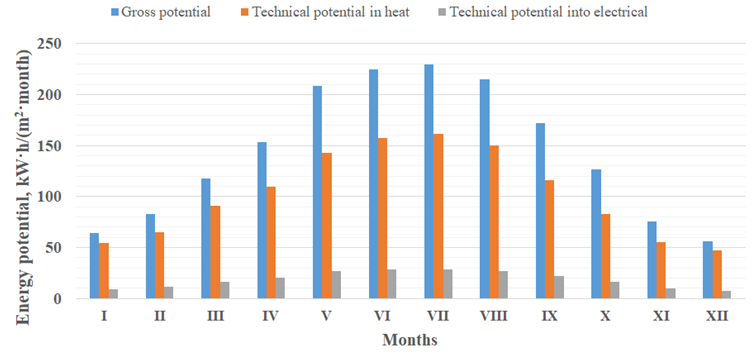
The technical potential of solar radiation of the city of Arkadag is the average long-term total energy that can be obtained from solar radiation within one year at the current level of development of innovative technologies and compliance with environmental standards of the city. The technical potential of solar radiation represents the sum of technical potentials converted into thermal and electrical energy [3, 9, 10]. The methodology for determining the technical potential of thermal energy and electrical energy and converted from solar radiation is given in works [9, 10, 16]. Based on the calculation results, a histogram of the technical potential converted into thermal and electrical energy was constructed, which is shown in Figure 1.
The Economic Potential
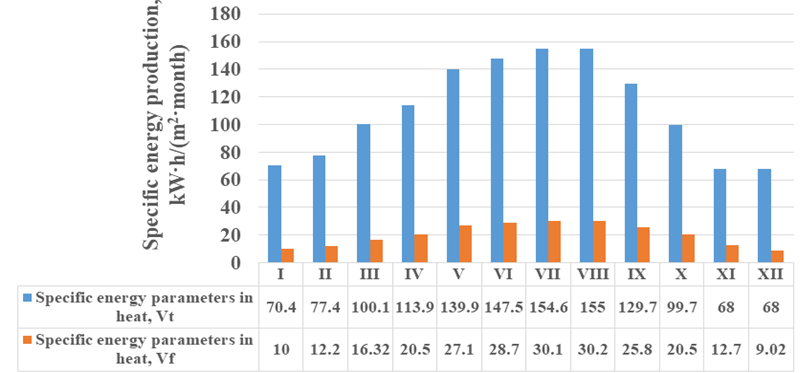
Of solar energy in the city of Arkadag is the production of thermal and electrical energy in the region from solar radiation, which is economically justified for the region at the existing price level for energy received from traditional sources, taking into account and compliance with environmental standards [3, 9, 10, 11, 12]. The ecological potential of solar energy represents the sum of the economic potentials of thermal energy and electrical energy obtained by the corresponding transformation of solar radiation. The economic potential of solar energy represents the sum of the economic potentials of its constituent zones. The average specific production of energy parameters in solar thermal and photovoltaic installations in the city of Arkadag by month during the year is shown in Figure 2.
Environmental potential is part of the technical potential, the conversion of which into useful usable energy is environmentally feasible at a given level of reduction of harmful emissions into the environment from fossil organic fuels when converted into thermal, electrical and other types of energy from equipment, installations, stations and vehicles, etc. pollutants [3, 9, 10]. The expressions defining economic efficiency do not take into account the impact of the introduced installations on the environment, on the social conditions of human life and activity. Renewable energy sources, compared to traditional ones, have an important advantage in the ability to ensure the environmental cleanliness of installed installations, and in some cases, the possibility of improving the environmental situation [9, 10, 16, 17, 18].
The ecological potential of solar energy represents the sum of the economic potentials of thermal energy and electrical energy obtained by converting solar radiation.
One form of taking into account the impact of input energy sources on the ecology of a region can be the introduction of a regional environmental factor of the source into the unit cost of energy received, taking into account the relative costs of compensating for the harmful consequences of introducing a unit of energy from a particular source in the region. If the specific cost of an energy source in production is known, then the specific cost taking into account the coefficient of the regional environmental factor > 1 for a source leading to deterioration of the environmental situation in the region, and the coefficient of the regional environmental factor < 1 for a source that improves the environmental situation in the region; for the same source, the environmental coefficient in different regions can change in value, become more or less than one [3, 9, 10]. The expected results of the environmental potential from converted solar energy into thermal and electrical energy in conventional units per square meter are shown in Figure 3.
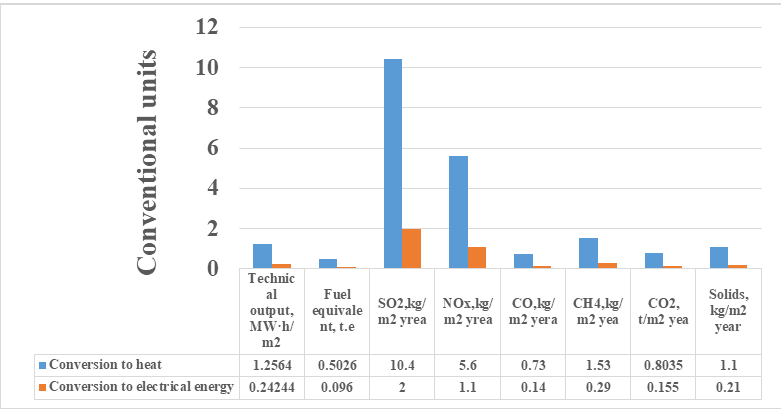
Discussion of the research results. As a result of scientific research, scientifically based and theoretically systematized principles for the use of solar energy resource potentials using a formalized methodology were obtained, the potential and volume of reducing anthropogenic loads on the environment from the use of solar energy installations during conversion into thermal and electrical energy were determined. The estimated calculated results are: The gross resource potential of solar energy in the city of Arkadag is equal to - 1844.6 kW•h /(m2 year); The technical potential for conversion into thermal and electrical energy is equal to - 1256.44 and 242.44 in kW•h/ (m2 year). Economic potentials from conversion into thermal and electrical energy in the city are: 502.6 and 96.98; in kg.t./(m2 ∙year): Expected environmental potential: reduction in emissions of various harmful substances into the environment when using solar photovoltaic modules in the city of Arkadag will be: - with annual electricity generation from 1 m2 – 242.44 kW⋅h, annual fuel consumption savings – 96.96 kg of fuel equivalent, the reduction in emissions will be, kg per year: SO2 – 2.0; NOx – 1.1; CO – 0.14; CH4 – 0.29; CO2 – 155.0; solid substances – 0.21;-when converted into thermal energy from 1 m2 and an annual production of 1256.4 kW⋅h, the annual fuel economy is 502.6 kg of fuel equivalent ; emission reduction will be, kg per year: SO 2 – 10.4; NOx-5.6; CO – 0.73; CH4 – 1.53; CO2 – 803.5; solids – 1.1.
Taking into account the obtained calculations of gross, technical, economic and environmental potentials, the use of solar energy installations in the city of Arkadag is an effective, affordable means of energy saving and ensuring environmental safety [9, 10]. Correlation analysis is used to study the relationship between two random variables. The Pearson correlation coefficient, R2, is used as the strength of this relationship. As a correlation analysis, we examined the dependence of gross, technical, energy potentials on the average long-term solar radiation by month during the year in the city of Arkadag (see below the found values of R2, which indicate the accuracy of calculations of two functional quantities of solar radiation depending on the transformation into thermal and electrical energy). The mathematical relationship is expressed by regression coefficients; we derive the regression equation in the form y = a+bx, where a is the initial ordinate and gives the value of y at x = 0, b is a regression coefficient showing how much the value of y will change on average if x changes by one [3, 9, 10, 16, 17, 18].
In our calculations, the potentials of solar radiation depending on the conversion into thermal and electrical energy, the equations have the form: gross y = - 0.3332x + 160.19, R² = 0.0003; technical to thermal: y = -0.7073x + 112.64, R² = 0.0027; technical to electrical: y = -0.0787x + 21.22; R² = 0.001; specific energy parameters of solar thermal, Vt: y = -0.1797x + 116.02, R² = 0.0002; specific energy parameters of solar photovoltaic, Vf : y = 0.1594 x + 21.38; R² = 0.0042. Thus, the obtained regression equations of technical potential and specific energy parameters of solar radiation converted into thermal and electrical energy will contribute to the forecasting of various solar energy technological installations, as well as in the preparation of design estimates and feasibility studies for construction in the city of Arkadag.
Conclusion
Based on the study, the following were obtained: systematized, scientifically based gross energy, technical, economic and environmental solar resource potentials from the introduction of solar energy technologies; The technical, economic, and environmental characteristics of power plants were assessed in terms of energy efficiency , fuel economy, and environmental impact for the city of Arkadag per square meter of conversion into thermal and electrical energy [19]. As a result, empirical equations were obtained taking into account the gross, technical and environmental potentials of solar energy in the city of Arkadag, with the help of which energy and environmental forecasting can be carried out. The results obtained will help predict the possibilities of saving electricity and reducing CO2 emissions per square meter in grams of CO2 equivalent when converting solar energy into electrical energy, as well as calculate the energy potential of solar power plants, equipment, and structures in a modern city of the 21st century.
Conflict of interest
The author declares no competing financial interest.
References
-
Berdimuhamedov GM (2018) Turkmenistan is on the path to achieving sustainable development goals- Ashgabat. Turkmen State Publishing Service, pp: 468.
-
Berdimuhamedov GM (2022) Electric power power of Turkmenistan-Ashgabat. Turkmen State Publishing Service, pp: 130.
-
Strebkov DS, Penjiyev AM, Mamedsakhatov BD (2012) Development of solar energy in Turkmenistan: monograph. M GNU VIESKh, pp: 498.
-
Bezrukikh PP, Arbuzov YD, Borisov GA, Vissarionov VI, Evdokimov VM, et al. (2002) Resources and efficiency of using renewable energy sources in Russia. St. Petersburg, Nauka, pp: 314.
-
Vissarionov VI, Deryugina GV, Kuznetsova VA, Malinin NK (2008) Solar energy: textbook for universities. MPEI Publishing House, pp: 276.
-
Strebkov DS (2019) Solar Energy Basics. In: Bezrukih PP (Ed.), SAM Polygraphist, pp: 326.
-
Duffy DA, Beckman WA (1977) Thermal processes using solar energy. Mir, pp: 429.
-
Kondratyev KY, Pivovarova ZI (1978) Radiation regime of inclined surfaces. Gidrometeoizdat, pp: 215.
-
Penjiyev AM (2018) Agricultural technology for growing melon trees in protected soil conditions: monograph. Russians Moscow, pp: 230.
-
Penjiyev AM (2023) Eco-energy resources of renewable energy sources: monograph. Russians Moscow, pp: 400.
-
Penjiyev AM (2018) Thermal Regim in Combined Cultivation Constructions. Applied Solar Energy 54(3): 196-204.
-
Strebkov DS, Penjiyev AM (2019) Solar power plants with parabolic trough concentrators in the desert area of Karakum. Applied solar energy 55(3): 195-206.
-
Penjiyev AM (2017) Fundamentals of GIS in the development of renewable energy. Lambert Academic Publishing, Germany, pp: 308.
-
(1989) Scientific and applied reference book on the climate of the USSR. Episode 3, Gidrometioizdat, parts 1-16, pp: 502.
-
Turkmen SSR (1974) Solar radiation and radiation balance for individual years. USSR Climate Handbook, Tashkent 30(1): 98.
-
Arbuzov YD, Evdokimov VM, Levinskas AL (1996) Development of photovoltaic modules with parabolic concentrators and silicon photoconverters. T Solar engineering, pp: 3-10.
-
Gorodnichev RM, Pestryakova LA, Ushnitskaya LA, Levina SN, Davydova PV (2019) Methods of environmental research. Fundamentals of statistical data processing: educational and methodological manual. NEFU Publishing House, Yakutsk, pp: 94.
-
Penjiyev AM (2009) Prospects for alternative energy and its environmental potential in Turkmenistan. Alternative energy and ecology 9(77): 131-139.
-
Rybakova LE (1985) Use of solar energy. Ashgabat, pp: 280.
- Plant Diversity, Regeneration Dynamics, and Socio-Ecological Impacts at the Forest-Savanna Transition Zone, Cameroon
- Bird Community, Feeding Guilds and Habitat Associations Along the Proposed River Dibombe Hydropower and Transmission Line Project in Nkam and Moungo Divisions, Cameroon
- Plant Diversity and Carbon Storage Potential Across Different Land Use Types in Infrastructure Development Landscapes in Cameroon: Implications for no Net Loss of Biodiversity
- Optimization and Modelling for the Remediation of Brilliant Green Dye and Ni2+ ions from Water Using Advanced gC3N4/PVA@ Alginate Bio-Polymeric Hydrogel Beads
- The Negative Implications of Using Cell Phones on Human Health and Environment
- A Comprehensive Survey of Population Ecology in Insects