
Evaluation of Coiled Tubing Limitations to Drill Out Frac Plugs
This paper examines the efficacy of utilising coiled tubing technology for the drilling out of frac plugs in the oil and gas industry. While coiled tubing offers advantages such as speed, efficiency, and reduced rig time, its application is not without limitations. Mechanical constraints, hydraulic challenges, and operational issues can impede the effectiveness of coiled tubing in frac plug removal. Through an analysis of these limitations, accompanied by real-world case studies and examples, this paper highlights the need for mitigation strategies and technological advancements. It concludes with recommendations for future research and development efforts aimed at optimising the use of coiled tubing in this critical aspect of well completion operations.
Ekrem Alagoz1* and Yaser Alghawi2
Keywords: Coiled Tubing; Well Completion; Frac Plugs; Wellbore Integrity; Hydraulic Challenges
Introduction
In the realm of oil and gas extraction, technological advancements continually shape the landscape of well completion operations. One such innovation that has garnered attention in recent years is the utilization of coiled tubing [1] for the drilling out of frac plugs. This paper seeks to evaluate the efficacy of coiled tubing technology in this specific application, shedding light on both its advantages and limitations. Frac plugs, also known as fracturing plugs or bridge plugs, play a crucial role in the hydraulic fracturing process. Following the stimulation of a well, frac plugs are deployed to isolate sections of the horizontal wellbore, facilitating the efficient fracturing of multiple zones within a single well. Once the fracturing operation is complete, these plugs must be drilled out to allow for the unimpeded flow of hydrocarbons from the reservoir to the surface.
There has been continuous development in the completions of unconventional oil and gas wells, which is driving the success of unconventional resources exploitation through the mitigation of operational challenges while providing cost effective results [2]. There are multiple types of plugs [3], among which four popular types are mentioned here: cast iron bridge plugs [4], composite frac plugs [5], dissolvable frac plugs [6], and semi-dissolvable frac plugs. Selection of plugs for a certain application involves various parameters, such as the capability of milling with minimal weight on bit, minimal produced debris, and differential pressure. Coiled tubing is a prevalent technology in oil and gas operations. It is used in a multitude of well intervention and drilling applications. A typical coiled tubing design is a continuous length of steel pipe with associated surface equipment. Moreover, the required drilling, completion, or workover equipment are required in the tool. While originally developed for producing wells, the technology has gained increasing implementation in the drilling and completion applications, especially with the industry trend for multi-fractured horizontal and extended reach wells [7]. Unconventional wells are routinely stimulated using plug-and-perf hydraulic fracturing operations to maximize production from low-permeability zones [8, 9]. During this procedure, coiled tubing drillout is a crucial step that aims to remove plugs and achieve full production potential [10].
The importance of drilling out frac plugs cannot be overstated. Efficient plug removal directly impacts the productivity and profitability of oil and gas wells. Delays or inefficiencies in this process can result in extended rig time, increased operational costs, and ultimately, diminished well performance. Therefore, optimizing the method by which frac plugs are drilled out is a critical endeavor for operators seeking to maximize the return on investment in their wells. In light of these considerations, this paper endeavors to explore the limitations inherent in using coiled tubing for the drilling out of frac plugs. By identifying and analyzing these constraints, we aim to provide insights that can inform decision-making processes and drive advancements in well completion technologies.
Literature Review
Stanonjcic, et al. [11] provided a review of the successful applications of multistage fracturing in the period 2000- 2009, in which they outlined the application of coiled tubing in plug drill out operations. Lehr and Cramer [12] outlined the best practices for using composite bridge plugs for fracture treatment operations. McNeil, et al. [13] highlighted a hybrid system design of coiled tubing deployment for extended reach wells, including drill outs. Rowden, et al. [14] presented a review of an operator’s workflow to optimize coiled tubing drill out operations and overcome technical challenges in the Haynesville and Eagle Ford shale plays. Asafa, et al. [15] reviewed misconceptions associated with coiled tubing hydraulics and hole cleaning, while also reviewing common drill out applications and associated cost implications. McIntosh, et al. [16] studied the vibratory tools during coiled tubing drill out in five Eagle Ford wells to better understand the top competing tools and to make a comparison.
Zanellato, et al. [17] outlined the difficulty of locating information on similar experiences while experimenting with mills and bits for drilling out frac plugs for a new unconventional project in Vaca Muerta play, Argentina. They provided guidance to advice future coiled tubing and intervention projects. Pope, et al. [18] presented an evaluation of the use of a real-time monitoring station for coiled tubing drillouts. Results from 50 wells with improved practices showed average savings of $100,000 and average drillout time of 21 hours per well, as well as reporting zero stuck or sticky events. Kuhlman, et al. [19] examined the role of real-time force monitoring in maintaining operation efficiency through decreasing operational failures, reducing non-productive time, and increasing drillout efficiency. They used interactive tubing force analysis (TFA).
Process of Drilling out Frac Plugs
The process of drilling out frac plugs involves several sequential steps to ensure efficient and effective plug removal. Typically, this procedure is performed using coiled tubing deployed downhole, although alternative methods such as conventional drill pipe may also be employed depending on specific well conditions and operational requirements. Preparation and Planning: Prior to initiating the drill-out operation, thorough planning and preparation are essential. This includes selecting the appropriate tools and equipment, calculating anticipated pressures and flow rates, and conducting a comprehensive risk assessment to mitigate potential hazards. Coordination between various stakeholders, including drilling engineers, well site personnel, and service providers, is crucial to ensure smooth execution of the operation [20]. Deployment of Coiled Tubing: Once the well site is prepared and all necessary precautions are in place, the coiled tubing unit is rigged up and deployed into the wellbore. Coiled tubing offers several advantages over conventional drill pipe, including its ability to reach greater depths and navigate complex well trajectories with ease [21].
Engagement with Frac Plug: After reaching the desired depth, the coiled tubing is positioned adjacent to the target frac plug. Various techniques, such as jetting, milling, or mechanical punching, may be employed to engage and initiate the drill-out process. The selection of the appropriate method depends on factors such as plug composition, wellbore conditions, and operational preferences in Figure 1 [22].
Drilling and Removal: Once engaged, the coiled tubing applies rotational force and hydraulic energy to gradually drill through the frac plug. Specialized tools, such as milling bits or abrasive jet nozzles, are utilized to disintegrate the plug material and facilitate its removal from the wellbore. Careful control of parameters such as weight on bit, rotational speed, and fluid flow rates is essential to optimize drilling efficiency and minimize the risk of tool failure or wellbore damage [23].
Post-Drill-Out Evaluation: Upon successful removal of the frac plug, post-drill-out evaluation may be conducted to assess wellbore integrity and confirm the effectiveness of the operation. This may involve various diagnostic techniques, such as logging or pressure testing, to detect any potential issues or anomalies that could impact well performance [24]. The process of drilling out frac plugs using coiled tubing is a meticulously orchestrated operation that requires careful planning, precise execution, and continuous monitoring. By adhering to best practices and leveraging advances in drilling technology, operators can overcome challenges and achieve optimal results in plug removal operations in Figure 2.
![Figure 1: Frac Plug Sample from Halliburton [4].](/fulltextimages/12760/fig_1.png)
Design and Case Study
There are several software packages available for service companies and operators regarding coiled tubing design and job planning. This Haynesville Shale case study was performed using the commercial software “Cerberus” to evaluate limitations of coiled tubing for drilling out frac plugs after a horizontal multi-stage frac job. This same software can be used to evaluate limitations of coil tubing for any other type of coil tubing utilized workover such as cleaning out salt bridges in the tubing or drilling out sand plugs in the tubing or cased lateral. In order to begin planning for a coiled tubing job, the first thing to be addressed is what environment the tools will be in and what the coiled tubing is being used for.
In other words, what is the goal of the work over and why are you selecting coil tubing over other strategies such as stick pipe and a work over rig? For this case study, the goal is to evaluate the limitations of using coiled tubing to drill out frac plugs right after a frac job in the Haynesville Shale. In order to decide of whether to drill out the frac plugs with a conventional work over rig or coiled tubing, it is important to look at a typical Haynesville well environment. These horizontal wells range from 10,000 to 15,000 feet deep (TVD), can have initial flowing pressures over 10,000 psi and have bottom-hole temperatures ranging from 300 to 400 degrees Fahrenheit. The Figure 3 below shows a generic wellbore diagram for a typical Hayneville Shale well for reference.
![Figure 2: Typical Eagle Ford Wellbore Schematic [6].](/fulltextimages/12760/fig_2.png)
Clearly, using stick pipe such as a PH6 work-string and a conventional work over rig to drill out Frac plugs is not obtainable mainly because of well control issues: coiled tubing has the advantage to operate under pressure, while using a work over rig requires the well to be killed (unless using a snubbing unit, which can be very costly). This advantage of operating under pressure and being able to provide a boundary between the surface and the pressure from the well is vital because these wells can have initial flowing pressures over 10,000 psi.
Now that coiled tubing has been chosen for this application, modeling can be done to tell the operator or service company how far into the lateral (relative to measured depth, MD) coiled tubing can reach to drill out frac plugs, or when “friction lock-up” occurs. The limitation for drilling out frac plugs has two key factors: being able to circulate (where bottom-hole pressure is advantageous) in order to circulate plug parts and sand to surface and avoiding “friction lock-up,” which is defined as when frictional forces overcome stripping forces being applied to the coil tubing string. A practical way to think about friction lock-up is the depth (MD) at which the motion of the coil tubing string stops while running in the hole because of frictional forces acting on the coil tubing string. The list below contains key considerations and assumptions for this case study that were used in the model to determine friction lock-up depths based on varying target depth (TVD) and well inclination (these will vary from job to job and from well to well).
- BHA = 3.75” mill, 2.875” motor, hydro-pull, disconnect, check valve and coil tubing connector.
- 2” tapered coil tubing string: thickness ranges from 0.203” to 0.156” (4 total sections).
- 5.5” 23.0# production casing from surface (0’) to 9,500’ and 5” production casing from 9500’ to total depth, TD (TD will vary based on each sensitivity for this case study).
- Friction coefficients for Cerberus: RIH = 0.27 and POOH = 0.22 (Baker Hughes)
- Temperature gradient of 0.02 o/ft.
- Uniform curve build rate of 10 o/100 ft.
- Coil speed (RIH & POOH) = 60 ft/min.
- Circulating fluid used: 10% NaCl (8.87 ppg).
- Wellhead pressure = 6,000 psi.
- Stripper friction = 1,000 lbf, Reel back tension = 1,500 lbf (Cerberus)
- Circulation flow rate = 80 gal/min.
- Axial agitator force = 800 lbf (Cerberus)
- Assume 80% yield safety factor for coil tubing.
- Coiled tubing reel type: QT-1000 grade material.
Using the assumptions and Hayneville Shale environmental factors listed above, Cerberus models were created for a large variety of cases: target depth (TVD) sensitivities were done for several different TVD’s and sensitivities were also modeled for a variety of wellbore designs including toe-up (greater than 90o inclination) and toe-down (less than 90o inclination) designs. The results from these sensitivities are shown in the Table 1.
- Assumptions (Cerberus- Haynesville Shale Horizontal
- Well-Coil Tubing Modeling):
- Coil Tubing “Lockup” Depths Shown in Highlighted Boxes (MD, ft)
- 88
- Toe-down Laterals
- Toe-up Laterals
- 89
- 90
- 91
- 92
- 93
- 94
- 7,000
- 14,500
- 13,990
- 13,525
- 13,120
- 12,760
- 12,465
- 12,185
- 8,000
- 15,445
- 14,950
- 14,500
- 14,059
- 13,715
- 13,425
- 13,155
- 9,000
- 16,389
- 15,912
- 15,509
- 15,044
- 14,688
- 14,388
- 14,112
- 10,000
- 17,591
- 16,913
- 16,409
- 16,001
- 15,665
- 15,375
- 15,105
- TVD(ft)
- 11,000
- 19,205
- 18,419
- 17,849
- 17,358
- 16,979
- 16,665
- 16,387
- 12,000
- 20,275
- 19,700
- 19,020
- 18,520
- 18,140
- 17,800
- 17,500
- 13,000
- 21,288
- 20,711
- 20,095
- 19,588
- 19,188
- 18,845
- 18,565
- 14,000
- 22,324
- 21,735
- 21,131
- 20,638
- 20,234
- 19,885
- 19,546
- 15,000
- 23,320
- 22,750
- 22,134
- 21,631
- 21,237
- 20,865
- 20,525
- 16,000
- 24,325
- 23,734
- 23,138
- 22,627
- 22,225
- 21,885
- 21,519
Table 1: CT “Lockup” Depths.
Note that the color of each box above has no significance other than to make it easier to differentiate between values. Each of the depths displayed in the highlighted boxes above represent the theoretical point in the lateral (MD) at which friction lock-up will occur (this can be thought of as a stall of motion of the coil tubing string and BHA due to friction). One of the observations from this table is that for each lateral target depth (TVD), a greater inclination angle or the more “toe-up” the lateral is, the sooner friction lock-up will occur. This is a crucial piece of information to an operator, as it affects how long the lateral can be drilled for each depth. An easy way to put this into perspective is to ask the question of why an operator would spend additional money to frac stages beyond the point of which you can drill out the frac plugs to unlock those reserves. The Figure 4 below is a graphical representation of the findings from this case study: the end of each line represents the point at which plugs can no longer be drilled out (MD, ft).
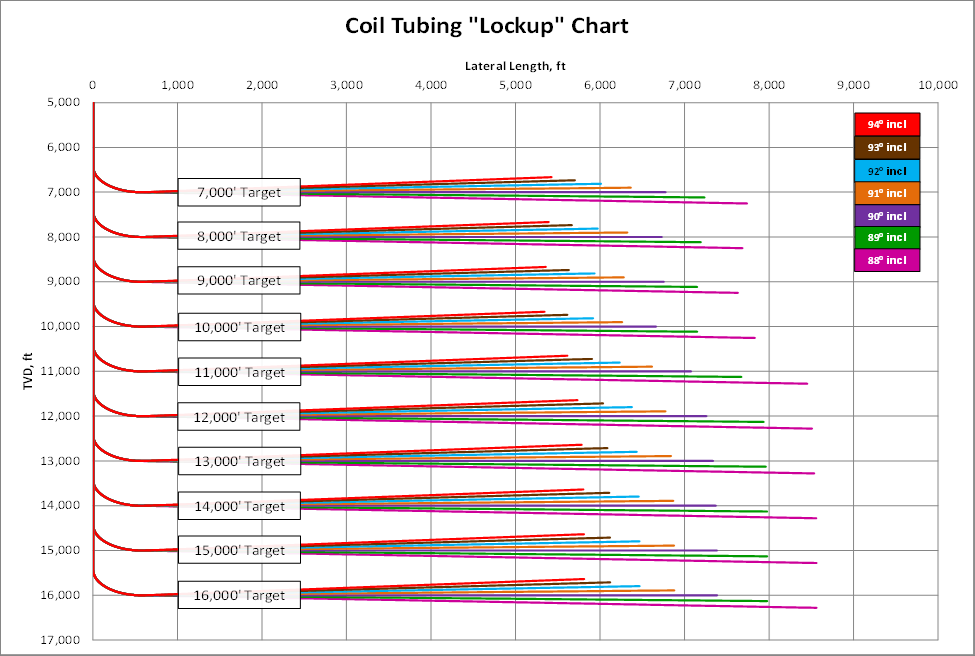
This chart can be utilized for future Hayneville well drilling plans: an engineer can look at this chart and decide of how long the lateral can be for each area of the play (assuming the list of assumptions for the model is about the same area-to-area in the play). It is important to note that the depths in the chart above are purely theoretical and the length of the coil tubing reel can be a limitation for how far into the lateral the BHA can drill out frac plugs. For example, based on the chart above, if a lateral is landed at 88 degrees inclination and 15,000’, it is possible to drill out frac plugs to a total MD of approximately 23,500’ (15,000’ TVD plus ~8,500 lateral length) based on coil tubing friction lock-up. However, the majority of coil tubing reels in the Hayesville Shale area are only 20,000 feet in length and it is not possible to drill out frac plugs beyond much more than 19,500’ MD. This is only one example of how any operator or service company can provide accurate predictions of the limitations of coil tubing for various workovers utilizing coil tubing, but it is vital to remember that there are other factors to be considered other than theoretical simulations.
Conclusion
Coiled tubing has been utilized in the oil industry for a long time and new technology advancements have continued to expand its long list of applications. Some advantages of coiled tubing include no downtime to connect pipe, the ability to operate under pressurized or “live” well conditions and the ability to intervene into a well without having to pull the tubing. This paper highlighted a few of the applications, including one of the most popular uses for coil tubing for United States onshore applications: drilling out frac plugs with coiled tubing. The friction lock-up depth can be determined in order to prevent job failure and can also serve as a vital tool for field development. Although coiled tubing has many applications, it does have a variety of limitations. These limitations include (but are not limited to) maximum over-pull, maximum number of cycles used on the coil tubing reel, friction lock-up depths, pressure and temperature ratings on the coil tubing string and not being able to circulate fluids up the hole due to low bottom-hole pressure. After this study, it is vital for safety and operational success that all coiled tubing limitations be identified and properly accounted for prior to using coiled tubing for any application. Coiled tubing can save companies money and be safely utilized for many jobs, but job design and safety are crucial to successfully implementing coil tubing.
References
-
Alagoz E, Tali B (2023) Applications and Limitations of Coiled Tubing Technology: A Glance. Science Journal of Energy Engineering 11(1): 10-18.
-
Sohrat B, Abdullah A, Habiballah (2023) Frac Plug Evaluation to Improve Operations Efficiency. Middle East Oil, Gas and Geosciences Show, Manama, Bahrain, pp: SPE-213262-MS.
-
Zachary W, Michael F, Porter J, Vargus G (2019) Evolution of Frac Plug Technologies – Cast Iron to Composites to Dissolvable. SPE Middle East Oil and Gas Show and Conference, Manama, Bahrain, pp: SPE-194802-MS.
-
Rattray F, Annandale(2008) Oil Milling of Cast-Iron Bridge Plug With Electric-Line-Conveyed Technology. SPE/ICoTA Coiled Tubing and Well Intervention Conference and Exhibition, The Woodlands, Texas, USA.
-
Steven C, Jeffery H, Lehr D, Brandt N (2012) Best Practices for Composite Plug Milling. Paper presented at the SPE/ICoTA Coiled Tubing & Well Intervention Conference and Exhibition, The Woodlands, Texas, USA, pp: SPE-154060-MS.
-
Michael F, Walton Z (2016) Degradable Metal for Use in a Fully Dissolvable Frac Plug. Paper presented at the Offshore Technology Conference, Houston, Texas, USA, pp: OTC-27187-MS.
-
Varhaug M (2014) The Defining Series: Introduction to Coiled Tubing. Oilfield Review Summer 26(2).
-
Miskimins JL (2019) Hydraulic Fracturing: Fundamentals and Advancements.
-
Ahmed U, Meehan DN (2016) Unconventional Oil and Gas Resources: Exploitation and Development. 1st (Edn.), CRC Press, London.
-
Meza G, Guillermo, Alarcon B, Xaymaca, Loundy R (2020) A Detailed Evaluation of Coiled Tubing Drillouts of Composites and Dissolvable Plugs In Permian Basin and Eagle Ford Fields. SPE/ICoTA Well Intervention Conference and Exhibition, The Woodlands, Texas, USA, pp: SPE-199790-MS.
-
Stanojcic M, Jaripatke O, Sharma A (2010) Pinpoint Fracturing Technologies: A Review of Successful Evolution of Multistage Fracturing in the Last Decade. SPE/ICoTA Coiled Tubing and Well Intervention Conference and Exhibition, The Woodlands, Texas, USA, pp: SPE-130580-MS.
-
Douglas J, Cramer D (2011) Best Practices for Multi- zone Stimulation Using Composite Bridge Plugs. SPE Production and Operations Symposium, Oklahoma City, Oklahoma, USA, pp: SPE-141456-MS.
-
McNeil F, Lindsay SD, Lyons R, Gracey RP (2011) New Hybrid System Brings the Flexibility of Coiled Tubing to Long, Extended-Reach Wells. SPE/ICoTA Coiled Tubing & Well Intervention Conference and Exhibition, The Woodlands, Texas, USA, pp: SPE-142769-MS.
-
Vanessa R, Joddie C, Chavez M (2012) Improving Coiled Tubing Plug Drillout Operations in Shale Gas Completions. SPE/ICoTA Coiled Tubing & Well Intervention Conference and Exhibition, The Woodlands, Texas, USA.
-
Kolapo A, Brandon WT, Gonzalez A, Wiskofske MT (2014) Improving Post-Stimulation Coiled Tubing Drillout. SPE/ ICoTA Coiled Tubing and Well Intervention Conference and Exhibition, The Woodlands, Texas, USA, pp: SPE- 168290-MS.
-
McIntosh T, Baros KJ, Gervais JG, Schultz R, Whitworth J (2016) A Vibratory Tool Study on Extended Reach Horizontals During Coiled Tubing Drillout in the Eagle Ford Shale. SPE/ICoTA Coiled Tubing and Well Intervention Conference and Exhibition, Houston, Texas, USA, pp: SPE-179087-MS.
-
Gabriel Z, Martin S, Pach E, Nebiolo M (2017) Fracturing Plugs Drillout Experiences in Unconventional Applications. SPE/ICoTA Coiled Tubing and Well Intervention Conference and Exhibition, Houston, Texas, USA, pp: SPE-184765-MS.
-
Charles P, Alistair A, Inscore J, Epperson R, Sumner B (2017) Stop, Drop and Circulate; An Engineered Approach to Coiled Tubing Drillouts. SPE Annual Technical Conference and Exhibition, San Antonio, Texas, USA, pp: SPE-187337-MS.
-
Ray LK, Gideon TG, Pursell JC, Buck NA, Scherer KR (2022) Optimizing Drillouts Using Live TFA. Paper presented at the SPE/ICoTA Well Intervention Conference and Exhibition, The Woodlands, Texas, USA, pp: SPE-208999- MS.
-
Pop OE, Papuc RT, Khateeb A (2020) A review of the main factors affecting the efficiency of drilling operations using coiled tubing. Journal of Petroleum Exploration and Production Technology 10(5): 2473-2490.
-
Miska SZ (2006) Frac Plug Drillout. In Hydraulic Fracturing: Theory and Practice. Elsevier, pp: 509-514.
-
(2024) Fas Drill Ultra Frac Plug, Halliburton.
-
Li Z, Meng X, Li M, Zhang G, Wang Z (2019) A review of milling techniques for improving the drillability and mechanical removal efficiency of frac plugs in multistage fracturing operations. Journal of Petroleum Science and Engineering (173): 1233-1248.
-
Pawlik M, Champagne J, Whitworth J, Cody T (2014) Optimizing Frac Plug Mill Outs in Horizontal Wells using Coiled Tubing. SPE/ICoTA Coiled Tubing and Well Intervention Conference and Exhibition, The Woodlands, Texas, USA, pp: SPE-168279-MS.
- Plant Diversity, Regeneration Dynamics, and Socio-Ecological Impacts at the Forest-Savanna Transition Zone, Cameroon
- Bird Community, Feeding Guilds and Habitat Associations Along the Proposed River Dibombe Hydropower and Transmission Line Project in Nkam and Moungo Divisions, Cameroon
- Plant Diversity and Carbon Storage Potential Across Different Land Use Types in Infrastructure Development Landscapes in Cameroon: Implications for no Net Loss of Biodiversity
- Optimization and Modelling for the Remediation of Brilliant Green Dye and Ni2+ ions from Water Using Advanced gC3N4/PVA@ Alginate Bio-Polymeric Hydrogel Beads
- The Negative Implications of Using Cell Phones on Human Health and Environment
- A Comprehensive Survey of Population Ecology in Insects