
Acute Hepatic Failure-An Unusual Complication of Dengue Fever in Adults
Dengue fever usually results in a mild to moderate elevation of liver enzymes. Hepatic failure is indeed a rare clinical picture in the scenario of adult dengue fever. We present a case of dengue haemorrhagic fever in an adult female, leading to acute liver failure. She was conservatively managed with adequate supportive care and discharged after 10 days. She had complete recovery and no residual symptoms were observed during follow up after one week.
Case Report
A 48-year-old female presented with symptoms of high-grade fever, generalized myalgia and diffuse abdominal pain with non-bilious, non-projectile vomiting of 7 days duration. She also had symptoms of mucosal bleeding in the form of haematuria and melena. She did not have any past co-morbidities. Clinical examination revealed a temperature of 101°F, pulse rate of 92/min, blood pressure 110/80 mm Hg and respiratory rate of 24/min. She was hemodynamically stable with saturation (SPO2) of 98% in room air. The patient was icteric and had bilateral subconjunctival haemorrhages. She had petechial spots over the soft palate and extensive petechial rash all over the trunk and limbs. Rest of the general examination was unremarkable; there was no eschar. On systemic examination, the cardiovascular system had normal heart sounds and no murmur; examination of the chest revealed bilaterally equal air entry with basal creps; abdominal examination revealed mild hepatomegaly. She was conscious and oriented without any focal neurological deficits.
Journal of Infectious Diseases & Travel Medicine
Table 1 shows the patient’s haematological and biochemical investigations at admission, during hospital stay and on the day of discharge. Hemogram showed leucocytosis [15,510 per cu mm] with thrombocytopenia [25,000 per cu mm]. Her liver enzymes were significantly elevated [AST: 15,051 and ALT: 4122]. She also had
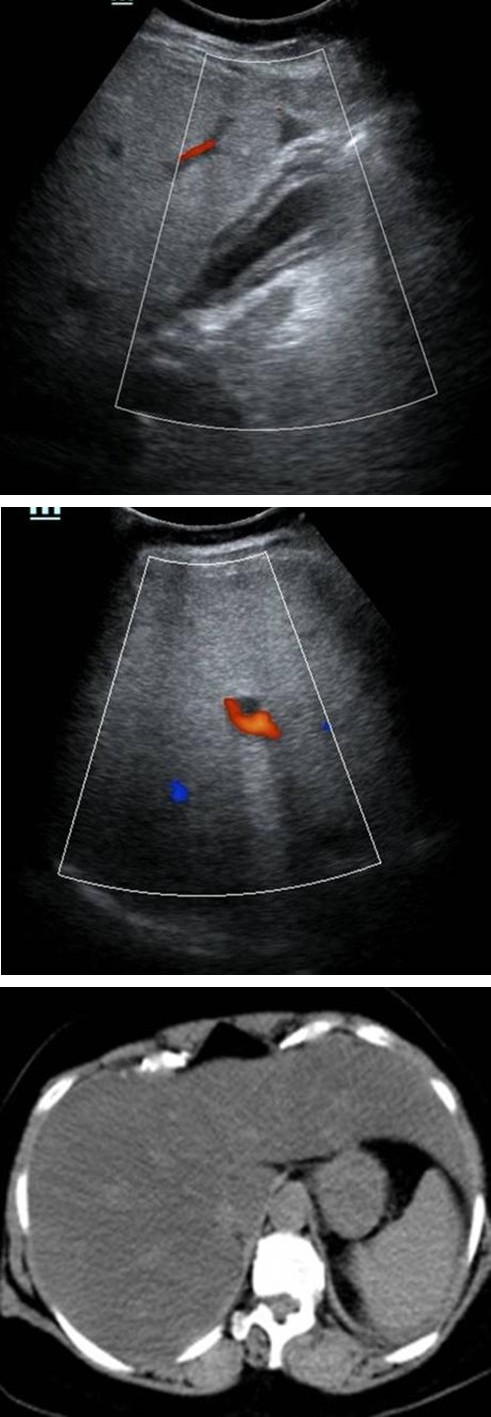
deranged coagulation parameters as evidenced by a pro- thrombin time of 26.1 seconds and INR of 2.26. Chest radiograph revealed bilateral hazy bases. Ultrasound scan showed mild hepatosplenomegaly with Grade 2 fatty liver and Gall bladder wall thickening (Figures 1A & 1B).
(A) (B) Figure 1A: USS of liver showing hepatomegaly with diffuse fatty changes.
Figure 1B: USS showing GB wall thickening with tram-track pattern (hypoechoic zone separated by two echogenic layers). There was no ascites or pleural thickening. Plain CT showed normal lung fields with hepatomegaly (Figure 2).
- Journal of Infectious Diseases & Travel Medicine
- Day of illness
- Day of admission
- [Day 1]
- Day 2
- Day 3
- Day 4
- Day 7
- Day of
- Discharge
- Hb [g/dl]
- 11
- 8.9
- 8.2
- 10.2
- 10.4
- 10.8
- Total white cell count [per cu mm]
- 15510
- 16270 14200
- 12700
- 10400
- 9550
- Platelet count [per cu mm]
- 25000
- 87000 1,40,000 1,40,000 2,44,000
- 2,50,000
- Total Bilirubin [mg/dl]
- 3.9
- 3.8
- 4.5
- 4.3
- 1.9
- 1.6
- Direct Bilirubin [mg/dl]
- 2.3
- 2.6
- 2.4
- 2.1
- 1
- 1.1
- Total protein [g/dl]
- 6
- 6
- 6
- 5.5
- 6
- 6
- Albumin [g/dl]
- 3.1
- 3.4
- 3.3
- 2.7
- 3.5
- 3.6
- Aspartate aminotransferase [U/L]
- 15051
- 12984
- 7803
- 4048
- 345
- 217
- Alanine aminotransferase [U/L]
- 4122
- 3260
- 2370
- 1692
- 384
- 239
- Alkaline phosphatase [U/L]
- 181
- 191
- 166
- 175
- 178
- 180
- Creatinine [mg/dl]
- 1.1
- 1.2
- ----
- ----
- 1.1
- 1.2
- Prothrombin time [sec]
- 26.1
- 24.5
- 20
- 20.6
- 19.4
- 18.2
- International normalized ratio
- 2.26
- 2.08
- 1.63
- 1.67
- 1.52
- 1.4 aPTT [activated partial thromboplastin time - sec]
- 29
- ----
- ----
- ----
- ----
- 26
- Creatinine phosphokinase [U/L]
- 140
- 144
- ----
- ----
- ----
- 148
- Serum Sodium [mEq/L]
- 130
- 135
- 136
- 139
- 136
- 136
- Serum Potassium [mEq/L]
- 4
- 4.2
- 3.8
- 3.7
- 3.4
- 3.6
- Serum Ammonia [µg/dl]
- 99
- 90
- 40
- 25
Table 1: Laboratory profile of the patient during the course of illness.
Journal of Infectious Diseases & Travel Medicine
Ultrasound findings of hepatosplenomegaly, GB wall thickening, pleural effusion and ascites in patients presenting with signs and symptoms of Dengue Fever are virtually diagnostic of this entity. Gall bladder wall oedema has been reported as one of the most common ultrasound findings in Dengue fever. In GB wall oedema there is preservation of mucosal echogenicity with hypoechoic appearance of muscle layer. There are 4 patterns of GB wall thickening described in Dengue fever [6]. They are A) Uniform wall thickening; B) Tram -track pattern; C) Asymmetric wall thickening; D) Honeycomb pattern. Uniform wall thickening was mostly seen in mild forms while tram- track or honeycomb pattern should alert possibility of severe forms of Dengue. Our case had tram –track pattern of wall thickening with central hypoechoic zone in between two echogenic layers indicating severe form of Dengue fever. Supportive measures focusing on hydration and hemodynamic stability with serial monitoring of liver enzymes and coagulation parameters forms the crux of acute hepatic failure management. Sepsis and systemic inflammatory response syndrome should be anticipated by close surveillance periodically and treated promptly with initiation of adequate antibiotics. Fresh frozen plasma and platelet transfusion should be reserved for active bleeding and thrombocytopenia respectively. Dengue fever related hepatic failure has considerably low case fatality in contrast to other aetiologies of acute hepatic failure in adults. In 2013, Tan SS and Bujang MA, described eight patients managed with standard medical therapy alone having 100% survival rates [7]. Dengue fever in children usually has a relatively higher rate of acute fulminant hepatic failure leading to 50% mortality [8]. Likelihood of spontaneous recovery in dengue related acute hepatic failure can be determined by King’s College criteria or Model for End-Stage Liver Disease (MELD) score.
References
-
Chrispal A, Boorugu H, Gopinath KG (2010) Acute undifferentiated febrile illness in adult hospitalized patients: the disease spectrum and diagnostic predictors—an experience from a tertiary care hospital in South India. Trop Doct 40(4): 230-234.
-
Trung DT, Thao LTT, Hien TT (2010) Liver involvement associated with dengue infection in adults in Vietnam. Am J Trop Med Hyg 83(4): 774- 780.
-
Souza LJ, Alves JG, Nogueira RMR (2004) Aminotransferase changes and acute hepatitis in patients with dengue fever: analysis of 1,585 cases. Braz J Infect Dis 8(2): 156-163.
-
Samanta J, Sharma V (2015) Dengue and its effects on liver. World J Clin Cases 3(2): 125-131.
-
Arora S, Nathaniel SD, Paul JC, Hansdak SG (2015) Acute liver failure in dengue haemorrhagic fever. BMJ Case Reports bcr 2015-209443.
-
Parmar JP, Mohan C, Vora M (2017) Patterns of Gall Bladder Wall Thickening in Dengue Fever: A Mirror of the Severity of Disease. Ultrasound Int Open 3(2): E76-E81.
-
Tan SS, Bujang MA (2013) The clinical features and outcomes of acute liver failure associated with dengue infection in adults: a case series. Braz J Infect Dis 17(2): 164-169.
-
Poovorawan Y, Hutagalung Y, Chongsrisawat V (2006) Dengue virus infection: a major cause of acute hepatic failure in Thai children. Ann Trop Paediat 26(1): 17-23.
- Epidemiological and Clinical Aspects of Intestinal Parasitoses Among Students in the City of Bocaranga, Central African Republic
- Artificial Intelligence Empowers Global Infectious Disease Prevention and Control: Opportunities and Challenges
- Factors that Affect the Incidence of Babesia and Blood Donor Testing in Select States: A Regression Analysis
- Neuro-TB: The Battle between Tuberculosis and the Nervous System
- The Biological and Health Implications of Cat Fleas (Ctenocephalides felis): Assessing Zoonotic Risks and Hygiene Strategies
- Biostatistical Analysis of Medicinal Plants for Treating Schizophrenia