
Aspects of Quality of Life in Children with Latent Tuberculous Infection
Background: Latent tuberculosis infection is an asymptomatic condition in which patients carry the bacteria, but do not show any sign of illness, however they are at risk of disease activation at any time in the future. Latent tuberculosis infection is often not to affect the quality of life of patients. Preventive treatment of latent tuberculosis infection can reduce the risk of activation; however, this treatment can produce such side effects as well as psychosocial challenges, which can increase stigma and psychological stress. These factors can impair the Quality of Life of patients in term of physical, mental and social well-being. Understanding of influence of latent tuberculosis infection on the physical and mental well-being of these patients is important as successful strategies to reduce the tuberculosis burden globally. Our purpose is to explore patients during diagnosis and treatment of latent tuberculosis infection, measure their quality of life. Objective: During 2017-2019 were examined 100 children 4-7 years old. Methods: Quality of life was defined with the help of questionnaire PedsQL version 4.0 (the Russian version), for children. Results: At children with active tuberculosis specific process has a most negative influence upon quality of life, comparatively temporary negative influence has LTI. Conclusion: With provision of latency currents of infecting with mycobacteria of tuberculosis, indicators of quality of life should be considered as one of defining, reflecting psychological component adaptation of child, and can be recommended to enter in program of examination and dispensary observation of children with LTI.
Introduction
Tuberculosis is a main infectious reason of deaths in the world and one of 10 leading reasons of deaths in the world. From tuberculosis in 2016 have all over the world died 1, 7 million people (including four hundred thousand people with HIV), but had suffered 10,4 million people. In 2016 1 million детей заболел tuberculosis, and 250 000 детей have died from it (including детей with HIV-associated by tuberculosis). Tuberculosis is one of the main reasons to deaths of the people with HIV. Serious problem became the tuberculosis with multi drug resistance. However, in global scale number of patients with tuberculosis falls approximately on 2% per annum [1].
At present statistics data persuasively show that in some country of the world number of children, for the first time infected with tuberculosis mycobacterium, continues to grow. For instance, in some region to Russia amount such children forms more than 2% whole baby population of the country. Most often primary infecting children of the preschool age, diseases range in this age group on 52% exceeds the general range of diseases amongst baby population [2, 3].
Today latent tuberculous infection (LTI) often turn researchers attention as condition, characterized by presence positive tuberculin skin reaction in the background of absence of clinical and roentgenological sign of local (active) tuberculous process. Importance of the problem LTI is in growing of children with such condition. As well as high range of diseases among children from this groups speaks that preventive work with infecting by tuberculous mycobateriya children is conducted in insufficient volume [4, 5].
In spite of value of the problem, the role general practitioner in system primary public health care of children with LTI is passive, consists only in discovery of this group children by method tuberculin skin test and issue to phthisiatrician. That has served the cause to persisting study [6].
Purpose
Study the deflections of health and quality of life at children of preschool age with latent tuberculous infection.
Materials and Methods
During 2017-2019 were examined 100 children 4-7 years on the base of Samarkand state antituberculous sanatorium, kindergarten № 84 of Samarkand. For enabling child in conducted study obligatory condition was presence BCG vaccination at birth, attendance by children educational institution. In study were not included children, which parents were not agree to participate in study, children with delay psychomotor developments, having chronic diseases with symptoms of intoxication, children, have had sharp disease before 1 month back.
Children were divided in 3 groups. First group (n=40)-a children with LTI, which were engulfed by dispensary observation and got the chemoprophylaxis in sanatorium. “Sharp turn” of tuberculin skin tests was noted at 3 (7,5%) children, increase of test result on 6 mm and more for one year - at 19 (47,5%), hyperergic result of test – at 12 (30%); annual increase test results with papule size on 12 mm and more - at 3 (7,5%), unchangeable sizes of the test in more than 3 years - at 3 (7,5%) children. Group of the comparison (n=40) has comprised preschool age children, treated in Samarkand state tuberculosis hospital. Group of the checking (n=20) have constituted the preschool age children from 1 groups of health with presence correct scar of BCG vaccination. In all group distribution children on sex and age had not a reliable difference.
Estimation of children health was conducted by analysis health factors: social, genetic, biological. In addition were studied criteria of health: physical development, functional condition, level to resistivity, psychomotor development, sharp and chronic diseases in anamnesis, presence of congenital development defects.
It was used study anamnestic data, questioning, estimation quality of life, anthropometry, data of objective examination, laboratory data and parameters of functioning. Information about each child is received information from history of disease and history of child development. Was conducted analysis factor risk of contamination with mycobacteria tuberculosis: physician-biological, social, genetic. Efficiency of vaccination BCG valued on presence scar, size less 4 mm was indicate as faulty vaccination. Physical development valued with the help of specialized tables. Leukocyte intoxication index is calculated on formula Shemitova V.F. Children observed by other specialists.
In help of cluster method all data were generalized. Quality of life was defined with the help of questionnaire PedsQL version 4.0 (the Russian version), for children. Made descriptive sample method, method one-factorial analysis of variance, Chi-square, U-criterion of Mann-Uitni, factor of Spearmen correlation, criterion of Fisher, reliable were considered differences p<0,05.
Results and Discussion
Our study is indicating that at preschool age children with LTI there are deflections of health condition and quality of life. Premorbid background complicated by risk factors of developing tuberculous infection. Among specific risk factor, in the main group priority value has a contact with the source of infection (45,0%), presence of the disease at close relatives (42,5%), faulty vaccination BCG - 1-4 mm, absence of the incidence with chemoprophylaxis children with “sharp turn» of tuberculin skin test (17,5%). Reliable difference at frequency specific factor risk with group children, who had treatment in Samarkand state antituberculous sanatorium, was not revealed. Factors, having importance, as at children with LTI, so at children with evident form of the disease, were contact with tuberculous patients and faulty vaccination of BCG.
Important social risk factors at children with LTI were: not working parents (82,5%), asocial lifestyle of family (50,0%), unsatisfactory home conditions (77,5%), alcoholism of parents (72,5%), large families (55,0%). Nearly similar factors detected at children with evident form of tuberculosis. Biomedical risk factors at children with LTI in the first group were polydeficient anemia (35,0%), chronic nonspecific lungs disease (27,5%), preeclampsia and eclampsia during pregnancy in mother`s anamnesis (45,0%) - realistically often, than at children with evident tuberculosis. During of cluster analysis are determined as significant factors - early begin artificial feeding (65,0% - on 55,0% often, than in checking group, p<0,01), extensive tooth decay (32,5% , p<0,001), presence to anemia light degree (27,5%, p<0,01) - as at children with LTI, so and at children with evident forms of the tuberculosis. These risk factors promoted lowered resistivity of the children organism, and according to opinion O.B. Nechaeva, could become the reason infecting children with mycobacteria tuberculosis and it persisting in child organism, and speak about insufficiency of mechanism immunological protection. Low resistivity of organism was one of the important sign at group of children with LTI.
At preschool age children with LTI exist the subclinical signs of infecting MBT, basically manifestations of intoxication. Deflections in physical development (PhD) are discovered at 62,5% (p<0,001) of the first group, at each third child from this groups it was connected with low mass of the body (30,0%, p<0,01). Deficit of body mass is probably connected with reinforcement of the processes catabolism, which is called to provide the compensation and adaptation during chronic stressful situation. Intoxication phenomena in the first group children were also expressed as pale skin cover (47,5%, p<0,001), anemia light degree (27,5%), fast heart rhythm (25,0%). These signs were importance as well as in group of the comparison. Intoxication was confirmed by leukocyte intoxication index by V.F. Shemitova. In the main group children this index was positive more than at half of examined person (75,0%).
Condition of peripheral lymph elements in the first group and group of the comparison in principal did not differ, that is indicate of generalities in reactions lymphatic system of children in response to persistence MBT in child organism. However, by comparing these factors in the first group and group of healthy children, noted brightly expressed differences: lymphatic elements dense and elastic consistencies (77,5%), plural (85,0%), size more than 5 mms (85,0%), with perifocal inflammation phenomena (22,5%, p<0,01), unrepresentative localization lymphadenopathy - an cubital (20,0%), parotid (42,5%), occipital (35,0%) in first group was realistically often than in checking group (p<0,01).
In the first group children with LTI were noted such signs as headaches (27,5%, p<0,01), intolerance of transport (27,5%, p<0,01), pains in chest (17,5%, p<0,05), reduction to concentrations and attention (82,5%, p<0,05), hyperactivity (50,0%, p<0,05), emotional lability (67,5%, p<0,05), petulance (67,5%, p<0,05). During checkup of children with LTI is realistically often discovered marbling of skin cover (100%) and hyperhidrosis of distal extremities (62,5%) , than in group healthy children (p<0,01). These signs were significant at group children with LTI, as reasons of the functional breaches to specific organic pathology. Supposedly, these signs can be indicative of sanitary action quality, which conducted in primary section of health care.
Assessment of life`s quality have revealed that at children with LTI quality of life realistically has a low indicators, than at children from checking group, as in opinion of children, as in opinion of tutors. Indicators of life`s quality (QL) in examined groups are presented in Table 1 & Figure 1.
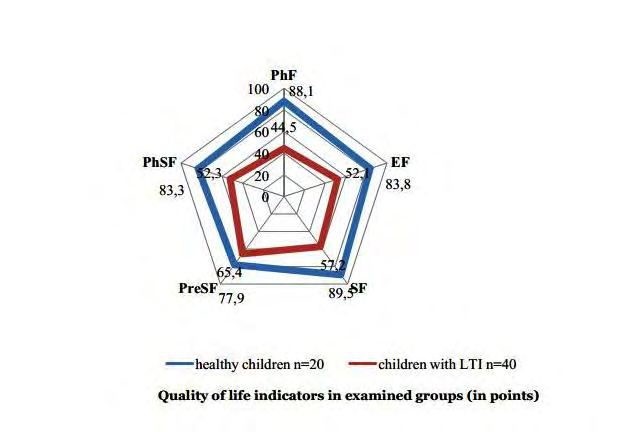
| Aspects of QL | LTI n=40 (M±σ) | Suffered with TB n=40 (M±σ) | Healthy n=20 (M±σ) |
|---|---|---|---|
| Physical functioning | 44,5 ± 2,5 | 40,2 ± 2,1 | 88,1 ± 3,4 |
| Emotional functioning | 52,1 ± 3,3 | 53,2 ± 2,4 | 83,8 ± 3,9 |
| Social functioning | 57,2 ± 2,1 | 42,7 ± 2,1 | 89,5 ± 2,2 |
| preschool functioning | 65,4 ± 2,0 | 48,0 ± 5,1 | 77,9 ± 1,3 |
| psychosocial functioning | 52,3 ± 2,4 | 47,9 ± 3,4 | 83,3 ± 2,8 |
| Total scales | 54,8 ± 2,6 | 46,1 ± 2,4 | 84,9 ± 2,5 |
Table 1: Indicators of life`s quality (QL) in examined groups are presented.
Indicators of the physical functioning at healthy children were double above than at children with LTI and active tuberculosis - 88,1±3,4 (against 44,5±2,5 and 40,2±2,1 points). Presence of the clinical manifestation of disease is greatly reflected on children`s ability to coping with obstacle, run, participation in athletic games. At children with LTI indicators of their physical functioning also were low - 44,5±2,5 that directs that LTI has an influence upon the general condition of organism, that reveals in general weakly expressed malaises at this groups children. This brings them to independent restriction of the daily physical load. At children with active tuberculosis, physical functioning indicators were low. These patients were revealed at peak period of disease that brings sharply expressed change of general condition patients and expressed in practically full refusal of physical loads, daily duties, in accordance with physical activity.
Lowest indicators of emotional functioning noted at children with LTI and active tuberculosis - 52, 1±3, 3 and 53,2±2,4 points, that indicated of negative influence of tuberculosis to nervous system. Children from this groups more annoyed, moody, whining, feel discomfort from clinical symptoms of disease, at them is often noted presence of alert on cause of contact with persons of opposite sex. Amongst children with active tuberculosis, we have revealed changes in emotional status that is connected with understanding of incurability of diseases, despondency from joining of tuberculosis. High indicators of emotional functioning are registered at healthy children - 83, 8±3, 9. However, at part of these children is noted presence discomfort from need to visit kindergarten.
During analysis of social functioning highest indicators noted at groups of healthy children – 89, 5±2, 2 points, and this is indicative of adaptation детей, both to condition of kindergarten, and to acquisition of new friend relationships with other children. In group children with LTI indicators of social functioning were 57, 2±2, 1 points. This reflects presence of such problems as compelled temporary cessation of the social relations in group in by reason of receiving of preventive treatment in tuberculous sanatorium. Amongst children with active tuberculosis fixed the lowest indicators of social functioning -42, 7±2, 1 points. As judged by answer respondent of these groups, awe for its future is from realizations contagiousness of diseases, as well as incurability of it.
Preschool functioning practically does not suffer at healthy children -77,9±1,3 points, only at a part children is revealed by restlessness, absence of attention, as well as inattentive attitude to performing of tasks. At children with active tuberculosis this scale of functioning has a low indicators - 48,0±5,1 points. These patients often skip the occupations in case of its condition, impossibility concentration during occupation. At children with LTI life in school is evaluated of 65,4±2,0 points, the main problems of this group carried temporality - a restriction of visit the kindergarten at period of stay in sanatorium.
Scale of psychosocial functioning is a total scale emotional and social functioning. According results of this scale higher indicators were noted in group of healthy children -83,3±2,8 points, comparatively low in group children with LTI - 52,3±2,4 points, and realistically low in group of patient with active tuberculosis - 47,9±3,4 points. Total scale has revealed the regularity - at children with active tuberculosis specific process has a most negative influence upon quality of life, comparatively temporary negative influence has LTI.
Revealed changes in general have brought to reduction of QL indicators both in first and second group. With provision of latency currents of infecting with mycobacteria of tuberculosis, indicators of quality of life should be considered as one of defining, reflecting psychological component adaptation of child, and can be recommended to enter in program of examination and dispensary observation of children with LTI.
Base on the above data introduces following picture of developing deflections mechanism of health condition at children with LTI:
- complex disadvantage physician-social factor leads to chronic stressful situation,
- that provokes adaptive and regulator overstrain and
- leads to immunological insufficiency,
- which clinical revealing low resistivity,
- that in condition not efficient immunization BCG and contact with bacterial isolation,
- is realized as infecting child with tuberculosis mycobacteria, with development LTI,
- it supporting chronic stressful reaction with transition in vicious circle and
- prospect of the failure to adaptation with transition in tuberculosis.
Social disorder connected with breach of main biorhythm regularities of life, high psychoemotional exhaustion on home conflicts background; it brings to reduction of child health and disadaptation of system activity. Certainly, this is an obligate ambience for persisting any infections, in this instance persisting of MBT. In base of fetter of development LTI at preschool age children, were designed approaches to improvement of preventive maintenance and dispensary observation at participation general practitioner, marked active position of general practitioner in saving of children health, infected with MBT. Also was determinate of favorable current LTI
group - “observation” group, overstrains of adaptation - “attention” group and disadaptation - “risk” group; as well as were improved questions of receivership in rendering physician-social help such children between phthisiatrician and family (social institution) with participation primary health care organization.
Consequently, in structure of medical-social help to children with latent tuberculous infection is defined staging of observations. First stage of medical help to children with LTI must be dispensary-policlinic section (district pediatricians, physicians of the educational institutions, general practitioner), which timely revealed children, infected with MBT (by tuberculin skin tests data), and direct to phthisiatrician this children for specialized help. Second stage must be to define the branch a physician-social help, realizing nonspecific rehabilitation of children with LTI, directed on elimination risk factor and consequence chronic physician-social stress. We suppose the expedient observation by general practitioner to children with LTI not less than three years, because long processes of astenization, reduced adaptation require time to value efficiency specific chemoprophylaxis and nonspecific correction. In addition, children with LTI from “attention” and “risk” groups pass the rehabilitation (third stage) on base of general profile sanatorium (more than 1 month). In case of favorable current of adaptation, (“observations” group) rehabilitees can be realized on area, in families or in social institution.
Therefore, our study has shown that preschool age children with LTI have rather significant deflections of health condition, revealing by symptoms of intoxication, expressed breaches adaptation and regulation mechanisms. Results of study have logistical confirmed need of improvement of the preventive maintenance and dispensary observation at children with LTI and active participation in its base of the interdepartmental approach. All of this allows newly taking a look at problem of the latent tuberculous infection at preschool age children and role general practitioner in preventive maintenance of the development such dangerous diseases as tuberculosis.
Conclusion
- Preschool age children with latent tuberculous infection have rather significant deflections in their health condition.
- Anamnesis of children with latent tuberculous infection greatly burden with specific risk factor of infecting MBT. These are not enough effective BCG vaccination at 72,5% of examined person, tuberculosis at close relative (37,5%), as well as biomedical and social factors, provoking low level of resistance at 55,5% children of main group: early artificial feeding (65,5%), sharp diseases of respiratory tract (42,5%) and asocial family.
- In spite of latent current of the primary tuberculous infection, at preschool age children there are realistically significant clinical signs: marbling of skin cover (72,5%), sweating (80,0%), hyperhidrosis (52,5%), deflections of physical development (60,0%), lymphadenopathy (72,5%). At 47,5% детей with latent tuberculous infection is defined toxicosis, by first degree of leukocyte intoxication index.
- Latent tuberculous infection promotes reduction of adaptability processes of child organism, revealing in deficit of quality of life.
- Well-timed taking by general practitioner on dispensary register children with latent tuberculous infection, differentiated approach depending on conditions mechanisms of adaptation and regulation, complex and interdepartmental medical examination are contribution to preventive maintenance of development tuberculosis at given contingent of children.
References
-
Nechaeva OB (2020) Tuberculosis in children in Russia. Tuberculosis and lung diseases 98(11): 12-20.
-
World health organization (2017) Global hepatitis report.
-
Brown J, Cappoci S, Smith C, Morris S, Abubakar I, et al. (2015) Health status and quality of life in tuberculosis. Int J Infect Dis 32: 68-75.
-
Adzhablaeva DN (2020) The study of the life quality parameters in children and adolescents with HIV associated tuberculosis. Tuberculosis and lung diseases 98(9): 14-17.
-
Adzhablaeva DN (2018) Life quality assessment in phthisiopediatrics. Tuberculosis and lung diseases 96(2): 32-35.
-
Varni JW, Sherman SA, Burwinkle TM, Paige ED, Pamela D (2004) The PedsQL™ Family impact model: Preliminary reliability and validity. Health Qual Life Outcomes 2: 55.
- Epidemiological and Clinical Aspects of Intestinal Parasitoses Among Students in the City of Bocaranga, Central African Republic
- Artificial Intelligence Empowers Global Infectious Disease Prevention and Control: Opportunities and Challenges
- Factors that Affect the Incidence of Babesia and Blood Donor Testing in Select States: A Regression Analysis
- Neuro-TB: The Battle between Tuberculosis and the Nervous System
- The Biological and Health Implications of Cat Fleas (Ctenocephalides felis): Assessing Zoonotic Risks and Hygiene Strategies
- Biostatistical Analysis of Medicinal Plants for Treating Schizophrenia