
A Prospective Diagnostic Study Evaluating the Prevalence of Vitamin D Deficiency and Insufficiency in a Cohort of Orthopaedic Trauma Patients
Vitamin D deficiency is very common in both developed and developing countries. This study was conducted to estimate the prevalence of vitamin D deficiency and insufficiency in orthopedic trauma patients and subsequently make recommendations about vitamin D supplementation in them. A prospective diagnostic study was conducted including orthopedic trauma patients within the age range of 21-50 years, between January 1, 2014 and June 30, 2017. All the patients were subjected to estimation of blood 25-hydroxyvitamin D levels. Vitamin D deficiency was defined as a 25-hydroxyvitamin D level less than 20 ng/mL and insufficiency was defined as a level between 20 and 30 ng/ml. 613 patients were tested for blood 25-hydroxyvitamin D levels. It was observed that vitamin D deficiency and insufficiency had an overall prevalence of 45.5% and 35.4%, respectively, in the orthopedic trauma patients. Overall deficiency prevalence in males and females was 44.3% and 47%, respectively. Most commonly affected patients belonged to age groups >36 years, while younger patients had lower prevalence of deficiency or insufficiency. Vitamin D deficiency and insufficiency were highly prevalent in this large population of orthopedic trauma patients. Vitamin D is an essential component of calcium metabolism and subsequently its adequate levels are important for bone healing. Establishing the prevalence of vitamin D deficiency and insufficiency can help in making adequate supplementation of vitamin D in orthopedic trauma patients.
Introduction
Vitamin D is the main regulator of body calcium metabolism [1, 2]. Vitamin D increases uptake of calcium from diet and also enhances calcium absorption in bones [1, 2, 3, 4]. Good bone quality depends upon presence of adequate calcium and vitamin D levels in the body [1, 2, 3, 4]. Any fracture drastically increases body requirements of calcium, for it is the main element involved in fracture healing process and bone mineralization.[3] For the same reason, orthopedic trauma patients are commonly prescribed calcium for accelerating fracture healing. But for calcium to act on bones, adequate amounts of vitamin D are necessary. Without vitamin D presence, calcium supplementation cannot work properly [1, 2, 3, 4, 5]. This study was conducted to find out the prevalence of vitamin D deficiency and insufficiency in orthopaedic trauma patients and to make recommendations about vitamin D supplementation in this cohort of patients.
Materials and Methods
A prospective diagnostic study was conducted at the department of orthopedics of a tertiary care center between January 1, 2014 and June 30, 2017. A total of 1030 patients of orthopaedic trauma, who were admitted in the department of orthopaedics were evaluated for inclusion in the study. Inclusion criteria were age between 21 and 50 years and presence of at least one fracture of duration less than 15 days. Exclusion criteria were set as pregnant women, cases already taking vitamin D supplements and patients with other medical and surgical comorbid conditions. All the cases were evaluated for blood 25-hydroxyvitamin D levels as an indicator of vitamin D deficiency [6, 7, 8]. All the tests were performed in the college central laboratory. Normal vitamin D levels were defined as >30 ng/ml, insufficiency as levels between 20-30 ng/ml and deficiency as levels <20 ng/ml [4, 5, 6, 7, 8]. All the cases were divided into age groups of five year intervals, from 21-25 years to 46-50 years. Prevalence rates were calculated for the different age groups and gender categories.
Results
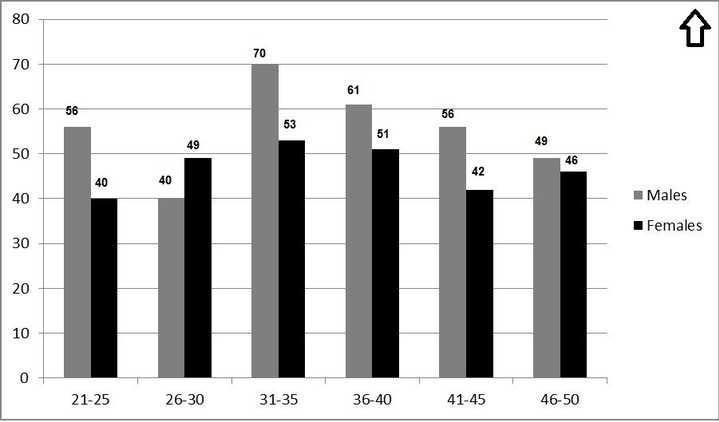
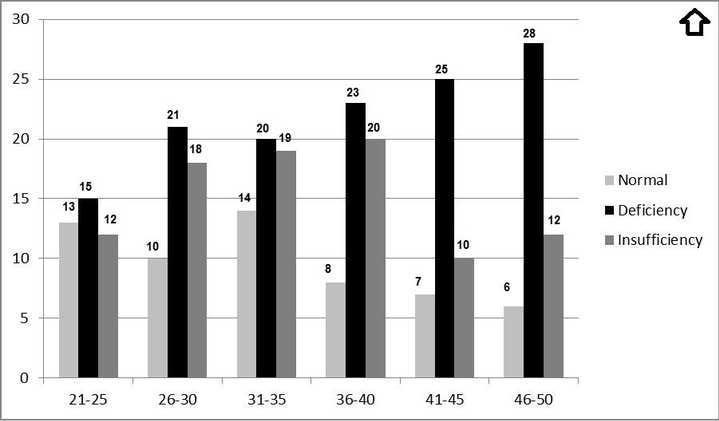
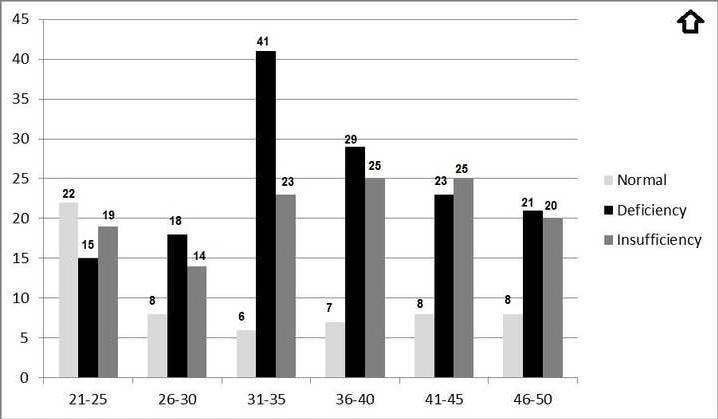
A total of 1030 admissions were made during the study period. Out of 1030, only 613 cases were included in the analysis on the basis of inclusion and exclusion criteria. On division into age groups, maximum cases were categorized into age group of 31-35 years. Out of all 613 cases, 45.8% were females (Figure 1). After testing blood 25-hydroxyvitamin D levels, it was observed that in this cohort of orthopaedic trauma patients vitamin D deficiency prevalence was 45.5%, vitamin D insufficiency prevalence was 35.4%, with combined deficiency and insufficiency having prevalence of 80.9%. Highest prevalence of vitamin D deficiency was observed in the age group 46-50 years (51.6%) and lowest in age group 21-25 years (31.3%) (Table 1). Highest and lowest prevalence of vitamin D insufficiency levels were seen in the age group of 36-40 years (40.2%) and 21-25 years (32.2%), respectively (Table-1). Normal vitamin D levels had highest prevalence in 21-25 years (36.5%) age group and lowest in 36-40 years (13.4%) age group. In males prevalence of vitamin D deficiency was 44.3% and in females was 47% (Figures 2 & 3). Insufficiency prevalence in males and females was 38% and 32.4%, respectively (Figures 2 & 3).
| V | itamin D | Vitamin D | Vitamin D | ||||||||
| Age groups | |||||||||||
| Normal | deficiency | insufficiency | |||||||||
| 21-25 years | 36.50% | 31.30% | 32.20% | ||||||||
| 26-30 years | 20.20% | 43.80% | 36.00% | ||||||||
| 31-35 years | 16.30% | 49.60% | 34.10% | ||||||||
| 36-40 years | 13.40% | 46.40% | 40.20% | ||||||||
| 41-45 years | 15.30% | 49.00% | 35.70% | ||||||||
| 46-50 years | 14.70% | 51.60% | 33.70% | ||||||||
| Total | 19.10% | 45.50% | 35.40% |
Table 1: Showing Vitamin D statuses of all age group
Discussion
Vitamin D is a fat soluble vitamin which is the main regulator of calcium metabolism in the body [1, 2, 3]. UV rays present in the sunlight can convert 7- dehydrocholesterol present in the skin into cholecalciferol or vitamin D3 [1, 2, 3]. Dietary sources of vitamin D are animal products like eggs, milk, meat, etc. Deficiency of vitamin D is generally the result of decreased sun exposure or diet insufficient in animal products [4]. Calcium metabolism and bone health including bone healing are interlinked. Vitamin D acts by making more calcium available for absorption into the bones [9]. With the aim of providing sufficient calcium to bones healing form fractures, patients are generally given calcium supplementation. But vitamin D is required for calcium absorption from the intestine [10]. Prevalence of vitamin D deficiency has been previously studied in various study cohorts like elderly, children, postmenopausal women, etc [11, 12, 13, 14]. But there are no documented studies about the prevalence of vitamin D deficiency in the cohort of orthopaedic trauma patients in India. Low levels of vitamin D observed in this study were alarming. Nearly about 81% the cases were found to be having low vitamin D levels. More commonly affected were those in the older age groups of more than 36 years. Deficiency and insufficiency were equally prevalent in both the sexes with only marginal differences in prevalence values. It can be concluded that this study highlights the high prevalence of vitamin D deficiency in orthopaedic trauma patients and calcium supplementation alone cannot help bone healing in this cohort of patients. Vitamin D supplementation in adequate quantities and for appropriate period is important and should be made part of the treatment protocol for orthopaedic trauma patients.
References
-
Lips P (2006) Vitamin D physiology. Prog Biophys Mol Biol 92(1): 4-8.
-
DeLuca HF (2004) Overview of general physiologic features and functions of vitamin D. Am J Clin Nutr 80(6): 1689-1696.
-
Heaney RP (2005) The Vitamin D requirement in health and disease. J Steroid Biochem Mol Biol 97(1- 2): 13-19.
-
Grant WB, Holick MF (2005) Benefits and requirements of Vitamin D for optimal health. Altern Med Rev 10(2): 94-111.
-
Heaney RP (2003) Vitamin D depletion and effective calcium absorption. J Bone Min Res 18(7): 1342.
-
Hathcock JN, Shao A, Vieth R, Heaney R (2007) Risk assessment for vitamin D. Am J Clin Nutr 85(1): 6-18.
-
Hollis BW (2005) Circulating 25- hydroxyvitamin D levels indicative of Vitamin D insuffiency: implications for establishing a new effective dietary intake recommendation for vitamin D. J Nutr 135(2): 317-322.
-
Dawson-Hughes B, Heaney RP, Holick MF, Lips P, Meunier PJ, et al. (2005) Estimates of optimal vitamin D status. Osteoporos Int 16(7): 713-716.
-
Bischoff-Ferrari HA, Willett WC, Wong JB, Giovannucci E, Dietrich T, et al. (2005) Fracture prevention with vitamin D supplementation: a meta- analysis of randomized controlled trials. JAMA 293(18): 2257-2264.
-
Heaney RP, Dowell MS, Bierman J, Hale CA, Bendich A (2001) Absorbability and cost effectiveness in calcium supplementation. J Am Coll Nutr 20(3): 239- 246.
-
Babu US, Calvo MS (2010) Modern India and the vitamin D dilemma: evidence for the need of a national food fortification program. Mol Nutr Food Res 54(8): 1134-1147.
-
Lips P, Hosking D, Lippuner K, Norquist JM, Wehren L, et al. (2006) The prevalence of vitamin D inadequacy amongst women with osteoporosis: an international epidemiological investigation. J Intern Med 260(3): 245-254.
-
Khadilkar AV (2010) Vitamin D deficiency in Indian Adolescents. Indian Paediatr 47(9): 756-757.
-
Marwaha RK, Tandon N, Garg MK, Kanwar R, Narang A, et al. (2011) Vitamin D status in healthy Indians aged 50 years and above. J Assoc Physicians India 59: 706-709.
- Return to Work Among Manual Workers After the Latarjet Procedure: A Cohort Study of 43 Patients
- Refractory Pelvic Collection Following Modified Stoppa Approach for Both-Column Acetabular Fracture Fixation: A Case Report
- Comparative Study of Dynamic Knee Phenotypes Under Loaded and Unloaded Conditions: Clinical Impact
- Locked Intramedullary Nailing of the Tibia Using a Humeral Nail: A Care Case Report
- Subtalar Dislocation: About a Case Report
- Surgical Site Infection in Orthopedics in a Country with LimitedResources: Indications, Treatment and Results