
Ankle Plica, is it a Myth? Report of Two Cases and Review of Literature
Introduction: Chronic ankle pain in active adults is associated with disability, pain, and giving way, undermining sports and leisure activities. The aetiology is multi factorial. Material and methods: Two adult active and fit patients presented with chronic ankle global pain, stiffness and occasional giving way. History of ankle sprain was present in both patients. Ankle arthroscopy revealed ankle plica across the gutters, with no other anomaly. Excision of the plica arthroscopically cured the problem with no recurrence after a year of follow-up. Conclusion: Ankle plica, does seem to exist and cause disability; it should be put in the differential diagnosis in patients otherwise having good ankle movement and relatively normal investigations. Arthroscopy, will identify the problems and cure it by excision. The plica finding on ankle arthroscopy should be considered as a pathological lesion needing excision in symptomatic patients
Introduction
Synovial plicae, both symptomatic and asymptomatic, are increasingly being diagnosed with the expansion of arthroscopic procedures in synovial joints. Ankle plicae, however, remain an uncommon diagnosis and have previously only been reported as symptomatic in the post- traumatic ankle. Random cases are reported for patients having symptomatic ankle plica successfully treated with arthroscopic debridement [1, 2]. The common presentation is that of ankle impingement; however this could be either a bony of fibrous tissue impingement. Symptoms of instability and a history of recurring ankle sprains are common findings in patients with anterior ankle plicae, posterior ankle pain is the main presentation for posterior ankle synovial plica, which constitutes one in 15 reported cases in literature [1, 2, 3, 4, 5].
We present two cases of ankle problems caused by plicae. The aim of this paper is to make ankle arthroscopic aware of this pathology.
Material and Methods
Case 1: Forty seven years fit gentleman presented with 2 years history of intermittent right ankle medial pain with no history of trauma, the symptoms were unpredictable and examination of the ankle was recorded to be normal. The patient however had anteromedial gutter ankle pain and tenderness.
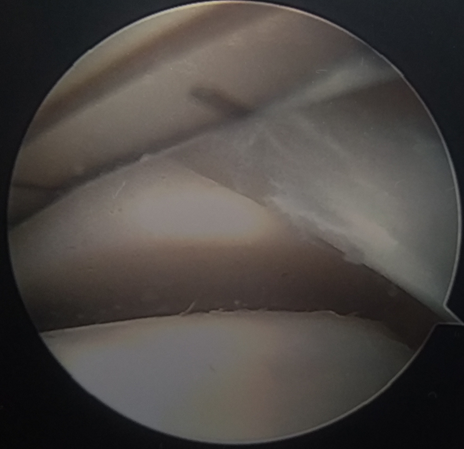
Investigations were unremarkable, arthroscopy of the ankle revealed anteromedial gutter plica, impinging on the talus, with no other anomaly in the ankle. The plica was excised. Following surgery, the ankle was stiff and swollen in the first 10 weeks after surgery, however, the symptoms gradually improved. At 13 months follow up, he was symptoms free (Figure 1).
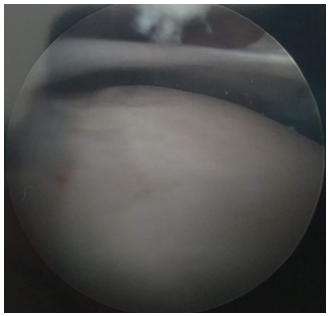
Case 2: A 34 years old lady fell in a swing and developed anterolateral left ankle pain for 3 years. The range of ankle movement was full, however during activities, the ankle used to become stiff and painful, she had a feeling of giving way. She was uncomfortable on deep palpation of the lateral gutter, the joint was stable. Magnetic resonance image and plain radiography were not showing any gross anomaly. Arthroscopy of the ankle revealed anterolateral plica causing impingement on the talus. Arthroscopic excision cured the symptoms with no recurrence 11 months after surgery (Figure 2).
Discussion and Review of Literature
Reports on synovial plica in the ankle are scare [1, 2, 3, 4, 5]. Fifteen cases of meniscoid plica of the ankle including the current two cases, is reported. Recurrent ankle sprains and trauma seem to be a causative factor for the traumatic fibrous plica. The symptoms are of vague ankle pain or impingement of the ankle. Pain on ankle dorsiflexion and sense of instability are the main features of the non-traumatic plicae of the ankle. The plica could be on either sides of the ankle as seen in the current two cases; anterior ankle plica constituted 14 out of the 15 reported cases. Posterior fibrous plica causing impingement is reported in one of the 15 cases, this constitutes 6.6% of total cases reported in literature.
The role of magnetic resonance in the diagnosis of 9 patients with ankle pain was used in a series published by Larciprete M, et al. [5] it was concluded that high field General Electric unit at 1.0 T; sequences and views were appropriate for the diagnosis of the condition. The administration of intra articular Gadolinium is helpful in identifying the condition [5]. The findings of arthroscopy were either a fibrous tissue (meniscoid lesion) or hypertrophy of the synovial tissue. The diagnosis of plica was confirmed on arthroscopy. The synovial plica was in the posterior part of the ankle in one of these patients.
Conclusion
The ankle plicae need to be considered as a possible cause of vague ankle pain in patients with symptoms and signs of impingement of the ankle with pain on dorsiflexion of the ankle and locking/ signs of instability. MRI scan may identify the lesion, however arthroscopy of the ankle and arthroscopic excision is treatment of choice.
References
-
Dimmick S, Linklater J (2013) Ankle impingement syndromes. Radiol Clin N Am 51(3): 479-510.
-
Highcock AJ, Cohen D, Platt S (2012) Atraumatic, symptomatic ankle plica successfully treated by arthroscopic debridement: a case report. Foot Ankle Surg 51(4): 472-474.
-
Somorjai N, Jong B, Draijer WF (2013) Intra-articular plica causing ankle impingement in a young handball player: a case report. J Foot Ankle Surg 52(6): 750-753.
-
Rosenbaum AJ, Positano RG, Positano RC, Dines JS (2016) Ankle Impingement Caused by an Intra-articular Plica: A Report of 2 Cases. Foot Ankle Spec 9(1): 79-82.
-
Larciprete M, Giudice G, Balocco P, Faletti C (2000) Ankle impingement syndrome. Radiol Med 99(6): 415-419.
- Return to Work Among Manual Workers After the Latarjet Procedure: A Cohort Study of 43 Patients
- Refractory Pelvic Collection Following Modified Stoppa Approach for Both-Column Acetabular Fracture Fixation: A Case Report
- Comparative Study of Dynamic Knee Phenotypes Under Loaded and Unloaded Conditions: Clinical Impact
- Locked Intramedullary Nailing of the Tibia Using a Humeral Nail: A Care Case Report
- Subtalar Dislocation: About a Case Report
- Surgical Site Infection in Orthopedics in a Country with LimitedResources: Indications, Treatment and Results