
An Overview of the Influence of Age and Experience on the Frequency of Compliance on the Use of Safety Eye Glass Wears by Welders on Duty in Abakaliki Metropolis
In this work, we considered the influence of age and years of experience of a welder on the job to the frequency of compliance to use of protective eyewear when on duty in Abakaliki metropolis. To get at this, well-structured questionnaire was prepared and administered randomly to some sampled welders from population of 101 welders housed within 67 welding workshops located in the area of the study. The data collected from the questionnaire was arranged and analyzed using Chi-square from where it was revealed statistically that neither age nor years of experience on the job has influence the welders’ compliance to the use of the protective eyewear while on duty in Abakaliki metropolis.
Introduction
Having been aware of radiation side effect not only to eyes but also to other part of the body especially the radiation due to arc welding [1]. The western world like America for instance have enacted the protective act which is not just limited to the wearing of welding goggle, but also the use of other personal protective equipment [2] as they have taken a view of the implications and dangers of welding without proper precautionary measure [3]. Unprotected exposure of the eyes to these rays is known to be one of the major causes of both acute and chronic ocular disorders that are being observer on those welders [4, 5]. This is because many common welding procedures involve open electric arc or flame that is of high risk since the radiation emitted is UV and Infrared which causes damage to the eye lens, sometimes the retina and even skin significantly [6, 7].
In fact it has been noticed that many causative factors that lead to the increased ocular disorders among the welders generally is due to chronic exposure to welding light and yet they do not care to protect their eyes from welding light [8]. There is no doubt however that with the regular use of proper protective eye wear will go ahead to minimize the risks of ocular injury associated with the welding of which full face welding helmets with dark face plates are more appropriate to prevent this exposure is regarded as the best option [9]. As some researchers have discovered, it is ultraviolet radiation and far infra-red (IR) that are absorbed by the cornea and eye lens whereas visible light and near infra-red is the one that finally penetrate to the retina. While have been discovered that the ultraviolet radiation and far infra-red (IR) that may be absorbed by the cornea and eye lens get to the retina [10, 11]. Therefore this forms the believe that long term chronic exposure of the eyes to ultraviolet radiations is associated with conditions like pterygium, pingueculae, malignant melanoma, cataract and some other age related macular degeneration [5, 12, 13, 14]. This is more reason why lots optometrists have carried out survey and assessment of the compliance of welders to the use of the necessary safety eye wear while on duty and their awareness to the implication of noncompliance [15, 16, 17]. To further the survey and analysis based on the compliance of welders to safety precaution in Abakaliki metropolis, we intent to take also a look on the influence of age and how long a welder has been on the job on the conscious compliance to the use of the safety guard of the eyes protection while on duty by welders in Abakaliki.
Materials and Method
The first step taken was to find out the level of awareness of these artisans to the occupational hazard involved in welding as a profession due to the effect of radiation that is evolved during welding, and how far they have been conscious in taking precautionary to avert or minimize the side effect on their eyes due to continuous focusing of their eyes on this radiation prior to the time of this survey. This descriptive step aims at finding out the level of awareness and compliance to the use of protective eyewear among welders Abakaliki local government area of Ebonyi state was necessary because Abakaliki as capital of Ebonyi State covers area of 42.0Km2 and density of 20,636Km2 and more so the inhabitants are predominantly engaged in a small/ medium scale businesses, petty trading, self-employed artisans such as welding and fabrication, and so there is the need to ascertain how they are methodically imbibe the culture of adherent to the necessary precautionary measure before this point in time in order save these artisans from eye problem. After that, we then administered a well-structured questionnaire designed for used in this study. Further explanation clearly given to the participants as regards the essence of survey as well as the need to give honest response to the questions contained in the questionnaire. Data for this study was randomly obtained from selected participants housed within 67 welding workshops assessed in Abakaliki Metropolis. The questionnaire which was structured to suit the objectives of the study centered on the welders with population of 101 was administered through interviewing and administering same to those selected.
Result / Discussion
The results of the work were presented below with first of all showcasing the frequency distribution of the population involved on the study and subsequently the frequency distribution and bar chart of sampled age and years of working experience.
| Age | Frequency | Percentage (%) |
|---|---|---|
| 16 – 25 | 18 | 17.82 |
| 26 – 35 | 40 | 39.6 |
| 36 – 45 | 24 | 23.76 |
| 46 – 55 | 9 | 8.91 |
| 56 – 65 | 6 | 5.94 |
| 66 – 75 | 4 | 3.97 |
| TOTAL | 101 | 100 |
Table 1: Frequency distribution of age of participants.
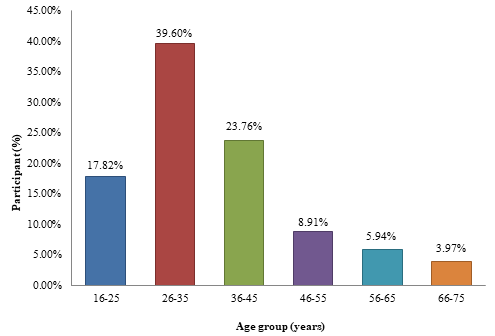
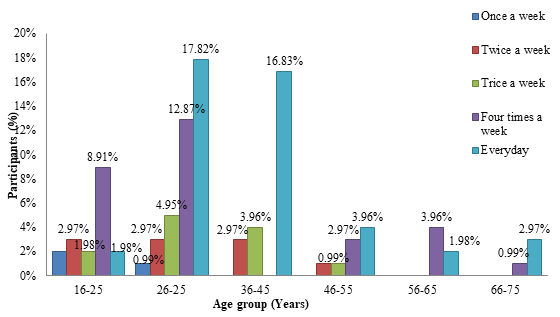
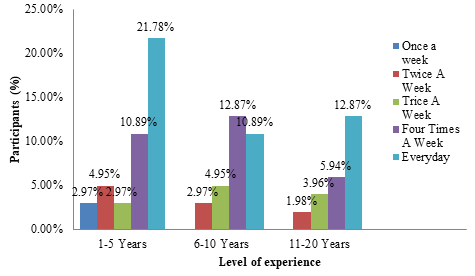
A chi-square test of independence was performed to examine the relation between age and the compliance with the use of protective equipment was presented in figure 1 showing that the age between 26-35 and 36-45 appeared to have complied more though not significantly glaring as indicated by the test conducted. According to the test, the relation between these variables was not significant, X2=30.81, p<.057,age has not much effect on compliance with the use of protective equipment On the other hand on considering the frequency of compliance level based on the year of work experience as presented in figure 3 and table 2 was analyzed using chi-square test in order to assess the independence of work experience on the level of compliance performed, it was found the relationship between working experience and the compliance with the use of protective equipment as indicated in these variables was not significant, based this result X2=8.949; p< 0.347 [17]. Thus we presume that working experience has no effect on compliance with the use of protective equipment.
| 1 - 5 Years | 6 - 10 Years | 11 - 20 Years | Total | |
|---|---|---|---|---|
| Once a week | 3 | 0 | 0 | 3 |
| Twice a week | 5 | 3 | 2 | 10 |
| Trice a week | 3 | 5 | 4 | 12 |
| Four times a week | 11 | 13 | 6 | 30 |
| everyday | 22 | 11 | 13 | 46 |
| Total | 44 | 32 | 25 | 101 |
Table 2: Frequency of compliance level based on years of experience.
Summary
From the observation in accordance with this result, it was clearly revealed that there is no statistically significant relationship between working experience and the compliance with the use of protective eye wear in terms work experience which implies that working experience has no effect on compliance with the use of protective eyewear based on this (X2= 8.949, p<.347). Similarly, there is also no statistically significant relationship between age and the compliance with the use of protective equipment and based on this value (X2= 30.81, p<.057), age also appears to have no effect on compliance with the use of protective eye wear by welders in Abakaliki metropolis.
Therefore the truth as observed from the results based on this study reveal that there is awareness to protective eye wear usage and the existent of ocular risk associated with welding as a profession among the welders, but they do not care on the compliance to the eyes protective measure. So in all case the level of compliance to the protective eye wear usage (54.55%) among the welders was found to be relatively low irrespective of the age and experience on the job by the welders in Abakaliki area of Ebonyi state. The general observation indicates that those who even manage to make use of the protective eye wear unfortunately do not even make use of the correct type of protective eyewear. On final analysis it was observed that those who have worked for more than 5 years comply less with the use of protective eye wear than those who have worked for less as shown the bar chart and thus the trend is not stratified as to generalize that years of experience and age plaid a role.
References
-
Ihekaire DE, Oji CS (2017) Corneal injuries associated with ocular hazards in the welding industry: A case study of Nekede mechanic village Nekede, Imo State, Nigeria. International Journal of Ophthalmology & Visual Science 2(2): 37-54.
-
Shyam SB, Singh SB, Sagtani RA, Niraula SR, Pokharel PK (2013) Awareness of occupational hazards and use of safety measures among welders: a cross-sectional study from eastern Nepal. BMJ Open 4(6): e004646.
-
Ajayi IA, Adenike OA, Charles OB, Oluwatoyin HO, Omotoye OJ (2011) Awareness and utilization of protective eye device among welders in southern Nigeria community. Ananas of African medicine 10(4): 294-299.
-
Shaikh MA (2001) Hazard perception and occupational injuries in the Welders and lathe machine operators of Rawalpindi and Islambad. Journal of Pakistan Medical Association 51(2): 71-74.
-
Tomany SC, Cruickshanks KJ, Klein R, Klein BE, Knudtson MD (2004) Sunlight and the 10-year incidence of age- related maculopathy: the Beaver Dam Eye Study. Arch Ophthalmol 122(5): 750-757.
-
Mgonja CT (2017) The effects of arc welding hazards to welders and people surrounding the welding area. International Journal of Mechanical Engineering and Technology 8(3): 433-441.
-
Franck C (1986) Eye symptoms and signs in buildings with indoor climate problems of office eye syndrome. Acta ophthalmol 64(3): 306-311.
-
Pabley SA, Keeney HA (1984) Welding Process and Ocular Hazards and New Protective Devices. Indian Journal of Ophthalmology 32(5): 347-349.
-
Fich M, Dahl H, Fledelius H, Tinning S (1993) Maculopathy caused by welding arcs: A report of 3 cases. Acta Ophthalmol Copenh 71(3): 402-404.
-
Voke J (1999) Radiation effect on the eye–ocular effect of ultraviolet radiation. Optometry Today 8:30-35.
-
Sithole HL, Oduntan OA, Oriowo MO (2009) Oculo-Visual Status of the welders in the capricorn district of the Limpopo province of South Africa. S Afr Optom 68(1): 32-37.
-
Oduntan AO, Nthangeni ME, Ramudzuli MR, Madu SN (2003) Causes and prevalence of low vision and blindness in black South African adults in the Limpopo Province. S Afr Optom 62: 8-15.
-
Bergmanson JPG, Söderberg PG (1995) The significance of ultraviolet radiation for eye diseases. Ophthal Physiol Opt 15(2): 83-91.
-
Sheedy JE, Edlich RF (2004) Ultraviolet eye radiation: the problem and solutions. J Long Term Eff Med Implants 14(1): 67-71.
-
Ajayi IA, Adenike OA, Charles OB, Oluwatoyin HO, Omotoye, OJ (2011) Awareness and utilization of protective eye device among welders in southern Nigeria community. Ananas of African medicine 10(4): 294-299.
-
Sufiyan MB, Ogunleye OO (2012) Awareness and compliance with use of safety protective devices and pattern of injury among quarry workers in Sabon-Gari Local Government Area, Kaduna state North-Western Nigeria. Annals of Nigeria Medicine 6(2): 65-70.
-
Ifeanyi VI, Ejidike EG, Ugwu EI (2022) Assessment of the use of Safety Eye-Glass Wear among Welders in Abakaliki Metropolis Ebonyi State, Nigeria, Greener Journal of Medical Sciences 12(1): 84-90.
- Psychogenic Erectile Dysfunction in Late Adulthood: A Case Report on Clinical Intervention and Intimacy Restoration
- Clinical Trials on COVID-19 in 2025: A New Chapter in Global Health Research
- Innovations and Challenges in Contemporary Medical Clinical Trials: An Editorial Perspective
- Innovations and Challenges in Contemporary Medical Clinical Trials: A Critical Perspective
- Reimagining Clinical Trials: The Power of Continuous Feedback from Medical Reports
- Factors Influencing Brain Drain: Perspectives from a Medical School in Turkey