
Interaction of Molecules in Solutions of C60 in Polar Solvents
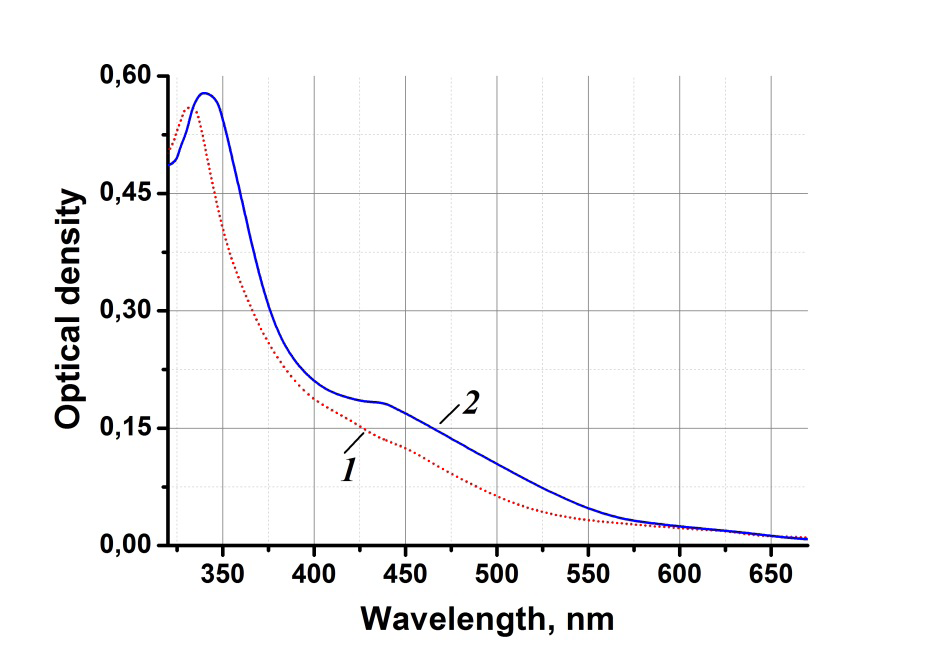
The features of fullerene C60 in N-methyl-2-pyrrolidone (NMP) solutions and NMP/water solvents were studied using optical absorption spectroscopy, dynamic light scattering (DLS) and atomic force microscopy (AFM). When 30% distilled water was added to the C60/NMP solution, a bathochromic shift (by ~9 nm) and a hyperchromic effect for the characteristic absorption maximum (331 nm) for the solution, as well as a relatively weak and broad new absorption region around 440 nm, were found. These optical changes are explained by the partial destruction of C60-C60 and C60-NMP complexes when water is added to the solution, and the formation of new C60-water complexes or mixed solvate shells of C60-NMP and C60-water during their reorganization. It was determined that at a constant concentration of C60 in solutions, the maximum hydrodynamic diameter of the synthesized fullerene nanoaggregates in a C60/NMP solution is ~23 nm, and in a C60/NMP/water solution is ~33 nm.
Introduction
The interaction processes of the light fullerenes (C60, C70) with molecules of various organic and inorganic solvents are actively being studied [1, 2]. One of the functions of fullerenes is the formation of donor-acceptor complexes when dissolved in one- and two-component solvents [3]. Additionally, fullerene molecules are known to exhibit control over unusual behavior associated with self-organization [4, 5, 6].
An effective direct method for observing physical processes occurring in solutions of fullerenes in experiments is to freeze the solution using an “automated vitrobot” at a very high speed (approximately 103 ℃/sec) and study it using an transmission electron microscope [7]. Additionally, indirect experimental methods, such as X-ray diffraction analysis (XRD), mass spectrometry, optical spectroscopy, dynamic and static light scattering methods and others are considered effective for determining the physical and chemical properties of fullerenes in various solvents [8, 9, 10, 11]. By employing these research methods in a comprehensive manner, it becomes possible to identify different approaches for synthesizing complex structural nanomaterials with novel physicochemical properties based on fullerene molecules.
Currently, due to their unique properties, fullerene- containing nanomaterials are used in nano- and microelectronics devices, solar energy applications including panels and photovoltaic elements, green energy technologies, hydrogen gas storage, sensors, therapeutic purposes in medicine, drug delivery systems in pharmacology, biotechnologies, biochip preparation [12, 13, 14, 15, 16]. The potential use of fullerene molecules in modern medicine is mainly attributed to their ability to penetrate lipid membranes, act as effective photosensitizers in singlet oxygen formation, and deactivate free radicals [16, 17]. Methods for synthesizing quasispherical materials with monomolecular and porous (fractal) structures based on C60 and C70 fullerenes in one- component solvents were defined in [18, 19]. Synthesis of one-dimensional nanomaterials from the C60 molecule in a two-component solvent system was described by the authors of [20, 21]. It’s worth noting that the interactions between fullerene and solvent molecules, as well as the physical processes involved when transferring C60 fullerene to biologically compatible solutions (such as aqueous and alcoholic solutions), are not yet fully understood and require further research.
Hence, the aim of this study is to investigate C60/N- methyl-2-pyrrolidone and C60/N-methyl-2-pyrrolidone/ water solutions using optical spectroscopy, atomic force microscopy, and dynamic light scattering (DLS).
Materials and Methods
C60 fullerene powder with purity >99.8% (Sigma Aldrich, USA), N-methyl-2-pyrrolidone (C5H9NO) with purity >99.5% and double distilled water were used in the experiments. The maximum solubility of C60 fullerene in N-methyl-2- pyrrolidone (NMP) is ∼0.89 mg/ml, but it is practically insoluble in water. Polar NMP with dielectric constant ε = 32 is completely miscible with water with ε=80 in an arbitrary volume. The mixture of C60 powder and NMP was intensively mixed using a magnetic rotator “MS-11H” (WIGO, Poland), and a C60/NMP solution with a concentration of ∼0.017 mg/ml was prepared. In another case, distilled water was gradually added to the C60/NMP solution and mixed using a magnetic rotator, and a C60NMP/water solution with a concentration of ∼0.017 mg/ml was prepared. In this case, the volume fractions of NMP and water in the solution are 70:30, respectively. All experiments were performed at room temperature (T≈24±1℃).
Electronic absorption spectra of the studied solutions were obtained using a Shimadzu UV-2700 spectrophotometer (Shimadzu, Japan) in the wavelength range of ∼300÷800 nm.
Morphological properties of C60 fullerene nanoaggregates synthesized in solution were studied using an atomic force microscope (AFM) brand “Solver Next” (NT- MDT, Russia).
Hydrodynamic sizes of C60 fullerene nanoaggregates were measured by dynamic light scattering (DLS) on a Zetasizer Nano ZEN3600 (Malvern Instruments Ltd.). The device is equipped with a He-Ne laser (with a wavelength of ∼633 nm and a power of ∼5 mW), the laser beam is directed at the object at an angle of 173°.
Experimental Results and their Discussion
First, the properties of the optical absorption spectra of C60/NMP and C60/NMP/water solutions were studied (Figure 1). The initial concentration of C60 fullerene in the studied solutions is approximately 0.017 mg/ml. In the optical absorption spectrum of C60 fullerene in NMP solvent, it is characterized by the presence of maximum absorption at a wavelength of ~331 nm (Figure 1). If the C60/NMP solution is kept at a constant concentration for a certain period of time, NMP molecules form complexes with C60 fullerene molecules through the donor-acceptor mechanism, resulting in shifts, flattening, and changes in intensity of the ~331 nm absorption peak (hypo- or hyperchromic effects) [22]. A clear solvatochromatic effect was observed in the optical absorption spectrum of the resulting C60/NMP/water solution (Figure 1) when 30% distilled water was added to the C60/NMP solution. The optical absorption spectrum of the C60/NMP/water solution shows a main absorption maximum at ~340 nm and a relatively weak broad absorption region around ~440 nm. Upon adding water to the C60/NMP solution, the C60-C60 and C60-NMP complexes are partially broken and rearranged. In this case, the formation of new C60-water complexes or C60-NMP and C60- water mixed solvate shells occurs, which does not happen when fullerene is added directly to water. The maximum at ~340 nm in the optical absorption spectrum of the C60/ NMP/water solution corresponds to C60-NMP and C60-water mixed complexes, while the broad optical absorption at ~440 nm can be explained by the formation of new C60- water complexes.
Using the dynamic light scattering (DLS) method, the hydrodynamic sizes of particles in the studied solutions of C60 fullerene were determined. DLS measures Brownian motion in a C70 solution and relates it to the size of nanoaggregates. For this, the device (Zetasizer Nano ZEN3600) illuminates a fullerene solution with an He-Ne laser and analyzes fluctuations in the intensity of the scattered light. Next, the diffusion coefficient of dispersed particles in the solution is determined by analyzing the correlation function of fluctuations in the intensity of scattered light. Then, from the diffusion coefficient, the hydrodynamic size of C70 nanoaggregates is calculated using the well-known Stokes- Einstein equation. Output from a typical DLS experiment give us a graph of the distribution of hydrodynamic diameters of light-scattering nanoaggregates by intensity. Figure 2 illustrates the distribution of hydrodynamic diameters (by intensity) of nanoaggregates synthesized in C60/NMP and C60/NMP/water solutions of the fixed C60 concentration. It is evident that in the C60/NMP solution (Figure 2), the diameters of the main fraction of light-scattering fullerene nanoaggregates are distributed in the range of ~11.8÷36.5 nm, with the maximum distribution of C60 nanoaggregates being around 23 nm. Considering that the total dielectric constant of the C60/NMP/water solution is higher than that of the C60/NMP solution, it is clear that intermolecular interactions are relatively strong in the C60/NMP/water solution.
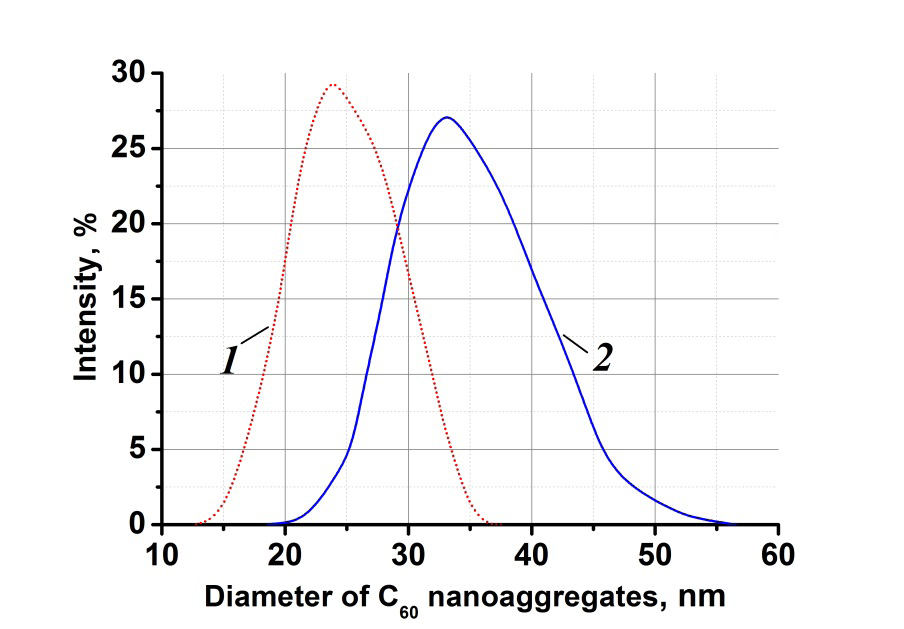
The maximum value of the hydrodynamic diameter of C60 nanoaggregates synthesized in the C60/NMP/water solution shifts to ~33 nm. In turn, the hydrodynamic sizes of C60 nanoaggregates in the C60/NMP/water solution are distributed in the range of ~18.6÷56.5 nm (Figure 2). Therefore, the addition of 30% distilled water to the C60/ NMP solution results in the redistribution of intermolecular interactions and the reorganization of C60 nanoparticles. This indicates a specific interaction of water with the C60 fullerene molecules initially dissolved in the NMP solvent. After the rearrangement of C60 nanoparticles in the C60/NMP/water solution, it is evident that the geometrical dimensions of C60 nanoaggregates increase compared to those in the C60/NMP solution.
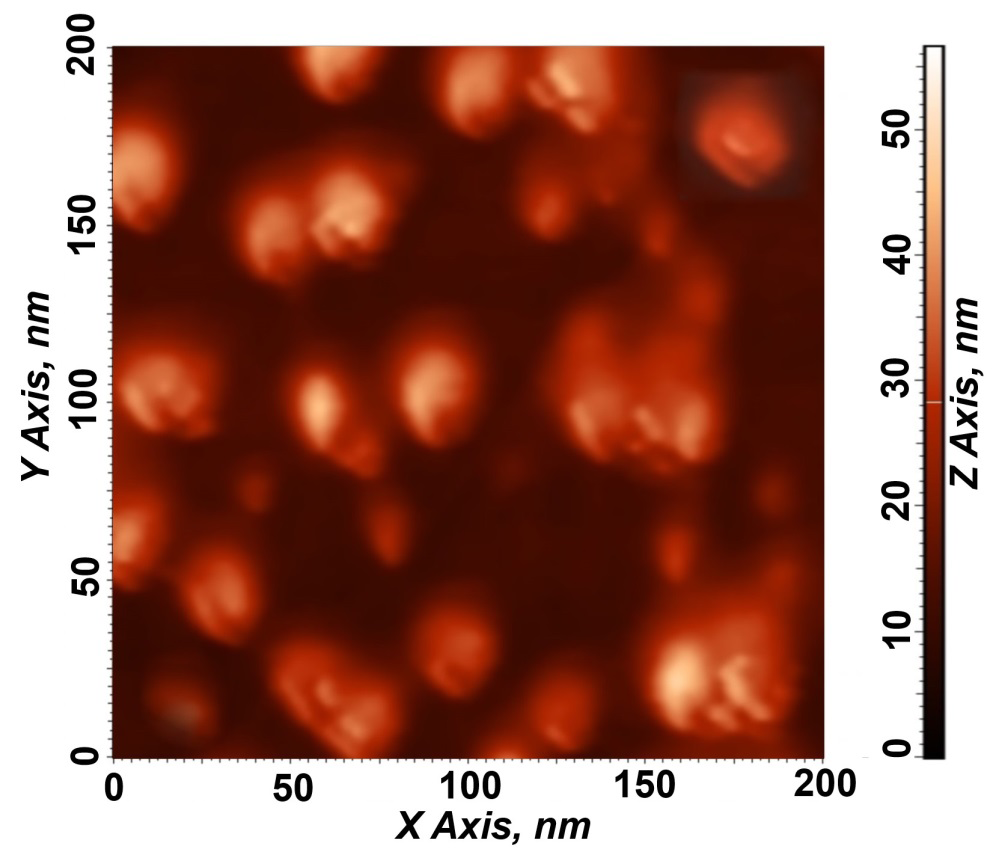
Figure 3 shows the atomic force microscopy (AFM) image of aggregates synthesized in the C60/NMP/water solution. It can be observed that the C60 aggregates synthesized in the solution exhibit a quasi-spherical shape, with their geometrical dimensions varying in diameter within the range of dn≈20÷60 nm. These nanoaggregates are composed of 636056 24389
3 $$ n = \left(\frac {d _ {n}}{d _ {0}}\right) ^ {3} \approx 2 4 3 8 9 + 6 $$
monomer C60 molecules, which has a diameter d0≈0.7 nm.
Thus, on the basis of research using optical absorption spectroscopy, dynamic light scattering and atomic force microscopy methods of C60 fullerene solutions in one- and two-component polar solvents (NMP and NMP/water), new properties of formation of nanoaggregates were determined. The obtained scientific results are important for effective use in the field of nanotechnology, especially in nano- and microelectronics and modern medicine.
Conclusion
In the optical absorption spectroscopy method, a maximum at a wavelength of ~331 nm was identified in the absorption spectrum of a low-concentration C60/NMP solution. A clear solvatochromatic effect was observed in the optical absorption spectrum of the C60/NMP/water solution containing 30% by volume of distilled water, characterized by a “red shift” of the main absorption peak by approximately 9 nm and an increase in absorption. Additionally, a relatively weak broad absorption band ~440 nm appeared in the C60/ NMP/water solution. The “red shift” of the main absorption peak corresponds to the formation of C60-NMP and C60-water mixed complexes, while the broad optical absorption at ~440 nm indicates the formation of new C60-water complexes.
The diameters of the fullerene nanoaggregates synthesized in the C60/NMP solution, as determined by the DLS method, range ~11.8÷36.5 nm, with the maximum distribution centered ~23 nm. In the C60/NMP/water solution (with a water volume fraction of 30%), the maximum hydrodynamic diameter of C60 nanoaggregates was ~33 nm, with their diameters distributed in the range of ~18.6÷56.5 nm. The addition of distilled water to the C60/NMP solution resulted in the redistribution of intermolecular interactions and reorganization of C60 nanoparticles, leading to an increase in their geometric dimensions compared to those in the C60/NMP solution.
The geometrical dimensions of the C60 aggregates synthesized in the C60/NMP/water solution, as determined by the AFM method, range ~20÷60 nm. Additionally, it was demonstrated that C60 nanoaggregates predominantly assemble in a quasi-spherical form.
Acknowledgements
This work was supported by the Foundation for Fundamental Research of the Academy of Sciences of the Republic of Uzbekistan: “Investigation of the physical regularities of the self-organization processes of organic nanoscale materials in liquid systems”.
References
-
Salo VA, Buchelnikov AS, Evstigneev MP (2022) Interceptor potential of C60 fullerene aqueous solution: a comparative analysis using the example of the antitumor antibiotic mitoxantrone. Eur Biophys J Vol 51(3): 297- 307.
-
Bakhramov SA, Makhmanov UK, Aslonov BA (2023) The Synthesis of C70 Fullerene Nanowhiskers Using the Evaporating Drop Method. Condens Matter 8(3): 62-71.
-
Xingmao Ch, Youzhi C, Maxvon D (2024) Recent advances in supramolecular fullerene chemistry. Chemical Society Reviews 53(1): 47-83.
-
Makhmanov UK, Kokhkharov AM, Bakhramov SA (2019) Organic fractal nano-dimensional structures based on fullerene C60. Fullerenes Nanotubes and Carbon Nanostructures 27(3): 273-278.
-
Jinrui L, Mengjun Ch, Shengju Z, Hongguang L, Jingcheng H (2022) Self-assembly of fullerene C60-based amphiphiles in solutions. Chemical Society Reviews 51(8): 3226- 3242.
-
Mchedlov-Petrossyan NO, Marfunin M, Kriklya NN (2023) Colloid Chemistry of Fullerene Solutions: Aggregation and Coagulation. Liquids 4(1): 32-72.
-
Kokhkharov AM, Zakhidov EA, Gofurov ShP, Bakhramov SA, Makhmanov UK (2013) Clusterization of fullerene C70 molecules in solutions and its influence to optical and nonlinear optical properties of solutions. International Journal of Nanoscience 12(4): 1350027.
-
Ginzburg BM, Tuichiev Sh, Tabarov SKh, Shepelevskii AA, Shibaev LA (2005) X-ray diffraction analysis of C60 fullerene powder and fullerene soot. Tech Phys 50: 1458-1461.
-
Astefanei A, Núñez O, Galceran MT (2014) Analysis of C60-fullerene derivatives and pristine fullerenes in environmental samples by ultrahigh performance liquid chromatography-atmospheric pressure photoionization- mass spectrometry. Journal of Chromatography A 1365: 61-71.
-
Strelnikov DV, Link M, Weippert J, Kappes MM (2019) Optical Spectroscopy of Small Carbon Clusters from Electron-Impact Fragmentation and Ionization of Fullerene-C60. J Phys Chem A 123(25): 5325-5333.
-
Kamanina N (2023) Refractive Properties of Conjugated Organic Materials Doped with Fullerenes and Other Carbon-Based Nano-Objects. Polymers 15(13): 2819.
-
Sachdeva Sh, Singh D, Tripathi SK (2020) Optical and electrical properties of fullerene C70 for solar cell applications. Optical Materials 101: 109717.
-
Shetti NP, Mishra A, Basu S, Aminabhavi TM (2021) Versatile fullerenes as sensor materials. Materials today Chemistry 20: 100454.
-
Otarbay ZE, Gabdullin MT, Abdullin KhA, Shur DV, Ismailov DV, et al. (2018) Hydrogenization of fullerene as a method of storage of hydrogen. Journal of Physics: Conf Series 987: 012025.
-
Esmaeal Gh, Hashem RT, Ayesha K, Georgios I (2023) Giannopoulos. Experimental and computational physics of fullerenes and their nanocomposites: Synthesis, thermo-mechanical characteristics and nanomedicine applications. Physics Reports 996: 1-116.
-
Ohata T, Ishihara K, Iwasaki Y, Sangsuwan A, Fujii Sh, et al. (2016) Water-soluble complex formation of fullerenes with a biocompatible polymer. Polym J 48: 999-1005.
-
Goodarzi S, Da Ros T, Conde J, Sefat F, Mozafari M (2017) Fullerene: biomedical engineers get to revisit an old friend. Materials Today 20(8): 460-480.
-
Makhmanov UK, Ismailova O, Kokhkharov A, Zakhidov E, Bakhramov E (2016) Features of self-aggregation of C60 molecules in toluene prepared by different methods. Physics Letters A 380(24): 2081-2084.
-
Makhmanov UK, Esanov SA, Sidigaliyev DT, Musurmonov KN, Aslonov BA, et al. (2023) Behavior of C70 Fullerene in a Binary Mixture of Xylene and Tetrahydrofuran. Liquids 3(3): 385-392.
-
Bakhramov SA, Makhmanov UK, Kokhkharov AM (2019) Synthesis of nanoscale fullerene C60 filaments in the volume of an evaporating drop of a molecular solution and preparation of thin nanostructured coatings on their basis. Appl Sol Energy 55(5): 309-314.
-
Funamori Y, Suzuki R, Wakahara T, Ohmura T, Nakagawa E, et al. (2020) Large elastic deformation of C60 nanowhiskers. Carbon 169: 65-72.
-
Makhmanov UK, Kokhkharov AM, Bakhramov SA, Esanov ShA, Aslonov BA, et al. (2022) Investigation of C60/NMP and C60/NMP/xylene solutions by absorption spectroscopy and dynamic light scattering. Uzbek Physical Journal 24(3): 171-175.
- Solution-Processed Chiral Perovskites for Biomedical Applications
- Nanotechnology in Health Chemistry and Medicine: Current Challenges and Future Directions
- Human Exposure to Micro- and Nanoplastics: Pathways, Toxicity, and Intervention Strategies
- Exosome Nanomedicine for Cancer Therapy
- Micro and Nanoplastics–Plastisphere, Biotoxicity, Impact on Human Health, and Mitigation Strategies
- Process Validation of Cefixime Powder for Suspension Dosage Form, 50 mL