
Experiential Agripreneurship Training in Sub-Saharan Africa: Integrating a Business Incubator into Postgraduate Livestock Education at the University of Buea
The global consensus suggests that traditional agricultural education in developing economies is insufficient to meet competitive workforce demands, often leading to graduate unemployment. This paper details the design, implementation, and initial outcomes of integrating a high-fidelity Student Business Incubator (SBI) approach into a Master's degree in Livestock Production at the University of Buea (UB), Cameroon. The UB-LPA-SBI is an experiential model where postgraduate students (N=20 over two cohorts) execute a profit-and-loss broiler production business plan on campus. This innovative approach aims to shift agricultural education from theoretical instruction to experiential agripreneurship training to foster Entrepreneurial Intention (EI). Initial financial analysis using business cycle data confirmed a successful proof of concept: students successfully generated an average entrepreneurial reward of USD 76.05 (Cohort 1) and USD 70.66 (Cohort 2) after repaying seed capital loans and interest. Critical implementation hurdles included reconciling rigid university/ state procurement systems with commercial demands and managing external market risks (e.g., farm raid). The study presents one of the first empirically documented cases of embedding a high-fidelity business incubator model directly within an African state university's agricultural curriculum. The model provides a practical framework for African Higher Education Institutions to produce job creators by aligning training with economic competitiveness, though it highlights the critical necessity of securing financial autonomy to overcome institutional rigidities and scale the operation to a commercially viable level.
Abbreviations
SBI: Student Business Incubator; UB: University of Buea; EI: Entrepreneurial Intention; GESP: Growth and Employment Strategy Paper; LPA: Livestock Production and Agripreneurship; EE: Entrepreneurship Education; FAVM: Faculty of Agriculture and Veterinary Medicine; DOC: Day Old Chicks; AOTS: Association of Overseas Technical Scholarships.
Introduction
Graduate unemployment remains a pressing economic challenge across Africa [1]. There is growing discussion and evidence suggesting that traditional curriculum-based education is insufficient for the demands of the digitalized workforce, especially in developing economies, because it often fails to impart essential digital literacy, critical thinking, and problem-solving skills [2] Traditional models also struggle with slow curriculum adaptation and inadequate infrastructure [3]. Cameroon’s livestock production sector, a vital part of the national economy, is primarily constrained by reliance on traditional, extensive farming systems and a resulting non-competitive production sector [4]. A significant factor contributing to this stagnation is the lack of business and financial management skills among technical graduates [5].
This imbalance severely limits graduates’ self- employability, leading to a disconnect between tertiary education output and national economic needs. The University of Buea (UB), in alignment with the national policy for inclusion and the need to address graduate unemployment, introduced a specialized MSc in Animal Science (Livestock Production) [6]. This program is uniquely structured across four semesters, moving sequentially from scientific Principles and Processes to Application and Farm Business (Semester 3) and culminating in a Research Project (Semester 4). This paper presents a detailed account of the application of a student business incubator (SBI) within a farm business semester, implemented at the University of Buea Livestock Production and Agripreneurship Students Business Incubator (UB-LPA-SBI). The goal was to provide empirical data on the feasibility, design structure, and initial outcomes of embedding a high-fidelity business incubator within a state university’s agricultural curriculum.
Literature Review
While African postgraduate Animal Science programs traditionally emphasize technical knowledge, there is a recognized gap in developing crucial non-technical skills, such as business management, entrepreneurship, communication, data science, and leadership [7]. Addressing these gaps is essential to fully prepare graduates for the diverse demands of the modern African livestock industry and related agribusiness sectors. Acknowledging the academic debate on whether Entrepreneurship Education (EE) directly translates into Entrepreneurial Intention (EI) [8], our program’s goal was to foster Entrepreneurial Intention (EI), defined as the conscious mental state preceding the decision to start a business [9]. This is considered a more robust outcome than simple Entrepreneurial Education (EE) [10]. Theorists like David Kolb emphasized that knowledge is created through the transformation of experience [11]. Directly engaging with material helps learners internalize concepts more deeply than passive listening or reading, leading to a greater sense of mastery and confidence. The literature consistently supports that moving from abstract knowledge to concrete application significantly boosts a person’s belief in their capabilities and their drive to learn more (Pang, 2009). Thus literature confirms that hands-on experience increases self-confidence and motivation [10]. This Student Business Incubator (SBI) innovative approach aims to leverage experiential learning as a direct mechanism to translate education into entrepreneurial intent, thereby generating both employment readiness and a self-sustaining university revolving fund.
Methodology: The Business Incubator Design and Implementation
Ethical Compliance
All procedures performed in studies involving human participants were in accordance with the ethical standards of the institutional research committee and with the 1964 Helsinki Declaration and its later amendments and comparable ethical standards.
The UB-LPA-SBI Model
The UB-LPA-SBI is an on-campus business incubator designed for enrolled master’s students of Animal Science (Livestock Production, specialization). It operates on a high-fidelity experiential learning model in which students transition from theory to practice by implementing a real- time, short-duration animal production business plan. • Core Activity: Each student develops and executes a full business cycle (maximum six months), taking real financial and operational risks to produce a pre-defined animal product (e.g., broiler chickens) with the explicit objective of generating a profit.
• Graduate Profile: Students are trained as Graduate Family Farmers (or entrepreneurs), leaving the program not just with a dissertation but with a fully tested feasibility study and business plan for their immediate post-graduation community insertion.
• Finance Model: The model is semi-commercial. The university, through the Support Programme for the University of Buea Livestock Production and Agripreneurship Students Business Incubator (SP UB LPA SBI) based in the Faculty of Agriculture and Veterinary Medicine (FAVM), provides seed capital as a loan. Students supplemented this with personal funds to determine the scale of the operation. Students were required to repay the loan at a fixed interest rate (initially 3%, revised to 5%). All remaining profits are retained by the students as a reward for their entrepreneurial efforts.
Relationship between Actors
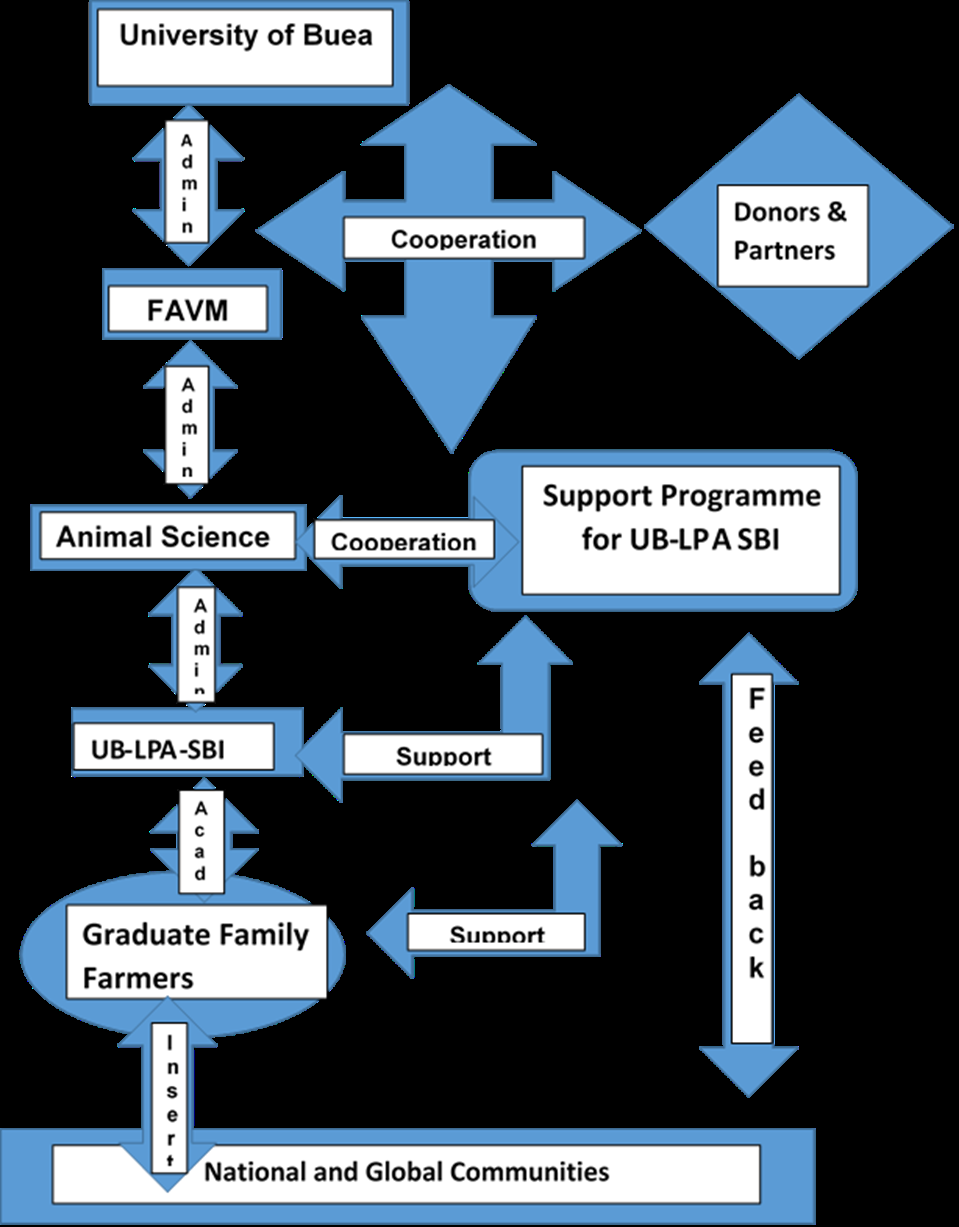
The success of UB-LPA-SBI relies on a coordinated ecosystem of stakeholders, as illustrated by the program structure (Figure 1). The Support Programme for the UB- LPA-SBI (SP-UB-LPA-SBI) University of Buea, [12] serves as the coordinating body, facilitating cooperation between the University Hierarchy (Administration and FAVM), students (Graduate Family Farmers), and external Donors & Partners to secure resources and external support for post-graduation integration into national and global agripreneurial communities.
Results and Discussion: Initial Outcomes and Implementation Evolution
Initial Financial and Operational Performance
The program’s initiation phase (the 2019/2020 and 2020/2021 cohorts) focused on broiler chicken production.
Table 1 presents the key financial outcomes for the 20 students who graduated in the first two batches. • Pioneer Cohort (2019/2020): Ten students started with 32 Day-Old Chicks (DOCs). Mean Profit (Reward for Entrepreneurial Effort) after loan repayment and 3% interest: FCFA 44,737.1 (USD 76.05). • Second Cohort (2020/2021): Ten students increased their starting capital to an average of 55 DOCs. Mean Profit (Reward for Entrepreneurial Effort) after loan repayment and 3% interest: FCFA 41,563.9 (USD 70.66).
| S/N | Name | Mat.no | Number of Chicks | Unit Price | Loan Amount | Interest on Loan (3%) | Loan Repayment | Variable Cost (FCFA) | Profit (FCFA) | Profit (USD) |
|---|---|---|---|---|---|---|---|---|---|---|
| 1 | Naihibu Musa Ndemsah | AV19P011 | 32 | 500 | 16000 | 480 | 16840 | 76000 | 56000 | 95.2 |
| 2 | Nsoyeh Sandrine Koyka | AV19P013 | 32 | 500 | 16000 | 480 | 16840 | 88,100 | 46695 | 79.38 |
| 3 | Atabongawung Evira Asongacha | AV19P015 | 32 | 500 | 16000 | 480 | 16840 | 98000 | 55293 | 94 |
| 4 | Esam Adenine Atime | AV19P012 | 32 | 500 | 16000 | 480 | 16840 | 220650 | 50000 | 85 |
| 5 | Feghang Desmond Bongjam | AV19P014 | 32 | 500 | 16000 | 480 | 16840 | 176200 | 39344 | 66.88 |
| 6 | Emmanuel Bongmini Ngumnloh | AV19P017 | 32 | 500 | 16000 | 480 | 16840 | 220650 | 50000 | 85 |
| 7 | Soh Yashmir Ngoh | AV19P021 | 32 | 500 | 16000 | 480 | 16840 | 200000 | 32000 | 54.4 |
| 8 | Ajamah Julius Tamoze | AV19P023 | 32 | 500 | 16000 | 480 | 16840 | 88,100 | 46695 | 79.38 |
| 9 | Shu Raisa Lum | AV19P024 | 32 | 500 | 16000 | 480 | 16840 | 176200 | 39344 | 66.88 |
| 10 | Sarah Etombi Ekema | AV19P010 | 32 | 500 | 16000 | 480 | 16840 | 200000 | 32000 | 54.4 |
| Mean for 2019/2020 Batch | 32 | 500 | 16000 | 480 | 16840 | 154390 | 44737.1 | 76.05 | ||
| 11 | Ndum Gorreti Tufoin | AV20P062 | 50 | 650 | 32,500 | 975 | 33,473 | 220650 | 21765 | 37 |
| 12 | Nghombuoche Hesen Boris | AV20P067 | 50 | 650 | 32,500 | 975 | 33,473 | 103500 | 44025 | 74.84 |
| 13 | Keubiwou Brandom Rahim | AV20P068 | 50 | 650 | 32,500 | 975 | 33,473 | 176200 | 90000 | 153 |
| 14 | Ma-Tabe Bisong | AV20P069 | 50 | 650 | 32,500 | 975 | 33,473 | 103500 | 44025 | 74.84 |
| 15 | Nguimdo Mbusop Tiziano | AV20P070 | 100 | 650 | 65,000 | 1950 | 66,950 | 207000 | 88050 | 149.69 |
| 16 | Ndifor Godfred Mbah Nchole | AV20P072 | 50 | 650 | 32,500 | 975 | 33,473 | 176200 | 39344 | 66.88 |
| 17 | Ngock Ngock Aime Gael | AV20P077 | 50 | 650 | 32,500 | 975 | 33,473 | 220650 | 21765 | 37 |
| 18 | Tchiegnou Frederic | AV20P080 | 50 | 650 | 32,500 | 975 | 33,473 | 220650 | 21765 | 37 |
| 19 | John Atemnkeng | AV20P081 | 50 | 650 | 32,500 | 975 | 33,473 | 178740 | 24900 | 42.33 |
| 20 | Jam Jude Jua | AV20P111 | 50 | 650 | 32,500 | 975 | 33,473 | 176200 | 20000 | 34 |
| Mean for 2020/2021 Batch | 55 | 650 | 35750 | 1072.5 | 36820.7 | 178329 | 41563.9 | 70.66 |
Table 1: Some of the business activities of the first two badges of graduate students trained in the University of Buea Livestock
The initial results, though modest in financial returns, represent a powerful proof of concept that real-world profit- and-loss business training can be successfully embedded within the rigid structure of a state university in Cameroon.
The program demonstrated that experiential learning is a viable pedagogical tool for fostering EI, confirming the assertion that hands-on experience increases self- confidence and motivation [10]. The slight drop in average profit for the second cohort, despite the increased scale, was directly attributed to an external security challenge (farm raid), demonstrating the real-world, high-risk nature of the experiential learning environment and teaching essential resilience skills.
Conceptual and Implementation Hurdles and Mitigation
The transition from a theoretical academic program to a commercial agripreneurship incubator encountered significant hurdles. Conceptual Hurdles: The program successfully overcame foundational knowledge gaps required to include students from diverse non-agricultural backgrounds (e.g., Biochemistry, Microbiology, and Zoology) through a carefully sequenced curriculum. The focus remains on translating Entrepreneurship Education (EE) into sustained Entrepreneurial Intention (EI), which is planned for formal assessment via a five-year graduate evaluation.
Implementation Hurdles: The most significant hurdle is the mandated use of intermediaries/suppliers for procurement, which results in inflated costs (e.g., Day old chicks (DOCs) costing the university FCFA 1,500 vs. a market price of FCFA 500). This bureaucratic hurdle is counterproductive to commercial profitability. Furthermore, the current scale (average of 32-55 DOCs) remains small (hobby scale), limiting the depth of commerce experience.
To Address these, UB has Initiated Strategic Efforts: Financial Autonomy: The program secured a Competitive University Grant to establish a revolving fund. This is critical as it bypasses the restrictive state procurement system for day-to-day operations. External Partnerships: Efforts are underway to source new partners and develop infrastructure, which is essential for moving the production scale from a hobby to a commercial level (target 500 broilers per student).
Policy Implications: The model challenges the conventional view of a state university. Sustained political and administrative goodwill is indispensable to facilitate internal regulatory adaptations required for the program to function as an agile business entity within the larger bureaucracy.
Conclusions
The integration of the Business Incubator approach into the Livestock Production curriculum at the University of Buea is a determined step towards improving entrepreneurial outcomes among African youth. The initial operation confirmed the feasibility of an experiential, high- fidelity business model within a state university setting, effectively generating both graduate entrepreneurial capacity and university revenue. Although hurdles related to scale, institutional financing, and state procurement remain, the foundation provided by the new revolving fund and robust institutional goodwill offers a strong basis for future sustainability and expansion. The UB-LPA-SBI serves as an actionable blueprint for African higher education institutions committed to producing job creators, rather than just job seekers in the vital agricultural sector.
Funding
This research did not receive any specific grant from funding agencies in the public, commercial, or not-for-profit sectors. The University of Buea provided a seed grant of 4,999, 500 FCFA (USD 8,839.13) for SP-UB- LPA-SBI to go about its work and implant the SBI in the university community as an income generating activity.
Author Contributions
Conceptualization: E.D., E.E.E.E.; Methodology: E.D., N.L.M., E.E.T., A.M, .MA J P., O.P.M., Data Curation: E.D., A.B.N., I.S.M., N.N.W.; Writing -Original Draft: E.D.; Writing-Review & Editing: E.D., E.E.E.E., O.P. M.
Conflict of Interest
The authors declare that the research was conducted in the absence of any commercial or financia6l relationships that could be construed as a potential conflict of interest.
Data Availability Statement
The data presented in this study are available upon reasonable request from the corresponding author.
Acknowledgments
The authors thank the University of Buea, the National Employment Fund, Cameroon; Empowerment NGO, Cameroon; Catholic University Institute, Buea, Cameroon; MTN Mobile Money Corporation, Cameroon; Alex Ekweme Federal University, Ndufu Aliko Ikwo, Nigeria; Golder Meir Mount Carmel Institute, Haifa, Israel; and the Association of Overseas Technical Scholarships (AOTS) Tokyo Kenshu
Centre, Japan for their intellectual and strategic inspirations that contributed to the design and implementation of this innovative program.
References
-
Seti TM, Ngqulana A, Sindesi OA (2025) Industry perceptions of employability skills for agricultural graduates in the fourth industrial revolution. SA Journal of Industrial Psychology 51: 1.
-
Mhaske P, Bhattacharjee B, Haldar N, Upadhyay P, Mandal A (2025) Bridging digital skill gaps in the global workforce: A synthesis and conceptual framework building. Research in Globalization 11: 100311.
-
Madsen SS, Thorvaldsen S, Sollied S (2021) Are Teacher Students’ Deep Learning and Critical Thinking at Risk of Being Limited in Digital Learning Environments? IntechOpen, pp: 55-70.
-
Cameroon GESP (2020) Cameroon: Growth and employment strategy paper 2010/2020: A Reference Framework for Government Action over the period 2010-2020, Yaounde: Republic of Cameroon, Cameroon.
-
Tambi MD, Anyah FJ (2019) Constraints and challenges of livestock production in Cameroon. South Asian Res J of Bus Manag 1(1): 10-17.
-
University of Buea (2024) Faculty of Agriculture and Veterinary Medicine Records another Milestone in Research Profile: First Calf birth from Artificial Insemination (AI). University of Buea Newsletter 7.
-
Grobler R, de Witt FH, Cason ED, Einkamerer OB, Josling GC, et al. (2020) Training the next generation of animal scientists for South Africa. Animal Frontiers 10(3): 10- 17.
-
Mahendra AM, Djatmika ET, Hermawan A (2017) The effect of entrepreneurship education on entrepreneurial intention mediated by motivation and attitude among management students, State University of Malang, Indonesia. International Education Studies 10(9): 61-69.
-
Gorgievski MJ, Stephan U, Laguna M, Moriano JA (2018) Predicting entrepreneurial career intentions: values and the theory of planned behavior. Journal of Career Assessment 26(3): 457-475.
-
Oosterbeek H, Praag MV, Ijsselstein A (2010) The impact of entrepreneurship education on entrepreneurship skills and motivation. European Economic Review 54(3): 442-454.
-
Kolb DA (1984) Experiential learning: Experience as the source of learning and development. Prentice-Hall, pp: 1-256.
-
University of Buea, (2025) Support Programme for the University of Buea Livestock Production and Agripreneurship Students Business Incubator.
- Enhancement of Vegetative Growth and Fruit Yield in Cucumber (Cucumis sativus L.) via Spiritual Blessing (Biofield) Energy Intervention
- Production of Açaí (Euterpe oleracea Mart.) under Different Agroforestry System Management Intensities in Amazonian Floodplain (Varzea) Forests
- Coffee and the Production Region: What is the Secret to the Expression "Quality"?
- Advances in Agricultural High-Quality Development
- Linking Compost Residue to ABAGE in Plants - a Short Note
- Building Living Structures – The Use of Space and Time for their Development