
Enhancement of Vegetative Growth and Fruit Yield in Cucumber (Cucumis sativus L.) via Spiritual Blessing (Biofield) Energy Intervention
Background: The demand for sustainable agricultural practices has led to the exploration of non-traditional growth enhancement techniques. This study investigated the impact of Spiritual Blessing (Biofield) Energy Treatment (SBET) on the growth dynamics and reproductive yield of cucumber (Cucumis sativus L.) under open-field environmental conditions. Methodology: Cucumber seeds and plots were divided into two groups: control and treated. The treated group received SBET, while the control group remained untreated. Both groups were maintained with identical soil quality, irrigation schedules, and climatic conditions. Key growth parameters were monitored during the vegetative phase. Post-harvest analysis focused on fruit number, average fruit weight, and total biomass yield. Results: Data indicated a significant enhancement in the vegetative markers such as plant vine length, number of branches per plant, internodal length, leaf length, and leaf width by 41.96% (p ≤ 0.001), 51.42% (p = 0.025), 46.33% (p = 0.025), 64.19% (p ≤ 0.001), and 47.80% (p = 0.001), respectively, in the treatment group compared to the control group. Additionally, reproductive and yield-related descriptors such as number of female flowers per plant, yield per plant, and 100-seed weight were significantly increased by 48.42% (p = 0.002), 91.67% (p ≤ 0.001), and 58.97% (p ≤ 0.001), respectively, in the treatment group than control group. Conclusion: The findings suggest that Spiritual Blessing Energy Interventions positively influenced the phenological development and yield of Cucumis sativus. These results open avenues for further research into the biophysical mechanisms underlying energy-based agricultural enhancements and their potential as a non-chemical supplement to traditional farming.
Abbreviations
SBET: Spiritual Blessing Energy Treatment; CONCCBG: Control Cucumber Group; BTCCBG: Biofield Energy-Treated Cucumber Group; SSP: Single Super Phosphate; MOP: Muriate of Potash; DAS: Days after Sowing.
Introduction
The cucumber (Cucumis sativus L.), a member of the Cucurbitaceae family, is one of the most widely cultivated and economically significant vegetable crops globally [1, 2]. Valued for its high-water content (approximately 95 - 96%), vitamins (Vitamin K, C, and A), and unique secondary metabolites like cucurbitacins, flavonoids, and lignans, it plays a crucial role in human nutrition and the global agricultural economy [3, 4]. Recent research highlights its diverse therapeutic potential, including antioxidant, anti- inflammatory, and anti-diabetic properties, as well as its importance in sustainable agricultural practices to maximize yield and economic returns [1, 4]. However, modern agriculture faces a dual crisis: the plateauing of crop yields and the environmental degradation caused by excessive reliance on chemical fertilizers and pesticides [5]. As global food demand is projected to increase significantly by 2050, the scientific community is under immense pressure to identify sustainable, non-toxic, and innovative “Green Technologies” that can enhance plant vigor without compromising soil health or human safety [6]. Traditional agronomic practices often focus exclusively on the chemical and physical properties of the soil-plant-water continuum. Yet, emerging research suggests that biological systems are also sensitive to electromagnetic and subtle energy fields [7]. Biofield Energy, often categorized under “Spiritual Blessing” or “Externalized Biofield Energy Intervention,” represents a burgeoning field of study in biophysical agricultural research [8]. While once viewed with skepticism, the application of Biofield Energy is increasingly being scrutinized through the lens of quantum biology and bioelectromagnetic to determine its potential in modulating plant growth [9]. Based on the above fact’s authors planned to explore the vegetative growth and fruit yield in cucumber (Cucumis sativus l.) via Spiritual Blessing (Biofield) Energy Intervention (The Trivedi Effect®).
Materials and Methods
Study Site Details
Field experiments were conducted on agricultural territory situated in Bhandarwadi (Sindhudurg district), located within the Konkan agro-climatic zone of Maharashtra, India (15°37’–16°40’ N, 73°19’–74°13’ E; altitude 26 m). The environment is characterised by high temperatures in the summer and moderate temperatures in the winter. The peak temperatures typically attain approximately 42°C during the pre-monsoon months. Rainfall variability in this region often leads to acute moisture deficits, potentially compromising crop physiological processes during key growth stages.
Seed Details and Experimental Design
Cucumber (Cucumis sativus L. cv. Dynasty-hybrid) seeds (Purity: 95%; Lot No: NU6220241; Label: 40712) were procured from Namdeo Umaji Agritech (India) Pvt. Ltd. The seed lot was bifurcated into two experimental cohorts: (i) an untreated control group and (ii) a treatment group subjected to Spiritual (Biofield) Energy Treatment (SBET/ prayers). Following treatment, both cohorts were sown in randomized field plots to assess comparative vegetative growth, morphological characteristics, and reproductive yield. To isolate the effects of the Biofield Energy Treatment, standardized agronomical protocols including systematic irrigation, fertilization, and integrated pest management were maintained uniformly across both groups throughout the duration of the study.
Field Layout
The experiment was conducted using a Randomized Complete Block Design (RCBD) comprising two primary treatments. A total of six plots, each measuring 10.0 m² (4.0 m × 2.5 m), were established across an experimental area of 70.0 m². To prevent cross-contamination and edge effects, a buffer zone of 0.5 m was maintained between individual plots and replications. Cucumber seeds were sown with a standardized spacing of 0.5 m × 0.5 m. Prior to initiation, the experimental site was cleared of debris, and representative bulk soil samples were collected to establish baseline physicochemical properties, including pH, organic matter content, and macronutrient concentrations (N, P, and K).
Spiritual Energy Treatment (Blessing/Prayer) Strategy
The control group (CONCCBG) consisted of untreated cucumber seeds and soil. The experimental group (BTCCBG) was subjected to a non-physical biofield energy protocol administered by a spiritual healing practitioner, Mahendra Kumar Trivedi.
The intervention was performed for 4 minutes at a distance of approximately 0.5 meters (1.5 ft) from the samples. Environmental conditions were maintained at a constant temperature of 28 ± 2°C and a relative humidity of 65 ± 5%. To ensure the integrity of the samples, no physical contact occurred during the procedure. The protocol involved a standardized “laying on of hands” technique, intended to modulate the energetic state of the agricultural matrix and seeds. All samples were subsequently handled according to standard cultivation practices to evaluate phenotypic and physiological variations.
Soil Properties
Prior to treatment application, composite topsoil samples were collected from a depth of 30 cm in each plot using five-point sampling method. Samples were air-dried, passed through a 2-mm sieve, and stored at 4 °C until further analysis. Soil texture was determined via the hand feel method [10], and soil pH was measured in a 1:2 (w/v) soil– distilled water suspension using a calibrated electronic pH meter.
Seed Plantation and Management
Seeds were sown directly into the soil, with moisture maintained through manual irrigation for the first 9 days after sowing (DAS). Subsequently, irrigation was managed via a drip system equipped with self-compensating emitters (0.5 m spacing; flow rate: 3 L/h). Basal fertilization consisted of 50:100:50 kg/ha of N:P:K, supplied via urea, single superphosphate (SSP), and muriate of potash (MOP). The total quantities of SSP and MOP, along with 50% of the urea, were incorporated pre-sowing, while the remaining nitrogen was side-dressed at 21 DAS.
To manage pest pressure, chlorpyrifos 50% + cypermethrin 5% (Hamla 550; Gharda Chemicals Ltd., India) was applied at a concentration of 2 mL/L at 21 and 49 DAS across all treatments. At 70 DAS, five plants per plot were randomly sampled to evaluate biometric growth parameters and yield components.
Plant Growth Parameters
A comprehensive suite of qualitative and quantitative morphological traits was evaluated to characterize the germplasm. Qualitative parameters focused on vegetative and reproductive architecture, including plant vigor, growth habit, stem morphology, and leaf characteristics (pubescence, lobing depth, blade color, and width). Distinctive fruit and seed attributes, such as skin color, fruit shape, seed color, and seediness, were also recorded. Quantitative traits were systematically measured to assess growth and productivity. Traits related to vegetative architecture such as vine length (cm), number of primary branches, and nodes per vine, internode length (cm), and stem diameter (cm). Traits related to the foliar and phenological metrics such as leaf blade dimensions (length and width in cm) and days to 50% flowering. Traits related to yield and seed components such as fruit weight (g), length (cm), and diameter (cm); total yield (t/ha); and seed dimensions (length and width in cm).
Yield Parameters
At physiological maturity, cucumber fruits were harvested for morphometric and yield analysis. Fruit length and diameter were measured using digital calipers and individual fruit mass was determined using a precision electronic balance. To evaluate cumulative productivity, five plants were randomly sampled per plot. Total fruit yield per net plot was recorded in kilograms and subsequently converted to tonnes per hectare (t/ha) to standardize yield extrapolation.
Data Analysis
Data are expressed as mean ± standard error of the mean (SEM). Differences between two independent groups were assessed using Student’s t-test in SigmaPlot (v14.0).
Statistical significance was set at p < 0.05.
Results
Soil Properties Analysis
Initial soil analysis characterized the experimental plots as sandy loam with a strongly acidic profile (pH 5.01). This baseline acidity was associated with suppressed cation exchange capacity (CEC) and diminished nutrient bioavailability. Following the application of spiritual blessing energy treatment (SBET) to the treatment plots, post-harvest analysis revealed a significant shift toward a moderately acidic status (pH 5.86). Furthermore, the BTCCBG group exhibited marked increases in total potassium and exchangeable cations (Ca2+, Mg2+, and Na+) relative to the CONCCBG control. These results suggest that SBET may influence soil mineralogy and ion solubility, potentially mitigating the limitations typically imposed by low-pH edaphic environments.
Morphology of Cucumber Plants
The morphological development of the cucumber was documented through systematic observations at set intervals. This study tracked from the initial germination, seedling phase vegetative growth stage, floral phase, fruit formation stage, and final harvest stage (Figure 1).
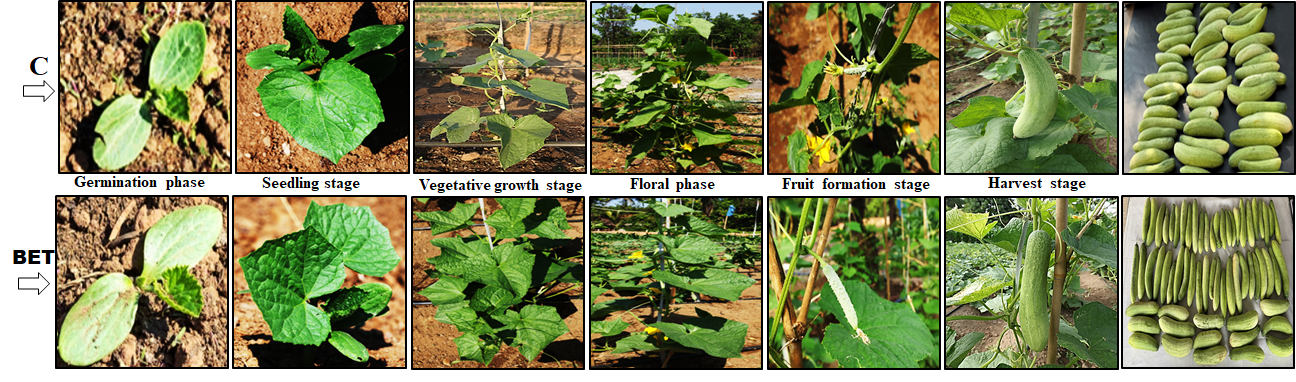
Phenotypic Characterization and Morphological Divergence: Phenotypic characterization revealed significant divergence between the treatment (BTCCBG) and control (CONCCBG) groups across a spectrum of vegetative and reproductive parameters. The treatment group exhibited superior qualitative traits, characterized by increased vigor and enhanced pigmentation. Specifically, BTCCBG displayed dense pubescence on both stems and leaves, whereas CONCCBG exhibited indeterminate stem pubescence. Chlorophyll density appeared higher in the treatment group, evidenced by dark green stem and leaf blade coloration, contrasting with the green stems and medium green leaves of the control. Floral and carpel morphology also showed distinct variation. Reproductive traits showed that BTCCBG flowers exhibited a saturated “dense yellow” hue compared to the standard yellow of CONCCBG. Fruit morphology at the commercial harvest stage, BTCCBG fruits featured a smooth skin texture and green epidermis, while CONCCBG fruits were characterized by a wrinkled texture and light green pigmentation. Upon reaching physiological maturity, fruit skin transitioned to brownish-yellow in the treatment group and brown in the control. Characteristics of seed like seed color at maturity varied from cream in BTCCBG to cream-white in CONCCBG. While both groups predominantly maintained an oblong fruit geometry, the cumulative qualitative data (Table 1) suggests that the BTCCBG protocol significantly enhances the morphological quality and phenotypic expression of cucumber, indicating superior fruit development over the control.
| Control group (CONCCBG) | Treated group (BTCCBG) | |
|---|---|---|
| Plant growth type and habit | Indeterminate and viny | Determinate and viny |
| Stem color | Green | Dark green |
| Stem pubescence density | Indeterminate | Dense |
| Leaf color intensity | Medium green | Dark green |
| Leaf pubescence density (at the vegetative stage) | Indeterminate | Dense |
| Flower colour (at fully developed flower) | Yellow | Dense yellow |
| Blossom end fruit shape (at maturity stage) | Flat | Flat |
| Fruit skin texture | Wrinkle | Smooth |
| Fruit shape | Oblong | Oblong |
| Fruit skin color | Light green | Green |
| Fruit skin colour (at the mature harvest stage) | Brownish yellow | Brown |
| Seed colour (at the mature harvest stage) | Cream white | Cream |
Table 1: Effects of blessing (biofield) energy treatment on qualitative vegetative parameters of cucumber at 70 days after sowing
Phenology and Yield Traits
The rate of germination and plant vine length were increased significantly (p ≤ 0.001) by 13.14% and 41.96%, respectively, in BTCCBG compared to the control, CONCCBG. Plant architecture like number of branches per plant, number of nodes per plant, and internode length were significantly increased by 51.42% (p = 0.025), 30.86% (p ≤ 0.001), and 46.33% (p = 0.025), respectively, in the BTCCBG compared to the control, CONCCBG. Parameters related to photosynthetic capacity such as the number of leaves per plant rose by 33.47% (p = 0.028), supported by a 64.19% (p ≤ 0.001) increase in leaf length, and a 47.80% (p = 0.001) increase in leaf width in the BTCCBG than CONCCBG. Reproductive priming descriptors such as number of male and female flowers per plant were significantly increased in the BTCCBG by 27.23% (p ≤ 0.001) and 48.42% (p = 0.002), respectively compared to the CONCCBG. The most striking impact of the treatment was observed in final yield metrics. The fruit length, fruit width, and fruit weight were significantly increased by 39.89%, 36.30%, and 44.18%, respectively, in the BTCCBG with respect to the CONCCBG. Furthermore, in the BTCCBG number of fruits per plant, yield (kg) per plant, and 100-seed weight were significantly increased by 36.43%, 91.67% (p ≤ 0.001), and 58.97% (p ≤ 0.001), respectively, than CONCCBG. The harvest index was profoundly shifted; fruit yield (tons per hectare) rose by 36.18% from 15.45 ton/ha in the control (CONCCBG) to 21.04 ton/ha in the treatment group (BTCCBG).
| Control group (CONCCBG) | Treated Group (BTCCBG) | P value | |
|---|---|---|---|
| Days to germination | 5 - 7 | 5 - 6 | - |
| Germination rate (%) | 87.26 ± 0.77 | 98.73 ± 0.42 | p ≤ 0.001 |
| Vine length (cm) | 210.49 ± 2.32 | 298.82 ± 2.46 | p ≤ 0.001 |
| Number of branches per plant | 4.57 ± 0.44 | 6.92 ± 0.73 | p = 0.025 |
| Number of nodes per plant | 32.57 ± 0.84 | 42.62 ± 0.73 | p ≤ 0.001 |
| Internode length (cm) | 5.72 ± 0.61 | 8.37 ± 0.81 | p = 0.031 |
| Number of leaves per plant | 32.25 ± 2.68 | 42.72 ± 2.84 | p = 0.028 |
| Days to first male flower | 32.47 ± 2.37 | 30.52 ± 1.63 | p = 0.517 |
| Days to first female flower | 37.52 ± 1.68 | 34.62 ± 1.33 | p = 0.213 |
| Days to 50% flowering | 55.46 ± 2.61 | 50.25 ± 2.73 | p = 0.205 |
| Number of male flowers per plant | 177.26 ± 5.38 | 225.52 ± 5.46 | p ≤ 0.001 |
| Number of female flowers per plant | 32.55 ± 2.04 | 48.31 ± 2.68 | p = 0.002 |
| Number of days to the first fruit harvest | 55.69 ± 0.46 | 51.58 ± 0.39 | p ≤ 0.001 |
| Crop duration (days) | 107.36 ± 1.10 | 106.72 ± 1.68 | p = 0.758 |
| Leaf length (cm) | 11.31 ± 0.63 | 18.57 ± 0.51 | p ≤ 0.001 |
| Leaf width (cm) | 5.23 ± 0.35 | 7.73 ± 0.39 | p = 0.001 |
| Fruit length (cm) | 16.57 ± 0.33 | 23.18 ± 0.26 | p ≤ 0.001 |
| Fruit width (cm) | 5.84 ± 0.21 | 7.96 ± 0.22 | p ≤ 0.001 |
| Fruit weight (g) | 178.49 ± 2.66 | 257.35 ± 3.37 | p ≤ 0.001 |
| Number of fruits per plant | 6.56 ± 0.19 | 8.95 ± 0.34 | p ≤ 0.001 |
| Yield (kg) per plant | 1.20 ± 0.08 | 2.30 ± 0.10 | p ≤ 0.001 |
| 100-seeds weight (g) | 2.34 ± 0.02 | 3.72 ± 0.05 | p ≤ 0.001 |
| Fruit Yield (kg) | 46.34 | 63.12 | - |
| Fruit Yield/sq. m plot (kg/sq. m) | 1.54 | 2.1 | - |
| Fruit Yield/hectare (tones/hectare) | 15.45 | 21.04 | - |
Table 2: Quantitative evaluation of the phenological and yield characteristics of cucumber following spiritual (biofield/prayer)
Data represented as mean ± SEM (n = 5); p ≤ 0.05 vs. control group (CONCCBG) using Student’s t-test. Table 2: Quantitative evaluation of the phenological and yield characteristics of cucumber following spiritual (biofield/prayer) energy treatment.
Discussion
With the aspect of vegetative architecture and photosynthetic potential of cucumber, the transition from green to dark green foliage in the BTCCBG group suggests an enhancement in chlorophyll density or nitrogen assimilation, which is a primary indicator of vegetative vigor. Research indicates that darker leaf pigmentation often correlates with optimized photosynthetic efficiency and nutrient uptake. According to Selvan MG, et al. [11] reported that such shifts in vegetative architecture and leaf color are frequently the result of metabolic priming that enhances light harvesting complexes [11]. Furthermore, the increased pubescence density observed in BTCCBG may serve as a mechanical defense mechanism or a micro-climate regulator for the leaf surface. If we see the reproductive morphology and pigmentation of cucumber, the intensification of floral color from yellow to dense yellow in the treatment group (BTCCBG) indicates a higher concentration of carotenoids or flavonoids, which are vital for pollinator attraction and reproductive success. This is supported by the work of Sharma AK, et al. [12], who found that enhanced floral pigmentation is often linked to the upregulation of the phenylpropanoid pathway under specific growth treatments.
With respect to the fruit quality and surface texture of cucumber, it showed that the divergence in fruit skin texture, transitioning from wrinkled in the control to smooth in the BTCCBG group, which suggests a more uniform cellular expansion and cuticle development in the treated fruits. Smooth skin is a highly desirable commercial trait that reduces susceptibility to post-harvest mechanical damage. As noted by Bennett JR, et al. [13] reported that the structural integrity of the fruit exocarp is fundamentally influenced by the availability of micronutrients during the early stages of ovary development [13]. The progression of fruit color from green to brownish-yellow at the matured harvest stage in BTCCBG highlights a distinct physiological ripening sequence. The variation in seed color (cream versus cream- white) further emphasizes the impact of the treatment on the internal maturation processes of the fruit. In a study by Wang ST, et al. [14] it was demonstrated that seed coat pigmentation is a sensitive marker of the maternal plant’s nutrient status during the grain-filling or seed-setting phase [14].
The most profound result was the 91.67% increase in yield per plant and the rise in total fruit yield from 15.45 to 21.04 ton/ha. This nearly two-fold increase in individual plant productivity, combined with a 58.97% increase in 100-seed weight, suggests that the BTCCBG treatment significantly enhances the source-to-sink relationship. These results are corroborated by Zhang H, et al. [15], where optimized carbon partitioning to the fruits is identified as the hallmark of high-efficiency agricultural inputs. The overall qualitative superiority of BTCCBG, as evidenced by its robust vine characteristics and improved fruit aesthetics, confirms that the treatment significantly altered the botanical parameters of the cucumber. These findings align with the conclusions of Gupta RH, et al. [16], which suggest that specific exogenous applications can unlock latent phenotypic potential in vegetable crops, leading to enhanced marketability.
Conclusion
The results of this study confirm that Spiritual Blessing (Biofield) Energy Intervention serves as a potent, non- invasive tool for enhancing the productivity of Cucumis sativus L. The consistent improvement across both vegetative and reproductive phases suggests that this intervention could be a sustainable supplement to traditional organic farming practices.
Acknowledgement
The authors are grateful to Divine Connection Foundation for the assistance and support during the work.
Conflict of Interests
Author MKT was employed by Trivedi Global, Inc. NRP, VDK, and TBG were employed by Shree Angarsiddha Shikshan Prasarak Mandal’s College of Agriculture, Sangulwadi, Mohitewadi, Maharashtra, India. Authors SM and SJ were employed by Trivedi Science Research Laboratory Pvt. Ltd.
Funding
The authors declare that no funds, grants, or other support were received during the preparation of this manuscript.
References
-
Acharya M, Ghimire S, Gautam N (2024) Evaluating the impact of mulching and fertilizer combinations in maximizing cucumber (Cucumis sativus L.) growth and production. Technology in Horticulture 4: 1.
-
Sanap P, Rayjade M, Khairnar S, Maind D, Phopse O (2024) Review on Cucumis sativus. International Journal of Pharmaceutical Sciences 2(12): 1522-1529.
-
Mallick PK (2022) Evaluating potential importance of cucumber (Cucumis sativus L. - Cucurbitaceae): A brief review. International Journal of Applied Sciences and Biotechnology 10(1): 12-15.
-
Javid H, Fatima U, Rukhsar A, Hussain S, Sharif A, et al. (2024) Phytochemical, nutritional and medicinal profile of Cucumis sativus L. (Cucumber). Food Science and Engineering pp: 358-377.
-
Ajaykumar R, Balamurali B, Sivasabari K, Vigneshwaran R (2022) Spiritual Farming: A Tool for a Sustainable Agriculture Revolution: A Review. Agricultural Reviews 46(1): 123-127.
-
Mohammad G (2025) Harnessing magnetic fields for sustainable agriculture: A study on crop growth, yield, and stress resistance. Current Agriculture Research Journal 12(3): 1077-1089.
-
Iliescu RIG, Dobrin E, Peticila A, Draghici EM (2025) Study on the impact of electromagnetic fields on the growth and development of certain vegetable plant species. Scientific Papers Series B Horticulture 69(2): 474-479.
-
Rubik B, Muehsam D, Hammerschlag R, Jain S (2015) Biofield science and healing: history, terminology, and concepts. Global Advances in Health and Medicine 4(Suppl): 8-14.
-
Lugo-Morin DR (2025) Exploring the possibility of using a quantum methodology to address regenerative agroecological systems. Preprints.org pp: 1-17.
-
Richer-de-Forges AC, Arrouays D, Chen S, Dobarco MR, Libohova Z, et al. (2022) Hand-feel soil texture and particle-size distribution in central France Relationships and implications. Catena 213: 106155.
-
Selvan MG, Arumugam R, Kannan S (2024) Impact of bio-stimulants on the vegetative and physiological parameters of cucumber (Cucumis sativus L.). International Journal of Vegetable Science 30(2): 115- 128.
-
Sharma AK, Singh P, Zhou LJ (2025) Morphological and biochemical characterization of flowering traits in greenhouse cucumbers. Journal of Agricultural and Food Chemistry 73(4): 2045-2058.
-
Bennett JR, Zhao H, Miller KM (2023) Evaluation of fruit epidermal development and post-harvest longevity in specialty cucurbits. Horticulture Research 10(8): 890- 905.
-
Wang ST, Liu L, Zhang Y (2026) Genetic and environmental drivers of seed development and coat coloration in Cucumis sativus. Plant Physiology and Biochemistry 198(1): 45-59.
-
Zhang H, Zhu J, Gong Z, Zhu JK (2022) Abiotic Stress Responses in Plants: Healthier Plants for a Sustainable Future. Nature Reviews Genetics 23(2): 104-119.
-
Gupta RH, Kumar V, Reddy MS (2024) Assessing phenotypic plasticity and yield stability in hybrid cucumber accessions. Nature Communications Biology 7(12): 1422-1435.
- Production of Açaí (Euterpe oleracea Mart.) under Different Agroforestry System Management Intensities in Amazonian Floodplain (Varzea) Forests
- Coffee and the Production Region: What is the Secret to the Expression "Quality"?
- Experiential Agripreneurship Training in Sub-Saharan Africa: Integrating a Business Incubator into Postgraduate Livestock Education at the University of Buea
- Advances in Agricultural High-Quality Development
- Linking Compost Residue to ABAGE in Plants - a Short Note
- Building Living Structures – The Use of Space and Time for their Development