
Major Protein Complexes in Mitochondria-Associated Endoplasmic Reticulum Membranes
Mitochondria-associated membranes (MAMs) are structural and functional connection sites between the endoplasmic reticulum (ER) and mitochondria dynamically connected by many molecules. The MAMs mainly rely on these molecules for their various functions, and protein complexes are the most important ones. Here, we focus on the intrinsic protein complexes involved in MAMs of mammalians. Additionally, we summarized some critical information that may be useful for future research.
Introduction
Mitochondria and endoplasmic reticulum (ER) are two organelles with highly complex structures and functions in a eukaryotic cell that play independent biological roles in previous studies. However, it was observed in the 1950s and isolated in 1990 for the first time that there was a connection between the ER and mitochondria. Afterward, they described it as the mitochondria-associated membranes (MAMs) [1, 2]. Today their composition and function have been investigated in depth. As a communication platform between ER and mitochondria, the MAMs are dynamically connected and perform various functions, mainly relying on a range of molecules [3]. In particular, the protein complexes located in MAMs of mammalian cells are the focus of this review.
IP3R-Grp75-VDAC
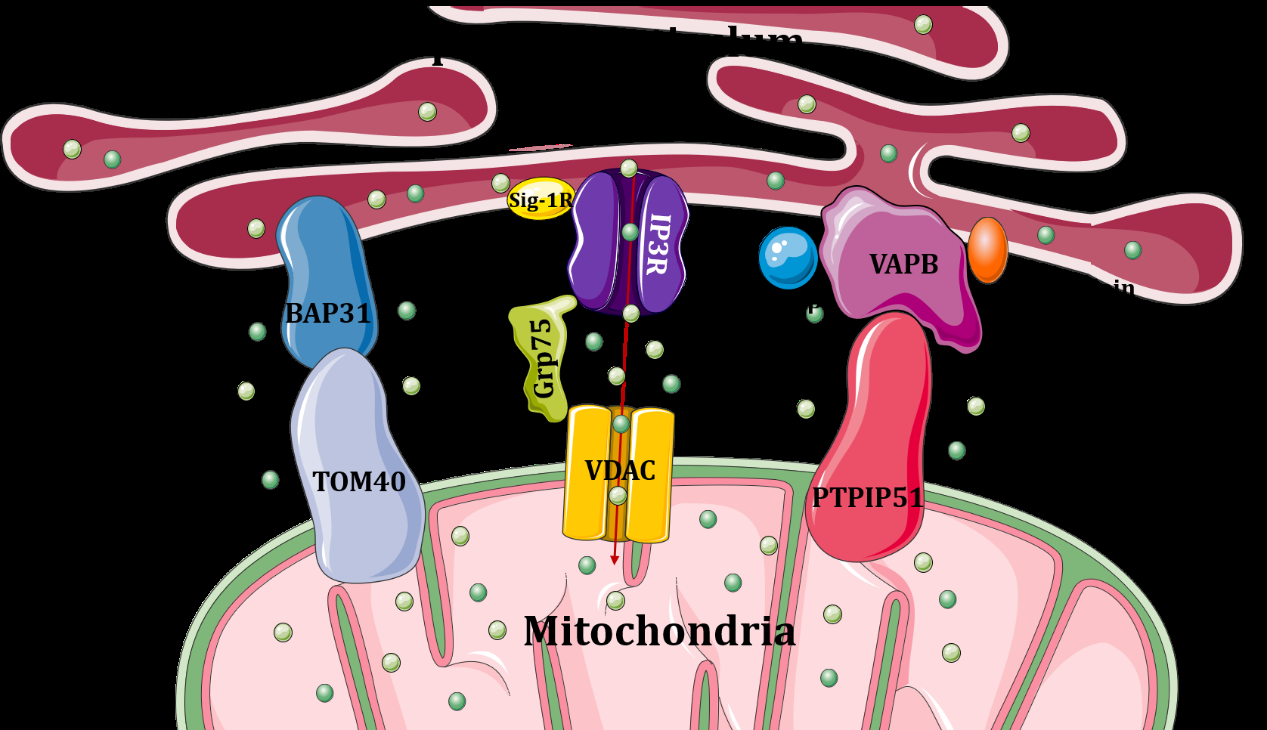
IP3R/Grp75/VDAC is the most important and intensively studied protein complex in MAMs as a marker (Figure 1). The inositol 1,4,5-triphosphate receptor (IP3R) in the ER and voltage-dependent anion channel (VDAC) in the outer mitochondrial membrane (OMM) are the core channels for Ca2+ transport in MAMs [4, 5]. As a member of the heat shock protein 70 families, Grp75 connects IP3R and VDAC to maintain structural stability and proper function of the interaction [6]. The IP3R1 in MAMs is phosphorylated by glucagon depending on PKA to regulate gluconeogenesis in the fasting period [7]. Moreover, silencing of Grp75 in Huh7 hepatocytes to disrupt MAMs function reduced insulin signaling [8]. While over-expression of Grp75 to increase MAMs contents prevented palmitate-induced ER stress [9]. The sigma-1 receptor (Sig-1R) is a chaperone located on MAMs that can affect the Ca2+transport by IP3R to increase ATP production [10].
VAPB-PTPIP51
Recently, the VAPB-PTPIP51 complex was also involved in ER-mitochondria contact. Vesicle-associated membrane protein-associated protein B (VAPB) anchors to the ER membrane by a C-terminal transmembrane domain, and has a vital role in membrane trafficking, lipid transfer, and metabolism, unfolded protein response (UPR), and autophagy [11]. Protein tyrosine phosphatase-interacting protein 51 (PTPIP51) is a mitochondrial outer membrane protein interacting with various proteins to perform different biological functions [12]. Overexpression of either VAPB or PTPIP51 promotes the ER-mitochondria coupling and Ca2+ transport from ER to mitochondria [13]. The siRNA-mediated disruption of the VAPB-PTPIP51 interaction decreases the formation of the MAMs and activates the formation of autophagosomes [14]. α-Synuclein and glycogen synthase kinase-3β (GSK-3β) are proteins that exercise a regulatory function on the complex [13].
BAP31-TOM40
BAP31 and TOM40 are other coupling proteins involved in MAMs. Located at the ER membrane, B cell receptor- associated protein 31 (BAP31) is a transmembrane protein that participates in the endoplasmic reticulum-associated degradation (ERAD) pathway and apoptosis [15]. Situated in OMM, the outer mitochondrial membrane 40 (TOM40) is the translocation enzyme complex promoting external protein translocation to mitochondria [16]. The connection of BAP31 and TOM40 facilitates the pre-NDUFS4 transfer from the cytoplasm to the mitochondria, which increases the nuclear- encoded mitochondrial protein translocation and oxygen consumption [17]. Destroying the BAP31-TOM40 complex of MAMs leads to impaired mitochondrial homeostasis [18].
Conclusion
The protein complexes between the ER and mitochondria are involved in different biochemical reactions and maintain the structural stability of the MAMs. The integrity of the MAMs is fundamental to their biological function. The dysfunction of MAMs is closely associated with various diseases, including aging diseases, cardiovascular diseases, infectious diseases, cancer, and genetic diseases. In particular, the regulation of glucose metabolism, calcium transport, and autophagy by MAMs appears to be important in bone regeneration, a topic that is inextricably linked to dentistry and implantology. Yet, there is a lack of research in this area. The exploration of the protein composition of MAMs has contributed to our understanding of their structural and functional alterations in disease and provided theoretical support for subsequent therapy. However, none of these proteins are specific to MAMs, leading to off-target effects, so the targeted drugs or detection methods for MAMs to be investigated. What’s more, the protein composition of MAMs is abundant, and there are still many new protein complexes to be discovered.
Funding
This work was supported by the Natural Science Foundation of Shandong Province (ZR2021MH092) and the Natural Science Foundation of Jiangsu Province (BK20210111).
References
-
Vance JE (1990) Phospholipid synthesis in a membrane fraction associated with mitochondria. J Biol Chem 265(13): 7248-7256.
-
Bernhard W, Haguenau F, Gautier A, Oberling C (1952) Submicroscopical structure of cytoplasmic basophils in the liver, pancreas and salivary gland; study of ultrafine slices by electron microscope. Z Zellforsch Mikrosk Anat 37(3): 281-300.
-
Cohen S, Valm AM, Lippincott Schwartz J (2018) Interacting organelles. Curr Opin Cell Biol 53: 84-91.
-
Valladares D, Utreras Mendoza Y, Campos C, Morales C, Diaz Vegas A, et al. (2018) IP3 receptor blockade restores autophagy and mitochondrial function in skeletal muscle fibers of dystrophic mice. Biochim Biophys Acta Mol Basis Dis 1864(11): 3685-3695.
-
Lipper CH, Stofleth JT, Bai F, Sohn YS, Roy S, et al. (2019) Redox-dependent gating of VDAC by mitoNEET. Proc Natl Acad Sci U S A 116(40): 19924-19929.
-
D Eletto M, Rossin F, Occhigrossi L, Farrace MG, Faccenda D, et al. (2018) Transglutaminase Type 2 Regulates ER- Mitochondria Contact Sites by Interacting with GRP75. Cell Rep 25(13): 3573-3581.
-
Perry RJ, Zhang D, Guerra MT, Brill AL, Goedeke L, et al. (2020) Glucagon stimulates gluconeogenesis by INSP3R1-mediated hepatic lipolysis. Nature 579(7798): 279-283.
-
Tubbs E, Theurey P, Vial G, Bendridi N, Bravard A, et al. (2014) Mitochondria-associated endoplasmic reticulum membrane (MAM) integrity is required for insulin signaling and is implicated in hepatic insulin resistance. Diabetes 63(10): 3279-3294.
-
Emily T, Stéphanie C, Maud R, Nadia B, Gabriel B, et al. (2018) Disruption of Mitochondria-Associated Endoplasmic Reticulum Membrane (MAM) Integrity Contributes to Muscle Insulin Resistance in Mice and Humans. Diabetes 67(4): 636-650.
-
Hayashi T, Su TP (2007) Sigma-1 receptor chaperones at the ER-mitochondrion interface regulate Ca(2+) signaling and cell survival. Cell 131(3): 596-610.
-
Lee S, Min KT (2018) The Interface between ER and Mitochondria: Molecular Compositions and Functions. Mol Cells 41(12): 1000-1007.
-
Yeo HK, Park TH, Kim HY, Jang H, Lee J, et al. (2021) Phospholipid transfer function of PTPIP51 at mitochondria-associated ER membranes. EMBO Rep 22(6): e51323.
-
Stoica R, De Vos KJ, Paillusson S, Mueller S, Sancho RM, et al. (2014) ER-mitochondria associations are regulated by the VAPB-PTPIP51 interaction and are disrupted by ALS/FTD-associated TDP-43. Nat Commun 5: 3996.
-
Gomez Suaga P, Paillusson S, Stoica R, Noble W, Hanger DP, et al. (2017) The ER-Mitochondria Tethering Complex VAPB-PTPIP51 Regulates Autophagy. Curr Biol 27(3): 371-385.
-
Niu K, Xu J, Cao Y, Hou Y, Shan M, et al. (2017) BAP31 is involved in T cell activation through TCR signal pathways. Sci Rep 7: 44809.
-
Gonzalez Montoro A, Auffarth K, Honscher C, Bohnert M, Becker T, et al. (2018) Vps39 Interacts with Tom40 to Establish One of Two Functionally Distinct Vacuole- Mitochondria Contact Sites. Dev Cell 45(5): 621-636.
-
Takushi N (2019) BAP31 regulates mitochondrial function via interaction with Tom40 within ER- mitochondria contact sites. Sci Adv 5(6): eaaw1386.
-
Quistgaard EM (2021) BAP31: Physiological functions and roles in disease. Biochimie 186: 105-129.
- Diagnosis and Management of Mental Nerve Paresthesia Secondary to Apical Periodontitis of Mandibular Second Premolar: A CBCT Based Case Report
- A Randomized, Double Blinded Clinical Trial to Compare the Effect of Oral Premedication (Diclofenac Potassium or Dexamethasone) on Post-Operative Pain Following Pulpectomy
- Modified Lip Repositioning Technique for the Management of Excessive Gingival Display
- Integral Role of Non-Dental Providers and Fluoride Dissemination
- Root Canal Treatment Rate in Deciduous Teeth Among 6-Year- Olds in the Era of Discontinuing Water Fluoridation - Historical Cohort Study
- The Impact of the Notch1 on the Migratory Capacity and the Expression of E-Cadherin and CyclinD1 in Ameloblastoma Cells