
Anticancer Evaluation of Secondary Metabolites in Hep- 2 Cell Lines from Exiguobacterium Profundum BC2-11
The stressed environment contains full of oxidative stress which constitutes the plants and microbes. These sustains in this environment by changing its biological activity by producing some of the metabolites as intermediate products to survive within the microbial population. As these produce different metabolites with different biological activities so this current investigation has focused on the characterization and biological evaluation of the potential metabolite from E. profundum BC2-11 which was isolated from the stressed environment. The crude pigment extract was subjected to HPTLC profile and it exhibited six peaks, the 5th peak was observed to be highest area of 5973.3 (47.39%) which was the bioactive metabolite. The crude colored metabolite was assessed for antimicrobial assessment against clinical pathogens and it revealed highest activity against maximum pathogens. The radical scavenging activity for the colored metabolite was determined through DPPH, metal chelation, reductive power and total antioxidant capacity. The colored metabolite disclosed 50% of inhibitory activity at lower concentrations. The in vitro cytotoxicity evaluation was analyzed in Hep-2 cell lines and the dilution of 1:4 indicated about 54% cell viability and this was confirmed through MTT assay. Further the colored metabolite will be taken for bioprospecting studies and pharmaceutical applications.
Introduction
Pollution is the effect of undesirable changes in our surroundings that have harmful effects on plants, animals and human beings. This occurs when only short-term economic gains are made at the cost of the long-term ecological benefits for humanity. No natural phenomenon has led to greater ecological changes than have been made by mankind. The most of soil microbes are functionally redundant and replaceable with other species without any change in general soil function. According to recent estimation, the reduction of taxonomic diversity in metal polluted soils can reach 99.9%, with most species belonging to rare taxa, but the functional importance of these rare taxa for soil nutrient cycling and ecosystem resilience is unknown. Changes in the relative diversity and functional characteristics of microbial communities might have unpredictable consequences for nutrient cycling and thus productivity. A research has found the soil bacterial functional diversity to be a good indicator of effects in different metal pollution, ecosystem type or ecosystem management. The changes in the abiotic factors (temperature, moisture) may stronger affect less diverse soil microbial communities. Resistance of the microbial communities in long term polluted soils (e.g. heavy metals) to an additional stressors and/or disturbances (temperature, soil moisture, toxic compounds). A large numer of bacteria, fungi and algae produce pigments. These pigments are biological pigments and can be used for various industrial purposes. Bacteria are found to contain more anticancer property which induces the apoptosis in cancer cells and induces the cell death. With this view, the research has been focused to characterize the propsective secondary metabolites extract and evaluate its cytotoxicity properties in Hep-2 cell lines. This would reveal the anticancer property for the secondary metabolites extract from E. Profundum BC2-11 (Genebank accession No: KP966110) [1].
Materials and Methods
Antioxidant Activity
DPPH radical scavenging assay: The effect of colored metabolite extract on DPPH radical was determined using the method of Mani et al (2015). Different concentrations of the colored metabolite extract (50 to 100 µg/ml) were prepared and subjected to antioxidant tests. To 1 ml of each concentration of the extract, 5 ml of 0.1mM methanol solution of DPPH was added, vortexed and followed by incubation at 27ºC for 20 min. The control was prepared without any extract and absorbance of the sample was measured at 517 nm using UV/VIS Spectrophotometer using methanol to set 0. The ability to scavenge DPPH radical was calculated by the following equation: DPPH scavenging effect (%) = [(A0-A1)/A0] x 100; Where A0 was the absorbance of the control reaction and A1 was the absorbance in the presence of the standard sample or fraction. As the secondary metabolites extract contain rich in antioxidants, the extract was taken for cytotoxicity evaluation through MTT analysis.
In vitro Cytotoxicity Analysis
The Hep- 2 cell lines was were purchased from NCCS Pune were maintained in Dulbecco’s modified eagles media (HIMEDIA) supplemented with 10% FBS (Invitrogen) and grown to confluency at 37°c in 5 % CO2 in a humidified atmosphere in a CO2 incubator(NBS, Eppendorf, Germany). The cells were trypsinized (500µl of 0.025% Trypsin in PBS/ 0.5mM EDTA solution (Himedia)) for 2 minutes and passaged to T flasks in complete aseptic conditions. For the assays and the continuous cell propagation adherent monolayers in exponential growth phase (about 80% confluence) were harvested with trypsin/ EDTA (0.05%/0.02 %) in phosphate buffered saline (PBS).
MTT Assay
MTT is a colorimetric assay that measures the reduction of yellow 3-(4, 5dimethythiazol-2-yl)-2, 5- diphenyl tetrazolium bromide (MTT) by mitochondrial succinate dehydrogenase. The MTT enters the cells and passes into the mitochondria where it is reduced to an insoluble, coloured (dark purple) formazan product. The cells are then solubilised with an organic solvent Dimethyl sulfoxide (Himedia) and the released, solubilised formazan product was measured at 540nm. Since reduction of MTT can only occur in metabolically active cells the level of activity is a measure of the viability of the cells. 6.25,12.5,25,50,100µg/ml of sample was added from 1mg/ml stock to grown cells and incubated for 24 hours. The % difference in viability was determined by standard MTT assay after 24 hours of incubation. The cells were washed with 1x PBS and then added 30µl of MTT solution to the culture (MTT -5mg/ml dissolved in PBS). It was then incubated at 370C for 3 hours. MTT was removed by washing with 1x PBS and 200µl of DMSO was added to the culture. Incubation was done at room temperature for 30 minutes until the cell got lysed and colour was obtained. The solution was transferred to centrifuge tubes and centrifuged at top speed for 2minutes to precipitate cell debris. Optical density was read at 540 nm using DMSO as blank in a micro plate reader (ELISASCAN, ERBA). % viability = (OD of Test/ OD of Control) X 100.
Results
DPPH Antioxidant Assay
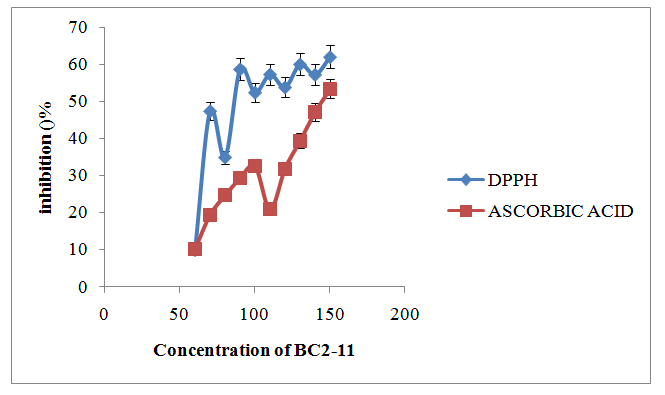
DPPH free radical determines the free radical scavenging capacity or antioxidant potential (AOD) of the pigment sample, which shows its effectiveness by prevention, interception and repair mechanisms against injury in a biological system [1]. In this investigation, the IC50 value of colored metabolite extract was found to be 870μg/mL concentration. It means that the colored metabolite had good scavenging activity at least concentration which is equivalent to standard ascorbic acid (Figure 1).
Cytotoxicity Analysis
MTT Analysis
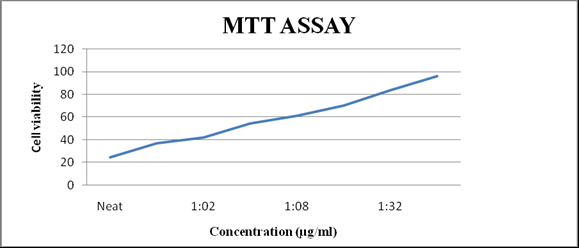
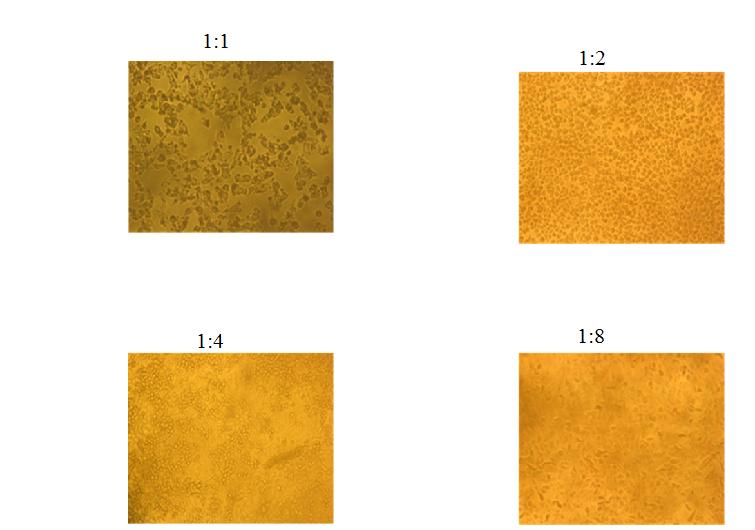
The MTT analysis will reveal the cell death and cell viability at different concentration of the extract which was done in duplicates. In this investigation the sample was diluted at different concentration such as 0.2, 0.4, 0.6, 0.8, 1.0, 1.2 and 1.4 µg/mL (Table 1 and Figure 2). The secondary metabolites extract was found to inhibit maximum cells at a moderate concentration. At the concentration of 1:4 the cell viability was found to be 54.38% which constitutes the compound of about 0.6 µg (Figure 3). This exhibited the maximum inhibition of the extract at minimum concentration.
| S.no | Dilutions | Absorbance | Cell viability | ||||||||
|---|---|---|---|---|---|---|---|---|---|---|---|
| 1 | Neat | 0.14 | 24.56 | ||||||||
| 2 | 1:1 | 0.21 | 36.84 | ||||||||
| 3 | 1:2 | 0.24 | 42.10 | ||||||||
| 4 | 1:4 | 0.31 | 54.38 | ||||||||
| 5 | 1:8 | 0.35 | 61.40 | ||||||||
| 6 | 1:16 | 0.40 | 70.17 | ||||||||
| 7 | 1:32 | 0.48 | 84.21 | ||||||||
| 8 | 1:64 | 0.55 | 96.49 | ||||||||
| 9 | Cell control | 0.57 | 100 |
Table 1: MTT analysis of secondary metabolites extract from E. profundum BC2-11.
Discussion
The bacterial strains were found to inhabitant on soil environment. The iron and steel industry causes significant effects on environmental media such as air emissions, soil pollution by sedimentation and water pollution of settling up of organic matter, oil, grease, suspended solids, benzene, phenols, acids and ammonia. These interact with the soil community and the community includes plants, microbes and water source. These conditions drastically affect the microbe which leads to produce different molecules and metabolites for their survival between the microbial communities. Because of these serious problems the micro organisms were able to develop different pathways for synthesizing different metabolites [1]. This strain E. profundum BC2-11 was reported to produce the carotenoids [2]. The colored metabolite was extracted using methanol when compared to other solvents. The stressed environmental soil had majority of micro organisms which were prevalent in producing different metabolites for their survival between microbial communities. The isolated Exiguobacterium profundum BC2-11 produced orangish metabolite which possessed the antimicrobial as well as possesses the antioxidant property. This secondary metabolites extract was taken for anticancer evaluation through MTT analysis. The different dilution of the extract was assessed and cell viability ranged as 54% at 1:4 diluted concentrations. The cells will enter the G0/ G1 phase where the proliferation starts and the cell which are not in complete morphology will be neglected in this stage. The complete cells will enter the S phase where the genetic materials will be synthesized and the cell will pass on to G2 and M phase where mitosis taken place with the division. The cells will get multiplied at this stage. Most of the secondary metabolites attack the G1 phase so that cells will not enter S phase and these will be dead at this phase itself. Whereas most of the anticancer metabolites induce the apoptosis in S phase which would eventually stop the growth and further processes in a cell. So the cell viability will be less when compared to other non cancerous drugs. In this investigation, the secondary metabolites extract profoundly induce apoptosis at G phase and further confirmation have to be determined through FACS analysis. So we suggest that this orangish metabolite can be taken as anticancer drug in medical fields.
References
-
Manon Mani V, Keerthana G and Preethi K (2015) Evaluation of antioxidant potential of bioactive colored metabolite isolated from Exiguobacterium profundum BC2-11 and it’s bioactivities. Int J Recent Sci Res 6(4): 3612- 3617.
-
Fatima S, Hoda Y, Hanafy H (2013) Pigment production by Exiguobacterium aurantiacum FH, a novel Lebanese strain. Int J Curr Microbiol App Sci 2(12): 176-191.
- Antifungal Activity of New Acetophenone Derivatives
- Interconnected Microbiomes Human Health Within an Environmental Framework
- Silkworm-Based Vaccine Production for H5N1: A One Health Approach to Pandemic Preparedness
- Microbial Diversity and Lipolytic Activity of Bacteria and Fungi from Oil-Contaminated Sites in Makurdi Metroplois
- Antibiotic Resistance Profile of Bacteria Isolated at the Central Laboratory of the National Hospital Center of Nouakchott
- Epidemiology and Sensitivity to Antibiotics of Germs Isolated from Blood Cultures in the Laboratory of the National Hospital Center of Nouakchott-Mauritania