
Genome Editing: Tools and Application in Plants
The emergence of genome editing methods promises a real revolution in genetic engineering. These technologies rely on engineered nucleases that cleave DNA in a sequence-specific manner because of the presence of a sequence-specific DNA-binding domain or RNA sequence. Genome editing by engineered nuclease have the potential to change the genomic architecture of a genome at precise locations, with desired accuracy. Several engineered nucleases, including zinc finger nucleases (ZFNs) and TAL effectors nucleases (TALENs) and CRISPR CAS 9 have been used in plants, promising to revolutionize conventional methods of genetic engineering. Targeted editing of the genomes of an organism used to improve productivity and quality of crops. Given the power of genome editing tools and the increasing number of researchers using and developing these tools, a revolutionary change is taking place in crop that resistance to various biotic and abiotic stresses to meet the increasing demand for food and ensure world food security in the future. The review highlights the broad applicability of engineered Nuclease (ZFN, TALEN, and CRISPR CAS 9) mediated targeted plant genome editing and their application for development of designer crops.
Introduction
Since the discovery of the DNA double helix in 1953, many basic biological concepts such as gene transcription and translation, genetic code and epigenetic modification, have been established by developing multiple experimental techniques. These include enzymes for in vitro DNA manipulations (such as polymerases, restriction endonucleases and DNA ligases), recombinant DNA technology, in vitro DNA synthesis, site-specific mutagenesis, and whole-genome sequencing. Nonetheless, site-specific modification within genomes has remained a major challenge [1].
The earliest method of genome editing in higher plants involved oligonucleotide‐mediated mutagenesis (OMM) to cause site‐specific gene targeting using chemically synthesized oligonucleotides with base replacement or addition caused by endogenous DNA‐repair enzymes .The method differs from genome editing with engineered nucleases approaches in that OMM does not deliver a nuclease to the site of action. Optimized OMM trait development systems are resulting in the first genome‐edited crops for commercial release [2]. Recent discoveries in genome editing use site‐directed nucleases (SDNs) where engineering of the nuclease allows for highly specific targeting to any given gene of interest. Engineered nucleases create site-specific double-strand breaks (DSBs) at specific locations in the genome of an organism. The double-strand breaks are repaired through non homologous end-joining (NHEJ) or homologous Directed recombination (HDR).
Several engineered nucleases, including zinc finger nucleases (ZFNs) and TAL effector nucleases (TALENs) and CRISPR CAS 9 have been used in plants, promising to revolutionize conventional plant breeding [3, 4]. ZFNs and TALENs are artificial bipartite enzymes that consist of a modular DNA-binding domain and the FokI nuclease domain. The DNA-binding domain can be engineered to recognize a specific DNA sequence. In addition, there is a high rate of failure, at least for ZFNs, to recognize and cleave the intended DNA sequence [5]. The most rapidly emerging tool is a bacterial monomeric DNA endonuclease, known as Cas9 (CRISPR-associated protein 9), which can be targeted to a specific genomic sequence by an easily engineered 20 base pair (bp) RNA guide sequence that binds to its DNA target by Watson Crick base-pairing [6].
Gene editing using programmable nucleases is arguably a key component of the future in crop improvement and will significantly contribute to increasing crop yield without additional land, through advancing plant biology research and directly editing crops. A programmable nuclease binds a specific target DNA sequence and makes a double-stranded break. Erroneous repair of the break by non-homologous end joining can induce insertion/deletion mutations whereas homologous recombination can induce insertions or gene repair from an exogenously supplied template [7].
Besides potential for boosting crop yields, genome editing is now one of the best tools for carrying out reverse genetics and is emerging as an especially versatile tool for studying basic biology. Although genome editing introduces foreign DNA into the genome, it may simply involve changes of a few nucleotides in the plant’s own DNA. These technologies are efficient as transgenic methods and could be used to generate new varieties without introducing foreign genes into the plant genome in many cases. Therefore, new crop varieties generated using these methods could be considered as non- transgenic and more acceptable in societies where transgenic plants are rejected by the public. Gene editing using programmable nucleases is a key component of the future in crop improvement and will significantly contribute to increasing crop yield without additional land, Increase disease and herbicide resistance, addition of nutritional value to crops through advancing plant biology research and directly editing crops [7]. In this review, I briefly described recent method of genome editing systems and their application in plants and crop improvement.
Genome Editing Tools
The use of synthetic biology requires a complete understanding of the biological processes that need to be integrated into the genome. Several DNA, RNA, and protein-based tools have been developed to edit and incorporate suitable agronomic traits into the desired crops. Random integration of genes into the existing genomes of target organisms to obtain a transgene construct is one of the most common mechanisms for gene targeting [8, 9]. Hence, plant biologists used transposons or retro-transposons to incorporate a transfer DNA (T-DNA) insertion mutant, resulting in random insertions [10]. Sometimes, the random insertion fails to completely knockout the open reading frame of a gene, leading to the increased possibility of obtaining mutant plants with partial functions, dominant-negative effects, or aberrant protein products. The introduction of single nucleotides into the genes (or amino acids into the proteins) cannot be completed using such methods. Hence, chemical mutagenesis methods and target-induced local lesions in genomes have been developed to overcome such problems [11, 12].
With the beginning of the first transgenic experiments in the 1980s, strategies have been developed to establish new traits in crop plants by combinatorial use of strong or tissue-specific promoters fused to protein encoding genes. After realizing that certain transgenes and even similar endogenous genes were silenced, strategies were established for knocking down genes responsible for certain unwanted traits, which are based on RNA interference (RNAi) [13]. However, these approaches did not lead to complete gene knockouts in many cases and have not been widely adopted in plant breeding so far. Many efforts have been undertaken to develop homologous recombination (HR) in plants, which was widely used in bacteria, yeast and mouse for gene replacements or corrections, but could not be established in plants with a promising success rate [14]. A paradigm shift was established in the middle of the 1990s with the introduction of double strand breaks (DSBs) by mega nucleases that have a recognition site of 18 bp and were first identified in yeast mitochondria. With induced DSBs by mega nucleases, much higher numbers of HR events could be observed [15] and finally DSBs have also lead to induced mutations by incorrect repair mechanisms. With the use of mega nucleases, the position for a HR or a putative mutation was exactly predictable [16].
However, recognition sites are randomly scattered in the genome and a redesign of recognition motifs for specific target genes is very laborious. With the invention of zinc finger nucleases (ZFNs), for the first time every gene could be targeted. The discovery of transcription activator-like effector (TALE) proteins, which are channeled to plant cells by bacterial pathogens of the genus Xanthomonas to activate plant genes and, thereby, increasing the virulence of the pathogen allowed an even easier targeting of genome editing sites [17]. In recent years, we have the fastest spread of a method in biology ever that achieves genome editing. It relies on an adaptive immune response of bacteria and archae bacteria and is based on clustered regularly interspaced short palindromic repeats (CRISPR). This allows bacteria to identify invading DNA by a small RNA encoded by the so- called spacer, which was taken up by the species during a historical or more recent attack of virus or plasmids [18].
Zinc Finger Nucleases
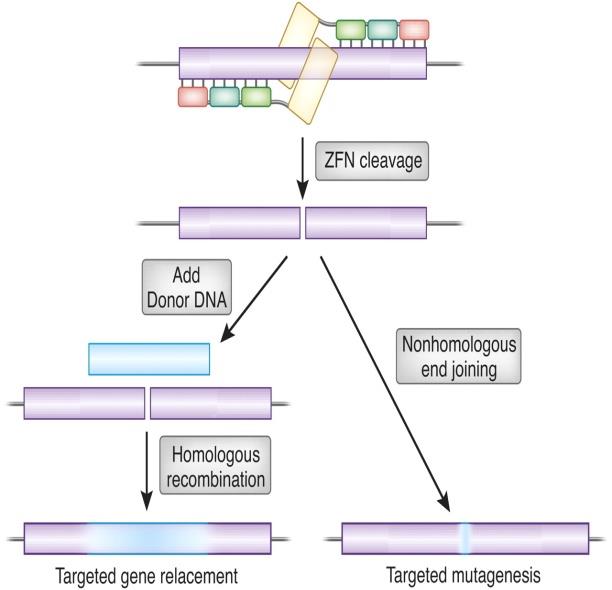
ZFNs are chimeric molecules with three to four zinc finger DNA binding domains, from which each recognizes a triplet of nucleotides by binding, and a FokI nuclease [19]. Zinc finger nucleases are proteins bearing multiple zinc finger domains that are capable of recognizing a specific sequence of six to nine consecutive base pairs within the genome of a particular organism. To the C- terminal end of this DNA recognition molecule is added a nonspecific nuclease domain from the restriction enzyme FokI to create one-half of a ZFN pair. The second half of the pair has a similar structure and designed to recognize and bind to a DNA sequence on the opposite DNA strand approximately 6 nucleotides away from the first ZFN [20].
The DSB is often repaired by the nonhomologous end joining (NHEJ) DNA repair mechanism that is error-prone. That is, during the repair process, usually small number of nucleotides can be deleted or added at the cleavage site. If this faulty repair is in the coding region of a gene, it can disrupt the reading frame and create an inactive (knockout) gene. Alternatively, if a DNA fragment with strong homology to the disrupted gene (but not the exact same sequence) is present, the new DNA fragment can bind and displace the original gene sequence by a process called homologous recombination and result in ‘gene replacement [21, 22].
Successful use of ZFNs for gene editing in Arabidopsis was first reported in 2005 [23]. Then reported in tobacco 2005 [24]. An important step forward in making gene replacement through HR more facile was the recent design of plasmids containing DNA replication origins from Gemini viruses. These modified viruses allowed delivery of ZFNs (or Cas9/sgRNA genes) and, simultaneously, delivery of fragments of DNA that were homologous to target gene sequences and that contained a desired gene mutation [25]. Zinc finger nucleases have also been utilized to demonstrate that several other gene editing and chromatin modification techniques are possible with designer nuclease technologies [26]. For example, cell- and tissue-specific gene expression is possible, as shown by the ability to localize gene expression to the egg cell in Arabidopsis [27]. A designed pairs of ZFNs have been effective in allowing creation of both small and large [28, 29] (Figure 1). Deletions of chromosomal segments [30] (Table 1).
| Organism | Method | References | ||||||
|---|---|---|---|---|---|---|---|---|
| Danio rerio | Embryo Injection Zygote | [31] | ||||||
| Hemicentrotu pulcherrimus | Injection | [32] | ||||||
| Xenopustropicalis | Embryo, injection | [33] | ||||||
| Rattus norvegicus | Zygote, injection | [34] | ||||||
| Mus musculus | Zygote, injection | [35] | ||||||
| A. thaliana | DNA transformation | [36] | ||||||
| Nicotiana sp. | Cell culture | [37] | ||||||
| Zea mays | Viral delivery | [38] | ||||||
| Homo sapiens | Viral delivery | [39] | ||||||
| M. musculus | DNA transformation | [40] | ||||||
| Cricetulus griseus | DNA transformation | [41] | ||||||
| Sus domestica | DNA transformation | [42] |
| Transcription Activator-Like Effectors | |
|---|---|
| Nucleases (Talens) |
Transcription activator-like effectors nucleases are engineered from fusing a TAL effectors DNA-binding domain to a DNA cleavage domain (a nuclease which cuts DNA strands). Transcription activator-like effectors (TALEs) can be engineered to bind to practically any desired DNA sequence, so when combined with a nuclease, DNA can be cut at specific locations [43]. The restriction enzymes can be introduced into cells, for use in genome editing with engineered nucleases (Figure 2).
![Figure 2: General structure of TALENs. TALENs have generated much interest and excitement because they can be very easily and rapidly designed by researchers using a simple ‘protein-DNA code’ that relates modular DNA-binding TALE repeats domains to individual bases in a target-binding site. Over the last years, leveraging technologies and methodologies previously developed for the use of ZFNs, several groups have used TALENs to modify endogenous genes in yeast, fruit fly, roundworm, crickets, zebra fish, frog, rat, pig, cow, thale cress, rice, silkworm, and human somatic, and pluripotent stem cells Supplementary and presumably the technique will continue to extend to additional organisms[44]. Furthermore, a recent large-scale test demonstrated that TALENs have a very high success rate and can be used to target essentially any DNA sequence of interest in human cells. Although ZFNs and TALENs have not been directly compared, many studies have shown that TALENs and ZFNs have comparable efficiencies when targeted to the same gene [45]. Thus, the ease of design, high rates of cleavage activity, and the essentially limitless targeting range of TALENs make them suitable for the use by non-specialist researchers.](/fulltextimages/3299/fig_2.jpeg)
Figure 2: General structure of TALENs. TALENs have generated much interest and excitement because they can be very easily and rapidly designed by researchers using a simple ‘protein-DNA code’ that relates modular DNA-binding TALE repeats domains to individual bases in a target-binding site. Over the last years, leveraging technologies and methodologies previously developed for the use of ZFNs, several groups have used TALENs to modify endogenous genes in yeast, fruit fly, roundworm, crickets, zebra fish, frog, rat, pig, cow, thale cress, rice, silkworm, and human somatic, and pluripotent stem cells Supplementary and presumably the technique will continue to extend to additional organisms[44]. Furthermore, a recent large-scale test demonstrated that TALENs have a very high success rate and can be used to target essentially any DNA sequence of interest in human cells. Although ZFNs and TALENs have not been directly compared, many studies have shown that TALENs and ZFNs have comparable efficiencies when targeted to the same gene [45]. Thus, the ease of design, high rates of cleavage activity, and the essentially limitless targeting range of TALENs make them suitable for the use by non-specialist researchers.
Crispr/Cas9 Technology
The search for an evolutionary genome editing approach results in to the advent of a system called clustered Regularly Interspaced Short Palindromic Repeat (CRISPR/Cas9). When compared with previous genome editing systems (TALENs and ZFNs), CRISPR/Cas9’s simplicity, efficiency, specificity, minimal off-target effects, and amenability to multiplexing has brought hasty genetic manipulation in almost all tested eukaryotes CRISPR/Cas9 Technology. CRISPR/Cas9 system was first discovered by Japanese scientist in bacteria as an adaptive immune system by which enables the bacteria to defend against invading foreign DNA, like bacteriophage. Later on they were found in 40 % of sequenced bacterial genomes and 90% of the archaea [46].
The CRISPR system is composed of CRISPR loci in the genome and a Cas9 protein. The engineered CRISPR/Cas9 system contains the following three main components: the CRISPR associated protein 9 (Cas9), and two noncoding CRISPR RNAs (crRNAs). A trans-activating crRNA (tracrRNA) and a precursor crRNA (precr RNA). Cas9 contains an HNH nuclease domain and a RuvC-like nuclease domain that involved in the crRNA maturation process and crRNA-guided DNA cleavage. The tracrRNA is a small trans encoded RNA complementarity to the repeats within the pre-crRNA. The pre-crRNAs are transcribed from CRISPR loci. The palindromic repeats (usually between 23 and 47 bp) are typically identical in length and sequence within a CRISPR locus. The spacers (typically 21-72 bp) are derived from invading viral DNA and guide Cas9 to cleave an invading protospacer. The pre-crRNA encompasses much of the CRSIPR repeat- spacer array and is transcribed together with the tracrRNA. Subsequently, the tracrRNA hybridizes with the pre-crRNA to form an RNA duplex and associates with Cas9. The mature crRNA: tracrRNA duplex directs Cas9 to the DNA target sequence consisting of protospacer adjacent motifs (PAM) and complementary protospacer sequence. Finally, the Cas9 HNH nuclease domain cleaves the DNA strand that is complementary to the RNA guide while the RuvC-like nuclease domain cleaves the DNA strand that is non-complementary to the target to create a DSB within the protospacer about 3-4 nucleotides upstream of the PAM [47, 48, 49]. A Protospacer Adjacent Motif (PAM) downstream of the gRNA binding region is required for Cas9 recognition and cleavage as illustrated in (Figure 3) [50]. Cas9/gRNA cuts both strands of the target DNA, triggering endogenous Double Strand Break (DSB) repair. For a knockout experiment, the DSB is repaired via the efficient but error -prone Non Homologues End Joining (NHEJ) pathway, which introduces an indel at the DSB site that knocks out gene function. In a knock -in experiment, the DSB is repaired by Homology Repair (HR) using the donor template present, resulting in the donor DNA sequence integrating into the DSB site.
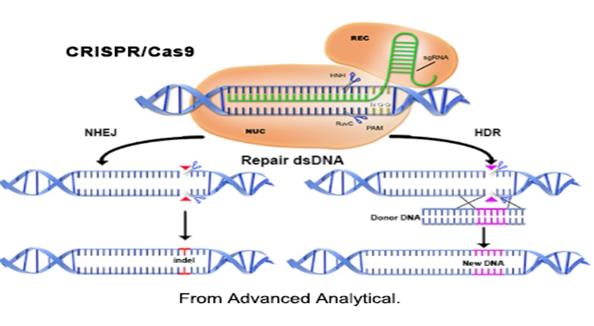
NHEJ based genome editing by CRISPR-Cas9
Due to ease of engineering, CRISPR-Cas9 has been widely adopted for genome editing in plants (Table 2). CRISPR-Cas9 quickly moved beyond proof-of-concept; promoting a reverse genetics revolution in plant research and creating many desirable traits in major crops. Using rice as an example, multiple yield-related genes have been targeted in rice [50].
CRISPR-Cas9 has been widely used for functional study on rice genes. In addition, environment induced male sterility has been engineered to facilitate hybrid- based breeding [51]. Disease resistance traits have been developed by knocking out host genes in rice and Arabidopsis [52] .The intrinsic property of CRISPR-Cas9 for targeting viral DNA for cleavage makes it a great tool to increase plant immunity against DNA viruses (Table 3).
| Plant species | Target gene | Modification | Reference | ||||||||
|---|---|---|---|---|---|---|---|---|---|---|---|
| Arabidopsis | PDS3, FLS2, RACK1b, | NHEJ | [53] | ||||||||
| Arabidopsis | BRI1, GAI, JAZ1 | NHEJ | [54] | ||||||||
| Arabidopsis | CHLI1, CHLI2, TT4, | NHEJ | [55] | ||||||||
| Arabidopsis | AP1 | NHEJ | [56] | ||||||||
| Barley | GFP (transgene) | NHEJ | [57] | ||||||||
| Cabbage | HvPM19 | NHEJ | [57] | ||||||||
| Camelina | BoIC.GA4.a | NHEJ | [58] | ||||||||
| C. reinhardtii | FAD2 | NHEJ | [59] | ||||||||
| Cotton | CpFTSY, ZEP | NHEJ | [60] | ||||||||
| Cotton | GFP (transgene) | NHEJ | [61] | ||||||||
| Cotton | MYB25-like A, MYB25 | NHEJ | [58] | ||||||||
| Dandelion | DPT 5 | NHEJ | [62] | ||||||||
| Flax | CLA1, VP | NHEJ, HDR | [63] | ||||||||
| Grape | 1-FFT | NHEJ | [64] | ||||||||
| Lettuce | EPSPS, BFP (transgene) | NHEJ | [65] | ||||||||
| Liverwort | Rt3 | NHEJ | [66] | ||||||||
| Lotus | IDN DH, BIN2, ARF1 | NHEJ | [67] |
Table 3: CRISPR-Cas9 mediated genome editing in plants.
| ZFN | TALENS | CRISPR CAS 9 | References | |
|---|---|---|---|---|
| components | Zn finger domains Nonspecific FokI nuclease domain | TALE DNA-binding domains Nonspecific FokI nuclease domain | crRNA, Cas9 protein | [63] |
| Structural protein | Dimeric protein | Dimeric protein | Monomeric protein | [63] |
| catalytic domain | Restriction endonuclease FokI | Restriction Endonuclease FokI Endonuclease FokI | RUVC, HNH | [7,63] |
| Length of target sequence | 24-36 | 24-59 | 20-22 | [68,30] |
| Protein engineering step | required | required | Should not be complex to test gRNA | [26,69] |
| Cloning | necessary | necessary | Not necessary | [26,69] |
| gRNA production | No applicable | Not applicable | Easy to produce | [69,70] |
| Mode of action | Double-strand breaks in target DNA | Double-strand breaks in target DNA | DSB or Single -strand nicks in target DNA | [63,70] |
| Mutation rate | High | middle | low | [63] |
| Multiplexing | difficult | difficult | possible | [70,71] |
Table 4: Comparison of plant genome editing techniques.
Application of Genome Editing in Plants
Gene Knockout
At present, the most widely used and important application of genome editing is to knockout target genes. In plants, NHEJ is the main pathway used to repair DSBs, and the process can introduce small deletions or insertions (indels), typically smaller than 100 bp. Introduction of indels in a coding region mostly leads to frame shift mutations resulting in the loss of gene function. Most importantly, the mutations are stable and heritable in future generations. Due to its simplicity and high efficiency, CRISPR/Cas9 is now the dominant tool for knocking out genes [72].
Genome editing has been used for simultaneous targeting of multiple genes in many plant species, including Arabidopsis, rice, maize, soybean and tobacco Multiplex gene editing is not only useful for functional genomics research, such as the study of redundant gene families and functionally related genes but is also important for crop improvement, allowing fast pyramiding of multiple traits. For example, CRISPR/Cas9 was used to simultaneously knockout three negative regulators of grain size in rice, GW2, GW5, and TGW6 and the new varieties exhibited 20%-30% increases in grain size and weight compared to the wild type [73].
When two DSBs are introduced on the same chromosome at a certain distance, the two sites may connect through the NHEJ pathway resulting in the deletion of the intervening sequence. Relatively large deletions are useful for some purposes in research and crop improvement, such as the study of gene clusters and non-coding RNAs. TALEN and CRISPR have been used to produce large deletions in species such as rice, Arabidopsis, and tobacco [74]. In rice, up to 245 kb has been removed from the genome with a high frequency using CRSIPR/ Cas9 and our group successfully deleted a large genomic fragment in Arabidopsis containing the CBF1, CBF2andCBF3genes [75].
Gene Targeting
Gene targeting refers to the use of genetic engineering methods to produce a one-for-one substitution of a DNA fragment (gene replacement) or the insertion of a new sequence in a specific genomic locus (gene knock in). Gene targeting has many applications in functional genomics research, such as precise gene modifications and epitope tagging of endogenous proteins. Gene targeting has been the focus of research for a long time, mostly based on homologous recombination, but the low frequency of targeted integration limited its use to a very few species such as tobacco and rice [76]. For many years, ZFN, TALEN and CRSIPR/Cas9 have been successfully used for gene targeting in tobacco, maize, Arabidopsis, tomato, rice, barley, flax, moss soybean and wheat. One drawback of HDR technique is low efficiency, but theoretically possible to increase HDR-mediated gene targeting efficiency by suppression of the NHEJ pathway. Another way to improve HDR-mediated gene targeting is to deliver large amounts of repair template, donor DNA, to the plant nucleus. Particle bombardment can provide multiple copies of donor DNA and has been employed for genome editing-assisted gene targeting in multiple plants [63, 77]. Gemini virus system is also another method to deliver abundant donor DNA which has the property of excising a fragment of its genomic DNA once inside a cell to produce a self-replicating plasmid.
Application of Genome Editing Systems in Crop Improvement
In the last several years, genome editing has been used to produce new crop varieties with improved traits, including increased yield, enhanced disease resistance, improved food quality and higher stress tolerance (Table 4).
Improved Yield
Grain yield is mainly determined by grain number, size and weight, all of which are typical quantitative traits, and many genes affecting crop yield have been characterized. Knockout of genes known to negatively affect yield, such as GS3, DEP1, GS5, GW2, Gn1a, and TGW6 in rice, is a simple and direct way to improve crops. GS3, DEP1 and Gn1a have been individually mutated using CRISPR/Cas9, and some of the predicted phenotypes were observed [50]. Simultaneous knockout of GW2, GW5, and TGW6 in rice resulted in a 29.8% increase in thousand-grain weight in the triple mutant. In bread wheat, thousand- kernel weight also exhibited an increase after the three homo-alleles of GASR7, a negative regulator of kernel width and weight, were knocked out using CRISPR/Cas9 [78]. It is nevertheless important to remark that increased grain yield per plant and higher thousand-grain weight does not necessarily translate into improved crop yield, because large-scale field trials are necessary to verify the potential agronomic improvements.
Improved Oil Composition
A high content of polyunsaturated fatty acids, particularly linolenic acid, in oils results in poor oxidative and frying stability which limits their applications. Fatty acid desaturase (FAD) genes have been targeted to change fatty acid composition and improve oil quality. The FAD2 gene family is responsible for the conversion of oleic acid (monounsaturated) into linoleic acid while enzymes encoded by the FAD3 gene family catalyze the production of linolenic acid from linoleic acid. TALENs were used to simultaneously knock out two soybeanFAD2genes, FAD2-1AandFAD2-1B, resulting in vastly improved oil quality: oleic acid increased from 20% to 80% and linoleic acid decreased from 50% to <4% [79]. To further improve oil composition, mutations in FAD3A were introduced into the previously produced fad2- 1a/fad2-1b soybean plants by TALEN, resulting in further increased levels of oleic acid and decreased levels of linolenic acid. Recently, two independent groups used CRISPR/Cas9 to simultaneously knock out all three FAD2 homeolog genes in the allohexaploid, camelina sativa, producing a significant enhancement in oil composition [77].
Biotic and a Biotic Resistance
Genome editing has been applied to increase disease resistance by editing disease-related gene. In rice, Li, T. et al (2012) [80] targeted the rice bacterial blight susceptibility gene OsSWEET14 for TALEN‐based disruption and observed strong resistance to infection with normal phenotypes. Moreover, Wang et al. (2016) [81] modified OsERF922 and observed significantly enhanced blast resistance with no effect on important agronomic traits. In wheat, by inactivating all three MILDEW‐RESISTANCE LOCUS (MLO) genes, Wang et al. (2014) [82] showed that the infection rates were significantly reduced combined with a race non‐specific resistance. With a similar approach in cucumber, virus resistance could be produced by editing the recessive elF4E (eukaryotic translation initiation factor 4E), without affecting plant development [83]. In terms of abiotic stress tolerance, genome editing can be a valuable weapon in generating novel allelic variation for breeding, as demonstrated in maize. The generation of novel ARGOS8 variants produced elevated expression across multiple tissues and at different developmental stages resulting in increased grain yield under drought stress conditions in the field [84].
In more recent papers, a transgene integration‐free targeted mutagenesis has been developed for hexaploid bread wheat and tetraploid durum wheat, as well as for corn. Zhang et al. (2016) [78] used plasmids encoding Cas9 and a conserved target site in the sgRNA for targeting all TaGASR7 homoeologs. After particle bombardment of immature embryos of two bread wheat varieties, out of 2,400 bombarded embryos 101 mutants were obtained out of which eight plants showed simultaneous knock outs in all six alleles. In addition, they targeted four more genes in bread wheat and TdGASR7 in durum wheat and got also mutations in these genes. In a second approach, Zhang et al. (2016) [78] used in vitro synthesized RNA of the coding region of Cas9 and the sgRNA to target all homoeologs of TaGW2, a gene which controls grain weight. They bombarded the RNA into immature embryos of bread wheat and could regenerate plants that showed mutations in all homoeologs in the first generation that were assumed to be free of transgenes, whereas in the DNA‐based approach most plants carried the transgene [78]. Finally, a DNA‐free genome editing was established in maize and wheat through biolistic delivery of rib nucleoprotein (RNP)
complexes of Cas9 protein and in vitro synthesized sgRNA to immature embryos of bread wheat and corn [85, 86]. In maize, target sites for four different genes were created and the RNP complexes were bombarded into immature embryos. From the regenerated plants, 2.4% to 9.7% had mutated alleles [86]. In a similar approach in wheat, all three homoeologs of TaGW2 were targeted with one conserved target region. Regenerated mutants could be obtained for single homoeologs in a frequency of about 4% of the used embryos and, by deep sequencing, it was shown that no off‐target effects were present [85].
CsLOB1 is a host disease-susceptibility gene which erumpent pustule formation in citrus [87]. Recently, two groups generated canker-resistant citrus cultivars by CRISPR/ Cas9-targeted modification of the CsLOB1 promoter. Knockout of the ERF transcription factor OsERF922, a negative regulator of rice blast resistance, resulted in enhanced resistance. Editing of the wheat TaMLO gene is another good sample of the use of gene editing to introduce disease resistance into susceptible crop varieties. Loss-of-function mlo alleles in barley, Arabidopsis and tomato produce broad-spectrum and durable resistance to Blumeria graminisf. Sp. tritici (Bgt) which cause powdery mildew TALEN-induced mutation of all three TaMLO gene homolog’s produced heritable broad-spectrum resistance to powdery mildew in bread wheat [82]. Using the same approach, CRISPR/Cas9- mediated gene disruption of the tomato SIMLO1 gene resulted in rapid generation of tomato fully resistant to powdery mildew [88].
Herbicide Tolerance
Herbicide tolerance is a very important trait in agriculture worldwide. So far, only four glyphosate tolerant crops are grown on a large scale: corn, soybean, rapeseed and sugar beet. They are genetically modified plants, as their tolerance results from the transformation with a bacterial EPSPS gene. The EPSPS gene encodes a 5- enolpyruvylshikimate-3-phosphate synthase, which is necessary for the biosynthesis of aromatic amino acids essential for plant survival. In plants, EPSPS is a target for glyphosate, a widely used herbicide which binds to EPSPS functional sites to prevent its activity. The usual method to introduce glyphosate tolerance in plants is to modify the EPSPS protein structure in order to disrupt herbicide binding while maintaining its catalytic activity). CRISPR/Cas9 has been used in Linum usitatissimum (Flax) to substitute two nucleotides in the EPSPS glyphosate binding site through HDR-based genome editing [63]. A similar approach has been used to introduce base substitutions in the rice EPSPS gene resulting in glyphosate-resistant rice [50]. ALS encodes the acetolactate synthase enzyme that participates in the biosynthesis of branched-chain amino acids like valine, leucine, and isoleucine. Inhibitors of ALS eventually leading to inhibition of DNA synthesis, but specific point mutations within the conserved region of ALS can confer resistance to these herbicides. ALS is the target of numerous herbicides including sulfonylurea, imidazolinones, triazolopyrimidines, pyrimidinyloxy benzoates, and sulfonyl amino carbonyl triazolinones [75].
| Crop | Gene | Function | Methods | Tools | References |
|---|---|---|---|---|---|
| Corn | ALS1, ALs2 | Herbicide resistance | Promoter disruption | CRISPR/Cas9 | [89] |
| Cotton | hppd, epsps | Herbicide resistance | Promoter disruption | Meganucleas | [90] |
| Flax | EPSPS | Herbicide tolerance | HDR-mediated base change | CRISPR/Cas9 | [63] |
| Rice | OsALS | Herbicide resistance | Gene knockout | CRISPR/Cas9 | [91] |
| Rice | OsEPSPS | Herbicide resistance | Gene knockout | CRISPR/Cas9 | [50] |
| Soybean | ALS1 | Herbicide resistance | HDR-mediated base change | CRISPR/Cas9 | [92] |
| Tomato | ANT1 | Anthocyanin accumulation | Viral gene disruption | CRISPR/Cas9 | [93] |
| wheat | TaMLO | Disease resistence | Gene knockout | TALEN | [82] |
| Tobacco | Region in viral genome | Virus resistance | Viral gene disiruption | CRISPRCA9 | [94] |
Conclusion
In the last several years, genome editing has emerged as a technology and revolutionized the field of functional genomics and crop improvement in various plants. Genome editing tools are becoming popular molecular tools of choice for crop improvement, especially engineered nucleases, have had a revolutionary influence on basic research in plants as well as crop improvement. These technologies rely on engineered endonucleases to generate double stranded breaks (DSBs) at target loci. CRISPR/Cas9 has emerged as the most promising approach due to its simplicity, ease of use, versatility, accuracy and tolerable off-target effects. The genome editing system holds great promise in generating crop varieties with enhanced disease resistance, improved oil composition, biotic and abiotic stress resistance, improved yield and quality and novel agronomic traits which will be beneficial for farmers and consumers. The technology has been successfully used for targeted mutagenesis in various crops.
Acknowledgement
I am indebted to many people in writing this Review. My sincerest gratitude and appreciation go to my advisor and my friends for their constructive advice and guidance.
References
-
Pray L (2008) Discovery of DNA structure and function Watson and Crick. Nature Education 1(1): 100.
-
Pratt J, Venkatraman N, Brinker A, Xiao Y, Blasberg J, et al. (2012) Use of zinc finger nuclease technology to knock out efflux transporters in C2BBe1 cells. Curr Protoc Toxicol 52(1).
-
Podevin N, Davies HV, Hartung F, Nogue F, Casacuberta JM (2013) Site directed nucleases a paradigm shift in predictable knowledge based plant breeding. Trends Biotechnol 31(6): 375-383.
-
Voytas DF, Gao C (2014) Precision genome engineering and agriculture: opportunities and regulatory challenges. PLoS biology 12(6): 1001877.
-
Voytas DF (2013) Plant genome engineering with sequence-specific nucleases. Annual review of plant biology 64: 327-350.
-
Jinek M, East A, Cheng A, Lin S, Doudna J (2013) RNA- programmed genome editing in human cells. elife 2: 00471.
-
Jinek M, Chylinski K, Fonfara I, Hauer M, Doudna JA, et al. (2012) A programmable dual-RNA- guided DNA endonuclease in adaptive bacterial immunity. Science 337(0696): 816-821
-
Paszkowski J, Baur M, Bogucki A, Potrykus I (1988) Gene targeting in plants. The EMBO Journal 7(13): 4021-4026.
-
JE, Stuart K, Shaw JMS, Feagin L (1988) Editing of kinetoplastid mitochondrial mRNAs by uridine addition and deletion generates conserved amino acid sequences and AUG initiation codons. Cell 53(3): 401-411.
-
Park SY, Vaghchhipawala Z, Vasudevan B, Lee LY, Shen Y, et al. (2015) Agrobacterium T-DNA integration into the plant genome can occur without the activity of key non-homologous end-joining proteins. Plant Journal 81(6): 934-946.
-
Henikoff S, Till BJ, Comai L (2004) TILLING Traditional Mutagenesis Meets Functional Genomics. Plant Physiol 135(2): 630-636.
-
Wang N, Shi L (2015) Screening of mutations by TILLING in plants. In Plant Genotyping 193-203.
-
Hannon GJ (2002) RNA interference. Nature 418: 244-251.
-
Puchta H (2002) Gene replacement by homologous recombination in plants. Plant Molecular Biology 48(1-2): 173-182.
-
Puchta H, Dujon B, Hohn B (1993) Homologous recombination in plant cells is enhanced by in vivo induction of double strand break into DNA by a site- specific endonuclease. Nucleic Acids Res 21(22): 5034-5040.
-
Puchta H, Fauser F (2013) Gene targeting in plants: 25 years later. Int J Dev Biol 57(6-8): 629-637.
-
Boch J, Scholze H, Schornack S, Landgraf A, Hahn S, et al. (2009) Breaking the code of DNA binding specificity of TAL-type III effectors. Science 326(5959): 1509-1512.
-
Sorek R, Lawrence CM, Wiedenheft B (2013) CRISPR- mediated adaptive immune systems in bacteria and archaea. Annu Rev Biochem 82: 237-266.
-
Smith J, Bibikova M, Whitby FG, Reddy AR, Chandrasegaran S, et al. (2000) Requirements for double-strand cleavage by chimeric restriction enzymes with zinc finger DNA-recognition domains. Nucleic Acids Res 28(17): 3361-3369.
-
Carroll D (2014) Genome engineering with targetable nucleases. Annu Rev Biochem 83: 409-439.
-
Hansen K, Coussens MJ, Sago J, Subramanian S, Gjoka M, et al. (2012) Genome editing with CompoZr custom zinc finger nucleases (ZFNs). J Vis Exp 14(64): 3304.
-
Osborn MJ, DeFeo AP, Blazar BR, Tolar J (2011) Synthetic zinc finger nuclease design and rapid assembly. Hum Gene Ther 22(9): 1155-1165.
-
Lloyd A, Plaisier C, Carroll D, Drews GN (2005) Targeted mutagenesis using zinc-finger nucleases in Arabidopsis. Proc Natl Acad Sci 102(6): 2232-2237.
-
Wright DA, Townsend JA, Winfrey RJ, Irwin PA, Rajagopal J, et al. (2005) High‐frequency homologous recombination in plants mediated by zinc‐finger nucleases. Plant J 44(4): 693-705.
-
Baltes NJ, Gil-Humanes, Cermak T, Atkins PA, Voytas DF (2014) DNA replicons for plant genome engineering. Plant Cell 26(1): 151-163.
-
Weeks DP, Spalding MH, Yang B (2016) Use of designer nucleases for targeted gene and genome editing in plants. Plant Biotechnol J 14(2): 483-495.
-
Faitelson LE, Samach A, Bessudo CM, Ragolsky NA, Levy AA (2011) Localized egg‐cell expression of effector proteins for targeted modification of the Arabidopsis genome. Plant J 68(5): 929-937.
-
Petolino JF, Worden A, Curlee K, Connell J, Moynahan TLS (2010) Zinc finger nuclease-mediated transgene deletion. Plant Moleculer Biology 73(6): 617-628.
-
Qi Y, Zhang Y, Zhang F, Baller JA, Cleland SC, et al. (2013) Increasing frequencies of site-specific mutagenesis and gene targeting in Arabidopsis by manipulating DNA repair pathways. Genome Res 23(3): 547-554.
-
Chen W, Qian Y, Wu X, Sun Y, Wu X, et al. (2014) Inhibiting replication of begomo viruses using artificial zinc finger nucleases that target viral- conserved nucleotide motif. Virus Genes 48(3): 494- 501.
-
Takasu Y, Kobayashi I, Beumer K, Uchino K, Sezutsu H, et al. (2010) Targeted mutagenesis in the silkworm Bombyx mori using zinc finger nuclease mRNA injection. Insect Biochem Mol Biol 40(10): 759-765.
-
Ochiai H, Fujita K, Suzuki K, Nishikawa M, Shibata T, et al. (2010) Targeted mutagenesis in the sea urchin embryo using zinc-finger nucleases. Genes Cells 15(8): 875-885.
-
Young JJ, Cherone JM, Doyon Y, Ankoudinova I, Faraji FM, et al. (2011) Efficient targeted gene disruption in the soma and germ line of the frog Xenopus tropicalis using engineered zinc-finger nucleases. Proc Natl Acad Sci 108(17): 7052-7057.
-
Mashimo T, Takizawa A, Voigt B, Yoshimi K, Hiai H, et al. (2010) Generation of knockout rats with X-linked severe combined immunodeficiency (X-SCID) using zinc-finger nucleases. PloS one 5(1): 8870.
-
Carbery ID, Ji D, Harrington A, Brown V, Weinstein EJ (2010) Targeted genome modification in mice using zinc-finger nucleases. Genetics 186(2): 451-459.
-
Osakabe K, Osakabe Y, Toki S (2010) Site-directed mutagenesis in Arabidopsis using custom-designed zinc finger nucleases. Proceedings of the National Academy of Sciences 107(26): 12034-12039.
-
Shukla VK, Doyon Y, Miller JC, DeKelver RC, Moehle EA, et al. (2009) Precise genome modification in the crop species Zea mays using zinc-finger nucleases. Nature 459(7245): 437-441.
-
Marton I, Zuker A, Shklarman E, Zeevi V, Tovkach A (2010) Non-transgenic genome modification in plant cells. Plant Physiology 154(3): 1079-1087.
-
Lombardo A, Genovese P, Beausejour CM, Colleoni S, Lee Y, et al. (2007) Gene editing in human stem cells using zinc finger nucleases and integrase-defective lentiviral vector delivery. Nat Biotechnol 25(11): 1298-1306
-
Connelly JP, Barker JC, Miller SP, Porteus MH (2010) Gene correction by homologous recomination with zinc finger nucleases in primary cells from a mouse model of a generic recessive genetic disease. Molecular therapy 18(6): 1103-1110.
-
Cost GJ, Freyvert Y, Vafiadis A, Santiago Y, Miller JC, et al. (2010) BAK and BAX deletion using zinc-finger nucleases yields apoptosis-resistant CHO cells. Biotechnol Bioeng 105(2): 330-340.
-
Watanabe M, Umeyama K, Matsunari H, Takayanagi S, Haruyama E, et al. (2010) Knockout of exogenous EGFP gene in porcine somatic cells using zinc-finger nucleases. Biochem Biophys Res Commun 402(1): 14- 18.
-
Boch J (2011) TALEs of genome targeting. Nat Biotechnol 29(2): 135-136.
-
Joung JK, Sander JD (2013) TALENs: a widely applicable technology for targeted genome editing. Nat Rev Mol Cell Biol 14(1): 49-55.
-
Hockemeyer D, Wang H, Kiani S, Lai CS, Gao Q, et al. (2011) Genetic engineering of human pluripotent cells using TALE nucleases. Nat Biotechnol 29(8): 731-734.
-
Ishino Y, Shinagawa H, Makino K, Amemura M, Nakata A (1987) Nucleotide sequence of the iap gene, responsible for alkaline phosphatase isozyme conversion in Escherichia coli and identification of the gene product. J Bacteriol 169(12): 5429-5433.
-
Horvath P, Barrangou R (2010) CRISPR/Cas, the immune system of bacteria and archaea. Science 327(5962): 167-170.
-
Bhaya D, Davison M, Barrangou R (2011) CRISPR-Cas systems in bacteria and archaea: versatile small RNAs for adaptive defense and regulation. Annual Rev Genet 45: 273-297.
-
Cong L, Ran FA, Cox D, Lin S, Barretto R, et al. (2013) Multiplex genome engineering using CRISPR/Cas systems. Science 339(6121): 819-823.
-
Li M, Li X, Zhou Z, Wu P, Fang M, et al. (2016) Reassessment of the four yield-related genes Gn1a, DEP1, GS3 and IPA1 in rice using a CRISPR/Cas9 system. Frontiers in plant science 7: 377.
-
Li Q, Zhang D, Chen M, Liang W, Wei J (2016) Development of japonica photo- Sensitive Genic Male Sterile Rice Lines by Editing Carbon Starved Anther Using CRISPR/Cas9. J Genet Genomics 43(6): 415- 419.
-
Pyott DE, Sheehan E, Molnar A (2016) Engineering of CRISPR/Cas9-mediated potyvirus resistance in transgene- free Arabidopsis plants. Mol Plant Pathol 17(8): 1276-1288.
-
Li JF, Norville JE, Aach J, McCormack M, Zhang D, et al. (2013) Multiplex and homologous recombination- mediated genome editing in Arabidopsis and Nicotiana benthamiana using guide RNA and Cas9. Nat Biotechnol 31(8): 688-691.
-
Feng Z, Zhang B, Ding W, Liu X, Yang DL, et al. (2013) Efficient genome editing in plants using a CRISPR/Cas system. Cell Res 23(10): 1229-1232.
-
Feng Z, Mao Y, Xu N, Zhang B, Wei P, et al. (2014) Multi generation analysis reveals the inheritance, specificity, and patterns of CRISPR/Cas-induced gene modifications in Arabidopsis. Proc Natl Acad Sci 111(12): 4632-4637.
-
Jiang W, Zhou H, Bi H, Fromm M, Yang B, et al. (2013) Demonstration of CRISPR/ Cas9/ sgRNA-mediated targeted gene modification in Arabidopsis, tobacco, sorghum and rice. Nucleic Acids Res 41(20): 188.
-
Lawrenson T, Shorinola O, Stacey N, Li C, Ostergaard L, et al. (2015) Induction of targeted, heritable mutations in barley and Brassica oleracea using RNA- guided Cas9 nuclease. Genome Biol 16: 258.
-
Chen X, Lu X, Shu N, Wang S, Wang J, et al. (2017) Targeted mutagenesis in cotton (Gossypium hirsutum L.) using the CRISPR/Cas9 system. Sci Rep 7: 44304.
-
Baek K, Kim DH, Jeong J, Sim SJ, Melis A, et al. (2016) DNA-free two-gene knockout in Chlamydomonas reinhardtii via CRISPR-Cas9 ribonucleoproteins. Sci Rep 6: 30620.
-
Janga MR, Campbell LM, Rathore KS (2017) CRISPR/Cas9-mediated targeted mutagenesis in upland cotton (Gossypium hirsutum L.). Plant Mol Biol 94(4-5): 349-360.
-
Li C, Unver T, Zhang B (2017) A high-efficiency CRISPR/Cas9 system for targeted mutagenesis in cotton (Gossypium hirsutum L.). Sci Rep 7(1): 43902.
-
Iaffaldano B, Zhang Y, Cornish K (2016) CRISPR/Cas9 genome editing of rubber producing dandelion Taraxacum kok-saghyz using Agrobacterium rhizogenes without selection. Industrial Crops and Products 89: 356-362.
-
Sauer NJ, Vasquez JN, Mozoruk J, Miller RB, Warburg ZJ, et al. (2016) Oligonucleotide-mediated genome editing provides precision and function to engineered nucleases and antibiotics in plants. Plant Physiol 170(4): 1917-1928.
-
Ren C, Liu X, Zhang Z, Wang Y, Duan W, et al. (2016) CRISPR/Cas9-mediated efficient targeted mutagenesis in Chardonnay (Vitis viniferaL.). Sci Rep 31(6): 322-389.
-
Woo JW, Kim J, Kwon SI, Corvalan C, Cho S W, et al. (2015) DNA-free genome editing in plants with preassembled CRISPR-Cas9 ribonucleoproteins. Nat Biotechnol 33(11): 1162-1164.
-
Sugano SS, Shirakawa M, Takagi J, Matsuda Y, Shimada T, et al. (2014) CRISP /Cas9 mediated targeted mutagenesis in the liverwort Marchantia polymorphaL. Plant Cell Physiol 55(3): 475-481.
-
Sugano SS, Ueta R, Osakabe Y, Watanabe T, Ishihara R, et al. (2016) Optimization of CRISPR/Cas9 genome editing to modify abiotic stress responses in plants. Sci Rep 26(6): 266-285.
-
Gaj T, Gersbach CA, Carlos F, Barbas (2013) ZFN, TALEN and CRISPR/Cas-based methods for genome engineering. Trends Biotechnol 31(7): 397-405.
-
Cho SW, Kim S, Kim JM, Kim JS (2013) Targeted genome engineering in human cells with the Cas9 RNA-guided endonuclease. Nature biotechnology 31: 232.
-
Noman A, Aqeel M, He S (2016) CRISPR-Cas9: tool for qualitative and quantitative plant genome editing. Front Plant Sci 21(7): 1740.
-
Mao Y, Zhang H, Xu N, Zhang B, Gou F, et al. (2013) Application of the CRISPR-Cas system for efficient genome engineering in plants. Mol Plant 6(6): 2008- 2011.
-
Puchta H (2005) The repair of double-strand breaks in plants: Mechanisms and consequences for genome evolution. J Exp Bot 56(409): 1-14.
-
Xu R, Yang Y, Qin R, Li H, Qiu C, et al. (2016) Rapid improvement of grain weight via highly efficient CRISPR/Cas9-mediated multiplex genome editing in rice. J Genet Genomics 43(8): 529-532.
-
Ordon J, Gantner J, Kemna J, Schwalgun L, Reschke M, et al. (2017) Generation of chromosomal deletions in dicotyledonous plants employing a user‐friendly genome editing toolkit. Plant J 89(1): 155-168.
-
Zhou H, He M, Li J, Chen L, Huang Z, et al. (2016) Development of commercial thermo-sensitive genic male sterile rice accelerates hybrid rice breeding using the CRISPR/Cas9-mediated TMS5 editing system. Scient Rep 6: 373-395.
-
Terada R, Uraw H, Inagaki Y, Tsugane K, Iida S (2002) Efficient gene targeting by homologous recombination in rice. Nat Biotechnol 20(10): 1030- 1034.
-
Zhang H, Zhang J, Lang Z, Botella JR, Zhu JK (2017) Genome Editing- Principles and Applications for Functional Genomics Research and Crop Improvement. Critical Reviews in Plant Sciences 36(4): 291-309.
-
Zhang Y, Liang Z, Zong Y, Wang Y, Liu J, et al (2016) Efficient and transgene‐free genome editing in wheat through transient expression of CRISPR/Cas9 DNA or RNA. Nature Communications 7: 12617.
-
Haun W, Coffman A, Clasen BM, Demorest ZL, Lowy A, et al (2014) Improved soybean oil quality by targeted mutagenesis of the fatty acid desaturase 2 gene family. Plant biotechnology journal 12(7): 934-940.
-
Li T, Liu B, Spalding MH, Weeks DP, Yang B (2012) High-efficiency TALEN-based gene editing produces disease-resistant rice. Nature biotechnology 30(5): 390-392.
-
Wang F, Wang C, Liu P, Lei C, Hao W, et al. (2016) Enhanced rice blast resistance by CRISPR/Cas9- targeted mutagenesis of the ERF transcription factor gene OsERF922. PloS one 11(4): 0154027.
-
Wang Y, Cheng X, Shan Q, Zhang Y, Liu J, et al. (2014) Simultaneous editing of three homoeoalleles in hexaploid bread wheat confers heritable resistance to powdery mildew. Nat Biotechnol 32(9): 947-951.
-
Chandrasekaran J, Brumin M, Wolf D, Leibman D, Klap C, et al. (2016) Development of broad virus resistance in non‐transgenic cucumber using CRISPR/Cas9 technology. Mol Plant Pathol 17(7): 1140-1153.
-
Shi J, Gao H, Wang H, Lafitte HR, Archibald RL, et al. (2017) ARGOS8 variants generated by CRISPR‐Cas9 improve maize grain yield under field drought stress conditions. Plant Biotechnology Journal 15(2): 207- 216.
-
Liang Z, Chen K, Li T, Zhang Y, Wang Y, et al. (2017) Efficient DNA‐free genome editing of bread wheat using CRISPR/Cas9 ribonucleoprotein complexes. Nature Communications 8: 142-161.
-
Svitashev S, Schwartz C, Lenderts B, Young JK, Cigan AM (2016) Genome editing in maize directed by CRISPR‐Cas9 ribonucleoprotein complexes. Nature Communications 7: 13274.
-
Hu Y, Zhang J, Jia H, Sosso D, Li T, et al. (2014) Lateral organ boundaries 1 is a disease susceptibility gene for citrus bacterial canker disease. Proc Natl Acad Sci 111(4): 521-529.
-
Nekrasov V, Wang C, Win J, Lanz C, Weigel D, et al. (2017) Rapid generation of a transgene-free powdery mildew resistant tomato by genome deletion. Scientific Reports 7: 482.
-
Svitashev S, Young JK, Schwartz C, GaoH, Falco SC, et al. (2015) Targeted mutagenesis, precise gene editing, and sitespecific gene insertion in maize using Cas9 and guide RNA. Plant Physiol 169(2): 931-945.
-
Halluin KD, Vanderstraeten C, Hulle J, Rosolowska J, Brande IVD, et al. (2013) Targeted molecular trait stacking in cotton through targeted double strand break induction. Plant Biotechnol J 11(8): 933-941.
-
Endo M, Mikami M, Toki S (2016) Biallelic gene targeting in rice. Plant Physiol 170(2): 667-677.
-
Sun X, Hu Z, Chen R, Jiang Q, Song G, et al. (2015) Targeted mutagenesis in soybean using the CRISPR- Cas9 system. Scientific Reports 5: 10342.
-
Zhang H, Zhang J, Wei P, Zhang B, Gou F, et al. (2014) The CRISPR/Cas9 system produces specific and homozygous targeted gene editing in rice in one generation. Plant Biotechnol J 12(6): 797-807.
-
Ali Z, Abulfaraj A, Idris A, Ali S, Tashkandi M, et al. (2015) CRISPR/ Cas9 mediated viral interference in plants. Genome biology 16: 238.
- Antifungal Activity of New Acetophenone Derivatives
- Interconnected Microbiomes Human Health Within an Environmental Framework
- Silkworm-Based Vaccine Production for H5N1: A One Health Approach to Pandemic Preparedness
- Microbial Diversity and Lipolytic Activity of Bacteria and Fungi from Oil-Contaminated Sites in Makurdi Metroplois
- Antibiotic Resistance Profile of Bacteria Isolated at the Central Laboratory of the National Hospital Center of Nouakchott
- Epidemiology and Sensitivity to Antibiotics of Germs Isolated from Blood Cultures in the Laboratory of the National Hospital Center of Nouakchott-Mauritania