
Preliminary Data of Bioresonant Impact on the Growth and Morphology of Candida guillermondi after Storage in Culture Collection
Bioresonant effect is the correction of body functions when exposed to electromagnetic fields strictly defined parameters. Impact is possible both on the cellular and at the level of the whole organism. The basic idea of using bioresonance is that with the proper selection of electromagnetic radiation, normal and weakening pathological changes in the body can be enhanced. The purpose of this work is to study the shape, size and growth of the yest culture stored in the collection after bioresonant impact. The culture of the yeast Candida guillermondi BDU-217, stored in the culture collection of the Department of Microbiology, Baku State University, was taken as an object for one year on the wort agar medium at a temperature of 4-6ï‚°C. After influence of electromagnetic fields to the cells, stored for one year, appeared colonies with signs of the initial culture. Moreover, with direct biorezonant impact the size of some colonies became much larger than the initial. And with impact simultaneous direct and inverse electromagnetic radiation, it gave results similar to both the initial and stored for one year culture. It has been shown that, regardless of the form of bioresonant impact (direct or inverted), the shape and size of the cells of the yeast culture can be restored and even modified, i.e. from ovoid to rodshaped. These preliminary data provide prerequisites for the recognition of a new scientific approach in restoring the changed properties of microorganisms using bioenergy information transfer. Experiments according to research are continued.
Introduction
It is well known that organisms have quantum properties, that is, emit and receive certain electromagnetic waves. The living cells have variable electromagnetic field are theoretically reasonable and this fact is proved by experiments. Many researchers study the phenomenon of information transfer in living systems [1, 2, 3].
The phenomenon of information transfer is determined by the possibility of direct and remote influence from the outside on the characteristics of a living organism by wave radiation. One of the possible ways of such an impact is the transfer of the properties of a biological object to a secondary carrier, through which it is possible to influence biological objects by controlling their physiological processes and vital activity. The control of living organisms, by effects of signals of a chemical nature and physical fields of a certain structure, essentially belongs to the category of information technology [4, 5].
Recently, several dozens of different ways of applying electromagnetic fields to biological objects (plants, animals, and microorganisms) have been proposed to activate biological processes and increase vitality and productivity. An increase in barley yields, increase in chick weight, effect on the growth of microorganisms, and inhibition of fungal growth has been shown [6, 7]. They are based on the fact that most physiological processes occurring in a living organism are accompanied by electromagnetic oscillations in a certain frequency spectrum and externally the influence of the same electromagnetic frequency spectrum causes resonance phenomena (bioresonance), which in turn stimulates or suppresses certain biochemical processes [8, 9, 10]. It is also shown that living systems can radiate and act with the help of this radiation on other objects [11].
Bioresonance therapy (BRT) is to correct the functions of the body when exposed to electromagnetic fields strictly defined parameters. Impact is possible both at the cellular level and at the level of the whole organism. The basic idea of using resonance is that with proper selection of electromagnetic radiation, it is possible to enhance normal (physiological) and attenuate altered (pathological) fluctuations in the body, i.e. carry out the restoration of the physiological state of the microorganism, modified as a result of storage. It is possible to remove and transmit to the BRT apparatus oscillations of electromagnetic fields taken from the surface of the body. Having undergone certain processing in this apparatus, electrical oscillations return to the body. Processing of electrical oscillations entering the BRT apparatus from the body is carried out by inverting (changing the phase by 180°C) modified properties and returning them to the body in a normal physiological state [5, 12]. The aim of this work is to study the growth, shape and size of yeast culture stored in the collection after bioresonant (electromagnetic waves) exposure.
Materials and Methods
As the object of the study was taken the yeast culture Candida guillermondi BDU- 217, stored in the culture collection for one year on wort agar nutrient medium at a temperature of 4-6°C. For experiments that were carried out in three stages, the initial culture (1 month storeged) of the fungus and the same culture that changed as a result of long-term storage (1 year) were selected.
The first stage was prepared using the IMEDIS-BRT-A equipment, based on the methods of exposure to the resonant frequencies of the electromagnetic field, to restore the properties of the yeast culture changed as a result of storage and suspensions of yeast cells from the original and stored cultures with the same cell concentration (4x10⁶). The number of cells used for the experiment was determined on the McFarland densitometer. The morphological (shape and size) and cultural properties (character of the colonies) of the original and stored cultures were studied [5, 13].
The second stage consisted in carrying out information transfer of electromagnetic effects: direct - transfer of information from the initial culture, inverted - transfer of information from the stored culture, simultaneous transfer of both the original and stored cultures to the information carrier. Selection of exposure modes: autonomous, time (2 min.), coefficient stronger 7, recovery type-“swing”, which determines the sequential change of the frequency spectra (in the range from 10 Hz to 500 Hz) of a given culture. The third stage is the study of the shapes and sizes of the studied culture after direct bioresonant exposure. As a control variant, the shape and size of the cells, the character of the colonies of the initial and storaged cultures were taken. All experiments were performed in fourfold.
Results and Discussion
The change of the yeast Candida guillermondi BDU-217 during storage (without subculture) in the culture collection for 1 year and the restoration of altered morpho-cultural signs using energy-information technology were studied. It was shown that the morpho- cultural properties Candida guillermondi BDU- 217 before storage (initial) and stored for a year differed from each other. So, the size of the colony of the initial culture (Figure 1A) was 1.5-2.0 times larger than the colonies of culture stored for 1 year (Figure 1B). The surface of the initial culture is shining and hemispherical, the surface of the colony of the culture after the year storage is dull and smooth.
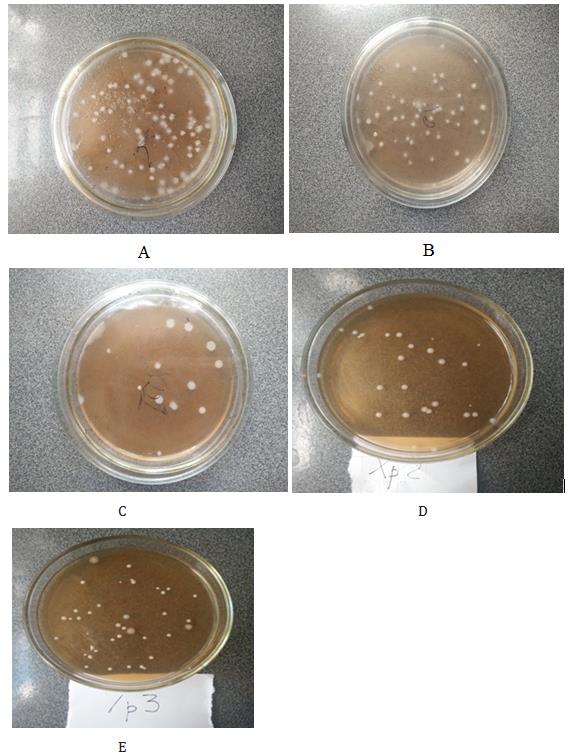
After influence of electromagnetic fields on the 1 year stored cells, appeared colonies with signs of the initial culture (Figures 1C and D), i.e. the surface of the colony became shining and hemispherical, the size of the colony was restored to the initial culture. Moreover, with direct bioresonance effects, the sizes of some colonies of the yeast culture (Figure 1C) have become much larger compared to the initial. This was facilitated by the information transmitted from the initial culture by means of electromagnetic radiation, which intensified the process of reproduction of the yeast cells and a direct effect by electromagnetic fields had a greater effect than the inverse effect. And with simultaneous influence direct and inverse electromagnetic radiation (Figure 1E) gave results similar to both the initial and stored for 1 year culture.
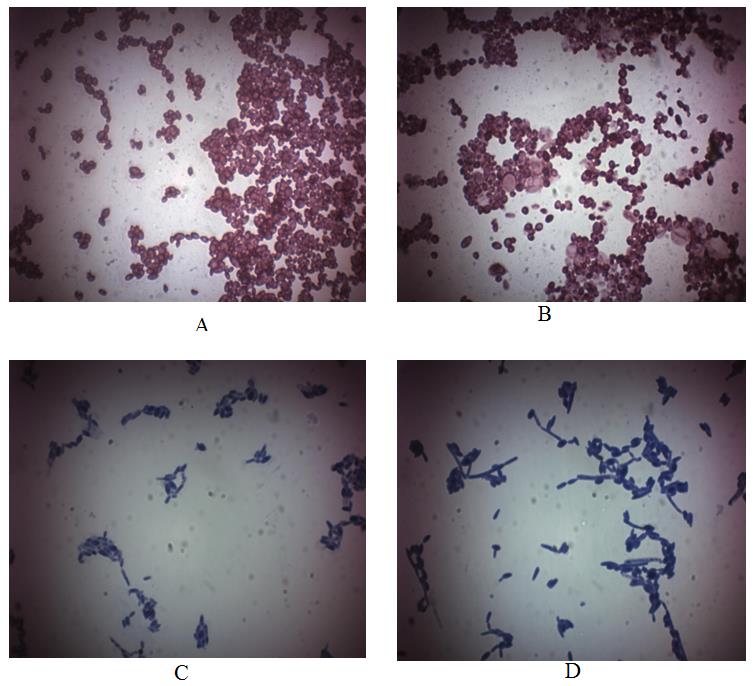
The comparative study of the morphology (shape and size) of the cells showed that the cell of initial culture had an ovoid shape with a size of 2x3 µm (Figure 2A). After 1 year of storage, the shape of the cells changed, acquiring a rounded shape, and the size of the cells decreased and became 1.5–2 µm (Figure 2B). After bioresonance influence, a part of the cells acquired the shape of initial cells (ovoid form). At the same time, cells elongated in the form of short rods appeared, and the size of the latter varied from 1x2 to 1x4 µm (Figures 2C & D). Consequently, regardless of the form of bioresonance influence (direct and inverse), the shape and size of the cells can be restored and even modified (from ovoid to rod-shaped).
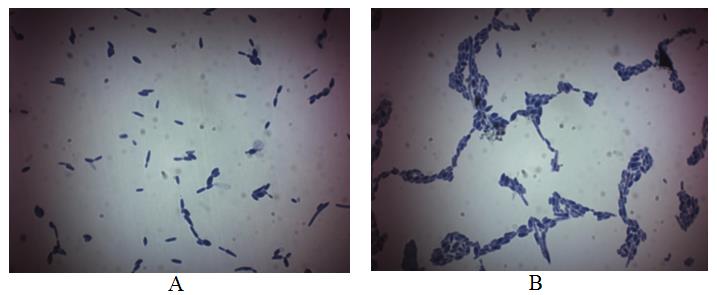
From Figure 3 it can be seen that after a simultaneous direct and inverse impact on the culture, differentiation is observed in restoring of cell to its original state, i.e, the cells of a small-sized colony have prevailed most of the rod-shaped form, and the cells of the large-sized colony have an ovoid shape. Thus, it is clearly possible to see at the same time the recovery process itself to the initial culture, as well as the modification of the cell culture associated with changes occurring during storage for 1 year.
References
-
Nikolaev Yu A (2000) Distant information interactions in bacteria. Microbiology 69(5): 597-605.
-
Gotovsky Yu V, Katorin VS (2000) Preliminary data on the effect of the resonant frequencies of the electromagnetic field on bacterial cells. Abstracts and Papers of the VI International Conference on BRT. M: Imedis 1: 21-23.
-
Khachumova KG (2014) The influence of low- intensity radiation on biological objects. Abstracts and reports of the XX International Conference M: IMEDIS 1: 69-71.
-
Ganbarov HG, Abdulgamidova SM (2012) The variability of yeast and the correction of their properties by electromagnetic fields. Monograph. Lambert Academic Publishing Berlin, pp: 144.
-
Gotovsky V, Gotovsky M, Ogorodnikov IG, Esiyev SS (2007) Experimental data on the optimization of the growth properties of lactobacilli by their energy- information transfer of known and necessary properties. Abstracts and Papers Proceedings of the XIII International Conference M: Imedis 1: 82-85.
-
Batrak EA, Zavada NP, Ryabova IS (2004) Analysis of isolates of staphylococcal strains under resonant- frequency effects by the IMEDIS-BRT-PK device. Abstracts and reports of the X International Conference on BRT. M Imedis, part 1, pp: 241-243.
-
Gotovsky M, Perov Yu F, Chernetsova LV (2010) Bioresonance therapy M: IMEDIS, pp: 205.
-
Heredia Rojas J, Gomez- Flores R, Rodriguer-Dela A, Rodríguez-de la F, Monreal-Cuevas E, et al. (2012) Antimicrobial effect of amphotericin B electronically activated water against Candida albicans. African Jour Microbiol Research 15(6): 3685-3689.
-
Gotovsky V, Perov F (2003) The modulating effect of external magnetic fields: growth, development and pathogenicity of microorganisms. Abstracts and reports of the IX International Conference on BRT. M: Imedis 2: 31-62.
-
Strasak L, Vetteri V, Smarda J (2002) Effects of low- frequency magnetic fields on bacteria _Escherichia coli_. Bioelectrochemistry 55(1-2): 161-164.
-
Heredia-Rojas J, Villarreal-Treviño L, Abraham O, Herrera-Menchaca LI, Gomez-Floreset R, et al. (2015) [INLINE_TABLE:4:0]
-
Tepper EE, Shilnikova V, Pereverzova GI (2004) Workshop on microbiology. Moscow: Drofa, pp: 256.
-
Gotovsky MV (2009) Control signals for the growth of _Escherichia coli_ cells when exposed to a device for bioresonance therapy. Traditional Medicine 17(2): 4- 6.
- Antifungal Activity of New Acetophenone Derivatives
- Interconnected Microbiomes Human Health Within an Environmental Framework
- Silkworm-Based Vaccine Production for H5N1: A One Health Approach to Pandemic Preparedness
- Microbial Diversity and Lipolytic Activity of Bacteria and Fungi from Oil-Contaminated Sites in Makurdi Metroplois
- Antibiotic Resistance Profile of Bacteria Isolated at the Central Laboratory of the National Hospital Center of Nouakchott
- Epidemiology and Sensitivity to Antibiotics of Germs Isolated from Blood Cultures in the Laboratory of the National Hospital Center of Nouakchott-Mauritania