
Biocatalyst Potential Candidate for Human Welfare
Biocatalysis is known since man knew about brewing which was known since 6000 years. Enzymes from microbial sources were then employed in industries such as production of beer, wine, cheese etc. Nearly 100 years down the lane biocatalysts have been used for chemical transformations. In order to access the repertoire of pharmacological and agrochemicals with high chemoselectivity, regioselectivity, and enantioselectivity, biocatalysis integrates microbiologists, enzymologists, and organic chemists. The usual chemical approach is challenged by the saturation of carbon-carbon double bonds by biocatalysts, as they avoid the usage of organocatalysts or precious metals (in combination with chiral ligands and molecular hydrogen). Since past 30 years they have been used for the synthesis of valuable fine chemicals especially pharmaceuticals. This review gives a brief about microbial biocatalyst including the photosynthetic blue-green algae.
Introduction
Enzymologists, microbiologist, and organic chemists collaborate in biocatalysis to access the repository of pharmacological and agrochemicals with high chemoselectivity, regioselectivity, and enantioselectivity. Biocatalysis is process which is been increasingly used now a days instead of the traditional synthetic routes to synthesize important molecules of industrial importance. Biocatalysts are very advantageous as they work under normal conditions of pH value, temperatureand pressure in an aqueous environment, which makes it a greener process to chemistry. It is also advantageous as these reactions are highly stereoselective, chemo-selective and regioselective. Biocatalysts play an important role in the synthesis of enantiomerically pure compounds used in pharmaceutical industries, agrochemicals and synthesis offlavours. Food and Drug Administration has given guidelines that drugs must be produced as chiral molecules and demand the proof that the isomer which is non-therapeutic must be non-toxic in case it is sold in a racemic form. The usual chemical approach is challenged by the saturation of carbon-carbon double bonds by biocatalysts, as they avoid the usage of organocatalysts or precious metals (in combination with chiral ligands and molecular hydrogen).
Ene-reductases (ERs) are a promising biocatalyst that can cooperatively reduce unsaturated double bonds with transition metals. They are also compatible with other emerging techniques such as photoenzymatic, chemoenzymatic, multi-enzymatic, photoelectrochemical, single reduction chemistry, and radical-mediated transformations. Enzymologists and synthetic chemists will be influenced by this study to investigate and further the fascinating chemistry revealed by ERs for both academic and commercial objectives.
Racemic Compounds
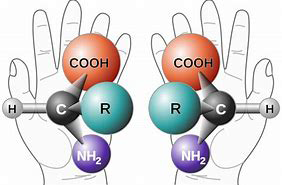
A mixture of equal proportions of mirror-image enantiomers are called as racemic compound (Figure 1). Single enantiomers and their racemates can be very different in pharmacological properties. This property is very important in medicinal chemistry for the synthesis of drug molecules [1]. Previously many drugs were formulated as their racemic mixtures and sold. The important case of drug thalidomide failure was the biggest turning point in the field of chiral drugs and chirality concerned. It was used by pregnant women as an analgesic during the 1960s (Figure 2). Structurally it was a simple compound and had only one chiral center, but the chirality of it proved to be very crucial on the pharmacological effects of this drug. Since the environment of drugs (human bod proteins, enzymes) in nature are chiral, enantiomers specifically bind to one type of the enzyme and produce different effects (Figure 3). They have a diastereoisomeric relationship with respect their receptor complexes. In the case of thalidomide, there was no study carried out on the potential consequences of this structure activity relationship and the drug molecule was synthesized and sold in the form of a racemic mixture. Unfortunately, pregnant women who consumed this drug during pregnancy gave birth to deformed children. Later on much investigation was carried out which proved that the R isomer was safe and had analgesic effect while the S isomer was teratogenic.
O
N
NH O
O
O
(R)-thalidomode (S)-thalidomode Figure 2. Representation of the enantiomers of thalidomide.
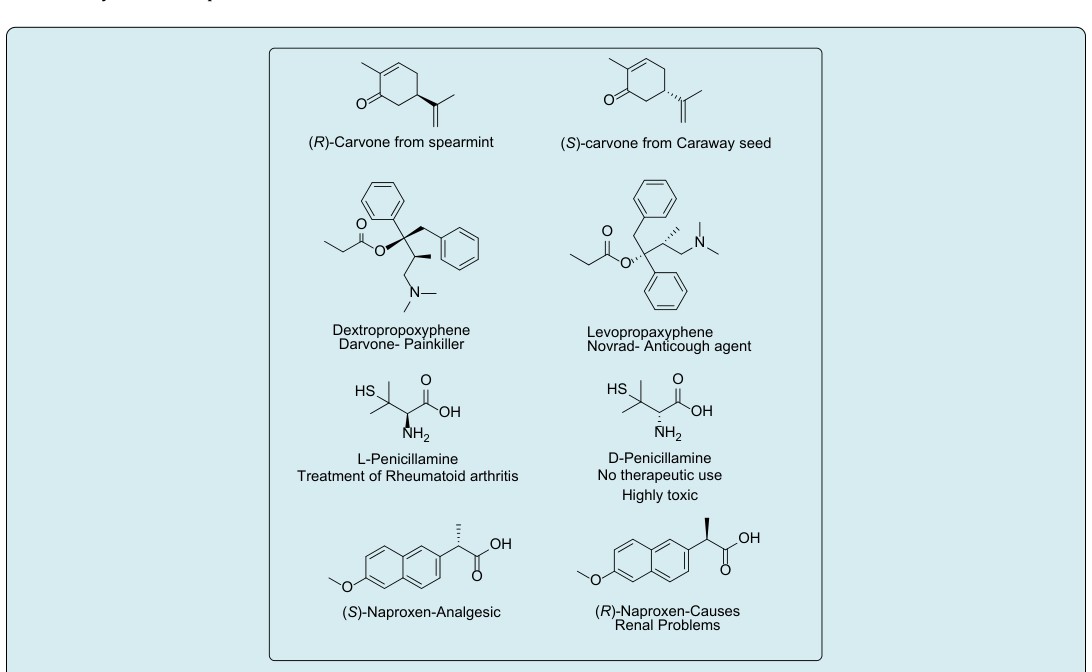
Some of the enanatiomers may show same therapeutic or toxic effects but they might differ in the magnitude of these effects; one may be pharmacologically active and the other may be inactive. Lot of research was carried out in the area O N NH O O O of stereochemistry of drugs in order to develop newer, safer and more effective drugs and other chemical compounds [2]. Figure 4 represents the compounds which show different effect based on the enantiomer.
Today many of the drugs marketed are chiral. Both the Pharmacodynamic and pharmacokinetic studies are carried out before the drug is released in the market [3].
Chiral Compounds
When a molecule or ions cannot be super imposed over its mirror counterpart in any combination of rotations the compound is said to be chiral. A chiral centre is defined as the centre atom which is connected to the four different atoms.
Approach for the Synthesis of Chiral Compounds
There are two different methods for the production of chiral center in the compound by the reduction of keto compounds to produce chiral secondary alcohols.
- Asymmetric hydrogenation using different chiral organometallic complexes
- Use of a biocatalyst (Enzyme keto-reductases).
Chemical Reagents Used for Synthesizing Chiral Compounds: Asymmetric hydrogenation of ketones can be carried out using chemical catalysts such as hydrides of Sodium, Lithium, and Ruthenium complex, (Table 1). The disadvantage of these methods is that the catalyst is very costly and their disposal is very difficult. It affords optically active secondary alcohol in good yields. The hydrogen molecule gets added to the carbonyl group from any of the two enantiofaces producing different enantiomers [4, 5].
| Sl. No. | Substrates | Catalyst | Work by | References |
|---|---|---|---|---|
| 1 | Aromatic ketones | Ionic tagged ferrocene-ruthenium catalyst system | Xu D, et al. | [6] |
| 2 | Aliphatic and base-labile ketones | Chiral ruthenabicyclic complexes | Matsumura K, et al. | [7] |
| 3 | Simple ketones | Ruthenium(II)-indan-ambox complex | Li W, et al. | [8] |
| 4 | Alpha-amino aliphatic ketones. | Ruthenium-catalyzed | Xie J, et al. | [9] |
| 5 | Simple ketones aromatic ketones, alpha,beta-unsaturated ketones,heteroaromatic, , and cyclopropyl ketones | Tunes Phos/1,2-diamine- ruthenium (II) complexes | Li W, et al. | [10] |
| 6 | Ketones | ruthenium-catalyzed asymmetric hydrogenation | Liu S, et al. | [11] |
| 7 | Alpha-chloro aromatic ketones | eta6-arene/TsDPEN- ruthenium(II) complexes | Ohkuma, et al. | [12] |
| 8 | Acetophenone | Chiral eta(6)-arene-N-tosyl ethylenediamine-ruthenium(II) complexes. | Sandoval C A, et al. | [6] |
| 9 | Simple ketones | Ruthenium catalysts with diamine and BINOL-derived phosphinite ligands | Guo R, et al. | [13] |
Table 1: Asymmetric synthesis using Metal catalysts.
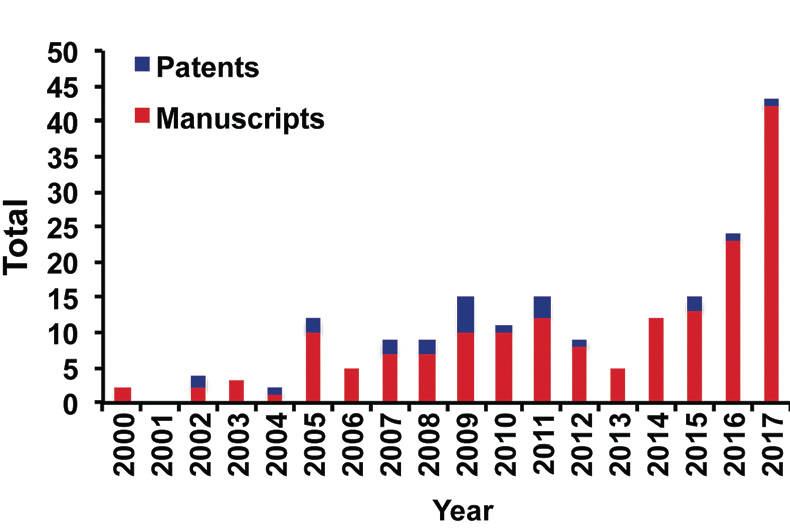
Bioreduction Using Biocatalysts: Enantiomerically pure secondary alcohols are used in the synthesis of chiral pharmaceutical products, flavors and agrochemicals. A symmetric reduction of prochiral ketones is the method for the synthesis of the required enantiomerically pure alcohols. Biocatalysis can be done using enzymes or whole cells from microorganisms or vegetables source for the bioreduction of prochiral ketones. These days lot of study is being carried out on the use of biocatalysts for chiral synthesis. Figure 5 represents the number of publications and patents in the area of biocatalysis from year 2000-2017 [14].
The below graph indicates the amount of research being put into biocatalysis and the amount of publications in these areas. Here in we describe several selected examples using free and supporting cells for the enantioselective bioreduction of prochiral ketones with Prelog or anti-Prelog selectivity.
a. Mechanism of Bioreduction Prochiral molecules are the compounds which are not chiral by themselves but can be converted to chiral compound in one step.Asymmetric transfer hydrogenation (ATH) is a powerful tool emerged these days for the asymmetric hydrogenation of prochiral ketones to their secondary alcohols. It is one of the most valuable intermediates in organic synthesis. In a recent studies the ATH reaction in aqueousmedia was proved to be feasible, producing chiral alcohols in good yields and showing high enantioselectivities [15].
Face from which the Hydrogen is added from NAD(P)H- Prelog rule O
R2
R1
Anti-Prelog Rule-Face
A trigonal planar sp_2-hybridized atom can be converted into a chiral center (pronounced “ray” and “sigh”)when a substituent is added to the _re or si face of the molecule. If Cahn-Ingold-Prelog proposesan arrangement of atoms in clockwiseorder of precedence, then the face is said to be re_if, when looking at that face, the substituents are arranged in a descending order in the opposite direction, it is said to be _si . It is important to note that the naming of the resulting chiral center as S or R depends on the preference of the incoming group (Figure 6).
OH
S L
(S) OH
S L
(R) Figure. 6. Example of asymmetric bioreduction of an aromatic ketone.
b. Enzyme Structure and Function The enzyme responsible for the keto reduction reactions is called Alcohol dehydrogenases (ADH) (EC 1.1.1.1). They represent a class of dehydrogenase enzymes which is present in many living organisms and smooth the conversion of prochiral ketones to alcohols. Herein there is a reduction of nicotinamide adenine dinucleotide (NAD+) to NADH. Bacteria_,_ Fungi and plants, all are known to contain the enzyme in varying proportions [16] (Figure 6).
c. Cofactor Regeneration All the reactions catalysed by reductases are cofactor dependent, thus, it becomes important task in industrial scale to see that an efficient method is available for regeneration of the consumed cofactors. The reduction process, using enzymes require the presence of NADH (nicotinamide adenine dinucleotide) and NADPH (nicotinamide adenine dinucleotide phosphate) together to catalyze the reaction in a way that: 1) The coenzyme and oxidized substrate bind to an enzyme, 2) Substrate is reduced, while the coenzyme is oxidized, 3) The coenzyme and reduced product detach from the enzyme, and 4) The coenzyme is recycled and ready for the process to begin again [17]. NAD(P)-dependent oxidoreductases are present in most of the organisms and catalyze the reduction of ketones to secondary alcohols. As there is need of expensive cofactors, this process becomes very costly. This problem is abolished by using whole plant part or tissue and microorgamisms since the living system has this cofactor system within them. Depending on the biocatalyst used, any desired enantiomer can be obtained, which could be an important factor for drug development process [18, 19].
d. Chiral Secondary Alcohols Chiral secondary alcohols play a vital role in pharmaceutical, agrochemical, and chemical industries. In recent years, large development has been carried out towards biocatalytic ketone reduction as a green process for producing to enantiopure alcohols. Genetic engineering technology for the production of novel hybrid enzymes now a days can create new much productive and robust enzymes with required activity. The combination of bioreduction along with other enzymatic or chemical steps allows the effective method in the synthesis of important complex chiral products [20].
e. Chirality and Biological Activity Chirality, is a theory of non-superimposable mirror images. It is a basic property of all biological living systems. Stereoisomer are the compounds that possess the same structural and molecular formula, but they are different in their three-dimensional structure. Chiral compounds have two non-superimposable mirror-images which are stereoisomeric forms called enantiomers.
f. Enzymes in Bioreduction Enzymes are present in all living organisms and they can perform reactions in very mild conditions of temperature and pH. They are remarkably stereoselective, chemoselective and regioselective. This ability, enables chemists to exploit the enzyme property, to use it in organic synthesis. In the past two decades there is rapid increase on research in the use of biocatalysis, for the synthesis of chiral compounds. These reactions can be catalyzed by
1. isolated enzymes or 2. whole cells The use of isolated enzymes is generally preferred because of a high yield and no side products formation. In case of isolated enzymes there is requirement to supply external cofactor NADPH which is very costly. The use of whole cells doesn’t require any external supply of cofactor as the whole cells contain the cofactor recycling mechanism. Thus most preferred is the use of whole cells [21].
Chiral metal complexes have been successfully used as catalysts in a number of cases of enantioselective synthesis such as BINAP-Ru. However, there are many reactions where there remain difficulties in obtaining required optical purity and yield. Moreover, there are many disadvantages of chemical processes like
- Less optical purity
- Costly chemicals In order to get over the above disadvantages of chemical processes, biotransformation procedures using enzymes have gained popularity for the asymmetric synthesis [22].
g. Alcohol Dehydrogenase Alcohol dehydrogenases (EC 1.1.1.1) are a category of dehydrogenase enzymes which occur in many organisms. They facilitate the conversion between Ketone and alcohols by the reduction of nicotinamide adenine dinucleotide (NAD+) to NADH.
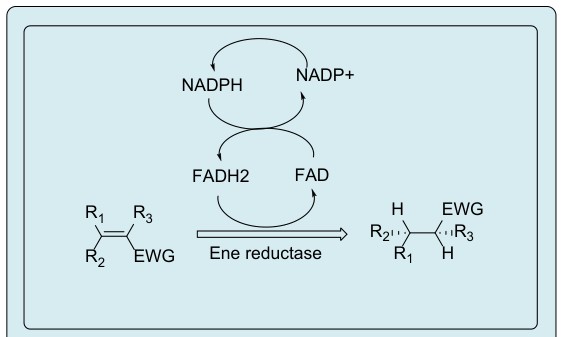
h. Enoate Reductase Recently many studies have been carried out on family of enzyme called as ene-reductases (ERs). These enzymes have shown potential in biocatalysis and the synthesis of fine chemicals as they reduce the C=C bond which is one of an important organic reaction (Figure 7). In the past five years the researchers have studied multi cascade enzyme processes where more than one enzyme can be used in the synthesis of a compound at different steps in different organisms (Table 2) [23].
| Sl. No. | Catalyst | Enzyme reported | References |
|---|---|---|---|
| 1 | Rhodococcus, Gordonia | Enoate reductase | [24] |
| 2 | Cyanobacteria* | Enoate reductase | [25,26] |
| 3 | Aspergillus | Enoate reductase | [27] |
| 4 | Clavisporalusitaniae | Ene reductase | [28] |
| 5 | Synechococcus sp. | Ene reductase | [29] |
| 6 | Saccharomycespastorianus (formerly S. carlsbergensis | Old yellow enzyme 1 (OYE1) | [30] |
| 7 | Penicillium citrinum | [31] | |
| 8 | Lycopersicon esculentum | [32,33] |
Table 2: Studied showing reduction of ene-bond using different biocatalyst.
Microalgae- Enoate Reductase: Cyanobacteria or the Blue- green algae or the Algal blooms are commonly known as troublesome pollution creating source of water ecosystems resulting mainly due to the anthropogenic eutrophication. The dense and profuse growth of these tiny photosynthesis bearing organisms usually seems like mat floating on the water bodies making the watercolor as brilliant blue-green or sometimes red. The ability of such rapid and huge growth in these photosynthesizing bacteria is due to the presence of numerous substances treated as chemical contaminations and biogenic elements, mainly nitrogen and phosphorus, which shows their exceptional adaptability related to their explicit “flexible” metabolism. Many researchers in this field have revealed the potential use blue-green algae as biotransformation catalysts, both for natural and synthetic compounds.
It is also possible to use blue-green algae in bioremediation of heavy metals and metal ions. During this process several nanoparticles of these metals are also produced. These attributes in combination with ease of maintaining blue- green alga under controlled conditions can be exploited as industrially important microorganisms characterized by promising bio catalytic potential. The phototrophic organism has been found growing in a wide range of aquatic habitat i.e. Marine water, brackish water as well as fresh water (ranging from 3oppt to 0ppt salinity). Cells of cyanobacterial species can adapt such systems tospecific substancesoccurring in their environment. Similarly, these cyanobacteria are when exposed to xenobiotic compounds. Various examples of cyanobacteria like Aphanizomenonklebahnii, Spirulina, Merismopedia glauca, Anabaena laxa, Nodulariamoravica and Synechocystisaquatilis_have the abilities to convert the monoterpenes and organophosphonic compounds. Among these species, _Anabaena, Synechocystisaquatilis, Nodulariamoravica, Aphanizomenonklebahnii, and Merismopedia glauca have also been described as the most potent biocatalysts, with the ability to convert chalcones to the corresponding cis-chalcone, dihydrochalcones (also a valuable natural sweetener), causing regioselective reduction of 1,3-diphenyl-2-propen-1-one and also by altering the C=C bond of the olefinic fragment of the molecule without affecting the carbonyl group. This may be made possible by the formation of enzymes that allow the compound to be metabolized. Inclusion of enzymes involved in a chain of internal changes. Their internal cellular structures possess mechanisms that transform many natural compounds with specific advantages of selective enzymatic behaviour such as chemo-, regio-, and stereo-selectivity.
The most important family of ERs is the FMN-dependent Old Yellow Enzyme (OYE). Thisis a class of oxidoreductases (EC 1.6.99.1) [34]. They specifically catalyse the reduction of α, β-unsaturated compounds, containing activating groups such as aldehydes, ketones etc.
Types of Biocatalysts
Vegetable Biocatalyst
One of a “green” procedure to obtain chiral compounds is by using plant biocatalysts. Interestingly, many plant based catalysts have been studied since years and are proved successfully for bioreduction. The most popular plant biocatalyst being Daucus carota. Carrots asbiocatalysis are due to the observed high yield and high enantioselectivities. Also, they are readily available in the market, easy to work with and inexpensive. Both R- and S-form configuration chiral alcohols could be obtained using plant biocatalysts depending on which is required [35].
Microbial Transformation
Several studies have been done on microbial reduction reactions for the stereo- and enantioselective reduction of ketones [36, 37]. Many microbes since then have been identified for the presence of keto reductase enzyme for the biotransformation processes. Advantages of Microbial Transformation: Like plant cell enzymes, microbial enzymes, are able to catalyse reactions with high regio- and stereospecificity. Microbes are physically, incredibly small to be able to be seen by the naked eyes. A part from that, theycarry important role in today‘s pharmaceutical industry. Microbes, including the blue-green algae, grow exponentially and are therefore factories that produce a wide variety of enzymes in a very short time period as they multiply exponentially. It is also very possible to obtain and breed these organisms that are heat tolerant and can survive in extreme environments such as cold or hot, acid or alkaline conditions. Microbial transformations is a viable reaction that is unlikely to be performed by conventional synthetic methods, as shown in Table 3. Due to their small size, they have a high surface are to volume ratio comparedto some biological systems. Microorganisms, including photosynthetic cyanobacteria, have great potential to induce biocatalysis due to the presence of enzymatic systems capable of converting unknown substrates. Therefore, many studies have been performed using endophytic species with different bio-transformations of interest.
Pyrobaculumcalidifontis VA1 is of the thermostable bacteria that produces various enzymes and is stable under extreme heat, acid and alkaline conditions [38]. Disadvantages and Challenges of Microbial Transformation: Though there are many advantages in the use of microbial catalysts it comes with certain drawbacks.
- If properly trained person doesn’t perform the reaction there are chances of contamination.
- There is a separate step required for the centrifugation of microorganism to obtain the reaction mixture.
- There might be reactant and product toxicity on the organism.
- The organism may use the substrate as energy source which doesn’t give the desired product.
- As the biological framework is complex in microbes, there are very low chemical yields.
- Same organism may produce different enzymes which gives rise to side reactions and unnecessary products.
- These processes are relatively very slow.
| Sl.No | Source | Substrate | References |
|---|---|---|---|
| 1 | Trichotheciumroseum | Acetophenones | [39] |
| 2 | Candida zeylanoides | (S)-1-(4-nitrophenyl)ethanol | [40] |
| 3 | Yarrowialipolytica | (S)-1-phenyl-1,2-ethanediol | [41] |
| 4 | Aspergillus sydowii. | α-bromoacetophenonol | [42] |
| 5 | Aspergillus sydowii CBMAI 934 | Acetic acid | [43] |
| 6 | Penicilliumcitrinum CBMAI 1186 | α,β,γ,δ-unsaturated ketones (enolate reductase) | [44] |
| 7 | Penicillium, Cladospori,Aspergillus and Verticillium | Naphthoflavones | [45] |
| 8 | Rhodotorulaglutinis (immobilised) | (S)-1-phenylethanol | [46] |
| 9 | Penicillium funiculosum, Alternaria alternate, Talaromyces flavus. | (S)-5-(1-hydroxyethyl) furo[2,3-c] pyridine | [47] |
| 10 | Saccharomces cerevisiae | ethyl 3-oxobutanoate | [48] |
| 11 | Candida, Cryptococcus, Debaryomyces, Hanseniaspora, Kazachstania, Kluyveromyces, Lindnera, Nakaseomyces, Vanderwaltozyma and Wickerhamomyces | (4R)-(-)-carvone and (1R)-(-)- myrtenal | [49] |
| Bacteria | |||
| 1 | Escherichia coli | Ketones | [50,51] |
| 2 | Acetobacter pasteurianus | Prochiral Ketones | [52] |
| 3 | Lactobacillus senmaizukei. | Acetophenones | [53] |
| 4 | Lactobacillus paracasei | (R)-1-(3-methoxyphenyl)ethanol | [54,55] |
| 5 | Lactobacillus paracasei. | (R)-1-(1,3-benzodioxol-5yl) ethanol | [56] |
| (S)-cyclohexyl (phenyl) methanol. | [57] | ||
| 6 | Burkholderia gladioli | Ethyl (R)-4-chloro-3- hydroxybutyrate | [58] |
Table 3: Asymmetric synthesis using Microbial catalysts.
Enzyme Application in Industry
Synthesis of an Intermediate of Montelukast
Montelukast 7 is an orally active selective leukotriene receptor antagonist (Figure 9), it is used as anti-asthma drug, and was originally developed by Merck under the name of Singulair®.
The chemical synthesis [60, 61] requires solvent and chiral reducing agent (−)-β-chloro di-isopinocampheyl borane [(−)-DIPchloride] and ((R)-Xyl-BINAP) ((R,R)-DPEN) RuCl2 as a catalyst to produce product with enantioselectivity O OMe O N Cl N Cl Figure 9: Step in the synthesis of Monteleukast.
Through contributions to bioinformatics and high- through put screening, molecular biology and process chemistry, a KRED was developed with exceptionally high enantioselectivity (>99.9% ee). The KRED produced an capability to reduce betulin to betulinic acid. From them one fungus Dothideomycete sp. selectively catalysed the oxidation of betulin to betulone (Figure 8) [59].
H
OH
H
H
O
H
of 99% ee [60]. These agents are very toxic and corrosive, and may burn if it comes in contact with skin; also, the chemical reduction of ketone is carried out at very harsh temperature of −20 to −25°C to get the best stereoselectivity. Research carried out at Codexis and Arch Pharm Labs Limited, and they developed a ketoreductase (KRED) using directed evolution, thus enacting the same process conditions.The final enzyme was 2000 fold stable and thus increased the productivity substantially. In this case Isopropanol was used for cofactor regeneration which is an auxillary substrate.
+ OH
Ketoreductase
O OMe
OH
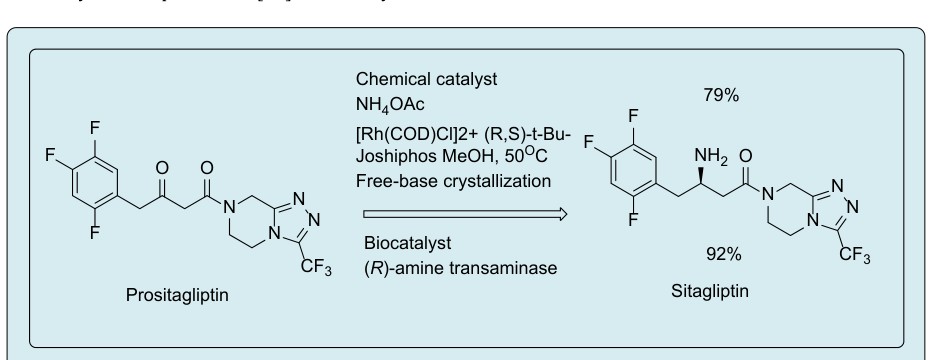
efficient and potent enzyme that catalyzes reactions of intrinsically water-insoluble substrate [62]. Synthesis of Sitagliptin Sitagliptin is an antidiabetic drug commercially manufactured by Januvia®, by Merck. It isfirst marketed gliptin family drug oral antihyperglycemic [63]. It is used along with other antidiabetic drugs such as metformin or thiazolidinedione, for the treatment of Type 2 diabetes mellitus. It acts by dipeptidyl peptidase-4 activity (DPP-4) inhibitor. Its, sales reached 6,358 million USD in the US as of 2014. It is expected to increase its sale by the year 2020 [64].
The chemical synthesis of sitagliptin was carried out by asymmetric hydrogenation of prositagliptin using a rhodium-based chemical chiral catalyst rhodium-based (Rh [Josiphos])[65]. However, the chemical process is not as effective as it is contaminated with rhodium and requires a further purification step.Davies, et al. investigated several other chemical synthesis processes [66]. The enzymatic process used an (R)- selective transaminase to convert prositagliptin to the active moiety of sitagliptin. The enzyme was engineered through multiple rounds of mutations, resulting in an enzyme with 92% yield of the final product and 99% ee. Additionally, manufacturing costs are reduced and heavy metals are eliminated [67].
(S)-3-Hydroxy-1-(3-(trifluoromethyl)-5,6- dihydro-[1, 2, 4]triazolo[4,3-a]pyrazin-7(8H)-yl)-4-(2,4,5 trifluorophenyl) butan-1-one ((S)-HTPP) is an important intermediate in the synthesis of Sitagliptin (Figure 10). Different fungal strains have been studied for the conversion of ketoamide 4-oxo-4-[3-(trifluoromethyl)-5,6- dihydro-[1, 2, 4] triazolo[4,3-a]pyrazin-7(8H)-yl]-1-(2,4,5- trifluorophenyl)butan-2-one (OTPP) to (S)-HTPP (Table 4). The group demonstrated that the reduction of OTPP was most effective at high temperature (45 °C), in the presence of distilled water and glycerol for cofactor generation. The yield obtained was 93% with 99% ee.
| Sl. No. | Organism | Work by | References |
|---|---|---|---|
| 1 | Rhizopus microsporus var. rhizopodiformis ZJPH1308 | Sun J, et al. | [68] |
| 2 | Pseudomonas pseudoalcaligenes | Wei Y, et al. | [69] |
Table 4: Microorganisms applied for the synthesis of sitagliptin.
Application in Positron Emission Tomography (PET)
Enzymes have excellent chemical selectivity and large turnover numbers, biocatalysis can propose appealing solutions in the field of radiochemistry. Chemists are inspired to create new radiotracers to enable non-invasive diagnosis of a wider range of disorders as a result of recent advancements in Positron Emission Tomography (PET). New radiotracers are developed to enable non-invasive diagnosis of a wider range of disorders and molecular basis inquiry, thanks to recent developments in PET. A novel method for radiolabeling physiologically active compounds with short half-lives positron emitters for application in positron emission tomography is called biocatalysis. Because the most widely used positron emitters have short half-lives (T1/2), such as fluorine-18 (18F, T1/2 = 109.8 min), carbon-11 (11C, T1/2 = 20.4 min), and nitrogen-13 (13N, T1/2 = 9.97 min), developing effective chemical schemes is necessary for the radiosynthesis of PET tracers in order to synthesize and purify the radioactive species in a short amount of time. Even though the 1970s and 1980s were the “golden years” of biocatalysis in radiochemistry, developments in enzyme engineering over the past ten years have greatly expanded the pool of enzymes that can be used in chemical reactions and may have applications in radiochemistry.
Conclusion
Biotransformation with plant as well as microbial cells enables access to complex bioactive compounds having chiral center which can be both commercial drugs and candidates. Due to their capacity to catalyze regio- and stereo selective reactions on small molecules they have been applied widely. Although there are difficulties in selection of specific biocatalyst which can specifically produce certain kind of enantiomer, genetic engineering is applied now a days to produce such synthetically engineered enzymes which can specifically reduce and produce the desired product. Biocatalysts offer attractive solutions in various field pharmaceutical, microbiology, agriculture, radiochemistrybecause enzymes present exquisite chemical selectivity, enable fast chemical conversions, high turnover numbers, and yield highly pure products under specific mild conditions.
Conflict of Interest
The authors declare no conflict of interest.
References
-
Howland RH (2009) Clinical implications of chirality and stereochemistry in psychopharmacology. J Psychosoc Nurs Ment Health Serv 47(8): 17-21.
-
Wainer IW (1992) Three-dimensional view of pharmacology. Am J Hosp Pharm 49(9 Suppl 1): S4-S8.
-
Brocks DR (2006) Drug disposition in three dimensions: an update on stereoselectivity in pharmacokinetics. Biopharm Drug Dispos 27(8): 387-406.
-
Ohkuma T (2010) Asymmetric hydrogenation of ketones: tactics to achieve high reactivity, enantioselectivity, and wide scope. Proc Jpn Acad Ser B Phys Biol Sci 86(3): 202- 219.
-
Huang H, Okuno T, Tsuda K, Yoshimura M, Kitamura M (2006) Enantioselective Hydrogenation of Aromatic Ketones Catalyzed by Ru Complexes of Goodwin−Lions- type sp2N/sp3N Hybrid Ligands R-BINAN-R‘-Py. J Am Chem Soc 128(27): 8716-8717.
-
Xu D, Zhou ZM, Dai L, Tang LW, Zhang J (2015) Asymmetric hydrogenation of aromatic ketones by new recyclable ionic tagged ferrocene-ruthenium catalyst system. Bioorg Med Chem Lett 25(9): 1961-1964.
-
Matsumura K, Arai N, Hori K, Saito T, Sayo N, et al. (2011) Chiral ruthenabicyclic complexes: precatalysts for rapid, enantioselective, and wide-scope hydrogenation of ketones. J Am Chem Soc 133(28): 10696-10699.
-
Li W, Hou G, Wang C, Jiang Y, Zhang X (2010) Asymmetric hydrogenation of ketones catalyzed by a ruthenium(II)- indan-ambox complex. Chem Commun 46(22): 3979- 3981.
-
Xie JH, Liu S, Kong WL, Bai WJ, Wang XC, et al. (2009) Highly enantioselective and diastereoselective synthesis of chiral amino alcohols by ruthenium-catalyzed asymmetric hydrogenation of alpha-amino aliphatic ketones. J Am Chem Soc 131(12): 4222-4223.
-
Li W, Sun X, Zhou L, Hou G, Yu S, et al. (2009) Highly efficient and highly enantioselective asymmetric hydrogenation of ketones with TunesPhos/1,2-diamine- ruthenium(II) complexes. J Org Chem 74(3): 1397-1399.
-
Liu S, Xie JH, Li W, Kong WL, Wang LX, et al. (2009) Highly enantioselective synthesis of chiral cyclic amino alcohols and conhydrine by ruthenium-catalyzed asymmetric hydrogenation. Org Lett 11(21): 4994-4997.
-
Ohkuma T, Tsutsumi K, Utsumi N, Arai N, Noyori R, et al. (2007) Asymmetric hydrogenation of alpha-chloro aromatic ketones catalyzed by eta6-arene/TsDPEN- ruthenium(II) complexes. Org Lett 9(2): 255-257.
-
Guo R, Elpelt C, Chen X, Song D, Morris RH (2005) A modular design of ruthenium catalysts with diamine and BINOL-derived phosphinite ligands that are enantiomerically-matched for the effective asymmetric transfer hydrogenation of simple ketones. Chem Commun 24: 3050-3052.
-
Britton J, Majumdar S, Weiss GA (2018) Continuous flow biocatalysis. Chemical Society Reviews 47 5891-5918.
-
Wu X, Xiao J (2007) Aqueous-phase asymmetric transfer hydrogenation of ketones--a greener approach to chiral alcohols. Chem Commun 24: 2449-2466.
-
Radianingtyas H, Wright PC (2003) Alcohol dehydrogenases from thermophilic and hyperthermophilic archaea and bacteria. FEMS Microbiol Rev 27(5): 593-616.
-
Matsuda T, Yamanaka R, Nakamura K (2009) Recent progress in biocatalysis for asymmetric oxidation and reduction. Tetrahedron: Asymmetry 20(5): 513-557.
-
Kroutil W, Mana H, Edegger K, Faber k (2004) Recent advances in the biocatalytic reduction of ketones and oxidation of sec-alcohols. Curr Opin Chem Biol 8(2): 120-126.
-
Jörnvall H, Hedlund J, Bergman T, Kallberg Y, Cederlund E, et al. (2013) Origin and evolution of medium chain alcohol dehydrogenases. Chem Biol Interact 202(1-3): 91-96.
-
Ni Y, Xu JH (2012) Biocatalytic ketone reduction: A green and efficient access to enantiopure alcohols. Biotechnol Adv 30(6): 1279-1288.
-
Nakamura K, Yamanaka R, Matsuda T, Harada T (2003) Recent developments in asymmetric reduction of ketones with biocatalysts. Tetrahedron: Asymmetry 14(18): 2659-2681.
-
Inoue K, Makino Y, Itoh N (2005) Purification and characterization of a novel alcohol dehydrogenase from Leifsonia sp. strain S749: a promising biocatalyst for an asymmetric hydrogen transfer bioreduction. Appl Environ Microbiol 71(7): 3633-3641.
-
Toogood HS, Scrutton NS (2018) Discovery, Characterization, Engineering, and Applications of Ene- Reductases for Industrial Biocatalysis. ACS Catal 8(4): 3532-3549.
-
Kozłowska J, Potaniec B, Żarowska B, Anioł M (2018) Microbial transformations of 4′-methylchalcones as an efficient method of obtaining novel alcohol and dihydrochalcone derivatives with antimicrobial activity. RSC Advances 8(53): 30379-30386.
-
Żyszka B, Anioł M, Lipok J (2017) Highly effective, regiospecific reduction of chalcone by cyanobacteria leads to the formation of dihydrochalcone: two steps towards natural sweetness. Microbial Cell Factories 16(1): 136.
-
Żyszka-Haberecht B, Poliwoda A, Lipok J (2018) Biocatalytic hydrogenation of the C=C bond in the enone unit of hydroxylated chalcones—process arising from cyanobacterial adaptations. Appl Microbiol Biotechnol 102(16): 7097-7111.
-
Corrêa MJC, Nunes FM, Bitencourt HR, Borges FC, Guilhon GMSP, et al. (2011) Biotransformation of chalcones by the endophytic fungus Aspergillus flavus isolated from Paspalum maritimum trin. Journal of the Brazilian Chemical Society 22(7): 1333-1338.
-
Ni Y, Yu HL, Lin GQ, Xu JH (2014) An ene reductase from Clavispora lusitaniae for asymmetric reduction of activated alkenes. Enzyme Microb Technol 56: 40-45.
-
Fu Y, Hoelsch K, Weuster-Botz D (2012) A novel ene- reductase from Synechococcus sp. PCC 7942 for the asymmetric reduction of alkenes. Process Biochemistry 47(12): 1988-1997.
-
Winkler CK, Tasnádi G, Clay D, Hall M, Faber K (2012) Asymmetric bioreduction of activated alkenes to industrially relevant optically active compounds. J Biotechnol 162(4): 381-389.
-
Ferreira IM, Rocha LC, Yoshioka SA, Nitschke M, Jeller AH, et al. (2014) Chemoselective reduction of chalcones by whole hyphae of marine fungus Penicillium citrinum CBMAI 1186, free and immobilized on biopolymers. Biocatalysis and Agricultural Biotechnology 3(4): 358- 364.
-
Hall M, Stueckler C, Kroutil W, Macheroux P, Faber K (2007) Asymmetric Bioreduction of Activated Alkenes Using Cloned 12-Oxophytodienoate Reductase Isoenzymes OPR-1 and OPR-3 from Lycopersicon esculentum (Tomato): A Striking Change of Stereoselectivity. Angew Chem Int Ed Engl 46(21): 3934-3937.
-
Hall M, Stueckler C, Ehammer H, Pointner E, Oberdorfer G, et al. (2008) Asymmetric Bioreduction of C=C Bonds using Enoate Reductases OPR1, OPR3 and YqjM: Enzyme- Based Stereocontrol. Advanced Synthesis & Catalysis 350(3): 411-418.
-
Scholtissek A, Dirk T, Adrie WH, VanBerkel WJH, Paul CE (2017) Old yellow enzyme-catalysed asymmetric hydrogenation: linking family roots with improved catalysis. Catalysts 7(5): 130.
-
Yang ZH, Zeng R, Yang G, Wang Y, Li LZ, et al. (2008) Asymmetric reduction of prochiral ketones to chiral alcohols catalyzed by plants tissue. J Ind Microbiol Biotechnol 35(9): 1047-1051.
-
Keppler AF, Porto ALM, Schoenlein-Crusius IH, Comasseto JV, Andrade LH (2005) Enzymatic evaluation of different Aspergillus strains by biotransformation of cyclic ketones. Enzyme and Microbial Technology 36(7): 967-975.
-
Mandal D, Ahmad A, Khan MI, Kumar R (2004) Enantioselective bioreduction of acetophenone and its analogous by the fungus Trichothecium sp. Journal of Molecular Catalysis B: Enzymatic 27(2-3): 61-63.
-
Hotta Y, Ezaki S, Atomi H, Imanaka T (2002) Extremely Stable and Versatile Carboxylesterase from a Hyperthermophilic Archaeon. Appl Environ Microbiol 68(8): 3925-3931.
-
Zilbeyaz K, Taskin M, Kurbanoglu EB, Kurbanoglu NI, Kilic H (2010) Production of (R)-1-phenylethanols through bioreduction of acetophenones by a new fungus isolate Trichothecium roseum. Chirality 22(6): 543-547.
-
Sahin E, Dertli E (2017) Highly Enantioselective Production of Chiral Secondary Alcohols with Candida zeylanoides as a New Whole Cell Biocatalyst. Chem Biodivers 14(9).
-
Zhang HL, Zhang C, Pei CH, Han MN, Li W (2019) Enantioselective synthesis of enantiopure chiral alcohols using carbonyl reductases screened from Yarrowia lipolytica. J Appl Microbiol 126(1): 127-137.
-
Rocha LC, Ferreira HV, Pimenta EF, Berlinck RG, Rezende MO, et al. (2010) Biotransformation of alpha- bromoacetophenones by the marine fungus Aspergillus sydowii. Mar Biotechnol (NY) 12(5): 552-557.
-
Oliveira JRD, Seleghim MH, Porto AL (2014) Biotransformation of methylphenylacetonitriles by Brazilian marine fungal strain Aspergillus sydowii CBMAI 934: eco-friendly reactions. Mar Biotechnol (NY) 16(2): 156-160.
-
Ferreira IM, Vasconcellos SPD, Cruz JBD, Comasseto JV, Porto ALM, et al. (2015) Hydrogenation of bis-α,β- unsaturated enones mediated by filamentous fungi. Biocatalysis and Agricultural Biotechnology 4(2): 144- 149.
-
Popłoński J, Sordon S, Tronina T, Bartmańska A, Huszcza E (2015) Fungal metabolism of naphthoflavones. Journal of Molecular Catalysis B: Enzymatic 117: 1-6.
-
Kurbanoglu EB, Zilbeyaz K, Kurbanoglu NI, Ozdal M, Taskin M, et al. (2010) Continuous production of (S)- 1-phenylethanol by immobilized cells of Rhodotorula glutinis with a specially designed process. Tetrahedron: Asymmetry 21(4): 461-464.
-
Pal M, Srivastava G, Moon LS, Jolly RS (2012) Bioreduction of methyl heteroaryl and aryl heteroaryl ketones in high enantiomeric excess with newly isolated fungal strains. Bioresour Technol 118: 306-314.
-
Bubalo MC, Mazur M, Radošević K, Redovniković IR (2015) Baker’s yeast-mediated asymmetric reduction of ethyl 3-oxobutanoate in deep eutectic solvents. Process Biochemistry 50(11): 1788-1792.
-
Goretti M, Turchetti B, Cramarossa MR, Forti L, Buzzini P (2013) Production of flavours and fragrances via bioreduction of (4R)-(-)-carvone and (1R)-(-)-myrtenal by non-conventional yeast whole-cells. Molecules 18(5): 5736-5748.
-
Li B, Li Y, Bai D, Zhang X, Yang H, et al. (2014) Whole-cell biotransformation systems for reduction of prochiral carbonyl compounds to chiral alcohol in Escherichia coli. Sci Rep 4: 6750.
-
Weckbecker A, Hummel W (2004) Improved synthesis of chiral alcohols with Escherichia coli cells co-expressing pyridine nucleotide transhydrogenase, NADP+- dependent alcohol dehydrogenase and NAD+-dependent formate dehydrogenase. Biotechnol Lett 26(22): 1739- 1744.
-
Du PX, Wei P, Lou WY, Zong MH (2014) Biocatalytic anti- Prelog reduction of prochiral ketones with whole cells of Acetobacter pasteurianus GIM1.158. Microbial Cell Factories 13(1): 84.
-
Çolak NS, Şahin E, Dertli E, Yilmaz MT, Taylan O (2019) Response surface methodology as optimization strategy for asymmetric bioreduction of acetophenone using whole cell of Lactobacillus senmaizukei. Prep Biochem Biotechnol 49(9): 884-890.
-
Yilmaz D, Sahin E, Dertli E (2017) Highly Enantioselective Production of Chiral Secondary Alcohols Using Lactobacillus paracasei BD101 as a New Whole Cell Biocatalyst and Evaluation of Their Antimicrobial Effects. Chem Biodivers 14(11).
-
Öksüz S, Şahin E, Dertli E (2018) Synthesis of Enantiomerically Enriched Drug Precursors by Lactobacillus paracasei BD87E6 as a Biocatalyst. Chem Biodivers 15(6): e1800028.
-
Sahin E (2018) Production of (R)-1-(1,3-benzodioxol-5- yl)ethanol in high enantiomeric purity by Lactobacillus paracasei BD101. Chirality 30(2): 189-194.
-
Sahin E, Serencam H, Dertli E (2019) Whole cell application of Lactobacillus paracasei BD101 to produce enantiomerically pure (S)-cyclohexyl(phenyl)methanol. Chirality 31(3): 211-218.
-
Chen X, Liu ZQ, Lin CP, Zheng YG (2016) Efficient biosynthesis of ethyl (R)-4-chloro-3-hydroxybutyrate using a stereoselective carbonyl reductase from Burkholderia gladioli. BMC Biotechnol 16(1): 70.
-
Liu H, Lei XL, Li N, Zang MH (2013) Highly regioselective synthesis of betulone from betulin by growing cultures of marine fungus Dothideomycete sp. HQ 316564. Journal of Molecular Catalysis B: Enzymatic 88: 32-35.
-
Bollikonda S, Mohanarangam S, Jinna RR, Kandirelli VKK, Makthala L, et al. (2015) An enantioselective formal synthesis of montelukast sodium. J Org Chem 80(8): 3891-3901.
-
Zhao M, King AO, Larsen RD, Verhoeven TR, Reider PJ (1997) A convenient and economical method for the preparation of DIP-Chloridetm and its application in the asymmetric reduction of aralkyl ketones. Tetrahedron Letters 38(15): 2641-2644.
-
Liang J, Lalonde J, Borup B, Mitchell V, Mundorff E, et al. (2010) Development of a Biocatalytic Process as an Alternative to the (−)-DIP-Cl-Mediated Asymmetric Reduction of a Key Intermediate of Montelukast. Org Process Res Dev 14(1): 193-198.
-
Aroda VR, Henry RR, Han J, Huang W, DeYoung MB, et al. (2012) Efficacy of GLP-1 receptor agonists and DPP- 4 inhibitors: meta-analysis and systematic review. Clin Ther 34(6): 1247-1258.
-
Fernandes JDR, Ogurtsova K, Linnenkamp U, Guariguata L, Seuring T, et al. (2016) IDF Diabetes Atlas estimates of 2014 global health expenditures on diabetes. Diabetes Res Clin Pract 117: 48-54.
-
Hansen KB, Hsiao Y, Xu F, Rivera N, Clausen A, et al. (2009) Highly Efficient Asymmetric Synthesis of Sitagliptin. J Am Chem Soc 131(25): 8798-8804.
-
Davies SG, Fletcher AM, Thomson JE (2015) Syntheses of (R)-sitagliptin. Tetrahedron: Asymmetry 26(20): 1109- 1116.
-
Savile CK, Janey JM, Mundorff EC, Moore JC, Tam S, et al. (2010) Biocatalytic asymmetric synthesis of chiral amines from ketones applied to sitagliptin manufacture. Science 329(5989): 305-309.
-
Sun J, Huang J, Ding X, Wang P (2016) Efficient Enantioselective Biocatalytic Production of a Chiral Intermediate of Sitagliptin by a Newly Filamentous Fungus Isolate. Appl Biochem Biotechnol 180(4): 695- 706.
-
Wei Y, Xia S, He C, Xiong W, Xu H (2016) Highly enantioselective production of a chiral intermediate of sitagliptin by a novel isolate of Pseudomonas pseudoalcaligenes. Biotechnol Lett 38(5): 841-846.
- Antifungal Activity of New Acetophenone Derivatives
- Interconnected Microbiomes Human Health Within an Environmental Framework
- Silkworm-Based Vaccine Production for H5N1: A One Health Approach to Pandemic Preparedness
- Microbial Diversity and Lipolytic Activity of Bacteria and Fungi from Oil-Contaminated Sites in Makurdi Metroplois
- Antibiotic Resistance Profile of Bacteria Isolated at the Central Laboratory of the National Hospital Center of Nouakchott
- Epidemiology and Sensitivity to Antibiotics of Germs Isolated from Blood Cultures in the Laboratory of the National Hospital Center of Nouakchott-Mauritania