
Immobilization of Trametes Versicolor Laccase onto Silica Aerogel via Covalent Attachment Method
Silica aerogels have a wide range of applications in enzyme immobilization studies as silica-based carrier materials with low density, high surface area and porosity. Their properties provide a more stable environment for enzymes and allow them to maintain their current activities. Immobilization of enzymes enables higher efficiency in enzyme-catalyzed industrial applications and reduces economic costs by reusing the immobilized enzyme. In this study, the enzyme laccase from T. versicolor was immobilized on aminated silica aerogel (SA-NH3) by covalent binding. SA-NH3 was prepared by a 24-hour aging process at 50 °C and had a surface area of 535 m²/g before amination. After amination, the surface area was calculated to be 43 m²/g at an APTES concentration of 1%. Analysis of the nitrogen adsorption/desorption isotherms showed that both SA and SA-NH3 had type IV isotherms and the material had a mesoporous structure. FTIR, XRF, SEM and zeta potential analyzes were performed for SA and SA-NH3 and it was confirmed that they had suitable characteristic properties for immobilization. The most suitable conditions for enzyme immobilization were a temperature of 25 °C, a pH of 4.5 and a glutaraldehyde concentration of 2%. Under these conditions, the immobilization efficiency was 35 % and the activity efficiency was 25%. This study showed that SA-NH3 is a potential carrier material for enzyme immobilization.
Isik S¹, Yucel S², Yuzugullu Karakus Y³*, Ozel C² and Yapici E⁴
¹Department of Biology, Institute of Science, Kocaeli University, Turkey ²Department of Bioengineering, Faculty of Chemistry-Metallurgy, Yıldız Technical University, Turkey ³Department of Biology, Faculty of Arts and Sciences, Kocaeli University, Turkey ⁴Department of Bioengineering, Institute of Science, Yıldız Technical University, Turkey
Abbreviations
SA: Silica Aerogel; SA-NH3: Silica Aerogel; BCA: Bicinchoninic Acid; BSA: Bovine Serum Albumin; N2: Nitrogen Gas; BET: Brunauer-Emmett-Teller; BJH: Barrett-Joyner- Halenda; FT-IR: Fourier Transform Infrared Spectroscopy; SD: Standard Deviation; MRT: Multiple Range Test; ANOVA: Analysis of Variance; SEM: Scanning Electron Microscope; XRF: X-Ray Fluorescence Spectroscopy.
Introduction
Laccase (E.C.1.10.3.2) is a multicopper-containing enzyme of the oxidoreductase class. It oxidizes aromatic amines, diphenols and aliphatic amines as well as various phenolic and non-phenolic compounds [1]. Due to their high stability and broad substrate selectivity, they are extremely useful biocatalysts for various biotechnological applications [2]. This oxidoreductase enzyme is of great importance for the development of properties relevant to promising industrial applications such as fiber biosynthesis, energy utilization, environmental protection, biosensors, food improvement, cosmetics industry, paper industry, textile industry and biodegradation of environmental pollutants [3]. However, the use of laccase in free form faces limitations such as stability issues and difficulties in reuse. At this point, the immobilization of laccase enzymes proves to be an effective method that both increases the stability of the enzyme and enables its reuse [4]. Immobilized laccase enzymes are used in many applications to reduce environmental pollution, especially in the removal of phenolic compounds and dyes. They also play an important role in the development of biosensors and in the production of antioxidants in the food industry. The immobilization of laccase enzymes contributes to the development of sustainable technologies. For example, it is used in the textile and paper industry to remove dyes and for wastewater treatment. It is also used in innovative applications such as the pre-treatment of lignocellulosic materials in the production of biofuels and energy generation in bioelectrochemical systems. With the development of carrier materials and immobilization techniques, the potential applications of laccase are expected to expand even further in the future [5].
Five techniques are used to immobilize laccase: physical adsorption, entrapment, encapsulation, covalent binding and cross-linking. These techniques can be roughly divided into physical (entrapment, encapsulation and adsorption) and chemical (covalent binding and cross-linking). The methods used for immobilization differ in terms of cost and ease of production, stability, catalytic efficiency and physical properties of the biocatalyst [6]. Immobilization by physical techniques results in relatively weak and reversible interactions with the carrier. This preserves the properties of the enzyme in solution, while the structure of the enzyme is less damaged [7]. However, weak interactions between the enzyme and the carrier led to leakage of the enzyme, which can result in a loss of activity and contamination of the environment [8]. Covalent binding is the most widely used method for binding enzymes (usually via lysine residues) to solid supports, but solid supports can also reduce the specific and volumetric activity of the biocatalyst [9].
A variety of materials from different sources can be used as carriers for the immobilization of enzymes. These materials can be broadly categorized as organic, inorganic, hybrid or composite materials. The carrier protects the enzyme structure from harsh reaction conditions and thus helps the immobilized enzyme to maintain its high catalytic activity [10]. However, there are some limitations in this area, as the matrix should not have a negative impact on the enzyme structure and should ensure a stable enzyme-matrix interaction [11]. In addition, for effective immobilization, the support should expose the active sites of the catalyst to allow easy binding of substrate molecules and reduce diffusion restrictions for substrates and products [12]. Among the many supports for immobilization, silica-based materials prepared by the sol-gel process are quite remarkable.
Silica aerogels are extremely light, porous and large-area materials that play an important role in various areas due to their physical and chemical properties. These aerogels are generally characterized by a low density (0.01-0.3 g/ cm³), a porosity of more than 90% and a large surface area of 500-1500 m²/g. Thanks to their high thermal insulation properties, they play an important role in energy saving and environmental protection. Thanks to their chemical stability, they’re also resistant in aggressive environments. These properties allow silica aerogels to be widely used in biotechnological and industrial applications [13].
Thanks to their porous structure, silica aerogels are an excellent carrier material for the immobilization of enzymes. The enzymes are stabilized by physically or chemically binding them to the pores inside the aerogel. This process ensures that the enzymes retain their activity over a long period of time and can be reused. By modifying the aerogel surface, the biological activity of the enzymes is optimized and at the same time their protection against environmental influences is increased. Studies on the immobilization of enzymes such as lipase and glucose oxidase have shown that this approach increases both enzyme activity and stability. Immobilization of enzymes in aerogels facilitates access to substrates and increases the cost efficiency of industrial processes [14].
Silica aerogels have several important advantages over other conventional carrier materials, including metal oxides such as aluminum oxide and titanium dioxide, carbon-based materials such as activated carbon and carbon nanotubes, and polymer carriers. The high porosity and large surface area of silica aerogels improve their reactivity as a catalyst support material, whereas this property is limited for metal oxides. In terms of thermal insulation, the thermal conductivity of silica aerogels is far below that of metal oxides, making it a very good insulator. It also has a higher chemical resistance to acidic and basic conditions than previous materials [15]. Silica aerogels do not burn and are more thermally stable compared to carbon-based carriers. Carbon carriers are usually damaged at high temperatures, whereas silica aerogel shows no changes under these conditions. Silica aerogel offers environmentally friendly production with much lower production costs than carbon materials - carbon nanotubes and graphene [16, 17]. Due to their mechanical strength and thermal stability, aerogels are more reliable than polymer carriers in harsh environments. These versatile advantages make silica aerogels a preferred choice for many industrial and scientific applications.
In this study, the enzyme Trametes versicolor laccase [18] was immobilized by covalent binding to silica aerogel prepared by sol-gel technique. Prior to immobilization, material characterization studies were performed on the silica aerogel and its characteristic properties were determined. Subsequently, the temperature, pH and glutaraldehyde concentration were optimized for the immobilization of the laccase enzyme, and the immobilized laccase enzyme was obtained.
Materials and Methods
Laccase Production
The preparation and purification of the laccase enzyme from T. versicolor was carried out according to the methods described by Karakus YY, et al. [18]. The enzyme activity was quantified using a spectrophotometric method. Guaiacol served as substrate. A reaction mixture consisting of 3.9 mL acetate buffer (10 mM, pH 5.0), 1 mL guaiacol (1.76 mM, Ɛ= 12100 M-1 cm-1) and 0.1 mL enzyme sample was incubated at 25 °C for 30 min. The absorbance was then measured at a wavelength of 450 nm. One unit of activity is defined as the amount of enzyme required to oxidize 1 µmol of guaiacol in one minute [19]. The protein concentration of the enzyme samples was quantified using the bicinchoninic acid (BCA) method [20]. Standardization was performed with bovine serum albumin (BSA).
Silica Aerogel Production
The method of Yücel S, et al. [21] was used for the synthesis of the silica aerogel, while the method of Nayak JP, et al. [22] was used for the aging phase in solvents. The silica concentration of the commercial Na2SiO3 solution to be used in the preparation was determined prior to the preparation of silica aerogel. For this purpose, 3 mL of sodium silicate solution was diluted with 12 mL of dH2O (1/5), using commercially neutral Na2SiO3. A semi-liquid gel-like structure was then prepared with 1 mL of 6N HCl. It was vacuum filtered after being purified with 200 mL dH2O to get rid of the sodium salts, and the sample remaining on the filter paper was dried at 110 ℃ for 12 h. The substance was weighed after drying and yielded 28.7% SiO2. The sodium silicate solution with the determined amount of silica was used to produce silica aerogel. For this purpose, 6N and 1N HCl solutions were prepared to form the gel-like structure. After the gel-like structure was formed, it was filtered through a filter under vacuum. The solid structure accumulated on the filter paper was placed in a beaker and washed with pure water to remove sodium-containing salts. It was then filtered through the filter again. The filtered sample was aged with a solution of 80% ethanol at 50 ℃ for 24 h. Then the surface was modified with 70% TEOS / 30% EtOH at 50 ℃ for 20 h and 70 ℃ for 4 h. At the end of this period, it was aged in n-hexane (three washes) at 50 ℃ for 24 h and then in n-hexane (two washes) at 50 ℃ for 72 h. At the end of this process, it was dried at 80 ℃ for 20 h and at 100 ℃ for 4 h.
Amine Functionalization of Silica Aerogel
The amination of silica aerogel was carried out with APTES (3-aminopropyltriethoxysilane). Support material and toluene (10:1) were combined in an Erlenmeyer flask at a concentration of 1% and the support material was shaken in an ultrasonic homogenizer for 30 min. After the addition of APTES (1:1; APTES: toluene), a redistillation (reflux) was performed. The conditions for re-distillation were set for 24 h at 110 ℃ and a stirring speed of 250 RPM. To get rid of excess APTES and solvent, centrifugation was performed at 9000 RPM for 15 min at the end of 24 h. After three ethanol washes, it was dried in a vacuum oven at 50 to 80 ℃ for 24 h [23].
Characterization of Silica Aerogel
The analysis of specific surface area, pore size and pore volume of silica aerogel (SA) and amine-functionalized silica aerogel (SA-NH3) was performed using an automated surface area and pore size distribution analyzer (Micrometrics, TriStar II 3020). Nitrogen gas (N2) adsorption–desorption isotherms were measured at 77 K. Dried samples were degassed under nitrogen gas flow at 90 ℃ for 1 h and 250 ℃ for 2 h prior to nitrogen gas adsorption/desorption measurements. The specific surface area of SA and SA-NH3 was determined using the Brunauer-Emmett-Teller (BET) method. The pore size and pore volume of the samples were calculated using the Barrett-Joyner-Halenda (BJH) method. The functional groups of SA and SA-NH3 were determined by Fourier transform infrared spectroscopy (FT-IR) (Shimadzu IR Prestige 21, Kyoto, Japan) in the wavenumber range of 4000–650 cm-1. The morphology of SA and SA-NH3 was imaged with a scanning electron microscope (SEM) (Zeiss EVO® LS 10 T) at 5 kV and different magnifications (x2.5K, x5K, x10K, x20K, x40K). Energy-dispersive X-ray fluorescence spectrometry (ED-XRF; Spectro, Xepos III, Germany) was used to determine the chemical elemental composition of SA. The zeta potential of SA and SA-NH3 was measured with the Zetasizer (Nano ZS, Malvern Instruments, England). For this purpose, 1.5 mg of silica aerogel samples with and without APTES were weighed and added to 20 mL of distilled water and the particles were homogeneously dispersed in the buffer using an ultrasonic bath for half an hour. Then 800 µL of the particle-PBS mixture was added to the cuvette and the measurement was performed for analysis.
Immobilization of Laccase Enzyme
Laccase immobilization was performed on SA-NH3 with glutaraldehyde, a cross-linking agent. SA-NH3 was incubated for 3 h at 25 ℃ with a glutaraldehyde solution at concentrations of 1-3% (w/v). The supernatant was then removed by centrifugation at 9,000xg for 10 min, and the pellet was washed three times with sodium acetate buffer (100 mM, pH 5.0) to remove excess crosslinker. Glutaraldehyde-treated SA-NH3 was incubated with an enzyme solution containing 0.3 mg laccase for 2 h [24]. At the end of the period, pellet activity measurements were performed to determine the enzymes bound to the aerogel surface, while the enzymatic activity in the upper phase and supernatant after washing was determined to identify the enzymes that could not bind [25]. The BCA method [20] was used to determine the amount of protein bound to the support.
Optimization of Immobilization Conditions
Temperature, pH and glutaraldehyde concentration were tested in the immobilization of laccase on carrier materials using the covalent binding method. The range of 4-45 ℃ was used to measure the effects of temperature. Buffer solutions with a concentration of 100 mM and a pH between 3.5 and 6.0 were used to measure the effect of pH. Glycine-HCl- (pH 2.0–3.0) and sodium acetate buffer (pH 4.0–6.0) were used for this purpose. To determine the optimal glutaraldehyde concentration in the covalent binding method, experiments were performed with 1% (w/v), 2% (w/v) and 3% (w/v) glutaraldehyde in a volume of 5 mL [26, 27].
Statistical Analysis
All experiments were conducted three times, and the data are presented as “mean value ± standard deviation (SD).” Means were compared using Duncan’s multiple range test (MRT) after conducting analysis of variance (ANOVA) at a significance level of p ≤ 0.05, as applicable. The statistical analysis was conducted using IBM SPSS Statistics software, version 22.
Results and Discussion
Characterization of Prepared Aerogel Materials
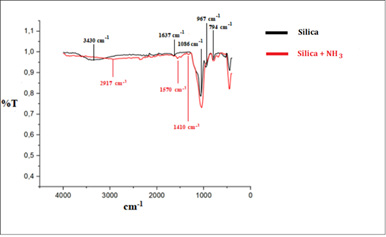
FT-IR Analysis of Silica Aerogel After Surface Modification (Functionalization) with 3-(aminopropyl) Triethoxysilane (APTES) In silica aerogel, the bands at 1086 and 794 cm-1 (Figure 1) represent the asymmetric and symmetric Si-O-Si stretching of silica gel, respectively, which are well known in the literature. The bands at 967 cm-1 correspond to the silanol -OH groups. The -OH stretching bands of silanol groups were observed at 3430 cm-1. A broad band between 3000 and 3700 cm-1, observed on the silica aerogel surface due to the absorption of atmospheric moisture, represents the fundamental stretching vibration of the O-H hydroxyl groups. The characteristic bands of C-H and N-H stretching are also observed in the range of 2917 cm-1 [28]. The band at 1410 cm-1 indicates the band compatible with -CH3 vibrations. Before amination, the bands at 3430 cm-1 and 1637 cm-1 represent water molecules adsorbed on the surface [29]. After amination, the band corresponding to NH2 bending at 1570 cm-1 and the stretching vibration of the other CH2 appeared in the FT-IR spectrum of the silica aerogel at 2917 cm-1 due to the methyl group added during amination [23]. Before amination, the bands at 3430 cm-1 and 1635 cm-1 in the silica aerogel represent water molecules adsorbed on the surface [29].
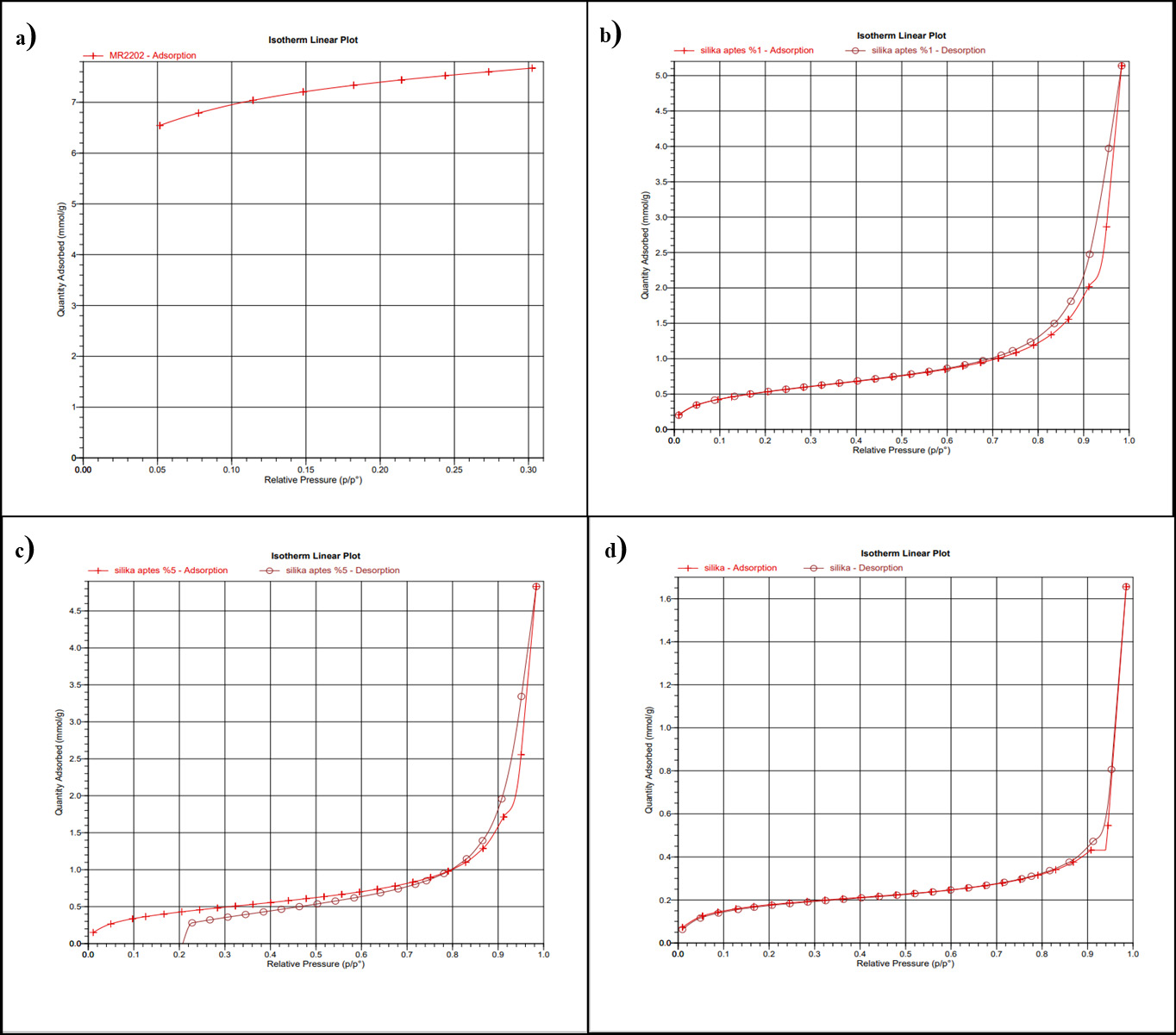
Brunauer-Emmett-Teller (BET) Surface Area, Pore Size and Pore Volume The specific surface area, pore size and pore volume of the synthesized silica aerogel were determined using the specific surface area and pore size distribution analyzer (Micromeritics, TriStar II 3020, USA) based on nitrogen adsorption-desorption measurements at 77 K. The specific surface area was determined according to the Brunauer method. The specific surface area was calculated using the Brunauer-Emmett-Teller (BET) method. The pore size and pore volume were determined from the isothermal desorption values obtained using the Barrett-Joiner-Halenda (BJH) method. Prior to analysis, moisture was removed from the prepared samples at 120 ℃ using a moisture analyzer. The samples from which the moisture was removed were weighed into sample tubes and degassed with nitrogen gas at 200 ℃ for 4 h (degassing).
After amine functionalization, the surface area, pore volume and pore diameter of the silica aerogel changed. The surface area of the silica aerogel decreased with increasing APTES concentration. It is expected that the surface area will decrease after functionalization. A decrease in pore volume with increasing APTES concentration was also observed here. However, the opposite is true for the pore diameters. For the silica aerogel treated with 1% APTES, an increase in pore diameter is observed compared to the initial value. The silica aerogel produced with an aging temperature of 50 ℃ and an aging time of 24 h has a very high surface area of 535 m2/g before amination. The surface area of the silica aerogel with 1% APTES concentration was 43 m2/g, 36 m2/g with 5% APTES concentration and 14 m2/g with 10% APTES concentration. Examination of the adsorption/ desorption isotherms for nitrogen (N2) showed that aminated and non-aminated aerogels exhibited a type IV isotherm (Figure 2). This situation shows that silica aerogels have a mesoporous structure [30]. Non-aminated aerogels exhibit higher nitrogen adsorption values. In addition, it was found that the nitrogen adsorption capacity decreased with increasing APTES concentration for all aerogels. This is due to the decreasing surface areas after functionalization of the aerogels [29].
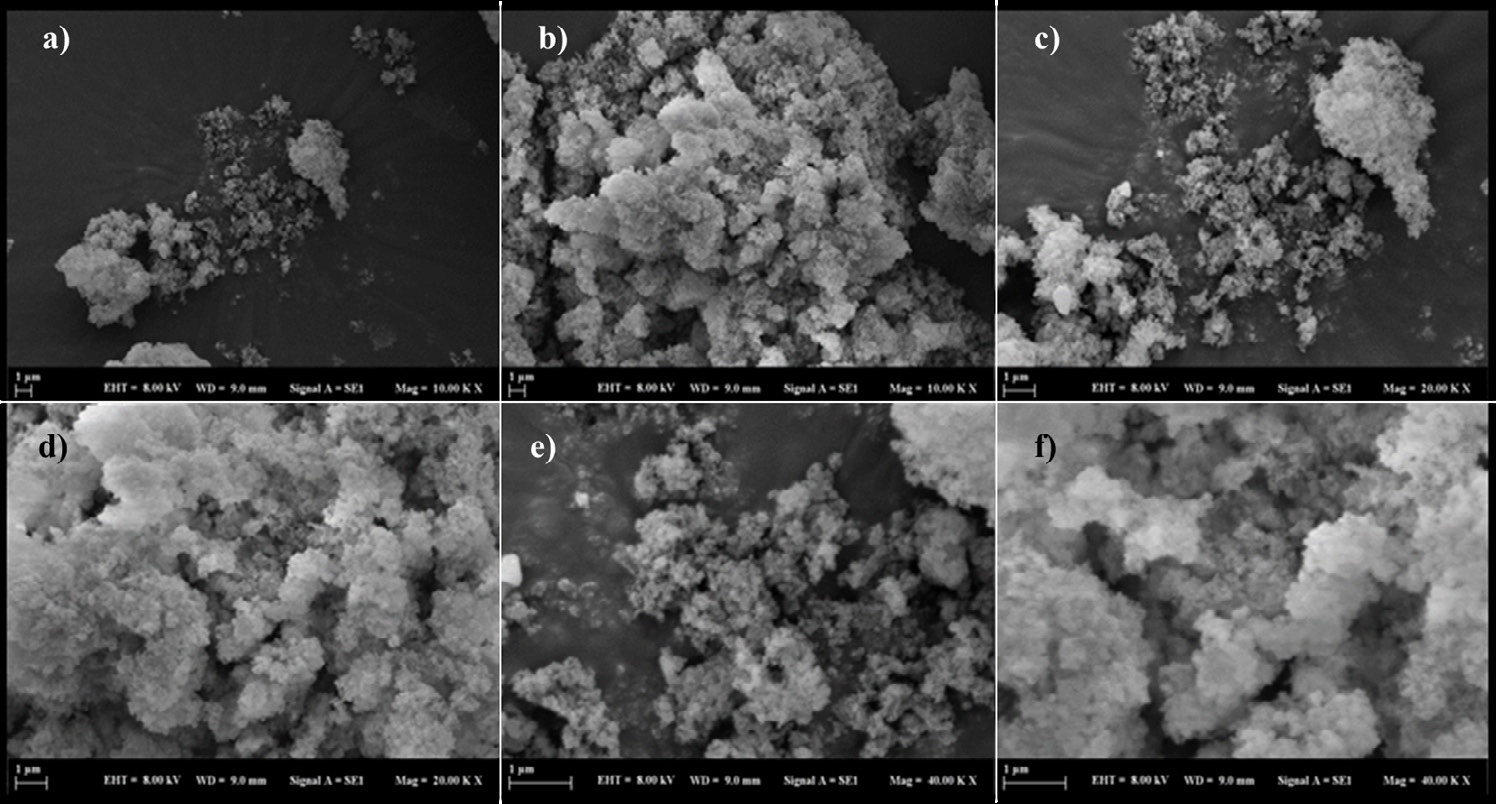
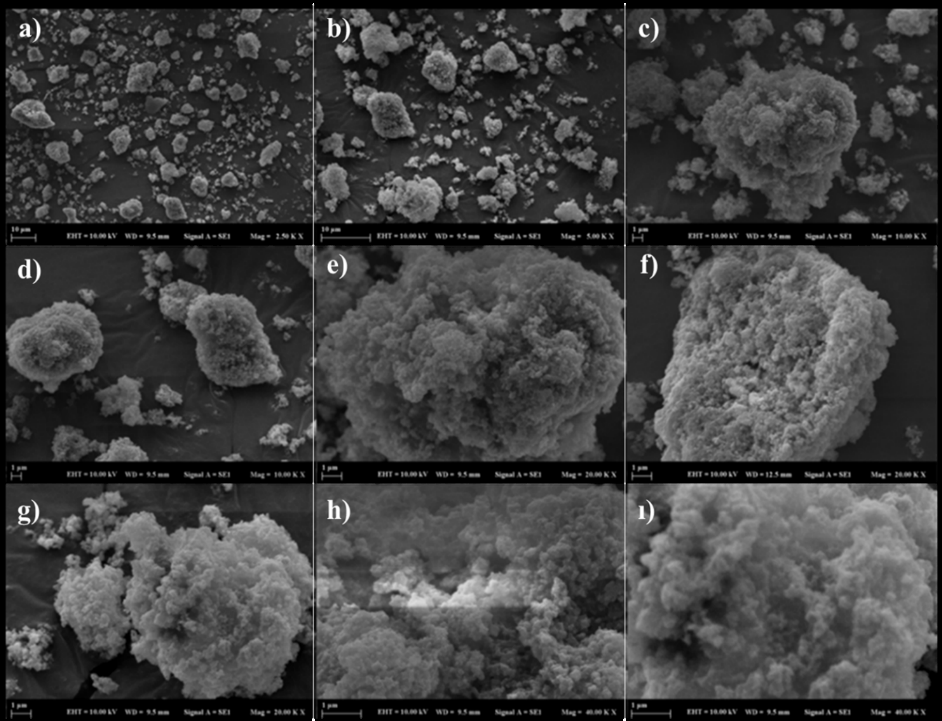
Scanning Electron Microscope (SEM) Images were taken at 10 kV and different magnifications (x1K, x1.5K, x10K, x20K and x40K) for three different aerogels that were produced and functionalized. From the SEM images of the silica aerogels shown in Figure 3, the synthesized silica aerogels have a spongy and porous network structure. These imaging results are also like the known silica aerogel samples [31, 32]. After functionalization, the particle sizes of the silica aerogel increased (Figure 4). This is due to the increase in amine concentration after functionalization [29].
X-Ray Fluorescence Spectroscopy (XRF) Analyses The XRF analysis was performed to determine the element content of silica aerogel. It was previously stored in a muffle furnace at 1000 ℃ for 1 day to remove impurities. The loss on ignition was also calculated in this way. The XRF analysis of the silica aerogel revealed an SiO2 content of 82%. As TEOS was used in the synthesis stage, this proportion is naturally higher. This is because silica aerogel with TEOS contains more silica. The reactions of Si–OH in silica and Si–OC2H5 in tetraethylorthosilicate lead to the formation of siloxane bonds (Si–O–Si). Therefore, the silica content in silica aerogel with TEOS is higher [31].
Zeta Potential Analysis The characterization of the effect of amine groups bound to the surface by functionalization of silica aerogel with APTES on the surface charge distribution was performed by measuring the zeta potential with the Zeta Sizer (Malvern Instruments). The zeta potential was measured by dispersing silica aerogels in distilled water at 25 ℃. The
modification of support materials requires the interaction of hydroxyl groups (-OH) on silicon with silanol groups (Si-OH) in APTES. The negative surface charge caused by the Si-OH groups on the surface of the silica aerogel materials used decreases because of the amine groups bound to the surface after modification with APTES, while the surface becomes more positive. The amine groups on the surface of the carrier materials modified with APTES therefore cause the surface to be positive [33]. According to the result of the zeta potential analysis, it was observed that the negative charge decreased after the functionalization of the surface of the non-APTES functionalized substrates (SA-15.2 mV; SA-NH3-2.18 mV). In the literature, based on the results of zeta potential analysis at pH 8.0 for silica aerogels functionalized with pure silica and increasing concentrations of APTES, it was found that the surface charge is negative for pure silica, while the negative charge of the surface decreases significantly with increasing APTES concentrations [29].
Optimization of Immobilization Conditions
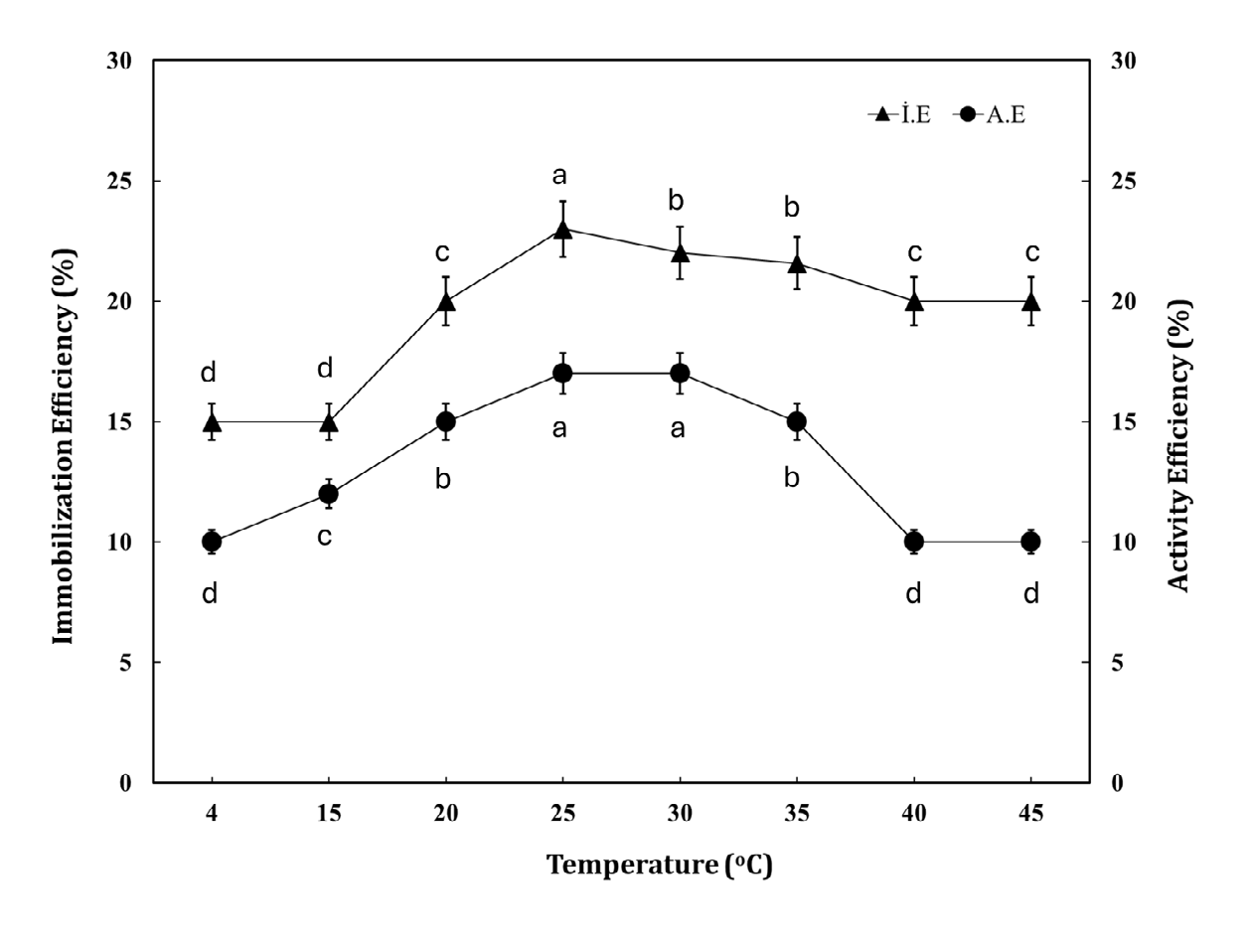
Determination of Optimum Temperature for Laccase Immobilization To determine the effect of temperature on the immobilization of the laccase enzyme on SA-NH3 by the covalent binding method, the laccase activity of the immobilized enzyme was measured at temperatures of 4, 15, 20, 25, 30, 35, 40 and 45 ℃ (Figure 5). While the immobilization efficiency for silica aerogel partially decreased with increasing temperature, the activity efficiency was observed at the highest temperature of 25 ℃. For this reason, 25 ℃ with 23% immobilization efficiency and 17% activity efficiency was set as the optimum temperature value. In the experiments performed with SA-NH3, similar immobilization efficiency and activity efficiency values were reached at temperatures between 20 and 40 ℃. Quite low values were obtained in terms of activity efficiency at temperatures of 4 and 45 ℃. At 25 ℃, the immobilization efficiency reached the highest value as 33% and activity efficiency as 23%.
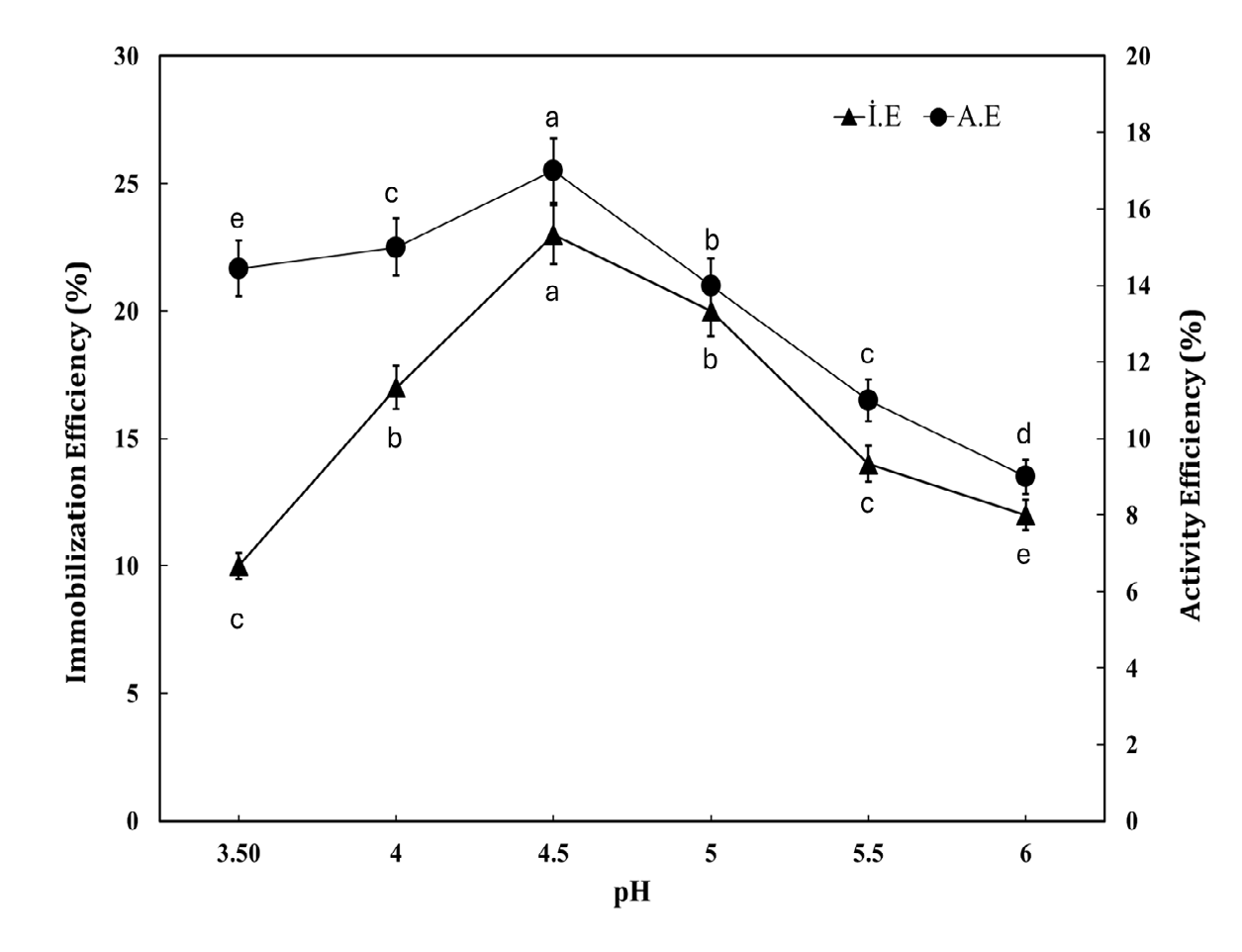
Determination of Optimum pH in Laccase Immobilization To determine the effect of pH on different support materials in the immobilization of laccase enzyme by the covalent binding method, each support material was immobilized at pH 3.5, pH 4.0, pH 4.5, pH 5.0, pH 5.5 and pH 6.0 and the laccase activity was determined (Figure 6). For SA-NH3, the immobilization efficiency at pH 3.5 and pH 6.0 was determined to be 10 and 12, respectively, while the activity efficiency was determined to be 14% and 9%, respectively. At a pH of 4.5, the immobilization efficiency was 23% and the activity efficiency was 17%, which is the highest value. This shows that the binding of the enzyme to the carrier during the immobilization process and the activity efficiency are better under slightly acidic conditions. The binding of the enzyme to SA-NH3 is quite limited at pH 3.5 and pH 5.5-6.0. The activity efficiency decreases accordingly at pH 5.5 and 6.0.
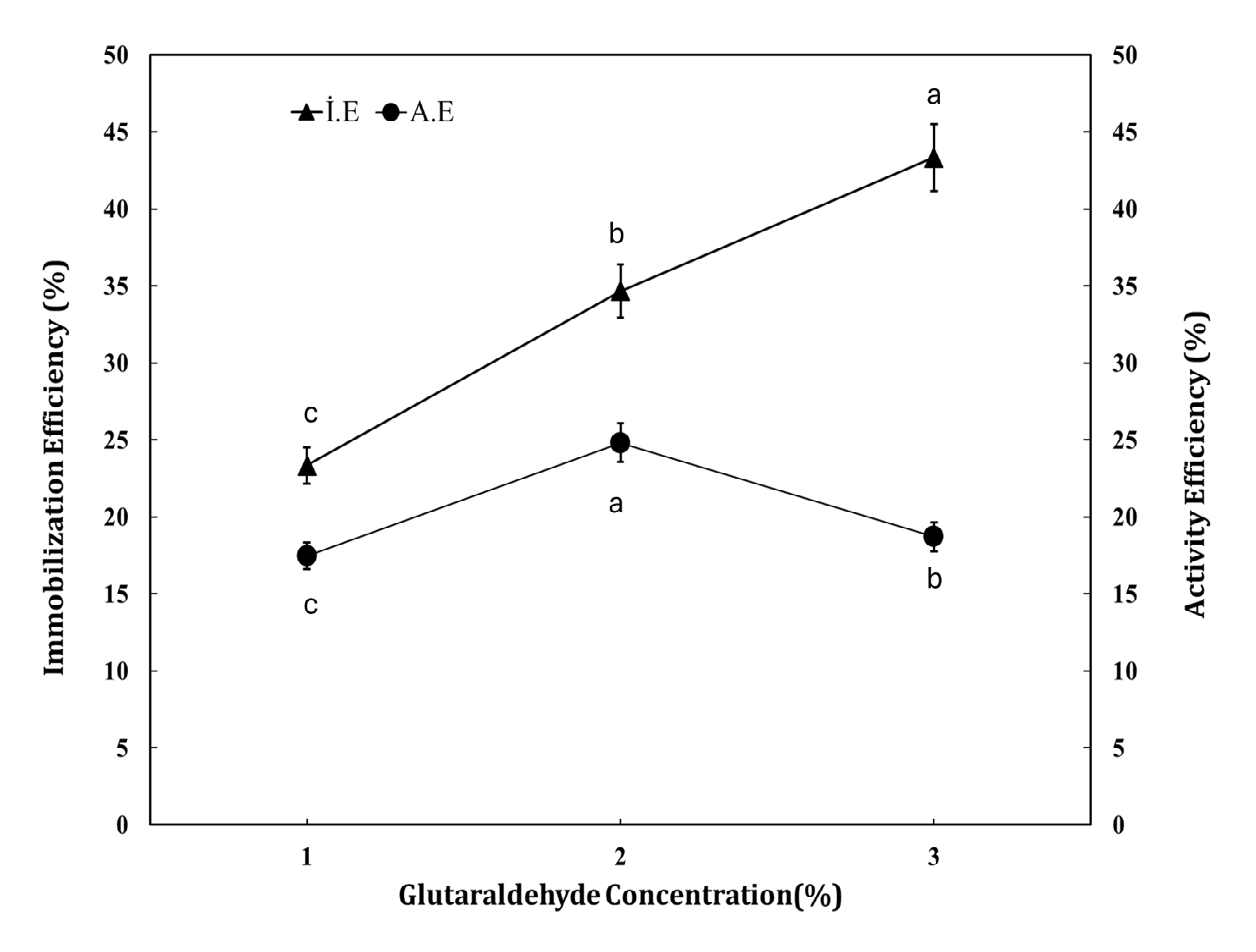
Determination of Optimum Glutaraldehyde Concentration in Laccase Immobilization To determine the optimal glutaraldehyde concentration of the covalent binding method, each SA-NH3 was treated with
1% (w/v), 2% (w/v) and 3% (w/v) glutaraldehyde in a total volume of 5 mL and experiments were performed (Figure 7). The highest percentage values for immobilization and activity efficiency in SA-NH3 were measured as 35% and 25%, respectively, in the presence of 2% (w/v) glutaraldehyde. The decrease in immobilization efficiency and activity efficiency at a value of 1% glutaraldehyde is due to the lack of sufficient aldehyde groups on the silica surface, so that the amino groups of the enzyme are unable to form sufficient bonds [18]. Although the increase in immobilization efficiency at a glutaraldehyde concentration of 3% is due to the excessive binding of glutaraldehyde and amino groups of the enzyme, the decrease in activity at this concentration shows that the 3% glutaraldehyde concentration inhibits the enzyme [34].
Studies on the immobilization of the laccase of T. versicolor on SA-NH3 are quite limited. In the study by Bautista LF, et al. [25], the laccase of T. versicolor was immobilized on mesoporous silica material, but the results regarding immobilization and activity efficiency were not considered. In the study by Guardado, et al. [35], commercial T. versicolor laccase enzyme was immobilized on silica gel with 35% immobilization efficiency by covalent binding and the laccase activity was 14±2 U g-1 silica gel. In our current study, the immobilization efficiency was also 35%, while the laccase activity was 25 U g-1 SA-NH3. This shows that the silica aerogel used in our study better preserves laccase activity.
The 35% activity yield and 25% immobilization yield obtained when immobilizing the enzyme laccase on silica aerogel are an important starting point for evaluating the efficiency and industrial applicability of this method. However, potential challenges that may arise in large- scale applications include increasing the immobilization yield, ensuring the long-term stability of enzyme activity and optimizing production costs [36]. In this direction, strategies such as modifying the surface properties of the aerogel, using more effective binding chemicals and adapting immobilization protocols to process integration can be investigated. Furthermore, by evaluating the reusability, resistance to reaction conditions and performance of the enzyme-aerogel system in large-scale production processes, optimizations can be made that offer advantages in terms of economic and environmental sustainability. In addition to increasing industrial scalability, these approaches can also significantly expand the potential for use in various biotechnological applications [37].
Conclusion
In this study, the T. versicolor laccase was immobilized on SA-NH3. SA-NH3, which was prepared at an aging temperature of 50 ℃ and an aging time of 24 h, exhibited a high surface area of 535 m2 g-1 before amination. At an APTES concentration of 1%, the surface area was 43 m2 g-1. Based on the adsorption/desorption isotherms for nitrogen (N2), it was found that aminated and non-aminated SA-NH3 exhibited a type IV isotherm. The content analyzes of SA-NH3 were performed using FTIR, XRF, SEM and zeta potential analysis techniques. Subsequently, the optimal immobilization condition for the laccase enzyme immobilized on silica aerogel was determined to be a temperature of 25 ℃, pH of 4.5 and glutaraldehyde concentration of 2%. Under these immobilization conditions, the immobilization efficiency was 35 % and the activity efficiency was 25 %.
Acknowledgements
We would like to thank Kocaeli University (Project No FBA-2021/2507) for funding. We would like to thank Research Assistant Elif Kale Bakır for her assistance with statistical analysis.
References
-
Surwase SV, Patil SA, Srinivas S, Jadhav JP (2016) Interaction of small molecules with fungal laccase: a surface plasmon resonance based study. Enzyme and Microbial Technology 82: 110-114.
-
Bilal M, Rasheed T, Nabeel F, Iqbal HM, Zhao Y (2019) Hazardous contaminants in the environment and their laccase-assisted degradation–a review. Journal of environmental management 234: 253-264.
-
Zheng F, Cui BK, Wu XJ, Meng G, Liu HX, et al. (2016) Immobilization of laccase onto chitosan beads to enhance its capability to degrade synthetic dyes. International Biodeterioration & Biodegradation 110: 69-78.
-
Zhou W, Zhang W, Cai Y (2021) Laccase immobilization for water purification: A comprehensive review. Chemical Engineering Journal 403: 126272.
-
Fernández-Fernández M, Sanromán MÁ, Moldes D (2013) Recent developments and applications of immobilized laccase. Biotechnology Advances 31(8): 1808-1825.
-
Yang J, Lin Y, Yang X, Ng TB, Ye X, et al. (2017) Degradation of tetracycline by immobilized laccase and the proposed transformation pathway. Journal of Hazardous Materials 322: 525-531.
-
Durán N, Rosa MA, D’Annibale A, Gianfreda L (2002) Applications of laccases and tyrosinases (phenoloxidases) immobilized on different supports: a review. Enzyme and Microbial Technology 31(7): 907- 931.
-
Naghdi M, Taheran M, Brar SK, Kermanshahi-Pour A, Verma M, et al. (2017) Immobilized laccase on oxygen functionalized nanobiochars through mineral acids treatment for removal of carbamazepine. Science of The Total Environment 584: 393-401.
-
Arsenault A, Cabana H, Jones JP (2011) Laccase‐based CLEAs: chitosan as a novel cross‐linking agent. Enzyme Research 2011(1): 376015.
-
Sheldon RA, Pelt SV (2013) Enzyme İmmobilisation in Biocatalysis: Why, What and How. Chemical Society Reviews 42(15): 6223-6235.
-
Fernandez-Lafuente R (2009) Stabilization of Multimeric Enzymes: Strategies to Prevent Subunit Dissociation. Enzyme and Microbial Technology 45(6-7): 405-418.
-
Wong LS, Khan F, Micklefield J (2009) Selective Covalent Protein İmmobilization: Strategies and Applications. Chemical Reviews 109(9): 4025-4053.
-
Zhan W, Chen L, Kong Q, Li L, Chen M, et al. (2023) The Synthesis and Polymer-Reinforced Mechanical Properties of SiO2 Aerogels: A Review. Molecules 28(14): 5534.
-
Meti P, Wang Q, Mahadik DB, Lee KY, Gong YD, et al. (2023) Evolutionary progress of silica aerogels and their classification based on composition: An overview. Nanomaterials 13(9): 1498.
-
Datta S, Christena LR, Rajaram YRS (2013) Enzyme immobilization: an overview on techniques and support materials. 3 Biotech 3: 1-9.
-
Zdarta J, Meyer AS, Jesionowski T, Pinelo M (2018) A general overview of support materials for enzyme immobilization: characteristics, properties, practical utility. Catalysts 8(2): 92.
-
Alves P, Dias DA, Pontinha ADR (2022) Silica aerogel- rubber composite: A sustainable alternative for buildings’ thermal insulation. Molecules 27(20): 7127.
-
Karakus YY, Isik S, Bakir EK, Turkmenoglu A, Ozkan AD (2024) Characterization of the three-phase partitioned laccase from Trametes versicolor strain with antiproliferative activity against breast cancer cells. International Journal of Biological Macromolecules 286: 138504.
-
Nyanhongo GS, Couto SR, Guebitz GM (2006) Coupling of 2, 4, 6- Trinitrotoluene (TNT) Metabolites onto Humic Monomers by A New Laccase from Trametes Modesta. Chemosphere 64(3): 359-370.
-
Smith PE, Krohn RI, Hermanson GT, Mallia AK, Gartner FH, et al. (1985) Measurement of Protein Using Bicinchoninic Acid. Analytical Biochemistry 150(1): 76- 85.
-
Yücel S, Ikizler BK, Terzioğlu P, Temel TM (2016) Influence of Gel Aging Time on The Properties of Various Silica Aerogels Synthesized from Water Glass. Materials Science Forum, Trans Tech Publications Ltd, 866: 176- 180).
-
Nayak JP, Bera J (2009) Preparation of Silica Aerogel by Ambient Pressure Drying Process Using Rice Husk Ash as Raw Material. Transactions of The Indian Ceramic Society 68(2): 91-94.
-
He Y, Luo L, Liang S, Long M, Xu H (2017) Amino- Functionalized Mesoporous Silica Nanoparticles as Efficient Carriers for Anticancer Drug Delivery. Journal of Biomaterials Applications 32(4): 524-532.
-
Ozyilmaz G, Tukel SS, Alptekin O (2005) Activity and Storage Stability of İmmobilized Glucose Oxidase onto Magnesium Silicate. Journal of Molecular Catalysis B: Enzymatic 35(4-6): 154-160.
-
Bautista LF, Morales G, Sanz R (2010) Immobilization Strategies for Laccase from Trametes Versicolor on Mesostructured Silica Materials and The Application to The Degradation of Naphthalene. Bioresource Technology 101(22): 8541-8548.
-
Patel H, Gupte S, Gahlout M, Gupte A (2014) Purification and Characterization of An Extracellular Laccase from Solid-State Culture of Pleurotus Ostreatus HP-1. 3 Biotech 4(1): 77-84.
-
Timur M, Demetgül C (2017) Synthesis and Metal Ion Uptake Studies of Silica GelImmobilized Schiff Base Derivatives and Catalytic Behaviors of Their Cu (II) Complexes. IJCCE 36(4): 111-122.
-
Tiryaki E, Elalmıs YB, Ikizler BK, Yücel S (2020) Novel organic/ inorganic hybrid nanoparticles as enzyme- triggered drug delivery systems: Dextran and dextran aldehyde coated silica aerogels. Journal of Drug Delivery Science and Technology 56(Part A): 101517.
-
Yang B, Tang K, Wei S, Zhai X, Nie N (2021) Preparation of Functionalized Mesoporous Silica as A Novel Carrier and İmmobilization of Laccase. Applied Biochemistry and Biotechnology 193: 2547-2566
-
Kim NH, Hwang HS, Lee JY, Choi KH, Park I (2011) Silica Aerogel for the Mechanical Reinforcement of Thermoset Epoxy Polymers. Proceedings of the 18th International Conference on Composite Materials (South Korea), Jeju. International Committee on Composite Materials, pp: 318-324.
-
Tadjarodi A, Haghverdi M, Mohammadi V (2012) Preparation and Characterization of Nano-Porous Silica Aerogel from Rice Husk Ash by Drying at Atmospheric Pressure. Materials Research Bulletin 47(9): 2584-2589.
-
Schulz A, Woolley R, Tabarin T, Mcdonagh C (2011) Dextran-Coated Silica Nanoparticles for Calcium- Sensing. Analyst 136(8): 1722-1727.
-
Xiao HY, Huang J, Cheng LIU, Jıang DS (2006) Immobilization of Laccase on Amine-Terminated Magnetic Nano-Composite by Glutaraldehyde Crosslinking Method. Transactions of Nonferrous Metals Society of China 16: S414-S418.
-
Guardado ALP, Druon-Bocquet S, Belleville MP, Sanchez-Marcano J (2021) A Novel Process for the Covalent İmmobilization of Laccases on Silica Gel and Its Application for the Elimination of Pharmaceutical Micropollutants. Environmental Science and Pollution Research 28: 25579-25593
-
Brena B, González-Pombo P, Batista-Viera F (2013) Immobilization of enzymes: a literature survey. Methods Mol Biol 1051: 15-31.
-
Chen Z, Oh WD, Yap PS (2022) Recent advances in the utilization of immobilized laccase for the degradation of phenolic compounds in aqueous solutions: A review. Chemosphere 307: 135824.
-
Dorcheh AS, Abbasi MH (2008) Silica aerogel; synthesis, properties and characterization. Journal of materials processing technology 199(1-3): 10-26.
- Antifungal Activity of New Acetophenone Derivatives
- Interconnected Microbiomes Human Health Within an Environmental Framework
- Silkworm-Based Vaccine Production for H5N1: A One Health Approach to Pandemic Preparedness
- Microbial Diversity and Lipolytic Activity of Bacteria and Fungi from Oil-Contaminated Sites in Makurdi Metroplois
- Antibiotic Resistance Profile of Bacteria Isolated at the Central Laboratory of the National Hospital Center of Nouakchott
- Epidemiology and Sensitivity to Antibiotics of Germs Isolated from Blood Cultures in the Laboratory of the National Hospital Center of Nouakchott-Mauritania