
Ectopic Testicular Torsion: About 2 Cases
Cryptorchidism is developmental defect in which a testis or both testes failed to descend from high in the abdomen to the bottom of the scrotum. Testicular descent is essential to normal spermatogenesis which requires temperature lower than the body temperature. We report two patients consulted for inguinal pain and were diagnosed with torsion of the spermatic cord on undescended testicle. The first consulted late and had a necrotic testicle, the second consulted on time and operative exploration found a viable testicle.
Introduction
Cryptochidism is defined as a defect in the migration of the testicle through the inguinal canal into the scrotum, placing the testicle in an ectopic position in this canal or in an intra-abdominal position [1]. Spermatic cord torsion of an undescended testicle is a rare surgical emergency whose diagnosis is often delayed due to the unusual location of the testicle, and is therefore associated with a higher risk of orchiectomy [2].
Cases
Case 1
A 14-year-old patient with no pathological history presented with 2 days’ left inguinal pain. Clinical examination revealed a soft abdomen, painful inguinal swelling and empty left hemiscrotum with right testicle in position. Ultrasound revealed torsion of the spermatic cord on a undescended testicle in inguinal position, with 2 turns of the spiral and a size decreased, non-vascularized testicle.
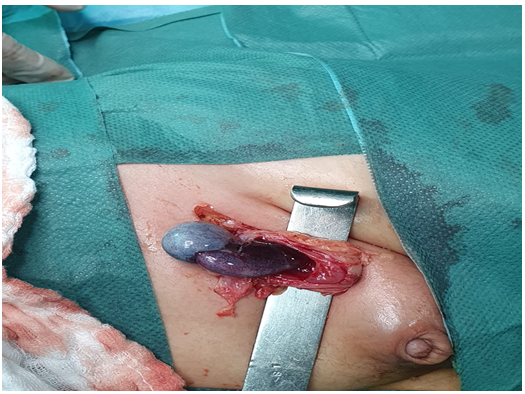
Surgical exploration was decided upon, performed via the inguinal approach, and revealed a torsion of the left spermatic cord on a pelvic ectopic testicle. The testicle was dark and did not regain its color after detorsion and soaking in warm saline Figure 1. An orchiectomy is then performed. Anatomopathological study revealed ischemic necrosis of testicular parenchyma with no sign of malignancy.
Case 2
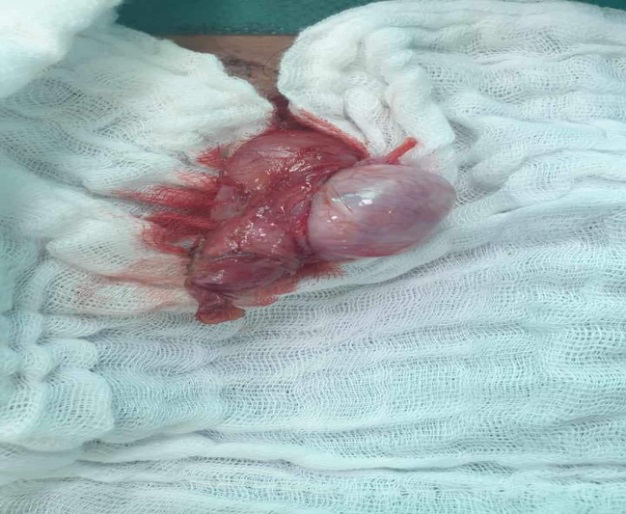
16-year-old patient, known to be have cryptorchidisme condition, presenting for 5 hours with pain in the left inguinal region, with no other associated signs. Clinical examination revealed a left inguinal mass that was mobile, hard and painful to palpation. Examination of the external genitalia revealed a right testicle in place, with a scrotal void on the left. Ultrasound revealed a well-defined oval mass of heterogeneous tissue resonance, measuring 3.4 x 1.3 x 3.4 cm, surrounded by a small layer of fluid effusion. Inguinal surgical exploration revealed torsion of the left spermatic cord on a pelvic ectopic testicle. After testicular resuscitation with warm saline, the testicle regained satisfying color and perfusion Figure 2. Orchidopexy was performed.
Discussion
Cryptorchidism is a relatively frequent congenital pathology in pediatric urology. The risk is multiplied by 10 in premature babies, low-birth-weight new-borns and those with a neuromuscular pathology [3]. It is the cause of complications, the most documented in the litterature being infertility and malignant transformation [4]. The absence of the testicle in the scrotum also predisposes to other risks, namely a high risk of torsion and exposure to trauma, not to mention the psychological impact of this pathology.
The first case of torsion of the spermatic cord on undescended testicle reported in the literature was by Gerster in 1897, and involved a sarcoma [5]. In 1964, Johnson And Holmes described cases of torsion on an ectopic testicle in patients suffering from spasmodic neuromuscular diseases. Up to 1984, 26 cases were reported in subjects with spasmodic neuromuscular disease [6]. The frequency of this condition is low: in a series of 153 cases of torsion of the spermatic cord, there were only three cases of undescended testicles [7]. It is a complication that most often occurs in young people, with a peak in frequency between the ages of 14 and 15 [7, 8, 9].
The mechanism of torsion in this context remains poorly understood. One theory is that it may result from a disproportion between the size of the spermatic cord and that of the cryptorchid testis, which is often atrophied. This disparity would create increased tension on the testicle, thus increasing the risk of torsion. This theory remains relevant even in the presence of a tumoral testis, which may twist under its own weight [10]. A second theory puts forward the role of the cremaster muscle, which, through pathological contractions, could especially induce torsion in individuals with neuromuscular pathology [11]. A third theory suggests a defect in the apposition of the epididymis in relation to the testis, creating a particular configuration predisposing to torsion [3]. It is noted that torsion is twice as frequent when the left testicle is involved, as the cord in this case is longer [12].
In fact, the possibility of torsion on undescended testis should be considered in any child presenting with inguinal or abdominal pain, associated with a painful inguinal mass and an empty hemiscrotum on the same side [10].
Torsion of an intra-abdominal testicle is relatively common in adults aged between 20 and 40. Symptoms may include abdominal pain associated with digestive symptoms such as nausea and vomiting. Common differential diagnoses include acute appendicitis and diverticulitis, but the absence of an intrascrotal testicle is an important diagnostic indicator. It should be noted that the risk of degeneration in this location is four times higher than when a testicle is located in the groin [13, 14].
If the testicle remains viable after detorsion, the authors suggest two distinct options: either lower the testicle in the same surgery, or defer it to a second time. The majority of authors recommend systematic fixation of the contralateral testicle [3, 10, 12].
The rate of preservation of the twisted testicle in scrotal position varies between 20% and 92% depending on the series [10]. The literature does not provide a rate for cryptorchidism, but it seems that the chances of recovery are lower, probably due to the often late diagnosis.
Conclusion
Ectopic testicular torsion remains a rare occurrence. Its lack of recognition is frequently responsible for delays in diagnosis, and its consequences can be serious. It is crucial to consider this diagnosis in the face of any acute pelvic or inguinal pain in a child. Ultrasound combined with Doppler
not only helps to confirm the diagnosis, but also to adjust the surgical management appropriate to the situation.
References
-
Pillai SB, Besner GE (1998) Pediatric testicular problems. Pediatr Clin North Am 45(4): 813-830.
-
Scorer CG (1964) The Descent of the Testis. Arch Dis Child 39(208): 605-609.
-
Cilento BG, Najjar SS, Atala A (1993) Cryptorchidism and testicular torsion. Pediatr Clin North Am 40(6): 1133- 1149.
-
Hutson JM, Clarke MC (2007) Current management of the undescended testicle. Semin Pediatr Surg 16(1): 64- 70.
-
Boschi L, Mandrioli M (1991) Torsion of a pelvic testicle in an adult. A clinical case. Minerva Chir 46(7): 341- 3436.
-
Abu-Dalu I, Urca I (1973) Torsion du testicule ectopique. Helv Chir Acta 40: 413-416.
-
Ein SH (1987) Torsion of an undescended benign tesicular teratoma. J Pediatr Surg 22(9): 799-801.
-
Garber HE, Kauffer GI (1968) Torsion of intraabdominal testicular seminoma. J Uroi 98(6): 684-685.
-
Mowad JJ, Konvolinka CW (1978) Torsion of Undescended Testis. Urology 12(5): 567-568.
-
Schneck FX, Bellinger MF (2002) Abnormalities of the testis and scrotum and their surgical management. In: Walsh PC, et al. (Eds.), Campbell’s Urology. 8th(Edn.), Philadelphia, pp: 2353-2394.
-
Schultz KE, Walker J (1984) Testicular Torsion in Undescended Testes. Ann Emerg Med 13(7): 567-569.
-
Ein SH (1987) Torsion of an Undescended Intraabdominal Benign Testicular Teratoma. J Ped Surg 22(9): 799-801.
-
Lewis RL, Roller MD, Parra BL, Cotlar AM (2000) Torsion of an Intra-Abdominal Testis. Current Surg 57(5): 497- 499.
-
Riegler HC (1985) Torsion of Intra-abdominal Testis. Surg Clin North Am 65: 1303-1329.
- Results of 6-Month Follow-Up of Patients After B-Turp and Thulep
- The Effect of Drinking Water with a High Content of Antimony and Arsenic on the Dynamics of their Distribution in the Kidneys and the Renal Excretory Function in Rats
- Effectiveness and Safety of Tansurethral Thulium Laser Enucleation of the Prostate in the Treatment of BPH: Review
- A Systematic Review on Molecular Pathophysiology Involved in Chronic Kidney Disease and the Role of Animal Models in Drug Discovery to Manage in Chronic Kidney Disease - An Update
- Functional Development of Kidneys in Human Ontogenesis
- Testicular Metastasis: Uncommon Prostate Cancer Case Report