
Civil Engineering Education in the 21st Century
Editorial
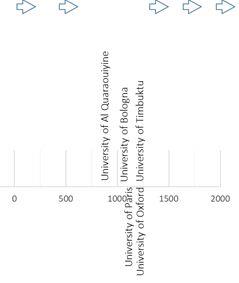
Higher education started at least two millennia ago. All ancient Greek philosophers had students and they reached high levels theories and perspectives about many subject taught today in universities. In Medieval times priests taught religious texts and works on the liberal arts to the younger generation priests. Formal universities, in western cultures, similar to contemporary ones, started about one millennia ago. For instance, University of Bologna, Italy was founded in 1088. Figure 1 depicts the evolution of universities over the last millennia (Figure 1).
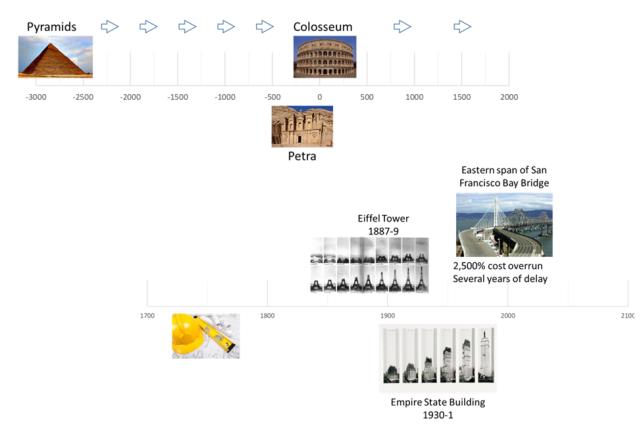
Engineering, on the other hand, started in the mid-18th century-the first engineering discipline was Civil Engineering (CE). The CE industry has an impressive history, starting with Great Pyramid of Giza in Egypt, constructed close to five millennia ago. The pyramids are the oldest structure left to testify the glory of this industry. Another example is Perta, which was built more than two millennia ago. UNESCO named Petra as one of the Seven Wonders of the World in 2007. Petra has a very advanced and sophisticated water supply and distribution system. Space limitations and the scope of this paper prevent mentioning the very long list of CE achievements. Figure depicts a historical timeline of CE achievements (Figure 2).
The “clients” of the universities are the CE industry actors- designers, entrepreneurs, contractors, project engineers, mangers etc. They are disappointed with the CE graduates. Why is that so? Are we doing something wrong? Is there not another way? After all, we work hard, we are devoted to our students and proud of our profession, and we have a large body of knowledge. Many CE professors believe that their job is to teach, meaning to transfer knowledge. However, this is a major mistake. Einstein said: “the value of education ... is not the learning of many facts but the training of the mind to think something that cannot be learned from textbooks”. Socrates believed that teaching, or knowledge transfer, is the wrong way to educate. He said: “I cannot teach anybody anything. I can only make them think ... no one can teach, if by teaching we mean the transmission of knowledge, in any mechanical fashion, from one person to another. The most that can be done is that one person who is more knowledgeable than another (professor in our case) can, by asking a series of questions, stimulate the other (student) to think, and so cause him to learn for himself.” Engineering higher education must adopt a different paradigm. This paper identifies two major necessary changes:
- Educating instead of teaching. Frontal lectures, in which the professor delivers a “speech” about all the relevant knowledge, separated from the tutoring classes, are not effective. Active learning, on the other hand, is a lot more effective. Active learning is an approach in which students are engage in the learning process. Active learning stands in contrast to teaching modes of instruction in which students are passive recipients of knowledge from an expert.
- Increasing the portion of Social Sciences and Humanity (SSH), as well as the basic sciences.
Employers in other industries have recognized the contributions of SSH to engineering education. They believe that SSH contributes to:
- Critical and logical thinking
- Increased ability to deal with subjective, complex and imperfect information
- Ability to consider evidence skeptically and examine more than one side of every problem
- Proficiency in skills beyond technical ability
- Ability to make decisions
- Increased level of ora l and written communication
- Ability to collaborate with team members A comparison between traditional CE curricula and the one advocated in this paper is depicted in Figure.
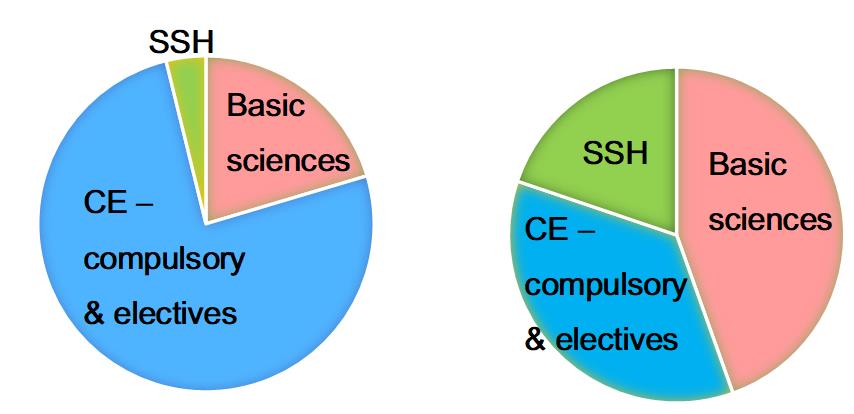
The traditional curriculum emphasise the CE material, which is the specific knowledge of the field. At the same time the SSH subjects take a very small role. The proposed paradigm advocates a shift to much higher portion of basic sciences as well as meaningfully increasing the SSH subjects. Contemporary professionals change their jobs a lot more frequently than one or two generations before. Hence, their ability to learn new material and to be able to deal with new subjects is of utmost importance. The larger portion of basic sciences is essential to this end.
Doubling, or even tripling the SSH subjects will also contribute to the students’ ability to cope with the constant changes in the requirements of their job. It will also make them more creative, more sceptical, more communicative and more collaborative. As a result, they will be better engineers and leaders in their professional engagement.
- Electronic Waste Management in the Top Ten Economies in the World: A Critical Review on Waste Generation, Regulations, Collection, Recycling and Environmental Challenges
- Some Challenging Transdisciplinary Aspects of the Sustainable Waste Management in the Permacrisis Context
- Use of Mobile Autonomous Systems for Pollution Control of Inland Water Bodies
- Environmental Impact Perspective Sustainable Online Textile Retailing: Harnessing Augmented Reality-Based Digital Twins in Bangladesh
- Composite Treatment Module for Removing Acidity and Metal (Loid)S from Acid Rock Drainage
- Household E-Waste Management Systems [E-Wms] in Malaysia