
Depredation of Crop Caused By Monkeys nearby Shivapuri- Nagarjun National Park, Kathmandu, Nepal
Introduction
Long-tailed macaques (Macaca fascicularis) are the most frequently seen species among the thirteen species of primates in Thailand and they were recently reported at 91 locations [1, 2, 3]. In comparison, only nineteen, twelve, eleven, and nine locations were observed for rhesus (M. mulatta), pigtailed (M. nemestrina), stump-tailed (M. arctoides) and Assamese macaques (M. assamensis) respectively [3] Macaques (genus Macaca; Family: Cercopithecidae) are ecologically extremely adaptive primates which are distributed more widely than any other non-human primate genus.
Two species of macaques have been reported in Nepal namely Rhesus macaque Macaca mulatta (Zimmermann, 1780) and the Assamese macaque Macaca assamensis (McClelland, 1840) but latter one is the less well researched nonhuman primate in Nepal [4] and was categorized as ‘Vulnerable’ in 2007 under IUCN Red List of Threatened Animals. Macaca assamensis is categorized as ‘vulnerable’ and is one of the protected mammals by the National Parks and Wildlife Conservation Act 1973 of Nepal [5, 6]. Its study was done in Makalu– Barun area and also in Langtang area. Macaca assamensis was first recorded in 1985 in Shivapuri Nagarjuna National Parks and thereafter remained unknown long time. It was reported that total 213 Assamese macaques (Macaca assamensis) were encountered in 9 groups within the total area surveyed of 113 km² at Langtang National Park [7, 8].
Assamese monkeys are shy, timid, and less aggressive to human beings in comparison to the rhesus monkey. They are arboreal, terrestrial, and omnivorous animals with multi-male and multi-female social troops [9]. With the rapid increment in human population in and around the monkey’s habitat, the relationship between these primates has turned into enmity. In fact, human beings are sole blame of destructing habitat of monkey. Human population growth and activities like deforestation, agriculture, and urbanization lead to an never ending encroachment on wildlife habitats. The interface of wildlife habitat and human use dominated landscape has become grounds for a wide range of human- wildlife conflict [10]. Human non-human primates’ conflict is increasing to the developing countries than developed countries due to greater biodiversity and lack of prevention measures such as farm fences, livestock guard [11]. In south Asia conflicts between humans and the Rhesus macaques (Macaca mulatta) seems to increase. In Uganda, the cost of crop raiding by primates and guarding varied from US$ 96- 519 per household per year. Likewise, in Kenya, crop raiding costs US$ 200-400/ households/year [12] which is a large amount of money in comparison to their daily income.
There are very few studies about damages causes by Assamese monkey nearby Shivapuri Nagarjun National Park. Several damages caused by Macaca assamensis were observed nearby Sivapuri Nagarjuna Shivapuri National Parks, but there is not any reliable record of these damages. Local people have been facing the problem caused by Macaca assamensis nearby this National Park. At the same time its damages distribution is not only limited in one location but also in several parts of National Park as well, but the spatial distribution of such damages is not so far mapped. Thus, this study was objectively done to assess the damages caused by Monkeys, spatial distribution of damages and explore the causes of interface between humans and Monkey nearby Shivapuri-Nagarjun National Park.
Materials and Methods
Study Area
Shivapuri-Nagarjun National Park (SNNP), near Kathmandu, Nepal, is comprised of two isolated forest tracts, Shivapuri and Nagarjun. Nagarjun forest covers 16 square kilometers and is immediately adjacent to the northwest boundary of Kathmandu city. Geographically, Shivapuri is located between 27° 45’ to 27° 52’ North and 85° 16’ to 85° 45’ east. Nagarjun is located between 27° 43’ to 27° 46’ north and 85° 13’ to 85° 18’ east.. The main range of the hill runs in the east-west direction with the highest peak at Jamacho (2100 m), which rises abruptly from the floor of Kathmandu valley (1350 m) (Figure 1).
.
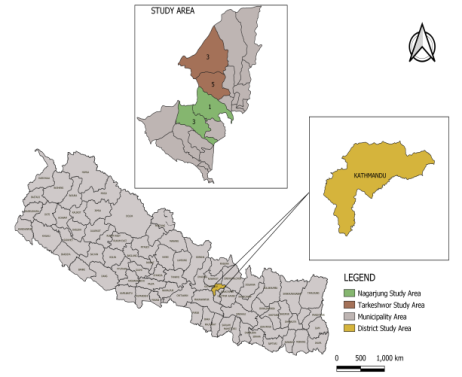
The temperature of study site ranges from 3.5℃ (January) to 30.2℃ (August). Similarly, relative humidity in December is maximum (91.5%) and in May it is minimum (78.0%). Likewise, rainfall in August was maximum i.e., 339.9 mm while it was a maximum of 552.8mm in July. There are four types of forests namely Schima wallichii forest, mixed broadleaved forest, pine forest, and dry oak forest in Nagarjun hill. There are few small patches of the grassy meadow (Nagarkoti 2006). These forests are home for sixteen species of herpetofauna including Naja kaouthia, Ophiphagus Hannah, Trimeresurus albolabris, Japulura variegate are recorded from Nagarjun forest among them Megophrys parvais most common among amphibians and Calotes Versicolor common among reptiles. Many Bird species including Kalij Pheasant (Lophura leucomelanos), Yellownapes (Picus spp.), Barbets (Megalaima sps.), Green-billed Malkoha (Phaenicophaeus tristis), Owlets (Glaucidiumsps.), Himalayan Griffon (Gyps himalayensis), Harriers (Circus sps.), Drongos (Dicrurus sps.)Thrush (Monticola sps and Myophonus spp.)Tits (Parus sps.), Nuthatch (Sitta sps.), Bulbul (Hypsipetes sps.), laughing thrush (Garrulax spp.), Babbler (Pomatorhinus sps.) and many species of wablers [13, 14].
Data Collection
The primary data were collected using site visit, group discussion, household survey and resource assessment. Similarly the secondary data were collected from report and published papers. Site visit: The seasonal calendar showing the crop like wheat, maize, paddy etc. and calendar of damage was prepared. The visit was concentrated based on these calendars. The checklist was prepared to note the damages during the visit time, photographs and videography of damages was captured. Group discussions: Total 4 group discussion was organized with different groups. Specifically, the group discussion was done with office staffs of National Park, victims caused by monkeys, authority of ward office and supportive organization. The causes of damages were also be recorded. For this the checklist was prepared and tested before going to field. Household survey: List of household damages caused by Monkey was prepared. Among them 120 households were surveyed to collect the data related to damages caused by monkey. The household survey was including the types of damage, time of damage, quantity of damage, season of damage, year of damage, monetary value of damage, area of damage. Damage of 3 years was collected using the call back method. The causes of damages were recorded. For this the checklist was prepared. Resource assessment: GPS coordinate of location of damages was recorded and at the same time coordinates was categorized according to types time of damage, quantity of damage, season of damage, year of damage, value of damage, area of damage. Key informant interview: Experts, Government authority, local people, policy maker. Total 20 key informant interviews were taken. The causes of damages were also recorded. For this checklist was prepared. Secondary data collection: Trend of damage, record of compensation, record of damages, and location of damages were collected from published and unpublished documents available in National park office, newspaper, news etc. Required data and information was collected from literatures, relevant books and paper, spokesperson of rural municipality, operational plan of forest users and libraries, etc. Data analysis: The collected data was analyses using statistical, spatial and unitary method. The statistical analysis was done using descriptive tools. The damages and its value were analyzed using unitary method to quantify the total damages. The mapping of damages caused by monkey was done and categorized based on size of damage, location of damage, density of damage. The Principle component analysis was done to find the major causes and their contribution in interface between monkey and people nearby Shivapuri-Nagarjun National Park.
Results
Damage caused by Rhesus Monkey (Macaca mulatta) at Different Sites
The descriptive statistics were performed to show average crop damage (kg) according to fiscal year. It was recorded that, mean with standard error, standard deviation, maximum and minimum values were 639.2±372.10, 832.05, 2080 and 78 respectively at Ichangu Narayan site. Similarly, mean with standard error, standard deviation, maximum and minimum values were 253.33±153.76, 266.33, 80 560 respectively. These values were varied according to fiscal year (Table 1).
| Villagea | Maize damage (Kg) in 2019/2020 | |||
|---|---|---|---|---|
| Mean ± SE | Sd | Min | Max | |
| Goldhunga | 639.2±372.10 | 832.05 | 78 | 2080 |
| Ichangu Narayan | 253.33±153.76 | 266.33 | 80 | 560 |
| Maize damage in 2020/2021 | ||||
| Goldhunga | 710.80±149.88 | 1226.87 | 60 | 8000 |
| Maize damage in 2021/2022 | ||||
| Goldhunga | 476±124.71 | 394.38 | 120 | 1360 |
| Year | Site | No of families got compensation | Evaluated damage kg | Compensation US$ |
| 2019/2020 | Goldhunga | 3 | 600 | 600 |
| Ichangu Narayan | 3 | 617 | 617 | |
| 2020/2021 | Goldhunga | 66 | 31214 | 38000 |
| Ichangu Narayan | Data not available | |||
| 2021/2022 | Goldhunga | 10 | 4760 | 40000 |
Table 1: Descriptive Statistic of Crop Damage.
Trend of Compensation of Crop Damage
The damage caused by monkey was varying in place to place and compensation was paid by Shivpuri Nagarjun National Park accordingly. According to report of national park, total 3 families each in Goldhunga and Ichangu Narayan were paid the compensations US $ 600 and US$ 617 as the damages evaluated 600 and 617 kg respectively in these sites in year 1029/2020. Similar compensation was paid based on the evaluation of park’s authority. It was the highest paid about US$ 38000 to 10 families in Goldhunga in 2020/2021 (Table 2).
Spatial distribution of Damage caused by Monkeys
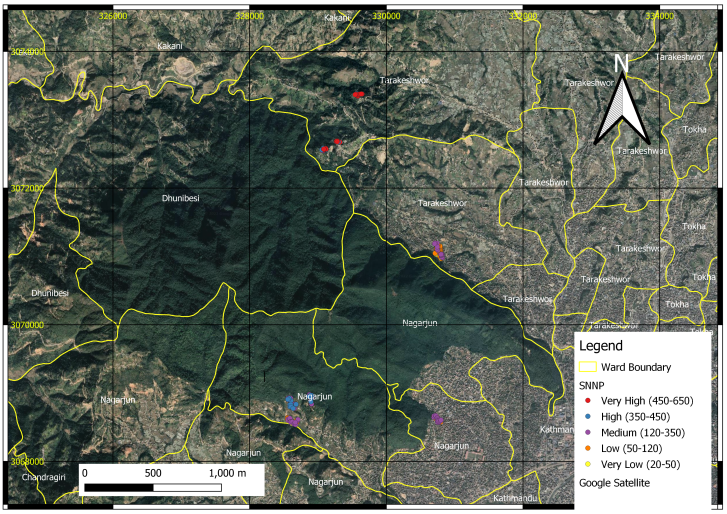
The crop damage caused by monkey was categories into 5 main types. These are very high damage ranging from greater than 450 Kg; High damage ranging from 350 Kg to 450 kg; Medium damage was ranging from 120 Kg to 350 Kg; Low damage ranging from 50 Kg to 120 Kg. and very low damage was ranging from 20 Kg to 50 Kg. Out of these studied area Tarakeshwor-3, Tarakeshwor-5, Nagarjun-1, and Nagarjun-3, Thulo Gaun of Tarakeshwor-3 which bore very high damage area and in Nagarjun-1 Raniban, Ichangu Narayan was high damage, Nagarjun-1, Nagarjun-3 (Gufa Gairi, Sarung Danda), Tarakeshwor-5 (Gol Dhunga) was medium damage, Nagarjun-1, Nagarjun-3, Tarakeshwor-5 was also bore low damage in some place. Tarakeshwor-5 also bore very low damage in some place which was little bit far from the SNNP (Figure 2).
Causes of Monkey and Human Conflict
In the graph 3 of variable, the dimension 1, X-axis was 42.61% and dimension 2, Y-axis was 32.83%. The graph plot showed that the charged thread was maximum. The charged thread line in the graph plot at the origin was observed vertical i.e. nearly 80° with the X-axis and which made the angle around 10° with Y-axis. In the graph, the chase-out of monkeys in the site was less than charged thread, i.e. 45° with the both X-axis and Y-axis. It showed a positive correlation between the charged thread and chased-out. These two actions have been borne by the positive region of the X-axis and Y-axis, more value than the other action i.e. stone throw, use of catapult, and shout. Similarly, the stone throw, use of catapult and shout has no any correlation with charged thread and chased-out, showed negative correlation because the stone throw, use of catapult and shout made the angle more than 90° with charged, thread and chased-out (Figure 3).
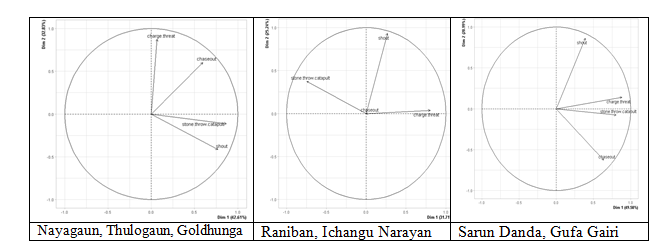
Further, when the Eigenvalues table was observed the variance of dimension 1 bore the highest value 1.704 and followed by dimension 2 with 1.31, dimension 3 with 0.558, and the smallest variance was with the dimension 4 0.424. The percentage of the variance was 42.611%, 32.833%, 13.959%, and 10.596% with dimension 1, dimension 2, and dimension 3, dimension 4 respectively. The highest cumulative percentage was bored by dimension 4 was 100. The second-highest cumulative percentage was with dimension 3 89.40, dimension 2 bore 75.445, and the smallest was with dimension 1 42.611 (Table 3).
| Variance | % of Variance | Cumulative % of Variance | |
|---|---|---|---|
| Nayagaun, Thulogaun, Goldhunga | |||
| Dimension 1 | 1.704 | 42.611 | 42.611 |
| Dimension 2 | 1.313 | 32.833 | 75.445 |
| Dimension 3 | 0.558 | 13.959 | 89.404 |
| Dimension 4 | 0.424 | 10.596 | 100 |
| Raniban, Ichangu Narayan | |||
| Dimension 1 | 1.268 | 31.705 | 31.705 |
| Dimension 2 | 1.01 | 25.24 | 56.945 |
| Dimension 3 | 1 | 25 | 81.945 |
| Dimension 4 | 0.722 | 18.055 | 100 |
| Sarun Danda, Gufa Gairi | |||
| Dimension 1 | 1.983 | 49.583 | 49.583 |
| Dimension 2 | 1.16 | 28.989 | 78.572 |
| Dimension 3 | 0.536 | 13.402 | 91.974 |
| Dimension 4 | 0.321 | 8.026 | 100 |
Table 2: Eigen values showing the causes of human monkey conflict.
The Table 4 showed that cause of monkey and human conflict. The some of the causes of monkey and human conflict showed positive, negative and no correlation between them.
- Principle Component
- Analysis
- Action
- Axis
- Result
- Causes of monkey and human conflict at
- Nayagaun, Thulogaun,
- Goldhunga
- Charge threat,
- Chase-out, stone throw, catapult, shout
- • stone throw, catapult and shout were in (+, -) axis
- Charge threat,
- Chase-out, stone throw, catapult, shout
- Causes of monkey and human conflict at Raniban
- Ichangu Narayan
- • stone throw, catapult was in (-, +) axis
- • Shout and Charge threat was in (+, +) axis
- Charge threat,
- Chase-out, stone throw, catapult, shout
- Causes of monkey and human conflict at Sarung
- Danda and Gufa Giri
- • Chase-out, stone throw, catapult as in (-, -) axis
Table 3: Causes of monkey and human conflict at SNNP.
Discussion
Crop depredation caused by wild animals is serious issues in the world [15, 16]. The results of this research demonstrate that site near the Shivapuri-Nagarjun National Park (SNNP), the two species of the monkey were found. The number of members in the troop was 15-20 and sometimes it was recorded 3-4 members or a single number. The highest number of Rhesus monkeys that were found in the residential area was due to the closer relationship with the crops to fulfill their food starvation. Rhesus monkeys were the more abundant of the two locally available species (128) and Langur’s population was found to be 14 which may be due to his most sympathetic nature to human and crop attacks Aryal & Chalise [17]. The low number of Hanuman langur may be due to the small, green habitat of nature, which was less eternity to humans Khatry [18]. The number of mature individuals counted was 82 (56.9%) and 62 (43.1%) were immature individuals [19]. Their abundance in a particular area depends on the area’s topography, forest types, vegetation patterns, and agricultural practices. Plantation of the new species of the plant in between natural forest which results from the shortage of food inside the national park, force the monkey to moves outside the national park in search of food. Planting exotic crops in place of natural food plants seem to have forced Rhesus monkeys to invade human settlements to survive Devi & Saikia [20]. Due to their intolerable activity; people today consider them pest species rather than important species of protection. Locals are even more concerned about the scale of the conflict over the next few years, as they speculate that Rhesus monkey populations will not decline [20].
The household survey found the result that, the highest damage of the crop was recorded in Goldhunga, Nayagaun, Thulogaun, and that was more than 450 Kg. Corn is a staple food, a preferred crop, and less susceptible to other forms of damage. Several studies support that monkey like to eat and damage the crop [4]. Reported that grains, fruits, and tubers were the most preferred and vulnerable to macaque attacks in the Makalu-Barun Conservation Area [21]. Gathered crop looting information through an interview in Lakuwa village of the Makalu-Barun Conservation Area. Rhesus and Assamese macaques were the most common crop looters and Langurs were the least visited. Assamese monkeys were worse than rhesus monkeys [9]. Paudel (2016) recorded 61.18 ha of land used to grow crops at Kali Gandaki River Basin in Baglung and Parbat districts and the total yield of the crop would be 688.29 quintals, but it was only 567.74 quintal. In fact, 120.55 quintal maize was damaged by macaques [22]. According to the survey, macaques most commonly attacked rice (69%) and corn (59%), cardamom (44%), millet (28%), and others (15.4%) [23, 24] reported wildlife attacks on buckwheat and barley in Langtang National Park and Rara National Park and also recorded monkey damage to crops on the southern border of the Makalu-Barun Reserve (MBCA) [25, 26].
The human and monkey conflict consequence several loss that were varying in quantity and money [27, 28]. The economic loss of 39 households was approximately $
23,477.90 annually with an average of $ 602 per household (equivalent to NPR 60,199.74) [29]. Most respondents shared that around 32% loss was due to the wild animals in maize, its value ranged from US 20, 0 to 5000 [30]. These findings were quite similar with the result of this research.
To achieve a better understanding of the spatial distribution patterns of damaged crops in Nayagaun, Thulogaun, Tarakeshwor-3 showed the extreme damage of the crops i.e. maize in one site and other was addressed moderate damage of the crops. In Tarakeshwor-5 Gol Dhunga 21 spot was recorded as the low damage of the crops then the Tarakeshwor-3. In Gufagairi, Sarung danda, Nagarjun-1. The damage and loss caused by the wild animals distributed according to the nature of animals and monkey generally like maize, wheat and fruits [31, 32]. This research showed that, damage caused by the monkey was commonly at maize field. There is no only one reason of monkey and human conflict but it is generally because of searching of food [33, 34, 35].
Principle component analysis showed the trend of the damage of the crops and monkey activities in the studied site. In Nayagaun, Thulogaun, Sarung Danda, Ghufa Gairi, and Raniban, Ichangu Narayan different data have been found from the house survey data collection. The result found with the Raniban, Ichangu Narayan shout and charge threat showed positive relation where the stone threw by catapult and chase-out have negative relation. People defended themselves against monkeys in a variety- and through a combination- of actions i.e., most often involved throwing stones or using a catapult (30%), shouting or throwing a firecracker (54%), or encouraging their dogs to chase monkeys (9%) and about 1% did nothing or tolerated the monkeys [36, 37]. Guards (93%) and slingshot/bow and stone or stone use (89%) are most commonly used to chase the monkey Barua [38]. Human Wildlife conflict is serious issues so as found in this park as well [39, 40, 41, 42].
Conclusion and Recommendation
The highest damage of the maize was found at Nayagaun, Thulogaun while this was the lowest at Raniban, Ichangu Narayan while medium damage was recorded at Naagarjun, Gufagairi, Sarung danda. The maize damage distribution was categorized into highest, medium and lowest group. The highest damage of maize was distributed dominantly at Thulogaun. Similalry, medium damage was distributed at Sarung Danda while lowest damage was distributed at Raniban area. Principle component analysis showed the trend and triggered the highest level of conflict and the action factor between humans and monkeys. The factors are use of catapult in Nayagaun, Thulogaun, shout and charge threat in Naagarjun, Gufagairi, Sarung danda and in Raniban, Ichangu Narayan. This research will be useful for scientific community and policy maker.
The distance from the national park area does not affect the harvest pattern, so an alternative harvesting system may be a better option. Priority should be given to maximize the alternative farming like chilli, garlic, onion, turmeric, and others fruits etc. The preferred species of monkey like plantation of fruits should be given high priority manage the conflict between monkeys and human.
References
-
Bernard T, Singh M, Kaumanns W (2004) Macaque societies: a model for the study of social organization. Cambridge University Press, United Kingdom.
-
Malaivijitnond S, Yuzuru H (2005) A new record of stump-tailed macaques in Thailand and the sympatry with long-tailed macaques. Tropical Natural History 5(2): 93-96.
-
Malaivijitnond S, Urasopon N, Goto S, Hamada Y (2009) Diversity study of primates in Thailand. The 2nd International Symposium on Southeast Asian Primate Research, Biodiversity Study of Primates in Laos. Laos.
-
Chalise MK (2000) Behavior study of Assamese monkeys (Macaca assamensis) of Makalu-Barun Area. In the proceedings of IIIrd National conference on Science and Technology, Kathmandu, Nepal.
-
Chalise MK (2013) Fragmented primate population of Nepal Primates in fragments. Springer 329-356.
-
Chalise MK, Bhattarai GP, Pandey B (2013) Ecology and behavior of Assamese monkeys in Shivapuri Nagarjun National Park, Nepal. Journal of Natural History Museum 27: 12-24.
-
Regmi GR, Kandel KP (2008) Population Status, Threats and Conservation Measures of Assamese macaque (Macaca assamensis) in Langtang National Park, Nepal. Environmental Science.
-
Regmi GR, Nekaris KI, Kandel K, Nijman V (2013) Crop- raiding macaques: predictions, patterns and perceptions from Langtang National Park, Nepal. Endangered Species Research 20(3): 217-226.
-
Chalise MK (2003) Crop raiding by primates and other wild animals in the mountains of Nepal. Proceedings of a national semina Kathmandu, Nepal.
-
Sinha A, Datta A, Madhusudan MD, Mishra C (2005) Macaca munzala: a new species from western Arunachal Pradesh, northeastern India. International Journal of Primatology 26(4): 977-989.
-
Seoraj-Pillai N, Pillay N (2016) A meta-analysis of human–wildlife conflict: South African and global perspectives. Sustainability 9(1): 34.
-
Zubiri CS, Switzer D (2001) Crop raiding primates: Searching for alternative, humane ways to resolve conflict with farmers in Africa. Oxford University, USA.
-
Grimmet R, Inskipp C, Inskipp T, Baral H (2003) Nepalka charaharu. Nepal: Bird Conservation.
-
Wada K (2005) The distribution pattern of rhesus and Assamese monkeys in Nepal. Primates 46(2): 115-119.
-
Rao K, Maikhuri R, Nautiyal S, Saxena KG (2002) Crop damage and livestock depredation by wildlife: a case study from Nanda Devi Biosphere Reserve, India. Journal of environmental management 66(3): 317-327.
-
Paudel G, Shrestha TK (2018) Crop Depredation by Monkey Outside Protected Area in Nepal; Costs, Conditions and Perceptions. Indian Forester 144(10): 929-935.
-
Aryal K, Chalise MK (2013) Human-monkey interface in Arkhale and Nayagaun, Gulmi, West Nepal. Nepalese Journal of Zoology 1(1): 30-40.
-
Khatry P (2006) Study on Monkey-Human conflict in Vijayapur area, Dharan, Eastern Nepal. Central Department of Zoology, Tribhuvan University, Kathmandu, Nepal.
-
Chalise MK, Hideshi O, Pandey B (2013) Assamese monkeys in Nagarjun forest of Shivapuri Nagarjun National Park, Nepal. Tribhuvan University Journal 28(1-2): 181-190.
-
Devi O, Saikia P (2008) Human-monkey conflict: a case study at Gauhati University Campus, Jalukbari, Kamrup, Assam. Zoos’ Print 23(2): 15-18.
-
Chalise MK, Karki J, Ghimire MK (2001) Survey of Assamese monkey in Langtang National Park, Nepal. Journal of the American Society of Hypertension 25(4): 4-5.
-
Paudel K (2015) Assessing illegal wildlife trade in Araniko-trail, Nepal. Pokhara: Pokhara University, Nepal.
-
Ghimirey Y, Acharya R, Pokhrel B (2018) Human- Assamese macaque conflict in Makalu-Barun National Park Buffer Zone, Nepal. Friends of Nature The Himalayan Naturalist 1(1): 3-7.
-
Upreti B (1985) Park people interface problems and new directions. Report of international workshop on management of national parks and protected areas of the Hindukush Himalayas, Kathmandu.
-
Upreti B (1985) The Park-people interface in Nepal. Proceeding of intern ational workshop on the management of National Parks and protected areas in the Hindu Kush-Himalaya, Kathmandu.
-
Jackson R (1990) Threatened wildlife, crop and livestock depredation and grazing in the Makalu- Barun Conservation Area. Kathmandu: Makalu-Barun Conservation Project, DNPWC, Nepal.
-
Saj T, Pascale S, James D (2001) The conflict between vervet monkeys and farmers at the forest edge in Entebbe, Uganda. African Journal of Ecology 39(2): 195- 199.
-
Ahsan M, Uddin M (2014) Human-Rhesus Monkey conflict at Rampur Village under Monohardi Upazila in Narsingdi District of Bangladesh. Journal of Threatened Taxa 6(6): 5905-5908.
-
Ghimire SC, Chalise MK (2018) Status of crop raiding by Assamese monkeys (Macaca assamensis) along the Budhigandaki river, central Nepal. Journal of Natural History Museum 30: 294-305.
-
Sharma S, Acharya S (2017) Human-rhesus macaque conflict at pumdivumdi/tallokodi, pokhara, west Nepal. Banko Janakari 27(2): 46-50.
-
Dai Y, Hacker C, Zhang Y, Li Y, Li J, et al. (2020) Conflicts of human with the Tibetan brown bear (Ursus arctos pruinosus) in the Sanjiangyuan region, China. Global Ecology and Conservation 22: e01039.
-
Siljander M, Kuronen T, Johansson T, Munyao MN, & Pellikka P (2020) Primates on the farm–spatial patterns of human–wildlife conflict in forest-agricultural landscape mosaic in Taita Hills, Kenya. Applied Geography 117: 102185.
-
Distefano E (2005) Human-Wildlife Conflict worldwide: collection of case studies, analysis of management strategies and good practices. Food and Agricultural Organization of the United Nations (FAO), Rome, Italy.
-
Li W, Essen E (2021) Guarding crops from monkey troops: farmer-monkey interaction near a nature reserve in Guangxi, China. Environmental Sociology 7(1): 12-24.
-
Sharma P, Chettri N, Wangchuk K (2021) Human– wildlife conflict in the roof of the world: Understanding multidimensional perspectives through a systematic review. Ecology and Evolution 11(17): 11569-11586.
-
Dittus W (2012) Problems with pest monkeys: myths and solutions. Journal of the Wildlife and Nature Protection Society of Sri Lanka 26(3-4): 18-23.
-
Dittus W, Gunathilake S, Felder M (2019) Assessing public perceptions and solutions to human-monkey conflict from 50 years in Sri Lanka. Folia Primatologica 90(2): 89-108.
-
Barua M (2010) Whose Issue? Representations of Human-Elephant Conflict in Indian and International Media. Science Communication 32(1): 55-75.
-
Beisner B, Heagerty A, Seil S, Balasubramaniam K, Atwill E, et al. (2015) Human–wildlife conflict: Proximate predictors of aggression between humans and rhesus macaques in India. American journal of physical anthropology 156(2): 286-294.
-
Adhikari J, Bhattarai B, Thapa T (2018) Human- wild mammal conflict in a human dominated midhill landscape: a case study from Panchase area in Chitwan Annapurna Landscape. Journal of Institute of Science and Technology 32(1): 30-38.
-
Chalise MK, Karki J, Ghimire M (2005) Status in Nepal: Non-human Primate. Special issue published on the occasion of 10th Wildlife Week, 2062, Kathmandu.
-
Chalise M (2000b) Crop raiding by wildlife, specially primates and indigenous knowledge of food conservation. Asian Primates 3-4(7): 4-9.
- Electronic Waste Management in the Top Ten Economies in the World: A Critical Review on Waste Generation, Regulations, Collection, Recycling and Environmental Challenges
- Some Challenging Transdisciplinary Aspects of the Sustainable Waste Management in the Permacrisis Context
- Use of Mobile Autonomous Systems for Pollution Control of Inland Water Bodies
- Environmental Impact Perspective Sustainable Online Textile Retailing: Harnessing Augmented Reality-Based Digital Twins in Bangladesh
- Composite Treatment Module for Removing Acidity and Metal (Loid)S from Acid Rock Drainage
- Household E-Waste Management Systems [E-Wms] in Malaysia