
Review on Using Persulfate as an Activator for Wastewater Treatment
Persulfate (PS, S2O8-2) has a standard oxidation potential making it use for treatment of a wide range of pollutants. It is also used within Advanced oxidation processes (AOPs),where Sulfate radicals (SR) can be effectively generated through PS activation by physical methods (such as heating, UV) and chemical methods (including transition metal ions, alkaline conditions), as well as coupling activation methods. Overall, SR-AOPs not limited applied to the treatment of refractory organics in wastewater but also are efficient in dealing with novel/emerging pollutants.
Introduction
The large increase in the population and the accompanying great development in the oil, chemical and food industries, This led to the generation of large quantities of wastewater containing large types of pollutants with complex structures that are difficult to decompose [1, 2, 3, 4].
Because the industrial wastewater composition varies depending on where it is formed, there is no specific method or technique for its treatment [5]. Generally accepted treatments for leachates mainly includes: (a) chemical and physical methods such as chemical oxidation, adsorption, chemical precipitation, coagulation/flocculation, sedimentation/flotation, and air stripping [6] (b) aerobic and anaerobic processes [7, 8, 9]. Various methods, including physical, chemical and biological ones for treating this type of wastewater have been used [10]. Due to its resistance to degradability; most of these methods did not give the desired results [11].
The advanced oxidation processes (AOPs) are the most commonly used techniques for removal of contaminants from effluents [11, 12, 13]. Hydroxyl radical-based advanced oxidation processes (HR-AOPs) attenuate lots of organic substances through conversion into CO2 and H2O [14, 15, 16]. Persulfate (S2O8 2-) is the strongest member of the peroxygen family, which has a standard oxidation potential (Eo) of 2.01 V [17, 18, 19, 20] Therefore, in recent years, it has been increasingly used for the chemical oxidation of organic contaminants [12, 21] and it has been able to remove the organics and ammonia from landfill leachates. Sulfate radical based advanced oxidation processes (SR-AOPs) are occurred when persulfate ion is activated [14, 22], and the sulfate radical (Eo = 2.4 V) is generated [23]. Transition metals, ozone, heat, or ultraviolet light irradiation are generally used for persulfate activation.
Typically persulfate anions can be activated to generate the intermediate sulfate free radical (SO4 •−) oxidant using transition metals, heat or ultraviolet light irradiation, pH and ozone [9].
In this manuscript, the most important methods of activating persulfate will be highlighted and also the possibility of using it in the treatment of wastewater.
The Mechanism of Activation of Persulfate and the Generation of Sulfate Radical
Properties of Persulfate
Peroxydisulfate or persulfate anion (S2O8 2-) is a strong oxidant (E0 = 2.01 V), which can be found in the form of three salts: ammonia, potassium and sodium [24, 25]. The application of sodium persulfate (Na2S2O8) is mostly favored since this salt has aqueous solubility as high as 730 g per kg of H2O at 25 oC. The use of ammonia persulfate can lead to the secondary contamination caused by residual concentrations of ammonia, whereas the use of potassium persulfate may be ineffective especially for in situ applications due to its low solubility [9].
Persulfate Activation Mechanisms
Persulfate is stable at room temperature and its direct oxidation reactions are slow showing a negligible efficacy for water treatment. Thus, it needs activation, which thereupon results in generation of sulfate radicals (SO4 •-) selectively degrading organic pollutants. Without activation, persulfate may react with some organic compounds, although the process efficacy is lower than the one of the activated persulfate. This may be explained by the higher oxidation potential of SO4 •- (E0 = 2.60 V) [26].
However, the overall extent of SO4 •- generation depends on the type of activation used Figure 1. The following paragraphs give an overview of different persulfate activation mechanisms with emphasis on the main advantages and disadvantages.
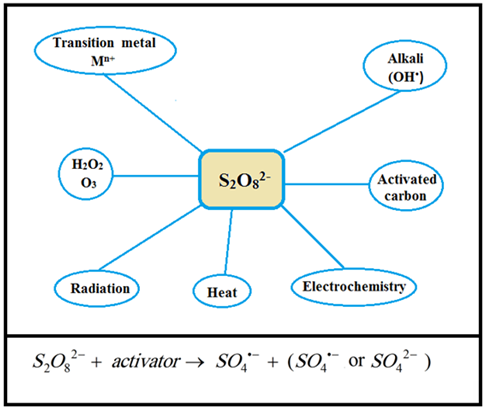
Transition metal-activated persulfate: Typically persulfate
anions can be activated to generate the intermediate sulfate free radical (SO4 •-) oxidant using transition metals (Equation (1)), where Ag+, Co2+, Ce3+, Ni2+, Fe2+, Fe3+, Mn2+, V3+ and Ru3+ are the most efficient transition metal ions for the first reaction [9, 27, 28].
$$ S _ {2} O _ {8} ^ {2 -} + M ^ {n +} \rightarrow S O _ {4} ^ {-} + S O _ {4} ^ {2 -} + M ^ {(n + 1) +} \tag {1} $$ Heterogeneous metal-bearing species-activated persulfate: Heterogeneous activation of persulfate is an alternative to homogeneous transition metals to avoid the formation of metal hydroxide sludge. It must be noted that the quantity of the latter strongly depends how well are the treatment conditions optimized or controlled.
Recently, zero-valent iron (ZVI, Fe (0)) has been used as a promising catalyst and as an alternate source of Fe (II) [21, 29]. In addition, it has the advantages including low cost and being non-toxic to the environment [30]. In addition to being a catalyst, it has a distinct role in transforming Fe (III) into Fe(II) [31]. nZVI has been reported to be effective in activating persulfate for the degradation of alkyl phenol polyethoxylate [32], bentazon (BTZ) [33], amicarbazone (AMZ) [34], acetaminophen [35], dye reactive blue 19 (RB19) [36], and aniline [37]. nZVI also achieved promising results when it was used as an activator of PS for the degradation of organic compounds [38], such as sulfamethazine (SMT) [39], trichloroethene (TCE) [40], and 2,4-dichlorophenol (DCP) [41].
Because of the higher surface area, nZVI showed more efficient results than ZVI in micrometer scales [42, 43]. nZVI without any support is less stable and tends to be agglomerated and oxidized [44, 45]. To overcome this disadvantage and to enhance their effectiveness in the removal of contaminants, composites of nZVI with some substances, such as resin [46], kaolinite [47], biochar [30] chitosan/silica [48], carbon [49], and graphene [50] have been used.
Fe (II) is considered as a homogeneous catalyst for activation of persulfate ions, which produce a stronger oxidant, i.e., sulfate radical (SO4 •−) according to Equation 2, ZVINFs is converted to Fe (II) according to several mechanisms: (1) corrosion in acidic medium through reaction with H+ (Equation 3); (2) exchanging electrons with S2O8 2- (Equation 4); (3) corrosion through reaction with oxygen and water (Equation 5 and Equation6); (4) reaction of generated Fe (III) in solution with Fe° (Equation 7) [29, 35].
2 2 • 2 3 2 8 4 4 S O Fe SO SO Fe − + − − + + → + + (2)
2 + + + → + (3)
2 2H Fe o Fe H
2 2 2 2 8 4 2 o Fe S O Fe SO − + − + → + (4)
Carbon-activated persulfate: To overcome this metal leaching problem, recent studies have emerged using carbonaceous materials as an alternative strategy for persulfate activation. The advantages of carbonaceous materials over metal based catalysts can be briefly categorized into the following categories: (1) non-toxicity due to their metal-free nature, completely preventing leaching of toxic metal ions. (2) Good chemical and thermal stability to withstand harsh reaction conditions – they can operate over a wide range of pH without the structure collapsing. (3) A high surface area with suitable pore volumes that facilitates the adsorption of pollutants into the catalyst’s active sites. (4) Malleable surface charge which provides control over the selection of a specific water pollutant. However, the catalytic activity of pristine carbonaceous materials is usually poor compared to that of the well-established metal-based catalysts, a consequence of the ambiguous active centers, inherent structural complexity and nonstoichiometric structure of the bulk carbonaceous material due to its graphitic degree, porosity, oxygen functionality and the presence of impurities. Therefore, various modulation strategies have been introduced to further control the surface characteristics of carbonaceous materials, such as size, morphology, and porous and electronic structure, which in turn manipulate their performance as persulfate activators [51].
Alkali-activated persulfate: The hydroxide anions activates persulfate to initiate sulfate radical formation, according to Equation 8 & 9 [52].
$$S_2O_8^{2-} + H_2O \rightarrow HO^- + SO_4^{2-} + H^+$$
$$S_2O_8^{2-} + HO^- \rightarrow SO_4^{2-} + SO_4^{2-} + H^+ + O_2^{2-}$$
Oxidant-activated persulfate: In $O_3$/persulfate process, when adding PS to solution, it reacts with OH•, according to Equation (10), which formed from decomposing ozone under alkane condition, according to Equations 11 & 12 [53]. This led to an improvement in the efficiency of removal.
$$O^3 + OH^- \rightarrow HO^- + O_2$$
$$O^3 + HO^- \rightarrow OH^+ + O_2^{2-} + O_2$$
$$S_2O_8^{2-} + OH^- \rightarrow HSO_4^{2-} + SO_4^{2-} + 1/2O_2$$
Hydrogen Peroxide can activate persulfate for soil remediation [54]. The knowledge about the interaction between two oxidants is still scarce, but it is proposed that H2O2 is decomposed into HO$^-$, which are then activating persulfate to generate $SO_4^{4-}$ (Equation 13). Another suggestion is that the exothermic reactions of H2O2 propagate $SO_4^{4-}$ formation by heat. In turn, $SO_4^{4-}$ can increase the formation of HO$^-$, which results in a multiradical system (Equations 14-15) [54].
Thermally-activated persulfate: Thermal activation is one of the simplest and an effective method for PS activation to generate reactive species. Since the bond energy of peroxide (0–0) in PS is 140–213.3 kJ mol$^{-1}$, a thermal activation at a temperature of 60$^\circ$C is sufficient to break the 0–0 bond for the generation of sulfate anion radicals ($SO_4^{4-}$) (Equation 16). These $SO_4^{4-}$ radicals can be further converted to hydroxyl radicals ($^*$OH), which are also an effective species (Equation 14). The generation of $SO_4^{4-}$ and $^*$OH radicals can be represented as given below [55].
$$S_2O_8^{2-} + heat \rightarrow 2SO_4^{4-} [30^0 C < T < 90^0 C]$$
$$SO_4^{4-} + H_2O \rightarrow SO_4^+ + OH^+$$
Radiation-activated persulfate: This activation type is similar to heat-activated persulfate, when UV radiation (Equation 18), gamma-radiation (Equation 19) or pulse radiolysis (Equation 19) induces the cleavage of peroxide bond generating a pair of sulfate radicals [54].
$$S_2O_8^{2-} + hv \rightarrow 2SO_4^{4-}$$
$$S_2O_8^{2-} + e^{-} \rightarrow SO_4^{4-} + SO_4^{2-}$$
The activation of persulfate by UV-light may involve second mechanism according to the reaction given in Equation 19: an electron can be produced from water exposure to UV, and persulfate is then activated by electron transfer Equations 20 & 21.
Electrochemically-activated persulfate: Persulfate activation by transition metal electrode-involving system in aqueous environment consists of simple chain reactions. First, the process is initiated with the production of transition metal by anodic corrosion, which activates persulfate and can be regenerated on a cathode [56]. This metod may help to overcome the problem of transition metal accumulation on the in the activated persulfate system, where the electrolysis of water takes place on the cathode consisting of OH- [56].
Conclusion
In this manuscript, the mechanism of using persulfate for treatment of pollutants was highlighted. Also, the possibility of activating it was shown, where the sulfate radicals it is generated. It also explains the mechanism activated by activators such as (transition metal ions, heterogeneous metal, carbon, alkali, oxidant, thermally, radiation and electrochemically).
References
-
Huling S, Pivetz B (2006) In-Situ Chemical Oxidation. Engineering Issue, EPA, pp: 1-60.
-
Pilli T De, Carbone BF, Fiore AG, Severini C (2007) Effect of some emulsifiers on the structure of extrudates with high content of fat. Journal of Food Engineering 79(4): 1351-1358.
-
Pilli T De, Legrand J, Derossi A, Severini C (2015) Effect of proteins on the formation of starch – lipid complexes during extrusion cooking of wheat flour with the addition of oleic acid Authors. International Journal of Food Science & Technology 50(2): 515-521.
-
Pilli T De, Legrand J, Giuliani R, Derossi A, Severini C, et al. (2009) Effect of Processing Variables and Enzymatic Activity on Wheat Flour Dough Extruded Under Different Operating Conditions. Food Technol Biotechnol 47(4): 404-412.
-
Kulikowska D, Klimiuk E (2008) The effect of landfill age on municipal leachate composition. Bioresour Technol 99(13): 5981-5985.
-
Renou S, Givaudan JG, Poulain S, Dirassouyan F, Moulin P, et al. (2008) Landfill leachate treatment: Review and opportunity. J Hazard Mater 150(3): 468-493.
-
Lema JM, Mendez R, Blazquez R (1988) Characteristics of landfill leachates and alternatives for their treatment: A review. Water, Air, and Soil Pollution 40(3-4): 223-250.
-
Soubh AM (2019) Assessment of Steel Slag as a Persulfate Activator for Treatment of Landfill Leachate. Open Access Journal of Waste Management & Xenobiotics 2(3): 1-6.
-
Soubh A, Mokhtarani N (2016) The post treatment of composting leachate with a combination of ozone and persulfate oxidation processes. Rsc Advances 6(80): 76113-76122.
-
Almeida CA, Debacher NA, Downs AJ, Cottet L, Mello CA, et al. (2009) Removal of methylene blue from colored effluents by adsorption on montmorillonite clay. J Colloid Interface Sci 332(1): 46-53.
-
Soubh AM, Ghalebizade M (2020) Using Nano-Converter Sludge of Steel Company as a Persulfate Catalyst for Removing Methylene Blue. Syrian Journal of Agricultural Research 7(6): 192-206.
-
Soubh AM, Baghdadi M, Abdoli MA, Aminzadeh B (2019) Assessment of Converter Sludge from Esfahan Steel Company as a Persulfate Nano-Activator for Permeable Reactive Barriers (Prbs) in Landfill Leachate Treatment. Pollution 5(2): 395-409.
-
Soubh AM (2020b) Using Ozone with Hydrogen Peroxide as Advanced Oxidation Treatment of Raw. Leachate Landfill, pp: 530-539.
-
Deng Y, Ezyske CM (2011) Sulfate radical-advanced oxidation process (SR-AOP) for simultaneous removal of refractory organic contaminants and ammonia in landfill leachate. Water Res 45(18): 6189-6194.
-
Soubh AM (2020a) Impact Persulfate on COD Analyze and Possibility Use it as Oxidant of Leachate. J Waste Manage Xenobio 3(4): 4-9.
-
Soubh AM, Mohammad SY (2023) Assessment the performance of steel slag as a persulfate activator for removal of methylene blue from aqueous solution. Syrian Journal of Agricultural Research 1(1): 1-15.
-
Abu Amr SS, Aziz HA, Adlan MN, Bashir MJK (2013) Pretreatment of stabilized leachate using ozone/ persulfate oxidation process. Chemical Engineering Journal 221: 492-499.
-
Soubh AM, Baghdadi M, Abdoli MA, Aminzadeh B (2018a) Activation of Persulfate Using an Industrial Iron-Rich Sludge as an Efficient Nanocatalyst for Landfill. Catalysts 8(5): 218.
-
Soubh AM, Baghdadi M, Abdoli MA, Aminzadeh B (2018b) Zero-valent iron nano fi bers (ZVINFs) immobilized on the surface of reduced ultra-large graphene oxide (rULGO) as a persulfate activator for treatment of landfill leachate. Journal of Environmental Chemical Engineering 6(5): 6568-6579.
-
Zhen G, Lu X, Zhao Y, Chai X, Niu D, et al. (2012) Enhanced dewaterability of sewage sludge in the presence of Fe(II)- activated persulfate oxidation. Bioresource Technology 116: 259-265.
-
Oh SY, Kang SG, Kim DW, Chiu PC (2011) Degradation of 2,4-dinitrotoluene by persulfate activated with iron sulfides. Chemical Engineering Journal 172(2-3): 641- 646.
-
Soubh AM, Abdoli MA, Ahmad LA (2021) Optimizing the removal of methylene blue from aqueous solutions using persulfate activated with nanoscale zero valent iron (nZVI) supported by reduced expanded graphene oxide (rEGO). Environ Health Eng Manag 8(1): 15-24.
-
House DA (1962) Kinetics and Mechanism of Oxidations by Peroxydisulfate. Chem Rev 62(3): 185-203.
-
Kolthoff IM, Miller IK (1951) The Chemistry of Persulfate. I. The Kinetics and Mechanism of the Decomposition of the Persulfate Ion in Aqueous Medium1. J Am Chem Soc 73(7): 3055-3059.
-
Liang C, Huang CF, Mohanty N, Kurakalva RM (2008) A rapid spectrophotometric determination of persulfate anion in ISCO. Chemosphere 73(9): 1540-1543.
-
Kattel E (2018) Tallinn University of Technology Application of Activated Persulfate Processes for the Treatment of Water and High-Strength Wastewater. Tallinn University of Technology, Estonia.
-
Anipsitakis GP, Dionysiou DD (2004) Radical generation by the interaction of transition metals with common oxidants. Environ Sci Technol 38(13): 3705-3712.
-
Cao J, Zhang WX, Brown DG, Sethi D (2008) Oxidation of Lindane with Fe(II)-Activated Sodium Persulfate. Environmental Engineering Science 25(2): 221-228.
-
Zhao J, Zhang Y, Quan X, Chen S (2010) Enhanced oxidation of 4-chlorophenol using sulfate radicals generated from zero-valent iron and peroxydisulfate at ambient temperature. Separation and Purification Technology 71(3): 302-307.
-
Hussain I, Li M, Zhang Y, Li Y, Huang S, et al. (2017) Insights into the mechanism of persulfate activation with nZVI/ BC nanocomposite for the degradation of nonylphenol. Chemical Engineering Journal 311(1): 163-172.
-
Liang C, Lai MC (2008) Trichloroethylene Degradation by Zero Valent Iron Activated Persulfate Oxidation. Environmental Engineering Science 25(7): 1071-1078.
-
Temiz K, Olmez-Hanci T, Arslan-Alaton I (2016) Zero-valent iron-activated persulfate oxidation of a commercial alkyl phenol polyethoxylate. Environ Technol 37(14): 1757-1767.
-
Wei X, Gao N, Li C, Deng Y, Zhou S, et al. (2016) Zero-valent iron (ZVI) activation of persulfate (PS) for oxidation of bentazon in water. Chemical Engineering Journal 285: 660-670.
-
Graça CAL, Fugita LTN, de Velosa AC, Teixeira ACSC (2018) Amicarbazone degradation promoted by ZVI- activated persulfate: study of relevant variables for practical application. Environ Sci Pollut Res Int 25(6): 5474-5483.
-
Deng J, Shao Y, Gao N, Deng Y, Tan C, et al. (2013) Zero-valent iron/persulfate(Fe0/PS) oxidation acetaminophen in water. International Journal of Environmental Science and Technology 11(4): 881-890.
-
Le C, Wu JH, Li P, Wang X, Zhu NW, et al. (2011) Decolorization of anthraquinone dye Reactive Blue 19 by the combination of persulfate and zero-valent iron. Water Sci Technol 64(3): 754-759.
-
Hussain I, Zhang Y, Huang S (2014) Degradation of aniline with zero-valent iron as an activator of persulfate in aqueous solution. RSC Adv 4(7): 3502-3511.
-
Al-Shamsi MA, Thomson NR (2013) Treatment of organic compounds by activated persulfate using nanoscale zerovalent iron. Ind Eng Chem Res 52(38): 13564-13571.
-
Lin CC, Chen YH (2018) Feasibility of using nanoscale zero-valent iron and persulfate to degrade sulfamethazine in aqueous solutions. Separation and Purification Technology 194: 388-395.
-
Dong H, He Q, Zeng G, Tang L, Zhang L, et al. (2017) Degradation of trichloroethene by nanoscale zero-valent iron (nZVI) and nZVI activated persulfate in the absence and presence of EDTA. Chemical Engineering Journal 316: 410-418.
-
Li R, Jin X, Megharaj M, Naidu R, Chen Z, et al. (2015) Heterogeneous Fenton oxidation of 2, 4-dichlorophenol using iron-based nano- particles and persulfate system. Chemical Engineering Journal 264: 587-594.
-
Crane RA, Scott TB (2012) Nanoscale zero-valent iron: Future prospects for an emerging water treatment technology. J Hazard Mater 211-212: 112-125.
-
Shih YH, Tai YT (2010) Reaction of decabrominated diphenyl ether by zerovalent iron nanoparticles. Chemosphere 78(10): 1200-1206.
-
Phenrat T, Saleh N, Sirk K, Tilton RD, Lowry GV, et al. (2007) Aggregation and sedimentation of aqueous nanoscale zerovalent iron dispersions. Environ Sci Technol 41(1): 284-290.
-
Zhan J, Zheng T, Piringer G, Day C, McPherson GL, et al. (2008) Transport Characteristics of Nanoscale Functional Zerovalent Iron/Silica Composites for in Situ Remediation of Trichloroethylene. Environ Sci Technol 42(23): 8871-8876.
-
Zhao Z, Jiang, G, Li A, Tai C, Wang Y, et al. (2007) Debromination of Decabrominated Diphenyl Ether by Resin-Bound Iron Nanoparticles. Environ Sci Technol 41(19): 6841-6846.
-
Zhang X, Lin S, Chen Z, Megharaj M, Naidu R, et al. (2011) Kaolinite-supported nanoscale zero-valent iron for removal of Pb2+ from aqueous solution: Reactivity, characterization and mechanism. Water Res 45(11): 3481-3488.
-
Zhu BW, Lim TT, Feng J (2006) Reductive dechlorination of 1,2,4-trichlorobenzene with palladized nanoscale Fe0 particles supported on chitosan and silica. Chemosphere 65(7): 1137-1145.
-
Wang Y, Sun H, Duan X, Ang HM, Tadé MO, et al. (2015) A new magnetic nano zero-valent iron encapsulated in carbon spheres for oxidative degradation of phenol. Applied Catalysis B: Environmental 172-173: 73-81.
-
Jabeen H, Chandra V, Jung S, Lee JW, Kim KS, et al. (2011) Enhanced Cr(vi) removal using iron nanoparticle decorated graphene. Nanoscale 3(9): 3583-3585.
-
Oyekunle DT, Zhou X, Shahzad A, Chen Z (2021) Review on carbonaceous materials as persulfate activators: structure–performance relationship, mechanism and future perspectives on water treatment. Journal of Materials Chemistry A 13: 8012-8050.
-
Liang C, Guo YY (2012) Remediation of diesel- contaminated soils using persulfate under alkaline condition. Water, Air, and Soil Pollution 223(7): 4605- 4614.
-
Qiao J, Luo S, Yang P, Jiao W, Liu Y, et al. (2019) Degradation of Nitrobenzene-containing wastewater by ozone / persulfate oxidation process in a rotating packed bed. Journal of the Taiwan Institute of Chemical Engineers 99: 1-8.
-
Sonawane S, Rayaroth MP, KLandge V, Fedorov K, Boczkaj G, et al. (2022) Thermally activated persulfate - based Advanced Oxidation Processes-recent progress and challenges in mineralization of persistent organic chemicals : a review. Current Opinion in Chemical Engineering 37: 100839.
-
Tsitonaki A, Petri B, Crimi M, Mosbæk H, Siegrist RL, et al. (2010) Critical Reviews in Environmental Science and Technology In Situ Chemical Oxidation of Contaminated Soil and Groundwater Using Persulfate : A Review. Environmental Science and Technology 40(1): 55-91.
-
Yuan S, Liao P, Alshawabkeh AN (2014) Electrolytic Manipulation of Persulfate Reactivity by Iron Electrodes for Trichloroethylene Degradation in Groundwater. Environ Sci Technol 48(1): 656-663.
- Electronic Waste Management in the Top Ten Economies in the World: A Critical Review on Waste Generation, Regulations, Collection, Recycling and Environmental Challenges
- Some Challenging Transdisciplinary Aspects of the Sustainable Waste Management in the Permacrisis Context
- Use of Mobile Autonomous Systems for Pollution Control of Inland Water Bodies
- Environmental Impact Perspective Sustainable Online Textile Retailing: Harnessing Augmented Reality-Based Digital Twins in Bangladesh
- Composite Treatment Module for Removing Acidity and Metal (Loid)S from Acid Rock Drainage
- Household E-Waste Management Systems [E-Wms] in Malaysia