
Quantification of Microplastic in Locally Brewed Beers in Malaysia
Humans ingest five grams of microplastics on a weekly basis. Beverages serve as a microplastic conduit for entering the human body. Nevertheless, beer received minimal attention on microplastics despite its popularity. The objective of this study is to measure the quantity of microplastic particles that are present in locally brewed and packed beers and the amount of microplastic consumed by the beer drinkers in Malaysia. To accomplish this, a total of 15 beer samples from 5 distinct brands were examined. The analysis indicated that microplastics fibres measuring less than 0.5mm and fragments measuring less than 0.1mm were present in all the beer samples. The concentration of microplastics ranged from 75.8 to 212 particles per litre. The microplastics solely exhibited the colours black, blue, brown, and red. This study has quantified the amount of microplastic consumed by beer drinkers in Malaysia, which ranged from 533 to 1484 microplastic particles per year, depending on the specific brand of beer. This discovery enhances our understanding of microplastic pollution in beer and the potential accumulation of microplastics in those who consume it.
Introduction
A new study has discovered that human consume a total of five grams of micro and nanoplastic on a weekly basis [1]. Microplastics, which are tiny plastic particles smaller than 5 millimetres, exist in various shapes such as filament, fibre, bead, fragment, film, foam and pellet [2]. They are produced through two primary mechanisms: the breaking apart of bigger plastic objects [3] and the purposeful production or utilization of microscopic plastic components for household and personal care items [4]. The problem of microplastic contamination is not a recent occurrence; yet, it may present a substantial risk to human health. This is because microplastic has been detected in human blood [5], heart tissues [6], placenta [7], lung tissue [8] and human brain [9].
Although research has indeed identified the presence of microplastics in human organs, establishing a clear and substantial connection between exposure to microplastics and health effects remains a complicated and ongoing difficulty. The existing research indicated the existence of microplastics in humans, but it did not definitively show a direct link between exposure to microplastics and negative health consequences.
The penetration of microplastics into the human body via different parts of our food and beverage intake has been investigated [10, 11, 12, 13]. Microplastic pollution in water sources, such as tap water and bottled water, has been well- documented [14, 15, 16]. To date, only a few articles have been reported on microplastic detection in beer [17, 18, 19]. These
articles revealed that there are multiple pathways where microplastics can be introduced.
The microplastics can come from both external sources, including plastic pollution in water bodies, air deposition, or industrial operations [17], and inside ones, such as the plastic materials used in brewing equipment, packaging materials, and even the basic ingredients themselves) [20, 21]. Hence, it is imperative to thoroughly examine the occurrence, varieties, and levels of microplastics in beverages, particularly beer in this case, in order to ascertain the possible contamination of drinks and hazards they can represent to human health and the ecosystem.
Having said that, this paper investigates microplastic contamination in beers that are brewed and packed in Malaysia. In addition, this paper also discloses the quantity of microplastics that enters the human body through the ingestion of beer. Alcohol beverages are one of the popular drinks among Malaysian. The revenue generated from the alcohol beverages in Malaysia estimated to hit US$1,760 million in 2023 while in 2019 it was USD262million. This demand is expected to grow annually by 10% [22]. According to Faostat (nd) the beer consumption in Malaysia averaged at 7.3L per person with a range of 6.6L to 8.9L per capita per year [23].
Methodology
Fifteen beer samples from 5 different brands were sieved using lab standard test sieve that was made of a 200 mm diameter stainless steel with a 60 µm mesh size. The samples were treated with 10 mL 30% H2O2, for 24 hours, at room temperature. Then, beer samples were filtered with 0.45 µm glass microfiber membrane filter Whatman GF/C 47 mm (Buckinghamshire, UK). The membrane filter was placed in a clean glass petri dish and dried at 50°C, for 24 hours. The microplastics trapped by the membrane filter was then observed under a microscope [20] and counted.
Microplastic Accumulation in Human Body
Based on the information from Hays, n.d., microplastic enters human body through beer can be calculated by using the formula below, consumption annually Microplastic consumption by human through beer= capita x microplastic abundance particle/L in beer
7.3L x 75.8 to 212 particle/L
553 to 1484 particles
Results and Discussion
Microplastic Shape and Size
Microplastic was detected in all the beer samples. Microplastic accumulation can be between 533 particles to 1484 particles per year. However, microplastic in beer, which is one of the most extensively used alcoholic beverages globally, has received little focus [24]. The global beer consumption in 2020 amounted to 177.50 million kilolitres, which is equivalent to 280.4 billion 633 ml bottles [25].
Table 1 shows the outcome of the shapes and sizes of microplastic in locally brewed and packed beer in Malaysia. Generally, microplastic abundance ranged from 75.8±24.2 to 212.0±62.6 particle/L. Among these brands, brand A has the highest microplastic abundance and Brand B has the least abundance. Fibre less than 0.5mm and fragment with less than 0.1 mm are prevalent in all the beer brands. These results are in line with the findings published by Diaz- Basantes MF, et al. [20].
| Brand | A | B | C | D | E |
|---|---|---|---|---|---|
| Fibre <0.5mm (particle/L) | 21.7±34.7 | 55.0±11.3 | 110.0±22.4 | 60.7±12.7 | 73.7±8.1 |
| Fragment <0.1mm (particle/L) | 133.2±45.1 | 20.8±12.9 | 102.0±40.2 | 24.0±18.0 | 75.4±60.4 |
| Total microplastic (particle/L) | 154.9±79.8 | 75.8±24.2 | 212.0±62.6 | 84.7±30.7 | 149.1±68,1 |
Table 1: Results of the shapes and size of microplastic abundance in beer.
Based on the information in Table 1, the highest amount of fibre which is less than 0.5mm was detected in brand C beer and lowest was in brand A. On the other hand, brand A has the highest fragment content while Brand B has the lowest fragment content.
Microplastic Colour
Figure 1 shows the colour of microplastics detected in all beer samples. Four prominent colours were detected in all beers namely black, blue, brown and red. However, the black and red microplastics recorded the highest abundance in brand A samples and the least amount of black microplastic was detected in Brand B. Although, all 4 colours are predominant in the beer samples, only a small amount of brown microplastic detected in brand B and red microplastic in brand D.
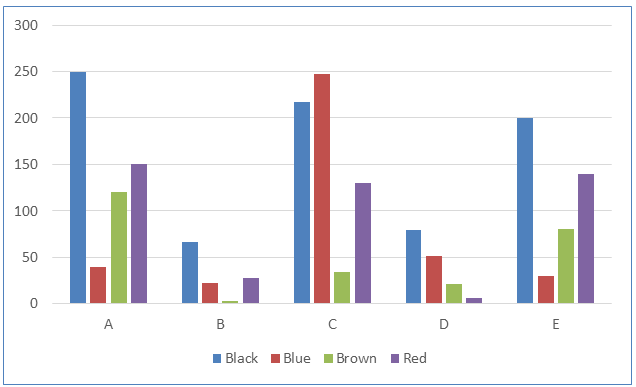
Potential sources of microplastic contamination in beer may arise from the utilization of freshwater during production and cleaning processes. Atmospheric deposition is a significant aspect in which beer comes into direct contact with air during the brewing process. Furthermore, pollution can be caused by the materials and equipment employed in the production process, particularly filters, as indicated by Shruti VC, et al. [18].
Malaysians consuming beer could accumulate 533 to 1484 particles of microplastic in a year depending on the beer brand. This finding could provide an overview of microplastic accumulation in human body and further research should be done in order to evaluate the impact on human health [26].
Conclusion
The presence of significant quantity of microplastic in Malaysian beers is evident. It has been identified from five locally brewed beers. The amount of microplastic found ranged from 75.8 to 212 particles/L. These figures contribute to 533 to 1484 particles of microplastic accumulation annually in human body.
Acknowledgement
This project is supported by Risks and Solutions: Marine Plastics in Southeast Asia – RaSP-SEA grant (Project No: RCO- FOR-NERC-2001-2021).
References
-
Katanich D (2022) You eat a credit card’s worth of plastic every week, says a new study. Euronews.
-
Lozano YM, Lehnert T, Linck LT, Lehmann A, Rillig MC (2021) Microplastic Shape, Polymer Type, and Concentration Affect Soil Properties and Plant Biomass. Front Plant Sci 12: 616645.
-
Pramanik BK, Pramanik SK, Monira S (2021) Understanding the fragmentation of microplastics into nano-plastics and removal of nano/microplastics from wastewater using membrane, air flotation and nano- ferrofluid processes. Chemosphere 282: 131053.
-
Sun Q, Ren SY, Ni HG (2020) Incidence of microplastics in personal care products: An appreciable part of plastic pollution. Sci Total Environ 742: 140218.
-
Leslie HA, Van-Velzen MJM, Brandsma SH, Vethaak D, Garcia-Vallejo JJ, et al. (2022) Discovery and quantification of plastic particle pollution in human blood. Environ Int 163: 107199.
-
(2023) Microplastics found in human heart tissues, both before and after surgical procedures. American Chemical Society.
-
Ragusa A, Svelato A, Santacroce C, Catalano P, Notarstefano V, et al. (2021) Plasticenta: First evidence of microplastics in human placenta. Environ Int 146: 106274.
-
Jenner LC, Rotchell JM, Bennett RT, Cowen M, Tentzeris V, et al. (2022) Detection of Microplastics in Human Lung Tissue Using μFTIR Spectroscopy. Sci Total Environ 831: 154907.
-
(2023) Microplastics could reach every organ including the brain, study finds. Euronews.
-
Gerretsen I (2023) How microplastics are infiltrating the food you eat. BBC.
-
Oleksiuk K, Krupa-Kotara K, Wypych-Ślusarska A, Głogowska-Ligus J, Spychała A, et al. (2022) Microplastic in Food and Water: Current Knowledge and Awareness of Consumers. Nutrients 14(22): 4857.
-
Sharma S, Sharma B, Sadhu SD (2022) Microplastic profusion in food and drinking water: are microplastics becoming a macroproblem. Environmental Science: Processes & Impacts 24(7): 992-1009.
-
Vitali C, Peters R, Janssen HG, Nielen MWF (2022) Microplastics and nanoplastics in food, water, and beverages; part I. Occurrence. TrAC Trends in Analytical Chemistry 159: 116670.
-
Kirstein IV, Gomiero A, Vollertsen J (2021) Microplastic pollution in drinking water. Current Opinion in Toxicology 28: 70-75.
-
Gambino I, Bagordo F, Grassi T, Panico A, De Donno A (2022) Occurrence of Microplastics in Tap and Bottled Water: Current Knowledge. International Journal of Environmental Research and Public Health 19(9): 5283.
-
Muhib I, Uddin K, Rahman M, Malafaia G (2023) Occurrence of microplastics in tap and bottled water, and food packaging: A narrative review on current knowledge. Science of the Total Environment 865: 161274.
-
Lachenmeier DW, Kocareva J, Noack D, Kuballa T (2015) Microplastic identification in German beer - an artefact of laboratory contamination. Deutsche Lebensmittel-Rundschau 111(10): 437-440.
-
Shruti VC, Pérez-Guevara F, Elizalde-Martínez I, Kutralam-Muniasamy G (2020) First study of its kind on the microplastic contamination of soft drinks, cold tea and energy drinks - Future research and environmental considerations. Sci Total Environ 726: 138580.
-
Li Y, Peng L, Fu J, Dai X, Wang G (2022) A microscopic survey on microplastics in beverages: the case of beer, mineral water and tea. Analyst 147(6): 1099-1105.
-
Diaz-Basantes MF, Conesa JA, Fullana A (2020) Microplastics in Honey, Beer, Milk and Refreshments in Ecuador as Emerging Contaminants. Sustainability 12(14): 5514.
-
Jin M, Wang X, Ren T, Wang J, Shan J (2021) Microplastics contamination in food and beverages: Direct exposure to humans. Journal of Food Science 86(7): 2816-2837.
-
Statista (2022) Alcoholic Drinks - Malaysia.
-
ReportLinker (2023) Forecast: Beer Consumption Per Capita in Malaysia.
-
World Population Review (2024) Beer Consumption By Country 2024.
-
Vohra S (2022) How much beer can you drink daily (without it causing harm). GQ, India.
-
Nizamali J, Mintenig SM, Koelmans AA (2023) Assessing microplastic characteristics in bottled drinking water and air deposition samples using laser direct infrared imaging. Journal of Hazardous Materials 441: 129942.
- Electronic Waste Management in the Top Ten Economies in the World: A Critical Review on Waste Generation, Regulations, Collection, Recycling and Environmental Challenges
- Some Challenging Transdisciplinary Aspects of the Sustainable Waste Management in the Permacrisis Context
- Use of Mobile Autonomous Systems for Pollution Control of Inland Water Bodies
- Environmental Impact Perspective Sustainable Online Textile Retailing: Harnessing Augmented Reality-Based Digital Twins in Bangladesh
- Composite Treatment Module for Removing Acidity and Metal (Loid)S from Acid Rock Drainage
- Household E-Waste Management Systems [E-Wms] in Malaysia