
Determination of Microbeads from Paste in Some Pharmaceuticals and Personal Care Products
Since the study of microplastics has only emerged in the last few years, there is a gap in research in terms of the analysis and quantification of microplastics in cosmetic pastes. Consequently, the main aim of this project was to develop an optimal analytical method for the separation and quantification of microbeads from cosmetic pastes in order to address this emerging global issue. Liquid solid extraction of microplastics from cosmetic paste through filtration under vacuum was implemented. And quantification with standard addition and characterisation via infrared spectroscopy and light microscopy were used. Optimal extraction conditions were established which consists of boiled distilled water and vacuum filtration using Büchner funnel of 125 mm diameter. Recovery from different pastes had 94.64 %, 85.09 % and 92.30 % microbead recovery which indicated that the extraction method proved to be efficient. Repeatability was found to be supportive of findings. The microbeads were analysed under light microscopy where it was established that the microplastics extracted from the cosmetic pastes were smaller than 1 mm in size. An ideal method was developed for the extraction and quantification of microbeads from pastes. From this research project it was also deduced that paste matrix affects the recovery of microbeads from the product. Thus, standard addition approach must be carried out for each paste for quantification with high trueness.
Introduction
Microbeads and Their Worldwide Impact
Global plastic pollution and its prevalence Despite the current surge of legislative proposals directed at decreasing plastic use and inadequate disposal, global plastic manufacturing has risen over 600% since 1975 [1, 2]. Worldwide plastic production has consistently increased at an alarming rate from 1.5 to 311 million tonnes [2, 3]. It has been evaluated that every year 4.8–12.7 million tonnes of plastic debris enter the ecosystem [1]. Due to the increase in production of synthetic polymers and its low biodegradability, it rapidly accumulates in the ecosystem, making it the most common type of global marine pollution [4, 5].
Defining microbeads
The industry uses the term ‘microbeads’ to describe microplastic particles present in pharmaceuticals and personal care products (PPCP); additionally, they may also be called microspheres, nanospheres or plastic particulates [3]. Currently, there is no unanimously approved definition in terms of the size range for microbeads. Various definitions of microbeads are used in literature, for example they were described as barely visible particles that pass through 500 μm sieve by Andrady [6] whereas particles smaller than 1 mm were classified as microbeads by Imhof, et al. [7] An extensive literature review conducted by Hidalgo-Ruz, et al. [8], identified the term ‘microbeads’ was first used in 2004 to describe plastics of 50 micrometres in size [8, 9]. Although internationally the definition differs in terms of the size range for microbeads, they are widely accepted as plastic fragments smaller than 5 mm [10, 11].
Microbeads found in the ecosystem are varied; they differ in shape, size and chemical composition. They are synthesised from polyolefin particles and are usually amorphous in shape without sharp edges which makes it appropriate for use in PPCPs [12]. The most commonly used polyolefin (Figure 1) include polyethylene (PE), polypropylene (PP), and polystyrene (PS) [13]. When analysing PCPs, microbeads synthesised from PE and PS were identified as spherical, threads or irregularly shaped particles, and mostly having a blue or white colour [14, 15].
![Figure 1: Chemical structures of the most commonly used polymers in the synthesis of microbeads, drawn using Accelery [13].](/fulltextimages/7584/fig_1.png)
Uses, sources and fate of microbeads Microbeads are used as exfoliants in certain PCPs, such as hand and facial cleansers, cosmetics and toothpastes [13]. The PCPs usually comprise of 0.05 to 12 % microbeads, with their size ranging from 450 to 800 µm [12, 13]. Microbead particle size in facial cleansers are usually kept to a standard size, since an exfoliant large in size may be too harsh on the skin, whilst small microbeads could be ineffective as an abrasive. Likewise, similar size and characteristics of microbeads are used in toothpastes to avoid cracking and subsurface chipping of tooth enamel. A survey conducted by Cosmetics Europe identified that PE accounted for 93 % of the microbeads used in PCPs in the European Union, Norway and Switzerland. Microbeads have also been found useful in medical applications, as carriers to deliver active pharmaceutical agents and in dental tooth polish [12].
After use of PCPs and medical applications, microbeads reach the marine ecosystem via wastewater. Microplastics enter the environment as either primary or secondary pollution. Whilst primary microplastics are originally manufactured in micro-scale, for example in cosmetics [16] and medicine [17], secondary microplastics are the result of physical and photochemical degradation of bigger plastic fragments [18, 19, 20]. The following (Table 1) provides an outline of sources of primary and secondary microplastics in the environment [12].
| Secondary Microplastics | |
| PCPs containing exfoliants | General littering of plastic waste |
| Medical applications | Plastic mulching |
| Industrial abrasives | Loss of plastic waste during waste collection |
| Drilling fluids for oil and gas exploration | Loss of plastic materials during natural disasters |
Table 1: Summary of sources for primary and secondary microplastics in the environment [12].
The size and form of microplastics in sewage sludge can be affected during sewage treatment works (STW), due to increased temperature, increased pH and mechanical mixing [21, 22]. The by-product of STW contains microplastics which is used to fertilise agricultural land, thus represents a source of microplastics to the environment [22]. Microplastics either remain in the soil, transported and dispersed by wind, or transferred with surface run-off to the aquatic environment [23, 24]. When sewage sludge is discarded into oceans, microplastics directly reach the marine ecosystem.
Studies have demonstrated that entry of microplastics to the environment may also be caused by heavy rainfall events where untreated wastewater overflow occurs and reaches oceans [25]. Moreover, in many areas of the world, untreated sewage containing microplastics is directly disposed of into the receiving waters [26].
Since the study of microplastics has only emerged in the last few years, there seems to be a gap in research in terms of primary microplastics, where no literature has identified the efficiency of extraction method or whether sample matrix has any effect on the efficiency of the separation methods and hence affect the accuracy of the quantification and knowledge available.
Materials And Methods
Materials and Method Development
Equipment and materials used
The materials used in this study include NaOH pellets and PE 180 µm microbeads both of which are from Sigma Aldrich. The cosmetic pastes utilised in the research project include clean and clear cream wash, Neutrogena Spot Stress Control face scrub, Real Shaving Co. face scrub and Senspa body scrub which were all purchased from the supermarket. Laboratory equipment used include vacuum filtration apparatus, Whatman filter paper of Grade 1, glass vials, glass beakers, glass stirring rod, and a heating mantle. Analysis equipment were also used which are infra-red spectroscopy (TherfoFinnigan) and light microscopy (Nikon SMZ1500) equipped with a Nikon camera.
Measuring microbead size
The size of the beads has been estimated from the light microscopy images by measuring the width of microbeads in the images with a ruler. A high number of microbeads were measured (n=30) and the average was calculated. Repeat photos were also taken (n=2) from the cosmetic pastes to increase the representativeness of the data obtained.
Preliminary tests for the extraction of microbeads from paste Preliminary tests were carried out in order to develop methodology for the extraction of microbeads from pastes: efficiency and low cost were main goals. Initially, a method for the disintegration of paste had to be developed where the disintegration process must be efficient enough to fully dissolve the cosmetic paste, yet microbeads must not dissolve and should remain in solid form.
Disintegration of the paste using NaOH under reflux was carried out using 1 g of Neutrogena Daily Scrub for over two hours. NaOH pellets were weighed at 4.01 g in order to produce 100 mL of NaOH 1 Molar solution. Using a round bottom flask stabilised on a cork ring, 1 g of paste from Neutrogena Daily Scrub was weighed and 100 mL NaOH solution added to the paste and swirled for two minutes. Then, a reflux apparatus was set up in the fume cupboard where the NaOH and paste mixture was left to reflux under heat for 2 h. However, this preliminary test did not prove to be successful in disintegrating the paste.
Therefore, another preliminary test was carried out. A sample of paste from Neutrogena Daily Scrub was weighed at approximately 2 g using a clean glass beaker. Next, 100 mL of distilled water was measured and heated using a heating mantle in the fume cupboard up to its boiling point which was then added to the paste. This mixture was stirred using a clean glass stirring rod for 2 min which resulted in the disintegration of the cosmetic paste.
Following the disintegration of paste, the separation of microbeads from the paste and distilled water mixture was carried out via vacuum filtration using a Büchner funnel with a 125 mm diameter. Vacuum filtration was carried out in the fume cupboard using Whatman filter paper Grade 1. Once filtration was complete, a tweezer was used to pick up the filter paper and place onto a watch glass. Any microbeads on the sides of the Büchner funnel were scraped off using a clean spatula and placed onto the filter paper. The watch glass was placed into the oven at approximately 60°C for 15 min to dry and evaporate any leftover distilled water on the microbeads used during the extraction process. The above methodology constituted the developed protocol for the separation of plastic microbeads from cosmetic pastes. Producing cosmetic paste samples Following the development of a protocol for the extraction of microbeads from pastes, paste samples were prepared in the laboratory with manually added in PE 180 µm microbeads in pastes that does not contain any microbeads. This was carried out in order to test the protocol and carry out statistical analysis.
Three paste samples were prepared from Clean and Clear cream wash that did not contain any plastic microbeads. To prepare the samples, 1 g of cream was weighed in a clean glass vial using a digital weighing scale. Separately, 0.2 g of PE microbeads were weighed in a measuring boat. Microbeads were added into the vial that contained the cream and this was mixed thoroughly using a laboratory vortex mixer to ensure PE microbeads have integrated well into the cream to resemble a daily use face wash (Figure 2 provides a visual representation of the procedure). This was repeated three times to produce three samples of paste with known quantities of PE microbeads to increase representativeness of results generated.
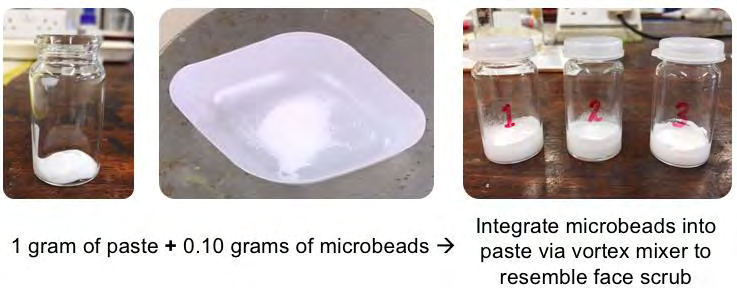
The cosmetic paste samples produced were used to test the developed protocol as presented in Table 2. Following extraction of microbeads from produced sample cosmetic pastes, the dry microbeads were weighed using a digital weighing scale in the laboratory and therefore statistical analysis was carried out.
carried out in order to examine whether cosmetic paste matrix affects microbead recovery and its quantification. The step-wise methodology of this approach involved carrying out the developed protocol (Table 2) on approximately 1.2 g sample of cosmetic paste. This generated a microbead recovery value which was “spiked” into a second paste sample of approximately 1.2 g. For the first cosmetic paste of approximately 1.2 g Neutrogena Daily Scrub, the number of microbeads recovered was weighed at 0.0902 g. The value of 0.0902 g of microbeads was spiked into a second sample of 1.2 g of Neutrogena Daily Scrub and extraction protocol was carried out. Standard addition procedure was carried out six times to produce representative data. Generated microbead recoveries were used to calculate the regression line and deduce percentage recovery of the developed protocol. Standard addition method was carried out on all three cosmetic pastes mentioned previously.
- By using the equation and data generated in Table 3, percentage microbead recovery is calculated for each cosmetic scrub to identify the efficiency of the methodology developed (Table 2).
- Standard Addition Method
- Standard addition approach was applied to three cosmetic pastes: Neutrogena daily scrub, Real Shaving Co. face scrub and Senspa Detox body scrub. The method was
- Final Optimal Protocol for the Extraction of Microbeads from Cosmetic Paste
- Final optimal protocol for the extraction of microbeads from paste
- Step 1
- Heat 100 mL distilled water in a clean glass beaker on a heating mantle in the fume hood to boiling temperature of
- 100°C.
- Step 2
- Using weighing scales, squeeze out 1 g of paste into a clean glass beaker.
- Step 3
- Once distilled water reaches boiling point, which can be confirmed using a thermometer, pour approximately 40 mL of the boiled distilled water into the glass beaker that contains 1 g paste.
- Step 4
- Using a clean glass stirring rod, stir the paste and distilled water mixture for approximately 3 min until paste completely dissolves and microbeads can be visibly seen floating on the surface.
- Step 5
- Set up vacuum filtration apparatus in the fume hood using a large Büchner funnel of 125 mm diameter and Whatman filter paper, Grade 1.
- Step 6
- Pour the paste-distilled water mixture into the Büchner funnel and carry out vacuum filtration. Rinse the beaker and pour into the funnel to ensure all microbeads are collected and separated.
- Step 7
- Once vacuum filtration is complete, pick up the filter paper using a tweezer and place on a glass plate.
- Step 8
- Place the glass plate into the oven at approximately 60°C for 15 min in order to dry the microbeads and get rid of any leftover distilled water used during the extraction process.
Table 2: Developed procedure for the separation of microbeads from pastes presented in a step-by-step format to allow ease of
Results
Protocol method and standard addition of three types of face and body scrubs are presented both tabulated (Table 1-4) and graphs with each its respective regression line and trend line equation (Figures 3-5). In addition, infrared spectroscopy was taken for the Clean and clear cream wash sample that does not contain microbeads, as well as the infrared spectroscopy of the microbeads extracted from each of the three cosmetic scrubs using the methodology developed. Furthermore, microbeads were then analysed under light microscopy to generate both qualitative and quantitative data that can help understand the nature of microbeads added to PCPs.
Microbead Recovery
Below are the results for the protocol test carried out (Table 2) and standard addition approach on three cosmetic products that contain microbeads: Neutrogena Daily faces scrub, Real Shaving Co. face scrub and Senspa Detox body scrub. The protocol test involved the production of a scrub sample resembling a cosmetic wash which was produced in the laboratory using PE microbeads and Clean and Clear cream wash.
Table 3 presents the recovery of microbeads from pastes using the protocol developed. The developed methodology was carried out on pastes produced in the laboratory to resemble an everyday use cosmetic face scrub. Three samples were produced (as described in section 3.1.4.) to increase representativeness of results, where microbead recovery obtained was 84 %, 85 % and 74 % with the mean percentage recovery of microbeads of 81 %.
| Sample 1 | Sample 2 | Sample 3 | Mean | SD | |
|---|---|---|---|---|---|
| Paste (g) | 1.0618 | 1.0286 | 1.0362 | 1.0422 | 0.0174 |
| Microbeads added (g) | 0.111 | 0.106 | 0.1055 | 0.1075 | 0.0029 |
| Microbeads recovered (g) | 0.0934 | 0.0896 | 0.0784 | 0.0871 | 0.0079 |
| Recovery (%) | 84.14% | 84.52% | 74.31% | 80.99% | 0.0608 |
Table 3: Tabulated results for the separation of microbeads from a paste produced in the laboratory using 180 µm polyethylene mic
Microbead percentage recovery generated in the experimental procedure in section 3.1.6 was carried out without the standard addition approach. Microbead percentage recovery from paste was calculated by dividing the number of microbeads recovered by the known numbers of microbeads added to the cream after carrying out the developed procedure.
By using microbead recovery equation in section 3.1.4 and the data generated in Table 3, the following is deduced:
Sample 1:
$$ \frac {0.0934}{0.1110} \times 100 \% = 84.14 \% $$
Sample 2:
$$ \frac {0.0896}{0.1060} \times 100 \% = 84.52 \% $$
Sample 3:
$$ \frac {0.0784}{0.1055} \times 100 \% = 74.31 \% $$
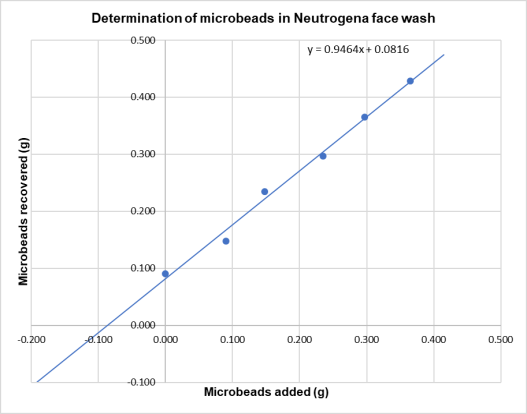
Standard addition for Neutrogena face scrub paste is presented in (Figure 3). The slope is 0.9464, which indicates percentage microbead recovery for Neutrogena face scrub is 94.64 %. The y- intercept is at 0.0816, which corresponds to the initial quantity of microbeads in the 1.2 g sample of Neutrogena face scrub of 0.816 g.
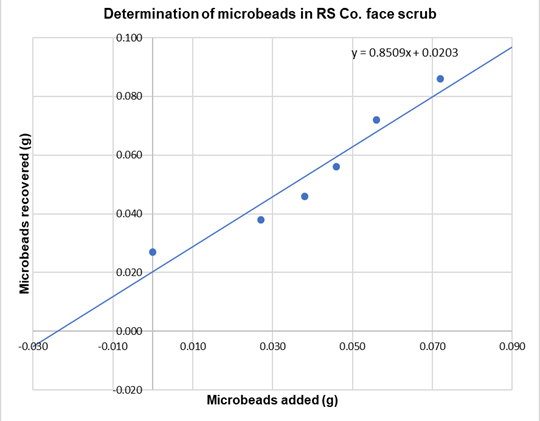
A second test to measure recovery was carried out with the cosmetic paste Real Shaving Co. face scrub. The results of the standard addition are presented in (Figure 4). The slope is 0.8509, which indicates precentage microbead recovery for Real Shaving Co. face scrub is 85.09 %. The y-intercept is at 0.0203, which corresponds to the initial quantity of microbeads in the 1.2 g sample of Real Shaving Co. face scrub of 0.0203 g.
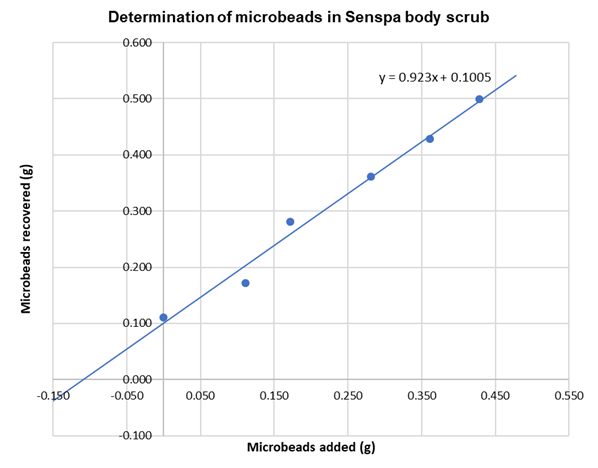
Standard addition of a third cosmetic paste, Senspa body scrub was carried out and data is presented in (Figure 5). The slope is 0.9230, which indicates precentage microbead recovery for Senspa body scrub 92.30 %. They-intercept is at 0.1005, which corresponds to the initial quantity of microbeads in the 1.2 g sample of Senspa body scrub of
0.1005 g.
From the experimental procedures carried out using the developed methodology for the extraction of micro beads form pastes, micro bead recovery for each cosmetic paste used can be identified and therefore the percentage of microbeads in each product.
| Recovery in 1.2 g | Recovery in 1 g | Microbeads in product | (%) of microbeads per product | |
|---|---|---|---|---|
| Neutrogena Daily face scrub 150 mL | 0.0816/0.9464= 0.0862 | 0.0718 | 150 mL x 0.0718= 10.77 g | 7.18% |
| RS Co. face scrub 100 mL | 0.0203/0.8509= 0.0238 | 0.0198 | 100 mL x 0.0198= 1.98 g | 1.98% |
| Senspa Detox body scrub 200 mL | 0.1005/0.9230= 0.1088 | 0.0906 | 200 mL x 0.0906= 18.12 g | 9.06% |
Table 4: Calculations of microbeads present in each of the PCPs used in the standard additions approach.
Since 1.2 g of paste was used to enumerate the recovery of microbeads, this value can be used to find recovery in 1 g of paste and consequently calculate microbeads present in the total weight in grams of each PCP used in this study. From the experimental procedure carried out, Table 4 presents the calculations to find the number of microbeads and the percentage of microbeads in each product. The percentage of microbeads per product ranged from 1.98 % to 9.06 %.
Discussion
Current research mainly focuses on macroplastics fragmentation rather than plastic microbeads added into PPCPs. There is lack of knowledge on quantitative analytical methods from cosmetic products, which comprise very broad ranges of matrices. Different matrices could lead to different recovery rates of microbeads. This could affect the accuracy of the quantifications of the beads in the cosmetic products, which may have legal and toxicological implications. The distortion of microbead recovery could possibly be caused by the components of the cosmetic paste itself which therefore would give false microbead recovery reading. This distortion can be called matrix interference or matrix effect, and it is the key focus in this research project.
Method Development
Numerous preliminary tests were carried out initially with vital observations being made throughout, in order to have developed the final optimal protocol presented in Figure 5. A reflux apparatus was set up in the fume cupboard where the NaOH and paste mixture was left to reflux under heat for 2 h. Following reflux, it was observed that the paste was completely disintegrated; however, the microbeads were dissolved too and had completely melted as there were no visible microbeads that could be seen. From this experimental procedure it can be established that the microbeads may have dissolved due to the very high temperatures that they were exposed too for a long period of time in a basic environment. Nevertheless, a significant observation was made during this preliminary test. When NaOH solution was poured over the paste and swirled, the paste disintegrated slowly without the need for reflux and the microbeads floated on the surface. However, since the paste was not fully dissolved, separation of the microbeads from the paste would not be efficient and would produce a very small percentage recovery as a proportion of the microbeads were still stuck into the paste. Due to the observation of microbeads floating on the surface by using NaOH solution, hot distilled water was trialled to see if it would produce similar results. The choice of hot distilled water was due to its properties of being easily heated up and not producing any chemical reactions. Therefore, distilled water would not cause any interactions with the paste or plastic microbeads. A sample of paste from Neutrogena Daily Scrub was weighed and boiled distilled water was added and stirred (Table 2). The choice of hot distilled water proved to be successful in disintegrating the cosmetic paste. By adding hot distilled water to Neutrogena paste sample, the microbeads could be visibly seen floating on the surface. In fact, the boiled distilled water successfully disintegrated the paste completely and therefore boiled water proved to be the most effective choice. This paste disintegration method only requires distilled water, which is cheap, safe, and readily available therefore additional testing for the disintegration of paste was no longer further investigated.
However, the use of the Büchner funnel during vacuum filtration proved to be inconvenient as filtration took over an hour to complete, due to the microbeads clogging up the filter paper and therefore not allowing the solution to pass through. Consequently, an alternative approach to the method was required. Instead of using Büchner funnel of the conventional 55 mm diameter size and 70 mL capacity, a larger Büchner funnel was trialled with 125 mm diameter. Due to the larger surface area and capacity, the microbeads were allowed to disperse more freely and therefore the mixture of 1.20 g paste containing microbeads was easily filtered as the number of pores was of a much greater quantity than the small Büchner funnel. Therefore, using a larger Büchner funnel in diameter and capacity proved to be the key to success for operating this methodology as the filtration process only required a couple of minutes to be completed.
Assessing the Final Optimal Protocol
A protocol was established (Table 2) and it had to be assessed in terms of the separation of microbeads from a paste. In order to assess and evaluate the microbead recovery and carry out statistical analysis, model paste samples with microbeads had to be produced in the laboratory. The paste samples were produced with known amounts of microbeads added. This allowed percentage recovery of microbeads from paste to be calculated. Three paste samples were prepared. The next steps replicated the developed protocol (Table 2) in order to assess it and enable quantitative data to be produced. The dry microbeads were then weighed using a digital weighing scale in the laboratory and therefore statistical analysis was carried out due to the fact that a known amount of microbeads was initially added which allowed for the determination of percentage recovery of microbeads from a paste. It was established that microbead percentage recovery from paste samples were calculated as approximately 84 %, 85 % and 74 %. Therefore, the average percentage recovery of microbeads from paste is 81% according to the approved procedure as mentioned earlier.
Method Validation via Standard Addition Approach
Advanced tests were required to be carried out as the value for microbead recovery could possibly be distorted by the components of the commercial paste itself which therefore would give false microbeads recovery reading. This distortion is called a matrix interference or matrix effect. Therefore, the method of standard additions is an effective technique to overcome matrix interferences. This involves the addition or “spiking” of known quantities of microbeads to paste samples.
The standard addition approach was carried out on three commercial face and body scrubs: Neutrogena Daily face scrub, Real Shaving Co. face scrub and Senspa Detox body scrub. This was done by carrying out the developed protocol (Table 2) on each of the aforementioned face and body scrubs.
The dry microbeads were then weighed, and this corresponded to the number of recovered microbeads from 1 g of commercial paste. The amount recovered was then added or “spiked” to another 1 g paste sample and the developed extraction method was then carried out 5 times, each time spiking a 1 g sample with the previous amount of microbeads recovered. This was carried out on each of the cosmetic face and body scrubs in this study. Thus, quantitative results were generated. Consequently, this allowed a standard addition graph to be drawn from the results and therefore allows for the determination of the number of microbeads in the paste without matrix interference.
Evaluation of Microbead Recovery
The microbead percentage recovery generated in the experimental procedure was carried out without the standard addition approach. The procedure generated three values for percentage recovery as the process was repeated three times for reliability. From Table 3, microbead percentage recovery from paste samples were calculated as approximately 84 %, 85 % and 74 %. Therefore, the average percentage recovery of microbeads from paste is 81% according to the procedure carried out (Table 2). The standard deviation of this percentage must then be calculated to generate a range for microbeads recovery from paste.
Relative Standard Deviation = Sample / Mean (100 %) Recovery: 81 % +/- (4.30 x 0.79 %) √3 = (81 +/- 1.96 %), there 4.30 corresponds to Student’s t-distribution for 95 % confidence and 2 degrees of freedom, therefore, the microbeads recovery ranges from 79.04 % to 82.96 %.
Comparison of the recovery range calculated of 79.04 % to 82.96 % to the percentage recovery determined in the standard additions approach is fundamental to deduce whether the percentage recovery in the standard additions approach lie within the recovery range. If the percentage recovery calculated in standard additions approach does fall within that range, we could assume that the recovery range of 79.04 % to 82.96 % may be used to correct recoveries for all pastes in PCPs and that there is no matrix effect that will distort microbeads recovery from pastes. Conversely, if matrix effect does exist based on the results shown in Figures 3-5, this would give a different recovery in comparison to a sample containing purely microbeads. Consequently, a calibration curve based on samples containing only microbeads cannot be used to accurately determine microbeads recovery from pastes.
Standard addition approach involves adding or “spiking” known quantities of the standard, which in this case are the microbeads, to the cosmetic paste and carrying out the protocol developed (Table 3) for the extraction of microbeads from pastes and weighing the microbeads in response to each addition. A calibration curve can be obtained based on simple linear regression and data used to extrapolate the microbeads recovery from pastes. As shown in Figures 3-5, the trendline equations confirm the microbeads percentage recovery from each cosmetic paste used in this study. For the Neutrogena Daily face scrub the microbeads percentage recovery is 94.64 %. Therefore, the microbead percentage recovery of 94.64 % does not lie within the range of 79.04% to 82.96% calculated earlier. Hence, matrix interference is present highlighting that paste matrix does have a considerable effect on the way microbeads recovery is conducted and the quality of the results obtained. Thus, the standard addition approach must take place for each paste in order to calculate reliable and accurate microbeads percentage recovery for each commercial paste. The microbeads percentage recovery for Real Shaving Co. face scrub and Senspa Detox body scrub are 85.09 % and 92.30 % respectively (presented in Figures 3-5)
Conclusion
The occurrence of plastic microbeads in PPCPs, such as face and body cleansers, and their usage by millions of consumers globally, should be of increasing concern to environmental scientists. This research project has developed a cost effective method for the extraction of microbeads from cosmetic pastes, which consists of the addition of hot distilled water to cosmetic paste (proportion 1:20) and passing the mixture through vacuum filtration with a Büchner funnel of 125 mm diameter in size. It is important to note that the proportion of water:paste and the size diameter of the Büchner funnel must be optimal for the successful implementation of the protocol. This extraction has been integrated in a quantitative method based on standard addition that involves the successive addition of commercially available beads. The developed methodology may prove to be beneficial for not only environmental scientists, but also cosmetic companies themselves. Analysis of plastic microbeads can be carried out to identify the nature of the plastic and the potential harm caused to the marine environment. By developing this methodology for the extraction of microbeads from cosmetic pastes, microbeads were then analysed via infrared and light microscopy to obtain both quantitative and qualitative data regarding microplastics added into cosmetic pastes by manufacturers. IR characterisation of cosmetic products indicated that plastic microbeads incorporated into PCPs may be synthetic polymers such as PE, PP and PS and are hydrophobic in nature.
References
-
Jambeck J, Geyer R, Wilcox C, Siegler T, Perryman M, et al. (2015) Plastic waste inputs from land into the ocean. Science 347(6223): 768-771.
-
Wilkinson J, Hooda P, Barker J, Barton S, Swinden J (2017) Occurrence, fate and transformation of emerging contaminants in water: An overarching review of the field. Environmental Pollution 231: 954-970.
-
UNEP. Marine plastic debris and microplastics – Global lessons and research to inspire action and guide policy change. United Nations Environment Programme, Nairobi. 2016.
-
Bhattacharya P, Lin S, Turner J, Ke P (2010) Physical Adsorption of Charged Plastic Nanoparticles Affects Algal Photosynthesis. The Journal of Physical Chemistry C 114(39): 16556-16561.
-
Gambardella C, Morgana S, Ferrando S, Bramini M, Piazza V, et al. (2017) Effects of polystyrene microbeads in marine planktonic crustaceans. Ecotoxicology and Environmental Safety 145: 250-257.
-
Andrady A (2011) Microplastics in the marine environment. Marine Pollution Bulletin 62(8): 1596- 1605.
-
Imhof H, Ivleva N, Schmid J, Niessner R, Laforsch C (2013) Contamination of beach sediments of a salpine lake with microplastic particles. Current Biology 23(19): R867-R868.
-
Hidalgo-Ruz V, Gutow L, Thompson R, Thiel M (2012) Microplastics in the Marine Environment: A Review of the Methods Used for Identification and Quantification. Environmental Science & Technology 46(6): 3060-3075.
-
Thompson RC, Olsen Y, Mitchell RP, Davis A, Rowland SJ, et al. (2004) Lost at sea: where is all the plastic? Science 304(5672): 838.
-
Arthur C, Baker J, Bamford H 2009 In: Proceedings of the International Research Workshop on the Occurrence, Effects, and Fate of Microplastic Marine Debris. September 9- 11, 2008. University of Washington Tacoma, Tacoma, WA. Group. 530.
-
Moore C (2008) Synthetic polymers in the marine environment: A rapidly increasing, long-term threat. Environmental Research 108(2): 131-139.
-
Duis K, Coors A (2016) Microplastics in the aquatic and terrestrial environment: sources (with a specific focus on personal care products), fate and effects. Environmental Sciences Europe 28(1): 2.
-
Gouin T, Avalos J, Brunning I, Brzuska K, de Graaf J, et al. (2015) Use of micro-plastics beads in cosmetics products in Europe and their estimated emissions to the North Sea environment. SOFW J 141: 40-46.
-
Napper I, Bakir A, Rowland S, Thompson R (2015) Characterisation, quantity and sorptive properties of microplastics extracted from cosmetics. Marine Pollution Bulletin 99(1- 2): 178-185.
-
Hintersteiner I, Himmelsbach M, Buchberger WW (2015) Characterization and quantitation of polyolefin microplastics in personal-care products using high- temperature gel-permeation chromatography. Anal Bioanal Chem 407(4): 1253-1259.
-
Zitko V, Hanlon M (1991) Another source of pollution by plastics: Skin cleaners with plastic scrubbers. Marine Pollution Bulletin 22(1): 41-42.
-
Patel MM, Goyal BR, Bhadada V, Bhatt JS, Amin AF (2009) Getting into the brain: approaches to enhance brain drug delivery. CNS Drugs 23(1): 35-58.
-
Zbyszewski M, Corcoran PL, Hockin A (2014) Comparison of the distribution and degradation of plastic debris along shorelines of the Great Lakes, North America. J Great Lakes Res 40(2): 288-299.
-
Galgani F, Hanke G, Maes T (2015) Global distribution, composition and abundance of marine litter. In: Bergmann M, Gutov L, Klages M, editors. Marine anthropogenic litter. Berlin: Springer pp. 29-57.
-
Koelmans AA, Besseling E, Shim WJ (2015) Nanoplastics in the aquatic environment. Critical review. In: Bergmann M, Gutov L, Klages M, editors. Marine anthropogenic litter. Berlin: Springer pp 325-343.
-
Habib D, Locke DC, Cannone LJ (1998) Synthetic fibers as indicators of municipal sewage sludge, sludge products, and sewage treatment plant effluents. Water Air Soil Pollut 103: 1-8.
-
Zubris KA, Richards BK (2005) Synthetic fibers as an indicator of land application of sludge. Environ Pollut 138(2): 201-211.
-
Dris R, Imhof H, Sanchez W, Gasperi J, Galgani F, et al. (2015) Beyond the ocean: contamination of freshwater ecosystems with (micro-)plastic particles. Environmental Chemistry 12(5): 539-550
-
Wagner M, Scherer C, Alvarez-Muñoz D, Brennholt N, Bourrain X, et al. (2014) Microplastics in freshwater ecosystems: what we know and what we need to know. Environ Sci Europe 26(1): 12.
-
Lambert S, Sinclair CJ, Boxall AB (2014) Occurrence, degradation and effect of polymer-based materials in the environment. Rev Environ Contamin Toxicol 227: 1-53.
-
Hammer J, Kraak MH, Parsons JR (2012) Plastics in the marine environment: the dark side of a modern gift. Rev Environ Contam Toxicol 220: 1-44.
- Hydrogen Peroxide Scavenging by Methanolic Extracts of Coriander: An In Vitro Antioxidant Study
- Aromatherapy in Palliative Care: A Fragrant Quest for Relief
- Empowering Women, Securing Futures: Contraception’s Role in Socioeconomic Progress in India
- Effect of Crospovidone, Croscaramellose Sodium in Combination on the Drug Release of Anti diabetic Medication in Tablet Form
- Knowledge, Attitudes, Anxiety, and Preventive Behaviors Regarding Covid-19 Affliction among Healthcare Workers in Pakistan
- “Competitive Landscape and Brand Equivalents: Implications for ANDA (Abbreviated New Drug Application) Approval”