
Design and Development of Mebendazole Lozenges by Natural Polymers
Mebendazole is an anti-helminthic drug used to treat infections caused by worms. It works by keeping the worm from absorbing sugar (Glucose), So that the worm loses energy and dies. There are many dosage forms like syrups, tablets, ODT`s available in the market but still there is need for new dosage form which acts effectively and locally for paediatrics and geriatric people with difficulty in swallowing. The local acting mechanism of mebendazole makes it more suitable to formulate as lozenges. The hard candy lozenges were formulated using sugar as a base Xanthum gum, Guar gum and Neem gum are used as natural polymers. The usage of liquid glucose in the formulation made the lozenges smooth which helped in improving the elegance of the formulation. Stevia was used as sweetener. Sweetener along with flavours is used to mask taste of drug. The formulation of hard Candy lozenges was subjected to physico-chemical as well as in vitro drug release. Among all the formulations of hard candy lozenges formulation F7 had shown in vitro drug release of 99.9% at the end of 30min.
Shravan Kumar Y*, Sindhuja G and Harika
Keywords: Mebendazole; Natural Gums; Lozenges; Local Acting
Introduction
Throat infections are most common disease in today’s world. However, it is not taken too seriously by people. Long term throat infection can lead to severe throat problems like Pharyngitis and also cancer. Lozenges are solid preparations that contain one or more medicaments, usually in a flavoured, sweetened base, and are intended to dissolve slowly in the mouth. In short lozenge is a small medicated candy intended to be dissolved slowly in the mouth to lubricate and soothe irritated tissues of the throat.
They are intended to be dissolved on the back surface of the tongue to provide drug delivery locally to the mouth, tongue, throat, etc., to minimize systematic therapy and maximize local drug activity and a wide range of actives can be incorporated in them. They can deliver drug multi - directionally into the oral cavity or to the mucosal surface.
Lozenges are placed in oral cavity, since the sublingual lozenges may be impractical due to their size, buccal lozenges are formulated and have been extensively used and are intended to be placed between the cheek and the gums.
Though the lozenge dissolution time is about 30 minutes, it also depends on the patient, as patient controls the rate if dissolution and absorption by sucking on lozenge until it dissolves. The consequences of this can be high variability’s in amounts of drug delivered each time the lozenge is administered. Sucking and the subsequent production of saliva may also lead to increased dilution of the drug and accidental swallowing.
Materials and Methodology
Materials
Mebendazole (31431-39-7) is a gift sample from Globalchem Asia Pacific Pvt. Ltd., India. Liquid glucose (8027-56-3) from HL Agro products Pvt. Ltd., Kanpur. Stevia (91722-21-3) from Magnificent cosmo cosmeceuticals, Warangal. Neem gum from Triveni Chemicals Pvt. Ltd., Gujarat, India. Guar gum (9000-30-0) from Lucid colloids Pvt. Ltd., Xanthum gum (11138-66-2) from Nutriroma Pvt. Ltd., Hyderabad. Citric acid (77-92-9) from Research lab fine chem industries. Coloring gents from Manju chemicals Pvt. Ltd., Chennai. Flavouring agents from CEC flavours and fragrance Pvt. Ltd., Tamilnadu, India.
Methodology
Preparation of Lozenges: Weigh the required amount sucrose and add one third amount of water by heating in china dish until all sugar granules were dissolved. Liquid glucose and gum was added when cooking temperature reaches to 110ºC. Continue the heating until the temperature reaches to 141-156ºC. The mixture was cooled up to 135ºC and add the color. Continue the cooling, until the temperature of the mixture reaches to 40ºC [1] (Table 1).
| Formulation Code | F1 | F2 | F3 | F4 | F5 | F6 | F7 | F8 | F9 | F10 |
|---|---|---|---|---|---|---|---|---|---|---|
| Mebendazole (drug) (mg) | 100 | 100 | 100 | 100 | 100 | 100 | 100 | 100 | 100 | 100 |
| Sucrose (mg) | 1816 | 1770 | 1925 | 2250 | 1905 | - | - | 1794 | 1905 | 1925 |
| Sugarlite (Sugar+Stevia) (mg) | - | - | - | - | - | 2250 | 2702 | - | - | - |
| Liquid Glucose (ml) | - | - | 800 | 800 | 800 | 900 | 900 | 900 | - | 800 |
| Stevia (mg) | 8 | 8 | 8 | 8 | 8 | 16 | 8 | 16 | 8 | 16 |
| Xanthum gum (mg) | 0.25% | 0.50% | 1% | - | - | - | - | - | - | - |
| Guar gum (mg) | - | - | - | - | - | - | - | 0.25% | 0.50% | 1% |
| Neem gum (mg) | - | - | - | - | - | 0.50% | 1% | - | - | - |
| Preservative | 60 | 60 | 60 | 60 | 60 | 60 | 60 | 60 | 60 | 60 |
| Colour | QS | QS | QS | QS | QS | QS | QS | QS | QS | QS |
| Flavour | QS | QS | QS | QS | QS | QS | QS | QS | QS | QS |
| Total Weight (mg) | 3000 | 3000 | 3000 | 3000 | 3000 | 3000 | 3000 | 3000 | 3000 | 3000 |
Table 1: Formulae to prepare hard candy lozenges.
Evaluation of Lozenges: The prepared Mebendazole lozenges were studied for physicochemical properties like weight variation, hardness, thickness, friability and drug content. Weight Variation Test: Twenty lozenges were taken and their weight was determined individually and collectively on a digital weighing balance. The average weight of one lozenge was determined from the collective weight. The percent deviation was calculated using the following formula [2]:
Individual we 0 ight – Average weight Av % = erage w eigh Deviatio t n ×10 Lozenge Hardness: Hardness of lozenge is defined as the force applied across the diameter of the lozenge in order to break the lozenge. For each formulation, the hardness of 6 lozenges was determined using Monsanto hardness tester and the average was calculated and presented with standard deviation [3]. Lozenge Thickness: The thickness of the lozenges was determined using Digital vernier calipers. Ten lozenges from each formulation were used and average values were calculated and presented with standard deviation [4]. Friability: Test the lozenges to the combined effect of shock, abrasion utilizing a plastic chamber which revolves at a speed of 25rpm for 4 minutes, dropping the lozenges at a distance of 6 inches in each revolution. A sample of pre weighed lozenges was placed in Roche Friabilator which was then operated for 100 revolutions. The lozenges where then re-dusted and reweighed [5].
( ) Initial weight of 10 table 0 ts -Final weight of 10 tablets Friability % In = itial weight of 10 table s ×10 t Determination of Drug Content: From each formulation ten lozenges were crushed and powdered. A powder equivalent to one lozenge was added to 50mL of pH 6.8 phosphate buffer and allowed to stand for 30 minutes with intermittent sonication to ensure complete solubility of the drug. The mixture was made up to volume with distilled water. The solution was suitably diluted and the absorption was determined by UV-Visible spectrophotometer at 272nm. Concentration of drug was calculated from the standard curve [2]. Moisture Content: By using Gravimetric method take 1 gm of sample and placed in vacuum oven at 60-70ºC for 12-16hrs. Final weight is subtracted from initial and the difference in moisture content was calculated [6].
Initial weight-Final weight % Moisture Content= ×100 Initial weight
In-vitro drug release studies: Dissolution conditions:
- Apparatus : USP I apparatus
- Dissolution medium : 250mL of pH 6.8 phosphate buffer
- Temperature : 37±0.50C
- Rotating speed of the paddle: 50rpm
- Sample time intervals : 5, 10, 15, 20, 25, 30 minutes
- Detection: UV-Visible spectrophotometer at 𝛌max 272nm The samples were withdrawn at predetermined time points, diluted appropriately and analyzed spectrophotometrically at 272nm. The cumulative percentage of standard deviation was calculated [2].
Results and Discussion
Pre-Formulation Studies
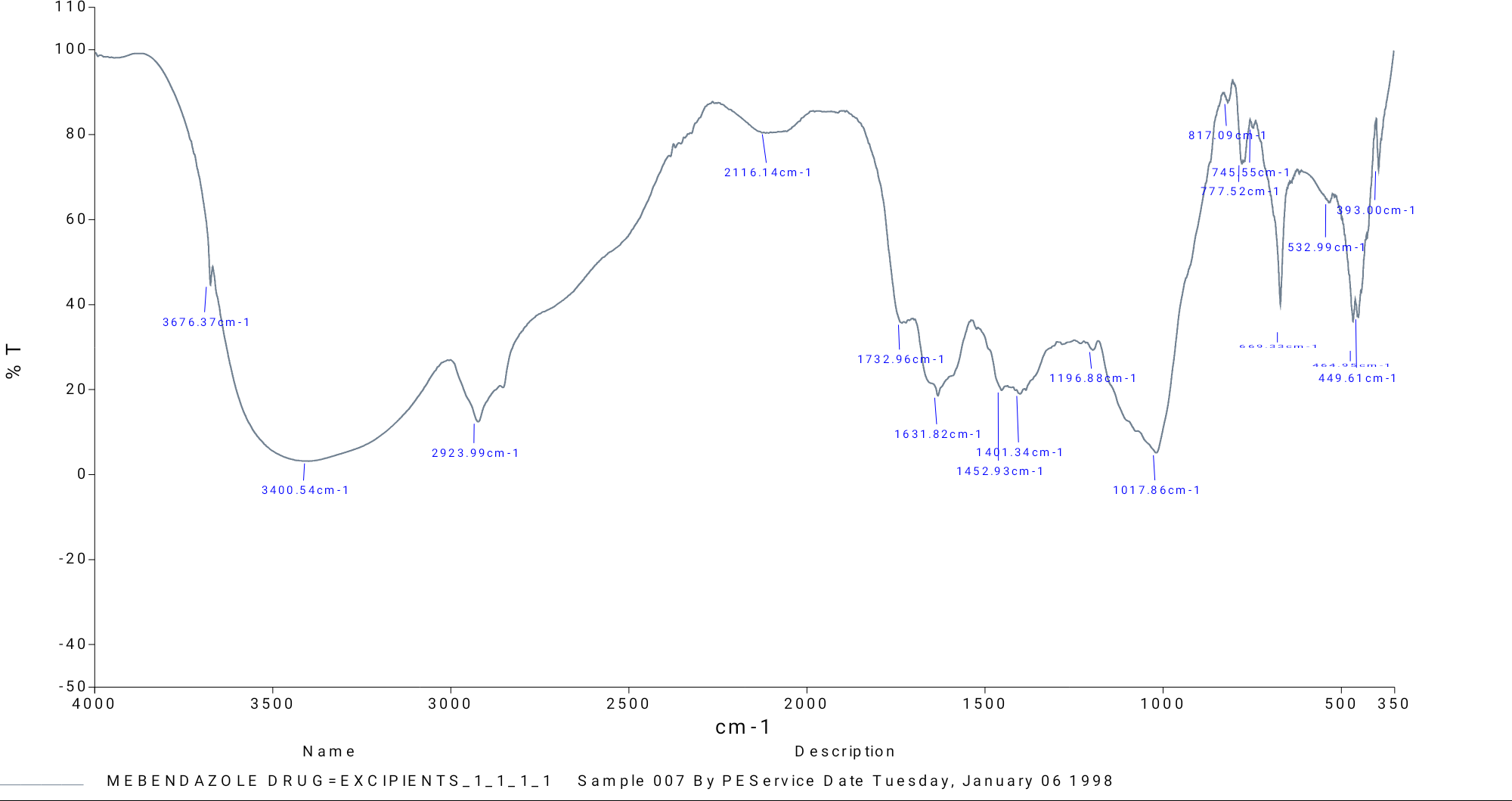
Drug-Excipient Compatibility Studies: An FTIR analysis was performed to investigate any possible interactions between Mebendazole and other ingredients. The FTIR spectrum of Mebendazole and the physical mixture of the Mebendazole-polymer complex was shown in Figure 2. The FTIR spectrum of Mebendazole revealed characteristic peaks at 3418cm-1 (CN Stretching), 2967cm-1 (NH Stretching), and 1732cm-1 in the present study (C=O-O Stretching). The optimized drug-polymer formulation (F7) demonstrated the characteristic peaks near 3400 cm-1 (CN Stretching), 2923cm-
1 (NH Stretching), and 1735cm-1 (C=O-O Stretching). As a result, the FTIR findings suggest that a drug was compatible with the polymer (Figure 2).
Evaluation of Lozenges: Average percentage deviation of all the formulations was found to be within pharmacopoeial limits. All lozenges formulations were found to be uniform in weight, with low standard deviation values, indicating efficient drug and polymer mixing. As a result, the F1-F10 formulations of lozenges pass the weight uniformity test (Table 2). The average weight variation of lozenges was found in between 2.9gm to 3.0gm. The moisture content of lozenges was found in between 0.83% to 0.97%. The lozenge hardness reflects differences in density and porosity, which are expected to result in different drug release patterns by affecting the rate of penetration of the dissolution fluid at the lozenge surface. The hardness of all lozenge formulations was found to be between 10.3 kg/cm2 and 12.5 kg/cm2, indicating that they possessed sufficient mechanical strength to withstand physical and mechanical stress conditions while handling (Table 2). The mean thickness was nearly uniform across all formulations, with values ranging from 7.15mm to 7.45mm. According to the standard deviation values, all of the formulations were within the range (Table 2). The hardness of a material is not always an absolute indicator of its strength. Friability is another measure of tablet strength. The friability of all lozenge formulations was found to be between 0.42% to 0.79%. In the current investigation, the perfect friability of all formulations was less than 1%, as reported in the pharmacopoeia, showing that the friability is within the standard limit. After tumbling in the Roche friabilator, the lozenges showed no evidence of capping, cracking, cleavage, or breaking. It ensures that the lozenges are mechanically stable (Table 2). All lozenge formulations were tested for drug content uniformity. Three trials from each formulation were spectrophotometrically analyzed. The average value and standard deviations for all lozenge formulations were calculated. The percentage of drug content ranged from 98.1% to 99.8%. Mebendazole exhibiting good content uniformity in all formulations indicates that the drug was distributed uniformly throughout the lozenges (Table 2).
| Formulation Code | Weight variation (mg) | Hardness (kg/ cm2) | Thickness (mm) | Friability (%) | Drug content (%) | Moisture content (%) |
|---|---|---|---|---|---|---|
| F1 | 2.9±2.0 | 10.79±0.52 | 7.4±0.01 | 0.63±0.04 | 99.44±1.95 | 0.84±0.03 |
| F2 | 2.9±2.2 | 10.3±0.72 | 7.45±1.56 | 0.57±0.02 | 98.3±1.72 | 0.87±0.09 |
| F3 | 3.0±3.1 | 12.0±0.28 | 7.29±0.04 | 0.42±0.07 | 99.7±1.66 | 0.91±0.07 |
| F4 | 3.0±7.2 | 12.5±0.79 | 7.35±0.02 | 0.58±0.05 | 98.1±1.25 | 0.86±0.04 |
| F5 | 2.9±3.5 | 11.4±0.42 | 7.2±0.3 | 0.58±0.08 | 99.5±2.01 | 0.85±0.07 |
| F6 | 2.9±2.2 | 12.8±0.9 | 7.15±1.2 | 0.54±0.10 | 99.3±1.67 | 0.87±0.01 |
| F7 | 2.9±2.8 | 10.34±0.41 | 7.3±1.32 | 0.59±0.00 | 99.8±1.34 | 0.83±0.02 |
| F8 | 3.0±3.3 | 10.51±0.42 | 7.38±0.02 | 0.58±0.04 | 98.6±1.72 | 0.90±0.07 |
| F9 | 3.0±2.1 | 11.22±0.51 | 7.25±0.04 | 0.79±0.06 | 98.4±1.54 | 0.85±0.03 |
| F10 | 2.9±3.2 | 10.32±0.31 | 7.23±0.04 | 0.59±0.10 | 99.8±1.32 | 0.97±0.05 |
Table 2: Physical evaluation of Lozenges.
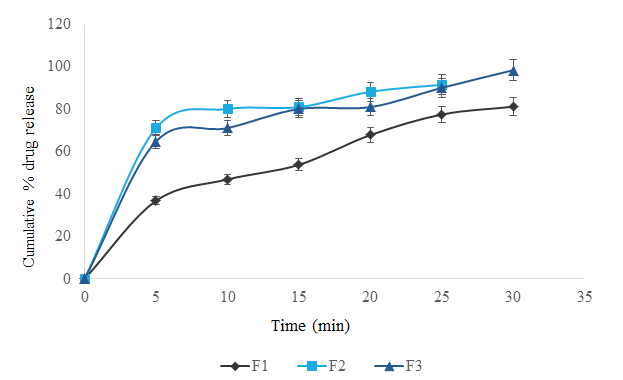
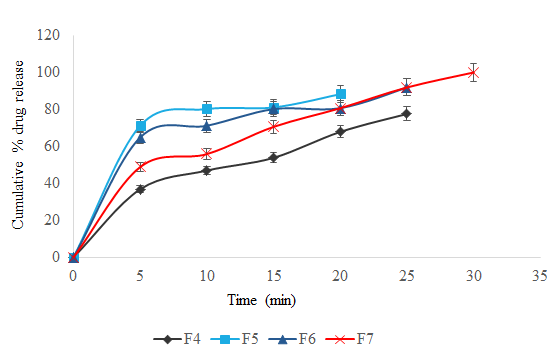
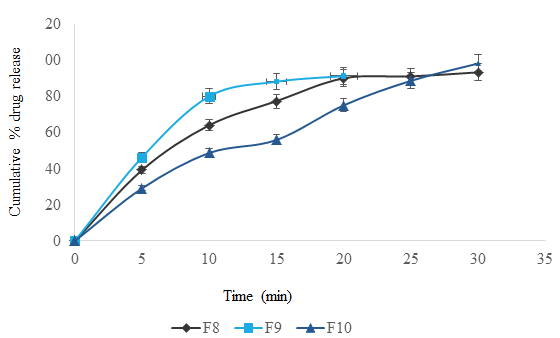
In vitro Drug Release Studies: Formulation F1, F2 of Mebendazole hard candy lozenges with Guar gum containing varying concentrations of sucrose without liquid glucose recorded the drug release of 80.1% (30mins), 93.6% (30mins). F3, F4 were prepared using sucrose, liquid glucose and Xanthum gum recorded the drug release of 96.6% (30mins), 92.9% (30mins). F5, F6, F7 were prepared by using Neem gum recorded the drug release 97.3% (20mins), 97.9% (30mins), 99.9% (30mins). F8 and F10 were prepared by using Xanthum gum and Guar gum recorded the drug release 93.2 % (20mins) and 90.1% (30mins) (Figures 3-5) [7, 8, 9, 10, 11, 12, 13, 14, 15, 16].
Among all the formulations F7 (Neem gum) showed the highest % of drug release, drug content. Hence it was considered as the optimized formulation among all the formulations.
Conclusion
Lozenges could be successfully prepared by fusion method using sucrose, liquid glucose, stevia, natural polymers, flavour and color. Studied the effect of different natural polymers on the in vitro drug release. The optimized formulation (F7) releases drug up to 99.9% in 30min.
Conflict of Interest
There is no financial interest among the authors of this manuscript that has influenced the results or interpretation of this manuscript.
Acknowledgment
We would like to thank Globalchem Asia Pacific Pvt Ltd. India, for providing a free sample of Mebendazole, as well as the management of Vaagdevi College of Pharmacy for providing us facilities to conduct this research.
References
-
Chanda R, Nallaguntla L (2020) Formulation and evaluation of medicated lozenges for sore throat. Asian J Pharm Clin Res 13(10): 62-67.
-
Srujan V, Sriram P (2019) Formulation and Evaluation of Montelukast Sodium Lozenges. Am J Pharm Tech Res 9(2): 112-123.
-
Pravalika L, Shravan Kumar Y (2021) Formulation and Evaluation of Theophylline Lozenges. Research J Pharm 14(3): 1601-1606.
-
Hanif S, Sarfraz RM, Syed MA, Ali S, Iqbal Z, et al. (2021) Formulation and evaluation of chitosan-based polymeric biodegradable mucoadhesive buccal delivery for locally acting drugs: In vitro, ex vivo and in vivo volunteers characterization. Latin American Journal of Pharmacy 40(4): 670-681.
-
Jain V, Ramchandani U, Agrawal S (2012) Formulation and evaluation of oral disintegrating tablet of oxcarbazepine. Int J of Pharm Life Sci 3(12): 2171-2176.
-
Choursiya S (2016) Research article of formulation and evaluation of lozenges for oral bacterial infection. Int J Pharm Pharm Sci 7(1): 606-617.
-
Mishra KK, Tasneem K, Jain V, Mahajan SC (2017) Formulation and Evaluation of Herbal Lozenges. J drug deliv ther 7(7): 87-90.
-
Kolap MB, Omase PK, Dashwant AV, Namde RS (2021) Review on lozenges. Research Journal of Pharmacology and Pharmacodynamics 13(2): 75-78.
-
Apurva PD, Shrikant TK, MM BD (2019) Medicated Chewable Lozenges: A Review Int J Recent Sci Res 10(04): 32071-32076.
-
Tangri P, Rao NR, Chauhan A, Chauhan P, Kumar T, Verma S (2020) Design and Evaluation of Guaifenesin Matrix Type Lozenges Using Herbal and Synthetic Polymer Blends. Int J Sci Res Eng Dev 3(3): 55-61.
-
Pothu R, Yamsani MR (2014) Lozenges formulation and evaluation: A review Int J Ayurveda Res 1: 290-294.
-
Leon Lachman, Herbert AL (2009) Industrial Pharmacy. In Gilbet S banker, Neil R Anderson, Tablets, Special Indian (Edn.), pp: 293-342.
-
Madhusudan Rao Y, Shiva kumar R, Praveen G (2016) Fabrication and evaluation of levocetrizine dihydrochloride lozenges. Int J Res Sci Tech 5(1): 664- 672.
-
Khaladkar A, Avalaskar A, Bharati P, Honkalas K (2019) Formulation and evaluation of Adhulsa lozenges for pediatric patients. J Drug Del Thera 9(2-s): 115-117.
-
MadhusudanRao Y, Shravan Kumar Y, Sandeep P, Naresh N (2015) Formulation and evaluation of lidocaine lozenges. Int J Inno Res Sci Engi Tech 4(11): 11640- 11647.
-
Chandrawanshi Mayuri J, Sakhare RS, Nagoba Shivappa N, Bhalekar Rohini V (2019) A review on medicated lozenges. World J Pharma Res 8(2): 396-412.
- Hydrogen Peroxide Scavenging by Methanolic Extracts of Coriander: An In Vitro Antioxidant Study
- Aromatherapy in Palliative Care: A Fragrant Quest for Relief
- Empowering Women, Securing Futures: Contraception’s Role in Socioeconomic Progress in India
- Effect of Crospovidone, Croscaramellose Sodium in Combination on the Drug Release of Anti diabetic Medication in Tablet Form
- Knowledge, Attitudes, Anxiety, and Preventive Behaviors Regarding Covid-19 Affliction among Healthcare Workers in Pakistan
- “Competitive Landscape and Brand Equivalents: Implications for ANDA (Abbreviated New Drug Application) Approval”