
Formulation and Quality Evaluation of Banana Wine
Fruits are very often used for the wine preparation since the beginning of civilization. In recent years emphasis has been given to fruits such as banana for the preparation of wine. Banana is highly perishable in nature, the fermentation is a low energy prevention process to increase a shelf life of this fruits. Banana has good amount of sugar content that makes them suitable substrate for the preparation of wine. The fermenting for analysis of pH, titrable acidity, specific gravity and reducing sugar using standard fermentation of banana wine lasted for 7 days. Physico-chemical parameters were determined during fermentation using standard procedures. Liquor of the fermenting must remove from every 48 hours from standard procedures. The effects showed that specific gravity of the wine used to be discovered to reduced notably as the fermentation progressed. The pH of banana wine at some point of fermentation improved from 3.80 to 4.16 at day to the closing day while the titrable acidity. (% w/v tartaric acid) of the banana wine reduced make bigger from 1.05 to 1.77. The alcohol content of the wine multiplied with time. This work has been focused on formulation and evaluation of banana wine in college laboratory.
Introduction
Banana is a very popular fruit due to its low rate and high nutritive value [1]. It is eaten up in fresh or cooked shape both as ripe and raw fruit. Banana has lot of nutritional benefits, and is counselled through medical doctors for patients who have low potassium because of its admiring potassium content [2]. It is a seasonal and quite perishable fruit, which can be available all year round. The massive quantity of bananas and plantains offers the potential for industrial use [3].
India is one of the largest producers of fruits in the world. Fruits are amongst the most necessary foods of mankind as they are no longer solely nutritive but are additionally necessary for the preservation of health. Fruits each in sparkling as nicely as in processed form no longer solely improve the nice of our diet but additionally provide essential substances like vitamins, minerals, carbohydrates and so forth [4]. In India, cultivation of banana fruit is on large scale i.e., 13.90 million lots and handy at cheaper rate in market. Maharashtra is the country’s greatest producer of bananas; growers right here have been facing issues like fluctuation in fees and incidence of ailment [5]. Fermenting banana juice is regarded to be a pleasing capacity of utilizing surplus and overripe bananas. There is a paucity of records in the literature on production of liquids the usage of ripe bananas [6]. Thus, the objective of this work used to be to produce and evaluate the high-quality of wine made from banana juice.
Profile of Banana
Banana (Musa sapientum) is a valued fruit across the world due to its flavour, high dietary value, and availability at some stage in the year. The bananas are abundantly cultivated in growing nations of Asia, Africa and Latin America which can bear fruit all-round the year presenting a convenient supply of energy for humans [7]. Bananas have a lot of dietary benefits and a better desire for human beings suffering from potassium deficiency because of its superb potassium content. Potassium is an important aspect of cell and body fluids that helps control heart beat and blood pressure, countering terrible results of sodium [8]. Bananas’ flavour is due, amongst different chemicals, to isoamyl acetate which is one of the important constituents of banana oil. Wine is an alcoholic beverage usually made from fermented fruit juice [9]. Maharashtra share is 58 As many as 30 wineries are in Nasik, eleven in Pune, 10 in Sangli, 3 in Solapur, 3 in Buldhana and one in Osmanabad. Maharashtra registered around 59.84 per cent increase in wine manufacturing to 2.11 crore litres [10].
Objective of the Study
The general objective is to produce wine from banana and the specific objectives is to evaluate the qualities of the wine. The production of alcohol from banana juice which use as complete replacement of malt in alcohol production by utilizing pure culture of Saccharomyces cerevisiae as fermenting organism. The main objective of the study is to extraction of the banana juice with suitable dilution with water, obtaining juice of desired consistency and followed by fermentation of the juice by addition of inoculums in aseptic condition. To evaluate the qualities of the wine and to carry out or monitor yeast count during fermentation. To present a study about banana in post-harvest handling, technology in banana, end products of banana, banana diseases.
Material and Methods
Raw Material
The various raw materials and chemicals that are required for the wine production are given as: Banana fruit and pulp, Yeast (saccharomyces cerevisae), pectinase enzyme, ascorbic acid, Distilled water, Spirit or Acetone, Sucrose and Maltose, Agar and Nutrient broth, Preservative or antioxidant (sodium metabisulphate), fermenter (5 L quadruple glass bioreactors (GBCN-5C, Zhenjiang East Biotech Equipment and Technology Co., Ltd., Zhenjiang, Zhenjiang, China), Refractometer (Digital Abbe Refractometer, S-9293), Thermometer (glass thermometer, 3000C) , Hydrometer (BS718 M50 at 20C Hydrometers, for specific gravity), Grinder, Hot air oven, Autoclave( Labtron, LVA-B15), Refrigerator, Centrifuge separator, Microscope, Conical flask, Petri plate, Measuring cylinder, Beaker, Nichrome wireloop, Burner etc.
Preparation of Banana Wine
The methods include the following steps. Cleaning banana, peeling, slicing, protecting colour, juicing, treating with pectinase, centrifuging, separating, adjusting, the components inoculating yeast, conducting, primary fermentation, aging, filtering, bottling, and sterilizing.
Preparation of Juice
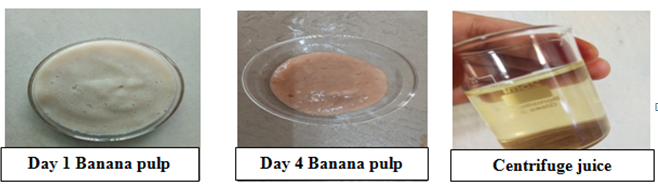
Mature, ripe, healthy bananas (Musa Paradisiaca) were purchased from a local market Nagpur. The fruits were classified as light yellow. Each of the banana fruits was washed, hand peeled, and sliced with a stainless-steel knife. The slices were ground into the grinder and the pulp was fermented for 7day, after these processes the pulp were centrifuge in the centrifugal machine and juice was produced [11].
Fermentation of Juice
The treated juice (40 ml) was added to the glass aspirator jars. Jar was seeded with 3% (V/V) of the 48h yeast inoculum. The jars were closed with rubber stoppers fitted with fermentation lock. The mixture was incubated at room temperature (30 ± 2°C) for 7days. Titratable acidity (TA), pH, soluble solids (SS), specific gravity (SG) and temperature were monitored daily during the fermentation. Racking was done for the fermenting Juices when gas evolution diminished. The matured wines gas evolution stopped. The wines were then transferred into wine bottles, pasteurized (60 ◦C, 30 mins) and stored in a refrigerator (10 ± 2°C) [12].
Preparation of Yeast Culture
Two-gram dry commercial baker’s yeast (Saccharomyces cerevisiae) were dissolved in 100 ml banana juice preheated at 3°C. The mixture was held in a culture propagating bottle at 30 ± 2°C for 48 h.
Clarification
At the quilt of the ageing period, some wine must have clear naturally, for others artificial clarification may be necessarily, this is completed by including fining agent, which will react with tannin, acid, proteins, and so on to supply coagulum’s which settles [13]. Fining is used to have an effect on a fast clearing of wines which will no longer clear naturally, to cast off substance which would render the wine unstable after bottling.
Packaging/Bottling
Wines can also be bottled before or after getting old relying on the producer. Most wines which are bottled before ageing are the sparkling wines and the commonly require filtration earlier than the ultimate bottling.
Methods of Evaluation
Soluble solids were determined using an Abbe refractometer. Moisture was determined by oven drying at 105°C. The pH value determined by standard pH meter by preparing buffer solution. Taken 10ml of wine in a beaker and electrode immersed. The measure pH is 3.57 [14].
Determination of Reducing Sugar
The quantitative estimation of decreasing sugar of the juice used to be decided the use of the method described by using [15]. 1 mL of 3,5-Dinitrosalicyclic acid (DNS) is added to 1 mL of supernatant of wort (sample) in a take a look at tube and the combination heated in boiling water for 10 minutes. The test tube is cooled rapidly in tap water and the quantity adjusted to 12 mL with distilled water. A blank containing 1 mL of distilled water and 1 mL of DNS is additionally prepared. The Optical Density (OD) of pattern is examine in opposition to the blank in a Spectrophotometer at 540 nm absorbance. The concentration of reducing sugar is estimated from glucose popular [16].
Determination of Specific Gravity
50 mL density bottle was absolutely cleaned with distilled water, dried in an oven for 500C and allowed to cool. The weight of the cooled dried bottle (W1) was recorded. The dried density bottle was once crammed with deionized water and floor of the bottle was cleaned with a cotton wool and weighed (W2). The density bottle. was emptied and cleaned twice with 10 mL of the juice thereafter the bottle was filled to the brim with the “must” and the bottle cleaned with cotton wool and weighed (W3). The specific gravity (Kg/m3) was calculated [17].
Determination of Titrable Acidity
This used to be determined by the titration.1% of aqueous alcoholic phenolphthalein as indicator used to be brought to 200ml of distilled water. It was titrated with 0.1M of NaOH. Titration was stopped when a faint but particular red coloration seemed andthe titre price was once cited that served as the initial titre. 5 mL of the have to use to be introduced to the neutralized solution. The identical 0.1M NaOH used to be used to titrate it. The titration was stopped at the look of faint, but precise red colour. The titre was taken. This served as the closing titre. The titratable acidity used to be calculated with reference to tartaric acid [18].
Determination of Alcoholic Content
The refractometer method used to be used in determining the alcohol content. An easy dry applicator was used to region 2drops of the pattern (must i.e., earlier than fermentation) on the prism of the refractometer and the price (original gravity) of the refractive index taken. Also, after fermentation, 2drops of the sample used to be utilized on the prism of the refractometer and the cost (total gravity) was taken. The refractive index of the pattern used to be taken on two days interval of time [19].
Determination of Temperature
An easy thermometer and measuring cylinder were once used for temperature reading. about 50ml of the sample was once used.
Results and Discussion
Organoleptic Evaluation
The organoleptic characteristics such as colour, odour, taste, clarity, flavour and the overall acceptance the sample were evaluated on the 21st day.
| S.No. | Organoleptic Properties | Results |
|---|---|---|
| 1 | Colour | Light yellow |
| 2 | Clarity | Clear |
| 3 | Taste | Slight taste |
| 4 | Odour | Likely moderate |
| 5 | Flavour | Light fruit |
| Days of Fermentation | Temperature | |
| Day 1 | 27°C | |
| Day 2 | 28°C | |
| Day 3 | 38°C | |
| Day 4 | 43°C | |
| Day 5 | 26°C | |
| Day 6 | 28°C | |
| Day 7 | 27°C |
Table 1: The organoleptic characteristics and results.
The find out about aimed at evaluating the qualitative performance of wine The result of the banana wine produced by way of the fermenting with yeast traces remoted from banana (S. cerevisiae) indicates excessive rate of alcoholic manufacturing at the give up of day 21. Throughout the duration of fermentation, pH of the need to was within the acidic vary 3.60 to 4.16. Indicate a gradual decrease in the pH as the fermentation time will increase and increased at the end of fermentation. The end result of titrable acidity carried out on the pattern as shown in table shows that the titrable acidity levels from 1.05 at zero day to 1.77 at day 21 in the fermenter. Therefore, the titrable acidity will increase as fermentation time increases.
Physicochemical Properties
Temperature Result for Banana Wine
| No. of Days | pH | Reducing Sugar (mg/ ml) | Titrable Acidity (%w/v) | Specific gravity (kg/ m3) | Alcohol Content (%v/v) |
|---|---|---|---|---|---|
| 0 | 4.2 | 0.25 | 1.04 | 1.009 ± 0.0012 | 0 |
| 2 | 3.9 | 0.23 | 1.07 | 1.027± 0.0042 | 0.4 |
| 5 | 3.7 | 0.13 | 1.13 | 1.022± 0.0034 | 2.4 |
| 7 | 3.6 | 0.6 | 1.24 | 1.020± 0.0058 | 4.9 |
| 9 | 3.9 | 0.2 | 1.32 | 1.014± 0.0035 | 5.7 |
| 14 | 4.2 | 0.1 | 1.47 | 0.999± 0.0085 | 7.6 |
Table 2: Physicochemical Properties.
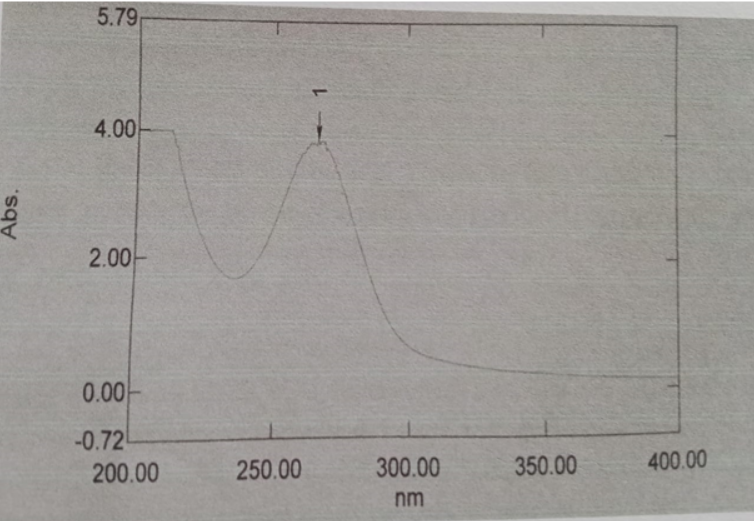
Wine Absorbance Peak
| Absorbance | Nanometre |
|---|---|
| 4 | 254 |
Table 3: Wine Absorbance Peak.
Conclusion
It may be concluded that a 10-day fermentation of banana juice produced a good quality wine. Banana wine is very nutritious and easy to produce and could then compete in the market with other wines because of its flavour, taste, aroma and the successful production of using indigenous fruits as substrates for wine production and the efficiency of locally isolated yeast Saccharomyces cerevisiae strains. Banana wine has a lot of nutritional benefits, vitamins including B5, B6, C, A are all present in banana wine and this makes it one of the high-ranking beverages over other alcoholic ones. Vitamin A helps in restrain of eye sight. Sensory evaluation shows that shade and taste was slightly good whilst odour and palatability was moderately good. The typical acceptability was moderate.
Acknowledgement
Authors are very much thankful to Principal and Management of Shree Sainath College of Pharmacy, Dawalameti, Nagpur for providing research facilities for the completion of this research work. We are also thankful to HOD, Department of Pharmaceutical Sciences, Nagpur for research assistance.
References
-
Kandhare KS, Gaikwad RS, Pate SS (2023) Production and evaluation of wine prepared from banana (Saccharomyces Cerevisiae). World Journal of Biology Pharmacy and Health Sciences 13(1): 312-321.
-
Dalal AS, Kumar S (2023) A review: potential of wine production from different fruits. The Pharma Innovation 12(4): 1281-1287.
-
Chang LS, Mishra S, Mishra H, Patel AK, Ekka SK, et al. (2023) Studies on Different Level of Wine Yeast and Sugar for Making Sapodilla Wine (Manilkara zapota). Environment and Ecology 41(2): 843-851.
-
Chang LS, Mishra S, Mishra H, Patel AK, Ekka SK, et al. (2023) Studies on Different Level of Wine Yeast and Sugar for Making Sapodilla Wine (Manilkara zapota). Environment and Ecology 41(2): 843-851.
-
Chavhan HB, Chavan SS, Janjal SG, Patil DU, Chaudhari RA, et al. (2022) Preparation and Physicochemical Analysis of Wine from Banana Fruit.
-
Kurniawan R, Mastuti TS (2022) Fruit Wine Characteristics with Variety of Banana Type along with Banana and Water Ratio. GCISTEM Proceeding 1: 186- 199.
-
Ezemba CC, Archibong EJ (2022) Wine Production from Banana (Musa sapientum) Using Yeast (Saccharomyces cerevisiae) Isolated from Grape (Vitis vinifera). Journal of Advances in Microbiology 22(2): 64-71.
-
Bilhman S, Ramanathan S, Dumjun K, Wunnoo S, Lethongkam S, et al. (2023) Value-Added from Microwave-Assisted Extraction of Musa sapientum Waste as an Alternative Safe and Effective Agent for the Treatment of Hyperpigmentation. Waste and Biomass Valorization 14(5): 1477-1488.
-
Rosalina Y, Warsiki E, Fauzi AM, Sailah I (2022) Study of Anthocyanin Extraction from Red Banana (Musa sapientum L. var Rubra) Waste and Characteristics of Light Effects. Science and Technology Indonesia 7(4): 522-529.
-
Quintero S, Giraldo DP, Garzon WO (2022) Analysis of the Specialization Patterns of an Agricultural Innovation System: A Case Study on the Banana Production Chain (Colombia). Sustainability 14(14): 8550.
-
Adhikari A, Paudel B, Pokhrel A (2022) Banana Production Status and Its Role on Income Generation and Livelihood Improvement in Chitwan, Nepal. International Journal of Applied Sciences and Biotechnology 10(2): 93-98.
-
Westerhoven ACV, Meijer HJ, Seidl MF, Kema GH (2022) Uncontained spread of Fusarium wilt of banana threatens African food security. PLoS pathogens 18(9): e1010769.
-
Ma W, Zheng H, Yuan P (2022) Impacts of cooperative membership on banana yield and risk exposure: Insights from China. Journal of Agricultural Economics 73(2): 564-579.
-
Chu X, Miao P, Zhang K, Wei H, Fu H, et al. (2022) Green Banana maturity classification and quality evaluation using hyperspectral imaging. Agriculture 12(4): 530.
-
Malakar B, Das D, Mohanty K (2022) Evaluation of banana peel hydrolysate as alternate and cheaper growth medium for growth of microalgae Chlorella sorokiniana. Biomass Conversion and Biorefinery 30: 1.
-
Singh A, Kumari A, Chauhan AK (2022) Formulation and evaluation of novel functional snack bar with amaranth, rolled oat, and unripened banana peel powder. Journal of Food Science and Technology 59(9): 3511-3521.
-
Das M, Rajan N, Biswas P, Banerjee R (2022) Dual enzyme treatment strategy for enhancing resistant starch content of green banana flour and in vitro evaluation of prebiotic effect. LWT 160: 113267.
-
Alabere A, Adebayo-Olajide TC (2023) Analysis of Physicochemical and Microbiological Parameters of Wine Produced from Banana and Pineapple. Asian Journal of Applied Science and Technology 7(1): 25-33.
-
Li Z, Qin C, He X, Chen B, Tang J, et al. (2022) Development of Green Banana Fruit Wines: Chemical Compositions and In Vitro Antioxidative Activities. Antioxidants 12(1): 93.
- Hydrogen Peroxide Scavenging by Methanolic Extracts of Coriander: An In Vitro Antioxidant Study
- Aromatherapy in Palliative Care: A Fragrant Quest for Relief
- Empowering Women, Securing Futures: Contraception’s Role in Socioeconomic Progress in India
- Effect of Crospovidone, Croscaramellose Sodium in Combination on the Drug Release of Anti diabetic Medication in Tablet Form
- Knowledge, Attitudes, Anxiety, and Preventive Behaviors Regarding Covid-19 Affliction among Healthcare Workers in Pakistan
- “Competitive Landscape and Brand Equivalents: Implications for ANDA (Abbreviated New Drug Application) Approval”