
Investigating Compounds Which Preserve Freshness of Black Tulip Longer
After flowers are cut-off, they start aging quickly. In order to slow down this process and extend the life of a cut flower, postharvest treatment is necessary. This study focuses on identifying the compound(s), which preserves the freshness of a cut flower longest. Fifteen different compounds were tested on the two groups of species; Hybrid Tea and Floribunda from South and North garden. The number of days of freshness for each compound from each garden and specie were measured and these measurements were used to conclude on the compound(s) that preserve the cut roses longest. In terms of analysis; Analysis of Variance, Generalized Estimating Equation and Generalized Linear Mixed Model were used, all of which provided similar results. It was concluded from the fifteen tested compounds that compound6 (Essence of Epiphaneia) and compound12 (Oil of Johns Son) prolong the freshness of cut roses longest. It also appeared that if a rose is taken from southern garden and is of Hybrid Tea specie, the freshness is preserved longer than if it is of Floribunda specie and taken from north garden. Due to the genetic similarity, it is assumed that these results are also applicable to black tulip.
Introduction
All flowers have a proper stage of maturity for cutting, which occurs for most flowers just before they fully open. The maturity of the flower takes place when the blooms are more enhanced than tight buds but not very old that they start to deteriorate [1]. Some flowers, such as tulips and roses live longest when they are cut in the bud stage or when they just start blowing. After flowers are cut from their mother plants, their aging process accelerate [2]. To delay this aging process and increase their life quality, post-harvest treatment is essential. Some commercial cut preservatives, such as 8-hydroxyquinoline sulphate (8HQS) and pulse treatment of sucrose and/or silver thiosulfate (STS) are currently in use chemicals, which show potential advantages of extending vase life and maintaining flower quality [3]. Most of commercial cut roses last for about 10 or more days. Therefore, using preservative solutions can be a solution to extend their life [4]. Moreover, due to physiological and pathological effects during the post-harvest handling, around 20% of fresh flowers die during the time of transportation. Hence, there is a need to explore possible ways to extend the life of a cut flower and keep its freshness for the longest time possible. This study focuses on extending the freshness of garden cut roses of Hybrid Tea and Floribunda species. Hybrid Tea roses are the most popular type of roses in the home garden, which are derived from a cross between Hybrid Perpetual and Tea roses [5]. Floribunda roses are a cross between the Hybrid Tea rose and Polyantha rose, which produces abundant clusters of flowers on its stems unlike to Hybrid Tea roses, which app ear as a single blossom on a long stem [6]. In this study, in order to preserve the freshness of cut roses for a long time fifteen compounds were used (see Appendix 1, Table 10 for compound names). Due to black tulip being one of the endangered plant species, the experiments were conducted on Hybrid Tea and Floribunda roses since they have elongated, cup-like blooms that are likely to tulips. Especially, Hybrid Tea roses are known for their long and elegant blooms similar to tulips [7]. The rep ort is organized as follows: Section 2 describes the data structure, study design and statistical methods used to analyze the data. Section 3 presents the results obtained from exploratory data analysis and statistical analyses, such as ANOVA, Generalized Estimating Equations and Generalized Linear Mixed Mo del. Section 4 provides discussion of the obtained results from the analysis and finally, section 5 presents a summary of the obtained results, providing recommendations for the longest preserving compound.
Objective
The main goal of this study is to identify the compound(s) that should be used to preserve the freshness of black tulip by experimenting the compounds on the cut roses.
Methods and Materials
Data Description and Study Design
The data consists of total of 3540 flowers. 1770 flowers were taken from each of the gardens and types (species) with 236 flowers assigned to each of the fifteen compounds. The study was located in France, where the garden is divided into a south and north plot, both containing roses from Hybrid Tea and Floribunda species. An experimental design was constructed to select the best compound(s) that preserves the freshness of roses for a long time. The flowers were randomized using the location (North=1, South=2) and the species (Floribunda=1 and Hybrid Tea=2) as stratification factors. There were a total of four plots utilized, two north and two south with one plot containing Floribunda and the other Hybrid Tea species. In order to be included in the experiment, the cut flowers had to be of the same stage of growth. To improve the representativeness of the sample (decrease bias), to make variability similar and to reduce sampling error, the roses from each stratum were selected using simple random sampling. Sampled roses were assigned to different preservation compounds in such a way that equal amounts of flowers from each stratum were assigned to each compound in order to have a balanced design. After all roses were put in their specific treatment vase, their freshness was measured each day for 30 days. Measurements occurred according to the freshness criteria defined as: presence of color change, hanging flower stalk and angle of bending at least 10% (36 °). When none of these criteria were met, the flower was considered as fresh and a value 1 was given. When one or more criteria was met, then the flower was considered not to be fresh and a value 0 was given. After 30 days of measurement, how long each flower survived (number of days that the cut rose stayed fresh) was recorded as the response variable. In the night of day 6 to day 7, 26 roses were severely damaged/destroyed, and they could no longer be used in the experiment nor the analysis as they were considered to be missing values. Because of a shortage of rose bushes, more than one roses were needed to be cut from the same rose bush. This is indicated by the variable Bush.
Sample Size Determination
The sample size of the study is obtained using R version 3.1.1 and is based on analysis of variance. The power was taken to be 85% with the level of significance 5%. The effect size was stated as 1 day. A pilot study was done to estimate the variance parameters. This pilot study was conducted for 60 roses stratified for each species and location for each compound. Based on all the obtained and chosen parameters, the calculated total sample size was 3540 flowers with 236 flowers per compound.
Explanatory Data Analysis
Explanatory data analysis was used to get an insight into the data set, explore various structures, relationships and patterns. Summary statistics and several types of plots were used to describe the data.
Statistical Models
Analysis of Variance (ANOVA) Three-way ANOVA model was used to determine if there is an effect of the three factors (compound, garden and type) on a continuous dependent variable (number of days of freshness). If the overall test of factor(s) are found to be significant, how the levels of factor differ should be examined in more detail in order to select the best compound(s). The mathematical description of the model
$$Y_{ijki} = \mu \ldots + \alpha_i + \beta_j + Y_k + e_{ijkl} \quad (1)$$
where; $i = 1, \ldots, 15; j = 1, 2; k = 1, 2; l = 1, \ldots, ni; Y_{ijki}$ is the number of days of freshness of $l^{th}$ flower from $j^{th}$ specie and $k^{th}$ garden using compound $i$, $\alpha_i$ is the $i^{th}$ compound effect with restriction $\sum_{i=1}^{15} \alpha_i = 0$, $\beta_j$ is the $j^{th}$ specie effect with restriction $\sum_{j=1}^{2} \beta_j = 0$ and is the $k^{th}$ garden effect with restriction $\sum_{k=1}^{2} Y_k = 0$, eijkl is the error term.
**Generalized Estimating Equations (GEE)**
Since the response variable, the number of days of freshness, is a count data and roses are clustered within bush, GEE based on Poisson regression model is considered as an alternative to the ANOVA model. The Generalized Estimating Equations approach, which was introduced by Liang KY [8] is a method for analyzing correlated outcome of the data. The within-subject correlation among the repeated measures is taken into account by defining a working correlation structure and fitting that structure into the estimation [9]. The method provides two estimates of the standard errors: the model-based (from a naively specified working assumption) and the empirical ones (robust). When adopting GEE, one does not use information of the correlation structure to estimate the main effect parameters. As a result, it can be shown that GEE yields consistent main effect estimators, even when the correlation structure is miss-specified [10]. The choice of the working assumption about the correlation structure can be made from independence, exchangeability, unstructured and auto-regressive AR (1).
In this study, exchangeable assumption was chosen since the correlation between bushes are not equally spaced measurements and do not depend on time. When the model-based and empirical standard errors are far apart, this can be seen as an indication for a poor choice of working assumptions. A poor working assumption is not wrong, but may hamper efficiency and, when at all possible, it may be of interest to then try alternative working assumptions [10].
The mathematical description of the model is given as:
$$\log(\mu_i) = \alpha_1 + \alpha_2 c_2 + \ldots + \alpha_{15} c_{15} + \alpha_{16} \text{Type} + \alpha_{17} \text{Garden} (2)$$
Where, $Y_i = \text{Poisson}(\mu_i)$, $C_2$, $C_3$, ..., $C_{15}$ are dummy variables for compound 2, ..., 15, respectively, $Y_i$ is the outcome for rose i and $\mu_i$ is the expected number of days $j^{th}$ rose stays fresh.
**Generalized Linear Mixed Models (GLMM)**
In this study, more than one roses were taken from a single bush and freshness of a flower was measured on a daily basis. As such, the measurements were taken from a single flower at different times and roses from the same bush were assumed to be correlated. Hence, it is advisable to use a longitudinal data analysis method to handle the correlated nature of the data. The response variable, freshness of flowers, is binary data but the measurements are correlated, therefore the common binary logistic regression model is not appropriate [11]. Therefore, GLMM was applied to select the compound with the highest probability of keeping the cut rose flowers fresh.
The mathematical description of the model is as follows:
$$\logit(\pi_{ijk}) = \alpha_6 + \text{Bush}_k + \alpha_1 \text{Day}_j + \alpha_2 c_2 \text{Day}_j + \ldots + \alpha_{15} c_{15} \text{Day}_j + \alpha_{16} \text{Type} + \alpha_{17} \text{Garden} (3)$$
Where; is binary outcome for rose i from bush k at day j, is the probability of the $j^{th}$ rose from $k^{th}$ bush still being fresh at $j^{th}$ day, $C_{i2}, \ldots, C_{i15} = 1$ if compound 2, ..., 15 is used, else 0 respectively, Type=1 if Type1 is used, else 0 and Garden=1 if Garden1 is used, else 0. Distilled water for compound, Hybrid tea for type and South garden for garden are considered as reference categories in all models considered in this study.
**Software**
Statistical analysis are performed using SAS version 9.4 and R version 3.1.1. All tests were performed at significance level of 5%.
**Results**
**Exploratory Data Analysis**
The data consisted of 3540 rose flowers with 26 missing and 3514 effective flowers. 1770 flowers were taken from each of the gardens and types (species). From the summary statistics provided in Appendix 1, Table 7 (part 7.1), it was observed that compound6 and compound12 have the highest average number of days of freshness; 21.12 and 20.97 with a standard deviations of 4.43 and 4.33, respectively while distilled water had 8.25 days with a standard deviation of 2.96. A box plot of the number of days of freshness against each compound was given in Figure 1. Compound6 and compound12 seems to have the highest average number of days of freshness while compound2 and compound10 appears to be providing the lowest number of days of freshness.
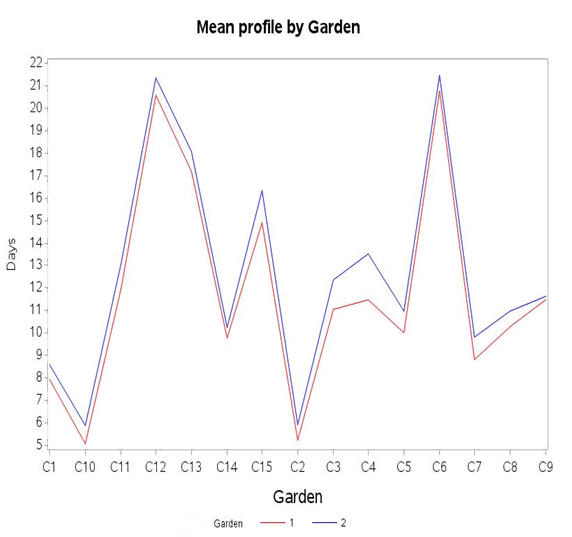
Figure 2 below represents the number of days of freshness against each of the compounds within the gardens. Compound6 and compound12 have the highest number of days of freshness while compound2 and compound10 have the lowest number of days of freshness in both of the gardens (1=North and 2=South). Additionally, it can be observed that there is no interaction between compound and garden. It can also be seen that garden2 has slightly higher preserving power than garden1.
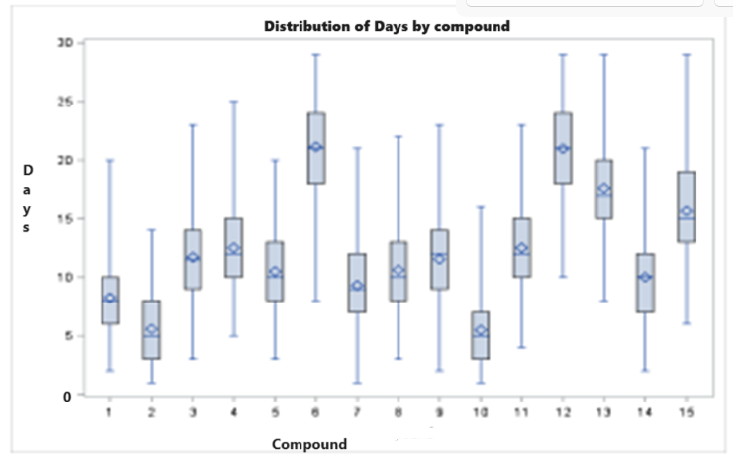
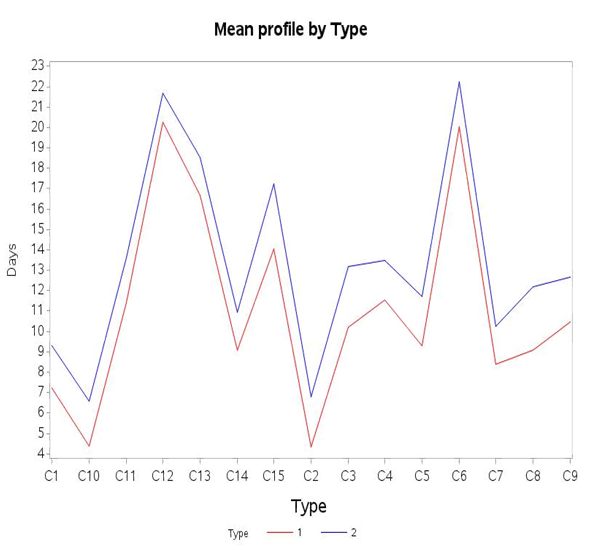
Figure 3 presents the number of days of freshness against each compound within the types (species). It has also observed that compound6 and compound12 have the highest number of days of freshness while compound2 and compound10 have the lowest number of days of freshness in both of the types (1=Floribunda and 2=Hybrid Tea). Besides, it is observed that there is no interaction between compound and type, and that type2 has slightly higher surviving power than type1. That being said, a rose from the species of Hybrid Tea may preserve its freshness for a longer time than a rose from Floribunda.
ANOVA Model
Three way ANOVA model was used with factors compound, garden and type with fifteen, two and two levels, respectively. The main factors compound, garden and type have significant effect in the freshness of the roses since the p-value for all of them in the F-statistics presented in Table 1(part 1.1) are very small (<0.0001) in comparison to 5% significance level. However, as their interactions were found to be insignificant, the model was refitted without
- the interactions. In order to see which compound, garden and type is better in preserving the cut rose, each levels’ parameter estimates were calculated as provided in Table 2.
- Effects of factors in the number of days of freshness of the cut rose
- Source
- F value
- Pr> F
- Part 1.1
- Compound
- 429.46
- <0.0001
- Garden
- 58.89
- <0.0001
- Type
- 358.6
- <0.0001
- Score statistics for Type III GEE analysis
- Part 1.2
- Source
- Chi-Square
- Pr>ChiSq
- Compound
- 246.67
- <0.0001
- Garden
- 168.21
- <0.0001
- Type
- 51.89
- <0.0001
Table 1: Effects of the factors on the days of freshness, and Score statistics for Type III GEE.
From the results in Table 2, it was observed that all the fourteen compounds have significantly different effect in comparison to compound1 (reference) since the p-value for all fourteen compounds are smaller than 5% significance level. All compounds, which have negative average estimated values have less preserving ability than the distilled water while those with positive average estimated values have higher preserving ability for the cut rose than distilled water.
It can be observed that the compound6 has a mean estimate of approximately 12.88 higher than the distilled water in preserving the freshness of cut roses. Compound12 is the second best with a mean estimate of approximately 12.74 higher than the distilled water. This shows that compound6 and compound12 both have almost the same and highest preserving ability. Compound10 and compound2 have lower preserving power for the cut flowers than distilled water.
| Parameter | Estimate | Std.Error | Pr>|t| |
|---|---|---|---|
| Compound2 | -2.68 | 0.33 | <0.0001 |
| Compound3 | 3.45 | 0.33 | <0.0001 |
| Compound4 | 4.26 | 0.33 | <0.0001 |
| Compound5 | 2.25 | 0.33 | <0.0001 |
| Compound6 | 12.88 | 0.33 | <0.0001 |
| Compound7 | 1.08 | 0.33 | 0.001 |
| Compound8 | 2.38 | 0.33 | <0.0001 |
| Compound9 | 3.34 | 0.33 | <0.0001 |
| Compound10 | -2.76 | 0.33 | <0.0001 |
| Compound11 | 4.26 | 0.33 | <0.0001 |
| Compound12 | 12.74 | 0.33 | <0.0001 |
| Compound13 | 9.37 | 0.33 | <0.0001 |
| Compound14 | 1.76 | 0.33 | <0.0001 |
| Compound15 | 7.38 | 0.33 | <0.0001 |
| Compound1 | 0 | 0 | |
| Garden2 | 0.91 | 0.12 | <0.0001 |
| Garden1 | 0 | . | |
| Type2 | 2.26 | 0.12 | <0.0001 |
| Type1 | 0 | 0 | . |
Table 2: Parameter estimates and significance tests for ANOVA model.
Since the p-value is small, there is significant difference between the gardens (1=Northern and 2=Southern). Garden2 has the highest power in preserving the cut rose, which means that if a rose is from southern part of the garden, it can survive for a longer time than a rose taken from northern part. Since the p-value for the type (specie) is small, there is significant difference between the two species (1=Floribunda and 2=Hybrid Tea). As it is observed from Table 2, Type2 has higher surviving ability such that arose from Hybrid Tea specie has higher surviving ability than a rose from Floribunda specie. In the ANOVA model, there are assumptions that should be fulfilled. Accordingly, the residuals of the model are assumed to follow a normal distribution with mean zero and constant variance. However, from the results of Kolmogorov-Smirnov normality test and Brown and Forsythe’s homogeneity of variance test, both the normality of error terms as well as the constancy of variance are found to be violated (Appendix, Table 6 and Figure 4).
Since the normality and constancy of variance assumptions are violated, Box-Cox transformation was done using a value of 0.5 λ = (Appendix, Figure 5). However, still both assumptions were violated (Appendix, Table 6). Outliers were identified by the Bonferroni test and observations with absolute studentized deleted residuals > ( ) 1 0.40
2 3514 , 3496
$$ \left[ t \left(\frac {1 - \alpha}{2 (3 5 1 4) , 3 4 9 6}\right) \right] = 0 $$ − are considered to be outliers while outliers with DFFIT > 2 17 2 2&( ) 0.212 1514 = are considered to be influential. Although, there are outliers observed, there are no influential outliers.
It should be noted that since the assumptions of the ANOVA model are not fulfilled, the conclusion based on ANOVA may not be sufficient enough.
Generalized Estimating Equations (GEE)
The assumptions in the ANOVA model were not met even after transformation of the response variable was done. Therefore, Generalized Estimating Equation (GEE) based on Poisson model was applied as an alternative to ANOVA. Due to the fact that more than one roses are taken from a bush, the roses within the same bush are likely to be correlated. For this reason, GEE was fitted as a model to account this within correlation structure.
In this study, GEE is used by assuming exchangeable correlation between roses within the same bush, i.e.
( ) ,
corr Yij Yik
$$ = \alpha \text {f o r} j \neq k \text {a n d} \operatorname {c o r r} \left(Y i j, Y i k\right) = 1 $$
corr Yij Yik =
$$ \begin{array}{l} \operatorname {c o r r} (1 i j) \\ \mathrm {f o r} j = k. \\ \end{array} $$
. The score statistics type III results provided in
Table 1(part 1.2) shows that since the p-value for compound,
type, and garden are less than 5% level of significance, those
variables have a significant effect on the mean number of
days cut flowers stay fresh.
| Parameter | Estimate | Standard Error | 95% Confidence | Limits | Z | Pr>Z |
|---|---|---|---|---|---|---|
| Intercept | 1.9732 | 0.0234 | 1.9273 | 2.019 | 84.36 | <.0001 |
| Compound2 | -0.3897 | 0.0361 | -0.4605 | -0.3189 | -10.79 | <.0001 |
| Compound3 | 0.3469 | 0.0291 | 0.2898 | 0.404 | 11.91 | <.0001 |
| Compound4 | 0.4224 | 0.031 | 0.3615 | 0.4832 | 13.61 | <.0001 |
| Compound5 | 0.2421 | 0.0296 | 0.184 | 0.3001 | 8.18 | <.0001 |
| Compound6 | 0.9412 | 0.0243 | 0.8936 | 0.9888 | 38.73 | <.0001 |
| Compound7 | 0.1192 | 0.0312 | 0.0581 | 0.1803 | 3.82 | <.0.0001 |
| Compound8 | 0.2586 | 0.0309 | 0.198 | 0.319 | 8.36 | <.0001 |
| Compound9 | 0.3426 | 0.0294 | 0.2851 | 0.4002 | 11.67 | <.0001 |
| Compound10 | -0.4048 | 0.0379 | -0.4791 | -0.3306 | -10.68 | <.0001 |
| Compound11 | 0.416 | 0.0281 | 0.3608 | 0.4711 | 14.78 | <.0001 |
| Compound12 | 0.9378 | 0.0252 | 0.8884 | 0.9872 | 37.187 | <.0001 |
| Compound13 | 0.7621 | 0.0264 | 0.7104 | 0.8139 | 28.85 | <.0001 |
| Compound14 | 0.1954 | 0.0308 | 0.1351 | 0.2557 | 6.35 | <.0001 |
| Compound15 | 0.6393 | 0.0263 | 0.5878 | 0.6909 | 24.3 | <.0001 |
| Compound1 | 0.000 | 0.000 | 0.000 | 0.000 | ||
| Typr2 | 0.1859 | 0.0091 | 0.1682 | 0.2037 | 20.51 | <.0001 |
| Type1 | ||||||
| Garden 2 | 0.0748 | 0.0094 | 0.0564 | 0.0933 | 7.95 | <.0001 |
| Garden1 | 0.000 | 0.000 | 0.000 | 0.000 | <.0001 |
Table 3: GEE parameter estimates based on empirical standard error estimates.
A parameter estimate based on empirical standard error are given in Table 3. All compounds are highly significant, indicating that all compounds preserve the cut roses significantly different from distilled water since the p-value for all compounds are less than 5% level of significance. The parameter estimates of compound2 and compound10 are negative, leading to the conclusion that compound2 and 10 preserve a cut rose shorter time than distilled water. The other 12 compounds kept the flower fresh longer than distilled water with the positive parameter estimates. The results of the estimated mean number of days a cut rose stayed fresh is given in Appendix, Table 7(part 7.2). The highest mean number of days of freshness for a cut rose was obtained using compound6 and 12 with 21.1 days and 21.0 days, respectively. Similarly the lowest mean number of days of freshness of a cut rose was obtained using Compound2 and Compound10 with 5.6 days and 5.5 days, respectively. The mean number of days of freshness of roses using distilled water was obtained to be 8.3 days. It is also noted that roses from garden2 and of type2 stayed fresh for a longer period of time in comparison to garden1 and type1, respectively.
In addition, the empirical standard error estimates are almost approximately the same as the model based on standard error estimates shown in Table 4. This implies that the assumed covariance or correlation structure is correct, as suggested by Muhlenberg’s and Verbeke [10].
| Parameter | Estimate | Standard Error | 95% Confidence | Limits | Z | Pr>Z |
|---|---|---|---|---|---|---|
| Intercept | 1.9732 | 0.0234 | 1.9243 | 2.0221 | 79.11 | < .0001 |
| Compound2 | -0.3897 | 0.0367 | -0.4617 | -0.3178 | -10.61 | < .0001 |
| Compound3 | 0.3469 | 0.0306 | 0.2869 | 0.407 | 11.32 | < .0001 |
| Compound4 | 0.4224 | 0.03 | 0.3635 | 0.4812 | 14.07 | < .0001 |
| Compound5 | 0.2421 | 0.0311 | 0.1811 | 0.3031 | 7.78 | < .0001 |
| Compound6 | 0.9412 | 0.0275 | 0.8873 | 0.9951 | 34.22 | < .0001 |
| Compound7 | 0.1192 | 0.032 | 0.0565 | 0.1819 | 3.73 | < .0001 |
| Compound8 | 0.2586 | 0.0311 | 0.1977 | 0.3195 | 8.32 | < .0001 |
| Compound9 | 0.3426 | 0.0305 | 0.2828 | 0.4024 | 11.23 | < .0001 |
| Compound10 | -0.4048 | 0.0369 | -0.4771 | 0.3325 | -10.98 | < .0001 |
| Compound11 | 0.416 | 0.03 | 0.3572 | 0.4747 | 13.88 | < .0001 |
| Compound12 | 0.9378 | 0.0276 | 0.8838 | 0.9918 | 34.04 | < .0001 |
| Compound13 | 0.7621 | 0.0283 | 0.7067 | 0.8176 | 26.93 | < .0001 |
| Compound14 | 0.1954 | 0.0314 | 0.1339 | 0.257 | 6.23 | < .0001 |
| Compound15 | 0.6393 | 0.0288 | 0.5829 | 0.6958 | 22.19 | < .0001 |
| Compound1 | 0.000 | 0.000 | 0.000 | 0.000 | < .0001 | |
| Type2 | 0.1859 | 0.01 | 0.1664 | 0.2054 | 18.67 | < .0001 |
| Type1 | 0.000 | 0.000 | 0.000 | < .0001 | ||
| Garden2 | 0.0748 | 0.0099 | 0.0554 | 0.0943 | 7.53 | < .0001 |
| Garden1 | 0.000 | 0.000 | < .0001 |
Table 4: GLMM parameter estimate for fixed estimates, and Type III tests of fixed effects. Part 5.1 GLMM parameter estimate for f
Generalized Linear Mixed Model (GLMM)
In this study, more than one rose was taken from a single bush and freshness of a flower was measured on a daily basis. As such, the measurements taken from a single flower at different times and roses from the same bush are correlated. Due to cluster of roses within a bush and the measurements being taken repeatedly over time, it is advisable to use a longitudinal data analysis method to handle the correlated nature of the data. Since our response variable, the freshness of a flower, is binary data and the measurements are correlated, the common binary logistic regression model is not appropriate. Therefore, GLMM was applied to select the compound with the highest probability of keeping the cut rose flowers fresh. The results of generalized linear mixed model provided in Table 5 (part 5.2) shows that days, days*compound, type and garden have significant effect on the log odds of freshness
- of flower. From the results of parameter estimate given in
- Table 5 (part 5.1), negative coefficient of days indicates that as the time (day) increases the log odds of freshness of the cut rose decreases. As compared to distilled water, the log odds of preserving a cut rose for a longer time are lowest for compound2 and 10. The log odds of probability of freshness for cut roses using compound6 and 12 are highest in comparison to the other compounds.
- Effect
- Estimate
- Std.Error t-Value
- P r > t
- Intercept
- 5.454
- 0.08417
- 64.8
- < .0001
- Day
- -0.7147
- 0.01407
- -50.8
- < .0001
- Day*Compound2
- -0.25
- 0.02036
- -12.28
- < .0001
- Day*Compound3
- 0.2003
- 0.01376
- 14.56
- < .0001
- Day*Compound4
- 0.2344
- 0.01347
- 17.4
- < .0001
- Day*Compound5
- 0.1419
- 0.01426
- 9.95
- < .0001
- Day*Compound6
- 0.4191
- 0.01278
- 32.78
- < .0001
- Day*Compound7
- 0.08229
- 0.01494
- 5.51
- < .0001
- Day*Compound8
- 0.1574
- 0.01416
- 11.11
- < .0001
- Day*Compound9
- 0.197
- 0.01377
- 14.3
- < .0001
- Day*Compound10
- -0.3148
- 0.02158
- -14.58
- < .0001
- Day*Compound11
- 0.2299
- 0.01344
- 17.11
- < .0001
- Day*Compound12
- 0.419
- 0.01279
- 32.76
- < .0001
- Day*Compound13
- 0.3635
- 0.01286
- 28.27
- < .0001
- Day*Compound14
- 0.126
- 0.01443
- 8.73
- < .0001
- Day*Compound15
- 0.3209
- 0.01296
- 24.76
- < .0001
- Day*Compound1
- 0
- .
- .
- Type2
- 1.1532
- 0.0499
- 23.11
- < .0001
- Type1
- 0
- .
- .
- .
- Garden2
- 0.458
- 0.04839
- 9.46
- < .0001
- Garden1
- 0
- .
- .
- Part 5.2.
- Type III tests of fixed effects.
- Effect
- F value
- Pr>F
- Day
- 6428.50
- < .0001
- Day*Compound
- 277.42
- < .0001
- Type
- 534.10
- < .0001
- Garden
- 89.57
- < .0001
Table 5: GLMM parameter estimate for fixed estimates, and Type III tests of fixed effects. Part 5.1 GLMM parameter estimate for
These findings are further confirmed by the predicted probability plot shown in Appendix, Figure 6. It is observed that compound6 and 12 are the best compounds in preserving the freshness of cut rose the longest since their curves are above the curves of other compounds.
As it can be seen from the results of GLMM in Table 5 (part 5.1), cut rose from garden2 (southern part) stays fresh for longer time than a rose from garden1 (northern part).
The rose of type2 (Hybrid tea) has also higher probability of staying fresh for longer time than a rose of type1 (Floribunda).
Discussion
In the exploratory data analysis, as the results of the summary statistics and different plots suggested, both Compound6 (Essence of Epiphaneia) and Compound12 (Oil of Johnson) preserve the cut rose for the longest period of time in comparison to other compounds. These compounds both have about 21 days preserving time while distilled water has about 8 days. Based on the analysis of variance results, it is suggested that both the compound6 (Essence of Epiphaneia) and compound12 (Oil of Johns Son) have the longest preserving power. In addition, the cut roses from the southern part of the garden stay longer than the cut roses from the northern part. Besides, a cut rose from the Hybrid Tea specie has better surviving ability than a cut rose from the species of Floribunda. However, as it was observed, since the assumptions of the ANOVA model have been violated, this results are not sufficient. Poisson regression model was used to analyze the data due to the count nature of our response variable, number of days of freshness, and GEE was used to take into account the correlation of roses clustering within a bush. From the result of Generalized Estimating Equations, all the compounds are preserving the cut rose differently from the distilled water.
The estimated coefficient of compound2 (Apathic Acid) was -0.3897, which indicates that the expected count for days of freshness is 1-exp (-0.3897) =32.3% lower than for distilled water. Similarly the estimated coefficient for compound10 (Lucifers Liquid) was -0.4048, implying that the expected count for days of freshness is lower than the distilled water. The estimated coefficient of compound6 (Essence of Epiphanies) and compound12 (Oil of Johns Son) were 0.9412 and 0.9378, respectively, which shows that its log of the expected number of days of freshness is 2.56 and 3.55 times higher, respectively than for distilled water. Compound6 and compound12 have the highest preserving power with about 21 average estimated days while distilled water has about 8 average estimated days. Similarly, the coefficient of compound3 (Beerse Brew), compound4 (Concentrate of Caduceus), compound5 (Distillate of Discovery), compound8 (Granules of Geheref), compound9 (Kar Hamel Mooh), compound11 (No osperol), compound13 (Powder of Perlimpinpin), compound14 (Spirit of Scienza) and compound15 (Zest of Zen) were 0.3469, 0.4224, 0.2421, 0.1192, 0.2586, 0.3426, 0.4160, 0.7621, 0.1954 and 0.6393, respectively. These values represent that the expected number of days of freshness for roses used the respective compounds, are higher than of roses used distilled water.
Finally, in order to select the compound(s) which preserves the rose the longest, significant positive estimates were observed. The estimate with the highest estimated slope was considered to be the best compound. Therefore, it was clear that the compound6 (Essence of Epiphaneia) and compound12 (Oil of Johns Son) as the best preservatives for the cut roses. Besides, a rose from southern part lives longer than a rose from the northern part of the garden, and a cut rose from a species of Hybrid Tea has higher surviving ability than a rose from the species of Floribunda. Therefore, if the rose is of Hybrid Tea specie and cut from the southern part of the garden, using compound6 (Essence of Epiphaneia) or compound12 (Oil of Johns Son) the rose stays fresh the longest. Generalized Linear Mixed Model (GLMM) was fitted, taking both clustering levels (bush and time) into account. GLMM results indicate that compound3 (Beerse Brew) and compound6 (Essence of Epiphaneia) are the compounds that preserve the roses for the longest period of time. The marginal plot of GLMM presented in Appendix, Figure 7 shows that the plot for compound6 (Essence of Epiphaneia) and comound12 (Oil of Johns Son) are above all the other compounds through all the time. The models state that the effect of each compound on the freshness of the rose does not only stands by itself but that this effect also depends on time. As it can be observed from the result of GLMM, Floribunda type roses stay fresh longer than roses of Hybrid Tea. In addition to that roses from northern part stay fresh longer period of time in comparison to roses from southern part.
Conclusion
It is known that keeping a cut rose flower fresh during its journey from garden to market is a challenge and a solution to this problem should be found to keep the cut roses fresh. Therefore, fifteen compounds were used to answer the research question that is to determine which compound(s) preserve the freshness of cut roses for the longest period of time. With this aim, different statistical analyses were conducted. The results of the exploratory data analysis stayed consistent through different analyses, such as ANOVA, Generalized Estimating Equations (GEE) and Generalized Linear Mixed Mo del (GLMM). Compound6 (Essence of Epiphaneia) and compound12 (Oil of Johns Son) were found as the best preservative compounds for the cut roses. In addition, a rose from the southern part of the garden and of Hybrid Tea specie was found to preserve its freshness longer than a rose from the northern part of the garden and of Floribunda specie. Hence, it is recommended to use Essence of Epiphaneia or Oil of Johns Son simultaneously to preserve the freshness of a cut rose for a long period of time.
The sample size in this study was calculated in the ANOVA framework. Calculating the sample size in the paradigm of longitudinal models may also be good.
References
-
Schmidt JC (2002) Care of Cut Flowers and Foliage. Horticulturist University of Illinois, pp: 1-7.
-
Asghari R (2014) Influence of liliums and roses interaction on post-harvest quality of the cut flowers as affected by pulsing solution and packaging materials. Bulgarian Journal of Agricultural Science 21(4): 784- 790.
-
Liao L, Lin Y, Huang K, Chen W, Cheng Y (2000) Postharvest life of cut rose flowers as affected by silver thiosulfate and sucrose. Botanical Bulletin of Academia Sinicia 41: 299-303.
-
Asghari R, Salari A, Gharehdaghi S (2014) Effect of Pulsing Solution and Packaging Type under Exogenous Ethylene on Physiological Characteristics and Post Harvesting Quality of Cut Roses (Rosa hybrida) by pulsing solution and packaging materials. American-Eurasian Journal of Agricultural and Environmental Science 14(4): 329-335.
-
Marriot M (2003) Modern (Post-1800). In: AV roberts, T Debener, S Gudin, eds. Encyclopedia of Rose Science, 1 Elsevier, pp: 370-384.
-
Grant G, Welch WC (2017) The Rose Rustlers. Texas A&M University Press.
-
Brown R (2015) Flowers That Are Similar to Tulips. Demand Media.
-
Liang KY, Zeger SL (1986) Longitudinal data analysis using generalized linear models. Biometrika 73: 13-22.
-
Lalonde TL, Nguyen AQ, Yin J, Irimata K, Wilson JR (2013) Modeling Correlated Binary Outcomes with Time-Dependent Covariates. Journal of Data Science 11: 715-738.
-
Muhlenberg’s G, Verbeke G (2005) Models for Discrete Longitudinal Data. New York: Springer.
-
Agresti A (2002) Categorical Data Analysis. New Jersey: John Wiley and Sons, Inc: 2nd (Edn.),.
- Origin, Evolution, and Functional Impact of Short Insertion- Deletion Variants in Human Genomes: A Review
- Harnessing Molecular Glues for Next-Generation Vaccine, Cancer and Cardiovascular Disease Drug Development: A Comprehensive Review
- Lateral Cervical Epidermal Inclusion Cyst in a Paediatric Patient: A Rare Case Report
- Malarial Plasmodium Falciparum with Hepatitis B and C Virus Infections among Blood Donors in Ife Central Local Government Area, Ile Ife, Osun State, Nigeria
- Withanolides and Withaferin A- What’s next in Ashwagandha Research
- Designing of Dual Pulse Photoacoustic Tomography for Imaging of Drug-Response and Tumor Growth