
Unveiling the Technological Tapestry: Exploring the Transformative Influence of AI and ML across Diverse Domains
In recent times, Artificial Intelligence (AI) and Machine Learning (ML) have become increasingly prevalent, fundamentally altering various industries and modernizing conventional methods. Their influence extends across a wide spectrum, ranging from financial technology to healthcare, robotics to quantum computing. This article offers an extensive examination of the intricate domain of AI and ML, highlighting their advancements and consequences across different sectors. Drawing upon scholarly research, patent disclosures, and academic literature, it investigates the pervasive impact of AI and ML on global industries and societies. Covering fundamental concepts and state-of-the-art applications, the article explores the interdisciplinary essence of AI and ML, emphasizing their transformative capacity and the ethical dilemmas accompanying their implementation. Through this analysis, the article seeks to illuminate the significant ramifications of AI and ML technologies, emphasizing the necessity for responsible management to maximize their benefits while addressing potential challenges.
Abbreviations
AI: Artificial Intelligence; ML: Machine Learning; NLP: Natural Language Processing; CNNs: Convolutional Neural Networks; RNNs: Recurrent Neural Networks; CDR: Call Data Record; SVM: Support Vector Machines; BFS: Breadth First Seeks; DFS: Depth First Search.
Introduction
In recent times, Artificial Intelligence (AI) and Machine Learning (ML) have gained widespread adoption, fundamentally altering industries and modernizing conventional methodologies. Spanning from financial technology to healthcare and from robotics to quantum computing, AI and ML innovations exert significant influence across various sectors. This study offers a comprehensive examination of the diverse landscape of AI and ML, investigating their advancements and ramifications across multiple domains. Drawing from extensive scholarly research, patent disclosures, and academic literature, this analysis delves into the pervasive effects of AI and ML on global industries and societies. Covering fundamental principles and cutting-edge applications (Figure 1), the study traverses the interdisciplinary essence of AI and ML, illuminating their transformative capacity and the ethical considerations accompanying their implementation. Through this inquiry, the study aims to elucidate the substantial influence of AI and ML technologies and emphasize the necessity for responsible governance to leverage their advantages while navigating potential ethical dilemmas [1, 2, 3, 4, 5, 6, 7, 8, 9, 10, 11, 12, 13, 14, 15, 16, 17, 18, 19, 20, 21, 22, 23, 24, 25, 26, 27, 28, 29, 30, 31, 32, 33, 34, 35, 36, 37, 38, 39].
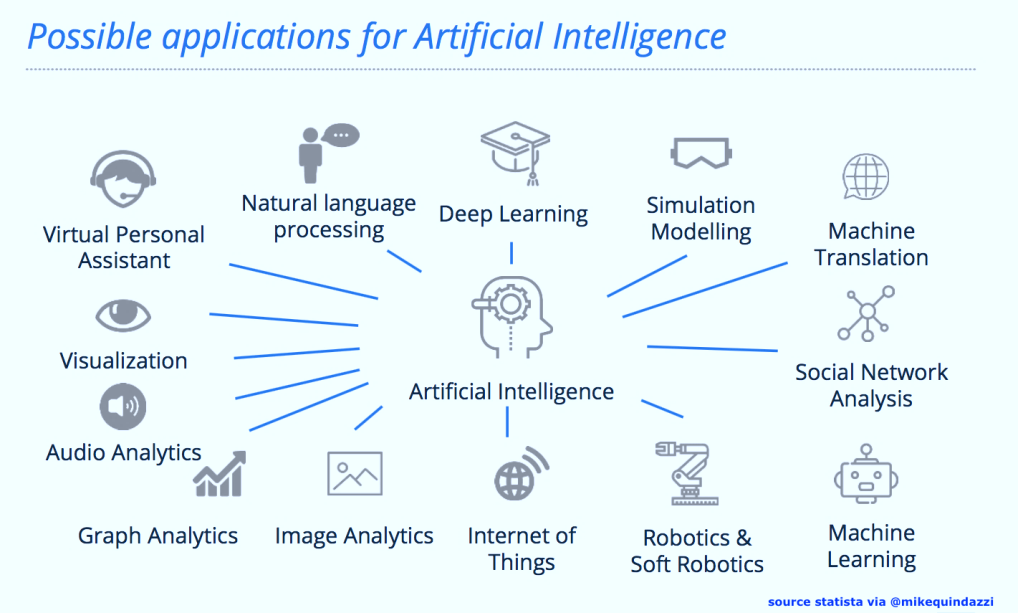
Literature Review
Recognizing ML and AI
This section provides an overview of AI and ML systems, based on research by Jain to explain AI and ML principles, including deep learning, neural networks, and natural language processing. Machine learning (ML) and artificial intelligence (AI) are two key technologies that are changing the face of the world. Artificial Intelligence (AI) is the development of computer systems that can do tasks that are typically performed by humans, such as language translation, speech recognition, and decision-making. As a branch of artificial intelligence, machine learning (ML) focuses on developing algorithms that let computers learn from data and make predictions or judgments without explicit programming.
Various techniques and algorithms form the basis of AI and ML. Many machine learning applications (Figure 2), such as image identification and natural language processing, are based on neural networks, which are inspired by the organization of the human brain. A subclass of neural networks called deep learning involves training models on large datasets in order to identify patterns and make decisions on their own. Natural language processing (NLP) is the ability of computers to understand and produce human language. This makes activities like chatbots, sentiment analysis, and machine translation easier. [1, 2, 3, 20, 26, 27, 28, 29, 30, 31, 32, 33, 34, 35, 36, 37].
![Figure 2: Applications of AI vs Applications of ML [21].](/fulltextimages/12944/fig_2.png)
Unsupervised learning, in which models find hidden patterns in unlabeled data, reinforcement learning, in which models learn by trial and error with feedback from their environment, and supervised learning, in which models are trained on labeled data to predict outcomes, are key ideas in understanding AI and ML. AI and ML technologies are becoming more and more pervasive, affecting industries as diverse as robots, quantum computing, healthcare, and finance. Comprehending the fundamental concepts and methodologies of AI and ML is essential for maneuvering through this rapidly changing landscape and utilizing their disruptive potential. AI and ML in Financial Technology (FinTech) [4, 16].
Investigating Jain, R. This section examines how AI-driven solutions are changing financial services, encompassing areas like algorithmic trading and personalized banking experiences. It draws on et al’s research on AI and ML in FinTech [19]. AI-driven solutions are bringing about a paradigm shift in the way that banking, investing, and financial management is done, completely changing the financial services industry [20]. Artificial Intelligence (AI) is improving efficiency, accuracy, and customization across the financial industry through the use of sophisticated algorithms and machine learning techniques [34, 36].
Algorithmic trading is one of the main areas where AI is advancing significantly. AI-powered trading systems use lightning-fast speeds to analyze enormous volumes of financial data, finding patterns, trends, and anomalies to execute transactions with accuracy and agility. These technologies allow financial organizations to take advantage of opportunities and reduce risks more successfully since they can instantly adjust to shifting market conditions. AI is also changing the way that risk is assessed in the financial industry. The intricacy and dynamics of contemporary financial markets may not be well reflected by traditional risk models, which frequently rely on past data and predetermined rules. On the other hand, AI algorithms are able to evaluate a variety of data sources, such as macroeconomic indicators, social media sentiment, and market news, in order to evaluate risk more thoroughly and proactively.
Furthermore, the personalization of banking experiences is being driven by AI. Financial institutions are using chatbots and virtual assistants driven by AI to provide personalized suggestions, respond to client questions, and offer immediate assistance. These AI-driven interfaces can recognize and predict user needs through machine learning and natural language processing, increasing consumer happiness and loyalty. In general, AI-driven solutions are promoting innovation in the financial sector, democratizing access to financial services, and enhancing decision-making procedures. In the years to come, it is anticipated that the impact of AI technologies on financial services will grow as they develop, changing client expectations, company models, and regulatory frameworks.
AI-Powered Prediction of Stock Markets
This part builds on the review by Jain, R. and explores new developments and difficulties in AI-based stock market prediction. It assesses predictive analytics algorithms and how they affect investment approaches. At the vanguard of financial innovation, AI-based stock market prediction provides investors with never-before-seen insights and chances for well-informed decision-making. AI models examine enormous volumes of financial data to estimate stock price movements more accurately and efficiently than traditional techniques by utilizing machine learning and advanced data analytics. AI-based stock market prediction uses a variety of predictive analytics methods, each having advantages and disadvantages. Using supervised learning algorithms, which train models to anticipate future price movements using historical market data, is one popular method. To capture complicated market dynamics, these models can combine a wide range of variables, such as technical indicators, fundamental considerations, and market sentiment data. Stock market prediction also makes use of deep learning methods like convolutional neural networks (CNNs) and recurrent neural networks (RNNs). These models are highly suitable for predicting stock values across various time periods because they are excellent at capturing temporal dependencies and non-linear correlations in time- series data.
Moreover, several predictive models are combined in ensemble methods like random forests and gradient boosting machines to increase accuracy and robustness. Ensemble approaches reduce the possibility of overfitting and improve prediction stability by combining the predictions of separate models. AI-based stock market forecasting has a significant effect on investing techniques. AI models can help investors manage risk more skillfully, optimize portfolio allocation, and spot possible trading opportunities. Furthermore, investors can instantly adjust to shifting market conditions thanks to AI-driven insights, which improves decision-making agility and responsiveness. Recognizing the drawbacks and dangers of AI-based stock market prediction is crucial, though. Even with advances in AI technologies, stock price prediction is still essentially speculative, and models may have trouble correctly gauging market movements, particularly when there is high volatility or unanticipated developments. AI- powered stock market forecasting is a potent instrument that provides investors with insightful information and chances to improve their investing plans. Investors can make educated judgments to meet their investing goals and more skillfully negotiate the intricacies of the financial markets by utilizing sophisticated machine learning techniques and predictive analytics models [19, 20].
AI and ML in Healthcare and Cybersecurity
This part examines AI and ML applications in healthcare, including disease diagnosis and public health surveillance, drawing on the call data record analysis conducted by Mishra et al. and the animal health study conducted by Jain, et al. Call Data Record (CDR) analysis is a unique use of data-driven methodologies to address complex societal and environmental concerns; it intersects with animal health and climate change. In order to uncover important trends and insights, CDR analysis entails looking through telecommunications data, such as call logs, text messages, and internet activity records. Public health, urban planning, and disaster response are just a few of the areas for which CDR research might yield useful information by utilizing advanced data analytics techniques like machine learning and network analysis.
When it comes to animal health and climate change, CDR analysis can present special chances for monitoring and mitigation initiatives. For example, researchers can track the migration patterns of wildlife, evaluate the effects of climate change on ecosystems, and comprehend the spread of infectious diseases by analyzing patterns of human mobility and communication resulting from CDRs. Furthermore, by spotting shifts in communication patterns suggestive of aberrant behavior or emergency scenarios, CDR analysis can support early warning systems for environmental catastrophes and natural disasters. Researchers and decision- makers can create focused actions to lessen the effects of climate-related events on animal populations and ecosystems by combining CDR data with environmental sensors and satellite photos. All things considered, CDR analysis is a potent instrument for tackling urgent issues pertaining to animal health and climate change. Researchers can obtain important insights into intricate socio-environmental processes and support evidence-based decision-making for sustainable development and conservation initiatives by utilizing the amount of information contained in telecoms data [9, 12].
Robotics, IoT, and Cattle Health Monitoring using AI and ML
This section discusses AI and ML’s importance in robotics and IoT, citing developments in autonomous systems and smart sensors as well as Rahul’s work on 5G technologies and Bhatla et al.’s study on cow health monitoring. Robotics, the Internet of Things (IoT), and livestock health monitoring are all undergoing revolutionary changes thanks to AI and ML, which are also providing creative ways to improve sustainability, productivity, and efficiency. AI and ML technologies in robotics allow robots to sense and interact with their surroundings on their own. Robots are able to comprehend visual input, identify objects, and move precisely and nimbly through complicated surroundings thanks to technologies like computer vision and sensor fusion. Robots may learn and adapt to new tasks and settings through experience thanks to reinforcement learning algorithms, which gradually improve their performance. Furthermore, AI-enabled collaborative robots, or cobots, can operate alongside people in logistics, manufacturing, and healthcare environments to improve output and security [27, 32, 38, 39].
AI and ML are essential for enhancing animal welfare and boosting livestock management techniques in the field of cow health monitoring. Heart rate, temperature, and activity levels are just a few of the physiological indicators that are monitored in real time by Internet of Things devices like wearable sensors and smart tags. AI systems examine this data to find anomalies that might point to nutritional inadequacies or disease breakouts, among other health problems. AI-powered cow health monitoring systems allow farmers to take proactive measures to minimize the risk of disease spread and optimize herd health by means of early warning signals and individualized recommendations. In addition, by facilitating intelligent data analytics and decision- making, AI and ML technologies are revolutionizing the IoT environment. Sensors built onto devices gather a tone of information about user behavior, energy usage, and ambient variables in IoT-enabled smart environments. Real-time processing and analysis of this data by AI algorithms reveals trends and insights that inform automated processes and actionable recommendations. For instance, using predictive analytics and adaptive control mechanisms, AI-powered IoT systems in smart cities can improve public safety, optimize traffic flow, and lower energy usage. In general, AI and ML are propelling innovation in IoT, robotics, and livestock health monitoring, providing game-changing answers to difficult problems and enhancing quality of life. These technologies have the enormous potential to transform companies, give people more power, and usher in a more sustainable future by utilizing the power of data-driven insights and autonomous decision-making.
The Potential Uses of Quantum Computing
This section explores the transformational potential of quantum computing in fields such as materials science and cryptography, based on the research of Patel et al. With its unmatched processing capacity and capabilities, quantum computing is a paradigm leap in computer technology that has the potential to completely transform a number of industries. Quantum computers use quantum bits, or qubits, which are different from classical computers in that they process information as either 0s or 1s based on the principles of superposition and entanglement. Due to this special characteristic, quantum computers are able to tackle problems at a pace and scale that is not possible for traditional computers, including complex calculations.
Numerous industries, including medicine development, materials research, cryptography, and optimization, stand to benefit from the prospective uses of quantum computing. Quantum computers could be able to swiftly factor huge numbers, which would allow them to crack encryption systems like RSA and ECC. This would provide serious security issues for privacy and data protection. On the other hand, new cryptographic methods made possible by quantum computing, including quantum key distribution, can enable provably safe communication channels that are impervious to quantum attacks.
Quantum computers have the ability to tackle combinatorial optimization problems, such the knapsack and traveling salesman problems, tenfold quicker than traditional techniques. This competence allows firms to improve operations and increase efficiency. It has significant implications for supply chain management, logistics, and resource allocation.
Quantum computers have the ability to model the behavior of complicated molecules and materials with an unprecedented level of accuracy in the field of materials science. This has made it easier to find new materials with desirable qualities that might be used in electronics, energy storage, and pharmaceuticals. Similarly, by modeling molecular interactions and forecasting the safety and efficacy of possible medication candidates, quantum computers can speed up the process of drug creation and development. Furthermore, by enabling more effective training and inference procedures and opening up new possibilities for handling optimization and pattern recognition tasks, quantum computing holds potential for improving artificial intelligence and machine learning algorithms. All things considered, quantum computing is a revolutionary technology that might upend and completely change a wide range of industries, including materials science, medication development, cryptography, and optimization. It is anticipated that quantum computing will have an exponentially greater impact on society and technology as it develops and becomes more widely available, bringing in a new age of invention and discovery [8].
Machine Learning-Based Document Classification
This section assesses various machine learning methods for document classification and arrangement, citing the work of Jain and Thakur. Machine learning-based document categorization is a potent method for automatically classifying and organizing massive amounts of textual material into pre- established groups or classes. In order to identify patterns and relationships between textual properties and their related categories, machine learning algorithms are trained on labeled datasets, which are collections of texts that have been tagged with the appropriate categories. These algorithms can categorize newly discovered, unlabeled documents according to their content once they have been trained. Several well-known machine learning techniques are used to classify documents, such as Naive Bayes, which is predicated on the idea that characteristics, given the class label, are conditionally independent. Naive Bayes is a popular option for document classification since it is easy to use, quick, and efficient for text classification jobs [37].
Support Vector Machines (SVMs): For binary and multi-class classification applications, SVMs are effective algorithms. To maximize the margin between classes and reduce classification errors, they locate the hyperplane in the feature space that best divides the various classes. Another well-liked approach for document classification is logistic regression, which works especially well for binary classification applications. By mapping the input attributes to a probability distribution over the classes, a logistic function is used to represent the likelihood that a document will belong to a specific class.
Decision Trees and Random Forests: Decision trees use feature values to recursively divide the feature space into smaller subsets, whereas random forests are collections of decision trees that combine several weak learners to produce predictions that are more accurate. These algorithms work well for binary and multi-class classification applications and are easily interpreted. Deep Learning Models: With remarkable effectiveness, deep learning models like convolutional neural networks (CNNs) and recurrent neural networks (RNNs) have also been used for document categorization tasks. These models are able to recognize intricate patterns and relationships in text by automatically learning hierarchical representations of the text data. Machine learning-based document classification has several uses in a variety of industries, such as customer service ticket routing, sentiment analysis, spam detection, and news classification. Machine learning algorithms help businesses gain useful insights, improve decision-making processes, and optimize workflows by automating the process of organizing and categorizing textual data.
NLP and Supervised Learning for the Identification of False News
This section examines AI methods for identifying false news while taking into account developments in supervised learning and natural language processing. The identification of fake news through the use of supervised learning and natural language processing (NLP) is a crucial application in the current information environment, where the spread of false information presents serious problems for society. Using machine learning techniques, this method uses the content and linguistic aspects of news stories to automatically classify them as real or fraudulent. The following steps are usually involved in the process: Data Collection: Compiling a dataset of news stories that have been categorized as either real or phony. These labels can be acquired manually by annotation or by using pre-existing datasets carefully selected for studies on the detection of fake news. Text Preprocessing: Organizing and preparing the text data in order to eliminate extraneous information and noise. To standardize the text representations, this stage may use tokenization, lowercasing, stopword removal, stemming, or lemmatization. Feature extraction is the process of taking out pertinent features to represent each news article from the preprocessed text data. Word frequency distributions, n-grams, syntactic and semantic characteristics, sentiment analysis scores, and metadata traits are frequently utilized in the detection of fake news. Model training is the process of using the extracted features from the labeled dataset to train a supervised learning algorithm, such as logistic regression, support vector machines (SVM), random forests, or neural networks [10]
Based on patterns in the feature space, the model learns to differentiate between news stories that are real and those that are fraudulent. Model Evaluation: Analyzing the accuracy, precision, recall, F1-score, and other pertinent metrics of the trained model using an independent test dataset. Cross-validation approaches can be utilized to guarantee the model’s resilience and generalizability across various datasets. Model Deployment: Using the learned model to instantly identify new, unseen news articles as bogus or real. The approach can help users recognize untrustworthy information sources by being integrated into social media networks, news aggregation systems, and fact-checking websites. Because they make it possible to analyze and comprehend textual content, including semantic meaning, context, and sentiment, natural language processing (NLP) techniques are essential to this process. In order to automatically identify patterns suggestive of fake news, supervised learning algorithms learn from labeled data. This enables scalable and effective disinformation detection in the digital media environment.
Algorithms for Depth First Search and Breadth First Search
This section explores the use of BFS and DFS algorithms in pathfinding and optimization issues, based on research by Jain. The basic graph traversal techniques Breadth First seek (BFS) and Depth First Search (DFS) are used to seek and explore nodes in a graph or tree data structure. These algorithms are extensively employed in many different fields, such as network analysis, puzzle solving, and pathfinding.
Breadth First Search (BFS): BFS visits every nearby node methodically before proceeding to the next level, exploring the graph level by level. It begins at the root node (or any other random node). To keep track of the nodes to be visited and make sure they are visited in the sequence determined by their distance from the starting node, this algorithm employs a queue data structure.
Important BFS steps:
- Put the starting node in a queue at the beginning.
- Continue until there is no more queue:
- Take a node at the head of the queue and dequeue it.
- Enqueue all of the dequeued node’s unvisited neighbors after visiting it.
- Continue visiting every node that can be reached.
In an unweighted graph, BFS is especially helpful for determining the shortest path between two nodes since it ensures that nodes are visited in increasing order of distance from the starting node.
Depth First Search (DFS): DFS recursively traverses each branch of the graph as far as it can before turning around. It begins at any random node, such as the root, and proceeds to examine each branch as thoroughly as it can before retracing its steps to investigate further branches. Recursion or a stack data structure is used by this approach to preserve the order in which nodes are visited.
Important DFS steps:
- Start a stack (also known as a recursive call stack) at the beginning node.
- Continue until the stack is cleared:
- Remove a node from the stack’s top.
- Push all of the popped node’s unvisited neighbors onto the stack by visiting it.
- Continue visiting every node that can be reached.
DFS is widely used in applications like cycle identification in graphs, topological sorting, and labyrinth solving where finding a complete path is more important than finding the shortest one. Two basic graph traversal algorithms, BFS and DFS, provide distinct approaches for examining nodes within a tree or graph. In unweighted graphs, BFS ensures the shortest path; nevertheless, DFS is better suited for scenarios requiring a thorough investigation of all possible paths [14].
Strategies for Solving Puzzle Problems
This section explores AI methods for solving challenging puzzles such as the 8-puzzle problem, citing the work of Jain and Patel. AI has been used to solve a number of challenging puzzles, such as the 8-puzzle problem, which consists of moving a set of numbered tiles on a 3x3 grid from one beginning configuration to the desired configuration in the fewest possible moves. Various artificial intelligence techniques, such as heuristic methods and search algorithms, can be utilized to effectively address this issue:
Brute Force Search: This method looks at every state of the puzzle, beginning with the original configuration and continuing until the desired configuration is reached. Although sound conceptually, the huge search space makes this strategy computationally expensive and unfeasible for bigger problem sizes.
Breadth-First Search (BFS): BFS visits every conceivable step from the starting configuration before proceeding to the next level. It methodically investigates puzzle states in a breadth-wise fashion. BFS ensures that the shortest path to the destination will be found, but for big search spaces, it may take a lot of memory and time.
Depth-First Search (DFS): DFS recursively travels as far along a branch as it can before turning around to investigate puzzle states. DFS is useful for puzzles with deep search spaces and can be memory-efficient, even if it may not always result in the shortest path.
A* Search Algorithm: This intelligent search algorithm combines the best features of heuristic and BFS techniques. It chooses the most promising states to investigate by evaluating states using a heuristic function that calculates the cost from the present state to the objective. As long as the heuristic is consistent and admissible, an A* search ensures that the best answer is found. Heuristic Functions: Heuristic functions calculate the approximate distance between a given state and the desired state. Common heuristic functions for the 8-puzzle problem are the number of misplaced tiles and the Manhattan distance, which is the total of the distances of each tile from its objective position. By giving priority to states that are closer to the goal, these heuristic functions direct the search towards the desired state. IDA*, a memory- efficient variation of A* search, carries out depth-limited searches repeatedly, progressively deeper until the target is located. This process is known as iterative-Deepening A (IDA)**. Combining the benefits of A* search and DFS, it ensures optimality while preserving memory [15].
Constraint Satisfaction Problems (CSP): By expressing constraints and variables related to the puzzle states, CSP frameworks can also be used to describe and resolve the 8-puzzle issue. Then, methodical solution searching can be done using backtracking techniques such as the constraint propagation algorithm (Tables 1 & 2).
| Topic | Description |
|---|---|
| Overview of AI and ML | AI and ML have become widespread, impacting various industries, including robotics, quantum computing, financial technology, and healthcare. The section provides an in-depth analysis of AI and ML, exploring their development, implications, and applications across different sectors. |
| Recognizing ML and AI | Based on Jain’s work, this section introduces AI and ML principles, including deep learning, neural networks, and natural language processing. It elaborates on the distinction between AI and ML, highlighting AI’s ability to mimic human intelligence and ML’s focus on algorithms that learn from data to make predictions or decisions without explicit programming. |
| AI and ML in Financial Technology (FinTech) | This section examines the impact of AI-driven solutions on financial services, particularly in areas like algorithmic trading and personalized banking experiences. It discusses how AI enhances efficiency, accuracy, and customization in finance, leading to improved risk assessment, trading strategies, and customer experiences. |
| AI-Powered Prediction of Stock Markets | Building on Jain’s research, this part explores new developments in AI-based stock market prediction and assesses predictive analytics algorithms’ effects on investment approaches. It discusses how AI models analyze vast financial data to forecast stock price movements, enhance risk management, and identify trading opportunities more effectively than traditional techniques. |
| AI and ML in Healthcare and Cybersecurity | Drawing from Mishra et al.’s work, this section explores AI and ML applications in healthcare, focusing on disease diagnosis and public health surveillance. It also discusses the potential of AI-driven solutions in analyzing call data records for animal health and climate change monitoring and mitigation efforts. |
| Based on Rahul’s and Bhatla et al.’s studies, this part highlights AI and ML’s role in robotics, | |
| IoT, and livestock health monitoring. It discusses how AI enables autonomous systems, smart sensors, and wearable devices to improve sustainability, productivity, and efficiency in various | |
| Robotics, IoT, and Cattle | |
| Health Monitoring | |
| This section explores the transformative potential of quantum computing in industries such | |
| The Potential Uses of | |
| Quantum Computing as materials science and cryptography, based on Patel et al.’s research. It discusses how quantum computers’ unparalleled processing power can revolutionize tasks like encryption, optimization, and drug discovery, leading to breakthroughs in numerous fields. | |
| This section assesses machine learning methods for document classification and organization, | |
| Machine Learning-Based based on Jain and Thakur’s work. It discusses various ML techniques, including Naive Bayes, | |
| SVM, deep learning, and their applications in categorizing textual data for tasks like sentiment | |
| Document Classification | |
| This part examines AI methods for identifying false news using supervised learning and | |
| NLP techniques. It discusses the process of collecting, preprocessing, and classifying news articles based on content and linguistic features to combat misinformation in digital media | |
| NLP and Supervised | |
| Learning for Identification of False News | |
| This section explores BFS and DFS algorithms in pathfinding and optimization problems, based | |
| Algorithms for Depth First on Jain’s research. It describes how these basic graph traversal techniques are used to explore | |
| Search and Breadth First nodes in a graph or tree data structure and their applications in network analysis, puzzle | |
| Search | |
| Drawing from Jain and Patel’s work, this section discusses AI methods for solving challenging puzzles like the 8-puzzle problem. It explores brute force search, BFS, DFS, A* search, heuristic | |
| Strategies for Solving | |
| Puzzle Problems functions, and constraint satisfaction problems and their applications in addressing complex |
Topic Overview AI/ML Applications Impact
Provides an in-depth analysis
of AI and ML, exploring their development, implications, and Overview of AI and ML applications across different sectors.
Introduces AI and ML principles,
Recognizing ML and
including deep learning, neural networks, and natural language AI
processing.
Examines the impact of AI- driven solutions on financial services, particularly in areas AI and ML in Financial Technology like algorithmic trading and personalized banking experiences.
(FinTech) Explores new developments in AI-based stock market prediction AI-Powered Prediction of Stock and assesses predictive analytics algorithms’ effects on investment Markets approaches.
Revolutionizing various industries such as robotics, quantum computing, financial Widely reshaping industries, bringing traditional approaches up to date.
technology, and healthcare.
Enhancing human-like capabilities in tasks such as language translation, speech Facilitating tasks that traditionally require human intelligence, enabling computers to learn from recognition, and decision- making. Focusing on algorithms data without explicit that learn from data for predictions or decisions.
programming.
Improving efficiency, accuracy,
Revolutionizing financial services, leading to improved and customization in finance.
Enhancing risk assessment, trading strategies, and customer risk management, trading strategies, and customer experiences.
satisfaction.
Analyzing vast financial data
for forecasting stock price movements, enhancing risk management, and identifying Providing investors with insightful information and chances to improve their trading opportunities more investing plans.
effectively.
Explores AI and ML applications in healthcare, focusing on disease AI and ML in Healthcare and diagnosis and public health surveillance. Discusses potential Cyber security Improving healthcare outcomes, facilitating early Enhancing disease diagnosis, public health surveillance, and animal health monitoring. Analyzing call data records for detection of diseases, and supporting environmental monitoring and mitigation efforts.
Enhancing productivity in agriculture, healthcare, and various industries, leading to more informed decision- making and improved sustainability.
Bringing breakthroughs
in materials science, cryptography, and other fields, enabling tasks previously unattainable with classical computing.
Enhancing efficiency and
accuracy in textual data processing, enabling better decision-making and insights extraction.
Improving detection
of false information, enhancing credibility and trustworthiness in news dissemination.
Enabling efficient exploration
of data structures, leading to improved problem-solving in various domains.
Enabling effective problem-
solving in puzzles and optimization issues, leading to improved efficiency and effectiveness in tackling challenges Table 2: Comparative study of various domains of AI and ML with Applications and Impact [1, 2, 3, 4, 5, 6, 7, 8, 9, 10, 11, 12, 13, 14, 15, 16, 17, 18, 19, 20, 21, 22, 23, 24, 25, 26, 27, 28, 29, 30, 31, 32, 33, 34, 35, 36, 37, 38, 39]
These AI methods can be used to quickly and effectively tackle challenging problems, such as the 8-puzzle problem, and arrive at ideal or almost ideal solutions. The size of the puzzle, the computational power at hand, and the required optimality of the solution all influence the technique selection.
- AI-driven solutions in analyzing call data records for animal health insights into climate change. and climate change.
- Highlights AI and ML’s role in robotics, IoT, and livestock health
- Enhancing sustainability, productivity, and efficiency in agriculture and healthcare.
- Enabling autonomous systems and smart sensors for improved
- Robotics, IoT, and Cattle Health monitoring. Discusses how AI enables autonomous systems,
- Monitoring smart sensors, and wearable devices to improve sustainability, decision-making. productivity, and efficiency.
- Explores the transformative potential of quantum computing
- Revolutionizing tasks like encryption, optimization, and drug discovery with quantum
- The Potential
- Uses of Quantum in industries such as materials science and cryptography.
- Computing
- Discusses breakthroughs enabled by quantum computers’ computing’s unmatched processing capacity. unparalleled processing power.
- Assesses machine learning
- Enabling automated classification of textual data for methods for document classification and organization.
- Discusses various ML techniques
- Machine Learning-
- Based Document tasks like sentiment analysis,
- Classification spam detection, and news and their applications in categorizing textual data [37]. classification.
- Examines AI methods for identifying false news using supervised learning and NLP techniques. Discusses the process
- Automatically classifying news
- NLP and Supervised articles based on content and
- Learning for
- Identification of linguistic features to combat misinformation in digital media of collecting, preprocessing, and classifying news articles to combat
- False News environments. misinformation.
- Explores BFS and DFS algorithms
- Facilitating exploration of graph or tree data structures for applications like network
- Algorithms for
- Depth First Search in pathfinding and optimization problems. Discusses their applications in network analysis, and Breadth First analysis, puzzle solving, and
- Search puzzle solving, and pathfinding. pathfinding.
- Discusses AI methods for solving challenging puzzles like the
- 8-puzzle problem. Explores brute
- Utilizing various techniques like
- Strategies for
- Solving Puzzle heuristic search and constraint force search, BFS, DFS, A* search, heuristic functions, and constraint satisfaction to tackle complex
- Problems problems effectively. satisfaction problems.
Table 2: Comparative study of various domains of AI and ML with Applications and Impact [1 - 39]
Conclusion
The paper concludes by underscoring the transformative potential of Artificial Intelligence (AI) and Machine Learning (ML) technologies across various domains. It emphasizes how these technologies have the power to revolutionize industries, drive innovation, and address complex societal challenges. From enhancing healthcare delivery to optimizing financial services, AI and ML are poised to reshape the way we work, live, and interact with technology. However, the paper also highlights the importance of ethical deployment and responsible stewardship in harnessing the benefits of AI and ML while mitigating potential risks. As AI technologies become increasingly integrated into everyday life, it is crucial to ensure that they are developed and deployed in a manner that upholds ethical principles, respects individual privacy, and promotes fairness and transparency. This includes addressing issues such as algorithmic bias, data privacy concerns, and the potential for unintended consequences of AI-driven decision-making. Furthermore, the paper emphasizes the need for interdisciplinary collaboration to fully realize the potential of AI and ML technologies. By bringing together experts from diverse fields, including computer science, ethics, law, social science, and humanities, we can better understand the complex implications of AI and ML and develop holistic approaches to address them. Interdisciplinary collaboration fosters a more nuanced understanding of the societal, ethical, and legal implications of AI technologies, enabling us to design systems that serve the common good and promote human well-being.
In conclusion, the paper calls for a balanced approach to AI and ML deployment-one that embraces innovation and technological progress while safeguarding against potential risks and ensuring that these technologies are used ethically and responsibly. By prioritizing ethical considerations and fostering interdisciplinary collaboration, we can harness the full potential of AI and ML to create a more equitable, sustainable, and inclusive future for all.
References
-
Gupta NA(2017) Literature Survey on Artificial Intelligence. IJERT (5)19.
-
McCarthy J, Minsky ML, Rochester N, Shannon CE (2006) A Proposal for the Dartmouth Summer Research Project on Artificial Intelligence. AI Mag (27)4: 12.
-
Moore A (2017) Carnegie Mellon Dean of Computer Science on the Future of AI. Forbes.
-
Becker A, Bar‐Yehuda R, Geiger D (2000) Randomised algorithms for the loop cutset problem. J Artif Intell Res 12: 219-234.
-
Singer J, Gent IP, Smaill A (2000) Backbone fragility and the local search cost peak. J Artif Intell Res 12: 235-270.
-
Chen X, Beek VP (2001) Conflict‐directed backjumping revisited. J Artif Intell Res 14: 53-81.
-
Hong J (2001) Goal recognition through goal graph analysis. J Artif Intell Res 15(1): 1-30.
-
Stone P, Littman ML, Singh S, Kearns M (2001) ATTAC‐2000: An adaptive autonomous bidding agent. J Artif Intell Res 15: 189-206.
-
Peng Y, Zhang X (2007) Integrative data mining in systems biology: from text to network mining. Artif Intell Med 41(2): 83-86.
-
Zhou X, Liu B, Wu Z, Feng Y (2007) Integrative mining of traditional Chines medicine literature and MEDLINE for functional gene networks. Artif Intell Med 41: 87-104.
-
Wang S, Wang Y, Du W, Sun F, Wang X, et al. (2007) A multi‐approaches‐guided genetic algorithm with application to operon prediction. Artif Intell Med 41(2): 151-159.
-
Halal WE(2003) Artificial intelligence is almost here. Horizon 11: 37-38.
-
Masnikosa VP (1998) The fundamental problem of an artificial intelligence realization. Kybernetes 27(1): 71- 80
-
Metaxiotis K, Ergazakis K, Samouilidis E, Psarras J (2003) Decision support through knowledge management: The role of the artificial intelligence. Inf Manag Comput Secur 11(5): 216-221.
-
Raynor WJ (2000) The international dictionary of artificial intelligence. Ref Rev 14: 1-380.
-
Stefanuk VL, Zhozhikashvili AV (2002) Productions and rules in artificial intelligence. Kybernetes 31: 817-826.
-
Tay DPH, Ho DKH(1992) Artificial intelligence and the mass appraisal of residential apartments. J Prop Valuat Invest 10(2): 525-540.
-
Wongpinunwatana N, Ferguson C, Bowen P (2000) An experimental investigation of the effects of artificial intelligence systems on the training of novice auditors. Manag Audit J 15(6): 306-318.
-
Jain R, Vanzara R, Sarvakar K (2024) The Rise of AI and ML in Financial Technology: An In-depth Study of Trends and Challenges. In: Kumar A, et al. (Eds.), Proceedings of the 6th International Conference on Communications and Cyber Physical Engineering. Springer, Singapore.
-
Jain R, Vanzara R (2023) Emerging Trends in AI- Based Stock Market Prediction: A Comprehensive and Systematic Review. Eng Proc 56(1): 254.
-
Jain R, Patidar N, Mishra S, Prajapati D, Solanki A, et al. (2024) Transparency in AI Decision Making: A Survey of Explainable AI Methods and Applications. Adv Rob Tec 2(1): 000110.
-
Introduction to AI.
-
(2023) Exploring Real-Time Data Analytics for AI & ML Applications.
-
Maganathan T, Soundariya S, Vishnupriya B (2020) Machine learning and data analytics for environmental science: a review, prospects and challenges. IOP Conference Series: Materials Science and Engineering. 955(1) IOP Publishing, pp: 1-10.
-
Chen W, Zoran M, Fethi AR (2023) Real-Time Analytics: Concepts, Architectures and ML/AI Considerations. IEEE Access 11: 1-24.
-
Rahul J, Ketan S, Chirag P, Sejal M (2024) An Exhaustive Examination of Deep Learning Algorithms: Present Patterns and Prospects for the Future. International Journal of Engineering and Technology 10(1): 2395- 5287.
-
Rahul J, Dhiren P (2023) Climate Change and Animal Health: Impacts, Challenges, and Mitigation Strategies. Open Access Journal of Veterinary Science & Research 8(2): 1-6.
-
Hiral BP, Sejal M, Rahul J, Nirali K (2023) The Future Of Quantum Computing And Its Potential Applications. Journal For Basic Sciences, pp: 513-519.
-
Patel HB, Shukla A, Prajapati D, Mevada J, Jain R, et al. (2023) Call Data Record Analysis using Apriori Algorithm. Indian Journal of Natural Sciences.
-
Deepak M, Megha P, Amit D, Nishi P, Zarana P, et al. (2024) Exploring the Efficacy of Natural Language Processing and Supervised Learning in the Classification of Fake News Articles. Advances in Robotic Technology (ART) 2(1): 7-12.
-
Dixit SK, Jain R, Patel H (2024) Impact of 5G Wireless Technologies on Cloud Computing and Internet of Things (IOT). Advances in Robotic Technology 2(1): 1-7.
-
Jain R, Sheetal D (2023) Revolutionizing the Future: Exploring the Multifaceted Advances of Robotic Technologies. Advances of Robotic Technology 1(1): 1-7.
-
Bhatla AB, Kikani YB, Joshi DG, Jain R, Patel K (2023) Real Time Cattle Health Monitoring Using IoT, ThingSpeak, and a Mobile Application 5(1)
-
Jain R, Mishra S, Prajapati D, Patel C (2023) The Intersection of Artificial Intelligence and Business: A Study of Impact and Implications. Journal of Advances in Artificial Intelligence 1(1): 45-48.
-
Jain R, Patel M (2023) Investigating the Impact of Different Search Strategies (Breadth First, Depth First, A*, Best First, Iterative Deepening, Hill Climbing) on 8-Puzzle Problem Solving-A Case Study. International Journal of Science & Engineering Development Research 8(2): 633-641.
-
Jain R, Prajapati D, Dangi A (2024) Transforming the Financial Sector: A Review of Recent Advancements in FinTech. International Journal of Science & Engineering Development Research 8(2): 250-267.
-
Rahul J, Archana T (2019) Comparative Study of Machine Learning Algorithms for Document Classification. International Journal of Computer Sciences and Engineering 7(6): 1189-1191.
-
Jain R, Prajapati DR, Sathwara DD, Suthar RK (2024) Survey on Mobile Cloud Computing. Adv Rob Tec 2(1): 000111.
-
Jain R, Patel DJ, Suthar RK, Jain R, Barhaiya H (2024) Survey on Virtualization Technique and Its Role in Cloud Computing Environment. Adv Rob Tec 2(1): 000112.
- Group Consensus of Nonlinear Hybrid Multi-Agent Systems with Self-Triggering Event Mechanism
- Optimum Vector Combinatorial Theory and Its Applications
- Manifold Systems Applied Theory for Innovative Robotic Technology
- Collaborative Robots: Human-Robots Coexistence in Industrial Environments
- Utilizing Idle Time for Job Clusters Reduces Inventory and Total Job Completion Time for Single Machine Scheduling
- Embracing the Future of Robotics with ART