
A Novel Mutation in the HPGD Gene Results in the Unusual Phenotype of: Palmoplantar Keratoderma with Digital Clubbing and Hyperhidrosis
<p>A 24-year-old man presented to our clinic with a 10-year history of palmoplantar keratoderma (PPK), hyperhidrosis and digital clubbing resistant to various treatments. Family history was negative for a similar condition. Whole exome sequencing was performed on the patients’ DNA and revealed a novel missense mutation, designated p.His156Gln, in the HPGD gene. PPKs may be inherited or acquired, however the triad of PPK, hyperhidrosis and digital clubbing has not been previously reported. HPGD has been previously described in the pathogenesis of hypertrophic osteoarthropathy as well as hyperhidrosis, however its role in palmoplantar keratoderma has not been evaluated. Here we identify a novel mutation implicated in the pathogenesis of this condition. Palmoplantar keratoderma (PPK) is a disorder of keratinization. Here, we present an unusual case of PPK in association with hyperhidrosis and digital clubbing. To the best of our knowledge these associations have not been previously reported.</p>
Case Report
A 24-year-old man, with consanguineous parents presented to our clinic with a ten-year history of palmoplantar skin thickening as well as hyperhidrosis (Figure 1). On physical exam, the patient had hyperkeratosis of his palms and soles associated with digital clubbing of all 20 digits and hyperhidrosis (Figure 1). The rest of the physical exam was normal. Family history was negative for any similar condition.
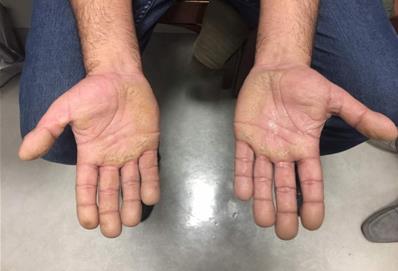
Figure 1: Keratoderma over the palms with hyperhidrosis and notable digital clubbing. A 4 mm punch biopsy was taken from the patient’s left palm, which revealed hyperkeratosis, hypergranulosis, mild epidermal hyperplasia, and sparse superficial perivascular lymphocytic infiltrate consistent with keratoderma (Figure 2). Systemic work-up for any cardio- pulmonary disease and malignancy was non-revealing.
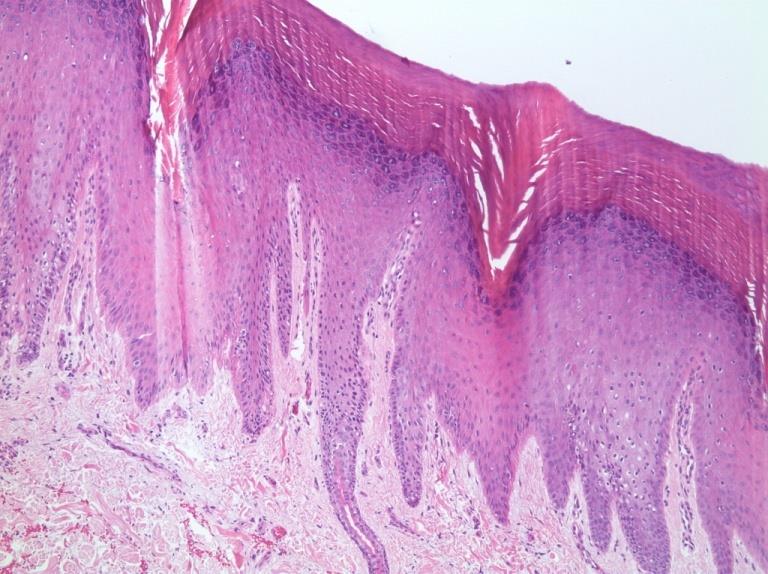
Figure 2: Punch biopsy from patient’s left palm consistent with keratoderma. Peripheral blood sample was collected. DNA extraction from the blood was performed using the QIAamp DNA blood midi kit from Qiagen (Cat No./ID: 51185) using the manufacturer's protocol. Exome sequencing was performed on the patient’s DNA to determine the molecular signature(s) underlying his condition. We used the exome capture method of the V6 Sure Select Kit from Agilent, and ran the libraries on a HiSeq4000 platform from Illumina at Macrogen-South Korea. We mapped the generated Fastq files to reference genome using the Burrows-Wheeler Alignment Tool (BWA). Using the Genome Analysis Tool Kit (GATK), insertions/deletions realignment and variant calling and filtering was conducted. Variant annotation was carried out using SnpEff and results were sent back in Excel sheet alongside the BAM and VCF files. The total read bases (bp) was within the 7 -7.8 X10⁶ range. The average throughput depth of target regions was 128.5 with more than 70% coverage of >50X. Analysis was then conducted as follows: we first filtered the ~100 000 SNPs and Indels by eliminating the synonymous variants and variants in the non-coding regions of the genes to reach up around 12 000 SNPs and Indels. The latter were then filtered out again to keep only the variants with less than a Minor allele frequency of 10 % (MAF<10%).
We identified a novel mutation in the HPGD gene, c.468T>A, leading to a change in the amino acid histidine to glutamine (p.His156Gln). The mutation was not found in 200 chromosomes screened from individuals of the same population. Additionally, insilico analysis using three softwares including: SIFT, PolyPhen and Varsome predicted the mutation to be deleterious/damaging and
| Study | History | Family History | ||||||
|---|---|---|---|---|---|---|---|---|
| Bureau, et al. | Two brothers with palmoplantar keratoderma, digital clubbing, and hyperhidrosis. Age of onset 7-8 years old | Consanguineous parents, with a positive family history | ||||||
| Hedstrand, et al. | Two sisters with palmoplantar keratoderma, digital clubbing and hyperhidrosis. Age of onset during childhood. (Not specified) | Consanguineous parents, with a negative family history | ||||||
| Rauch, et al. | One patient with palmoplantar keratoderma, digital clubbing and hyperhidrosis. Age of onset in early childhood. (Not specified) | Nonconsanguineous parents, with a negative family history. | ||||||
| Barraud-Klenovsek, et al. [1] | Palmoplantar keratoderma, digital clubbing and hyperhidrosis. Age of onset not specified. | Nonconsanguineous parents, with a negative family history |
Table 1: Reported Cases of Palmoplantar Keratoderma with Digital Clubbing. HPGD encodes for the enzyme 15-hydroxyprostaglandin de
Table 1: Reported Cases of Palmoplantar Keratoderma with Digital Clubbing. HPGD encodes for the enzyme 15-hydroxyprostaglandin dehydrogenase, an enzyme that catabolizes prostaglandins and is implicated in the pathogenesis of hypertrophic osteoarthropathy, (Table 2) however the role of this gene in the development of palmoplantar keratoderma is not known.
| Study | Mutation | Phenotype | ||||||
|---|---|---|---|---|---|---|---|---|
| Bergmann, et al. [2] | c.175_176del | One patients with the same mutation both with digital clubbing, only one with hyperhidrosis. | ||||||
| c.118G>T c.563C>T | One patient with two mutations associated with hyperhidrosis and digital clubbing. | |||||||
| Sinbaldi, et al. [3] | c.G217+1G>A | One patient with digital clubbing and hyperhidrosis. | ||||||
| Uppal, et al. [4] | c.175_176delCT | Three siblings with non-consanguineous parents all with digital clubbing, hyperhidrosis and pachyderma. | ||||||
| c.418G>C A140P | Eight family members with digital clubbing and hyperhidrosis. Distant consanguinity. | |||||||
| Tariq, et al. [5] | c.577T>C | Eleven family members with digital clubbing without hyperhidrosis or other skin manifestations. | ||||||
| Yuan, et al. [6] | c.310_311delCT | Nine patients (two related, the remaining 7 unrelated) all with digital clubbing and pachyderma. |
Table 2: Reported Mutations of HPGD Gene with Associated Phenotypes.
It is thought that mutations in the HPGD gene will lead to elevated levels of prostaglandins, which will stimulate tissue remodeling and clubbing of the digits [2]. Here we identified a novel mutation in the HPGD designated p. His 156Gln implicated in the development of hypertrophic osteoarthropathy, hyperhidrosis, and palmoplantar keratoderma [3, 4]. The involvement of the HPGD gene in the pathogenesis of this condition offers a novel approach in the treatment of these patients. Prostaglandin inhibitors may play a role in managing such individuals. Targeted gene therapy may play a vital role in both the prevention and treatment of these patients in the future.
Acknowledgement
We would like to thank the families for agreeing to participate in the study. This work was supported by an MPP and URB grant from the American University of Beirut Medical Center to Mazen Kurban.
References
-
Barraud-Klenovsek MM, Lübbe J, Burg G (1997) Primary Digital Clubbing Associated With Palmoplantar Keratoderma. Dermatology 194(3): 302-305.
-
Bergmann C, Wobser M, Morbach H, Falkenbach A, Wittenhagen D, et al. (2011) Primary Hypertrophic Osteoarthropathy With Digital Clubbing and Palmoplantar Hyperhidrosis Caused By 15- PGHD/HPGD Loss-Of-Function Mutations. Exp Dermatol 20(6): 531-533.
-
Sinibaldi L, Harifi G, Bottillo I, Iannicelli M, El Hassani S, et al. (2010) A Novel Homozygous Splice Site Mutation In The HPGD Gene Causes Mild Primary Hypertrophic Osteoarthropathy. Clin Exp Rheumatol 28(2): 153-157.
-
Uppal S, Diggle C, Carr I, Fishwick CW, Ahmed M, et al. (2008) Mutations In 15-Hydroxyprostaglandin Dehydrogenase Cause Primary Hypertrophic Osteoarthropathy. Nat Genet 40(6): 789-793.
-
Tariq M, Azeem Z, Ali G, Chishti MS, Ahmad W (2009) Mutation In The HPGD Gene Encoding NAD+ Dependent 15-Hydroxyprostaglandin Dehydrogenase Underlies Isolated Congenital Nail Clubbing (ICNC). J Med Genet 46(1): 14-20.
-
Yuan Lu, Chen L, Liao RX, Lin YY, Jiang Y, et al. (2015) A Common Mutation and a Novel Mutation in the HPGD Gene in Nine Patients with Primary Hypertrophic Osteoarthropathy. Calcif Tissue Int 97(4): 336-342.
- Epithelioid Granuloma; 3cases with Different Clinical Features
- Advancing Representation in Dermatology Clinical Trials: Ethical, Scientific, and Regulatory Imperatives for Inclusion Across all Fitzpatrick Skin Types
- A Case of Atopic Dermatitis with Concurrent Psoriasis Vulgaris: Successful Treatment with Upadacitinib
- Innovation Lifting Eyeshadow: A Synthesis of Makeup and Optical Illusion
- Distinguishing Superficial Actinic Porokeratosis from Actinic Keratosis with UVF Dermoscopy: A Case Report
- High Mobility Group Box 1 (HMGB1) in Cutaneous Inflammation: An Immune Modulator Bridging Cellular Stress, Ferroptosis and Danger Signaling